More Thanksgiving poems

Thanksgiving
The year has turned its circle,
The seasons come and go.
The harvest all is gathered in
And chilly north winds blow.
Orchards have shared their treasures,
The fields, their yellow grain,
So open wide the doorway~
Thanksgiving comes again!
~Old Rhyme

td-00075-dchildren-at-turkey-dinner-posters

Our National Thanksgiving

All the blessings of the fields,
All the stores the garden yields,
All the plenty summer pours,
Autumn’s rich, o’erflowing stores,
Peace, prosperity and health,
Private bliss and public wealth,
Knowledge with its gladdening streams,
Pure religion’s holier beams —
Lord, for these our souls shall raise
Grateful vows and solemn praise.”

~ Author unknown
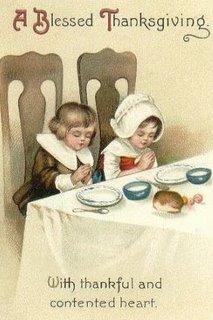
thankful-heart

Thankfulness

We’re thankful for Thy blessings, Lord,
Thy watchful eye above,
For freedom’s bell that rolls for all
In this dear land we love.
We’re thankful, Lord, for useful work,
For measure of good health,
For family ties and friendship dear,
More precious this than wealth.
For all Thy tender mercies, Lord,
For sunshine and for rain,
For golden harvest richly blessed
In yield of fruit and grain.
On this Thanksgiving Day, dear Lord,
We bow in humble prayer.
We’re thankful for Thy blessings, Lord;
Thy gifts are everywhere.

~ Kay Hoffman ~

thankssil3

Thanksgiving …

So many years have passed away
Since Pilgrims on Thanksgiving Day
At Plymouth met with fervent prayer
Their gratitude and food to share.
This is our land-the plains and hills,
The valleys where the sunshine spills
An amber light on beans and corn
Each time a golden day is born.
Today we think of pioneers
Who braved all dangers, met all fears,
Who planted in fertile loam,
Who tamed frontiers to make a home.
For forest-store, for waterways,
For cotton fields, for mountain ore,
For mighty spires we sing our praise.
For scholars with intelligence
Who attained wisdom of the sage,
Who left their heritage to us
And flag of freedom to this age.
We thank Thee, God, for rain and sun,
For peace at frosty winter’s edge,
For harvests and for vintage bells,
For faith and joy in work well done.
The flag we love now flies above;
May faith and virtue keep us strong
As we together sing this song:
“God Bless Thanksgiving Day!”

— An 1840’s Thanksgiving prayer by Stella Craft Tremble

Poetry Friday is at Holly Cupala‘s Friday.

More Thanksgiving -related posts on this blog:

Thanksgiving Bible Study

Thanksgiving devotionals and readings are here.

Some Thanksgiving quotes are here.

More Thanksgiving quotes are here.

Abraham Lincoln’s Thanksgiving Proclamation is here.

Thanksgiving “funnies” are here.

A “Redneck Thanksgiving” is here.

Thanksgiving poems are here.

Giving Thanks I am linking this to Kelli’s Week of Giving Thanks at There’s No Place Like Home — a festival of Thanksgiving posts — poems, quotes, decorations, crafts, recipes, etc.

Poetry Friday: Dirge for Two Veterans

I don’t remember now how I discovered “Dirge for Two Veterans” by Walt Whitman, from Leaves of Grass, but when I did a few weeks ago I knew I wanted to save it for the Poetry Friday before Veteran’s Day. Poetry Friday is hosted this week by Check It Out.

The last sunbeam
Lightly falls from the finish’d Sabbath,
On the pavement here, and there beyond it is looking,
Down a new-made double grave.

Lo, the moon ascending,
Up from the east the silvery round moon,
Beautiful over the house-tops, ghastly, phantom moon,
Immense and silent moon.

I see a sad procession,
And I hear the sound of coming full-key’d bugles,
All the channels of the city streets they’re flooding,
As with voices and with tears.

I hear the great drums pounding,
And the small drums steady whirring,
And every blow of the great convulsive drums,
Strikes me through and through.

For the son is brought with the father,
(In the foremost ranks of the fierce assault they fell,
Two veterans son and father dropt together,
And the double grave awaits them.)

Now nearer blow the bugles,
And the drums strike more convulsive,
And the daylight o’er the pavement quite has faded,
And the strong dead-march enwraps me.

In the eastern sky up-buoying,
The sorrowful vast phantom moves illumin’d,
(‘Tis some mother’s large transparent face,
In heaven brighter growing.)

O strong dead-march you please me!
O moon immense with your silvery face you soothe me!
O my soldiers twain! O my veterans passing to burial!
What I have I also give you.

The moon gives you light,
And the bugles and the drums give you music,
And my heart, O my soldiers, my veterans,
My heart gives you love.

A prayer for home

Lord, this humble house we’d keep
Sweet with play and calm with sleep.
Help us so that we may give
Beauty to the lives we live.
Let Thy love and let Thy grace
Shine upon our dwelling place.

-Edgar A. Guest

(Graphic courtesy of Graphic Garden)

Poetry Friday: October’s Party

I posted this a couple of years ago, and then didn’t post it last year because it seemed like it was everywhere. But I love it: it is one of my all-time favorite poems.

391883_autumn_colors.jpg

October’s Party
by George Cooper

October gave a party;
The leaves by hundreds came-
The Chestnuts, Oaks and Maples,
And leaves of every name.
The Sunshine spread a carpet,
And everything was grand,
Miss Weather led the dancing,
Professor Wind the band.

The Chestnuts came in yellow,
The Oaks in crimson dressed;
The lovely Misses Maple
In scarlet looked their best;
All balanced to their partners,
And gaily fluttered by;
The sight was like a rainbow
New fallen from the sky.

Then, in the rustic hollow,
At hide-and-seek they played,
The party closed at sundown,
And everybody stayed.
Professor Wind played louder;
They flew along the ground;
And then the party ended
In jolly “hands around.”

Poetry Friday is hosted by Two Writing Teachers today.

(Photo courtesy of stock.xchange)

Poetry Friday: Thy Sea Is Great

When I was a teen-ager, I saw a plaque or poster with a stylized painting of a boat on the sea with the saying, “O Lord, Thy sea is so great, and my boat is so small.” That saying resonated with me on many levels. A few weeks ago my pastor quoted part of a poem with a similar saying as a recurring line. I searched online for it and found it was a hymn from Henry J. van Dyke in 1922.

815127_sunsetlake_2.jpg

O Maker of the mighty deep
Whereon our vessels fare,
Above our life’s adventure keep
Thy faithful watch and care.

In Thee we trust, whate’er befall;
Thy sea is great, our boats are small.

We know not where the secret tides
Will help us or delay,
Nor where the lurking tempest hides,
Nor where the fogs are gray.

In Thee we trust, whate’er befall;
Thy sea is great, our boats are small.

When outward bound we boldly sail
And leave the friendly shore,
Let not our heart of courage fail
Until the voyage is o’er.

In Thee we trust, whate’er befall;
Thy sea is great, our boats are small.

When homeward bound we gladly turn,
O bring us safely there,
Where harbor lights of friendship burn
And peace is in the air.

In Thee we trust, whate’er befall;
Thy sea is great, our boats are small.

Beyond the circle of the sea,
When voyaging is past,
We seek our final port in Thee;
O bring us home at last.

In Thee we trust, whate’er befall;
Thy sea is great, our boats are small.

Poetry Friday is hosted at The Miss Rumphius Effect today.

(Photo courtesy of the stock.xchng.)

(This is a repost from August 2007, resurrected for Poetry Friday.)

Farewell, Summer, Fair But Faded Summer…

I mentioned earlier that I am a little more reluctant this year than usual to let go of summer, I think because our June was so busy that it didn’t seem like summer really began until a week or two into July. So I loved finding this poem here one Poetry Friday a few weeks ago. The whole poem is there, but these last two verses especially resonated with me as I say farewell to summer and hello to autumn.

Farewell To Summer

by George Arnold

The fitful breeze sweeps down the winding lane
With gold and crimson leaves before it flying;
Its gusty laughter has no sound of pain,
But in the lulls it sinks to gentle sighing,
And mourns the Summer’s early broken spell,—
“Farewell, sweet Summer,
Rosy, blooming Summer,
Sweet, farewell!”

So bird and bee and brook and breeze make moan,
With melancholy song their loss complaining.
I too must join them, as I walk alone
Among the sights and sounds of Summer’s waning.…
I too have loved the season passing well.…
So, farewell, Summer,
Fair but faded Summer,
Sweet, farewell.

Poetry Friday: Grandmother’s Beatitudes

I liked this when I first saw it in Elisabeth Elliot’s March/April 2003 newsletter, but it means even more now that my mother-in-law has moved near us. I have seen it in some places as “Grandmother’s Beatitudes,” other places as “Beatitudes for friends of the aged.”

Blessed are those who understand
My faltering step and palsied hand.

Blessed are those who know that my ears today
Must strain to catch the things they say.

Blessed are those who seem to know
That my eyes are dim and my wits are slow.

Blessed are those who looked away
When coffee spilled at table today.

Blessed are those with a cheery smile
Who stop to chat for a little while.

Blessed are those who never say,
“You’ve told that story twice today.”

Blessed are those who know the ways
To bring back memories of yesterdays.

Blessed are those who make it known
That I’m loved, respected, and not alone.

Blessed are those who know I’m at a loss
To find the strength to carry the Cross.

Blessed are those who ease the days
On my journey Home in loving ways.

– Esther Mary Walker

Poetry Friday is hosted this week by author amok.

Poetry Friday: Heroes

In thinking about 9/11 yesterday, one of the uplifting things that came out of the horror was the heroism on many fronts: first responders, people who packed up whatever they could and drove as close as they could to help distribute food and water, people who came from far away to volunteer to remove rubble and look for survivors.

One of the outstanding themes of To Kill a Mockingbird (which I finished recently, so it is still on my mind) was the quiet, unassuming heroism of Atticus Finch, who took a stand and did the right thing, knowing it was going to cost him, knowing it was going to carry repercussions for his children, shielding them as much as he could, but encouraging them to stand strong and conduct themselves with respect and without bitterness no matter what anyone else did.

Some time ago I came across Edgar Guest’s “Heroes,” and I love the way he honors both those who do what we normally think of as heroic as well as those everyday people who do right no matter what the consequences.

There are different kinds of heroes, there are some you hear about.
They get their pictures printed, and their names the newsboys shout;
There are heroes known to glory that were not afraid to die
In the service of their country and to keep the flag on high;
There are brave men in the trenches, there are brave men on the sea,
But the silent, quiet heroes also prove their bravery.

I am thinking of a hero that was never known to fame,
Just a manly little fellow with a very common name;
He was freckle-faced and ruddy, but his head was nobly shaped,
And he one day took the whipping that his comrades all escaped.
And he never made a murmur, never whimpered in reply;
He would rather take the censure than to stand and tell a lie.

And I’m thinking of another that had courage that was fine,
And I’ve often wished in moments that such strength of will were mine.
He stood against his comrades, and he left them then and there
When they wanted him to join them in a deed that wasn’t fair.
He stood alone, undaunted, with his little head erect;
He would rather take the jeering than to lose his self-respect.

And I know a lot of others that have grown to manhood now,
Who have yet to wear the laurel that adorns the victor’s brow.
They have plodded on in honor through the dusty, dreary ways,
They have hungered for life’s comforts and the joys of easy days,
But they’ve chosen to be toilers, and in this their splendor’s told:
They would rather never have it than to do some things for gold.

— Edgar Guest

Enjoy more entries or join in the fun at Poetry Friday, hosted this week at Biblio File.

Poetry Friday: John Greenleaf Whittier

Years ago when I was in college, someone jotted these lines across the back of an envelope of a note sent to me:

Drop Thy still dews of quietness,
Till all our strivings cease;
Take from our souls the strain and stress,
And let our ordered lives confess
The beauty of Thy peace.

I thought it was lovely, but I didn’t know where it came from (funny the difference the Internet makes in our lives with the ability to look these things up immediately!) Then some years later I found the same lines quoted and attributed to John Greenleaf Whittier in something Elisabeth Elliot wrote, though now I don’t remember what. Later still I heard it on the radio as a hymn. I don’t remember if I have ever sung it in church — I may have. But just recently I found it from from a much longer poem.

A few of the other verses are:

Dear Lord and Father of mankind,
Forgive our foolish ways;
Reclothe us in our rightful mind,
In purer lives Thy service find,
In deeper reverence, praise.

With that deep hush subduing all
Our words and works that drown
The tender whisper of Thy call,
As noiseless let Thy blessing fall
As fell Thy manna down.

Drop Thy still dews of quietness,
Till all our strivings cease;
Take from our souls the strain and stress,
And let our ordered lives confess
The beauty of Thy peace.

Breathe through the heats of our desire
Thy coolness and Thy balm;
Let sense be dumb, let flesh retire;
Speak through the earthquake, wind, and fire,
O still, small voice of calm.

More can be found under the hymn titled “Dear Lord and Father of Mankind” at Cyberhymnal. I am not as familiar with either of the tunes listed there: I have always heard it more often to the melody of the Navy Hymn, Eternal Father Strong to Save.

Whittier was a Quaker, which had a whole philosophy called “quietism” that I don’t ascribe to. But the Bible speaks of a “meek and quiet spirit, which is in the sight of God of great price” (I Peter 3:4a) and says in one of my favorite verses “For thus saith the Lord GOD, the Holy One of Israel; In returning and rest shall ye be saved; in quietness and in confidence shall be your strength” (Isaiah 30:15). David asks himself repeatedly in Psalm 42 and 43, “Why art thou cast down, O my soul? and why art thou disquieted within me?” The quietness in these verses is not a mystical state, but rather just a a peace of spirit resting on and trusting in the Lord. As David says in answer to his own question, “hope thou in God: for I shall yet praise him, who is the health of my countenance, and my God” (Psalm 42:11b). Psalm 46:10 a says, “Be still, and know that I am God.” Psalm 112:7 says, “He shall not be afraid of evil tidings: his heart is fixed, trusting in the LORD.” Psalm 46:1-3 says, “God is our refuge and strength, a very present help in trouble. Therefore will not we fear, though the earth be removed, and though the mountains be carried into the midst of the sea; Though the waters thereof roar and be troubled, though the mountains shake with the swelling thereof.” I have reminded myself at times that if I can trust God to carry me through those circumstances, I can trust Him for whatever more minor problems I am facing.

The last two lines are an allusion to Elijah’s encounter with the Lord in I Kings 19: “And he said, Go forth, and stand upon the mount before the LORD. And, behold, the LORD passed by, and a great and strong wind rent the mountains, and brake in pieces the rocks before the LORD; but the LORD was not in the wind: and after the wind an earthquake; but the LORD was not in the earthquake: And after the earthquake a fire; but the LORD was not in the fire: and after the fire a still small voice” (verses 11-12). I thought it odd that Whittier would say, ” Speak through the earthquake, wind, and fire,” when this passage says God did not speak through those means. Then it occurred to me he probably meant “through” not as in using those means to express Himself, but rather Whittier is asking God to speak to him in the midst of turmoil, to let him hear God’s still small voice over all the other clamor.

I found this lovely version on YouTube.

The Poetry Friday Round-Up can be found at Wild Rose Reader today.

Poetry Friday

Seeing Poetry Friday around the Internet has revived my love of poetry. I never really stopped loving it, but I stopped exploring it, content when a gem was found in my path. But now I am going back to old favorites and finding new ones.

One of the poets I most enjoyed learning about while I was in college was John Donne, an Anglican priest converted from Roman Catholicism, who is known as a metaphysical poet. According to this article that simply means he compared “two vastly unlike ideas into a single idea, often using imagery,” as opposed to “the conceits found in other Elizabethan poetry, most notably Petrarchan conceits, which formed clichéd comparisons between more closely related objects (such as a rose and love).” Most of his poems focus on love, death, or religion, the last “a matter of great importance to Donne. Donne argued that it was better carefully to examine one’s religious convictions than blindly to follow any established tradition, for none would be saved at the Final Judgment by claiming ‘a Philip, or a Gregory, A Harry, or a Martin taught [them] this‘” (Greenblatt, Stephen. The Norton anthology of English literature Eighth edition. W. W. Norton and Company, 2006. pp. 600–602.)

I enjoyed reading several of Donne’s poems, but the one I wanted to share today is “A Hymn to God the Father”:

Wilt thou forgive that sin, where I begun,
which is my sin, though it were done before?
Wilt thou forgive those sins through which I run,
and do run still, though still I do deplore?
When thou hast done, thou hast not done,
for I have more.

Wilt thou forgive that sin, by which I won
others to sin, and made my sin their door?
Wilt thou forgive that sin which I did not shun
a year or two, but wallowed in a score?
When thou hast done, thou hast not done,
for I have more.

I have a sin of fear that when I’ve spun
my last thread, I shall perish on the shore;
swear by thyself, that at my death thy Son
shall shine as he shines now, and heretofore.
And having done that, thou hast done,
I fear no more.

According to this source, the multiple use of the word “done” was a play on his own name, which was pronounced the same way. I think many Christians have gone through this process of confessing sin only to realize “I have more,” but thank God “where sin abounded, grace did much more abound: That as sin hath reigned unto death, even so might grace reign through righteousness unto eternal life by Jesus Christ our Lord” (Romans 5: 20b-21.)

Poetry Friday is hosted at Charlotte’s Library today.

By the way, Poetry Friday participants are very careful about copyright restrictions: if I refer to a modern poem and would deprive the author of potential income by copying his poem, I would only quote a few lines and link back to his site. But with older poems like this, they are quoted in multiple places on the Internet and in textbooks, and the copyrights involved, as far as I can tell, apply to the text about the poem rather than the original poem (and if I quote any of their comments I link back to them as well). Someone please correct me if I am wrong on that understanding.