What Light Reveals

I woke up in the middle of the night. As my eyes slowly adjusted to the darkness, I became aware of a round shape on the edge of my bed.

I thought it was a headhunter.

It’s not like we had a lot of headhunters roaming southeastern Texas in my childhood. But I was seven or eight with a vivid imagination. I constantly pictured someone hiding in dark corners, or reaching for my ankles in the darkness under the bed, or staring at me in the darkness while I slept.

I decided if the headhunter thought I was asleep, he wouldn’t bother me. So I laid very still, closed my eyes tight, and drifted off again.

In the morning, when I woke up to light streaming in my room, I saw the rounded head of my teddy bear beside me and had a good laugh at myself.

During this time, my brother and I shared bunk beds. I had the top bunk, since I was four years older. When he was little, my brother used to have some pretty wild dreams. Once he woke up in the night and toddled to my parents’ room to tell them there was a snake in our bed. They accompanied him back to our bedroom to turn on the light and assure him there was no snake . . . except there was a snake. The box springs under the top bunk were uncovered, and a snake was making its way through the coils. I happened to be asleep on the top bunk.

I don’t remember the sequence of events, but I was retrieved from bed, and our neighbor somehow appeared. I don’t remember her face because she usually wore a bonnet. She looked like an extra from Little House on the Prairie or maybe a middle-aged Holly Hobbie. Her name was Mrs. Beeson, and she seemed an expert on all manner of flora and fauna. She told us this was not a poisonous snake, and it was probably after a nest of eggs in the window next to the bed. Still, she chopped its head off. I can still remember watching in awe as the snake’s head and body still moved though they were severed.

In one situation, light exposed false reasons to fear and brought comfort. In another situation, light exposed a potential danger to be dealt with. In both, light showed the difference between reality and imagination.

Light provides rich imagery and symbolism in the Bible. This Bible Study Tools article says, “Throughout the Old Testament light is regularly associated with God and his word, with salvation, with goodness, with truth, with life. The New Testament resonates with these themes, so that the holiness of God is presented in such a way that it is said that God “lives in unapproachable light” (1 Tim 6:16). God is light (1 John 1:5) and the Father of lights (James 1:17) who dispels darkness.”

Ephesians 5:13 says, “When anything is exposed by the light, it becomes visible.” When we shine God’s light and truth into our lives, we discern reality from imagination. We see what’s innocent and what’s dangerous. Our fears are comforted with God’s power and grace. We see areas that need cleaning, like when the afternoon light exposes missed spots of dust. We see the next step on the path ahead as God’s “word is a lamp to my feet and a light to my path” (Psalm 119:105).

God’s light even exposes our hearts to us. Jeremiah asks, “The heart is deceitful above all things, and desperately sick; who can understand it?” (17:9). We can fool ourselves about our motives, even our own sin. Hebrews 4:12 tells us, “For the word of God is living and active, sharper than any two-edged sword, piercing to the division of soul and of spirit, of joints and of marrow, and discerning the thoughts and intentions of the heart” (emphasis mine).

Earlier in Ephesians 5, Paul says :

For at one time you were darkness, but now you are light in the Lord. Walk as children of light (for the fruit of light is found in all that is good and right and true), and try to discern what is pleasing to the Lord. Take no part in the unfruitful works of darkness, but instead expose them. For it is shameful even to speak of the things that they do in secret. But when anything is exposed by the light, it becomes visible (verses 8-13).

“The unfolding of your words gives light; it imparts understanding to the simple” (Psalm 119:130). We need to regularly shine God’s light on our circumstances, our culture, and our own hearts to have the right perspective and response.
(I often link up with some of these bloggers.)


Laudable Linkage

IMG_0195

Here are some noteworthy reads found this week.

The Weight and Wound of the Word, HT to Challies. “Some—perhaps much—of the Bible was given not for our comfort but for our discomfort. The Scriptures are profitable for reproof and correction, after all; they provoke, unsettle, and rebuke us. Far from harsh, this is a sign of God’s love. It is damaging for our souls—indeed, for our humanity—to turn against God in rebellion. The fact that he steers us away from sin and back to himself is evidence of his care.”

Three Unthievable Treasures. “Almost anything we treasure—from people to possessions to abilities—can vanish in an instant. However, Scripture teaches us about a few precious treasures that no thief, con man, devil, or despot can ever take away.”

If Just One Person Returned. “Instead of having us base our confidence on the word of friends or family members, he has us base our confidence on his infallible words. And why would we believe the word of a man if we will not believe the word of God himself? Why would we long to base our confidence on a created being if we will not believe the one who created us?”

The Best Choice: Bringing Christ into Our Decision Making, HT to the Story Warren. “I don’t remember much about registering for baby gear, but I remember crying. What was intended to be an exciting afternoon with my husband turned into a near panic attack. As if carrying a child with an eternal soul in my womb was not weighty enough, I was assaulted with hundreds of secondary and tertiary questions. Disposable or cloth diapers? If disposable, which brand? Pacifier or no pacifier? If yes, which brand? Three hours later, we walked out of a giant superstore far less confident and far more overwhelmed as soon-to-be parents.”

Why I Quit Praying for God to “Use Me,” HT to Challies. “Deep down, for the majority of my Christian life, I have lived, prayed, and ‘served’ because I related to God as my employer, not my ‘Abba Father’ (Gal. 4.6; Rom. 8.15). With God as my divine employer, I could count and quantify my work for him and be the judge of whether I was ‘useful’ or not. Having God as my employer, love, intimacy, acceptance, and belonging were not the name of the game. No. Productivity and getting things done are what was important. Meditation, confession, and repentance were replaced with planning and strategizing.”

A Key Sign You Are Maturing as a Preacher, HT to Challies. I’m not a preacher, but I see a parallel with writing. I used to think I couldn’t write on a given concept in Scripture without studying all the verses about it, and then I felt I had to include all the verses. But people don’t usually read lists of verses. And the more verses or points that are included, the harder it is to process. One’s head starts swimming instead of focusing or discerning a main point. So, substituting writing for preaching, this is a good reminder for me : “God calls us to preach the word, to be sure. But he calls us to preach to people. Real, living people. People with a distinctive set of issues, needs, and problems.”

7 Traits of False Teachers, HT to Challies. “In the same way Peter says, ‘There will be false teachers among you.’ Notice the words “among you.’ Peter is writing to the church and says, ‘There will be false prophets among you.‘ So he is not talking about New Age people on television. He is talking about people in the local church, members of a local congregation.”

These kinds of videos always get me a little misty. A baby gts glasses and sees his mom clearly for the first time. Love how he’s looking all over, taking things in, then he sees her eyes.

Happy Saturday!

Friday’s Fave Five

It’s Friday, time to look back over the blessings of the week
with Susanne at Living to Tell the Story and other friends.

It’s hard to believe we only have a week left in October. I enjoy these pauses every week to stop and reflect. They help time not to pass by in such a blur that we miss seeing God’s hand. Here are a few favorites from my week:

1. Feeling better. After being sick all week, I had a great Saturday. Then I had a horrible Sunday with head and body aches. I’m much better now. Jim still has a lingering cough from last week that’s plaguing him, but otherwise feels better.

2. Fall decorations. We finally had a day when we both felt like dealing with them–Jim getting the boxes up and down from the attic for me, and me placing them.

3. Sunday dinner with Jesse. I mentioned last week that we felt a little isolated, because we were trying not to share whatever illness we had. It felt almost like the beginning of the pandemic. Jesse asked to come over for dinner and a haircut, and since had been, was still a little sick, we felt it was okay to be together. It felt good to see him in person.

4. A cute new purse. I had not been able to find anything at my usual stores for months, so I looked on Amazon. This is a smidgen smaller than I usually have, but I think it will work okay.

5. Multi-tasking. A writer’s group I considered but decided not to join will still send me free videos sometimes. This week they had a series each weekday, but they were only accessible that week day–unless I wanted to pay $67 for lifetime access! No, thank you. When I wasn’t feeling well at the beginning of the week, I gave myself permission to just sit and listen. But I was too antsy to do that later in the week, so transferred stuff from my old purse to my new one and cleaned out files and old catalogs while I listened.

Bonus: an opportunity. Since some of you are only here for FFF, I wanted to mention something I shared earlier: I was invited to a radio interview next week, October 26, at 8:10 a.m. EDT. More information is here. It’s both exciting and nerve-wracking! I’d appreciate your prayers.

Hope you’ve had a great week!

Upcoming Radio Interview

I received an invitation yesterday for a radio interview next Tuesday, October 26, at 8:10 a.m. EDT. It’s with the same folks that interviewed me before, Kurt and Kate Mornings on Moody Radio Florida. They want to discuss my Monday post, From “What If” to “Even If.”

The top of their program page has a “Click to Listen Live” button. I’d love to have you tune in if you’re able and interested. I know some of you work then, and it’s way early for those west of me. They put 15-minutes segments of their programs on their Past Programs page, and if my segment ends up there (it didn’t last time), I’ll add the link here.

Most of all, I’d appreciate your prayers that all would go well: that the technology would work well with no glitches, That there won’t be any health issues, that God would give me what He wants me to say and help me not to blank out, and that He would be glorified and listeners would be ministered to.

Update: Thanks so much to those who prayed! Everything went very well. My oldest son was able to make a recording of the interview here, if you’d like to listen. Thanks again!

Memories of Glass

Memories of Glass by Melanie Dobson is a time-slip novel. One time line is modern day, and one begins in 1933 but quickly progresses to WWII.

In the older timeline, three childhood friends in Amsterdam are joined by a fourth when Anneliese Linden moves into their neighborhood. Just a few years later, the war has begun. Eliese’s father’s bank was closed because he was Jewish. Samuel works in another bank and sends his sister, Josie, on missions to deliver hidden correspondence in baskets of flowers and jam when she’s not taking classes at the teacher’s college. Klaas—well, no one knows quite where he stands, so they don’t trust him.

Eliese had moved to London for a time. Her friends don’t know that she’s back in Amsterdam with a young son. Her father has a position helping the Nazis, which he thinks will protect him and Eliese. Eliese feels conflicted registering the families that the Nazis round up, but she doesn’t know what she, as one young woman, can do. When she finds that Josie is working at a creche nearby, they form a plan to rescue some of the children.

In the modern timeline, Ava Drake helps her grandmother, Marcella Kingston, with her charitable foundation though the rest of the family disapproves. Ava’s mom had left the family years ago, but when she and Ava’s brother died in a fire, a case worker found Ava’s connections to the Kingstons. The Kingstons all view Ava as an outsider except Marcella, and since Marcella is the matriarch and holds the purse strings, they all go along—at least in public.

Part of Ava’s job is to vet the charities that apply to the Kingston Foundation for grants. In that capacity, she travels to Uganda to visit a man, Paul, who runs a coffee plantation as a means to help Ugandans. Later, Ava travels to the coffee company’s headquarters in Portland and meets Paul’s sister and grandmother, where she finds a surprising connection.

Ava determines that her family won’t heal until its past is brought to light. As she digs into her family history, she finds connections with the young friends from Amsterdam—connections that some of the Kingstons don’t want known.

The part about rescuing children away by deleting their names on the registration forms was a true one, and Melanie tells that story in her afterword. It’s a reminder that even thought it looks like someone is collaborating with the enemy, he or she might have another purpose in mind.

I felt for Eliese here—there were probably many who were in similar positions, stuck “helping” the Reich. If she resisted, she and possibly her father would have been killed. I was glad she found a way to help after all.

I found myself reading parts of this while also reading Women Heroes of World War II, mentioned yesterday. It was interesting seeing some of the activities there fleshed out in the novel.

There were a lot of details to keep up with, and I am not sure I caught all the threads in the end. But I enjoyed the stories of hope and redemption.

Women Heroes of World War II

Irena Sendler and her best friend, Ewa, were social workers in Poland when the Nazis took over. The Germans erected a nine-foot wall around the Jewish ghetto in Warsaw. The women were then separated, because Ewa was Jewish.

But Irena used her position as a social worker to visit homes in the ghetto and then secretly make arrangements with parents to take their children to safety.

She was arrested by the Gestapo, interrogated, and beaten to the point of breaking her legs and feet in several places. They decided to execute her, but she was suddenly released due to a bribe someone offered an official.

Kathryn J. Atwood has collected several stories of brave women such as Irena in Women Heroes of WWII: 26 Stories of Espionage, Sabotage, Resistance, and Rescue.

The women cover all ages, from teens on up. They ran the gamut from nurses to actresses, students to countesses, a pastor’s wife, a watchmaker.

Some were famous, like Corrie ten Boom, Josephine Baker, and Marlene Dietrich. Most were unknown.

Some hid Jews. Some were couriers. Some were saboteurs; some helped downed airmen get out of the country. One was an assassin. Some worked with organized resistance groups: some worked on their own.

What they all had in common was human decency, bravery, and a desire to help that overshadowed any reluctance or fear.

Kathryn gives an overview of the war in the introduction. Then she grouped the women by country, with a brief introduction of that country’s involvement in the war. I’ve read a lot of books about WWII, fiction and nonfiction (Irena’s story, mentioned above, sounds similar to the plot in The Medallion by Cathy Gohlke, making me wonder if that book is based on Irena’s story). But Kathryn’s summaries helped me see the bigger picture and taught me a few things I hadn’t known.

Each chapter is just a few pages, with a list at the end of other books, movies, or web sites featuring each person.

This is a YA book, but it’s not juvenile. It’s easily readable.

It could spark a lot of questions. What would you do in similar situations? Where is the line between helping and going too far? This is a secular book, so it doesn’t go into right and wrong. For instance, one dancer was required to wear skimpy costumes, but the author says this wasn’t “considered immoral but, rather, artistic and representative of the new Jazz Age” (p. 77). Nothing is said about whether the assassin was right or not. But if I shared this with a daughter, I’d want to discuss some of those issues.

There’s an updated version of the book: Women Heroes of World War II: 32 Stories of Espionage, Sabotage, Resistance, and Rescue. If I had known that before I started, I would have looked for this book at the library rather than the one with 26 stories.

But I am very glad to have read it the stories of these brave women. Thanks to Bev for the recommendation.

I’m going to count this book for the Wartime Experiences category of the Nonfiction Reading Challenge.

From “What if” to “Even If”

What if this odd symptom turns out to be something serious?

What if I don’t get the job?

What if this investment fails?

What if I bomb this presentation?

What if the scan shows cancer?

We have so many things to be concerned about, both large and small. And some of us are “gifted” with the ability to imagine all the ways something could go wrong.

Ed Welch says in Running Scared: Fear, Worry, and the God of Rest, “Worriers are visionaries without the optimism” (p.50, Kindle version).

So we cycle through our worries, scaring ourselves to death, feeling trapped like a hamster in a continuous wheel.

Someone once said that if the thing we worry about doesn’t happen, we’ve wasted all that angst and energy and head space. And if it does happen, we’ve doubled the toll it would have taken by worrying about it beforehand. That helps me put aside worried questions and supposing.

But something else helps me even more: facing those worries full on. What if the worst possibility happens?

If the medical news is not good, some hard roads may be ahead. But God promised His grace and help. And if “the worst” happens, it will be the best—we’ll be with Him without pain and sin. We don’t want to leave our loved ones. But God will give grace for that if and when the time comes. He won’t give grace for illness and parting in this moment because it’s not needed yet.

If this job or investment falls through, God will provide for us in some other way.

We’ll do everything we can to be ready for the presentation and will pray about every aspect of it. God will give grace when the time comes. But if we still fall on our faces—maybe we needed the humbling. Maybe others needed to see our humanity. Elisabeth Elliot once wrote in Keep a Quiet Heart that her daughter, Valerie, got lost in her notes during a talk and got flustered. She finished as best she could and sat down, discouraged. But ladies thanked her for what she shared. She later told her mother that she had prayed beforehand that the ladies would see she was just an ordinary woman who needed His help, and she felt this stumbling was His answer.

When we face our “what ifs” full on instead of running from them, we deplete them of their strength. In every case, no matter what “the worst” is, God’s grace will be there. He may take us down paths we wouldn’t have chosen. But He has things to teach us there that we couldn’t have learned elsewhere.

In Daniel 3, three young men could not in good conscience bow down to Nebuchadnezzar’s image, even when threatened with being thrown into a fiery furnace. They told the king, “Our God whom we serve is able to deliver us from the burning fiery furnace, and he will deliver us out of your hand, O king. But if not, be it known to you, O king, that we will not serve your gods or worship the golden image that you have set up.” (verses 17-18). God is able to deliver us, but even if He doesn’t, we’ll keep obeying and trusting Him.

One concern for many Christians these days is the increasing possibility of persecution. But Peter gives us encouragement:

But even if you should suffer for righteousness’ sake, you will be blessed. Have no fear of them, nor be troubled, but in your hearts honor Christ the Lord as holy, always being prepared to make a defense to anyone who asks you for a reason for the hope that is in you; yet do it with gentleness and respect, having a good conscience, so that, when you are slandered, those who revile your good behavior in Christ may be put to shame. For it is better to suffer for doing good, if that should be God’s will, than for doing evil (1 Peter 3:14-17).

God is sufficient for all our “What ifs.” I still pray and hope against certain things happening. But even if the “worst” happens, God will give grace and peace and enabling. Even if the outcome is not what we wanted, the better we know our God, the more we can trust Him.

(I often link up with some of these bloggers.)

(Update: I was asked to do a radio interview about this post. My son recorded it for me and linked to it here, if you’d like to listen.)

Friday’s Fave Five

It’s Friday, time to look back over the blessings of the week
with Susanne at Living to Tell the Story and other friends.

Is it Friday again already? This week has been a blur. Jim has been sick for around two weeks now, and I’ve been sick this week. We think it’s just a cold or maybe flu–we haven’t had the hallmark COVID symptoms of lack of smell or taste or trouble breathing. Still, it’s packed quite a wallop.

But there are always good things in a week, even when we have to look a little harder for them.

1. Soup and cookies. My son and daughter-in-law dropped off some chicken vegetable soup and peanut butter M&M cookies. Though she frequently makes meals for the family, it especially meant a lot this week when I had less energy.

2. Seeing our kids in person. We hadn’t seen them in a while, due to traveling for a memorial service and then being sick. We’ve Face-timed a couple of times, and though I enjoy that, I missed seeing them in person. When they dropped off the soup, we visited out in the front yard for a bit—like early pandemic days.

3. Naps. I can’t take decongestants due to heart rhythm issues, so I muddle through with cough drops, acetaminophen, and sleep. I’ve been letting myself doze off whenever the urge strikes.

4. Zoom services. Our church has kept the Zoom option open even when they resumed services. It’s been a help for those who are home sick or those who need to keep isolating due to heath issues. We’ve had four people in our small church test positive for COVID recently, so we’ve gone back to only using Zoom for a while. I’m glad that option is available. It’s more interactive for a small group than just using Facebook Live or YouTube, though I am thankful for those as well.

5. Jeopardy and AFV. America’s Funniest Home Videos just started their new season, and I am grateful for the laughs. And you may have heard of Matt Amodio’s 38-game winning streak that just came to an end. He seemed like a genuinely nice guy, and I really enjoyed watching him play.

How was your week?

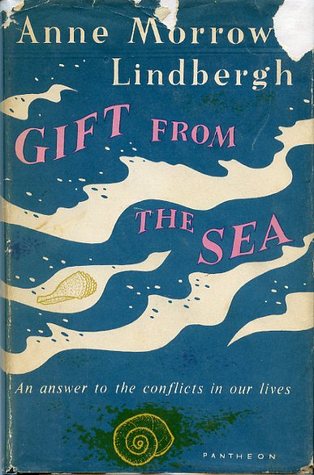
Gift from the Sea

Anne Morrow Lindbergh was not only married to famous aviator Charles Lindbergh and a pilot herself; she was also a popular author—and not just because of her famous name. Gift of the Sea is probably her most well-known book, still read widely even today.

Anne was a busy mother of five when she had a rare opportunity to go to the beach alone for a couple of weeks. She took the time to reflect on her struggles as a woman, wife, and mother. Over eight chapters, she uses the metaphor of the sea, island life, and different kinds of shells to illustrate different stages or aspects of life..

For instance, the chapter on the channeled whelk, a shell once inhabited by a creature, speaks to her of “the art of shedding.” What she says in this chapter would fit right in with the minimalist movement of the last few years: the need to simplify and pare down not only our stuff, but our responsibilities and relationships.

The chapter on the moon shell speaks of needed time alone.

I find there is a quality to being alone that is incredibly precious. Life rushes back into the void, richer, more vivid, fuller than before (p. 42).

Quiet time alone, contemplation, prayer, music, a centering line of thought or reading, of study or work. It need not be an enormous project or great work. But it should be something of one’s own. Arranging a bowl of flowers in the morning can give a sense of quiet in a crowded day–like writing a poem or saying a prayer. What matters is that one be for a time inwardly attentive (p. 56).

What Anne calls the double-sunrise is a bivalve that reminds her of early marriage, “two people listening to each other, two shells meeting each other, making one world between them” (p. 65).

What she calls an oyster bed has “small shells clinging to its humped back. Sprawling and uneven, it has the irregularity of something growing. It looks rather like the house of a big family, pushing out one addition after another to hold its teeming life” (p. 80). This speaks to her of the middle years of marriage.

I am very fond of the oyster shell. It is humble and awkward and ugly. It is slate-colored and unsymmetrical. Its form is not primarily beautiful but functional. I make fun of its knobbiness. Sometimes I resent its burdens and excrescences. But its tireless adaptability and tenacity draw my astonished admiration and sometimes even my tears. And it is comfortable in its familiarity, its homeliness, like old garden gloves when have molded themselves perfectly to the shape of the hand. I do not like to put it down. I will not want to leave it (p. 83).

I particularly liked this about middle age: “For is it not possible that middle age can be looked upon as a period of second flowering, second growth” (p. 86) rather than the “false assumption that it is a period of decline” (p. 87).

One other quote that stood out: “Good communication is as stimulating as black coffee and just as hard to sleep after” (p. 102).

I thought it interesting that even in Anne’s day (this book was published in 1955), she felt the weight of what she calls “planetal awareness.” How much more would she feel it now?

The world is rumbling and erupting in ever-widening circles around us. The tensions, conflicts and sufferings even in the outermost circle touch us all, reverberate in all of us. We cannot avoid these vibrations.

But just how far can we implement this planetal awareness? We are asked today to feel compassionately for everyone in the world, to digest intellectually all the information spread out in public print, and to implement in action every ethical impulse aroused by our hearts and minds. The interrelatedness of the world links us constantly with more people than our hearts can hold. Or rather—for I believe the heart is infinite—modern communication loads us with more problems than the human frame can carry. It is good, I think, for our hearts, our minds, our imaginations to be stretched, but body, nerve, endurance and life-span are not as elastic. My life cannot implement in action the demands of all the people to whom my heart responds. I cannot marry all of them, or bear them all as children, or care for them all as I would my parents in illness or old age. Our grandmothers, and even—with some scrambling—our mothers, lived in a circle small enough to let them implement in action most of the impulses of their hearts and minds. We were brought up in a tradition that has now become impossible, for we have extended our circle throughout space and time.

Faced with this dilemma what can we do? How can we adjust our planetal awareness to our Puritan conscience? We are forced to make some compromise. Because we cannot deal with the many as individuals, we sometimes try to simplify the many into an abstraction called the mass. Because we cannot deal with the complexity of the present, we often over-ride it and live in a simplified dream of the future. Because we cannot solve our own problems right here at home, we talk about problems out there in the world. An escape process goes on from the intolerable burden we have placed upon ourselves. But can one really feel deeply for an abstraction called the mass? Can one make the future a substitute for the present? And what guarantee have we that the future will be any better if we neglect the present? Can one solve world problems when one is unable to solve one’s own? (pp. 124-125).

Her answer was to concentrate on “the here, the now, the individual,” “the drops that make up the stream,” “not as a retreat from greater responsibility, but as a first real step toward a deeper understanding and solution of them” (pp 127-128).

I mentioned when I read Anne’s biography that she seemed a very conflicted person. Probably most women struggle with how to best use their time, how to meet the needs of others and not feel depleted, etc. She had more pressures than many, dealing with the fame and lifestyle her husband brought to the family. But she seemed to struggle a lot inwardly.

I want first of all… to be at peace with myself. I want a singleness of eye, a purity of intention, a central core to my life that will enable me to carry out these obligations and activities as well as I can. I want, in fact–to borrow from the language of the saints–to live “in grace” as much of the time as possible. I am not using this term in a strictly theological sense. By grace I mean an inner harmony, essentially spiritual, which can be translated into outward harmony. I am seeking perhaps what Socrates asked for in the prayer from the Phaedrus when he said, “May the outward and inward man be one.” I would like to achieve a state of inner spiritual grace from which I could function and give as I was meant to in the eye of God (pp 23-24).

I approached this book with some wariness, since Anne’s biographer said this book “is a journey infused with classic literature and Christian doctrine, yet rooted in teachings of Hindu and Buddhist philosophy. . . . Camouflaging her Hindu and Buddhist sources beneath the words of Christian saints and modern poets and writers” (Susan Hertog, Anne Morrow Lindbergh: Her Life, p. 429). I don’t know enough about Hindu and Buddhist doctrines to be able to discern those threads in the book, but I picked up on a bit here and there.

And there’s a lot of feminist thought, though Anne doesn’t take it as far as some. She does believe that marriage and family and even housework are worthy: she just struggles with how to meet the needs of all.

I identified with some of Anne’s struggle, though not all of her angst. I wouldn’t agree with all Anne’s philosophy, and I’d caution the need for discernment in reading the book. But I think one can take the Christian references and common sense passages at one’s own interpretation.

I’m going to see if Shelly Rae at Book’d Out will allow this book to count for the Oceanography category of the Nonfiction Reading Challenge. This is probably the closest I’ll get to that one. 🙂 If not, it would work for the Essays category.

Have you read Gift From the Sea? What did you think?

Catching the Wind

Melanie Dobson’s Catching the Wind made me want to lay everything else aside to read it. But I also wanted to slow down and savor it and hated to see it end

The story opens with two children playing in 1940 Germany. Brigette Berthold is ten and wants to play nothing but princesses and knights. Dietmar Roth is a few years older and tolerates the game because Brigette is his favorite playmate. Plus he promised her father that he would help take care of her.

When the children’s parents are attacked by the Nazis, Dietmar and Brigette run. If they can make it to the English Channel and get across, Hopefully Dietmar can find his aunt.

After a harrowing journey, they finally do make it to English soil. But then they are separated.

Over 70 years later, Dietmar is a wealthy old man who goes by the name Daniel Knight. He has hired several private investigators to try to find Brigette, with no luck. Now his hopes rest in a reporter, Quenby Vaughn. He has read her stories about refugee children and knows she searches with her heart.

Quenby is working on her own story about a wealthy English woman, Lady Ricker, rumored to have helped and secretly supported the Nazis in the 1940s. Understandably, the woman’s descendants don’t want the story to run and aren’t cooperating.

When Mr. Knight’s arrogant solicitor approaches Quenby with Mr. Knight’s proposal, he’s not forthcoming enough to interest her. But she agrees to meet with Mr. Knight. When she learns that Brigette’s story ties in with the Rickers, she’s hooked.

There are several layers to this story—what happened to Brigette and Daniel, what was going on with Lady Ricker, and Quenby’s family history of a mother who abandoned her, which has crippled her ability to trust.

As one character says, “I believe God uses our pasts, even our regrets to help us and other people find Him.”

I listened to the audiobook (winner of a 2018 Audie award) nicely read by Nancy Peterson. This is one of my favorites of Melanie Dobson’s.