Book Review: Hidden Among the Stars

In Austria in 1938, Annika Knopf is the daughter of the caretaker of the Dornbach family’s castle in Hallstatt. She and the Dornbach’s only son, Max, have been friends since childhood. But now they are grown, and she has quietly loved him for a long time.

When Annika discovers Max is hiding treasures of their Jewish friends on the estate grounds, she wants to help. Max wants to protect her as much as possible, but the time comes when he must accept her offer.

Max has never seen Annika as anything but a good friend. He’s in love with Luzia Weiss, a beautiful and brilliant violinist with the local orchestra. The Dornbach and Weiss families have been friends for years. But as Hitler’s forces advance, it’s not healthy to associate with Jews like the Weiss family. Max loves Luzia still and looks for ways to avoid fighting for the Reich and to get Luzia and her family out of Austria before it’s too late. In the meantime, he brings Luzia to the family’s lake castle to hide and asks Annika to watch over Luzia.

In modern times, Callie Randall runs a book store with her sister. Her tumultuous early life, with rejection from both parents and and betrayal by her fiance, has turned her naturally introverted character into someone who enjoys hiding out and is afraid of . . . almost everything except her job and shop.

Callie’s sister gifts her an early edition copy of Bambi, and Callie finds within its pages a list of items in the same script as the book’s font. The name written in the front is Annika Knopf. Callie begins an Internet search, hoping to reunite the book with Annika or someone in her family. But Callie discovers Annika’s story may intersect with Charlotte, the woman who took Callie and her sister in and whom she loves like a mother. Callie yearns to find Annika and restore to Charlotte something of her lost history. But first she must find the courage to step outside her safe haven.

I had read several WWII-era books this year, and was determined to read something from a different time. I love stories from that era, but I was starting to get a little tired of it. However, when I read the description of Hidden Among the Stars by Melanie Dobson, I had to read it next. A main character with a personalty similar to mine, a bookstore owner, mention of several classic children’s books, a castle on a lake—all these drew me in. And I am glad. I think this might be my favorite of Melanie’s books so far—and that’s saying something, because I’ve enjoyed all I’ve read from her.

I listened to the audiobook, wonderfully read by Nancy Peterson. Unfortunately, the audio version didn’t include any back matter that books sometimes have about the author’s inspiration for writing, historical research, etc. However, I did find that information on Melanie’s site here. There really is an abandoned castle in Hallstatt! I enjoyed hearing about Melanie’s trip there.

I’m pretty sure this will be one of my top ten books of the year. Highly recommended.

Don’t Reject God Because of His People

There are a number of reasons people walk away from Christianity, or at least from church. Some have faced disdain or hurt from those who were supposed to model and minister Christ to them. Some groups or ministry leaders were found to have shocking hidden pasts or current sins. Some movements displayed racist thought in their pasts.

Sometimes leaving a particular group or church or dissociating from an individual is the right thing to do.

But we shouldn’t reject the whole body of God’s truth because some of His people, or those who professed to be His people, fell so far from His ideal. They’re accountable for their sins and failures, but what they do doesn’t void the truth they taught. We’re accountable for the truth we’ve heard despite the vessels it sometimes came through.

Someone once said if you look for the fatal flaw, you’ll find it. And you don’t have to look very far in some cases. That’s because we all have one—or more than one. Some seem worse, or more obvious, than others.

When you look through the Bible, you find people who loved and followed God, yet they failed in spectacular ways. Though we grieve over their falls, we don’t dismiss the truth they taught. We don’t throw out Proverbs because Solomon failed to keep his own admonitions. We lament David’s sins, but we don’t reject the psalms because of them. The disciples fought over who was greatest and fled when Jesus was arrested. Yet God transformed and used each of them in mighty ways.

Instead of throwing out “the baby with the bath water,” we can learn from the failures of others.

We’re all at risk of falling. Proverbs 16:18 warns that “Pride goes before destruction, and a haughty spirit before a fall.” 1 Corinthians 10:12 says, “Therefore let anyone who thinks that he stands take heed lest he fall.” Verse 13 goes on to say that we’re not tempted beyond our ability, but God will provide a way of escape. But we need to look to Him: we can’t take pride that we would never do certain things.

Most have or will experience failure of others. Joseph’s own brothers wanted to kill him and sold him into slavery. Abigail’s husband, who should have been her leader and protector, nearly caused their household to be attacked by the king. Saul, who should have been David’s mentor, instead was jealous and tried to kill David. At some point, we will fail others and they will fail us.

Learn from people who failed what not to do, what precautions could have been taken, etc.

For all the bad ones, there are many good ones. When I worked with the general public, the rude and obnoxious customers and comments hurt and stayed with me a long time. Yet there were many more kind and thoughtful customers than bad ones. Though none is perfect, there are many within Christendom who love God and others well. Don’t let the bad ones obscure the good ones.

Compare what we see and hear with Scripture. Those noble Bereans “received the word with all eagerness, examining the Scriptures daily to see if these things were so” (Acts 17:11). They took what they were told even of Paul and Silas and checked it against Scripture.

Others’ failures don’t nullify truth. In Romans 3:, Paul writes, “What if some were unfaithful? Does their faithlessness nullify the faithfulness of God? By no means! Let God be true though every one were a liar” (Romans 3:3-4). Does that mean faithfulness doesn’t matter, or people get away with being unfaithful? No. God will deal with them. But their unfaithfulness doesn’t make God unfaithful or disprove His truth.

Hold fast. Hebrews 10:23 says, “Let us hold fast the confession of our hope without wavering, for he who promised is faithful.” Then verse 35-36 says, “Do not throw away your confidence, which has a great reward. For you have need of endurance, so that when you have done the will of God you may receive what is promised.”

Stir up others to love and good works. “Let us hold fast the confession of our hope without wavering, for he who promised is faithful. And let us consider how to stir up one another to love and good works,” which, interestingly, takes place in the context of church: “not neglecting to meet together, as is the habit of some, but encouraging one another, and all the more as you see the Day drawing near” (Hebrews 10:23-25). Perhaps some would have been prevented from a fall by a loving friend’s kind rebuke.

Forgive. Most have found that when they refuse to forgive others, the one they end up hurting the most is themselves. Unforgiveness can lead to bitterness and unanswered prayer or keep us from being forgiven. Jesus said, “For if you forgive others their trespasses, your heavenly Father will also forgive you, but if you do not forgive others their trespasses, neither will your Father forgive your trespasses” (Matthew 6:14-15). He taught that we’ve been forgiven so much, we should not withhold forgiveness for lesser sins than the ones we’ve committed against Him (Matthew 18:21-35).

Overcome evil with good” (Romans 12:21). This sentence comes at the end of a section about loving enemies and not avenging ourselves, but leaving vengeance to God. That’s not to say we don’t report or deal with wrong-doing. Sometimes we need to allow consequences to catch up to someone for their own good and for protection of ourselves and others. But we don’t seek to “get them back.” Instead, we go the extra mile and do them good.

Jesus knows what we’re going through. No one has been failed by others as much as Jesus. His family didn’t understand Him. His disciples missed the point of His teaching much of the time. They fled when He was arrested. The people He came to save rejected Him. But He didn’t walk away from them. He loved even when they didn’t love Him. He patiently kept working with them. “Since then we have a great high priest who has passed through the heavens, Jesus, the Son of God, let us hold fast our confession. For we do not have a high priest who is unable to sympathize with our weaknesses, but one who in every respect has been tempted as we are, yet without sin” (Hebrews 4:14-15).

Keep our eyes on Christ. Others will fail us, even those who mean well. “Let us run with endurance the race that is set before us, looking to Jesus, the founder and perfecter of our faith,” (Hebrews 12:2b-3a).

In Psalm 55, David tells of his fear, trembling, horror, and anguish due to the oppression of an enemy. Then he reveals in verses 12-14:

For it is not an enemy who taunts me—    then I could bear it;
it is not an adversary who deals insolently with me—    then I could hide from him.
But it is you, a man, my equal, my companion, my familiar friend.
We used to take sweet counsel together; within God’s house we walked in the throng.

Instead of letting a friend’s betrayal drive him away from the God he professed, David let the situation drive him to God.

But I call to God, and the Lord will save me.
Evening and morning and at noon I utter my complaint and moan, and he hears my voice. He redeems my soul in safety  from the battle that I wage (verses 16-18).

Cast your burden on the Lord, and he will sustain you;
he will never permit the righteous to be moved (verse 22).

When others fail you, betray you, ignore you, or hurt you, they are accountable to God. But don’t walk away from Him because of them. Run to His arms and let Him heal, soothe, encourage, and strengthen you.

“The Lord builds up Jerusalem; he gathers the outcasts of Israel.
He heals the brokenhearted and binds up their wounds.”
(Psalm 147:2-3)

Man may trouble and distress me;
Twill but drive me to Thy breast.
Life with trials hard may press me.
Heaven will bring me sweeter rest.
Oh, tis not in grief to harm me
While Thy love is left to me.
Oh, twere not in joy to charm me
Were that joy unmixed with Thee.

Henry Francis Lyte, “Jesus, I My Cross Have Taken”

(I often link up with some of these bloggers.)

Laudable Linkage

IMG_0195

Here are some noteworthy reads found this week.

From Meat to Meta: Facebook’s Disincarnate Dreamworld, HT to Challies. “For those who labour under the Enlightenment (and latterly Zuckerbergian) prejudice that ideal reality is immaterial and universal, the notion that God could have a body is quite a scandal. But it is deeply, deeply good news that the Word ‘became’ flesh.”

Life Beyond the Spiritual Shallows. “There is a depth to God’s character that cannot be assessed with quick glances and fleeting thoughts. We will never become the kind of women who face the lion’s den without a deep understanding of God’s character. We will never know that depth if we cannot find ways to circumnavigate our brain’s wiring and study God’s Word for longer than eight second bursts.”

Should We Pursue Self-Love? HT to Challies. “God acknowledges the reality of self-love, but He certainly does not teach it as a Christian virtue to be cultivated. Rather, it is an existing reality, necessary for our survival, in some respects healthy, but in other ways very much tainted by our sin. Our instinct to take care of ourselves is something we are to extend to others, that we might lovingly take care of them.”

When You Are Wrongly Accused: 5 Things to Do. “What can we do when we are wrongly accused? Either directly or indirectly? When someone we know is telling us we are a bad person, exhibiting bad behavior that we are not responsible for, have ruined something way beyond our control, or have a pattern of wrong deeds and we feel it simply is not true. Before you start responding to their accusations, you want to ask yourself a few questions.”

Two Important Principles for Trusting God: Commas and Periods. “Clearly, punctuation matters when giving instructions. It’s even more important when it comes to trusting God. Understanding and embracing the principles of God’s punctuation can give us peace—and even joy—in the waiting.”

Night Watch, HT to Challies. “Night watch. Our God neither slumbers nor sleeps (Psalm 121). And sometimes He wakes us in the night. To watch and pray. I remember when the two emails arrived. One after the other. To our inbox in Karachi. Same time. Same message. Traveling across the world. From opposite sides of the United States.”

Dividing Lines: Beware of “Us vs. Them.” “The Bible separates people into just two categories as well: those who are in Christ and those who aren’t. But this important distinction does not give us permission to attack people who don’t agree with us. In fact, Jesus told a parable about a religious person who did just that.”

This moving video, shared by Lisa, is titled Before You Call the Cops. This man had an experience when, just seeing him, a woman reacted in fear. He encourages us to get to know each other and not fit everyone into stereotypes.

Friday’s Fave Five

It’s Friday, time to look back over the blessings of the week
with Susanne at Living to Tell the Story and other friends.

Can you believe we’re more than 1/3 of the way through November already?

This has been kind of a strange week. By Thursday afternoon, I didn’t have anything in mind for today’s FFF. But that’s one reason I love this exercise: when I stop to consider, there are always blessings. Some might be overlooked if we don’t pause and think.

1. Veteran’s Day. I’m abundantly grateful for those who served our country and defended our freedoms and those who still do so today.

2. Finding a recorded program. I caught part of Elisabeth Elliot’s Gateway to Joy radio program while driving on Wednesday. BBN Radio plays her old radio programs at 11:15 a.m. weekday mornings. One thing she said really struck me, and I don’t remember hearing her say it before. The foundation that set up her web site has included many of her talks and writings, so I searched there, but couldn’t find the one I was looking for. Finally I looked up the program on BBN, and discovered they have the audio of her programs for the current week on their site. I was so glad I got to hear what she said again, and in context this time. (The episode was titled Reflections of a Granny #3: The Secret of Tranquility.)

3. Recording apps.Since the above-mentioned program was only going to be online this week, I wanted to record it in case I wanted to listen to it again later. I found a recording app in the app store and figured out how to use it.

4. Lunch with a friend. It had been a long time since we’d met for lunch, and I thoroughly enjoyed catching up.

5. Timothy seeking me out. I try not to spend time off in the kitchen when the family’s here, and everyone is good to pitch in and help when we eat together. But sometimes when I’m in the kitchen tending to something, Timothy will come in and see how I am doing or tell me something about his day. That touches my heart so much.

Bonus: I used to go fancy for holiday celebrations. The last few years, we’ve decided to simplify and decrease the work load. Many places have pretty and inexpensive holiday paper plates. I had found dessert paper plates and napkins for Thanksgiving at one store, but there were no dinner-sized plates. Then, when Jason and Mittu came over, they brought some dinner-sized Thanksgiving paper plates, but said their store didn’t have the smaller dessert plates. It was neat how it worked out.

Hope you’ve had a good week!

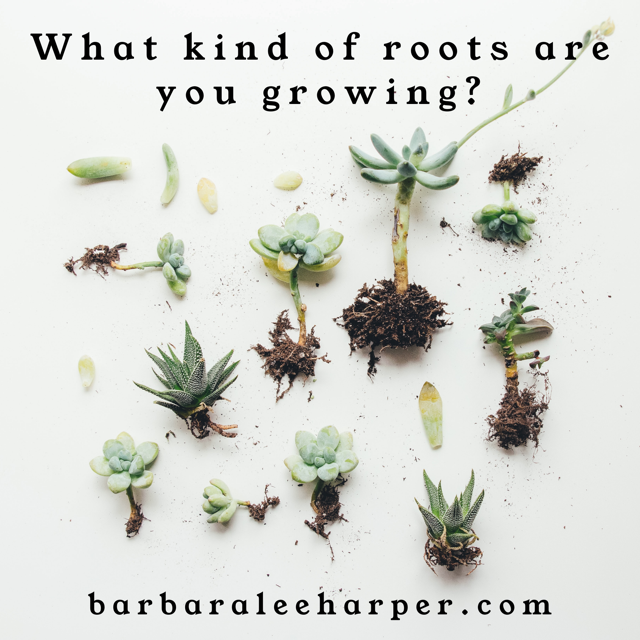
What Kind of Roots Are You Growing?

I am guilty of negligent planticide. Multiple counts of it.

Houseplants rarely survive my care . . . or lack thereof. I forget to seek out their specific needs. I just stick them in front of a window and water them . . . when they look a little droopy. Turns out, that’s not healthy for them. And not all of them require full sunlight. And fertilizer? You mean there’s not one generic plant food for them all?

My hanging baskets outside fare better since my dear husband has taken it upon himself to keep them watered.

But plants in the ground or big planters do best for me. At least they get dew every morning and enough rain to keep going, and they have enough room for a deep root system.

Occasionally, though, I’ll do battle with a plant that not only survives my neglect, but actively thrives despite my attempts to get rid of it.

Once I had what I thought was a pretty kind of ivy. I think it may have come in a mixed basket of some kind. I planted a few strands along the front edge of of two outdoor planters so they would spill out over the front, making a pretty foreground to the begonias and petunias behind it.

The only problem was, the ivy took over. It stretched over the other plants until eventually it was the only thing growing in the planter. It took all the nutrients so there was none left for anything else. Despite my frequent trimming, the ivy grew so fast that it began to attach itself to the ground around the planters. I pulled up several cords of ivy vines, but in a few days there would be new shoots. I thought we’d never get rid of it.

When a book I read recently mentioned a root of bitterness, some of a root’s imagery came to mind. The phrase comes from Hebrews 12:15: “See to it that no one fails to obtain the grace of God; that no ‘root of bitterness’ springs up and causes trouble, and by it many become defiled.” Deuteronomy 28:18b warns: “Beware lest there be among you a root bearing poisonous and bitter fruit.”

Despite my botanical ignorance, I know a few things about how roots function.

Roots need room to grow. We planted two crepe myrtle trees at the same time in different parts of the yard. One did well and is now as tall as the house. The other is only about three feet tall. The latter is in a small area between the sidewalk and house, where there must not be enough room for it to spread its roots out.

Roots anchor the plant to the ground. Plants could easily blow over or be dug up without a sufficient root system. Somehow weeds seem to have the strongest or deepest roots, making it difficult to eradicate them completely. Some taproots can grow 200 feet downward according to this article.

Roots take nutrients and water from the soil and feed the plant. Some roots even store food for later use.

Roots help some plants reproduce in other areas. And weeds return unless you dig them up or kill them at their roots.

A root of bitterness will act the same way as a persistent plant’s root system. If we’re not careful, that kind of root will anchor itself in our souls. We can’t easily brush it away or dig it out. It will spread so it takes over our thinking. It will leach nutrients away from other areas of life, so we fail to grow spiritually while the bitterness increases. Eventually we plant bitterness in others as we spread our discontent.

I need to frequently examine my heart. Even when I am not aware of any deep roots of bitterness, I often find seedlings of grudges, resentment, or irritation. I need to avoid giving these roots room to grow. If I don’t dig these up right away, they can send their roots deep and cause bitterness.

Instead I want to be “rooted and built up in him and established in the faith, just as you were taught, abounding in thanksgiving” (Colossians 2:7).

I want to be like the blessed “man who trusts in the Lord, whose trust is the Lord. He is like a tree planted by water, that sends out its roots by the stream, and does not fear when heat comes, for its leaves remain green, and is not anxious in the year of drought, for it does not cease to bear fruit” (Jeremiah 17:7-8).

I pray “ that according to the riches of his glory he may grant you to be strengthened with power through his Spirit in your inner being, so that Christ may dwell in your hearts through faith—that you, being rooted and grounded in love, may have strength to comprehend with all the saints what is the breadth and length and height and depth, and to know the love of Christ that surpasses knowledge, that you may be filled with all the fullness of God” (Ephesians 3:16-19).

I want to be anchored in Jesus, the “root of Jesse” (Romans 15:12-13), the “root of David” (Revelation 5:4-6), the “root and the descendant of David, the bright morning star” (Revelation 22:15-17).

Guarding against spiritual weeds takes diligent care. While we pull out weeds by the root, we plant in their place the right kind of roots. The verse just before the one that mentions the root of bitterness says, “Strive for peace with everyone, and for the holiness without which no one will see the Lord” (Hebrews 12:14).

Even those of us without a physical green thumb can carefully tend our hearts, pulling up weeds, planting good things, sinking our roots deeply into Christ.

(I often link up with some of these bloggers.)

Laudable Linkage

A collection of good reading online

Here are some of the most noteworthy reads discovered recently:

We Are All Cultists On the Inside. “Yet a little honest self-examination will probably reveal that we all have a cultist lurking within ourselves. We may pay lip service to diversity, but when it comes down to it we find that our natural instinct is toward uniformity—a uniformity to our own emphases, our own convictions, our own preferences.”

How to Prepare for the Metaverse, HT to Challies. The first time I encountered the term “metaverse” was in the animated film Spiderman: Into the Spider-Verse. But lately I’ve caught snatches of news that indicates the metaverse is, or will be, a real-world thing. This article explains what it is and what its impacts might be.

5 Takeaways from the Facebook Papers, HT to Challies. One of them: “A 2018 presentation from internal Facebook researchers, as revealed by the WSJ, showed that divisiveness and polarization increased the time people spent on Facebook, which in turn generates more money for Facebook.” It’s not just our imaginations that FB has turned into a place for arguing rather than socializing.

Does It Really Matter Whether Adam Was the First Man? HT to Challies. “The simple aim of this article is to show that, far from being a peripheral matter for fussy literalists, it is biblically and theologically necessary for Christians to believe in Adam as a historical person who fathered the entire human race.”

Loving the God of Little Things, HT to The Story Warren. “It’s troubling, this idea that one should be cut off from joys of all kinds if one hasn’t achieved the joy of having a family. It suggests both a lack of trust in God to have every person’s best interests at heart, and a lack of the imagination to comprehend all the different kinds of joys God offers us.”

I’m not sure who alerted me to the artistry of Tanaka_Tatsuya on Instagram, but I’ve enjoyed his creations quite a lot. He takes everyday objects and reimagines them in miniatures. He usually shares an overview photo and then one or two zoomed in to the intricate detail. Here’s one of my favorites:

Happy Saturday!

Friday’s Fave Five

It’s Friday, time to look back over the blessings of the week
with Susanne at Living to Tell the Story and other friends.

It feels like we had a short autumn and dived right into winter, with nights in the 30s and days in the 40s. But I’m hoping fall isn’t done yet.

Here are some favorites from this week:

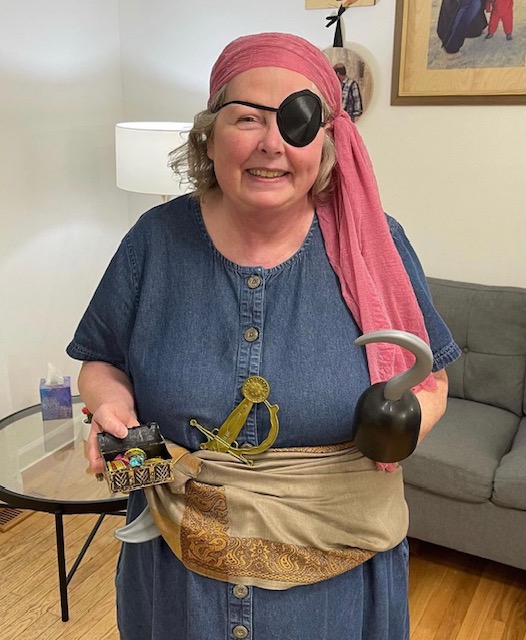
1. Family costume party. My son and daughter-in-law used to take my grandson trick-or-treating in public places like the zoo or mall. But then Covid came, and this year and last we got together as a family and dressed up in costumes. Here’s this year’s array:

We have Captain America, a cute fox, a mini Darth Vader, a pirate, a . . . he was going for a Mandalorian storm trooper, and Cyclops.

Pirates had grandmas, too, right? 🙂 I gave Timothy my pirate accoutrements after we got done.

2. Tilapia. I’ve only had it twice, and my daughter-in-law made it both times. Good stuff.

3. Fall color has finally come in the neighborhood trees. So pretty.

4. Light kitchen duty. Jim had a company dinner to go to one night and was out of town for two evenings. I made frozen pizza the first night he was away, got take-out Mexican food the second night, and Jason and Mittu brought hamburger pie over the third. Now that I think about it, I didn’t make dinners over the weekend, either: we had the tilapia with the family one night and got fast food Friday night and Sunday lunch. So I probably better come up with something good for dinner tonight, huh? On a side note, it’s amazing how many dishes get dirty even without making dinner and with using paper plates.

5. A party at Grandma’s house. Mittu texted me a conversation with Timothy. She mentioned that Granddad was on a work trip. Timothy said, “So we’re having a party at their house tonight?” Mittu commented, “Glad we have a child that thinks visiting Grandma by herself is a party.” Me, too.

Happy Friday? What’s something good from your week?

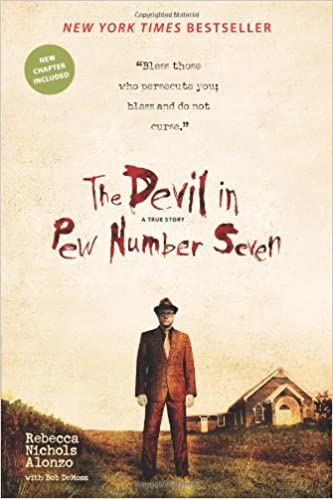
The Devil in Pew Number Seven

“The story you are about to read actually happened, every last detail of it. As the plot unfolds, my hunch is that you’ll need to remind yourself of this reality more than once.” So Rebecca Nichols Alonzo opens her book The Devil in Pew Number Seven.

Her hunch was right.

Rebecca tells the story of a man who harassed—no, terrorized her family for several years as she was growing up.

Rebecca’s father was the new pastor of a small church in Sellerstown, NC, in 1969. He found that one man, a Mr. Watts, held key positions in the church even though he was not a member. Recognizing Mr. Watts’ “stranglehold” on the church, Pastor Nichols “made changes to end his dominance” (p. 48).

Mr. Watts did not take his loss of position well, nor the pastor’s difference of opinion over issues like the style of the new church roof. Mr. Watts started acting up in church from pew number seven, making faces at the pastor while he preached, tapping on his watch, walking out and slamming the door loudly before the sermon was finished.

The Nichols family started receiving threatening anonymous phone calls in the middle of the night and unsigned letters. One letter promised the pastor’s family would leave “crawling or walking, running or riding, dead or alive” (p. 54).

Then followed several incidents of escalating attacks: home invasions while the family was away, which one time included water in the fuel tank and oil in the water pump; shots fired at the outside walls; dynamite set off near the house.

The Nichols family, the neighbors, the church, and even the police knew who was behind these attacks, but no one could prove it. Some of the incidents occurred while Mrs. Nichols was pregnant and then while the family had a newborn.

Finally events came to a tragic head. (It’s no spoiler to say this since it’s mentioned in the first chapter).

The rest of the book tells of the long-term effects these years had on the family and the necessity of learning to forgive those involved.

Rebecca was a child when much of this happened, but she read her parents’ journals, newspaper reports, court documents, and interviewed several people from the town.

It’s hard to fathom how far this man went to drive out the pastor. Rebecca’s father felt he couldn’t leave, because that would mean Mr. Watts would again assert his dominance over the church if Pastor Nichols left. The pastor and his wife also believed and modeled for their children “Love your enemies and pray for those who persecute you” (Matthew 5:44).

I first heard of this book from my friend Lou Ann. But I kept passing it by on my TBR list because I thought it might be too hard to read. I finally listened to the audiobook nicely read by Pam Ward. Then I checked the book out of the library to see the pictures and read the afterword.

The book was not hard to read or listen to. Rebecca doesn’t sensationalize the violence. She begins with the climactic incident, but then backtracks to tell how her parents met, were called to the ministry, how they came to Sellerstown, and other “normal” occurrences.

Some of my favorite quotes:

With a few rare exceptions, everyone in Sellerstown was related to one another in some way. Which is why at times, shotguns in hand, they watched out for one another. The Sellers kin are true salt-of-the-earth people . . . although some were saltier than others (p. 31).

I knew [God] said in the Bible that He’s a father to the fatherless and to the brokenhearted. I was both, so we had a perfect fit. There was one more insight I came to embrace. I needed God more than I needed to blame God (p. 235).

I didn’t ask for this abrasion on my soul to be a part of my life; it just is. Now, day by day, I have the choice to forgive the two men who took so much from me, or I can choose to wallow in a toxic brew of bitterness. True, I forgave . . . a long time ago. But that doesn’t mean I still don’t have to forgive him again and again . . . (p. 250).

I’m the one who remains in jail if I withhold God’s grace by failing to forgive when wronged (p. 251).

My one critique is that the author seems to belabor some points overmuch. For instance, with the first threatening phone call, a little more than a page is spent on describing what happens inside the phone when it rings, explaining how phones in those days didn’t have optional ring tones and couldn’t be left off the hook without setting off a warning tone, how her father couldn’t take the phone off the hook anyway because a country pastor was “on call” 24/7 just like a country doctor was. Maybe this was supposed to build suspense with three rings leading up to the first threat, but it just seemed extraneous and a touch irritating. But, this is a minor criticism and for the most part doesn’t hinder the story.

Sometimes the circumstances were hard to read about and illustrated how “truth is stranger than fiction,” But I highly recommend this book. Ultimately it’s about God’s grace and strength through the most difficult of times.

Is This the Right Way?

“I hope you know where we’re going.”

My mother-in-law would say this whenever I drove her anywhere.

Ten years before my mother-in-law passed away, we moved her from her long-time home in Idaho to be near us, then in SC and later in TN.

For the first five years, she was in an assisted-living facility. She was still mobile (with a walker) and verbal then.

When she first came, we had to gently insist that she needed new hearing aids. We could yell right next to her, and she’d encourage us to “just speak up.” When we finally got the new aids, she could hear much better and didn’t fuss about them any longer.

The new hearing aids required that we visit the audiologist’s office every few months for a tune-up and tube replacement. It was my responsibility to chauffeur Mom to these appointments.

Mom had never driven. She had several physical issues as a result of being born two months premature in the days before the streamlined NICUs we have today. She was used to her husband driving her wherever she needed to go. And she was used to the familiar roads in her small town in Idaho.

She did not have Alzheimer’s, but she had a degree of dementia that flared up most often when she was nervous or agitated.

So on our drives, in a place and vehicle and with a driver she wasn’t used to, she would frequently express her hope that I knew the way.

I would reassure her again and again. Once I teased, “No, I thought I’d just get in the car and drive around until we found it.” But her uncertain look told me that teasing probably wasn’t wise.

Later I would learn that when we’d get in these repetitive conversational loops, logic didn’t work. It was best to respond factually and then divert her attention. Trying to keep up a conversation kept her mind from reverting back to wondering where she was going . . . most of the time.

Her repeated question often reminded me of a poem I saw in one of Rosalind Goforth’s books. She and her husband were ministering in China when “foreign devils,” as they were called, were not welcome. They were staying in a “barn-like room” with paper windows full of holes. She couldn’t get warm. She got sick. She cried out, “O Lord, have you no pity? Oh, help me! Why should I suffer so?”

Just then someone brought in two baskets with a letter from two missionaries who had stayed with them the day before. The missionaries saw the Goforths’ meager accommodations and must have sensed that they had used most of their supplies to serve them. So the caring guest missionaries sent an assortment of food. Rosalind rejoiced at the kind provision. “But the most timely and precious evidence of God’s love and care came, when tearing paper off a bottle of grape juice,” she noticed this poem:

Is this the right road home, O Lord?
The clouds are dark and still,
The stony path is hard to tread,
Each step brings some fresh ill.
I thought the way would brighter grow,
And that the sun with warmth would glow,
And joyous songs from free hearts flow.
Is this the right road home?

Yes, child, this very path I trod,
The clouds were dark for Me,
The stony path was sharp and hard.
Not sight but faith, could see
That at the end the sun shines bright,
Forever where there is no night,
And glad hearts rest from earth’s fierce fight,
It IS the right road Home!

The poem was from an English paper printed in 1914, four years earlier, with no author listed. Who knows how it “happened” to find its way to Rosalind right when she needed it. She read the words over and over and finally prayed, “O Lord, if this is the right road home, then I will not murmur!”

Two days later, Rosalind returned to their home in Changte while others went on with the tour. Noting that she looked like a ghost of herself, friends cared for her until she recovered (Climbing, pages 118-120).

Even those of us who know the “prosperity gospel” is false sometimes fall into the trap of thinking the Christian life is akin to the “American dream.” When troubles come, we’re dismayed, because this isn’t what we thought the Christian life would be like. Did we take a wrong turn? Did God really mean for this to happen?

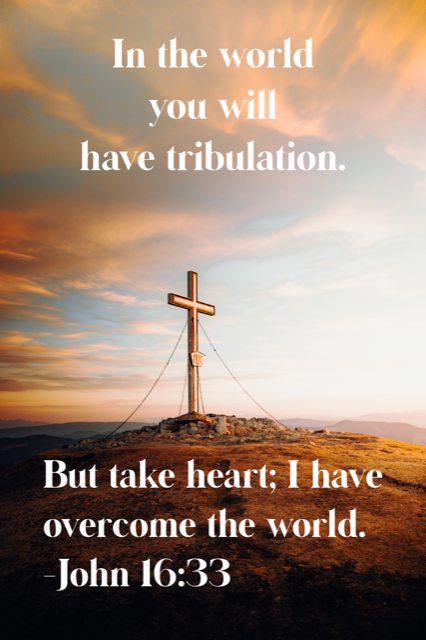
But He told us, “In the world you will have tribulation.” Yet He sandwiches that truth between two promises:

I have said these things to you, that in me you may have peace. In the world you will have tribulation. But take heart; I have overcome the world (John 16:33).

Several people in the Bible must have wondered if they, too, were on the right road:

Abraham and Sarah waiting long years for the son God promised.

The children of Israel wandering for forty years in the desert.

David, though anointed as the next king, hiding out in a cave from Saul.

John the Baptist in prison.

Peter when he heard Jesus speak of suffering and dying.

We’ve had friends who also must have wondered at times why life looked so different than they thought it would: a couple on deputation for the mission field when their son was diagnosed with leukemia; a young man in seminary who was in a car accident which left him paralyzed; a woman who is still alone though she thought she would have a husband and children; another woman who had to leave her beloved mission field due to her husband’s sin.

The Bible tells us often that trouble is part of life here. But the Bible also assures us time and again that God will be with us and help in trouble. God tells us not to lean on our own understanding, but to trust God (Proverbs 3:5).

He promises that when—not if—we pass through deep waters or fire, He will be with us:

When you pass through the waters, I will be with you; and through the rivers, they shall not overwhelm you; when you walk through fire you shall not be burned, and the flame shall not consume you (Isaiah 43:2).

What’s the best way to stay on the right path? “In all your ways acknowledge him, and he will make straight your paths” (Proverbs 3:6). If we’re seeking Him day by day, step by step, we can be assured we’re on the right path even if the circumstances are confusing.

What if we do stray from the path of God’s will? Sometimes trials are God’s chastening or His attempt to get our attention. Jonah went the opposite direction God told him and ended up inside a big fish. The prodigal son deliberately walked away from his father and ended up in a pigsty. Most of us don’t have one dramatic turn, but we gradually drift. We miss a few times with the Lord until we get out of the habit. We make excuses for a sin instead of killing it. Then we find ourselves either lukewarm and apathetic like the Laodicean church, or in a tangled mess. God issues many invitations in the Bible to repent and turn back to Him. One is Isaiah 55:7:

Let the wicked forsake his way
And the unrighteous man his thoughts;
And let him return to the Lord,
And He will have compassion on him,
And to our God,
For He will abundantly pardon.

A beautiful song based on this passage:

And I love this new version of the old hymn, “Coming Home”:

We can trust that God knows the way home and is with us every step.

(I often link up with some of these bloggers.)

Laudable Linkage

Here’s my latest list of thought-provoking online reads:

Meditation. “We have an advantage over Joshua in that we have the completed Word of God. God’s inspired instruction to us goes far beyond the Law of Moses. Joshua had a record of the past works of God, His requirements of Israel, and His promises to them. As Warren Wiersbe once noted, ‘If Joshua was able to conquer Canaan having only the first five books of the Bible, how much more ought we to overcome now that we have a complete Bible!’”

Back to the Word, HT to Challies. “I’m just about ready to give up the rational conversational approach to social intercourse and to start quoting straight Bible to people. The further we go, the more reason isn’t working anymore. In these sputtering last gasps of the Enlightenment, language itself is deconstructing before our eyes.”

Sin Coddlers Are Not True Friends, HT to Challies. “The affirmation-only style of friendship looks good on the surface, and no wonder it’s become mainstream. But the result is a reduced understanding of friendship.”

Prayer for the Unconverted. I love this old prayer.

Social Media’s Anger Problem, HT to Challies. “Someone says something online that we find offensive, and we retaliate with a harsh word, a quick jab, or a joke at their expense. What we have done at that moment is allow them to steal our blessing of a quiet and gentle spirit to pay them back for their worthless words.”

I Can . . . Except I Can’t, HT to Proclaim and Defend. “If ‘I can’t’ paralyzes people, ‘I can do it all’ sends them off pursuing the wrong things and forever wondering if they missed their passion.”

How Does God Equip Us? “It’s said that God doesn’t call the equipped, but he equips the called, and, as we reflected earlier in this 31 Day series, everyone is called and everyone has a part to play. So, how does God equip us for what he is calling us to do? The New Testament highlights three main ways.”

An Unexpected Way to Teach Our Children to Pray, HT to The Story Warren. “After years of praying about whatever her eyes land on, she’s getting her first glimpse of the struggle to come to God in ‘the right way.’  And how do I teach her when it’s a lesson I’m still trying to learn myself? Teaching our kids to pray can seem so daunting when we don’t know what to say too. But the beauty of our gracious God is that he doesn’t need our perfectly crafted words. Growing in our own prayer lives has the ability to speak volumes to our kids.”

The Purpose of Christian Books. “Christian books have a distinct purpose in today’s world and throughout history. What some might call ‘preaching to the choir’ is really ‘reminding the disciples about who God is and what he has done.’ Certainly, the Bible is the greatest example of God reminding us. The choir is a forgetful group.”

This is pretty neat: a piano-like instrument made from Popsicle sticks.

(For some reason, the video won’t play here. But if you click where it says, “Watch on YouTube,” you can see it there.)

Happy Saturday!