Friday’s Fave Five

It’s Friday, time to look back over the blessings of the week
with Susanne at Living to Tell the Story and other friends.

This hasn’t been the greatest week due to grey, rainy skies and a series of minor frustrations. But taking a moment to count blessings helps us change perspective and see God’s hand at work. Here are a few from my week:

1. My husband had to take care of some caulking that had chipped off around our shower. Part of the process was cleaning the area he was going to caulk. He took the opportunity to clean the whole shower plus the sink. That saved me a lot of time and effort that day. Plus he does a much better job of it than I do! We have hard water here and have to fight lime build-up. I can’t always get it off in spite of multiple cleaners and much scrubbing, but he can. It was so nice to step into a sparkling clean shower the next day. Much appreciated!

2. Take-out food. Due to the pandemic, we had not been getting take-out except for an occasional pizza. Some of you know that getting food out is one of my favorite things, one of the times I truly feel like I’m getting time “off.” So I have missed it. My son and daughter-in-law texted to ask about coming over Friday night and offered to bring something. We got Asian food from a place they like that we hadn’t tried yet. So good!

3. Movie night with the family. My son and daughter-in-law suggested watching Ferdinand together, an animated movie about a bull that doesn’t want to fight in the bullring. It was cute and funny.

4. My son and daughter-in-law’s kitchen makeover. My son sent this before and after photo:

They really brightened it up and modernized it!

5. A word in due season. One of the writing blogs I follow had a post I particularly appreciated this week. A few days after reading it, I realized this post was the answer to some earlier musing about my own writing. I don’t remember if I had consciously prayed about it, but I had sensed a need to adjust how I expressed myself a bit. Then it dawned on me that this post laid out how handle the very concerns I had been pondering. God is so good!

What’s a blessing from your week?

Do You Read More than One Genre?

Reading different genres

Do you read primarily one main genre? Or do you read several?

My favorite is contemporary Christian fiction along the lines of the Mitford series by Jan Karon. I love to hear about everyday people, their encounters with problems and neighbors and loved ones, and how God works in and through them. I have learned from and been deeply affected by Christian fiction..

But I also read a lot of historical fiction and a fair amount of suspense. I am not a big fan of romance. Most fiction has a love story, but I like books that have more to them than that. I don’t care for westerns or Amish fiction, but I have read some of each. I enjoyed some fantasy or speculative fiction. I wouldn’t read horror or erotica.

I love biographies and memoirs. Some biographies have had a profound influence on my life.

I read a lot of Christian nonfiction and enjoy it, but I have to make myself start and keep going with most of it. I gravitate more to stories.

I also like many classics. Someone once said “A classic is a book that has never finished saying what it has to say.” Classics still speak to us today even though writing styles and society customs have changed.

I read a little from non-Christian sources. Unfortunately, much secular fiction has a lot of language, sexuality, or gratuitous violence problems, which I don’t want to read. And you have to keep on guard against wrong philosophies. But some of it is still beneficial.

One reason I ask is just because I am interested. I love to talk books and reading interests.

But I am also curious. I’ve heard and read that authors should write primarily one genre so readers know what to expect from them. If they write in another genre, they’re told they’ll need to search for another audience. Some go so far to say that authors should use pen names if they write in two different genres.

That makes sense. If a writer is known for Amish fiction, it would be jarring to her readers to get that author’s latest work and discover it’s a gruesome murder mystery.

On the other hand, I have followed authors over to a different genre from what I have read from them before. In fact, I am more likely to try a different genre if an author I like has written in it, if only to see how they handle it. I wouldn’t want a favorite author to use a pen name for a different genre, unless they make it known that they’re doing so, because that makes it harder for fans to follow their work.

So I can see the wisdom of not disappointing readers who come to expect a certain kind of story from an author. And it’s probably wise for those just getting started to stay with one genre until they get established.

But I think sometimes a genre crossover can work.

What do you think? Would you follow an author from one genre to another? And what’s your favorite genre? Do you read more than one?

(Sharing with Grace and Truth, Hearth and Soul, Senior Salon,
InstaEncouragements, Booknificent)

How Can We Love Like Jesus?

How can we love like Jesus

It’s hard to find a story that doesn’t have romance in it. I don’t mind as long as the story itself has a meaty plot line. But I don’t read many books that are primarily romance. They seem to focus on all the tingles and end when the couple finally declares their love to each other. Tingles and the mushy-gushy stuff are fun. But they’re not the main component of love. And the real test and depth of love usually occur more in the “for worse” part.

Jesus told us to “love one another just as I have loved you” (John 13:34; 15:12). What’s more, He told us to go beyond loving those who please us or love us back, but also to love those who persecute us and hate us.

How can we do that? After all, He is God, and we are not. Oswald Chambers said in the My Utmost for His Highest reading for April 30, “The springs of love are in God, not in us. It is absurd to look for the love of God in our hearts naturally; it is only there when it has been shed abroad in our hearts by the Holy Spirit.”

Once a missionary was troubled because she didn’t love others the way she knew she should. For years she berated herself with the need to be more loving, but she continually failed, leaving her continually discouraged. Finally she started to meditate on God’s love for her, and without realizing it, her life was transformed so much that people asked her husband what had happened to her.

Though I’ve lost track of this story’s source (I believe it came from Rosalind Goforth), it has always inspired me because I can identify with it so well. I’m frequently appalled at my selfishness and often tell myself “I need to be more loving.” But, like the missionary, I continually fail.

How can we love more like Jesus?

Behold Him

We’re changed to be more like Him as we behold Him. “And we all, with unveiled face, beholding the glory of the Lord, are being transformed into the same image from one degree of glory to another. For this comes from the Lord who is the Spirit” (2 Corinthians 3:18).

What are aspects of His love?

Initiative God loved us even before we knew Him, before we turned to Him, even before the foundation of the world (Ephesians 1:3-6). “We love because he first loved us” (1 John 4:19)

Gracious. “God shows his love for us in that while we were still sinners, Christ died for us” (Romans 5:8). He loved us when we were most unlovable and undeserving. He didn’t wait for us to “clean up” or get “good enough.”

Sacrificial. “For God so loved the world, that he gave his only Son, that whoever believes in him should not perish but have eternal life” (John 3:16). God gave not just a pittance, not just a fraction, but rather what was most dear to Him.

Active. The Father and Son love not just in word, but in deed. “By this we know love, that he laid down his life for us, and we ought to lay down our lives for the brothers” (1 John 3:16). “Greater love has no one than this, that someone lay down his life for his friends” (John 15:13).

Giving. “Therefore be imitators of God, as beloved children. And walk in love, as Christ loved us and gave himself up for us, a fragrant offering and sacrifice to God” (Ephesians 5:1-2). That giving involved inconvenience, weariness, misunderstandings, false rumors, humiliation, pain, and death. He ministered to others when He was the only One who deserved to be ministered to.

Forgiving. “This is real love–not that we loved God, but that he loved us and sent his Son as a sacrifice to take away our sins.” (1 John 4:10, NLT).

Kind. “For we ourselves were once foolish, disobedient, led astray, slaves to various passions and pleasures, passing our days in malice and envy, hated by others and hating one another. But when the goodness and loving kindness of God our Savior appeared, he saved us, not because of works done by us in righteousness, but according to his own mercy, by the washing of regeneration and renewal of the Holy Spirit, whom he poured out on us richly through Jesus Christ our Savior” (Titus 3:3-6).

Longsuffering. “The Lord is slow to anger and abounding in steadfast love” (Numbers 14:18a).

Correcting. “My son, do not despise the Lord‘s discipline or be weary of his reproof, for the Lord reproves him whom he loves, as a father the son in whom he delights” (Proverbs 3:11-12). God’s love is not indulgent. Sometimes love involves doing the hard thing of bringing sin to the surface so it can be dealt with.

In the parable of the unforgiving servant, a man was forgiven a massive debt. However, instead of extending that same grace that he had received to others, he withheld forgiveness of someone’s very small debt and exacted a penalty. That story opened up to me the realization that my forgiveness towards another isn’t based on whether or not they “deserve it.” I did not deserve forgiveness, either. My forgiveness of others should be based on the fact that God has forgiven me so much more than anything I have had to forgive.

It’s the same with God’s love. My love for others should be an overflow of God’s great love for me. He took the first step in loving me, so I should not wait on others to make the first move. His love came at a great sacrifice, so I should not be surprised when love costs me. He loved me at my most unworthy and forgave a multitude of my offenses, so how can I withhold love from others? When I meditate on His love for me, His love flows through me to others.

Pray

Once, in an effort to be more loving, I compiled verses about love. I was delighted to find prayers in the Bible for more love, and I pray them for myself:

For this reason I bow my knees before the Father, from whom every family in heaven and on earth is named, that according to the riches of his glory he may grant you to be strengthened with power through his Spirit in your inner being, so that Christ may dwell in your hearts through faith—that you, being rooted and grounded in love, may have strength to comprehend with all the saints what is the breadth and length and height and depth, and to know the love of Christ that surpasses knowledge, that you may be filled with all the fullness of God. (Ephesians 3:14-19

It is my prayer that your love may abound more and more, with knowledge and all discernment (Philippians 1:9).

That their hearts may be encouraged, being knit together in love, to reach all the riches of full assurance of understanding and the knowledge of God’s mystery, which is Christ (Colossians 2:2).

May the Lord make you increase and abound in love for one another and for all, as we do for you (1 Thessalonians 3:12).

May the Lord direct your hearts to the love of God and to the steadfastness of Christ (2 Thessalonians 3:5).

Be Filled with the Spirit

Ephesians 5:5 tells us, “God’s love has been poured into our hearts through the Holy Spirit who has been given to us.” Part of the fruit of the Spirit is love, so when we’re filled with Him, we’ll be filled with His love.

Abide in Him

Trying to love as Jesus did will show us soon enough that we can’t do it in our own power. “Abide in me, and I in you. As the branch cannot bear fruit by itself, unless it abides in the vine, neither can you, unless you abide in me. I am the vine; you are the branches. Whoever abides in me and I in him, he it is that bears much fruit, for apart from me you can do nothing” (John 15:4-5).

Obey

Jesus said, “Whoever has my commandments and keeps them, he it is who loves me. And he who loves me will be loved by my Father, and I will love him and manifest myself to him. . . . If anyone loves me, he will keep my word, and my Father will love him, and we will come to him and make our home with him. Whoever does not love me does not keep my words” (John 14:21, 23-24a). We don’t obey in order to earn God’s love—as was said earlier, God loved us even when we were His enemies. But when we know Him, we show our love by obedience. That makes sense: if we say we love someone but do the opposite of what they want or don’t take their desires into account, our profession rings hollow. The verses about abiding in Him in John 15 are sandwiched in-between passages about showing our love by obedience.

May we continually learn more of His love and show it to others.

What helps you most to love like Jesus?

Ephesians 5:2. Walk in love as Jesus did.

(Revised from the archives)

(Sharing with Hearth and Soul, Sunday Scripture Blessings, Selah, Scripture and a Snapshot, Inspire Me Monday, Senior Salon, Remember Me Monday,Tell His Story, InstaEncouragements, Legacy Link-Up, Recharge Wednesday,
Let’s Have Coffee, Heart Encouragement, Grace and Truth, Blogger Voices Network)

Laudable Linkage

IMG_0195

Here are some of the noteworthy reads found this week:

An Executive Order Marginalizing Women and Girls, HT to Challies. “President Joe Biden’s directive subjects the liberties of women to the preferences of biological men.”

Strange Authority Speakers. HT to Challies. I am glad someone addressed this. Much of his applies to writers and bloggers, too.

Forgive: 7 Important Steps in Loving Well. “We think we have all the time in the world . . . until we don’t. Somehow, we believe we have time to make amends later, when we’re done holding onto hurts.”

Learn the Lesson of Aaron’s Oily Beard. I’ve often read those verses in Psalm 133 about unity among brethren being like the anointing oil that flowed from the priest’s head downward. I got that unity was good but had no idea what the oil had to do with it. This blog post was a light bulb moment.

Is There a Pattern to the Bible’s Miracles? “There are very significant characters in the Bible who seem to have passed their lives without experiencing a single recorded miracle . . . even the most extraordinary moments unfold in the fabric of normal life and providence.”

Somehow I recently discovered a series of poems read by actors. I found When You Are Old by William Butler Yeats touching. I had never read it before. I also enjoyed “The Road Not Taken” by Robert Frost and Rudyard Kipling’s “If” read by Michael Caine.

Happy Saturday!

Friday’s Fave Five

It’s Friday, time to look back over the blessings of the week
with Susanne at Living to Tell the Story and other friends.

Welcome to the first Friday’s Fave Fives for February! It’s been a cold, rainy month with a dusting of snow. But every day displays a little more light! Here are some highlights of this week:

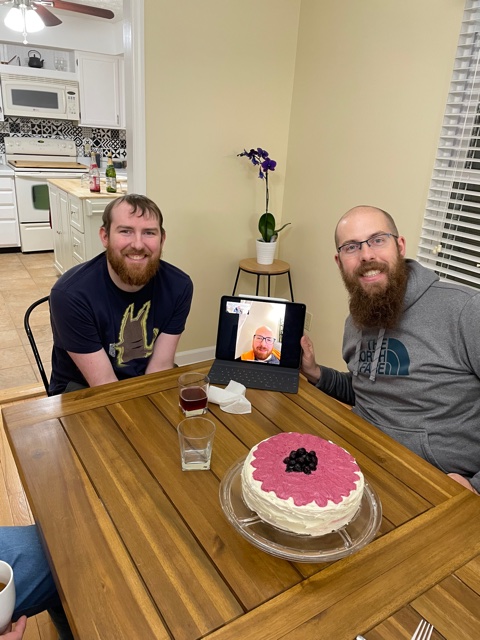
1. Jesse’s 10,000th day. My older sons figured out that my youngest’s 10,000th day was coming up. They suggested we all pitch in to get him 10,000 pennies and have a little surprise get-together to commemorate the occasion. Jason and Mittu invited us for dinner, and we were able to keep the purpose a secret from Jesse.

It was fun to hear Jason tell of the reactions he got at the bank when he asked for so many pennies. He had to go to three different ones. I had no idea they put pennies into $25 bricks like this.

This is Jesse’s “I can’t believe you gave me 10,000 pennies” look.

Mittu made a wonderful dinner of tilapia. I don’t think I’ve ever had it before, or if I did, it was in a pre-flavored frozen brick and not very good. But this was great!

2. Lemon Blueberry Cake. She also made a lemon blueberry cake–a couple of Jesse’s favorite flavors. I thought I’d take a polite very small piece, because I have never had anything with that combination that I liked. But this was so good!

The boys and that gorgeous cake

3. Drawful. This is a favorite game, and the boys figured out a way to use FaceTime and Zoom so we could play it with Jeremy. And I won! 🙂

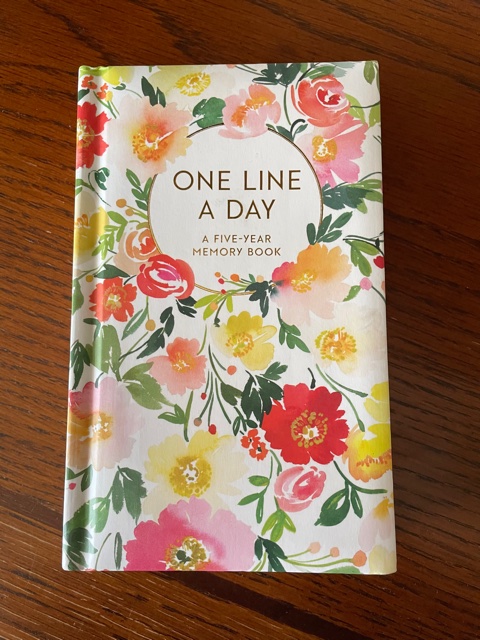
4. A five-year journal. I saw this line-a-day idea at Lisa’s and liked it so much that I ordered one. I have not kept a journal for years beyond what I record here. But I love the thought of just jotting down a line or thought from the day. I just got it, so I have not started on it yet. But I am looking forward to it.

5. Good timing. I was literally just about to leave for the grocery store when my husband brought the mail in, including a coupon for 5% off my entire order at the very store I was going to. And I had a sizable order.

What’s something good from your week?

Book Review: Influence: Building a Platform that Elevates Jesus (Not Me)

In the very first workshop of the very first writer’s conference I attended, the speaker commented that publishing had changed significantly over the past ten years.

He didn’t say how publishing worked before. I assume writers wrote books and sent them in to the publisher, who did the rest. The author would have to fix some things after editors combed over their manuscript. But the publisher would market the book to the waiting world. And that makes sense: the publisher has a much bigger reach than individual authors in their homes.

Now, however, publishers expect authors to do most of the marketing on their own.

One reason is the rise of online book purchasing. Publishers have lost the opportunity to create attractive signs and displays to catch shoppers’ eyes as they browse a bookstore. Many brick and mortar bookstores have closed.

Additional reasons are the success of bloggers with big followings who then publish books and the availability of “influencers” on social media. And though I have not read this, I can’t help but wonder if it’s a cost-cutting measure to significantly reduce a marketing department by having writer’s do their own marketing.

So in these times, one can’t publish a book with a traditional publisher without a significant “platform.” In the blogs and Facebook writer’s groups and Twitter accounts I follow, would-be authors have lamented multiple times that they were told their concept, writing, and style were all good, but they were rejected because their platform wasn’t big enough (as determined by their social media followers and newsletter subscribers). One recent tweet I saw said the writer was told he needed upwards of 20,000 followers. I don’t know if that’s the norm. But all of this is discouraging.

Sure, anyone can self-publish these days. But a self-published book won’t get much beyond family and friends without taking some measure to get it out in front of the public.

All of this puts unknown Christian writers in a quandary. We’re supposed to humble ourselves, not exalt ourselves. We’re not supposed to be self-promotional. Drawing attention to ourselves in that way is distasteful to most of us. And we don’t want to annoy friends by constantly sharing “Buy my book!” posts on social media. So how in the world can we build a platform that publishers require and still maintain a clear conscience and a Christian testimony?

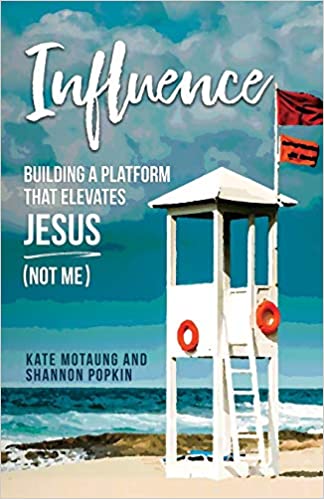
Kate Motaung and Shannon Popkin have wrestled through these issues and shared their conclusions and experiences in Influence: Building a Platform that Elevates Jesus (Not Me). They begin with this helpful analogy: instead of viewing platform like a stage where celebrities seek attention and applause, think instead of a lifeguard’s platform. He’s not there to elevate himself, but to see who needs help and get a life jacket to them. He “puts himself out there” not to be admired, but so those who need help can find him.

As Christian writers, we have a message the world needs. Focusing on serving others will help us maintain the right perspective.

Then there’s the other side of the problem: What if my book is a success? What if my blog post goes viral? How can I guard against getting big-headed and puffed up?

Kate and Shannon acknowledge that praise, attention, “likes,” and such can be addicting. They discuss pride and humility and the biblical foundations necessary for a right perspective.

They also go into envy, comparison, heart motivations, disappointments, dealing with unexpected wrenches thrown into the works. They look at how people in the Bible got their message out.

And they discuss “imposter syndrome”—the feeling that we’re fakes, that we really don’t have anything worthy to say.

The right perspective is to realize and admit that we can’t do it on our own. That we are nothing without Him. That we don’t have anything to say without His enabling. Humility is essential for the people of God. It’s a good thing to think less of ourselves. But it’s not biblical or honoring to the Lord if we doubt His ability to use us for His purposes and His glory (p. 19).

If He has called us to something, He will enable us. He doesn’t want to hide our talents in the ground. He wants us to let our lights shine where they can be seen and point the way to Himself.

There’s no need to shrink yourself down or deflate your gifts. That’s not humility any more than inflating your importance is (p. 77).

Finally, the authors discuss conquering anxiety over our platforms, times to turn down opportunities, and trusting that God is in control over all.

They’re not only grounded in Scripture, but they are transparent about their own struggles.

There are discussion questions at the end of the book for personal use to to facilitate group discussions.

The one thing I wish they had included was a chapter or appendix on practical ways to build a platform. They mention some in passing. But it would have been helpful to have a list and a brief description. No one can do all the things. Each person can only do what resonates with them and works within their time constraints and personality. But such a list might have given some new ideas to try.

Overall I thought this was an excellent book. It’s one I can highly recommend and one I should probably reread once a year or so.

(Sharing with Booknificent, Grace and Truth, InstaEncouragements,
Carol’s Books You Loved)

Book Review: In Between

In Jenny B. Jones YA novel, In Between, 16-year-old Katie Parker finds herself a ward of the state when her mother goes to prison. Her father is out of the picture. Just about the time she gets adjusted to a group home, she’s sent to new foster parents in the small town of In Between, Texas.

But Katie doesn’t want a foster home with strangers. Her foster dad is a pastor, of all things. Katie knows next to nothing about churchy ways. Her first plan of action is to make herself as unappealing as possible so James and Millie Scott will send her back to the group home.

Meanwhile, she has multiple misadventures navigating a new school, avoiding friendship with the near-perfect Frances, who has been assigned to help her, making sense of church, and getting into trouble with her foster grandmother, “Mad Maxine.” She suspects her foster parents are hiding some secret sorrow and determines to find out what it is.

Though light and humorous in tone, the book brings out several deep truths without being preachy or didactic. I enjoyed Katie’s outside-looking-in perspective.

Some of my favorite quotes from the book:

My own mother thought variety in your diet meant eating a different Hot Pocket than you did the night before.

I was gonna read my Bible. I’m sure it’s a great book, but I decided I’d just wait for the movie.

Sometimes Christians are like Shakespeare. It’s English, but a totally different version.

I winced at Katie’s reference to God as “the Big G-man,” but she doesn’t know any better.

I don’t normally read YA (Young Adult) books. But the plot attracted me, it was on a Kindle sale, and I had enjoyed a book or two by Jenny B. Jones before. I enjoyed getting to know Katie and thought Jones did a great job telling her story.

This is the first of five books in the Katie Parker Production series.

(Sharing with Booknificent, Carol’s Books You Loved, Booknificent)

Book Review: Fear and Faith

I was telling a friend recently that I wished we could pray and study the Bible on certain issues like anxiety or anger or being more loving and then have them settled for all time. But some of these issues seem to require a regular (sometimes daily) dose of truth. Fear and Faith: Finding the Peace Your Heart Craves by Trillia J. Newbell is another dose of truth for me.

I was not familiar with Trillia until someone I knew on Twitter kept retweeting her posts. I always liked what she had to say, so I started following her myself. I don’t remember if I discovered this book or had it recommended, but when I saw Trillia’s name, I got it. But then, it’s been sitting on my shelf for a while. I enjoyed her God’s Very Good Idea, a book for children about God’s design for different races and types of people. And then I finally picked up Fear and Faith, going through a chapter on recent Saturday mornings.

Trillia confesses she is one who “struggles with fears regularly and is fighting for faith . . . who firmly believe God is in control and yet still struggles with fear” (pp. 13-14). Exactly! I know God is in control, powerful, wise, loving, and kind. Yet fears and anxieties still come unbidden. Trillia reminds us that we’re not perfect yet, but we’re in a state of continual growth.

Trillia mentions control in almost every chapter. And it’s true, we’re less anxious in situations where we have control and we know what’s coming (or think we do).

The very thing we are holding onto (control) is, ironically, the thing we most need to let go of. As you and I come to understand that our God isn’t ruling as a tyrant but is lovingly guiding and instructing as a Father, we can loosen the tight grip on our lives that produces the bad fruit of fear. This isn’t “Let go and let God.” It’s “Let go, run hard toward your Savior, and learn to trust God” (pp. 16-17).

Trillia spends a chapter each on different kinds of fear: fear of man, fear of the future, fear of tragedy, of not measuring up, of other women, etc. She spends one chapter on “Why We Can Trust God” and another on “The Fear of the Lord”—the right kind of fear we’re supposed to have. One later chapter discusses “When Your Fears Come True”—when God allows the thing we feared or worse.

During our storms, you and I have the same God with us that the disciples had with them; we can trust that He is in the boat. He may or may not calm the storm immediately—we may have to endure great suffering—but He will not leave us (p. 141).

Trillia grounds everything she says on God’s Word. She shares from her experience and that of other women. Her writing is easily readable and relatable.

This is a good resource if you, like me, need regular doses of truth to combat anxiety and fear.

(Sharing with Carole’s Books You Loved, Booknificent, Senior Salon)

What is Success?

What is success in the Bible?

What does the word “success” bring to mind?

Money in the bank—enough to cover bills plus a little extra? A house and two cars? A desired promotion? A vibrant ministry with thousands of followers? Plans that turn out exactly as we wanted?

Sometimes people are smack dab in the center of God’s will, yet their lives don’t appear successful.

But wait—doesn’t God promise success if we follow Him? Doesn’t Joshua 1:8 say:

This Book of the Law shall not depart from your mouth, but you shall meditate on it day and night, so that you may be careful to do according to all that is written in it. For then you will make your way prosperous, and then you will have good success.

And Psalm 1:3 says of the person who meditates on God’s Word day and night:

He is like a tree planted by streams of water that yields its fruit in its season, and its leaf does not wither. In all that he does, he prospers.

And Proverbs 3:3-4 says:

Let not steadfast love and faithfulness forsake you; bind them around your neck; write them on the tablet of your heart. So you will find favor and good success in the sight of God and man.

The very next verses in Proverbs 3 are the more well known, but we usually take them out of context:

Trust in the Lord with all your heart, and do not lean on your own understanding. In all  your ways acknowledge him, and he will make straight your paths. Be not wise in your own eyes; fear the Lord, and turn away from evil (verses 5-7).

Look at John the Baptist. He had faithfully preached and prepared the way of the Messiah. He pointed others to the Lamb of God, not caring that he lost “followers” to Jesus. But he spent his last years in prison and then was beheaded by an evil ruler.

After God gave Jeremiah the message He wanted him to share with the people, God said, “So you shall speak all these words to them, but they will not listen to you. You shall call to them, but they will not answer you” (Jeremiah 7:27).

When Elisabeth Elliot went to the mission field, she had every expectation that God would bless her work and that of other missionaries “in beautiful, demonstrable ways.”

Her words sounded naive. After all, she’d read missionary biographies; she knew the stories of men and women who had lost their lives, like John and Betty Stam, or lost their health, or lost their minds, in service of Christ. She was ready to pay any price to be obedient to His leading.

But, like many, she believed that God would surely take her sacrifices and make them into successes for His sake . . . glorious victories that human beings could see, that could be reported to supporters back home, bringing glory to God (Ellen Vaughn, Becoming Elisabeth Elliot, pp 100-101).

Instead, during this period in her life, Elisabeth lost a vital coworker to murder, the results of several months of linguistic study to theft, her husband and four colleagues to spears from the very tribe they were trying to reach, and the ministry she thought God had been preparing her for to relationship issues.

Elisabeth titled the book about this period of life These Strange Ashes, words taken from an Amy Carmichael poem which begins:

But these strange ashes, Lord, this nothingness,
This baffling sense of loss?

For many years, people often asked Elisabeth “if the men’s mission on Palm Beach was a ‘success.'”

To her, the only measure of any human action came down to one thing: obedience. She’d look at an interviewer as if the “success” question was dull. Yes, yes, of course. After all, they knew God wanted them to go to the tribe, and they were obedient to His leading (Vaughn, p. 259).

Vaughn goes on to say that “If ‘success’ is defined not by obedience, but by measurable outcomes, then we’ve got to get into metrics” (p. 259)—how many people were saved or called to service, and how many people the men reached as opposed to what the men might have accomplished had they lived, etc. But we can never know those things. And God doesn’t always measure success in numbers.

Elisabeth wrote:

I believe with all my heart that God’s story has a happy ending. . . . But not yet, not necessarily yet. It takes faith to hold onto that in the face of the great burden of experience, which seems to prove otherwise. What God means by happiness and goodness is a far higher thing than we can conceive (Vaughn, p. 260).

Success, basically, is doing the will of God and leaving the results to Him..

Sometimes He brings about visible results. Sometimes He turns things around, like He did for Joseph, who was the favorite son, then sold into slavery, then falsely accused and imprisoned before becoming Pharaoh’s right-hand man and saving nations from starvation. Elisabeth went on to have a long and fruitful writing and speaking ministry, made all the richer and deeper by what she went through in her early adult life. A strong group of believers grew up among the tribe she worked with her husband died for, the Waodani, with a world-wide witness despite human foibles.

Sometimes the visible outcome doesn’t occur in this life. Lazarus–not the one whom Jesus raised from the dead—was a neglected beggar at the gate of a rich man. Things weren’t set “right” in his life til he went to “Abraham’s side” and was comforted. Poor, loyal Uriah, who was so faithful that he wouldn’t enjoy the pleasures of home while the king’s soldiers were in battle, was sent to the forefront of the battle to be killed off by the king who impregnated his wife.

Hebrews 11 tells wonderful success stories of those “who through faith conquered kingdoms, enforced justice, obtained promises, stopped the mouths of lions, quenched the power of fire, escaped the edge of the sword, were made strong out of weakness, became mighty in war, put foreign armies to flight. Women received back their dead by resurrection” (verses 33-35). However, “Some were tortured, refusing to accept release, so that they might rise again to a better life. Others suffered mocking and flogging, and even chains and imprisonment. They were stoned, they were sawn in two, they were killed with the sword. They went about in skins of sheep and goats, destitute, afflicted, mistreated—of whom the world was not worthy—wandering about in deserts and mountains, and in dens and caves of the earth” (verses 35-38). Yet they were all “commended through their faith” (verse 39).

For this light momentary affliction is preparing for us an eternal weight of glory beyond all comparison” (2 Corinthians 7:14).

The ultimate example of what looked like failure from a human standpoint is the life and death of Jesus

His life on earth had a most inauspicious beginning. There was the scandal of the virgin birth, the humiliation of the stable, the announcement not to village officials but to uncouth shepherds. A baby was born – a Savior and King – but hundreds of babies were murdered because of Him. His public ministry, surely no tour of triumph, no thundering success story, led not to stardom but to crucifixion. Multitudes followed Him, but most of them wanted what they could get out of Him and in the end all His disciples fled. Yet out of this seeming weakness and failure, out of His very humbling to death, what exaltation and what glory (Elisabeth Elliot, These Strange Ashes, p. 145).

The seeming failure was not a failure at all. Christ’s death accomplished salvation for all who will believe in Him.

Therefore, if anyone is in Christ, he is a new creation. The old has passed away; behold, the new has come. All this is from God, who through Christ reconciled us to himself and gave us the ministry of reconciliation; that is, in Christ God was reconciling the world to himself, not counting their trespasses against them, and entrusting to us the message of reconciliation. Therefore, we are ambassadors for Christ, God making his appeal through us. We implore you on behalf of Christ, be reconciled to God. For our sake he made him to be sin who knew no sin, so that in him we might become the righteousness of God. (2 Corinthians 5:17-21).

So those verses in Joshua and Psalms and other places about success are true. God does grant success to those who meditate on His Word and walk with Him. The circumstances may or may not look successful. If things seem to be going wrong, it’s good to pray and examine our hearts and actions for sin, for blind spots, for better ways to do things. But otherwise, we can leave the results to God.

The success Psalm 1 promises is that our “leaf does not wither.” We won’t “dry up” spiritually. God will continue to give grace and strength, no matter the circumstances.

But sometimes we look at outcomes in this life, seeking the reassurance of a happy ending, and it’s just not there. What then? As Betty put it, His ways are “inscrutable.” So we have to rest, not in the peace of a pretty story, but in the reality of faith in a Person we cannot see (Vaughn, p. 245).

Psalm 1:3

(Sharing with Sunday Scripture Blessings, Selah, Scripture and a Snapshot,
Hearth and Soul, Inspire Me Monday, Senior Salon, Remember Me Monday,
Tell His Story, InstaEncouragements, Let’s Have Coffee, Recharge Wednesday,
Share a Link Wednesday, Heart Encouragement, Grace and Truth.
Linking does not imply 100% agreement.)


Laudable Linkage

A collection of good reading online

Here is a short but thought-provoking list of reads discovered this week.

Be Reasonable for the Sake of the Gospel. “Hyperbole seems to be the rhetorical strategy of the day in Christian circles. In comment boxes, imprecise language and thinking, haphazard arguments based on fallacy, and all kinds of claims about what Satan is doing often taint an otherwise helpful, measured post.” I’ve noticed this, too.

5 Common Mistakes to Avoid When Studying the Bible. “When we pick and choose verses from Scripture aimed merely at lifting our spirits when we’re feeling down, we run the risk of reducing the Bible to a self-help manual.”

Infographic: You Have More Time for Bible Reading Than You Think. Interesting graphics that show how much time it takes to read different parts of the Bible and how much time we spend in other pursuits.

The Tyranny of Tech and Trans, HT to Challies. Alarming on many levels.

I’ve heard a bit about the guarding of the Tomb of the Unknown Soldier, but not as much as is shown here. I so appreciate the respect shown.

If a bear came where I was sitting, I don’t know if I could calmly sit still. But that’s probably the best thing to do.

Happy Saturday!