Book Review on Grandparenting

As I mother, I felt compelled to read every Christian book on parenting I could find. I was the chief babysitter for my five younger siblings (my youngest sister was born when I was 17), so I wasn’t inexperienced with children. But the responsibility of having my own weighed on me heavily. I didn’t feel I knew what I was doing, and I didn’t want to ruin them for life.

I haven’t felt quite as compelled as a grandparent. Perhaps having a supporting rather than a major role relieves some of the pressure. Maybe I’ve grown in the Lord and in following His guidance enough now that, even though I haven’t arrived and am not perfect in any category, I don’t feel I need to find a book for every issue (though I do still read a lot). And much of grandparenting seems common sense on top of the same love and courtesy shown to one’s own children.

The first two books I did read by grandparents to grandparents were major disappointments—not the grandparenting advice, but the theological basis of the authors.

But Michele‘s review of There’s a Reason They Call It GRANDparenting by Michele Howe encouraged me to get this book.
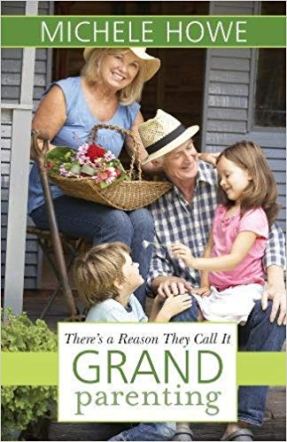
Howe’s premise is that there’s a difference between everyday grandparents and grandparents:

Becoming a grandparent is living with eternity in mind—all the time. It means going the extra mile (or more, many more) for the sake of your grandchildren. It will entail sacrifice of every sort. Time. Money. Energy. Sleep. But every sort of giving up and giving away the best of what we have and are is all good . . . in the light of eternity.

Grandparenting is all about bending the knee before our Lord Jesus Christ and asking him for our marching orders. Then we get up from our knees and get busy loving our grandchildren in ways they will remember, value, and appreciate (p. 2).

Grace upon grace. Unconditional love. Total acceptance. Open arms. These are only a few of the attitudes and actions that make grandparents so different from folks who assume a casual role as a grandparent. Which would you rather be: a seemingly insignificant bystander who shows up now and then with a gift but with two closed fists that demand affection from the grandchildren before letting go of the goods; or someone who views every opportunity to interact with grandchildren as having potential eternal impact and takes their love as it comes, without offense? (p. 45).

Howe reminds us that our empty nest years are not about finally having “me time.” We never retire from being a godly influence, especially to our own family.

She highlights the primary roles of prayer, seeking guidance from God, and following the parents’ lead and preferences.

She shares numerous tips and truths. Just a few:

  • Hospitality is not just something we exercise towards those outside our families. We make time and place for our adult children and their families as well.
  • Grandparenting is not about spoiling or over-indulging.
  • We can provide a safe haven when parents fail, as in cases of drug addiction and abuse. Grandparents provide tough love and step in to call authorities in these cases if need be.
  • We need to remember each child is unique.
  • We can make special memories and teaching opportunities out of everyday occasions and tasks.
  • Though sometimes we need to exercise authority, “I never need to yell, demean, or demand. Rather, I can use gentle but firm words to steer them toward making good choices” (p. 29).

Each chapter is only about four pages long and ends with a “take-away action thought,” a prayer, and a few “grand ideas” for how to implement the concepts from that chapter. The thirty chapters could be read one a day over a month, but they’re short enough to read more if desired. I generally read two in one sitting.

To be totally honest, the grandparenting vs. grandparenting repetition became a little wearing after a while. On the other hand, that was probably the most succinct way to make the distinction between casual, aloof, or insensitive grandparents and involved, attentive, spiritually-minded grandparents.

Though I don’t think I learned anything earth-shatteringly new from this book, the gentle nudges, thoughtful reminders, and spiritual focus were all helpful. I’d recommend this book for any stage of grandparenting, perhaps even as a gift to new or upcoming grandparents.

(Sharing with Booknificent, Faith ‘n Friends, Literary Musing Monday,
Carole’s Books You Loved)

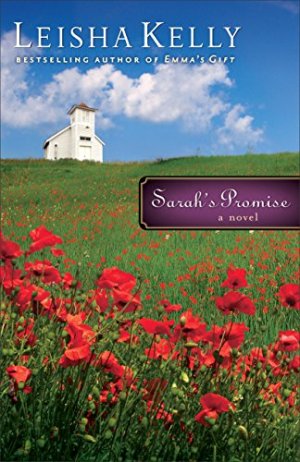
Two Book Reviews: Rachel’s Prayer and Sarah’s Promise

Leisha Kelly’s books about the Wortham family take them from the Depression through WWII. Since I finished the last two within a couple of days of each other, I decided to review them together.

In Rachel’s Prayer, WWII is in full force. Several from the Worthams’ Southern Illinois area enlisted, including Robert, the Worthams’ only son, and three of the next-door Hammond boys. Frank Hammond desperately wanted to, but his limp and inability to read kept him out of the service.

The Hammond’s father, George, handles his sons’ leaving like he handles everything else: by not handling it and withdrawing. He has not handled life well since the first books, but he took a downward turn when his wife died, leaving him with ten children. Throughout this book the family begins to think it’s not just drinking and laziness that affect George. There’s something fundamentally wrong with his thinking. He would probably be diagnosed with depression today.

Rachel is Robert’s girlfriend, and his sister and parents are getting used to the idea that he’s grown up and will probably propose once he gets back home.

With that many young men going off to war, it’s inevitable that some won’t come back and some will come back changed. The folks at home deal with uncertainty and sorrow not only across the sea, but in their own neighborhoods.

But even though there are sad parts to this book, God works through the sadness to strengthen and draw people closer to Himself. Ultimately Sarah finds it good to “to let my future, my heart, and his, rest where he said they belonged: in the hands of God. No other hands could be so capable. None could be more generous, more able to give peace in trials, strength in despair, and understanding in the midst of a confusing world.”

In Sarah’s Promise, Sarah Wortham and Franky Hammond are engaged. Frank is about to leave on a 200-mile journey to help his brother move. Folks are worried because Frank can’t read and the winter weather is iffy. But Frank has a good memory, and his brother has drawn a map and told him the succession of towns he’ll need to pass through.

Everyone assumes Frank will continue on doing wordwork with Sarah’s father. Sarah would like nothing better than to live nearby to the only home she’s ever known. But Frank wants to prove himself. All his life he’s dealt with not only being unable to read, despite desperately wanting to, but also with being thought “different.” Frank tends to think deeply to the point that he’s unaware of what’s going on around him, causing his siblings and especially his father to accuse him of being addle-brained and unable to function without supervision. Frank would love the opportunity to work on his own and provide for Sarah without the safety net of their families, which scares Sarah to death.

While Frank is away, he and Sarah both have praying to do, trials to undergo; lessons to learn. One of the most beautiful parts of the book I can’t share much about without spoiling the climax, but my heart was so touched by a pastor’s ministry to Frank when he was at his lowest, when all his father’s verbal abuse made him think he couldn’t accomplish anything.

I dearly loved all of these books. Leisha had such a skill in bringing us right into the characters’ circumstances and emotions and weaving spiritual truth into the fabric of her stories. I was sad to learn, as I mentioned in a previous review, that she and her teenage son had passed away a few years ago in a car accident. I’m sad for her family but also for readers.

I wanted to list the first four books as well, linked back to my reviews:

  1. Julia’s Hope introduces us to the Worthams, a family at their lowest point that has lost everything in the Depression. They come to an abandoned house and offer to fix it up in exchange for living there, eventually allowing the elderly owner to come back home as well.
  2. Emma’s Gift. Emma, the elderly lady from the first book, dies, as does her neighbor, Mrs. Hammond, mother of ten. The Hammonds and Worthams are not only devastated, but uncertain of their future, as Emma owned the property they all live on.
  3. Katie’s Dream. Sam Wortham’s ne-er-do-well brother brings a young girl and a convincing story that she belongs to Sam. But Sam has never been unfaithful. Why is his brother doing this? Will the town, and most importantly, his wife, believe him? And what do they do about the little girl?
  4. Rorey’s Secret. Rorey, the oldest Hammond daughter, has gotten in with a bad crowd. When a fire starts in the family’s barn, causing serious damage and injuring Mr. Wortham and Bert Hammond, Frank is blamed. He’s innocent but won’t cast the blame on anyone else. Rorey knows the truth, but will she share it?

The last three books are technically the Country Road Chronicles, but they timeline continues through all six. Each could be read as a stand-alone book, but I’d recommend reading them all in order. There’s a Christmas story in the series as well that I haven’t read yet: I’ll save it for December.

I’m going to sorely miss the Worthams and Leisha.

(Sharing with Carole’s Books You Loved, Booknificent)

Forsaking Thoughts

Saturday morning I was arrested by a phrase in Seasons of the Heart, compiled by Donna Kelderman. One sentence of the day’s selection, written by Frances Ridley Havergal, said, “Oh, forsake the thoughts as well as the way, and return unto the Lord, and He will abundantly pardon.”

I’m sure the inspiration for her comment came from Isaiah 55:7: “Let the wicked forsake his way, and the unrighteous man his thoughts: and let him return unto the LORD, and he will have mercy upon him; and to our God, for he will abundantly pardon.”

I’d read this verse before, several times. It and other passages talk about managing our thoughts, so the idea wasn’t new to me. But perhaps because the wording was rearranged just a bit, that idea of forsaking certain thoughts stood out. It’s not enough to forsake a certain sin if we’re still thinking about it all the time. And some thoughts in themselves are sins (lust, pride, etc.). We need to forsake sinful thoughts as well as sinful ways.

But how can we forsake thoughts when they spill into our minds unbidden? We might not want to think them, but we can’t seem to get away from them.

First, we need to pray. Something I sometimes pray is  Psalm 19:14: “Let the words of my mouth and the meditation of my heart be acceptable in your sight, O LORD, my rock and my redeemer.

Then, we can change our thoughts.

In How to Say No to a Stubborn Habit, Erwin Lutzer said that if someone told you to stop thinking about the number 8, suddenly that’s all you can think of. What to do then? Think of other numbers, do equations, arrange them in different orders, etc.

The best way to get rid of one thought is to replace it with another. Instead of passively being at the mercy of whatever thoughts assail us, we can actively think about profitable things. We can take our thoughts captive (2 Corinthians 10:5).

David Martyn-Lloyd Jones put it this way in Spiritual Depression:

Have you realized that most of your unhappiness in life is due to the fact that you are listening to yourself instead of talking to yourself? Take those thoughts that come to you the moment you wake up in the morning. You have not originated them but they are talking to you, they bring back the problems of yesterday, etc. Somebody is talking. Who is talking to you? Your self is talking to you. Now this man’s treatment [in Psalm 42] was this: instead of allowing this self to talk to him, he starts talking to himself. “Why art thou cast down, O my soul?” he asks. His soul had been depressing him, crushing him. So he stands up and says, “Self, listen for moment, I will speak to you.”

So what can we say to our souls?

We can turn our thoughts to anything active, really: planning our next week, what we’re going to serve at the next church fellowship, how to rearrange the desk or living room, etc.

But the best thoughts to turn to are God’s. After the verse about forsaking wicked or unrighteous thoughts and ways in Isaiah 55, God goes on to say His thoughts are higher than ours. Romans 12:2 says “Do not be conformed to this world, but be transformed by the renewal of your mind, that by testing you may discern what is the will of God, what is good and acceptable and perfect.”

Sometimes in an urgent situation, singing a hymn (either out loud or to ourselves) helps in a couple of ways. First, it turns our thoughts to God’s truths. Then, once we start a well-known song, our minds want to finish it out. This has helped me a lot in times of anxiety. There was a period of time where I was often plagued by negative, almost blasphemous thoughts about God. I didn’t believe them. I was quite distressed, unsure where they were coming from. Finally I decided every time such a thought would begin, I’d start singing a hymn of praise to God. If it was Satan suggesting these thoughts, I guess he got tired of it after awhile when his efforts just led to more praise to God.

Either reading or remembering Scripture helps us center our thoughts on God’s. The more we read and memorize, the more the Holy Spirit can “teach you all things and bring to your remembrance all that I have said to you” (John 14:26). If we’re wrestling with a particular temptation—lust, pride, gluttony, etc.—it helps to look up verses to combat those, list some to have them ready, and start memorizing them.

Then, it helps to concentrate on the positive and not just the negative, what we can do instead of what we can’t, doing rather than don’t-ing. 2 Timothy 2:22 says, “So flee youthful passions, and pursue righteousness, faith, love, and peace, along with those who call on the Lord from a pure heart.” Colossians 3 tells us to put off some things—immorality, evil desire, covetousness, anger, wrath, malice, slander, obscenity, lying—and put on other things like humility, forgiveness, kindness, patience, love, compassion.

Just trying to stop thinking about what we can’t do is like trying to stop thinking about the number 8. Not only will our minds keep trying to go there, but we’ll be discontent. But if we focus on what we’re supposed to be doing instead, we’ll have enough to keep us busy for a long time.

How about you? What ways have you found to forsake wrong thoughts?

(Sharing with Inspire Me Monday, Global Blogging, Kingdom Bloggers, Tell His Story, Purposeful Faith, Hearth and Soul, Happy Now, Tea and Word, InstaEncouragement, Anchored Abode, Let’s Have Coffee, Worth Beyond Rubies, Recharge Wednesday,
Share a Link Wednesday, HeartEncouragement, Destination Inspiration, Faith on Fire, Grace and Truth, Faith ‘n Friends)

Laudable Linkage

IMG_0195

I found a lot of good reading this week, so I have a little longer list than usual. I hope you find something edifying here.

How to Fall . . . Again. HT to Challies. “You may have some obvious boundaries in place to keep you from the explicit routes back to your old sins. But there are some ways your new life might make you vulnerable to new sins. The devil is cunning and is perfectly willing to cut you in the left side while you protect your right. How might this happen? What are some ways you might fall again?”

What If the Worst Comes to Pass? Developing a What If Theology, HT to Challies.. Dealing with anxiety by facing the “what ifs” full on rather than hiding from them.

From Gay to Gospel: The Fascinating Story of Becket Cook, HT to Challies. Moving testimony.

6 Powerful Keys To Overcoming Anger, HT to Challies. “What is it that I want right now that I’m not getting? This question has changed my life. This question has helped me again and again to overcome the temptation to anger in my life. I try to ask myself this question when I’m tempted to be angry. What is it I want right now that I’m not getting?”

4 Ways to Grow in Self-Control, HT to Challies. “Self-control is one of the biggest indicators of Christian character. Without it, you’ll eventually ruin your life and legacy. With it, you can thrive and be a blessing to others around you. You’re probably convinced of the need for self-control. But how do you get it?”

Aspire to Live Quietly, HT to Challies.. “Be honest, do you love the conflict? Do you love the argument? If so, be insignificant on social media and preserve your soul. For what use is it to you if you gain all the world’s likes but lose your soul?”

Prime Prayer Attitude. Has Amazon prime affected our praying? Do we expect the answer at our front door in two days or free returns if we don’t like what we get?

Friend, What’s Your Name? Learning how to make friends from a child’s example.

No Pang Shall Be Mine? HT to Challies. Being a Christian doesn’t necessarily make for an easy death. Death is still the final enemy.

Was Jesus a Person of Color? An Immigrant? A Palestinian? HT to Challies. “Jesus should not be a political pawn whose identity shifts to match whatever the political cause is of the day. It is better for us to orient our lives around him than him around our politics.”

A Sad Tale of a Wealthy Millennial’s Moral Confusion, HT to Challies. I am coming across this idea more and more that wealth is immoral. I’ve toyed with the idea of writing a post about it, but this says almost everything I would want to.

The Deepfake Artists Must be Stopped, HT to Challies. This is disturbing. People have found ways to copy a person’s voice to make fake recordings of them saying and doing whatever the creator wants.

Creating a Bible Study Notebook. The ladies at Do Not Depart have been discussing this topic all month and share some free printables.

Downton Abbey Cast Reverses Roles, HT to Laura. Fun!

Finally, I stumbled across this and really enjoyed it. Some of you may remember Jim Varney’s Ernie or Ernest character. I had no idea that Varney was a trained classical actor. It was also interesting seeing how Ernest got started. I think this must have aired before some of his later movies, since it doesn’t reference them.

Friday’s Fave Five

It’s Friday, time to look back over the blessings of the week
with Susanne and other friends at Living to Tell the Story .

We finished out our family stay-cation last week with some more games before my oldest son headed back to his home. Then we crashed for the rest of the weekend. 🙂 It never gets any easier to say good-bye, but we look forward to the next visit at Christmastime. Meanwhile, here are some of the best parts of the last week.

1. Homemade cheesecake and compote. One of Jeremy’s birthday gifts was a set of two stacking pans that go in the Instant Pot in order to cook two different things at once. Something was said about cheesecake, so he put together a recipe from two he found and made them in his new pans in our Instant Pot. Then he made two different compotes, one with strawberries and one with blueberries. We had some chocolate syrup on hand for those who’d rather have that. So good! Jim used some of the leftover blueberry compote on pancakes and I think Mittu said she poured some over ice cream.

2. Laptop repair. My laptop had been having issues for a while, so I asked Jeremy to look at it while he was here. After trying different things, with nothing working, we copied my files there onto a flash drive and had to reset the whole computer to its initial factory specifications. Jesse finished doing what needed to be done after Jeremy had to leave. It’s working much better now than it has in ages. I’m thankful and happy they were able and willing to work on it.

3. A successful school beginning. Timothy started kindergarten through an online home school program this week. He’s been eager and excited and responding well. Jason and Mittu have had several confirmations that this is the right path for now.

4. Meals brought over. Mittu made several meals for a friend whose husband was in an accident, but then discovered the family did not want any visitors. All but one of the meals contained gluten, which Mittu and Timothy can’t eat. So they brought three of them over here. You know I always appreciate time off from the kitchen. But with getting back into the routine after the family stay-cation last week, it’s been especially helpful.

5. Lunch with a friend and free pie! A friend and I had had to cancel plans to get together a few times in a row. We finally made it to lunch this week. We took advantage of O’Charley’s Free Pie Wednesday. I had a half club sandwich and the loaded potato soup (I brought home half of each) and the French Silk pie–sooo good. I had not been to O’Charley’s in years, so it was nice to get reacquainted with them. But the best part was visiting together and catching up.

And that’s it for the last week of August! September means fall is coming soon—and cooler temperatures!

End-of-August Musings

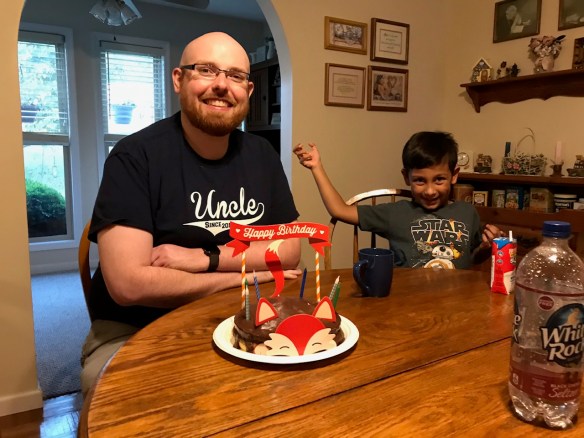
August is a full month for us with an anniversary (my son and daughter-in-law’s 10th this year) and two birthdays (my oldest son’s and mine). My oldest son came to visit for a week or so to cerebrate both our birthdays. Jim took the week off as well. Jesse is in-between finishing school and finding a job, so I’m not sure what future Augusts will look like. I hope he’ll be able to find a job locally or at least close enough to visit for those occasions. But we’ll see what happens then and just enjoy having everyone together now.

We didn’t have any major outings this time—just to a restaurant for my birthday and to an arcade/bowling/and other activities place for their Monday night specials. We enjoyed a lot of time talking and playing games.

Other than “birthday week” and getting ready for it, August was a fairly quiet month. Thankfully the trend of mishaps from last month did not continue!

Here are some of the things we’ve been into this month:

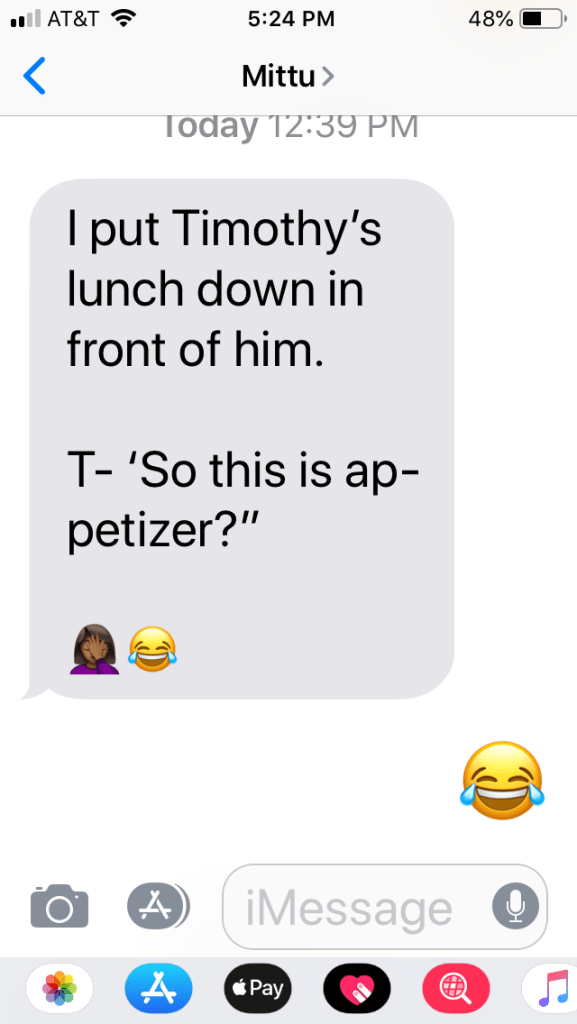
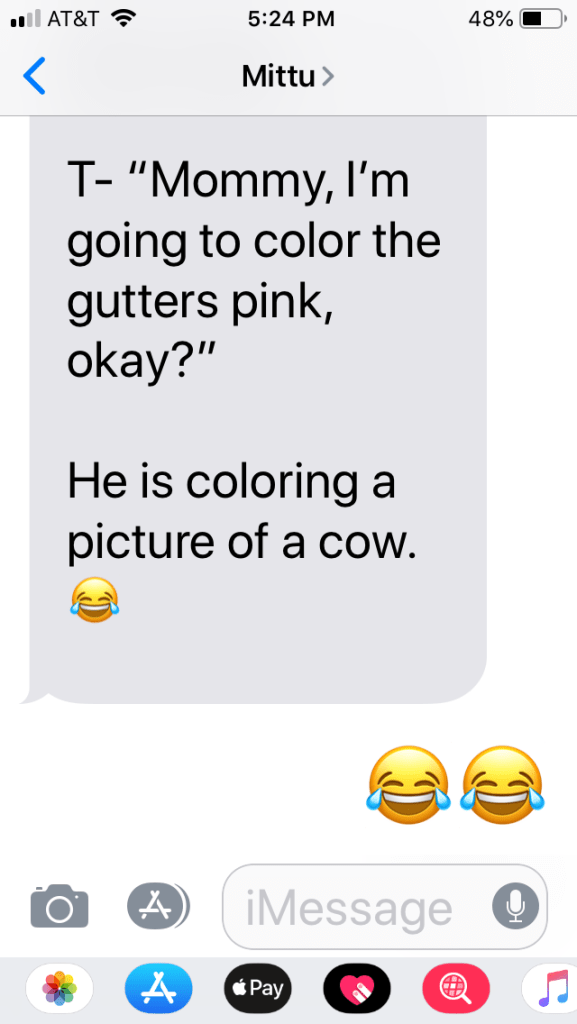
Timothyisms:

A couple of texts from my daughter-in-law about my grandson’s sayings:

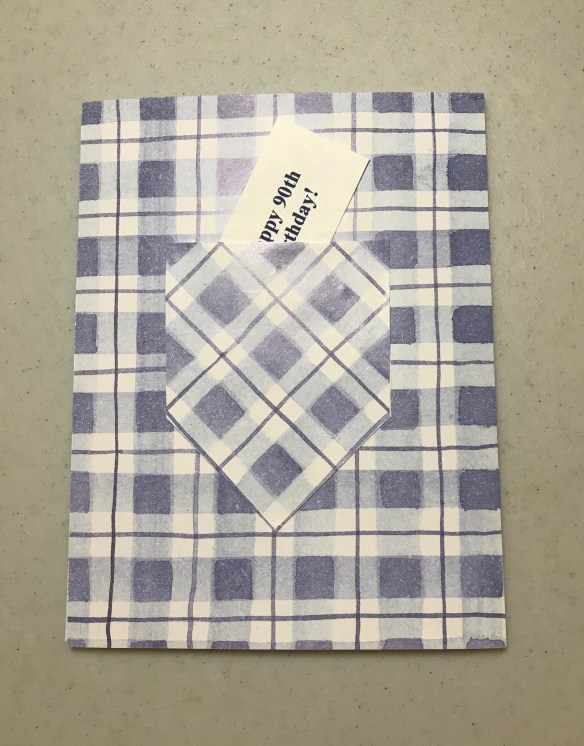
Creating:

This card was for Jason and Mittu’s anniversary:

This was for Jeremy’s birthday:

The dimensions look a little wonky because it’s partially open.

This is for a beloved former pastor who turns 90 this weekend. I’m taking a risk showing this one because it hasn’t gotten to him yet—but I don’t think he reads this blog, so hopefully it will be ok. 🙂

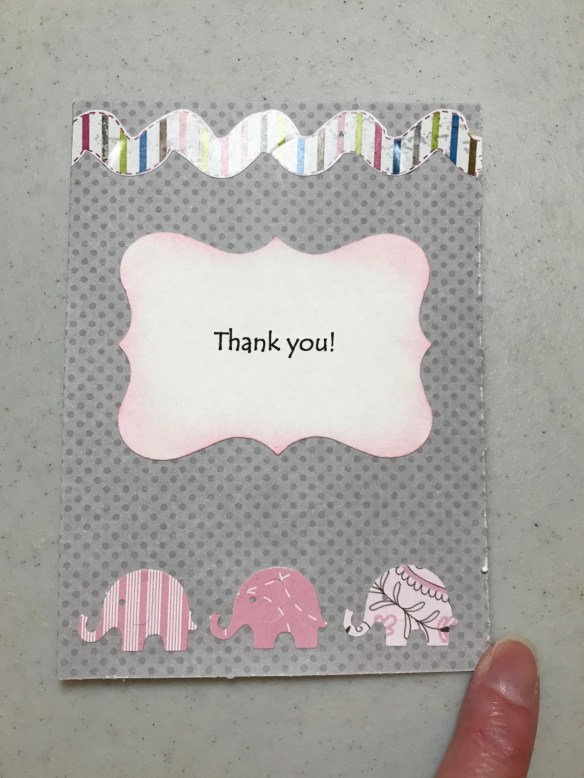
This is for my pastor’s wife. There’s a story behind it. When she asked how my book-in-progress was going, I told her I’d had some good sessions, and bit by bit it would get done. She told me her husband always says any big task is like eating an elephant—one bite at a time. Later she gave me a little pink elephant to encourage me to keep taking those small “bites” til the task is completed. Thus the pink elephants on the card, made with a little hole-punch. 🙂

I wasn’t quite satisfied with a couple of these—but maybe if I don’t point out the mistakes, you won’t notice them. 🙂

Watching:

Jesse and I usually watch something with lunch and finished the Netflix remake of Lost In Space yesterday. It was pretty intense! But very well done. It had just a couple of bad words in it. Now we have to figure out what to start next. Any suggestions?

I also started watching When Calls the Heart, the Hallmark series based on Janette Oke’s books, while riding my exercise bike. It’s been so long since I’ve read the books, I have forgotten a lot about them. But that’s probably a good thing, or else I’d be constatntly comparing them

I mentioned on a couple of Friday’s Fave Five posts that we watched Lady and the Tramp and I Can Only Imagine together. I watched Savings Mr. Banks  and The Case for Christ while exercising before starting When Calls the Heart.

Sometimes I hate to mention shows because right after I do, they’ll have something bad on them. I’m usually wary of any kind of comedian shows on TV because they almost always contain something objectionable. One night Bring the Funny, a comedian competition show, was on, so I gave it a try. It was pretty good! And clean! I haven’t watched all the episodes, so I can’t vouch for all of them, but I hope they keep it clean.

Reading:

I’ve completed this month:

  • 84, Charing Cross Road by Helene Hanff , a collection of notes between Helene and the employees of a used book store in London, especially a Frank Doel. Though it wasn’t exactly what I was expecting at first, it was enjoyable to watch the correspondence change from strictly business notes to more personal exchanges as friendships developed.
  • Kill Order by Adam Blumer, a novel about a man whose doctor inserted an implant in his brain during surgery, and now someone else is controlling his actions. I also interviewed Adam and his book and writing here.

Those of you who know me well know that’s a low number of completed books for me! I’ve been making steady progress on some others, which will probably all get done at the same time. 🙂 I’m currently reading:

  • Anna Karenina by Leo Tolstoy
  • There’s a Reason They Call It GRANDparenting by Michele Howe
  • Rachel’s Prayer by Leisha Kelly
  • Loving People: How to Love and Be Loved by John Townsend

Blogging:

Some of the blog posts from this month:

  • Examine Yourselves to See Whether You Are in the Faith. With a couple of well-known professing Christians no longer professing recently, it behooves all of us to make sure of where we stand with the Lord and not take for granted we’re Christians because we grew up in that atmosphere.
  • Prayer: Talking With Our Father. What the Bible says about prayer, bringing it to the main point that it’s not a ritual we perform: it’s talking with the One who loves us best.
  • Biblical Prayers. Kind of a sequel to the previous one, I listed a few prayers from the Bible that we could pray as is or in our own words today.
  • When Interruptions ARE the Ministry. God often works through interruptions, in the Bible and in our lives.
  • Don’t Stop Preaching to the Choir. This was inspired by Christian writers who want to leave off writing Christian books to write for the general market, but its truths would apply to anyone who works primarily with Christians. Don’t stop “preaching to the choir,” because the choir still needs it.

Writing:

I didn’t work on my book during our “stay-cation,” but before that I had some good sessions. This is the first day in a long while I’ve had the whole day open, so I hope to get back at it. And I had a sudden flood of ideas for a couple of other books that I’m excited about and can’t wait to get to.

And that about wraps up August, though I’ll still have a Friday’s Fave Five and Laudable Linkage post before the month is officially done.

Our August has been joyful, but I know some have had a trying or sorrowful month. I pray for God’s grace for you, whatever He brings you through.

(Sharing with Linda, Grace and Truth, Faith ‘n Friends, Global Blogging, Hearth and Soul, Happy Now, InstaEncouragement, Shannan’s What I’m Into, Worth Beyond Rubies, Literary Musing Monday)


Book Review: Kill Order

In Adam Blumer‘s new novel, Kill Order, Landon Jeffers is an award-winning pianist diagnosed with brain cancer. After his doctors removed as much of the tumor as they could, they inserted an implant into his brain to continue to fight the remaining cancer.

But that’s not all they inserted.

Landon is recovering from surgery at his mother’s house when he starts having vivid partial memories of a couple of incidents in his childhood. As he tries to unravel what really happened, he also starts having strange dreams. In one, he stole an item from his mother’s neighbor. When he wakes up, he finds evidence that he really did commit the crime.

Then he wakes up one morning with blood on his clothes. As he turns himself in to the police, he learns he can’t be sure whom to trust. He has to find a way to escape whoever’s controlling him.

Adam keeps readers on the edge of their seats. Bits of humor are sprinkled throughout at just the right moments. Landon is not a Christian, but his mother and childhood friend both are, so there is some tension along those lines as well.

Adam had pledged to his readers that he will keep his novels clean. There are no swear words or sexual scenes here.

Adam also makes his books distinctively Christian. I’ve read too many books that are “Christian lite” or that are Christian in name only. I like to see Christian people doing Christian things in Christian fiction, seeking God’s will as they wrestle with issues. I loved how Adam’s characters developed spiritually.

Kill Order is a highly enjoyable, highly recommended book.

I interviewed Adam last week about what sparked the idea behind Kill Order, how he got started writing, and other topics here.

There are a few days left in the contest for to win a signed paperback copy of Kill Order here. Or you can find Adam’s book on Amazon, Barnes and Noble, or Lighthouse Publishing of the Carolinas. At the time of this writing, the Kindle version is only $2.99.

Here is a trailer for the book:

(Sharing with Carole’s Books You Loved, Booknificent)

Don’t Stop Preaching to the Choir

You’re likely familiar with the phrase “preaching to the choir.” It comes up when one person is holding forth on some topic, and another responds, “Well, Bud, you’re preaching to the choir,”  meaning, “I know what you’re saying and I agree with you.” The choir, behind the pastor both literally and figuratively, are probably the most familiar with what he has to say and the most in agreement with it.

I’ve seen Christian authors use this phrase to describe their desire to write for the general market rather than the Christian one. Why keep writing to people who are already believers, who already agree with what we’re saying, when we can use our words to help influence an unbeliever towards Christ?

Writing as a light to the lost is a worthy goal. Yet I wonder just how “general market” one can be and still have any light shine through. One author friend was told by two Christian publishing industry professionals that he’d have more success if he wrote for the general market and took the Christian content out of his latest manuscript. But how can one have any kind of Christian witness without Christian content? Perhaps the idea that readers will like a general book so much that they’ll look up the author, find out he or she is a Christian, and seek to know more about their faith. Or an author might write a few books in both markets, and fans from one will seek out the other.

Some do manage to share Christian truth even in general market books. Jan Karon’s Mitford books share an amazing amount of truth even though they’re not marketed as Christian fiction. Perhaps unbelievers accept her Christian content because her main character is a minister. Or perhaps her stories are just so enjoyable, people who don’t like the Christian aspect are willing to overlook it. C. S. Lewis’s Narnia tales are marketed as children’s books or fantasy, yet they have a Christian undertone veiled by symbolism. One trouble with that veil, though, is that some readers interpret meanings in vastly different ways than the author intended.

What happens with a lot of crossover fiction is that Christians complain that there is not enough Christian content while non-Christians complain that there is too much. One post cited criticism by non-Christians as one reason to remove Christian content from fiction. But some non-Christians will always object to any Christianity in a book, no matter how winsomely it’s expressed. Jesus said the world would hate the Christian message and its messengers. In the past, when a majority of American society had a somewhat God-fearing leaning, general Christian-sounding content was more tolerated. Not so in these postmodern days. Yet we don’t win the lost without sharing the truth. Jesus said, “Sanctify them in the truth; your word is truth” (John 17:17).

Some have also cited a smaller Christian market as a reason to go “general.” The Christian market will always be smaller than the general one. There are more people on the wide road than the narrow one, Jesus said. But that’s no reason to leave Christian fiction behind. Though many Christian writers would love to make best-seller lists, most don’t write for that purpose.

A Christian author might write a great general market book that manages to share light and truth that non-Christians will accept, or at least tolerate. But there are still reasons not to keep writing Christian fiction:

  • To use God’s gifting. Both evangelism and shepherding/teaching are God’s good gifts (Ephesians 4:11). Neither is a lesser calling. Though we might be called primarily to evangelize or disciple, we’re to engage in both.
  • To help Christians grow in Christlikeness. The purpose of God’s gifts is “to equip the saints for the work of ministry, for building up the body of Christ, until we all attain to the unity of the faith and of the knowledge of the Son of God, to mature manhood, to the measure of the stature of the fullness of Christ” (Ephesians 4:12-13). Christians are not perfect yet. Even though they agree and support the body of Christian truth, they’re all in various states of growth and maturity. Yes, we grow mainly from reading and hearing the Word of God. But Christian fiction helps flesh out truth. Many times I have been strengthened and encouraged in my own walk with the Lord by the journey of the characters in a Christian fiction book.
  • To help Christians increase and abound. Wherever we are in our Christian walk, there’s still room for growth. Paul prayed that his readers’ “love may abound more and more, with knowledge and all discernment” (Philippians 1:9). Even though the Philippians were demonstrating their love, they needed to increase.
  • To provide the missing element. Years ago in Why Read Christian Fiction, I commented that Christian fiction has the element missing from all other fiction: God, His truth, His ways. The best secular story may show literary redemption, a protagonist pulling himself up by his bootstraps and conquering the obstacles. Christian fiction depicts real life for a Christian in dependence on God.
  • To help work through hard issues. Even mature Christians still wrestle with questions like suffering, seeming inequity, etc. Some who wouldn’t be inclined to read a nonfiction book on these subjects might appreciate a story with characters who ask the same questions they have.
  • To remind of the truth. New Testament writers often encouraged people to remember the way God had brought them to Himself, the truth they had been taught, etc. Peter said, “I am stirring up your sincere mind by way of reminder” (2 Peter 3:1).
  • To help readers to be a light. As Christian readers grow and are encouraged spiritually, they will in turn shine the light of Christ in their spheres of influence. So those who write to other Christians are not wasting their light: they’re multiplying it. By strengthening other Christians, we’re helping God’s truth get out beyond our own reach.
  • To evangelize. Even though Christian fiction might be directed “to the choir” who already knows the truth, there are professing Christians who have found that they were not really saved. And Christian fiction is sometimes accepted by non-Christians. Some of my own loved ones did not like to talk about spiritual issues, but they loved to read and would accept Christian novels I passed along. In one situation, Christian fiction laid a great deal of groundwork towards a person’s salvation.

It’s not wrong for a believer to write for the general market. Some are called to do that and have done so with great success. Most of us need to be more evangelistic in general. We can do everything—eat drink, and write—as unto the Lord. Some people would never willingly pick up Christian books, so if writers can convey truth without being blatant, that’s wonderful. The book of Esther is not fiction, though it is written in story form. It doesn’t mention the name of God, yet His fingerprints are all over the narrative. If Christians can write in a similar way, wonderful!

I would encourage those writing for the general market not to try to be like the world in order to win it. That never works. Jesus was a friend of sinners, but He did not join in their sin. The Bible talks about all kinds of sin, but doesn’t drag readers through the gutter. There’s no need to add objectionable elements in the name of realism.

I also encourage Christian writers not to forsake the Christian market just because it’s smaller or because they don’t think they can be as effective. For all the reasons I’ve mentioned and more, Christians can have a great ministry in Christian fiction.

Have you been ministered to through Christian fiction? I’d love for you to share about it in the comments.

(Sharing with Inspire Me Monday, Kingdom Bloggers, Tell His Story, Purposeful Faith, Global Blogging, Happy Now, Hearth and Soul, Tea and Word, Anchored Abode, Let’s Have Coffee, Worth Beyond Rubies, Recharge Wednesday, Porch Stories, Share a Link Wednesday, Heart Encouragement, Grace and Truth, Faith ‘n Friends, Booknificent)


Friday’s Fave Five

It’s Friday, time to look back over the blessings of the week
with Susanne and other friends at Living to Tell the Story .

Some weeks require more thought to come up with five good things to share. This is not one of those weeks for me! It will be hard to limit myself to just five.

1. Jeremy’s visit. My oldest son is visiting from out-of-state. It’s a joy to have him here. Jim took the week off, too, and we’ve had lots of family time, games, chatting and catching up.

2. Jeremy’s birthday was the week before, and he celebrated with friends then. But we had our family celebration last weekend.

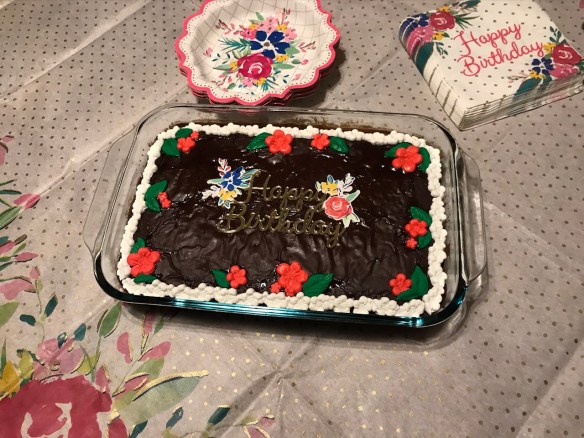
3. My birthday. My family always goes the extra mile to give me a special day. Lunch from Chick-Fil-A brought in, dinner out, wonderful gifts, and this beautiful cake made by my daughter-in-law. The plates and napkins are so pretty, too!

4. A mini-vacation from cooking. We went out a couple of nights and Mittu cooked a couple of nights. So I felt like I had a bit of vacation time, too!

5. A family outing. Different ones have done various things in the daytime: Jim, Jeremy, and Jesse went to a shooting range, the kids went out to lunch, Jeremy and Jason’s family went to a favorite coffee shop. We had one family outing to a place that has arcade games, bowling, laser tags, etc. Timothy wanted to play the games, so Jason took him to do that while the rest of us bowled. But we visited and touched base with each other in-between activities. When setting up the names for bowling, it asked to take pictures, which we were a little annoyed about at first. But then it used the pictures for funny videos in-between turns which we got a good laugh at.

I also wanted to let you know I had an interview with author Adam Blumer yesterday, which included an opportunity to win a signed copy of his newest excellent suspense novel.

Happy Friday!

Interview with Adam Blumer, Author of Kill Order

Adam Blumer writes page-turning “meaningful suspense” novels. I loved his first two: Fatal Illusions and The Tenth Plague (linked to my reviews). His third novel, Kill Order, just released a few days ago. Here is the summary:

When he sleeps, the forgotten terrors of the past come alive.

Grammy-winning pianist Landon Jeffers’s brain cancer has given him only a few years to live. But when he sleeps, the forgotten terrors of his past torment him. When he wakes, shameful memories come rushing back. Desperate for answers, Jeffers discovers that a brain implant intended to treat his cancer is really a device to control him, forcing him to commit terrible crimes. Now he’s being manipulated by an evil crime syndicate and a crooked cop.

What if free will isn’t? What if your every move is predestined? If you kill, are you guilty of murder?

Intriguing, isn’t it? I’ve read the book and will be reviewing it next week, and I can assure you, it’s excellent! At the end of this post, I’ll let you know how you can enter to win a signed copy of the book.

Today I am welcoming Adam to Stray Thoughts to share a little about about himself, Kill Order, and writing.

First, a little background information:

Adam Blumer fixes other people’s books to pay the bills. He writes his own to explore creepy lighthouses and crime scenes. He is the author of three Christian suspense novels: Fatal Illusions (Meaningful Suspense Press); its sequel, The Tenth Plague (Kirkdale Press); and Kill Order (Lighthouse Publishing of the Carolinas).

A print journalism major in college, he works full-time from home as a book editor after serving in editorial roles for more than twenty years. He lives in Michigan’s Upper Peninsula with his wife, Kim, and his daughters, Laura and Julia. When he’s not working on his next thriller, he’s hiking in the woods, playing Minecraft with his daughters, or learning new chords on his guitar. He is committed to writing clean suspense that is free of profanity, vulgarity, and sexual content. He is a member of American Christian Fiction Writers (ACFW), the Christian Editor Network, and The Christian PEN. He works with literary agent Cyle Young of Hartline Literary Agency.

What gave you the inspiration to write Kill Order?

My dad, Larry, passed away from brain cancer in 2011, and several aspects of his cancer journey kicked off the initial story idea. One key detail involved a medical procedure; the doctors agreed to remove as much of my dad’s brain tumor as possible and replace it with medicinal wafers intended to fight the existing cancer. My mind began playing the what-if game. What if the doctor implanted something else, something that could monitor or even control my dad’s life? The story’s premise grew from there.

I noticed that your branding on your website is for “meaningful suspense.” What inspired you to write these kinds of thrillers and suspense novels? Also, could you please tell us what inspired your “clean fiction guarantee”?

I began reading Christian novels in junior high and soon gravitated to suspense. Back in the day, an inspirational thread was a staple in Christian fiction, and I believe a Christian novel can do more than simply entertain. These days many authors are leaning toward writing clean, moral stories but avoiding overt Christian content. I’m a believer that the inspirational content should stay (hence “meaningful suspense”). Books can encourage and even challenge readers’ thinking while taking them on a roller coaster of a ride. The “clean fiction guarantee” came about due to the rise of objectionable content in some Christian fiction. My fans were expressing disappointment to me due to content issues when they tried books by some Christian authors. I felt it was time to declare where I stood, and many readers have appreciated my guarantee.

When did you realize your calling to create words on paper to share with the world?

When I was a child, I began writing wildly imaginative pirate and fantasy stories. My first handwritten story was a fantastical tale about Captain Kidd’s spyglass. In high school, I also wrote and finished an unpublished novel called Down with the Ship. It’s such an Agatha Christie copycat that I laugh whenever I peruse it, but emulation is how a lot of authors get to be where they are today. Those were the early projects that inspired me to take novel writing seriously. When I won a high school award for creative writing, I wondered if God wanted to do more with my love for fiction. In college I won more writing awards, and though I studied journalism, I took as many creative writing courses as possible. God opened doors from there, and I’ve never lost my love for fiction writing.

If you could go back in time and give advice to your younger self, what would that be?

Writing the story is only half of the project. The other half is finding out what readers like to read, crafting the story for them by following publishing standards, and writing the story to the best of your ability. Then remember that publishers can take a very long time to decide whether they want your work. Don’t get discouraged. Just keep going and waiting.

Name your three biggest frustrations about the writing business.

  1. The amount of time each book requires from start to finish. Included in this is the long wait time from publishers.
  2. The continually changing rules in writing and publishing. Just when you think you know what publishers are looking for, your agent tells you something else.
  3. Book marketing. One cannot guarantee sales. I wish a book release was like the movie Field of Dreams. “Build it, and they will come.” If only it were that easy. There is almost an equal amount of work in just promoting the book.

On the flip side, what excites you the most about the creative process?

I get most excited about the creative process when a plot development I never saw coming unexpectedly presents itself, taking the story in a new but stronger direction. This epiphany has happened to me several times.

Where is your favorite place to write?

I have been blessed with a wonderful home office. Though I often like to write in other locations, this is by far my favorite place. I can close the door, shut out life’s distractions, pray, and become immersed in my story. Now and then, if I need a break, I can glance out the window and delight in God’s creation.

What are you reading at the moment, and who are a few of your favorite authors and why?

I’m currently enjoying Mind Games by Nancy Mehl. I especially enjoy a good thriller, whether Christian or secular. Some of my favorite authors are Steven James, Terri Blackstock, Frank Peretti, Ted Dekker, and Brandilyn Collins. I like how they weave story threads together and craft their scenes in ways that keeps the plot moving forward. Their books are great examples of what works in suspense writing. I learn so much simply by reading their novels.

What is the best part of your author’s life?

I love hearing from readers who went to work tired because they stayed up too late finishing one of my novels. If I kept them immersed in my story and entertained, that’s a score in my book.

Do you have any new writing projects on the horizon?

I’m almost finished with the first draft of the sequel to Kill Order and hope to have something ready for my agent sometime this fall.

Adam, thank you for stopping by and for giving us another great book. I am looking forward to the next one. Thank you, especially, for producing books that are not only well-written, but clean and meaningful.

Thank you for the opportunity to talk about my writing life at your blog.

Where Readers Can Buy a Copy of Kill Order

Paperback:

Amazon: https://www.amazon.com/dp/1645261867/
Barnes & Noble: https://www.barnesandnoble.com/w/kill-order-adam-blumer/1132572349?ean=9781645261865
Lighthouse Publishing of the Carolinas: https://www.shoplpc.com/product/kill-order/

Kindle E-book: https://www.amazon.com/dp/B07VRSPGMN/

How to Connect with Adam

Website: http://www.adamblumerbooks.com/
Facebook: https://www.facebook.com/AdamBlumerNovelist
Twitter: https://twitter.com/adamblumer
Amazon: https://www.amazon.com/Adam-Blumer/e/B001PYV33I/ref=ntt_dp_epwbk_0
Goodreads: https://www.goodreads.com/author/show/2315682.Adam_Blumer
Pinterest: https://www.pinterest.com/adamblumer/
Instagram: https://www.instagram.com/adamblumer/

Kill Order Paperback Giveaway:

You can enter for the opportunity to win a signed paperback copy of Kill Order here.

(Sharing with Grace and Truth, Happy Now, Hearth and Soul, Tea and Word, Booknificent)