The Biltmore Estate and Downton Abbey Exhibit

My husband and I have visited the Biltmore Estate in Asheville, NC, a handful of times. I believe the last time we went was for our 25th anniversary fifteen years ago. I had pretty much decided there was probably no need to return—once you’ve seen it in different seasons, there’s nothing new to see, I thought.

And then I heard they were going to have an exhibition of the Downton Abbey television show at the Biltmore!

Then the question was—how should I go about seeing it? My daughter-in-law and I loved the show, but my husband and youngest son had never seen it. I think Jason, Mittu’s husband had seen at least some episodes, but I don’t know if he was as into it as I was. So should I go by myself? Should I see if Mittu wanted to take a day trip with me? Should I ask a friend? Should I ask my husband even though he wasn’t familiar with the show?

The dilemma was solved when Mittu asked if we could go to the exhibition in lieu of presents for her birthday this year. We went last Saturday.

We got into Asheville around 11 and ate lunch at Farm Burger, as its online menu showed it had gluten free options for Mittu and Timothy. I didn’t want anything heavy or greasy, so I tried the build-your-own chicken burger. It was pretty good. I also snagged a few of Jason’s garlic parmesan fries, and they were great.

Unfortunately, the DA exhibits were in two different buildings and not in the Biltmore house itself. You have to choose a time when you buy tickets, so we needed to go in to see the house when we first arrived.

If you’re not familiar with the Biltmore, it’s the largest home in America, built by George Washington Vanderbilt. He had visited the Asheville area in 1887 and liked it so well, he began buying up land to build a home. Construction began in 1889. He was a bachelor at the time and planned to being his mother to live at the house and to host family and friends. He didn’t marry until 1898, when he was 35. The estate wasn’t even entirely finished then, but it was livable.

I’m reading The Last Castle: The Epic Story of Love, Loss, and American Royalty in the Nation’s Largest Home by Denise Kiernan about the Biltmore House. I had hoped to finish it before visiting, but was only halfway done. Still, what I read enhanced the visit, and and I am sure that the visit will enhance the remaining reading.

One of the things that impressed me the most was that the land had been fairly depleted before building began. Frederick Olmsted, a landscape architect whose long list of credits includes Central Park, was asked to do the landscaping at Biltmore. He had to take into account not only what the land would like like at the time, but how things would grow over time.

The second impressive thing about the estate, besides the sheer size, is the detail in every single aspect. This is the right half of the house as we’re coming from from where the shuttle dropped us off:

Biltmore estateI have many more pictures that one post will hold, but this is what is called the Winter Garden, just inside the front doors and to the right:

Biltmore Winter GardenOne of my favorite rooms is the library. Vanderbilt was known for being well-read, even buying unbound manuscripts so he could have them bound the way he liked them.

Biltmore Library

You can see a bit of the painted ceiling. One of my favorite moments occurred when we were all exclaiming. “Look at the painting! Look at all the books! Look at the spiral staircase in the corner!” And Timothy (almost age 6) said, “Look at the security camera!” 🙂

My second favorite room was Mrs. Vanderbilt’s bedroom. I didn’t like the black bedcoverings so much, but I loved the ceiling. We didn’t get a picture, but you can see a glimpse here.

We got to go up an elevator that was original to the building. Unfortunately it only went between the first and second floors. The design was all wrought iron, but at some point they put plexiglass behind it for safety purposes. We didn’t get pictures of it, but someone else’s video is here.

One room I didn’t remember seeing before was called the Halloween room, painted by George’s daughter Cornelia. There they offered a photo opportunity with George and Edith. 🙂

The tour includes the downstairs area, where the bowling lanes, kitchen, laundry, and servant’s rooms are. Another funny moment here: we tried to explain to Timothy what the chamber pots were for. When he heard someone else commenting on them, he called them “Thunder pots.”

Just outside the house is a group of little shops and eateries. We enjoyed a snack before heading down to the DA exhibit. Unfortunately, we didn’t have time to explore the little shops if we wanted to catch the DA exhibits before they closed.

The first part of the exhibit was in a new building called Amherst at Deerpark. While waiting to get in, we asked what the building was normally used for. The attendant said that once the exhibit was over, the building could be rented for special events, wedding receptions, etc.

This part of the exhibit was called interactive, but that’s probably because there are life-sized videos of Carson speaking to the guests as if he can see them. There are also some artifacts behind glass or in drawers covered with glass. When you first walk in the hallway, there is a massive picture of the DA cast in costume. Then there is a stop to watch a video. Then we stepped into a room where we saw larger than life-sized pictures of half the faces of the cast (not half the cast—half the face of each cast member).

Just to show you a couple of representative displays, pictures and text like this were on walls and tables discussing all the characters and different aspects of the times.

Downton Abbey exhibitOther displays held letters, props, jewelry, etc.

This is where I have a wee bit of complaint. This area was extremely crowded, and there was not a direct flow of traffic. It was very hard to get around to look at anything, much less take time to read the displays. I got around the whole room and glanced at almost everything, but was so claustrophobic, I just wanted to get out as soon as possible. This would have been better in a larger area, or even scattered around in some of Biltmore’s more open areas.

The next section was a lot more fun. It included sets from the show. I didn’t see any information which specified, but I am assuming these were the actual sets (if not, they were very good recreations).

Mr. Carson’s office:

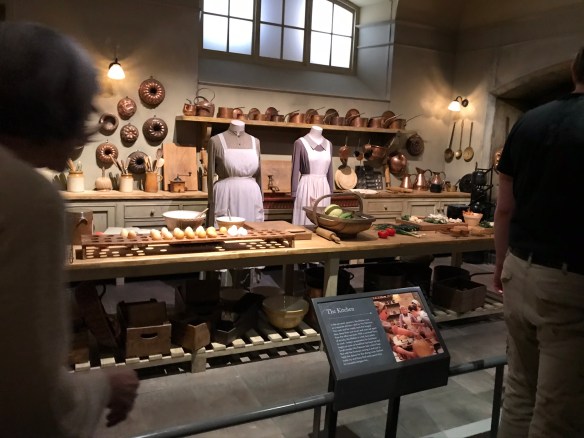
Downton Abbey butler officeThe kitchen:

The bells:

They also had the formal dining room and Lady Mary’s bedroom.

Then we had to take another shuttle to Antler Hill Village to see the costumes. I enjoyed this quite a lot. Even without remembering who wore which clothes, we found ourselves guessing which dress went with which character just by its style. I have multitudes of pictures but will just share a couple.


Downton Abbey costumes

I had mentioned at the beginning feeling like there was no need to go back to Biltmore and see the same things again. What i didn’t know was that the Antler Hill Village area was all fairly recent, plus a few new rooms had been opened up. Plus, in all the times we’ve been there, we’ve never seen the greenhouse or Biltmore Village. The latter was built by Vanderbilt for workmen and employees. I’ve been reading in the book I mentioned about All Souls Cathedral, also built by Vanderbilt, and its stained glass windows dedicated to George’s mother and close friends and other family who passed away. I had hoped to catch a glimpse of it, but by the time we were done, we were tired and needed to get back on the road. So some day I’d be up for another visit to see some of these areas.

Jason and Mittu did stay overnight and went back the next day to see the greenhouse and some other areas. Timothy was a little trooper and seemed to enjoy himself. We were glad there were some grassy areas in-between buildings where they allowed people to walk and kids to run. He was looking forward to the pool at the hotel. 🙂

All in all, it was a fun visit. I enjoyed seeing the Biltmore again and loved seeing the Downton Abbey sets and costumes. If you’re a fan of the show, I hope you get a chance to see the exhibit. It’s at the Biltmore until April 7. I’m assuming the house and exhibit would be a lot less crowded on weekdays: I’d recommend going then if you can.

Have you visited the Biltmore or see the Downton Abbey exhibit?

When Not To Be Minimalist

When not to be minimalistI enjoyed reading Joni Eareckson Tada’s Spectacle of Glory devotional book a couple of years ago. One quote from the book that came back to me many times after reading it was from the August 9 entry, which commented on Ephesians 3:8 about “the unsearchable riches of Christ”:

We can study all we want, but Jesus will always be a greater Savior than what we think He is. He is more ready to forgive than you can imagine asking Him. He is more willing to supply your wants and needs than you are to declare them. He is so much more ready to give than you are to receive. Don’t ever tolerate low thoughts of a barely adequate, minimalist Savior who might “keep you going” but not much more. Jesus has riches to bestow on you right now. He will not only give you heaven above, but heaven-hearted joy in serving Him here on earth.

Lord, my thoughts about You are too small, too lean, too sparse, too thin, too colorless. Paul writes about your unsearchable riches, but on some days, I barely even approach the treasuries. My mind is filled with too many smaller things. I’m in the trees and can’t see the mountains. Lift my gaze to your greatness and majesty today (p. 242, emphasis mine).

The phrase “minimalist Savior” especially jumped out at me, since minimalism is such a byword these days. I don’t want to comment on the current notions of minimalist lifestyles or practices, but I began to think of other ways we should not be minimalists.

In thoughts of our Savior

Joni wasn’t saying Jesus lived extravagantly while on earth. He was born into a poor earthly family. He didn’t own a home as an adult. One former pastor used to say that Jesus was “born from a borrowed womb and buried in a borrowed tomb.”

But, contrary to the “prosperity gospel,” all blessings are not material. God promises to supply our needs, but He doesn’t promise physical riches to His followers. Rather, “according to the riches of his glory” (Ephesians 3:16), He “is able to do far more abundantly than all that we ask or think” (Ephesians 3:20. The KJV says “exceedingly abundantly.”)

In prayer

Couched between Ephesians 3:16 and 18, based on those riches of Christ, this is what Paul prays for:

According to the riches of his glory he may grant you to be strengthened with power through his Spirit in your inner being, so that Christ may dwell in your hearts through faith—that you, being rooted and grounded in love, may have strength to comprehend with all the saints what is the breadth and length and height and depth, and to know the love of Christ that surpasses knowledge, that you may be filled with all the fullness of God.

Sometimes when I find myself suggesting to God ways that He might answer, I remind myself of this: He can do far more than I can ask or even think, according to Ephesians 3:20.

In worship

In Mark 14, a woman came into the house where Jesus was a dinner guest. John 12:1-8 identifies her as Mary of Bethany, whose brother, Lazarus, Jesus had raised from the dead (Matthew 26:6-13 also records this incident). She “came with an alabaster flask of ointment of pure nard, very costly, and she broke the flask and poured it over his head.

That might seem weird to us in our time. I went on a bit of a rabbit trail trying to discover what anointing meant and why it was done in that day. The best explanation I found so far is here. Anointing was a mark of respect and also a way of setting apart a prophet, priest, or king. Christ is referred to an anointed in other passages. Perhaps Mary was showing her gratefulness for Jesus having raised her brother. Perhaps she had some of these other aspects in view. But Jesus took her actions as anointing his “body beforehand for burial.” Whether Mary did this unwittingly or whether she caught what so many of the other disciples missed when Jesus foretold His death, I don’t know. Others criticized her actions, pointing out that this expensive ointment could have been sold and given to the poor. But Jesus said, “Leave her alone. Why do you trouble her? She has done a beautiful thing to me” (verse 6). And He promised that “wherever the gospel is proclaimed in the whole world, what she has done will be told in memory of her” (verse 9).

A similar incident occurs in Luke 7. We know this is a different situation because the event, timing, host, woman, actions, critics, criticisms, purpose, and response from Jesus are all different. The woman in this case is known as sinful. She wet Jesus’ feet with her tears, dried them with her hair, and anointed them with the expensive ointment. The host, a Pharisee, criticized Jesus in his heart, saying, “If this man were a prophet, he would have known who and what sort of woman this is who is touching him, for she is a sinner.” Jesus then told of two debtors. One owed a large amount and one owed a small amount. Both debts were forgiven. Jesus asked which of the debtors would love the lender more. The Pharisee answered, “The one, I suppose, for whom he cancelled the larger debt,” (verse 43). Jesus said of the woman, “Therefore I tell you, her sins, which are many, are forgiven—for she loved much. But he who is forgiven little, loves little” (verse 47). Her actions were extravagant both because of the cost of the ointment, but also because she loved so much that she risked ridicule and shame from others to show her great love to Him.

Have we thought recently about the greatness of our sins and how much it cost Jesus to forgive them? Have we meditated on His goodness and greatness enough to be overawed?

In giving

We’ve already seen from these two women that their love and worship led to costly actions. Does that mean we need to get some expensive perfume to bring to church or pour out when we read our Bibles? No. But generosity should be part of our character. King David once said, “I will not offer burnt offerings to the Lord my God that cost me nothing” (2 Samuel 24:24).

When Paul sought financial help for needy saints, he told the Corinthians:

Whoever sows sparingly will also reap sparingly, and whoever sows bountifully will also reap bountifully. Each one must give as he has decided in his heart, not reluctantly or under compulsion, for God loves a cheerful giver (2 Corinthians 9:6-7).

He wasn’t speaking just to the rich Corinthians. He referred earlier to the Macedonians, who first gave themselves to the Lord and then to the apostles, and who begged for the opportunity to give out of their extreme poverty (2 Corinthians 8:2-5).

I’ve seen a lot of criticism of the rich online recently, and a lot of judgment about what they do with their wealth. But we’re not accountable for them. We’re accountable for ourselves. The Macedonians were in extreme poverty yet begged to be allowed to give to help others.Jesus commended a poor widow who only offered two small coins because that was her all (Luke 21:1-4).

Giving abundantly doesn’t necessarily mean we need to sell everything we have and give it to the poor. Jesus only told one man to do that, because he knew that man’s wealth was a problem for him. 1 Corinthians 16:2 tells us to give as God has prospered us.

Sometimes we save to be able to give. Another former pastor once advised his people to have a “benevolence” section in their budget, to put aside a little bit of money every paycheck so that when they become aware of a need, they would have some on hand to give.

We should give wisely, of course. There is a type of giving that enables people to continue on in their sin. Sometimes we have to say no. Sometimes God says no, because what we’re asking isn’t good for us or isn’t the right time.

And we don’t just give money. Our time, schedules, attention, homes, all belong to God, to be used as He directs.

We don’t give for show, as Ananias and Sapphira and the Pharisees did. But we give as God directs out of a grateful heart for what He has given us.

And we can’t outgive God. Jesus said, “Give, and it will be given to you. Good measure, pressed down, shaken together, running over, will be put into your lap. For with the measure you use it will be measured back to you” (Luke 6:38).

In love

1 Peter 1:22 tells us to “love one another with a pure heart fervently.” Other translations say “deeply” or “earnestly.” Biblical love could take another whole post (or several) to expound upon, but it’s aptly summed up in 1 Corinthians 13. Verses 4-8a say:

Love is patient and kind; love does not envy or boast; it is not arrogant or rude. It does not insist on its own way; it is not irritable or resentful; it does not rejoice at wrongdoing, but rejoices with the truth. Love bears all things, believes all things, hopes all things, endures all things. Love never ends . . .

My heart is full, thinking of God’s great generosity to me, inspired to be generous towards others, overflowing into even more ways to be generous rather than minimalist: thankfulness, praise, patience, and more.

How about you? I’d love to hear your thoughts in the comments.

(Sharing with Inspire Me Monday, Global Blogging, Senior Salon, Hearth and Home, Literary Musing Monday, Purposeful Faith, Happy Now, Tell His Story, InstaEncouragement, Anchored Abode, Recharge Wednesday,
Worth Beyond Rubies, Share a Link Wednesdays, Let’s Have Coffee,
Heart Encouragement, Grace and Truth, Faith on Fire,
Blogger Voices Network. Linking does not imply 100% agreement)

Laudable Linkage

These are some noteworthy reads discovered this week:

To Redeem ‘Cancel Culture’, There Must Be Room for Redemption, HT to Challies. “But now to the most apparent deficiency of secularism as a religion: the absence of any explicit provision for redeeming and restoring to acceptance by the community those judged guilty of violating its moral code.”

Peace in the Beforehand. “If I dread an upcoming difficulty, as well as suffer through it, I’ve doubled my misery.” And, Sandy goes on to say, if we dread something, but then everything goes fine, we’ve wasted all that angst. Such a helpful perspective.

My Heart Is a Featherweight. I’ve enjoyed Laura Ingalls Gunn’s blog for many years. Yes, she’s related to the real LIW. But this might be my favorite post: a true story about how God brought two people to the exact same spot, one with a longtime desire, one looking for just the right person to give a treasured item to.

Dear Teenage Daughter: You Aren’t Entitled.

Protecting Digital Accounts After Death.

And a thought for the day:

. . . or sunrises or seasons or growth.

Happy Saturday!

Friday’s Fave Five

friday fave five 12It’s Friday, time to look back over the blessings of the week
with Susanne at Living to Tell the Story and other friends.

And another week is nearly down for the count. Time passes so quickly, I enjoy slowing it down for just a bit by pausing to remember some of the best parts of the previous week.

1. A successful new recipe. This was actually from the previous week, but I forgot to mention it. I wanted to make something different for a church potluck, searched online, and tried Crockpot Honey Teriyaki Meatballs. I used frozen gluten-free meatballs, as we have a number of gluten-intolerant folks. I only used half the sugar called for and used canola oil instead of sesame oil (the latter was expensive, and I didn’t want to buy a whole bottle for one teaspoon). It tasted great and was easy to put together. There were only half a dozen meatballs left, so I consider it a success. I’m looking forward to making it again some time.

2. Valentine’s Day. One of my favorite holidays.

3. My husband making a return. I just hate taking things back to stores. My husband had errands to run in the vicinity of a store I needed to make a return to, and I asked him if he’d mind taking care of it for me. He gladly did so. As much as I LOVE the cards, flowers, candy, balloons, gifts, and expressions of love on Valentine’s Day, these kinds of things show love to me even more. In addition, Friday I walked into the laundry room to discover an odor like something burning. To me it smelled like rubber or a belt with too much friction. Thankfully my husband was working from home that day and came over to investigate. He spent Saturday morning taking the dryer apart, checking out all its parts, vacuuming out the lint.

4. Sleeping in Saturday. I woke up about 2:30 a.m. Saturday with a raging headache. Once I finally got back to sleep, I didn’t wake up til after 7. That’s rare for me: I’m usually up between 5 and 6 even without an alarm clock. I stayed in my pjs til mid-morning and basically took it easy. It took all day for the headache to abate. The only downside was missing our every-other-month ladies’ Bible study. Thankfully I had gotten a lot done earlier in the week, so I could rest up without feeling I needed to take care of other things.

5. Christian music and programming. Thursday I woke up around 4:10 a.m. and couldn’t get back to sleep. I had a good time of prayer, but later in the morning was in a funk—unusual for me. I couldn’t pinpoint what was wrong. Everyone else was out, so I couldn’t blame another person. I usually listen to an audiobook while getting ready in the morning, but decided to finish the last of the Revive Our Hearts podcast series with Valerie Elliot Shephard, Elisabeth Elliot’s daughter. I turned on the Christian radio station while peeling potatoes for the crockpot. I came across this post in my Feedly account talking about the use of music in our quiet time. I clicked on several of my favorites and a couple that were new to me. All of that worked together to tenderize my heart and change my perspective. Later in the afternoon I got a bit of a nap in and felt much better, so lack of sleep was probably a major factor. But I was still thankful for the variety of means available to minister to my spirit.

Bonus: My daughter-in-law’s birthday! Actually, as I am writing on Thursday afternoon, we haven’t celebrated yet. So this is an anticipatory fave. Their family is coming over tonight for dinner and cake, if the “wintry mix” we received today doesn’t cause problems. Then we have some special plans over the weekend that I look forward to telling you about next week.

Update: the snow and slush did melt and we were able to get together. Always a joy to celebrate Mittu’s special day. Timothy, as you can see, is at the age of mugging for the camera. 🙂

And that’s my week. How was yours?

Book Review: The Words Between Us

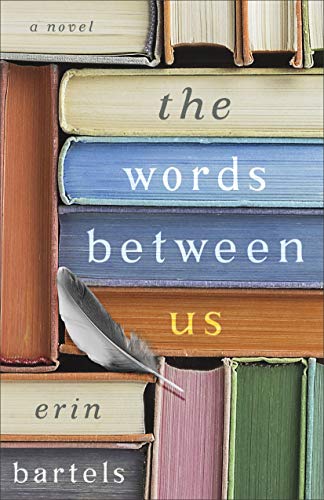
In Erin Bartels’ novel, The Words Between Us, Robin Dickinson is a loner who runs a used book shop in Michigan. Only her party-girl friend, Sarah, knows Robin’s real last name is Windsor and her father was a U. S. Senator tried and found guilty for murder and treason. Robin’s mother was implicated as well, and both parents have been in prison for eighteen years. Robin hasn’t seen either of them in all that time.

The book opens on the day Robin’s father is scheduled for execution. Robin just tries to get through the day and avoid the news when she gets a surprise package in the mail: a book from the only other person who knew her secret and betrayed her: Peter.

Robin had met Peter when she first moved to the area after her parents’ arrest to stay with her grandmother. He found out she liked to read. His mother had died a year ago and his father had boxed up all her books. Peter was reading them one by one in her honor. He offered to loan them to Robin, and she repaid him with a poem. They were heading toward a high school romance until a crisis resulted in Peter’s betrayal. Now, after having no contact in eighteen years, he sent her a copy of the first book he had loaned to her. Why? How did he know she was here?

The chapters alternate back and forth between “Then” and “Now” as Robin’s story unfolds.

In some ways, this is a story of how people survive excruciating pain. In others ways, it’s a story of judgments and misconceptions. Even when we think we have a “right” to our opinions about others, sometimes we’re wrong. It has elements of mystery and suspense. Ultimately, it’s a story about words and their effect, as the title says.

As the gorgeous cover indicates, there are a multitude of literary references.

Robin spends a lot of time thinking of the meaning of death, that indefinable something that’s missing life. Pondering a dissected frog and dead goldfish, Robin muses: “Always a body, but with something missing, something twisted out of order. It was that off bit that made me wonder. What was really missing other than breath? Because it wasn’t just that.” She notices that same absence in an old house. And later, she realizes even some books do not live:

Most of these books are not alive. They have not stood the passage of time.

They do not still burn in the hearts of those who have read them. It’s unlikely any of those readers could pull the names of the protagonists from memory. They are merely inert paper and ink, and I doubt very much they could live again.

I know why some books live on forever while others struggle for breath, forgotten on shelves and in basements. the authors . . . hadn’t bled. They hadn’t cut themselves open and given up a part of themselves that they would dearly miss. They hadn’t lost anything in the writing. That’s the difference between the books that I could never aptly explain to Dawt Pi and the ones I let The Professor [a parrot] shred. That’s the difference between the dead and the living.

Was that also what made a person or a bird or a frog alive? Was there a part of God’s heart that animated each otherwise insignificant part of the world? Had he given something up in creating me?

A couple of other quotes from the book:

Sometimes we’re handed adversity for our own good, so we’ll grow. Just because something’s hard doesn’t mean it’s not worth fighting for.

There are many types of quiet. The quiet when you first open a book and prepare yourself to enter a story. The quiet of the seed underground, waiting for spring. The quiet that follows the moment the past rips through time to invade the present.

I couldn’t remember who recommended this book to me, but I had thought it was Christian fiction. Yet I didn’t see much of anything connected to faith at first besides a couple of references, so I thought I was mistaken:

“God loves you, Robin. I pray for you—every day.” I can’t answer her without releasing the tears that are swiftly building up behind my eyes like a river behind a dam. I wish I was so sure that God looked at me with anything but fathomless disappointment.

Because of all the people I know, she’s the only one who has ever made me wonder if perhaps God must be real despite everything.

But by the end, Robin opens up to the possibility of faith in a God who loves her. So there’s a faith element, but it’s not heavy-handed.

I enjoyed Robin’s story and journey.

(Sharing with Carole’s Books You Loved, Booknificent)


Working Toward Harmonious Relationships

IMG_2041

I’ve remembered what this speaker said for decades.

I don’t remember his main topic or even where I heard him. But at some point in his talk, he mentioned a husband forgetting his wedding anniversary. And then he said something like this: “Wives, don’t stand back with arms folded, tapping your foot, waiting to see if he remembers, and then lowering the boom when he doesn’t. Help him remember.”

How wise. “Getting after him” in some way—pouting, anger, silent treatment—will only make him feel guilty, maybe even defensive. And the day that’s supposed celebrate love turns into a negative experience. You might think, “Well, he ruined it first.” However, we can either redeem the situation or make it worse by our reaction.

My husband doesn’t usually forget special occasions. But this speaker’s advice  filtered into my thinking to apply generally to how we deal with each other’s foibles. “Punishing” or getting back at each other or stewing in resentment compounds the negative and widens the breach. How can we work towards harmony and away from dissension?

Look for ways to help.

Perhaps a week or two before an anniversary (or birthday or whatever), we could casually say, “Do you want to do anything special on our anniversary?” We could even invite him to something we’ve planned.

This principle goes so much farther than marriage and anniversaries. It applies to any relationship. If a child constantly forgets a chore, instead of incessantly nagging, we can find another way to help them remember: a chore chart, a privilege after his work is done, etc. If a wife is constantly late, perhaps a husband can help the kids get their shoes on so that’s one less thing she has to do.

Confront kindly when necessary.

Does that mean we can never confront each other about a problem or tell another when he has hurt our feelings or offended us in some way? No, of course not. Working out these issues helps the relationship progress and get even closer—if the issue is handled in a kind, thoughtful, edifying way rather than an angry or punishing manner.

“Do unto others . . “

Jesus said, “And as you wish that others would do to you, do so to them” (Luke 6:31). Would we want someone to scowl or withdraw if we failed them in some way? Or would we prefer a frank discussion? Would a preliminary reminder help, or would that seem like nagging?

Take into account different personalities and “love languages.

Perhaps a husband shows love by working hard, keeping up with repairs at home, keeping the lawn mowed. Tell him how much you appreciate all of that—and then suggest that, just every now and then, flowers or candy or a nice dinner out or watching a romantic movie together would really make you feel special. Perhaps she showers you with gifts, but you’d really appreciate a compliment once in a while. There might not be a way for her to know that unless you gently and kindly tell her.

Choose what’s most important.

Perhaps he leaves things out of place. We might resent that he’s created even more work for us. We could tell him how debris around the house makes us feel. Or we could just pick it up.

Above all, keep loving one another earnestly, since love covers a multitude of sins. (1 Peter 4:8).

Hatred stirs up strife, but love covers all offenses (Proverbs 10:12).

Forbear and forgive.

None of us has to be doormats. We should never put up with abuse or outright sin. But we do have to accept that no one is perfect. (This article helps differentiate between things we shouldn’t let go).

I therefore, the prisoner of the Lord, beseech you that ye walk worthy of the vocation wherewith ye are called, with all lowliness and meekness, with longsuffering, forbearing one another in love; endeavouring to keep the unity of the Spirit in the bond of peace (Ephesians 4:1-3).

Put on then, as God’s chosen ones, holy and beloved, compassionate hearts, kindness, humility, meekness, and patience, bearing with one another and, if one has a complaint against another, forgiving each other; as the Lord has forgiven you, so you also must forgive. And above all these put on love, which binds everything together in perfect harmony (Colossians 3:12-14).

Build up instead of tearing down.

However we handle these issues, we need to keep in mind our goal. The aim isn’t “Everyone do everything my way”—or shouldn’t be. The goal is harmony, feeding and increasing our love for each other, and building one another up.

The wisest of women builds her house, but folly with her own hands tears it down. (Proverbs 14:1)

Therefore encourage one another and build one another up, just as you are doing (1 Thessalonians 5:11).

So then let us pursue what makes for peace and for mutual upbuilding. (Romans 14:19).

Sometimes a choir or musical group will sing in unison, but more often they sing in harmony. Different voices bring different tones and notes into play, yet the outcome is all the more beautiful for the differences that come together into a beautiful whole. It takes a lot to get to that place. The composer has to arrange the piece. The leader has to interpret it. The instrumentalists and singers all have to learn their parts. They have have to practice together several times. Some might be too loud or soft, too fast or slow at first. But finally, each individual part works together with the rest, and the effect can bring tears to our eyes.

May the God of endurance and encouragement grant you to live in such harmony with one another, in accord with Christ Jesus, that together you may with one voice glorify the God and Father of our Lord Jesus Christ (Romans 15:5-6).

What are ways you work towards harmony in relationships?

(Sharing with Inspire Me Monday [Anita wrote about relationships this week, too, and brought out factors I hadn’t thought about], Global Blogging, Senior Salon,
Hearth and Soul, Literary Musing Monday, Purposeful Faith, Tell His Story,
Happy Now, InstaEncouragement, Anchored Abode, Recharge Wednesday,
Share a Link Wednesday, Let’s Have Coffee, Heart Encouragement,
Grace and Truth, Faith on Fire, Blogger Voices Network)

Laudable Linkage

IMG_0195

Here’s my recent roundup of recommended reading for your reviewing relish. 🙂

Yes, You Can Trust the Four Gospels. Even When They Conflict. Argument against a new theory that posits the gospel writers wrote in a literary way, changing and even making up details to support their theme. This author did a lot of research and contends that, no, they reported facts..

When Valentine’s Day Hurts.

Crumbling Into Compassion, HT to The Story Warren. Beautiful story of redemption and reconciliation.

Are You Too Sensitive? Sensitivity has its good and bad points.

People Are Hard to Hate Up Close. “Attributing these characteristics to those on the left or the right may give us the momentary thrill of self-righteous indignation, but it deepens the divide, fuels our anger, and keeps meaningful conversations from occurring.”

Are You Seeking Counsel or Gossiping? I’ve often wondered what exactly makes up gossip. It’s not just sharing when someone else did something wrong–the epistles do that. I’ve often wondered if it primarily has to do with intent. This post has some good guidelines.

The Advance of the New Legalism, HT to Challies. I have seen wisps of this: “We are prone to seeing our way of doing things as a good way (which it might well be). But what we consider a good way soon becomes the best way (which, still, it could be). Only, the best way quickly gets called the right way which, soon enough, becomes the only way that, in turn, becomes synonymous with a biblical mandate (at least, in our minds).”

Leave “Always” and “Never” Out of Your Marriage. I came across that advice early on, and it probably saved us trouble.

What Do Hit Men and Porn Watchers Have in Common? “So what about those people who watched the video? If they watched a person being raped for their entertainment, surely they are complicit in that rape, aren’t they?”

The Way to Good Judgment. Is it only through experience, and bad experience at that? Nope.

The Best Way to Give Generously, HT to Lisa. “I don’t know about you, but I have to admit that the gifts I give of myself are frequently stingy and laced with traces of criticism, if not outright begrudging. Here’s where we have the chance to offer ourselves grace, though, recognizing that when God highlights one of His attributes for us like this, He’s giving us an opportunity to do things differently.”

Finally, a thought for carrying Valentine’s Day love into everyday life:

Louisa May Alcott quote about loving handsHappy Saturday!

Friday’s Fave Five and Happy Valentine’s Day!

friday fave five 12It’s Friday, time to look back over the blessings of the week
with Susanne at Living to Tell the Story and other friends.

Happy Valentine’s Day to you! I hope you have a wonderful day sharing love with others. This has been a busy week, but here are some of the bright spots in it:

1. Phone battery restored. My phone’s battery seemed to be slowly dying. I needed to charge it up increasingly often until it got to the point of having to keep it plugged in any time I wasn’t using it. I asked my son if he had any advice short of getting a new phone. He said making sure my operating system and apps were all updated might help a little. So I did that. Then one night when I noticed the phone was nearly dead, I let it run all the way out before I recharged it. The battery has been doing great since then, going all day without a recharge.

2. Laptop doing well. I get along better with my desktop than my laptop, but I do need my laptop sometimes. But it had been having a number of problems. Two of my sons worked on it around Christmas, putting all the files on a CD and then taking the computer back to factory reset. This is the first week I have used it extensively since then, and it did great.

3. Rain stopped. I mentioned last week we had rain and flooding. We had even more rain this week. It finally stopped yesterday, and we’re supposed to have clear skies the next few days. We’re even supposed to see the sun later today! I am also thankful the temperatures were moderate during all the rain (mostly 40s during the day). If they had been below freezing, we would have been in even more of a mess with all the precipitation.

4. Podcasts with Valerie Elliot Shephard. If you’ve read here long, you know I love the ministry of Elisabeth Elliot and considered her a mentor from afar. This week Nancy DeMoss Wolgemuth has been interviewing Valerie, Elisabeth’s daughter, on the Revive Our Hearts radio program every day this week. The Christian radio station I listen to doesn’t carry that program, but the ministry made the interviews available via podcast. I enjoyed listening to them while making Valentine cards. I don’t listen to podcasts much—I usually listen to music or audiobooks. But now that I know ROH has them, I might tune in more.

5. Valentine’s Day! One of my favorite holidays! I’ll be making heart-shaped cupcakes and mini meatloaves later today, and I’m looking forward to celebrating with the family tonight.

Valentine's DayAre you doing anything special for Valentine’s Day?

Book Review: Hard Times

In Charles Dickens’ book, Hard Times, Thomas Gradgrind is a member of Parliament who also runs a school. His philosophy of education emphasizes pure fact: no fancy, no imagination, not even any morality. He discovers one poor student in the school Sissy, who can’t seem to learn her facts. When he goes to talk to her father, he discovers that her father had worked in the circus but has mysteriously left. So he offers to take Cissy in to help care for his near-invalid wife if she promises never to return to the circus.

Gradgrind’s own children have been raised according to his philosophy at home. Both his oldest two, Louisa and Tom, are rather bored. The implications of their education play out differently for each of them.

Gradgrind’s close friend, Josiah Bounderby, is a blustery self-made man who boasts of his rise from “street kid” to a successful banker. He eventually takes on Tom as an apprentice and married Louisa. Louisa has no love for Bounderby, but as her father presents the facts of the case, marriage seems reasonable.

In another area of town lives Stephen Blackpool, one of what Bounderby calls “hands”—common workmen. Stephen was 40, but “looked older, but he had had a hard life” with seemingly all thorns and no roses. “He was a good power-loom weaver, and a man of perfect integrity” though not particularly intelligent.

Eventually Stephen’s path crosses that of the other characters and reasons for his hard life become known. His refusal to go in with the unionists gets him in trouble with them and Bounderby. When he leaves to find work elsewhere, he’s framed for a bank robbery.

Usually when I start a classic novel, I get some background information about it first. I didn’t this time: I just let the story draw me in. I wondered who would advocate a “just facts” education and why. After reading the book, I learned that a philosophy called Utilitarianism was going around at the time. You can read more about it at Wikipedia if you’re interested. Louisa’s path follows that of the son of one of Utilitarianism’s advocates, who felt he was emotionally stunted as a result of his upbringing. Tom’s maturity and character was stunted, too, but in a different way. Perhaps it’s better to say he was more warped than stunted.

The two most highly moral, compassionate, and common-sense characters, Sissy and Stephen, were not raised in this philosophy, and eventually they show some of the others a different way. Some of the characters end up sadder but wiser, “making .. facts and figures subservient to Faith, Hope, and Charity.” Dickens almost portrays all the poor as virtuous and the rich and powerful as corrupt, but he makes the characters complicated enough that they don’t fall into stereotypes. As he often writes not only for social awareness, but for social change, he appeals to the reader that “It rests with you and me, whether, in our two fields of action, similar things shall be or not.”

This is the shortest of Dickens’ novels and the only one not to have any scenes in London. This is his tenth novel and, like most of his others, first appeared in serial form. He infuses the story with his characteristic humor, pathos, and memorable characters and descriptions and keeps the reader thinking long after the book ends.

I listened to the audiobook, nicely read by Peter Batchelor, and read parts on the Project Gutenberg copy online here.

(Sharing with Carole’s Books You Loved, Booknificent)

Book Review: Good Tidings of Great Joy

I like to read an Advent or Christmas devotional in December. I didn’t have any new ones on hand last year and didn’t want to reread an old one. But then I came across Good Tidings of Great Joy: A Collection of Christmas Sermons by Charles Spurgeon in my Kindle collection.

I thought I could read a bit at a time, like a devotional book. And I could—but I just wasn’t getting as much out of the sermons as I did when I read them one at a time in their entirety. The only days I could work in reading a whole sermon at once were Saturdays. So that’s why I am just now finishing a book of Christmas sermons.

Spurgeon was not a big fan of Christmas, according to these messages. He thought it was too often used as an excuse for excess. And he disliked a superstitious keeping of church holidays. But he did concede that hard-working people could use the time off and that the holidays provided a time to bring out particular truths related to Christ’s birth.

There are eight messages in all, each focused on a text connected to Jesus’ birth. I won’t go into an outline or summary of each message, but I’ll just share a few quotes.

I. The Birth of Christ, Isaiah 7:14-15: “Therefore the Lord himself shall give you a sign; Behold, a virgin shall conceive, and bear a son, and shall call his name Immanuel. Butter and honey shall he eat, that he may know to refuse the evil, and choose the good.”

Let us take courage here. If Jesus Christ was born in a manger in a rock, why should He not come and live in our rocky hearts? If He was born in a stable, why should not the stable of our souls be made into a house for Him? If He was born in poverty, may not the poor in spirit expect that He will be their Friend? If He thus endured degradation at the first, will He count it any dishonor to come to the very poorest and humblest of His creatures and tabernacle in the souls of His children? Oh, no! We can gather a lesson of comfort from His humble parentage and we can rejoice that not a queen, or an empress, but that a humble woman became the mother of the Lord of Glory!

And so, “let us keep the feast, not with old leaven, neither with the leaven of malice and wickedness; but with the unleavened bread of sincerity and truth.” Do not feast as if you wished to keep the festival of Bacchus! Do not live, tomorrow, as if you adored some heathen divinity. Feast, Christians, feast! You have a right to feast. Go to the house of feasting tomorrow! Celebrate your Savior’s birth. Do not be ashamed to be glad—you have a right to be happy.

Remember that your Master ate butter and honey. Go your way, rejoice tomorrow, but, in your feasting, think of the Man in Bethlehem—let Him have a place in your hearts, give Him the glory

II. The Great Birthday, Luke 2:10: “And the angel said unto them, Fear not: for, behold, I bring you good tidings of great joy, which shall be to all people.

It is clear that if God condescends to be so intimately allied with manhood, He intends to deliver man and to bless him. Incarnation prophesies salvation. Oh, believing Soul, your God cannot mean to curse you.

If you know yourself lost by nature and lost by practice. If you feel sin like a plague at your heart. If evil wearies and worries you. If you have known the burden and the shame of iniquity, then will it be bliss to you even to hear of that Savior whom the Lord has provided!

God’s Omnipotence comes down to man’s feebleness and infinite Majesty stoops to man’s infirmity!

III. A Visit to Bethlehem: Luke 2:15b: “Let us now go even unto Bethlehem, and see this thing which is come to pass, which the Lord hath made known unto us.

“Here,” says this faithful son of Abraham, “is the fulfillment of a thousand prophecies and promises! The hope, the expectation and the joy of my noble ancestry!”

Do you know, my children, that our comforts were purchased at the expense of His sufferings?

IV. Holy Work for Christmas, Luke 2:17-20

Holy wonder will lead you to grateful worship.

That we may go again to the Bethlehem of our spiritual nativity and do our first works, enjoy our first loves and feast with Jesus as we did in the holy, happy, heavenly days of our espousals.

Let us go to Jesus with something of that youthful freshness and excessive delight which was so manifest in us when we looked to Him at first. Let Him be crowned anew by us.

We may well excuse ourselves from the ordinary ways of celebrating this season. And considering ourselves to be “holy work-folk,” we may keep it, after a different sort from other men, in holy contemplation and in blessed service of that gracious God whose unspeakable gift the new-born King is to us.

The mystery of God Incarnate, for our sake bleeding and dying—that we might neither bleed nor die! God Incarnate descending that we might ascend! Wrapped in swaddling cloths that we might be unwrapped of the grave clothes of corruption!

Learning need not be an impediment to grace and may be a fitting weapon in a gracious hand.

Let every man who truly hears the Gospel bid others come to drink of the water of life. This is all the warrant you require for preaching the Gospel according to your ability. It is not every man who has ability to preach the Word. And it is not every man that we should like to hear preach it in the great congregation, for if all were mouth, what a great vacuum the Church would be! Yet every Christian in some method should deliver the glad tidings. Our wise God takes care that liberty of prophesying shall not run to riot, for He does not give efficient pastoral and ministerial gifts to every man. Yet every man, according to his gifts, let him minister!

We set before you, now, another mode of keeping Christmas by holy wonder, admiration, and adoration.

Think not much of yourselves, but do not think too little of your callings. There is no trade which is not sanctified by the Gospel.

You have heard the faults of the preacher—let him mourn them. You have heard his Master’s message. Do you bless God for that? Scarcely will you ever hear a sermon which may not make you sing if you are in a right frame of mind.

V. The First Christmas Carol, Luke 2:14: “Glory to God in the highest, and on earth peace, good will toward men.

I wish everybody that keeps Christmas this year, would keep it as the angels kept it. There are many persons who, when they talk about keeping Christmas, mean by that the cutting of the bands of their religion for one day in the year, as if Christ were the Lord of misrule, as if the birth of Christ should be celebrated like the orgies of Bacchus. There are some very religious people, that on Christmas would never forget to go to church in the morning; they believe Christmas to be nearly as holy as Sunday, for they reverence the tradition of the elders. Yet their way of spending the rest of the day is very remarkable; for if they see their way straight up stairs to their bed at night, it must be by accident. They would not consider they had kept Christmas in a proper manner, if they did not verge on gluttony and drunkenness. They are many who think Christmas cannot possibly be kept, except there be a great shout of merriment and mirth in the house, and added to that the boisterousness of sin. Now, my brethren, although we, as successors of the Puritans, will not keep the day in any religious sense whatever, attaching nothing more to it than to any other day: believing that every day may be a Christmas for ought we know, and wishing to make every day Christmas, if we can, yet we must try to set an example to others how to behave on that day; and especially since the angels gave glory to God: let us do the same.

VI. The Incarnation and Birth of Christ, Micah 5:2: “But thou, Bethlehem Ephratah, though thou be little among the thousands of Judah, yet out of thee shall he come forth unto me that is to be ruler in Israel; whose goings forth have been from of old, from everlasting.

VII. God Incarnate, the End of Fear, Luke 2:10a: “And the angel said unto them, Fear not

Adam was afraid and hid himself from the presence of the Lord God among the trees of the garden. Sin makes miserable cowards of us all!

Now may I come to God since God has come to me.

That holy, filial fear of God, which makes us dread sin and constrains us to be obedient to His command is to be cultivated.

VIII. A Christmas Question, Isaiah 9:6a: “For unto us a child is born, unto us a son is given.”

Now, my hearer, have you a fear of God before your eyes—a filial fear, a fear which a child has lest it should grieve its parent? Say have you a child’s love to God? Do you trust to him as your father, your provider, and your friend? Have you in your breast “The spirit of adoption whereby we cry, Abba, Father?”

My favorite of these was the fourth, which looks at how different people responded to the birth of Christ.

I wish whoever had compiled these messages had included the dates they were originally preached.

Spurgeon is always good for a thoughtful read and for bringing things out of passages I hadn’t seen or considered in quite as much depth. I disagreed with him in just a couple of places due to our differences on the implications of election and free will. But overall I enjoyed this and benefited from it very much.

(Sharing with Carole’s Books You Loved, Booknificent)