Trusting or Grasping?

We know God has promised to meet our needs, so we pray about them. Then, because the needs are legitimate, we’ve prayed about them, and we have every right (or so we think) to expect them to be met, we push, pull, grasp, or demand instead of trusting.

One example in the Bible is Rebekah. God told her that the twins in her womb would become two nations, one would be stronger, and the older would serve the younger. Rebekah favored the younger, Jacob, perhaps because of this prediction, perhaps because her husband favored Esau, perhaps because Jacob’s more domestic personality meshed better with Rebekah’s – perhaps all of the above. But instead of waiting to see how God would work out His will, Rebekah manipulated and deceived in order to edge Jacob ahead of the game. Not only did Jacob follow her poor example, becoming a manipulator himself, but he had to flee Esau’s wrath, and Rebekah never saw her son again.

Or consider Sarah. God had promised that Abraham would have a son who would bless the nations. But years passed, and Abraham and Sarah had no child. So Sarah decided to help God out and persuaded Abraham to sleep with her handmaid, Hagar. The negative results of that action continues on today in the conflicts between the descendants of Abraham’s sons with Sarah and Hagar.

It’s not wrong to “put feet to our prayers” within God’s will. We trust God to meet our financial needs, and sometimes He does that miraculously, like Peter’s tax money in the fish’s mouth and the widow’s cruse of oil that didn’t run out. But most often He provides for our needs by providing work. When we ask God to meet someone else’s needs, He might lay it on our hearts to be part of the answer by helping them.

But manipulation comes in when we think God isn’t answering in the time or the way we feel best. Instead of waiting to be led by Him, we jump ahead with our own great ideas. Or we’re so afraid our needs won’t be met, we grasp them to ourselves like a football and run over or knock down any obstacles in our way.

Here’s an example. I function best with some time alone. I love the people in my life, and I love the happy chaos of time together. But I get easily over-stimulated and tense without some degree of quiet solitude. So I used to stake out my quiet time and then resent anyone who intruded into it or prevented it. Then I’d get all the more tense.Or I would ignore promptings to minister to others because I needed my solitude instead of trusting God to provide it another time.

When I sought time to write amidst a busy and unpredictable schedule, I’d get frustrated when no time seemed open and either whine or lash out inwardly against the circumstances in my life.

When I needed peace in an anxious moment, I grew frustrated that it wasn’t coming.

None of those scenarios demonstrates trust.  God promises to meet my needs, but that doesn’t mean I can be demanding or resentful if the answer doesn’t come in the way I expected. Trusting that He is going to supply my need doesn’t mean I grasp it with both hands and hang on with all my might.

Trusting means just that. I release my stipulations, my demands, and my ideas of the best ways everything should work out. I trust that He will meet my need or enable me to get by without it, as Paul did when he learned to be full or to be hungry, to be content in any situation.

Instead of staking out my quiet time and fending off everything and everyone, I can trust that God knew my needs and will provide for them in ways I can’t yet see.

If someone interrupts my quiet time, I can remind myself that it happened to Jesus, too. I can remember His admonition to seek first His kingdom, and all these other things will be added unto me. I can see interruptions as allowed by His hand. Did you realize that the woman with the issue of blood was an interruption? Jesus was on His way to heal the daughter of Jairus when He felt this woman’s touch of faith and confronted her. The Bible doesn’t say how Jairus felt about it, but I can imagine how I would feel in his place – especially when he received word that his ill daughter died. But Jesus continued on to Jairus’ house and raised his daughter. If Jairus was stewing and fretting, he didn’t need to.

When I realized this, I wish I could say it changed my view of interruptions forever. I still have to battle resentment and remind myself that God is sovereign over those as well as the bigger trials of life.

When my children were young, I’d get to the end of the day and lament that I hadn’t found a quiet moment to read the Bible. I began asking God at the beginning of the day to help me recognize those opportune moments. And He did.

Recently, for whatever reason, I was revved up and on edge, but the rest of the day was full, and I didn’t foresee an opportunity to just chill and relax. I bought it up to the Lord, and somehow He relaxed me and helped me to enjoy the rest of the evening without stress.

I am thankful Paul said he learned contentment whether in need or not. I haven’t aced the class yet, but I am learning. God knows my needs. I don’t have to grasp for His answer or manipulate circumstances or people in order to get it. I can rest in Him, trusting Him to meet them in the way and time He knows is best and will bring Him the most glory.

 Come to me, all who labor and are heavy laden, and I will give you rest. Take my yoke upon you, and learn from me, for I am gentle and lowly in heart, and you will find rest for your souls. For my yoke is easy, and my burden is light. Matthew 11:28-30

You keep him in perfect peace whose mind is stayed on you, because he trusts in you. Isaiah 26:3

 Let your reasonableness be known to everyone. The Lord is at hand; do not be anxious about anything, but in everything by prayer and supplication with thanksgiving let your requests be made known to God. And the peace of God, which surpasses all understanding, will guard your hearts and your minds in Christ Jesus. Philippians 4:5-7

Sit still, my daughter, until thou know how the matter will fall. Ruth 3:18a, KJV

Jesus, I am resting, resting,
In the joy of what Thou art;
I am finding out the greatness
Of Thy loving heart.
Thou hast bid me gaze upon Thee,
And Thy beauty fills my soul,
For by Thy transforming power,
Thou hast made me whole.

O, how great Thy loving kindness,
Vaster, broader than the sea!
O, how marvelous Thy goodness,
Lavished all on me!
Yes, I rest in Thee, Belovèd,
Know what wealth of grace is Thine,
Know Thy certainty of promise,
And have made it mine.

Simply trusting Thee, Lord Jesus,
I behold Thee as Thou art,
And Thy love, so pure, so changeless,
Satisfies my heart;
Satisfies its deepest longings,
Meets, supplies its every need,
Compasseth me round with blessings:
Thine is love indeed!

Ever lift Thy face upon me
As I work and wait for Thee;
Resting ’neath Thy smile, Lord Jesus,
Earth’s dark shadows flee.
Brightness of my Father’s glory,
Sunshine of my Father’s face,
Keep me ever trusting, resting,
Fill me with Thy grace.

Refrain

Jesus, I am resting, resting,
In the joy of what Thou art;
I am finding out the greatness
Of Thy loving heart.

~ Jean S. Pigott

(Sharing with Inspire Me Monday, Literary Musing Monday, Tell His Story, Let’s Have Coffee, Share a Link Wednesday, Grace and Truth)

Friday’s Fave Five


It’s Friday, time to look back over the blessings of the week with Susanne at Living to Tell the Story and other friends.

Here we are at the first Friday in May! I don’t know where April went, but let’s stop and savor this week before it slips by as well.

1. Church potluck. Great food and fellowship!

2. Rediscovered Christmas candy. My husband was rummaging through some shelves on his side of the closet and found something he had tucked away for me for Christmas and had forgotten. I’m happy to receive it any time! I was also glad it was not one big candy, as it appeared to be, but rather a container for the regular-sized pieces.

IMG_1511

3. Reorganization. I had done some cleaning out of our pantry a few weeks ago, but had a bit left to do. I also sorely wanted to find a better way to store a few kitchen items. Thankfully some tossing and rearranging yielded a much more workable solution.

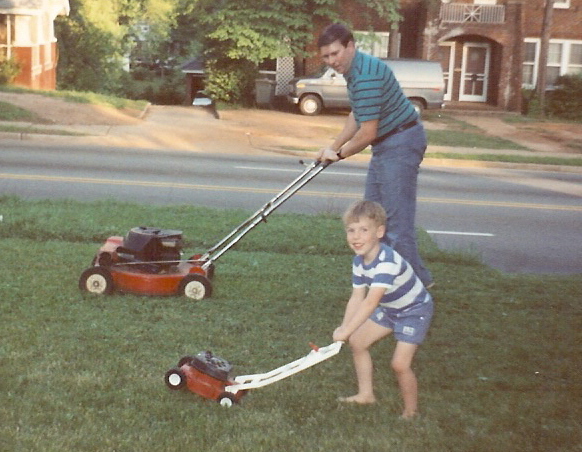
4. Mowing with Granddad. Since we have a riding lawnmower and Jason has a big yard, Jim cuts his grass. Lawn mowing day is Timothy’s favorite! So we got him a tractor like Granddad’s for his birthday, and then tried to recreate a picture from when Jason was little.

Mowing together 2

Timothy wasn’t quite in the mood to take pictures. 🙂 I didn’t notice til my son and daughter-in-law pointed it out to me that Timothy even dressed like Granddad. 🙂

5. Good medical results. I had my mammogram and bone density scan this week. The former was fine. I haven’t gotten the results of the latter yet. Then Jim had his first eye exam since his diabetes diagnosis, and everything was fine there: he didn’t even need to change his prescription.

I mentioned last week that his colonoscopy went well. We got a notice later that the polyps they sent for testing had precancerous cells, which, as I understand it, may be a problem in the future but may not. All they recommended was that his next colonoscopy should be in five years rather than ten, and that our kids should probably have a colonoscopy before their fifties. I hate that note of uncertainty, but there’s nothing to be done except wait and see what develops. And eat lots of fiber. 🙂 At any rate, it’s nice to have all that kind of thing done with for a while.

Happy Friday!

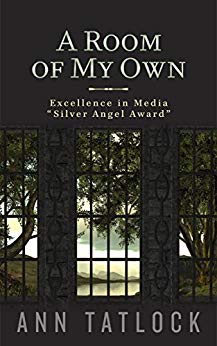
Book Review: A Room of My Own

Room of my ownIn A Room of My Own by Ann Tatlock, Virginia Eide’s family was not rich, by her father’s definition, but they were better off than most during the Depression. He was a doctor, which at least provided steady work, even if some people paid in goods and services rather than cash.

But not everyone had steady work. Ginny’s uncle’s loss of his job led to his whole family living with the Eides, with Ginny having to give up her room and sleep with her younger sisters.

The Depression also led to a shanty camp being set up outside of town called Soo City. People who had lost their jobs had nowhere else to go. They tried to rig up some kind of shelter to stay in while they looked for work.

When Virginia’s father was called to help a woman in labor in Soo City, Virginia’s mother had misgivings. Every time he was called there, she had a feeling that something bad was going to happen.

Of course, there were the usual opinions around town that the Soo City residents were bums, that they could find work if they wanted to. To combat those attitudes and develop Ginny’s empathy, her father asked her to assist him in his rounds there. He didn’t tell her his purpose: he just told her he could use her help. Likewise, when he gave some of their home-canned goods to Soo City residents, he asked if they could take the old jars of food off their hands because his wife was getting ready to start this year’s canning. He made them feel like they were doing him a favor.

Ginny feels important helping her father, and she comes to know many of the residents by name.

Meanwhile, her uncle has become involved with a man trying to set up a labor union, while townspeople accuse strikers and unionists of Communism.

Things come to a head with both the strikers and Soo City, bringing tragedy to Virginia’s world and jolting her out of childhood.

I loved the back-and-forth between Ginny’s girlish activities with her friend and her fledgling forays into being grown up. I loved her father’s gentle and thoughtful example. And I loved Ginny’s coming-of-age in a manner she had not expected.

Some of my favorite quotes:

We can’t help worrying sometimes. But in spite of what we feel, we can still trust God to do what’s right.

Fear, I discovered in that moment, is as contagious as disease–maybe even more so because it takes only a moment, a few words, or a look for it to leap from one person to the next.

Most people might just be glad it was the other fellow hit by hard times, but a sensitive person like you probably can’t look on the suffering of another without feeling guilty that you aren’t suffering in the same way. But you have to look at it this way. If you and I had nothing, we’d have nothing to give. And if we had nothing to give, our friends down in Soo City might be just a little bit worse off.

I was so overwhelmed by feelings that I couldn’t feel anything anymore.

I missed home. I missed the routines of our lives, all the otherwise unnoticed customs–meals together around the kitchen table, and evenings together on the porch or around the radio, all the untroubled hours of work and play and rest. How sweet all those simple things seemed now. How much I longed for that completely unromantic but loveliest of lives.

American flags waved from front porches all up and down our street. I saw the patriotic gesture as ironic–people had been complaining about our country all year long, but now that it was Independence Day, they went right ahead and celebrated as usual. Maybe it wasn’t hypocrisy that led to the flags and the fireworks. Maybe it was hope.

So for a time, with Charlotte at my side, I almost forgot where I was and why I was there. Friends can do that, bring a bit of real comfort in a time of distress like balm on a wound.

I love this one for the description, as one who grew up with oscillating fans before central air-conditioning was common: “The one small fan in the corner turned its head from side to side, giving off mechanical sighs of contentment as it blew warm air across the room.”

When I looked this book up on Amazon, I was surprised to see a note that it was written for the general market but “may contain content of an inspirational nature.” There is a natural faith element woven into the story without being at all preachy.

All in all, a very good book.

(Sharing with Booknificent, Literary Musing Monday, Carole’s Books You Loved)

End-of-April Musings

I’ve always loved this poem this time of year, because it’s so true and so cleverly stated:

Spring

The sun was warm but the wind was chill.
You know how it is with an April day
When the sun is out and the wind is still,
You’re one month on in the middle of May.
But if you so much as dare to speak,
A cloud comes over the sunlit arch,
A wind comes off a frozen peak,
And you’re two months back in the middle of March.

—Robert Frost

Spring seems to have relaxed its back-and-forth entry and gotten settled in, hopefully for a long stay. We’ve had a couple of days in the 80s, but for the most part the temperatures are at their most pleasant this time of year.

It’s odd how days seem harder to schedule when they are open-ended than when you have to work around a number of obstacles. I think maybe because unscheduled days have so many possibilities, it’s hard to narrow down the choices. Or maybe there’s not that sense of urgency that I have to get this done in this small window of time, so I tend to meander rather than dig in.

I have gotten lots of extra household tasks done this month, with cleaning out and rearranging kitchen cabinets and the pantry. Just this afternoon I found some better spaces for certain items. That kind of thing does make one feel good and accomplished!

But I still haven’t gotten back into my writing like I want to. I think it’s mostly because I am at the stage of needing concentrated time rewriting and shaping each chapter. It’s a lot easier to just write off the top of one’s head than to wrangle it into some coherent order. I think perhaps I need to dedicate a day of the week or a week of the month to writing. When I used to compile a ladies’ newsletter booklet for our former church, that was the main focus one week of the month. Up until a few months ago, I couldn’t really schedule my time very well because I never knew what would come up on any given day, with hospice people coming in and out and my husband working at the kitchen table. But now perhaps I can set aside some focused time for working on this book. I’m excited about it – I just need to get to it!

The exercise front has gone well, though, since we bought a used exercise bike. I try to use any day I don’t have to be somewhere, which usually amounts to 3-5 times a week. I’ve increased my time plus the resistance just a bit.

Our biggest events this month all happened within a week of each other: my oldest son came for a week’s visit, my grandson turned five, and we celebrated Easter. My husband took that week off and Jason took a couple of afternoons off. We enjoyed the visiting, feasting, games, outings, and chatting. The only card I made this month was for Timothy’s birthday:

IMG_1479

The ringmaster was from a Cricut design; everything else was freehand. That was the theme for this birthday:

IMG_0021(2)

On the reading front, I’ve completed the following:

The Fashion Designer, a novel by Nancy Moser. An English housemaid, Annie, left to her position in the early 1900s to pursue her own American dream of working in the fashion industry, eventually establishing her own company with friends. But Annie’s not the only one undergoing significant changes. An enjoyable read, and I loved the author’s notes in the back about the era and industry.

How Green Was My Valley by Richard Llewellyn (audiobook). This is a beautifully written classic about a boy’s coming-of-age in a Welsh mining village in the 1800s, but I wish I had know about a couple of unexpected objectionable elements beforehand.

I’ll Watch the Moon by Ann Tatlock will probably be one of my top ten books read this year. Told through the eyes of 9-year-old Nova in 1948, various members of a boardinghouse learn that everyone has a story, and God is trustworthy even in circumstances that make no sense.

Booked: Literature in the Soul of Me by Karen Swallow Prior about how books formed her. As an English professor, Karen shares lots of insights that made me understand more fully the books she mentioned that I’ve already read and made me want to read others I hadn’t thought I’d be interested in. Lots of food for thought here.

A Room of My Own by Ann Tatlock. I just finished this last night and hope to review it soon. I had enjoyed I’ll Watch the Moon so much, I decided to look up Ann’s other books I had collected through Kindle deals.

This is less than I usually read in a month, but Booked was not one to rush through, and How Green Was My Valley was long. Plus I didn’t read a whole lot during the week everyone was here, and I listened to a couple of Christian Publishing Show podcasts during my usual time for audiobook listening.

I’m currently reading:

Around the blog this month:

  • Giving of Ourselves in Ministry to Others. Sometimes setting up a program is the right response to minister to others. But sometimes we can just go through the motions of a program. True ministry involves giving of oneself.
  • The Forgotten Element in Bible Reading, taking time to think through what we’ve read rather than just making our way through a certain amount of material.
  • My Writing Journey.
  • Giving Out of Our Poverty. Thoughts from those Macedonians in Acts who wanted to give to help others even though they themselves were in poverty. They encouraged me when needing to give, not financially, but of myself when I felt I didn’t have anything to give. God meets those needs with His grace.
  • Strong Women in literature and the Bible.
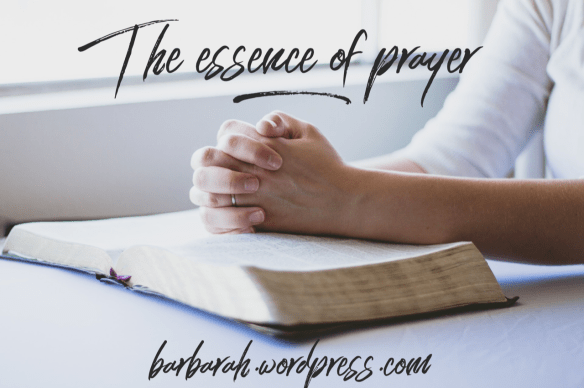
  • The Essence of Prayer: not just going through a form or ritual, but communication with our Dearest.

Although I didn’t plan it this way, a lot of my posts this month seemed to deal with not just going through outward forms in our quiet times or service to others. It’s so easy to slip into automatic pilot. Then in my quiet time reading just this morning, one of the ESV Study Bible comments on Hebrews 10:5-7 said, “God desired faithful hearts and lives more than mere performance of sacrificial rituals.” Amen. May we always be genuine and faithful.

(Sharing with Shannan)

The Essence of Prayer

So many posts and articles I see concerning prayer try to offer something new and exciting to the table. Sometimes it’s a particular form, ritual, or activity. One title said something like “5 Prayers to Unleash God’s Power in Your Life.” As if we have God on a leash!

I wonder if we’ve forgotten the essence of prayer. We’re told when we first become Christians that Christianity is not just a list of rules or a system of activities: it’s a relationship with God. But sometimes we can lose that focus and end up just doing things rotely. Remembering that we’re communicating with a Person can transform our viewpoint. The Bible uses different metaphors to picture the various aspects of our relationship with God: father/child, bride/bridegroom, shepherd/sheep, king/subject, master/servant, Savior/sinner, teacher/disciple.  Sometimes we approach God with those different aspects in mind. I most commonly think of prayer as just talking to our heavenly Father due to the prayer Jesus taught, the one we commonly call “The Lord’s Prayer.” We don’t search for different forms with which to talk to our earthly parents: why do we do so with God?

Well, prayer is a little different. For one, we can’t see God, so that feels a little awkward sometimes. And, for another, He is God, after all. That can be a little intimidating. And then, how can we have a conversation when we fall asleep mid-sentence or have to juggle massive prayer lists?

The best place to learn to pray is the Bible. We don’t have to restrict ourselves to just the words of Scripture, but they can form the basis of our approach to God. Jesus gave us a pattern for prayer in what is commonly called “the Lord’s prayer” (Matthew 6:9-13). The psalms give us multiple examples of someone pouring his heart out to God, even his not-so-nice feelings, reminding himself of truths about his God and straightening out his thinking. The epistles include marvelous examples of prayer. When we pray these Scriptures, we know we’re praying according to God’s will. We base our hope in God’s answer on what He has said. David said, “O LORD God, the word that thou hast spoken concerning thy servant, and concerning his house, establish it for ever, and do as thou hast said.” (2 Samuel  7:25, KJV). The psalmist of 119 said, ” Remember your word to your servant, in which you have made me hope” (verse 49).

Other Bible passages provide wonderful examples of prayer that we can learn from. Nehemiah’s quick prayer before answering the king (Nehemiah 2:1-8) is one of my favorites, because I send up those quick requests for help or wisdom frequently. On the other end of the spectrum are all 176 verses of Psalm 119, the longest chapter in the Bible. We have Daniel’s prayer, Habakkuk’s, Jesus’ prayer for His disciples in John 17, His agonized prayer in Gethsemane, Paul’s and Peter’s prayers for their readers in the epistles, and multitudes of others. I’ve copied various prayers from the Bible into the “Notes” section of my phone to have them quickly available. One of my favorites is from Colossians 1:9-12 (KJV):

For this cause we also, since the day we heard it, do not cease to pray for you, and to desire that ye might be filled with the knowledge of his will in all wisdom and spiritual understanding; That ye might walk worthy of the Lord unto all pleasing, being fruitful in every good work, and increasing in the knowledge of God; Strengthened with all might, according to his glorious power, unto all patience and longsuffering with joyfulness; Giving thanks unto the Father, which hath made us meet to be partakers of the inheritance of the saints in light.

See how immensely different this prayer is from the kinds of prayer requests we usually share with each other? It’s certainly not wrong to pray for health needs and financial concerns and such, but we need the elements in this prayer so much more than any physical desire.

Sometimes we compartmentalize our quiet time with a certain amount of Bible reading, prayer, and maybe memorization. But we can pray while we’re reading the Scripture. When we come to a passage of praise, we can lift our hearts in praise to God right in that moment: we don’t have to make a note of it to remember later when we pray. It’s the same with a petition or intercession for others. When something we read in the Bible reminds us of a need in our lives or others’ we can stop and pray right then. I used to think something wasn’t “officially” prayed for unless I had mentioned it during my quiet time, but later I learned I could talk to God all day, mentioning requests and concerns as they arose.

The Bible says that the marriage relationship pictures that of Christ and the church. So let’s compare the two in the realm of communication. Husbands understand if a wife has a super-busy day or if she is tired. But if that happens all the time, and she is frantically running around taking care of children, housework, even outside ministries, and never has time to just sit down with him, he’s not going to feel loved and wanted. If she spends the time they do talk in losing focus, daydreaming, pondering what to put on her grocery list, he is not going to feel heard. If the only time she communicates with him is on the run while doing other things or when she needs him to do something, or if their only conversation is in the last few  minutes before sleep when they’re drifting off in mid-sentence, their relationship is going to suffer.

There is nothing wrong with those types of communication in themselves. We are to pray without ceasing, all through the day, even while doing other things, as I mentioned before. He wants us to come to Him with our needs, and ending the day talking with Him is lovely. But there needs to be some times of just pure focus on Him, on worship and learning from Him. Even though God doesn’t “need” us in the same sense a husband does, He wants to fellowship with us, and He knows we need to hear Him.

Because we’re easily distractible, sometimes it does help to have something to help us remember what we’re doing. Some use acronyms, like ACTS: adoration, confession of sin, thanksgiving, and supplication. Another is PRAY: pray, repent, ask, yield. Sometimes if I have a hard time keeping my thoughts together, I pray through the Lord’s prayer, stopping at each phrase to expand the thought in my own words. For instance: “‘Our Father, which art in heaven’…thank you for your omniscience. You know every care in my heart as well as the rest of the world. Thank You for Your power, Your Holiness, Your love,” and so on.

Elisabeth Elliot said of distractions:

Distractions can be useful. They provide constant reminders of our human weakness. We recognize in them how earthbound we are, and then how completely we must depend on the help of the Holy Spirit to pray in and through us. We are shown, by a thousand trivialities, how trivial are our concerns. The very effort to focus, even for a minute, on higher things, is foiled, and we see that prayer–the prerequisite for doing anything for God–cannot be done without Him. We are not, however, left to fend for ourselves.

The Spirit too comes to help us in our weakness. For when we cannot choose words in order to pray properly, the Spirit himself expresses our plea in a way that could never be put into words, and God who knows everything in our hearts knows perfectly well what he means, and that the pleas of the saints expressed by the Spirit are according to the mind of God” (Romans 8:26-27 JB) (A Lamp For My Feet).

In another place, Elisabeth said:

When I stumble out of bed in the morning, put on a robe, and go into my study, words do not spring spontaneously to my lips–other than words like, “Lord, here I am again to talk to you. It’s cold. I’m not feeling terribly spiritual….” Who can go on and on like that morning after morning, and who can bear to listen to it day after day?

I need help in order to worship God. Nothing helps me more than the Psalms. Here we find human cries–of praise, adoration, anguish, complaint, petition. There is an immediacy, an authenticity, about those cries. They speak for me to God–that is, they say what I often want to say, but for which I cannot find words.

Surely the Holy Spirit preserved those Psalms in order that we might have paradigms of prayer and of our individual dealings with God. It is immensely comforting to find that even David, the great king, wailed about his loneliness, his enemies, his pains, his sorrows, and his fears. But then he turned from them to God in paeans of praise.

He found expression for praise far beyond my poor powers, so I use his and am lifted out of myself, up into heights of adoration, even though I’m still the same ordinary woman alone in the same little room. (From the chapter “Meeting God Alone” in On Asking God Why).

She went on to say that hymns were another source she used. They often combined prayer and praise

So sometimes we can use these boosts to our prayers as long as we remember that relationships are built on and maintained by communication, not just going through motions, not just repeating “vain repetitions” (Matthew 6:7, KJV), or “empty phrases” (ESV). God communicates with us through the Bible; we communicate with Him through prayer. May we always keep in mind that our time in prayer and the Word of God is communication with the One who loves us more than anyone else could and desires our fellowship and worship.

(Sharing with Inspire Me Monday, Literary Musing Monday, Tell His Story, Let’s Have Coffee, Share a Link Wednesday, Grace and Truth, Faith on Fire)


Laudable Linkage

Here’s my latest roundup of good reads on the Web:

Gospel Hope for a Weary Mom, HT to The Story Warren. “The good news is, it’s not our perfect love and perfect parenting that will reflect Jesus to our children; it’s admitting our dependence on Christ’s perfect love and perfect life that points them to their own need for a Savior.”

Love Hopes All Things–and Tosses the Worst Assumptions, HT to Challies. “With the admonition to be slow to speak we should also remember, So be slow to assume.”

What Do We Do When Our Stories Collide? “Yes, at first, the timing for the two stories could seem awkward at best, even insensitive. But it was also an honest view of real life. How we can be dealing with one thing – a joy-filled occasion – and be unaware that the person next to us can be grieving.”

Individual and Community Discipleship. Discipleship isn’t always about two people working through a curriculum. “I have a received a lot of discipleship from Christians who were just doing what God made them to do.” Me, too.

A “God Is Faithful” party. When friends didn’t want the attention of a going-away party, Sue turned it into a “God is faithful” party. Love this idea!

An RV Renovation, HT to Decor to Adore. Wow! Inspiring!

This video was shared at Appointment Etiquette at a Writing Conference. It’s all about the wrong ways to get your manuscript to an agent or publisher, but I think you’ll find it funny even if you’re not interested in publication:

Happy Saturday!

Friday’s Fave Five


It’s Friday, time to look back over the blessings of the week with Susanne at Living to Tell the Story and other friends.

Here are some of the best parts of the last week:

1. Time with family. My oldest son was here all the week before and just headed back Sunday morning. We saw Jason, Mittu, and Timothy every day Jeremy was here. We got in some game-playing and talking as well as a trip to the zoo and an Easter egg hunt.

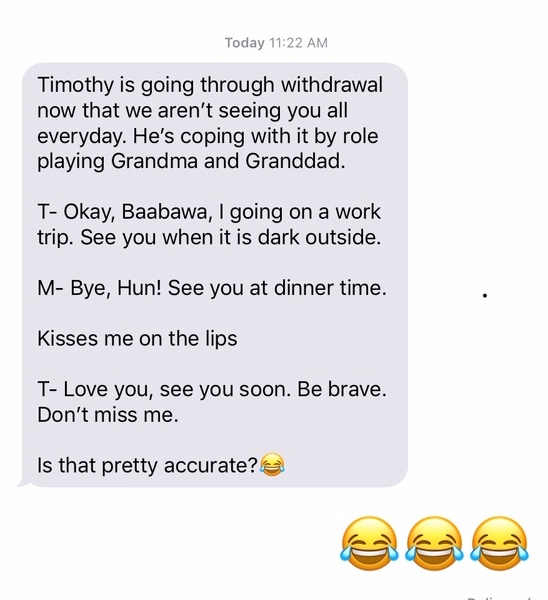
2. Quiet days after busy ones. Much as we love having everyone together and all the extra things to do, it was nice to just crash after Sunday morning church for the rest of the day. My daughter-in-law sent me this text, which made me smile.

IMG_0533(1)

3. Easter. Though in some ways, every Sunday is a commemoration of  Jesus’ resurrection, it’s a blessing to spend concentrated time focusing on it. We had our Easter dinner and other activities the day before while everyone was here. So it was nice on Sunday to just heat up some leftovers after church.

IMG_0157

IMG_1506

IMG_1495

4. Good medical results. Some of you remember that my husband had a cancerous kidney removed a few years ago. He has to have a follow-up CAT scan occasionally to make sure everything’s ok. That kind of cancer doesn’t usually spread, but there’s no ironclad guarantee. So a clean scan is good news indeed. Then he also had to have a routine colonoscopy Monday (another reason we had our Easter dinner on Saturday). Everything looked fine except for a couple of teeny polyps that were sent off for testing but weren’t expected to be problematic.

5. Lunch with a friend. Good fellowship, good food. And especially nice this time, since it gave me something to look forward to after a not-very-fun dentist appointment.

Bonus: Crossed-off to-do lists. On Mondays I usually make a list of things that have to get done as well as things I’d like to get to that week. Whatever’s left at the end of the week goes on to the next week’s list. It’s rare that every single item gets crossed off, but it happened recently!

Happy Friday!


Book Review: Booked: Literature in the Soul of Me

Karen Swallow Prior is a professor of English at Liberty University. In Booked: Literature in the Soul of Me, she shares how books taught and influenced her throughout her life.

Books have formed the soul of me. I know that spiritual formation is of God, but I also know—mainly because I learned it from books—that there are other kinds of formation, too, everyday gifts, and that God uses the things of this earth to teach us and shape us, and to help us find truth (p. 10).

In commenting on her parents being pretty free in what they allowed her to read, Karen says:

It seems to be to be an entirely negative, not to mention ineffective, strategy to shield children from reality rather than actively expose them to the sort of truth that merges organically from the give-and-take of weighing and reckoning competing ideas against one another (p. 14).

That sounds a lot like Hebrews 5:14 (ESV): “But solid food is for the mature, for those who have their powers of discernment trained by constant practice to distinguish good from evil.” Karen goes on to say:

Books meet with disapproval because of their objectionable content. Wisdom, however, considers not only what a book says (its content), but how it says it (its form). Just as important–or perhaps more important than–whether a book contains questionable themes like sex or violence or drugs or witchcraft or candy is how those topics are portrayed. Are they presented truthfully in terms of their context and their consequences? Are dangerous actions, characters, or ideas glamorized in such a way that makes them enticing? (pp. 14-15).

Karen came to these conclusions not only from her own experience, but also from John Milton’s Areopagitica, a tract against censorship. Milton’s fellow Puritans wanted to ban books that they deemed unworthy. Milton argued instead that books should be “promiscuously read.” “Promiscuous” did not have the sexual connotations then that it does today: it just meant “indiscriminate mixing” (p. 22).

The essence of Milton’s argument is that truth is stronger than falsehood; falsehood prevails through the suppression of countering ideas, but truth triumphs in a free and open exchange that allows truth to shine (p. 10).

Milton goes on to argue that “our faith and knowledge thrives by exercise,” that “Moses, Daniel, and Paul . . . were steeped in the writings of their surrounding pagan cultures,” and even bad books “to a discreet and judicious reader serve in many respects to discover, to confute, to forewarn, to illustrate”(pp. 22-23). He asserts, “Truth is strong . . . Let her and falsehood grapple; who ever knew Truth put to the worse, in a free and open encounter?” (pp. 23-24).

I don’t think either Milton or Karen are saying that “anything goes.” But we don’t have to restrict our reading to just that with which we already agree. Karen quotes 1 Thessalonians 5:21: “Test all things and hold fast that which is good” (p. 22).

I’ve spent the most time on this first chapter because I found it so fascinating. I don’t remember exactly when I started to come to some of these same conclusions– I think maybe during or not long after college. I realized that the Bible itself contains what many would consider objectionable elements, but it handles them in a way that does not glorify sin but exposes truth.

Karen goes on to discuss several different literary works and how they influenced her thinking. Charlotte’s Web had much in common with her own childhood and her grandparents’ farm (though her pet rooster wasn’t granted the same reprieve as Wilbur). Gerald Manley Hopkins’s “Pied Beauty” revealed the unexpected beauty found in surprising places. Jane Eyre’s quest to become her own person rather than Rochester’s mistress or St. John’s missionary wife gave insight to Karen’s emerging self between eighth-grade cliques. Vocation, sexuality, faith, doubt, love, and marriage were likewise informed by Karen’s reading.

I greatly enjoyed Karen’s discussion of books I was familiar with. Her chapter on Gulliver’s Travels helped clear up aspects of the book I had been confused about. Her discussion of Tess of the D’Urbervilles and Madame Bovary made me want to read both of those books. I knew the former was about a girl in Victorian times who got pregnant and the latter was about an adulteress, and I had figured both would be somewhat risque.  But Tess has to do with purity of heart. Either due to naivete or rape, she had gotten pregnant, which at that time meant she was “ruined.” Yet Hardy presents her purer of heart than the society that so harshly judged her. And Madame Bovary shows Emma’s struggle between the idealized life she longed for that would never be true while she missed the joys of everyday reality.

Madame Bovary changed my worldview. It made me realize that happiness is in here, not out there. That the imperfect love of a real person is far greater than the perfect love that exists only in fairy tales or movies. That living happily-ever-after begins with embracing life–not fleeing to fantasies–today (pp. 176-177).

Karen mentions throughout the book that she grew up in a home with believing parents and regular church attendance. Though she “asked Jesus into her heart” at a young age, she led a double life of sex, drugs, and drinking. She realized as an adult that she had never asked Jesus into her mind, and the Bible tells us to love Him with all our heart, soul, and mind. Furthermore, she realized that repentance involves a change of mind that results in a change of actions. While much of the book tells how God brought her to this place step by step, I wish she had included a little more about how this change came about from professing faith to really embracing it for herself.

I will warn some readers that Karen is quite frank about some of her thinking and activities in this split part of her life. But I think it’s important to realize that many young people (and even older people) are the same way, and hearing their stories will help us understand them better.

A few more quotes that stood out to me:

In focusing my attention on things much bigger than myself, ironically, I learned who I was. It’s the lesson, once again, that beholding is becoming (p. 142).

[Jonathan] Swift’s orthodox theology led him to a realistic understanding that all of man is fallen, and this includes man’s reason . . . His method was to expose the errors of rationalism by taking it to its logical extreme (p. 129).

I wanted not only to comfort the young woman, but also to get her to see that talking about such an event in a book was a safe, constructive way of dealing with these issues (pp. 101-102).

I’d love to audit Karen’s classes. I enjoyed the insights she brought out from the various works she cited and how they influenced her own growth.

(Sharing with Carole’s Books You Loved, Booknificent)

Strong Women

IMG_1507

A friend and I were discussing the two half-sisters in The Woman in White by Wilkie Collins. Marian Halcombe is gracious, smart, strong, and capable, but ugly. Laura Fairlie is pretty and sweet, but somewhat weak and fragile. You can guess which one gets the guy.

That discussion led to thinking about other women in literature. Dora, the first love of David Copperfield, was pretty, sweet, and charming, but childish and totally inept as a household manager. She even told him to think of her as a “child wife.” After failed attempts to strengthen Dora, David had to just accept and love her as she was. But Agnes, his friend whom he later came to love after Dora’s death, was steady, capable, strong, and mature, and they could support and help each other. Lucie Manette from A Tale of Two Cities came up in the aforementioned discussion as a Victorian ideal of the weak damsel in distress, but I disagreed. I think she had to be very strong to take in a father who was mentally disabled after so many years locked up unjustly in the Bastille and and nurse him back to health. Then she traveled to France at the height of the French Revolution to find out what had happened to her husband when she feared he was in danger. Elinor Dashwood in Sense and Sensibility is another strong literary woman. She was steady, had to manage the household frugally even when the rest of the family complained, had to reign in her emotions to do the honorable thing, as opposed to her sister, Marianne, who gave free reign to her emotions and whims. Ma Ingalls is another: I honestly don’t know how she dealt with the sheer hard work of her life as well as the loneliness of being away from other people so much.

I am not a feminist by any means, but I do like to see a female protagonist who does have some umph to her, who adds more to the story than a pretty face.

Besides literary examples, we have a plethora of strong women in the Bible. How could Mary, the mother of Jesus, endure all she did without His strength? Other strong biblical woman are Jochebed, Moses’ mother, who defied Pharaoh to protect her son; Rahab, who took a great risk to hide the Hebrew spies because of her faith in their God; Deborah, a judge who went to battle; Hannah, in grief over her barrenness, yet knowing to whom to turn; Esther, who risked her life to intercede for her people before the king; Priscilla, who helped her husband in business and in discipling; Mary and Martha, strong in different ways; Joanna and the other women who ministered to Jesus’s needs, and so many more.

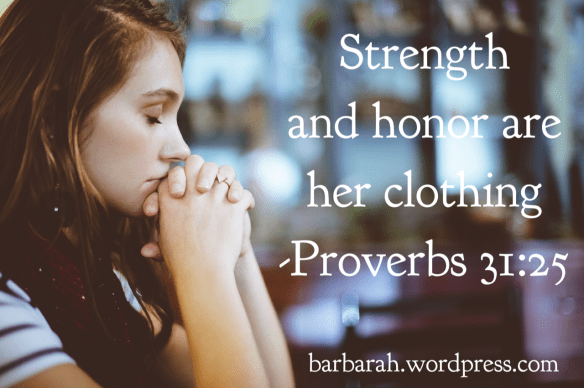
Being strong is not an unfeminine trait. In fact, Proverbs 31 says of the virtuous woman, “She girdeth her loins with strength, and strengtheneth her arms,” and “Strength and honour are her clothing.”

She is strong in character: excellent, or virtuous in some versions (verse 10), trustworthy (verse 11), does her husband good (verse 12), kind and compassionate (verses 20, 26), characterized by honor (or dignity in some versions) (verse 25), praiseworthy (28-31).

She is strong in industriousness and initiative: She “works with willing hands” (verse 13), she gets up early to start work and serve others (verse 15) – she’s not still in bed late in the morning waiting on someone to serve her (except maybe on special occasions), she weaves and knows her products are good (verse 18-19), she works into the evening (verse 18), she makes nice clothing (verse 21-22, 24), she makes products to sell (verse 24), she looks well to the ways of her household and is not idle (verse 27).

She is strong physically (verses 17, 25): she plants (verse 16),

She is strong mentally and intellectually: she seeks good products and prices (verses 13, 14, 16), she plans ahead for bad weather (verse 21), she is wise (verse 26).

She is strong spiritually: she fears the Lord (verse 30).

We can sometimes get discouraged just thinking about this epitome of womanhood, but as I like to say, she didn’t do all of that in a single day. And I don’t think we have to take up weaving, plant a vineyard, or have a home business to become virtuous women. But taken as a whole, the tenor of her life is that of strength, industry, and honor. She is definitely not a “damsel in distress,” but she doesn’t need to assert her strength by challenging her husband or stepping into his role.

Admittedly we all experience times of weakness, tiredness, and weariness, and there are times we do need rescue. I’ve so appreciated the times my husband has come to my aid when I’ve gotten stuck or over my head in a project, behind in getting ready for company, overwhelmed with a ministry activity, etc. As a family we all pitch in and help wherever needed rather than standing back and saying, “That’s your responsibility, not mine.” There is nothing wrong with a husband helping and serving his wife: if he loves as Christ loves the church, Christ helps and serves us. But I did struggle in early marriage with wanting my husband to help me in every little thing and having to remember that I am supposed to be a help meet for him. We don’t depend on our husbands instead of the Lord, but we do depend on their God-given assets and strengths. Our husbands also need to depend on us to be able to stand strong in the Lord’s strength. And God enables us to minister to others and give of ourselves even when we feel depleted.

We don’t usually step up to the brink of adulthood or marriage strong in all the ways we need to be. Strength of character has to be developed just as physical strength does. When you first start exercising physically, the first thing you notice is how weak and out of shape you really are, but starting to exercise even in weakness is the first step to developing strength. Often God develops strength in us by putting us in situations where we are totally weak. I could not have endured my husband’s many travels without learning to lean on the Lord for strength, but I was pretty much a basket case at first. I can remember the dismay of realizing as a young mother that I couldn’t just take to my bed when I was sick when I had little ones to take care of. I was probably overly dependent on my husband at first, but had to learn how to make decisions and take care of things while he was at work and out of reach.

Jonathan and Rosalind Goforth were missionaries to China from1888-1936. She had written his biography, and then by request wrote Climbing, one of my all-time favorite books, about missionary life and furlough from her perspective. She writes not as a “super-Christian,” but rather as a woman “of like passions” as we are. She writes in one place:

It was while I had a large family of little children about me and mission work was pressing heavily upon me, while feeling burdened and that strength was insufficient, I sought to find in God’s Word whether there were any conditions to be fulfilled for the receiving of divine strength. The result of this study was a surprise and joy to me, and later a blessing and help to many to whom I passed it on, for every condition the weakest could fulfill!

Conditions of receiving strength

1. Weaknesses. II Cor. 12:9-10
2. No might. Isa. 40:29
3. Sitting still. Isa. 30:7
4. Waiting on God. Isa. 40:31
5. Quietness. Isa. 30:15
6. Confidence. Isa. 30:15
7. Joy in the Lord. Neh. 8:10
8. Poor. Isa. 25:4
9. Needy. Isa. 25:4
10 Dependence on Christ. Phil. 4:13

The key is in Hebrew 11:32-34: “And what shall I more say? for the time would fail me to tell of Gedeon, and of Barak, and of Samson, and of Jephthae; of David also, and Samuel, and of the prophets: Who through faith subdued kingdoms, wrought righteousness, obtained promises, stopped the mouths of lions, Quenched the violence of fire, escaped the edge of the sword, out of weakness were made strong, waxed valiant in fight, turned to flight the armies of the aliens.”

Jesus said, “My grace is sufficient for thee: for my strength is made perfect in weakness” (II Cor. 12:9-10).

The song “I Could Not Do Without Thee” by Francis Ridley Havergal says it well:

I could not do without Thee,
I cannot stand alone,
I have no strength or goodness,
No wisdom of my own;
But Thou, beloved Savior,
Art all in all to me,
And weakness will be power
If leaning hard on Thee.

May you “be strong in the Lord, and in the power of his might” (Ephesians 6:10) today.

(Revised from the archives)

Update: I discovered this afternoon that Dr. Michelle Bengtson’s post, 10 Scriptures for When You Need Strength, shared even more from God’s Word to strengthen us.

(Sharing with Inspire Me Monday, Literary Musing Monday, Tell His Story, Let’s Have Coffee, Porch Stories, Share a Link Wednesdays, Faith on Fire, Grace and Truth, Booknificent)

Happy Easter!

Happy-Easter-Resized-Blog

The strife is o’er, the battle done;
The victory of life is won;
The song of triumph has begun: Alleluia!

The powers of death have done their worst;
But Christ their legions hath dispersed;
Let shouts of holy joy outburst: Alleluia!

The three sad days are quickly sped;
He rises glorious from the dead;
All glory to our risen Head! Alleluia!

He closed the yawning gates of hell;
The bars from heaven’s high portals fell;
Let hymns of praise His triumphs tell! Alleluia!

Lord, by the stripes which wounded Thee,
From death’s dread sting Thy servants free,
That we may live, and sing to Thee: Alleluia!

Alleluia! Alleluia! Alleluia!

~ Author unknown, translated by Francis Potts

(Graphic courtesy of Jenn at Clean and Scentsible)