Book Review: Hidden Places

Hidden PlacesIn Lynn Austin’s novel Hidden Places, Eliza Wyatt is a young widow with three children in the 1930s. After her husband’s death she had stayed on with her intractable father-in-law at Wyatt Orchards. But now he has died as well. She’s not sure how she is going to manage, but she wants to keep the house and orchards, the only true home she has ever known. With the Depression, she couldn’t sell it, anyway.

One night while doing chores outside she is startled by a hobo. She’s not opposed to helping hobos, so she invites him in and feeds him. Then she discovers he has a nasty gash on his leg and ends up tending him through a nearly fatal infection. In the meantime, her husband’s Aunt Betty – usually called Aunt Batty because she seems to have some mental issues — ends up moving in with Eliza when Betty’s roof caves in during a heavy snowfall. But Aunt Batty turns out to be an able hand around the house, and Eliza soon relies on her help. The hobo, Gabe, offers to stay on and help to pay back what Eliza has done for him.

Gabe proves an able hand as well, but seems to have an uncanny familiarity with the farm and its needs. She is drawn to him, but afraid of the past he is not revealing to her. Yet she hides her own past, too: not even her husband knew her background.

It turns out Aunt Batty has a hidden past as well, and an unexpected underlying wisdom.

One theme or motif throughout the book is that of angels, from an opening admonition to “Be not forgetful to entertain strangers: for thereby some have entertained angels unawares” (Hebrew 13:2), to Aunt Batty’s prayer for God to send a guardian angel to Eliza, to other references. Harsh, self-willed fathers turn up in a number of families, and several characters have to learn to follow their dreams despite such fathers and other obstacles. “Hidden places” in each heart come to light eventually, and, by God’s grace, are healed.

A couple of favorite quotes:

“Why did God have to make our lives so fragile and so short?” Walter thought for a moment before answering. “Because life is very precious to Him. He treasures each life He created and He wants us to treasure it, too—like fine porcelain china. God knows what it’s like to live and die in a frail human body like ours. His Son suffered physical death, Betsy, so that you and I can face it without ever being afraid.”

“All these troubles you’ve been having aren’t a punishment from God. He wants to use them to draw you closer to himself.”

Lynn’s writing and characterizations here are stellar. I was drawn in to each character’s story and ached with them through their trials and rejoiced in their triumphs. Excellent book overall.

(Sharing with Semicolon‘s Saturday Review of Books, Carole’s Books You Loved)

Book Review: Fly Away

Fly AwayIn the novel Fly Away by Lynn Austin, Wilhelmina Brewster faces forced retirement after teaching music at a Christian college all her adult life. She’s depressed and doesn’t know what to do with herself. She never married, never had any other hobbies or interests.

She volunteers playing piano at a cancer center sometimes, and one day there she runs into Mike Dolan – and they got off very much on the wrong foot.

Mike is a widower and a pilot who still flies for the business that he started and his son now runs. But Mike has just learned that he has cancer with a life expectancy of only three months. He doesn’t want to put his family through the same agony they experienced when his wife died, so he plans not to tell them. When the cancer gets too bad, he plans to fly – “and forget to land.”

Somehow he ends up telling Wilhelmina his plans, and she is horrified, especially when she learns he is not a Christian. But she has never witnessed to someone in her life. She talks to her pastor, but he feels like she should be the one to talk to Mike, since she knows him. She talks to her pastor brother, but he has someone over the evangelism department in his church and is not much help. She appeals to her professor brother, and he gives her several detailed arguments from Christian apologetics that she knows she won’t remember and doesn’t think Mike would respond to anyway. No one seems to know how to simply tell a dying man about the Savior and hope of heaven.

Wilhelmina tries to give Mike some tracts, but her efforts are thwarted. Somehow, though they keep finding reasons to see each other, and a tentative relationship begins. Mike feels sorry for her when he learns she has been retired against her will and tries to think of things to cheer up up – like a kite-flying contest with his grandchildren, something Wilhelmina never thought in a million years that she would do.

She learns that Mike isn’t just a project. And even though he’s dying, he knows how to enjoy life much more than she does.

My favorite line in the book comes from advice Wilhelmina’s father gives to a friend: “We have two choices, you and I; we can lose ourselves in despair or find ourselves in Christ” (p. 170).

My thoughts:

I loved this story. I could identify with Wilhelmina’s personality so much. There were so many comical moments, yet serious ones, too. The book blurb says one of them is “figuring out how to live, the other how to die.” Lynn’s notes in the book share that this was one of the first books she wrote. The story takes place in 1987, later than her many historical books, but too far back to be called contemporary. It was published in 1996 and went out of print, but has since been reprinted, keeping the 1987 references, which I enjoyed. I am so glad it was reprinted. I would have hated to miss this story.

(Sharing with Semicolon‘s Saturday Review of Books, Literary Musing Monday, Carole’s Books You Loved)

A Gift of Art

My son, Jason, made this bird picture for me:
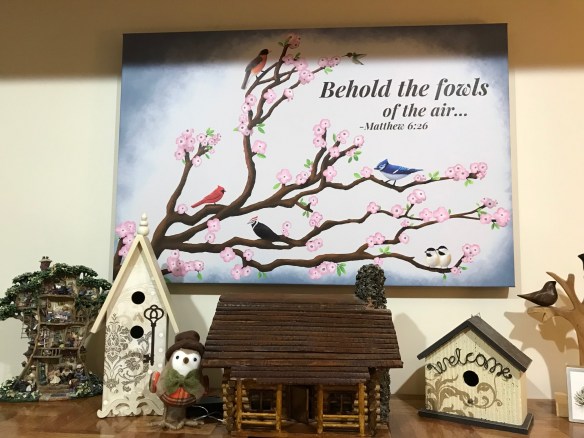
IMG_1184

He used the iPad Procreate program to make the picture and then had it printed on canvas at Photobarn.

It all started with wanting something to fill that space. I had a very small plaque there on an existing nail, just for something, but it was way out of proportion to the area. I had collected some bird-related decorations, so I thought something with birds would be good. I started a Pinterest board called Nest and bird art. I liked several of the pieces there showing bird silhouettes on canvas or wood, so I thought I’d try to do something on canvas. I knew next to nothing about painting on canvas, but those designs looked pretty simple, and I figured I could look up what paints to use. But I just never got going on it.

Then one year Jason made his brother Jeremy this picture on the iPad and had it printed, because Jeremy likes foxes:

Jeremy fox art

And I thought it was really good.

And I thought, “Hey! Maybe he could do my bird picture!” He’s talented in art even without the iPad program. And a bird silhouette should be simple, right?

Little did we know. 🙂

So I asked him, and showed him some samples of the kinds I particularly liked. The family room is in blues and tans with a bit of brown, my concession to the boys’ complaining when they were younger that everything was “too flowery.” (Those who know me well can imagine that. 🙂 ) So I knew I wanted those colors.

Jason emailed me his first draft:
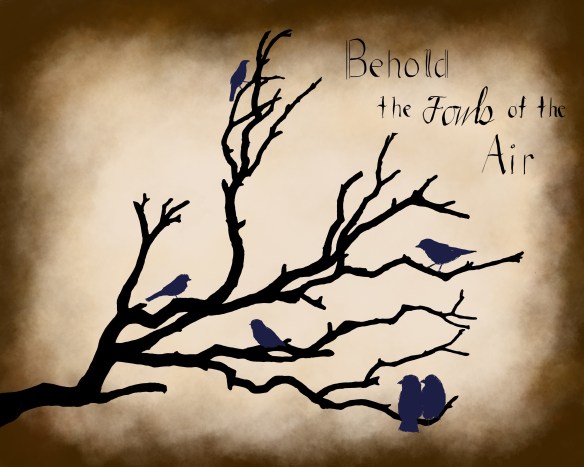
Bird 1 (2)

We both agreed that it looked almost Halloweenish. I decided I wanted different lettering plus a blue background with a brown border. So this was the next draft:
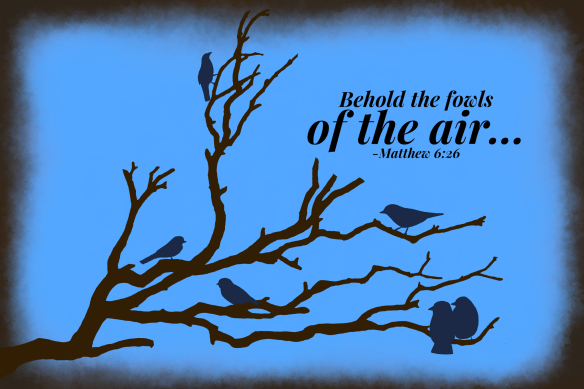
The blue was too blue. I decided maybe the border should be a darker blue and the background lighter. So this was next:
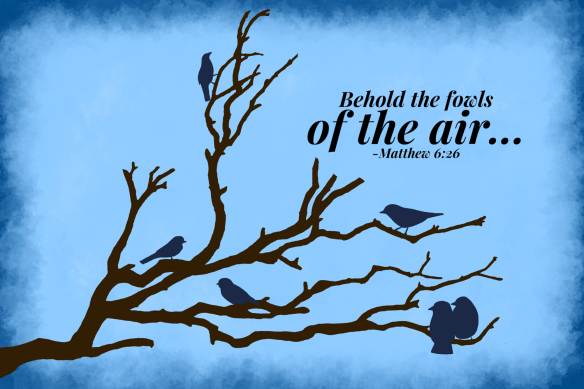
Better, but still not quite there yet. Plus we decided the bird on top looked a little precariously positioned. So next was:
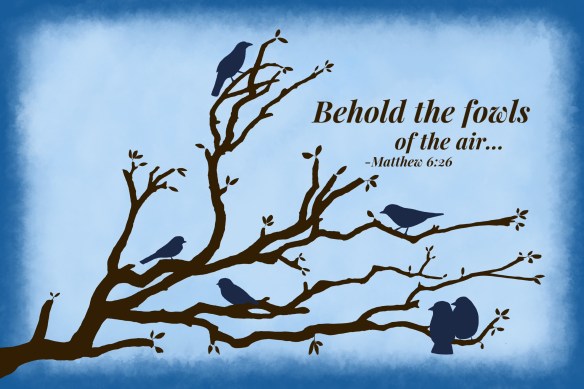
I liked the addition of the leaves and the placement of the top bird but didn’t feel the blues were just right yet.

The next draft was pretty much the same except we increased the width of the border. Then we decided to shape the border around the tree rather than just having it as a rectangle:
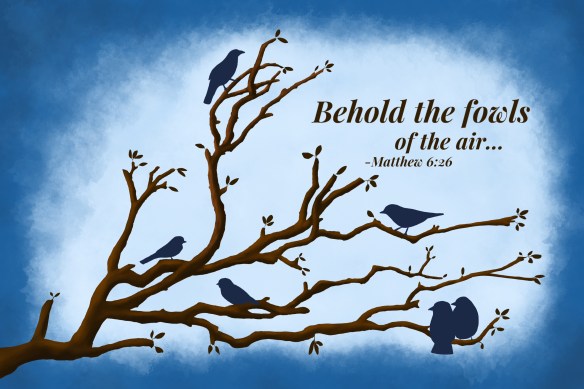
I liked the border much better, and the blue was closer, but still not quite there. Plus Jason had experimented with the tree to make it a little more 3-D rather than a flat silhouette, and I really liked that effect.

I think it may have been at this point that Jason used credits he had at Photobarn to print it off so we could see how the color might change from his iPad to the printing stage. His reasoning was that if it still didn’t come out right, he could sell the printed one while he worked on revising the one on his iPad to his mom’s (hopefully not too) exacting tastes.

One issue with the blue was that this picture would be hanging between two curtains that were kind of a slate blue. It took me years to decide on and then finally make those curtains, along with some matching pillows, so I didn’t want to just toss them. Plus, that’s my favorite shade of blue anyway.

So while Jason was working on the blue, I suggested that maybe since the tree was not just a silhouette any more, maybe he could do something similar with the birds. I don’t think I have the picture of that one, but he tried some light and shadow on them. Then he tried making a couple of them look like actual birds and asked me what I thought. I loved them! So we talked about what birds we commonly saw at our feeders, and he came up with this:
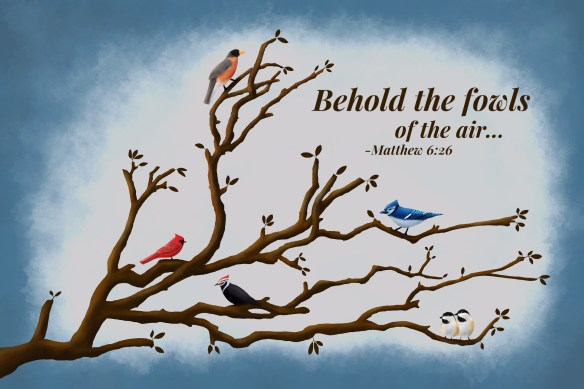
Nice! Then I suggested that maybe the leaves should be green rather than brown, since we had moved from the silhouette to a more realistic looking picture. I can’t find the draft he sent me then, but I felt the green that was used was brighter than I liked, and, because of that, drew attention to the leaves. So I suggested darkening or toning them down a bit or maybe even adding some pink flowers. And then we were discussing that there were as many birds as there were members of our family minus one. I forget which one of us came up with adding a hummingbird to represent Timothy.

Up to the very last minute I toyed with the idea of changing the verse to a newer version, which says “Look at the birds…” rather than “Behold the fowls.” But, besides not wanting to introduce yet another change, I felt that people might recognize this as Biblical language, and if they were familiar with the rest of the passage, it would naturally come to mind. If they just saw “Look at the birds” and missed the reference, they might just look at the birds but miss the larger point.

So, with all the changes, this was the end result:
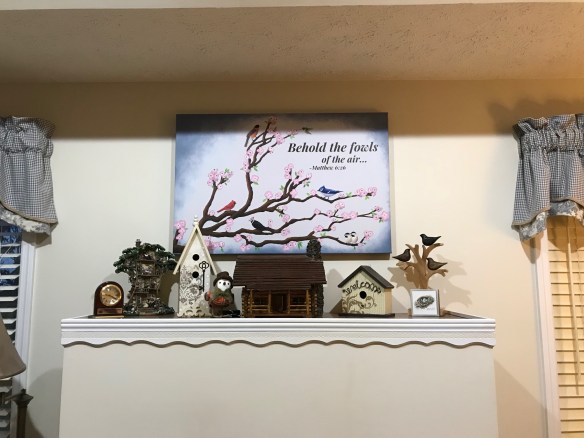
I can’t tell you how much I love it! It blends with the curtains well (although it might not look like it in this photo), it fills the space well, the colors and style are just what I like. And it was made by my very patient son. 🙂 And I got my pink flowers in that room after all. 🙂

I told him at one point that I would have gone through this same process even if I was doing it myself. It seems to take me getting into a project and starting it to think through and decide what I really want. I like to take my time with home decorating decisions because I don’t like changing them often: I want to think thoroughly about all the aspects and end up with an item that I am going to love and keep around for a long time to come.

I am not sure how long, in all, it took to complete this, from the first concept through the thinking, deciding, and changes, on top of his working full time and being a husband and dad. At least a year, maybe two or even more. But I think all the changes were worth it. I love the result, and I am so thankful to have this special piece. Thank you, Jason!

(All art work here is under copyright by Jason Harper.)

Don’t Plug In: Abide

IMG_1188

In our era, we’re used to plugging technology in to recharge. We have to bring power cords on trips and search for a place to plug in. We keep an eye on our phone so it doesn’t conk out on us at important moments. Our vocabulary has grown to include phrases like “recharging our batteries” when we need rest or refreshment or “plugging into” a power source. Some have even used the latter in connection with God and His power and provision.

In yesterday’s reading from Spectacle of Glory by Joni Eareckson Tada, she notes the differences between plugging in and abiding.

Jesus said in John 15:5: “I am the vine; you are the branches. Whoever abides in me and I in him, he it is that bears much fruit, for apart from me you can do nothing.

Joni comments:

We don’t get charged up in God in order to unplug and live on our own–until it’s time for the next charge. No. We never disconnect from Him. We are living branches connected to the living Christ. His life is our life.

Then, in probably the best definition for abiding that I think I have heard, Joni says:

Abiding is living in constant awareness of total dependence on Jesus. It involves a constant flow of life-giving sap from the Holy Spirit–not a spiritual charge that takes us up to 80 percent. Abiding in Christ is a 100 percent relationship.

It’s true that the Bible likens God’s Word to spiritual food, and our relationship with God, our love for Him, and our Christian character all grow as we spend time in the Bible. Our time in the Word of God helps cultivate that awareness of our dependence on Him. But we don’t, as Joni notes, “sit down for our quiet time and ask ourselves, How long do I have to be plugged into God today to get a good spiritual charge?

No, once we believe on Jesus as our Lord and Savior, we’re a vine connected to His branch. His life flows through us. He doesn’t charge us up and then us send us off to live independently til we need another charge. We don’t have to worry about becoming disconnected to Him. He’s always with us, constantly empowering us to live for Him.

I need your presence every passing hour.
What but your grace can foil the tempter’s power?
Who like yourself my guide and strength can be?
Through cloud and sunshine, O abide with me.

Henry Francis Lyte, 1847

(Sharing with Inspire Me Monday, Literary Musing Monday, Let’s Have Coffee, Porch Stories, Woman to Woman Word-filled Wednesday, Wise Woman, Faith on Fire)


Laudable Linkage

IMG_0195

Just a short list today:

Jerks for Jesus: Why the Temple Cleansing (etc.) Isn’t Your Permission to Always Be Fighting, HT to Challies. Yes and amen. I am so tired of reading people who defend their harsh and contentious attitude because of the OT prophets, Paul, and Jesus.

When You Have to Let Go of Your Dream, HT to Linda. “This is a wound, to be sure. But it’s not a mortal wound. This will not kill you. This is not the end. We are closing the chapter, not the book. We are sad and grieving and saying goodbye. And. We are moving on.”

On Direct-to-Consumer Genetic Testing, HT to Challies.

Care package ideas and printable tags to use with them.

The #LoveYourBookstore challenge runs Nov. 10-16, HT to Sarah. The idea is to encourage and draw attention to bookstores by visiting one, taking a picture of a book you are excited to gift, or a selfie with the book, and post it to Instagram or Twitter. And there are prizes!

And one last thought:

Have a good weekend!

Friday’s Fave Five

It’s Friday, time to look back over the blessings of the week with Susanne at Living to Tell the Story and other friends.

It seems like we’re having round two of colds. Jim is mainly over his except for a lingering cough, especially if he talks a lot. But mine is starting up in earnest with a sore throat and congestion. :-/ I am hoping and praying it doesn’t get as severe or last as long as Jim’s.

On last week’s FFF, many of you commented on my mention of live streaming a wedding. I wanted to explain that the wedding took place in a church that was set up to live stream their services, and the church just offered that technology for the wedding as well. Since the couple has friends from all over the country, it was nice for those of us who couldn’t come to be able to watch.

On to this week’s favorites:

1. Early voting. Though there is something exciting about participating in election day with the whole country, realistically, it’s nice to vote when it’s not so busy and it fits in the schedule better.

2. An impromptu get-together. Our church gets out much earlier than my son and daughter-in-law’s but they had to leave early last week. We ended up being nearby each other and stopped for lunch together.

3. An unexpected gift. While my son and his family were out shopping one day, Timothy saw a little stuffed bird. My daughter-in-law said he kept walking over to look at it. They asked him about it, and he wanted to get it for Grandma.

IMG_1182

4. Store apps. It’s so nice to get coupons that can be scanned from your phone rather than having to cut out and keep up with several pieces of paper.

5. Halloween is not my favorite holiday, but we have gotten into it more in recent years. Timothy dressed up like Batman, and his family went to the mall, where several stores passed out candy. It was nice for them to have a safe, free place to go. They came over afterwards to “trick or treat” at our house and showed us their pictures from the evening.

Happy Saturday!


Book Review: Alvin York: A New Biography of the Hero of the Argonne

Alvin York: A New Biography of the Hero of the Argonne by Douglas V. Mastriano is the newest biography of York and will, I am sure, be the definitive resource on him for years to come.

Alvin York was the third of eleven children born to a farming family in Pall Mall, TN in the late 1800s. The children had very little education because they were needed to help at home. Alvin was the oldest child at home when his father died, so he took on the responsibility to care for the family. He was a hard worker, but he was prone to drinking and fighting even though he was a church-goer. In his late twenties he was saved at a revival service in his church, and his life turned around.

When Alvin was drafted at the age of 29, he tried to register as a conscientious objector. He believed, as did his church, that “Thou shalt not kill” included war. His application and an appeal were rejected because the church did not have an official policy against war. Once in the Army, Alvin kept his feelings quiet as long as he could because he knew the taunts and accusations of cowardice he would receive from the other men. Finally he told his superior officers, Captain Danforth and Major Buxton. He had proved himself as a hard worker and a steady character, so both officers felt he was in earnest. Both were Christians, and one suggested they talk it out not as private and officers, but as Christian brethren. In a thoroughly cordial conversation, Alvin brought up verses that seemed to oppose military action while the others brought up verses that support it. Alvin asked for a leave to think and pray and went home for ten days. After a considerable time at a particular mountain where he liked to go and pray, he went back to the Army at peace about being a soldier.

On October 8, 1918, Alvin, a corporal at this point, fought the Germans with his battalion in the Argonne forest in France.  They were fired at by a German machine gun. Of the seventeen Americans, six were killed and three were wounded. York was the ranking officer left standing. York, a crack shot from years of hunting, took out the machine gun operator, six Germans coming at him with bayonets, and ended up capturing 132 German soldiers as prisoners of war. Later he was promoted to sergeant and was awarded the Medal of Honor.

When York came home to fame and acclaim, he did not want to make a profit off his service. “This uniform ain’t for sale,” he would say.

York returned to his farm in TN and married the girl who had waited for him, Gracie. With his eyes opened from his travel and experience, York wanted to make improvements for his people. He advocated for paved roads into the area and built schools. He accepted invitations to encourage troops and the war effort and to talk about his faith, but he didn’t like to talk about his exploits, which was what most people wanted to hear. He only relented when doing so might help earn money for the schools he was building: he never profited from such money for himself. Jesse Lasky was a movie producer who pursued York for 23 years, trying to get the rights to his story to make a film. When events were steaming up before WWII, York was one of the advocates for the US entering the fray. He felt Hitler needed to be stopped, as soon as possible. Many Americans, including influential ones like Charles Lindbergh, felt that the US should stay out of the fighting. Lasky finally convinced York that a film about his life would not only help young men who faced some of the same struggles he had, but it would inspire patriotism that would help support the WWII effort. York agreed and used the proceeds to fund an interdenominational Bible school. The film Sergeant York was Lasky’s most successful film, earning Gary Cooper an Academy Award for his portrayal of York. I enjoyed reading some of the background information about the film and the differences between the film and real life.

Some of York’s most inspiring words were spoken at the Tomb of the Unknown Soldier, May 1941:

There are those in our country who ask me…”You fought to make the world safe for Democracy. What did it get you?” Let me answer them now. It got me twenty-three years of living in an America where humble citizens from the mountains of Tennessee can participate in the same ceremonies with the president of the United States. It got me twenty-three years of living in a country where liberty is stamped on men’s hearts. By our victory in the last war, we won a lease on liberty, not a deed to it. Now after 23 years, Adolf Hitler tells us that lease is expiring, and after the manner of all leases, we have the privilege of renewing it, or letting it go by default….we are standing at the crossroads of history. Important capitols of the world will either be Berlin and Moscow or Washington and London. I for one pref Congress and Parliament to Hitler’s Reichstag and Stalin’s Kremlin. And because we were for a time side by side, I know this unknown soldier does too. We owe it to him to renew that lease of liberty he helped us to get.

I’m surprised that the concept of having a lease on liberty, which has to be renewed from time to time, rather than a deed, has not been quoted more often.

Mastriano goes into detail concerning York’s early life in Pall Mall, his struggles, his service, and the events in his life after the war. Some stories in York’s time exaggerated his efforts, claiming that his victory was single-handed, or at least nearly so. Neither York nor the Army made these claims, and York credited the other soldiers for their efforts and ultimately God for His enabling and protection. But the attention on him caused pushback from others. Some thought he seemed too good to be true and suggested his exploits were created or exaggerated by the military for propaganda purposes. Mastriano, a military man himself, takes great care to detail and substantiate everything concerning York. His efforts even extended to traveling to France and making an extensive search over the area where York fought on October 8, 1918. Even though the location and details were substantiated before York’s Medal of Honor, some have argued that the lack of the known spot where York fought raised a question mark over the validity of the claims made in his behalf. A wrong map that was discredited yet still placed in the archives contributed further confusion. Mastriano spent twelve years and thousands of hours researching York, traveling, and even searching for artifacts in the Argonne. His findings were scientifically studied and authenticated, resulting in the Sergeant York Historic Trail and Monument.

Though I have never seen the Sergeant York film, I had heard of it and was aware of the barest details of York’s story. My interest was piqued by hearing a series on York on the Adventures in Odyssey radio program, which I like to listen to while doing dishes. When I searched for a biography, I was delighted to find this one. I listened to the audiobook, but if I had been thinking, I would have gotten the print version for the pictures and maps and such. Usually when you purchase a book from Audible, you can get the Kindle version at a lesser price, but the Kindle version of this book is the most expensive I have ever seen. I just now found it in our library system, so I’ll look for it next time I go there.

York’s is an inspiring story not just for his military victory, but for his character. I’m happy to have read and learned more about him.

(Sharing with Semicolon‘s Saturday Review of Books, Literary Musing Monday, Carole’s Book’s You Loved)


What’s On Your Nightstand: October 2018

Nightstand82The folks at 5 Minutes For Books host What’s On Your Nightstand the last Tuesday of each month in which we can share about the books we have been reading and/or plan to read.
Here we are near the end of another month, and it’s time to look over my reading activity.

Since last time I have completed:

Emma’s Gift by Leisha Kelly, reviewed here. Two women in a close neighborhood pass away, and one women owns their property. The remaining families not only deal with their grief, but also the uncertainty of whether they’ll keep their homes. Very good.

The Lost Castle by Kristy Cambron, reviewed here. A moment of clarity for Ellie’s grandmother leads Ellie to a lost castle in France where she uncovers stories of strong women in two different timelines. Very good.

My Hands Came Away Red by Lisa McKay, reviewed here. A group of teens on a backpacking mission trip get caught up in village fighting and have to hike three weeks to safety. Excellent.

Borders of the Heart by Chris Fabry, reviewed here. A farmhand near the border of Arizona and Mexico comes across a dehydrated, injured woman and, instead of calling border patrol, decides to help her, leading them both into danger. Okay.

Women of the Word: How to Study the Bible With Both Our Hearts and Our Minds by Jen Wilkin, a reread, reviewed here. Loved it just as much as the first time through.

Classics of British Literature by John Sutherland was not a book, but a series of lectures about British literature. Reviewed here. Very informative.

Coming Unglued and Scrapping Plans by Rebeca Seitz. I’ll review them together with the last book in the series when I finish it.

I’m currently reading:

Reading the Bible for Life: Your Guide to Understanding and Living God’s Word by George Guthrie.

Alvin York: A New Biography of the Hero of the Argonne by Douglas V. Mastriano (audiobook)

The Elements of Style by William Strunk and E. B. White

Christian Publishing 101: by Ann Byle

Perfect Piece by Rebeca Seitz

Fly Away by Lynn Austin

Up Next:

There’s a Reason They Call It GRANDparenting by Michele Howe, recommended by Michele Morin.

Amazing Grace: William Wilberforce and the Heroic Campaign to End Slavery by Eric Metaxas

Close to Home by Deborah Raney

Katie’s Dream by Leisha Kelly

Are you reading anything good?


Don’t lose the individual in the community

The last few years have seen a marked increase in discussion of and emphasis on Christian community. Perhaps it has been spurred by the continual drop in church attendance or the tendency, in America at least, toward individualism.

God has ordained that we operate withing the realm of Christian community, meeting together regularly, sharpening each other, practicing all those Biblical “one anothers” on each other.

I’m thankful for Christian community. I love singing in church with brothers and sisters in Christ. I love group Bible studies and the way that discussion there stimulates my own thinking. I so appreciate being able to share prayer requests and burdens with others in the family of God. I don’t know how many times someone has shared a word of encouragement or conviction at just the right moment. I appreciate that God uses other people to sandpaper off my rough edges, though I don’t enjoy the process.

But I wonder if sometimes we lose the individual in the group. A few years ago a Christian leader wrote that “We will not know God, change deeply, nor win the world apart from community.” I disagreed. Though God uses community in each of those ways, the first two occur for me most often when alone with God. Recently I saw on Twitter a retweeted comment that we should change the pronouns in our hymnbooks and Christian songs from “I” and “me” to “our” and “we.” That particularly struck me because our church has been reading through the psalms together, and I had noticed over and over again that, though they were meant to be sung together, most of the psalms speak of individual experience. We don’t need to deemphasize our individual experience with God to reinforce the idea that we’re a group. Instead, we share with each other what God did for us individually, for the psalmist or songwriter or preacher or church member,  so that we encourage each other as we go back out into our individual lives that God will help us in the same way. An article I read which shared ways to incorporate Bible reading and study offered among its suggestions that of reading or studying with another person. Though studying the Bible with someone else is a great thing to do, it shouldn’t replace time alone in God’s Word.

We can’t imagine a family in which the father relates to the children just as a group and never one-to-one. Though we enjoy much time spent together as a family, we know that our father loves each of us, with all our foibles and quirks, individually. We know that we can talk to our father alone and ask for help or advice.

The same is true in our spiritual life. We shouldn’t worship or pray or read the Bible only with other people, as great as those experiences are.

God formed us individually. We’re born again individually. When we stand before God some day, we’ll give account only of ourselves. In-between those events, there will be times we have to stand alone. David encouraged himself in the Lord when everyone was against him. Joseph stood true and faithful to God when forsaken by his brothers, torn from his family, thrust into a new living experience foreign to everything he had grown up with and opposed to everything he believed. Notice in the psalms how many times the writer speaks of communing with God alone, remembering God’s kindness while lying awake at night. In Psalm 107, amidst the description of what God has done for the nation, the psalmist notes that God “satisfies the longing soul, and the hungry soul he fills with good things.” Soul – singular. We’re not lost in the crowd. God sees us, loves us, and meets our personal, individual needs.

God is our Father: we need to get to know Him personally. God has blessed us with the gift of community, but that doesn’t replace our personal relationship with Himself. We need to feed on His Word and speak to Him ourselves. There will be times we have to stand alone, times when no one else is near to support or advise or lean on. When that happens, we find that He is more than sufficient for every need.

(Sharing with Inspire me Monday, Literary Musing Monday, Tell His Story, Let’s Have Coffee, Woman to Woman Word-filled Wednesday, Porch Stories, Faith on Fire)


Laudable Linkage

Welcome to another gathering of great reads discovered this week:

Downstream. Love this analogy: “A river reaches places which its source never knows.”

If Kids Don’t Understand Why Miracles Don’t Discredit the Bible, Their Faith Will Be Easily Crushed, HT to Challies. “Miracle accounts simply don’t automatically discredit the Bible. Anyone who thinks they do hasn’t thought critically about the subject. Please help your kids understand this so they’re prepared the next time someone tries to make them feel like a fool by making simplistic appeals to ‘common sense.’”

Musical Choices–Objective Subjectivity. What music is appropriate for Christians has been the subject of multiple debates for years. But I think we can agree that music (not just words) which appeals to the flesh would fall on the wrong side for us. And we have to be honest about that appeal: as is shown here, if even secular musicians apply words like “raunchy” and “angry” to their music, how can we deny those elements are there?

Praying for Your Missionary’s Emotional and Mental Health. We pray for physical safety, but missionaries need help in other areas, too.

Josh Harris releases a statement on his book I Kissed Dating Good-bye. HT to Challies. I’m glad to see this. We gleaned some good principles from the book but formed our own philosophy which disagreed in parts with his.

The Literary Christmas Reading Challenge runs from Nov. 1 through Dec. 31.

If you like Christian Fiction and/or scavenger hunts, the annual Christian Fiction Scavenger Hunt starts here, with an opportunity to win “25 books as well as Amazon gift cards, an iPad and more!” Plus most of the individual authors are hosting giveaways on their own sites as well.

And, finally, a couple of thoughts found on Pinterest:

Happy Saturday!