Friday’s Fave Five

It’s Friday, time to look back over the blessings of the week with Susanne at Living to Tell the Story and other friends.

It seems like we’re having round two of colds. Jim is mainly over his except for a lingering cough, especially if he talks a lot. But mine is starting up in earnest with a sore throat and congestion. :-/ I am hoping and praying it doesn’t get as severe or last as long as Jim’s.

On last week’s FFF, many of you commented on my mention of live streaming a wedding. I wanted to explain that the wedding took place in a church that was set up to live stream their services, and the church just offered that technology for the wedding as well. Since the couple has friends from all over the country, it was nice for those of us who couldn’t come to be able to watch.

On to this week’s favorites:

1. Early voting. Though there is something exciting about participating in election day with the whole country, realistically, it’s nice to vote when it’s not so busy and it fits in the schedule better.

2. An impromptu get-together. Our church gets out much earlier than my son and daughter-in-law’s but they had to leave early last week. We ended up being nearby each other and stopped for lunch together.

3. An unexpected gift. While my son and his family were out shopping one day, Timothy saw a little stuffed bird. My daughter-in-law said he kept walking over to look at it. They asked him about it, and he wanted to get it for Grandma.

IMG_1182

4. Store apps. It’s so nice to get coupons that can be scanned from your phone rather than having to cut out and keep up with several pieces of paper.

5. Halloween is not my favorite holiday, but we have gotten into it more in recent years. Timothy dressed up like Batman, and his family went to the mall, where several stores passed out candy. It was nice for them to have a safe, free place to go. They came over afterwards to “trick or treat” at our house and showed us their pictures from the evening.

Happy Saturday!


Book Review: Alvin York: A New Biography of the Hero of the Argonne

Alvin York: A New Biography of the Hero of the Argonne by Douglas V. Mastriano is the newest biography of York and will, I am sure, be the definitive resource on him for years to come.

Alvin York was the third of eleven children born to a farming family in Pall Mall, TN in the late 1800s. The children had very little education because they were needed to help at home. Alvin was the oldest child at home when his father died, so he took on the responsibility to care for the family. He was a hard worker, but he was prone to drinking and fighting even though he was a church-goer. In his late twenties he was saved at a revival service in his church, and his life turned around.

When Alvin was drafted at the age of 29, he tried to register as a conscientious objector. He believed, as did his church, that “Thou shalt not kill” included war. His application and an appeal were rejected because the church did not have an official policy against war. Once in the Army, Alvin kept his feelings quiet as long as he could because he knew the taunts and accusations of cowardice he would receive from the other men. Finally he told his superior officers, Captain Danforth and Major Buxton. He had proved himself as a hard worker and a steady character, so both officers felt he was in earnest. Both were Christians, and one suggested they talk it out not as private and officers, but as Christian brethren. In a thoroughly cordial conversation, Alvin brought up verses that seemed to oppose military action while the others brought up verses that support it. Alvin asked for a leave to think and pray and went home for ten days. After a considerable time at a particular mountain where he liked to go and pray, he went back to the Army at peace about being a soldier.

On October 8, 1918, Alvin, a corporal at this point, fought the Germans with his battalion in the Argonne forest in France.  They were fired at by a German machine gun. Of the seventeen Americans, six were killed and three were wounded. York was the ranking officer left standing. York, a crack shot from years of hunting, took out the machine gun operator, six Germans coming at him with bayonets, and ended up capturing 132 German soldiers as prisoners of war. Later he was promoted to sergeant and was awarded the Medal of Honor.

When York came home to fame and acclaim, he did not want to make a profit off his service. “This uniform ain’t for sale,” he would say.

York returned to his farm in TN and married the girl who had waited for him, Gracie. With his eyes opened from his travel and experience, York wanted to make improvements for his people. He advocated for paved roads into the area and built schools. He accepted invitations to encourage troops and the war effort and to talk about his faith, but he didn’t like to talk about his exploits, which was what most people wanted to hear. He only relented when doing so might help earn money for the schools he was building: he never profited from such money for himself. Jesse Lasky was a movie producer who pursued York for 23 years, trying to get the rights to his story to make a film. When events were steaming up before WWII, York was one of the advocates for the US entering the fray. He felt Hitler needed to be stopped, as soon as possible. Many Americans, including influential ones like Charles Lindbergh, felt that the US should stay out of the fighting. Lasky finally convinced York that a film about his life would not only help young men who faced some of the same struggles he had, but it would inspire patriotism that would help support the WWII effort. York agreed and used the proceeds to fund an interdenominational Bible school. The film Sergeant York was Lasky’s most successful film, earning Gary Cooper an Academy Award for his portrayal of York. I enjoyed reading some of the background information about the film and the differences between the film and real life.

Some of York’s most inspiring words were spoken at the Tomb of the Unknown Soldier, May 1941:

There are those in our country who ask me…”You fought to make the world safe for Democracy. What did it get you?” Let me answer them now. It got me twenty-three years of living in an America where humble citizens from the mountains of Tennessee can participate in the same ceremonies with the president of the United States. It got me twenty-three years of living in a country where liberty is stamped on men’s hearts. By our victory in the last war, we won a lease on liberty, not a deed to it. Now after 23 years, Adolf Hitler tells us that lease is expiring, and after the manner of all leases, we have the privilege of renewing it, or letting it go by default….we are standing at the crossroads of history. Important capitols of the world will either be Berlin and Moscow or Washington and London. I for one pref Congress and Parliament to Hitler’s Reichstag and Stalin’s Kremlin. And because we were for a time side by side, I know this unknown soldier does too. We owe it to him to renew that lease of liberty he helped us to get.

I’m surprised that the concept of having a lease on liberty, which has to be renewed from time to time, rather than a deed, has not been quoted more often.

Mastriano goes into detail concerning York’s early life in Pall Mall, his struggles, his service, and the events in his life after the war. Some stories in York’s time exaggerated his efforts, claiming that his victory was single-handed, or at least nearly so. Neither York nor the Army made these claims, and York credited the other soldiers for their efforts and ultimately God for His enabling and protection. But the attention on him caused pushback from others. Some thought he seemed too good to be true and suggested his exploits were created or exaggerated by the military for propaganda purposes. Mastriano, a military man himself, takes great care to detail and substantiate everything concerning York. His efforts even extended to traveling to France and making an extensive search over the area where York fought on October 8, 1918. Even though the location and details were substantiated before York’s Medal of Honor, some have argued that the lack of the known spot where York fought raised a question mark over the validity of the claims made in his behalf. A wrong map that was discredited yet still placed in the archives contributed further confusion. Mastriano spent twelve years and thousands of hours researching York, traveling, and even searching for artifacts in the Argonne. His findings were scientifically studied and authenticated, resulting in the Sergeant York Historic Trail and Monument.

Though I have never seen the Sergeant York film, I had heard of it and was aware of the barest details of York’s story. My interest was piqued by hearing a series on York on the Adventures in Odyssey radio program, which I like to listen to while doing dishes. When I searched for a biography, I was delighted to find this one. I listened to the audiobook, but if I had been thinking, I would have gotten the print version for the pictures and maps and such. Usually when you purchase a book from Audible, you can get the Kindle version at a lesser price, but the Kindle version of this book is the most expensive I have ever seen. I just now found it in our library system, so I’ll look for it next time I go there.

York’s is an inspiring story not just for his military victory, but for his character. I’m happy to have read and learned more about him.

(Sharing with Semicolon‘s Saturday Review of Books, Literary Musing Monday, Carole’s Book’s You Loved)


What’s On Your Nightstand: October 2018

Nightstand82The folks at 5 Minutes For Books host What’s On Your Nightstand the last Tuesday of each month in which we can share about the books we have been reading and/or plan to read.

Here we are near the end of another month, and it’s time to look over my reading activity.

Since last time I have completed:

Emma’s Gift by Leisha Kelly, reviewed here. Two women in a close neighborhood pass away, and one women owns their property. The remaining families not only deal with their grief, but also the uncertainty of whether they’ll keep their homes. Very good.

The Lost Castle by Kristy Cambron, reviewed here. A moment of clarity for Ellie’s grandmother leads Ellie to a lost castle in France where she uncovers stories of strong women in two different timelines. Very good.

My Hands Came Away Red by Lisa McKay, reviewed here. A group of teens on a backpacking mission trip get caught up in village fighting and have to hike three weeks to safety. Excellent.

Borders of the Heart by Chris Fabry, reviewed here. A farmhand near the border of Arizona and Mexico comes across a dehydrated, injured woman and, instead of calling border patrol, decides to help her, leading them both into danger. Okay.

Women of the Word: How to Study the Bible With Both Our Hearts and Our Minds by Jen Wilkin, a reread, reviewed here. Loved it just as much as the first time through.

Classics of British Literature by John Sutherland was not a book, but a series of lectures about British literature. Reviewed here. Very informative.

Coming Unglued and Scrapping Plans by Rebeca Seitz. I’ll review them together with the last book in the series when I finish it.

I’m currently reading:

Reading the Bible for Life: Your Guide to Understanding and Living God’s Word by George Guthrie.

Alvin York: A New Biography of the Hero of the Argonne by Douglas V. Mastriano (audiobook)

The Elements of Style by William Strunk and E. B. White

Christian Publishing 101: by Ann Byle

Perfect Piece by Rebeca Seitz

Fly Away by Lynn Austin

Up Next:

There’s a Reason They Call It GRANDparenting by Michele Howe, recommended by Michele Morin.

Amazing Grace: William Wilberforce and the Heroic Campaign to End Slavery by Eric Metaxas

Close to Home by Deborah Raney

Katie’s Dream by Leisha Kelly

Are you reading anything good?


Don’t lose the individual in the community

The last few years have seen a marked increase in discussion of and emphasis on Christian community. Perhaps it has been spurred by the continual drop in church attendance or the tendency, in America at least, toward individualism.

God has ordained that we operate withing the realm of Christian community, meeting together regularly, sharpening each other, practicing all those Biblical “one anothers” on each other.

I’m thankful for Christian community. I love singing in church with brothers and sisters in Christ. I love group Bible studies and the way that discussion there stimulates my own thinking. I so appreciate being able to share prayer requests and burdens with others in the family of God. I don’t know how many times someone has shared a word of encouragement or conviction at just the right moment. I appreciate that God uses other people to sandpaper off my rough edges, though I don’t enjoy the process.

But I wonder if sometimes we lose the individual in the group. A few years ago a Christian leader wrote that “We will not know God, change deeply, nor win the world apart from community.” I disagreed. Though God uses community in each of those ways, the first two occur for me most often when alone with God. Recently I saw on Twitter a retweeted comment that we should change the pronouns in our hymnbooks and Christian songs from “I” and “me” to “our” and “we.” That particularly struck me because our church has been reading through the psalms together, and I had noticed over and over again that, though they were meant to be sung together, most of the psalms speak of individual experience. We don’t need to deemphasize our individual experience with God to reinforce the idea that we’re a group. Instead, we share with each other what God did for us individually, for the psalmist or songwriter or preacher or church member,  so that we encourage each other as we go back out into our individual lives that God will help us in the same way. An article I read which shared ways to incorporate Bible reading and study offered among its suggestions that of reading or studying with another person. Though studying the Bible with someone else is a great thing to do, it shouldn’t replace time alone in God’s Word.

We can’t imagine a family in which the father relates to the children just as a group and never one-to-one. Though we enjoy much time spent together as a family, we know that our father loves each of us, with all our foibles and quirks, individually. We know that we can talk to our father alone and ask for help or advice.

The same is true in our spiritual life. We shouldn’t worship or pray or read the Bible only with other people, as great as those experiences are.

God formed us individually. We’re born again individually. When we stand before God some day, we’ll give account only of ourselves. In-between those events, there will be times we have to stand alone. David encouraged himself in the Lord when everyone was against him. Joseph stood true and faithful to God when forsaken by his brothers, torn from his family, thrust into a new living experience foreign to everything he had grown up with and opposed to everything he believed. Notice in the psalms how many times the writer speaks of communing with God alone, remembering God’s kindness while lying awake at night. In Psalm 107, amidst the description of what God has done for the nation, the psalmist notes that God “satisfies the longing soul, and the hungry soul he fills with good things.” Soul – singular. We’re not lost in the crowd. God sees us, loves us, and meets our personal, individual needs.

God is our Father: we need to get to know Him personally. God has blessed us with the gift of community, but that doesn’t replace our personal relationship with Himself. We need to feed on His Word and speak to Him ourselves. There will be times we have to stand alone, times when no one else is near to support or advise or lean on. When that happens, we find that He is more than sufficient for every need.

(Sharing with Inspire me Monday, Literary Musing Monday, Tell His Story, Let’s Have Coffee, Woman to Woman Word-filled Wednesday, Porch Stories, Faith on Fire)


Laudable Linkage

Welcome to another gathering of great reads discovered this week:

Downstream. Love this analogy: “A river reaches places which its source never knows.”

If Kids Don’t Understand Why Miracles Don’t Discredit the Bible, Their Faith Will Be Easily Crushed, HT to Challies. “Miracle accounts simply don’t automatically discredit the Bible. Anyone who thinks they do hasn’t thought critically about the subject. Please help your kids understand this so they’re prepared the next time someone tries to make them feel like a fool by making simplistic appeals to ‘common sense.’”

Musical Choices–Objective Subjectivity. What music is appropriate for Christians has been the subject of multiple debates for years. But I think we can agree that music (not just words) which appeals to the flesh would fall on the wrong side for us. And we have to be honest about that appeal: as is shown here, if even secular musicians apply words like “raunchy” and “angry” to their music, how can we deny those elements are there?

Praying for Your Missionary’s Emotional and Mental Health. We pray for physical safety, but missionaries need help in other areas, too.

Josh Harris releases a statement on his book I Kissed Dating Good-bye. HT to Challies. I’m glad to see this. We gleaned some good principles from the book but formed our own philosophy which disagreed in parts with his.

The Literary Christmas Reading Challenge runs from Nov. 1 through Dec. 31.

If you like Christian Fiction and/or scavenger hunts, the annual Christian Fiction Scavenger Hunt starts here, with an opportunity to win “25 books as well as Amazon gift cards, an iPad and more!” Plus most of the individual authors are hosting giveaways on their own sites as well.

And, finally, a couple of thoughts found on Pinterest:

Happy Saturday!

Friday’s Fave Five

It’s Friday, time to look back over the blessings of the week with Susanne at Living to Tell the Story and other friends.

Here are some high points of the last week:

1. Healing. Thankfully we seem to be doing much better this week, though Jim still has a cough.

2. Live streaming. Jason was in a friend’s wedding out of state last weekend. I knew the groom: he has been at our home several times. But I had never met the bride. Thankfully they live-streamed the wedding, so I got to see not only the ceremony but also a glimpse of Mittu and Timothy when the camera panned the audience a few times.

3. A good trip for Jason, Mittu, and Timothy. They had safety traveling, they got to connect with a couple of old friends, Timothy handled everything really well, and they got to visit the Creation Museum!

4. Shopping is something I usually do at home online on purpose. But every now and then it’s fun to shop in town as well, especially when I find what I am looking for.

5. Fall/winter meals. I don’t use the oven a lot in the summer because the AC can’t keep up. So when the weather cools off it’s nice to get back to those oven meals plus “warm” meals like soup. We had soup a couple of times this week, a quiche, and hamburger pie. They not only make the house feel and smell cozy, but they are hearty as well.

Happy Friday!

Classics of British Literature Lectures

When I think of lectures, I picture sitting in a large room with spiral notebook and pen in hand and that question uppermost on the minds of students: “Will this be on the test?”

So, although I actually enjoyed lectures in college, I wasn’t inclined use my precious audiobook time to listen to them. I tend to do better listening to stories while I do something else with my hands. If I am reading for instruction, I need to have pencils and sticky tabs to mark important places, and I need to be able to flip back a few pages to get a better grasp on a concept.

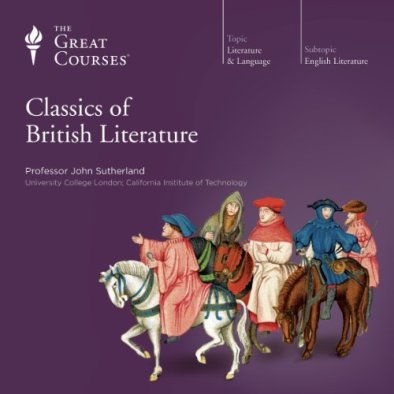
British classicsBut when Hope reviewed the Great Courses lectures on Classics of British Literature, I decided to get the series (which only cost one Audible credit). I’ve mentioned before that I was not exposed to many classics in my education, so I have made a deliberate point to read them as an adult. While I have enjoyed working through many of the obvious classics, I figured this series would bring more to my attention as well as enhancing my enjoyment of the ones I already knew.

John Sutherland is the lecturer, revealing a wide range of knowledge not only about British classics and authors, but the prevailing influences and philosophies of the times.

There are 48 lectures in the series, each lasting from 30-45 minutes. They begin with Beowulf and Chaucer, traveling over the years to Salman Rushdie, covering plays, poetry, and novels. Some lectures cover a person (some, like Shakespeare and Jane Austen, merit two lectures); some cover an segment of time (“The 1840s—Growth of the Realistic Novel”); some cover a group (“The Metaphysicals—Conceptual Daring,” “The Augustans—Order, Decorum, and Wit”). Some of the lectures cover one particular work (“The King James Bible,” “Frankenstein—A Gothic Masterpiece”). Others explore a particular genre (“Lyrical Ballads—Collaborative Creation,” “Voices of Victorian Poetry”).

Sutherland covers varying philosophies with the qualifier that we don’t have to agree with them, but understanding them helps us better understand the works in a particular time frame. He discusses some bawdy material with a fair amount of discretion, but I do wonder at the selection of those choices to share: however, I guess some of those are a part of the progression of literary history. Likewise, the tawdry content of some authors lives are shared for explanation, not titillation.

When covering several hundred years of literature, one can’t go into everything in depth. However, I was sad that Robert Burns, one of my favorites, received only 10-15 minutes, and his only work quoted was “Auld Lang Syne.” Oddly missing are C. S. Lewis and J. R. R. Tolkien and their works (although mention is made that Tolkien was a Beowulf scholar).

However, Sutherland did cover an immense swath of ground in this series. Time and again he brought out what was going on in history, how that influenced literature, and how literature in turn influenced life. This series might be better titled the History and Development of British Literature. Thankfully a PDF copy of Sutherland’s notes is available for further perusal.

It would be impossible to share even a fraction of the information gained from these lectures here, but here are a few points of interest and quotes that stood out to me.

  • The first literature was oral and communal rather than written and solitary. (I wonder what people who don’t think listening to audiobooks is “real” reading would say about that. 🙂 )
  • “Great literature is timeless. That is one of the main connotations of the word classic.” (Introduction)
  • Churches were “the nation’s chroniclers” until the 11th century.
  • “Literature is a time machine. It can take us back and connect us
    with people who are no longer here. It is, in the best sense, a conversation with the dead. In fact, this is the reason we read and study literature and the
    reason that it lives for us. This living quality of literature—the fact that it is
    still animated over centuries—makes it worth our time and effort and makes
    a historical approach to literature valuable” (from Lecture 1: “Anglo-Saxon Roots: Pessimism and Comradeship”)
  • “Literature has many functions in society. That’s one of the things that makes it so interesting to read and to study and to reread. Literature, good and bad, can instruct; it can entertain; it can educate. In some circumstances, literature can even corrupt us. Given literature’s dramatic power to influence readers, it perhaps isn’t
    surprising that exactly which works of literature are corrupting has been much disputed throughout the centuries.” (Lecture 4: “Spenser: The Faerie Queen”)
  • “If literature can corrupt, it can also civilize or at least contribute to the civilizing process by articulating the elements that hold a society together. Literature defines the core values on which a civilization is founded.” (Lecture 4: “Spenser: The Faerie Queen”)
  • I was astonished that Robinson Crusoe was seen not as a classic prodigal son story, but “an allegory of English colonialism in the 18th and 19th centuries” and an example of capitalism. (Lecture 17: “Defoe–Crusoe and the Rise of Capitalism)
  • Sutherland demonstrates a broad understanding of Christianity expressed in literature, but I felt he missed the boat on the last sentence here (unless the philosophy is of the people he is quoting, in which case the misunderstanding is theirs): “It’s interesting to note that many thinkers, such as Marx, Max Weber, and R. H. Tawney, have argued that the rise of capitalism is intimately connected with Protestantism and Puritanism. Just as capitalism stresses the individual acquisition of wealth, so do Protestantism and Puritanism stress the individual’s private, personal relationship with, and responsibilities to, God. The individual has credit with his maker and must earn his salvation.” (Lecture 17: “Defoe–Crusoe and the Rise of Capitalism) Neither Puritanism nor Protestantism teach that we have any credit with God or that we can earn our salvation.
  • I wondered at the statement “The novel would not exist in the form that we have it if it were not for women readers, because the novel is a domestic form” (Lecture 18: “Behn–Emancipation in the Restoration”). Weren’t other types of books read in homes before novels were invented? Or perhaps women generally weren’t as interested in reading until the novel came along?
  • “Literature expresses or embodies the noblest aspirations, the finest articulations, of idealism which a culture or society has.”
  • In William Blake’s “The Lamb” and “The Tyger,” Sutherland brings out the innocence of the lamb and its symbolism. He says, “The answer Blake hints at is that without the destructive tiger—without crucifixion, to allegorize it in Christian terms—the innocence of the lamb would be nothing. It would be literally bloodless. And it is the blood of the lamb, not the innocence of the lamb, that the Christian William Blake believes will save us” (Lecture 24: Blake–Mythic Universes and Poetry). But Christians believe that the Lamb’s – Jesus’ – innocence is vital as well. If He were just any other human, He could not have saved us. And part of salvation is not just forgiveness, but that His righteousness goes on our account: He fulfilled all of God’s law in our place.
  • Sutherland considers Chaucer, Shakespeare, and Jane Austen the “greater than great,” the “giants” of English literature.
  • In discussing 20th century poetry, Sutherland pointed out that no one could support himself by writing poetry as a main profession any more. One reason, he felt, was that the energy and creativity that in an earlier era would have gone to lyric poetry now went to popular music.
  • “The story of [British] literature is a constant series of beginnings or breaks—sometimes violent breaks—with tradition, or revolutions and new starts. … Literature advances … by rejection, contradiction, and radical innovation.” (Lecture 48: New Theatre, New Literary Worlds)

I definitely learned a lot! Overall, I really enjoyed the series and may explore other Great Courses now.

(Sharing with Semicolon‘s Saturday Review of Books, Carole’s Book’s You Loved)

What is worship?

We often hear about “worship wars” concerning whether the singing at church should be contemporary or traditional, hymn or praise song, choir or worship team.

But what I wonder is: how did we come to associate worship just with the singing at church? And how did we come to decide that the worship at church was good or not depending on how we felt afterward? We can worship via singing, but is worship just singing? And, for that matter, is worship just done at church, when we attend a “worship service?”

Dictionary.com defines worship as:

  • reverent honor and homage paid to God or a sacred personage, or to any object regarded as sacred.
  • formal or ceremonious rendering of such honor and homage
  • adoring reverence or regard

Years ago I heard a preacher define worship as “worth-ship,” thinking about and ascribing to God His worth. Someone else said something to the effect that God does not “need” our worship, but we need to give it to Him.

I decided to to a study of the word “worship” in the Bible. Let me hasten to say that such a study is just the beginning of a study of worship. There are passages where worship occurs, but that particular word is not used (many of the psalms, for example). There are synonyms to worship: I wondered, for instance, whether “praise” is an element of worship or a synonym. I didn’t take the time at this point to look up the Greek and Hebrew words for worship. I did look up many of these verses in context and found that often the whole chapter they were in was an expansion of what occurred in worship. I just searched through the ESV and not other translations. So, again, this is not a complete study or “the last word” in what worship means and involves. But it was an enlightening start.

I don’t think you’d want me to reproduce all eight pages of notes I accumulated here, but here is some of what I found.

Instruction regarding worship (not including OT ceremonial worship):

  • Don’t worship any other gods. Exodus 34:13-15, Deuteronomy. 8:19; Deuteronomy 11:13-17; 32:15-20; Psalm 97:7; Jeremiah 25:3-6; multitudes of other places
  • Worship only the one true God. Matthew 4:10; Luke 4:7-8; Revelation 14:7
  • Turn from sin. Jeremiah 25:3-6
  • “Ascribe to the Lord the glory due his name; bring an offering and come before him! Worship the Lord in the splendor of holiness; tremble before him, all the earth” 1 Chronicles 16:29-30a; Psalm 29 and 96
  • “I appeal to you therefore, brothers, by the mercies of God, to present your bodies as a living sacrifice, holy and acceptable to God, which is your spiritual worship. Do not be conformed to this world, but be transformed by the renewal of your mind, that by testing you may discern what is the will of God, what is good and acceptable and perfect.” Romans 12:1-2
  • Therefore let us be grateful for receiving a kingdom that cannot be shaken, and thus let us offer to God acceptable worship, with reverence and awe, for our God is a consuming fire. Hebrews 12:28:29

Who worshiped when (not including OT ceremonial worship):

  • Abraham’s servant when God answered his prayer for Isaac’s wife. Genesis 24:25-27
  • The children of Israel when they heard that God sent Moses to deliver them. Exodus 4:30-31
  • At the institution of the Passover: Exodus 12:26-28
  • When Moses went to speak to God: Exodus 33:9-11
  • Moses after seeing the Lord’s glory: Exodus 34:1-8
  • Jacob when blessing the sons of Joseph: Hebrews 11:21
  • Joshua on meeting the commander of the Lord’s army: Joshua 5:13-15
  • Gideon after hearing reassurance in the interpretation of a dream: Judges 7:14-16
  • Samuel’s father and family: 1 Samuel 1:3, 19
  • Samuel after being left with Eli: 1 Samuel 1:27-28
  • David after his child died: 2 Samuel 12:20
  • Dedication of temple: 2 Chronicles 7:1-3; Psalm 132:1-7
  • Jehoshaphat and Judah after God’s promise to fight for them: 2 Chronicles 20:18
  • When Hezekiah reestablished temple sacrifices, after first burnt offering: 2 Chronicles 29
  • First Passover after Israel returned to Jerusalem after exile: Ezra 6:19-22
  • When Ezra read the law: Nehemiah 8:5-7
  • Job after losing everything: Job 1:20
  • Wise men: Matthew 2
  • Disciples after Jesus walked on water and stilled the storm: Matthew 14:22-33
  • Man born blind: John 9
  • Women followers after resurrection: Matthew 28:1-10
  • Anna: Luke 2:36-38
  • Disciples after Jesus’ ascension: Luke 24:50-53
  • Disciples when Barnabas and Paul were set aside by the Holy Spirit for ministry: Acts 13:2
  • Lydia: Acts 16:14
  • Men of Athens: Acts 17: 22-34
  • Titius: Acts 18:7
  • Paul: Acts 24: 11, 14; 27:23
  • Israel: Acts 26:7; Romans 9:4
  • Visitor who is convicted: 1 Corinthians 14:24-25  
  • In the future: Egyptians: Isaiah 19:19-23; 27:13; Creatures in heaven: 24 elders (Rev. 4:10); elders (Rev. 5:14; 19:4); everyone (Rev. 5:14); angels, four living creatures (Revelation 7:9-12; 11:15-18; 19:4; Revelation 11:15-18); All nations: Rev. 15:4; In heaven: Revelation 22:3

Elements of worship:

  • Praise: too many references to list
  • Thanksgiving: ditto
  • Awe: ditto
  • Singing: 2 Chronicles 29:25-30; Psalm 96:1; Revelation 15:2-4 re God’s great deeds, His just and true ways, holiness, righteous acts
  • Cleansing, purifying: Ezra 6:19-22
  • Hearing the Word of God: Nehemiah 8:5-7; 9:1-8
  • Acknowledging who God is: Psalm 29:2, Psalm 96; Matthew 2 +; His holiness: Psalm 96:9; 99:5, 9 +, His exclusivity: Psalm 97:7 +;
  • Sacrifice, offerings, vows: Isaiah 19:21; Zephaniah 3:9-10
  • Amend ways, stop sin, disobedience, stubbornness: Jeremiah 7:1-3
  • Holiness: 1 Chronicles 16:29
  • Humility, truth: Zephaniah 3:9-13
  • Giving: Matthew 2
  • Fasting and prayer: Anna:  Luke 2:36-38; disciples: Acts 13:2
  • Joy, blessing God: Luke 24:50-53 +
  • Faith: John 9:38
  • In spirit and in truth: John 423-24; Philippians 3:3

The posture of worship

Interestingly, of the 15 times any posture is mentioned, 11 passages speak of bowing, often bowing the head, sometimes “bowed down with their faces to the ground.” The others speak of rising and standing (Exodus 33:9-11; 2 Chronicles 20:19), falling to the ground or on one’s face (Joshua 5:14; 2 Chronicles 20: 18), kneeling (Psalm 95:6).

False worship

God warns against false worship multiple times in the Bible, usually involving idols or false gods, but also the sun, moon stars, planets, angels, other people, creatures (Romans 1:25), Satan (Matthew 4:9-10; Luke 4:7-8), the dragon and beast in Revelation. Wrong worship was often accompanied by sin, stubbornness, not listening to or obeying God’s Word (2 Kings 17:6-23; Jeremiah 7; 13:9-11), asceticism (Colossians 2:18), “murders or their sorceries or their sexual immorality or their thefts” (Revelation 9:19-21). Also, the Pharisees were said to worship God in vain by teaching for commandments the doctrines of men (Matthew 15:1-9; Mark 7:7). A few times people worshiped deceptively (Absalom: 2 Samuel 15:7-12; Jehu 2 Kings 10; Herod: Matthew 2:8).

I know that outlines and lists are not considered the best blog writing, but it seemed to me in this case to be the most efficient way to present a lot of information.

But this little (and again I stress, incomplete) study did reveal a few things to me. Worship can include singing, but it is more than singing. It can occur with others or alone. It can occur in joyous or grievous circumstances. It won’t always result in our feeling warm and fuzzy or revved up: often it is accompanied by a deep humility, repentance, changing one’s ways. Though emotions are involved, worship that honors God must be based on truth, thus involving the mind. And the turning from sin often mentioned indicates we worship with our will as well. The characteristics most often involved in worship are acknowledging who God is, what He is like, what He has done, and thanking and praising Him.

This brings to mind the last line of Charles Wesley’s hymn, “Love Divine, A Loves Excelling”: “Lost in wonder, love, and praise.”

Erwin Lutzer’s quote reminds me of warnings about the Pharisees worshiping God in vain: “Worship that is not based on God’s Word is but an emotional encounter with oneself”

And this quote from Archbishop William Temple (about whom I know nothing beyond this quote) seems to sum it up nicely: “To worship is to quicken the conscience by the holiness of God, to feed the mind with the truth of God, to purge the imagination by the beauty of God, to open the heart to the love of God, to devote the will to the purpose of God.”

Splendor and majesty are before him;
    strength and joy are in his place.
Ascribe to the Lord, O families of the peoples,

    ascribe to the Lord glory and strength!
Ascribe to the Lord the glory due his name;
    bring an offering and come before him!
Worship the Lord in the splendor of holiness;
    tremble before him, all the earth;

    yes, the world is established; it shall never be moved.
Let the heavens be glad, and let the earth rejoice,
    and let them say among the nations, “The Lord reigns!”
1 Chronicles 16:27-32, ESV
(See verses 8-36 for a stupendous example of worship)

(Sharing with Literary Musing Monday, Inspire Me Monday, Tell His Story, Let’s Have Coffee, Porch Stories)

Laudable Linkage

Welcome to my latest round-up of noteworthy reads around the web:

Please Do and Don’t Assume Motives. This would solve so much. It doesn’t mean being naive.

Are You Becoming More or Less of an Encourager? HT to Challies. “The church must be an oasis for the true Christian! You must be such a great encouragement that you become a breath of fresh air for those who speak to you. Of course, we should confront sin and push people towards holiness, but when people talk to us they should feel like we care about them and, more importantly, their soul. Sadly, as life goes on and as time goes on, we can tend to become crankier and less thankful for our salvation, but the writer of Hebrews calls us to be different.”

We Don’t Need to Go Back to the Early Church, HT to Challies. I’ve heard off and on throughout my Christian life that we need to “do church” like the early church of the first century. But if you read the NT epistles, those churches were rife with problems that the NT writers had to correct.

How Can You Show Radical Hospitality as an Introvert? by Rosaria Butterfield, HT to Challies. “We need the people who are quietly listening and praying as other people are talking, discerning about things.”

Home Libraries Confer Long-term Benefits. “Home libraries are strongly linked to children’s academic achievement.”

Is Turning Off Your Notifications the Ultimate Productivity Hack? HT to Challies. Excess notifications are one of my biggest pet peeves, and I turned off most of them long ago. Especially anything that makes noise. Interesting note here that it takes “on average, 23 minutes and 15 seconds to get back to the task at hand after a distraction.”

And, finally, someone shared this on Facebook. Pretty cute.

Happy Saturday!

Friday’s Fave Five

It’s Friday, time to look back over the blessings of the week with Susanne at Living to Tell the Story and other friends.

This has been a sick week, literally. My husband has had some type of awful sinus/sore throat ailment all week. To give you some idea: we’ve gone through nine boxes of tissues this week. I haven’t had quite that: mine has been more sinus pressure, scratchy throat, headache, bone-deep tiredness. Acetaminophen has been my best friend this week. I thought I might be catching the flu, but it doesn’t seem to be that. Anyway, we made it through the week and are glad to have the weekend coming up. Here are some highlights of the last week.

1. Sick days aren’t fun in themselves, but it’s nice to have “permission” to just rest, read, sleep as needed. We took Sunday to stay home and do just that. I think that’s the main reason my ailments weren’t any worse: since they had just started that day, I think I headed them off. And I got a lot of good reading done, resulting in three book reviews this week.

2. Pumpkin day, as Timothy calls it. None of us grew up carving pumpkins, but my daughter-in-law wanted to try it a few years ago, so we have been doing it every year since. It’s fun when family traditions expand with new members! I was always afraid of the darker associations with Halloween when the kids were little, but these days I don’t think most people think of that when they see cute and clever pumpkin faces. Along with carving pumpkins, it has become almost a tradition to have homemade caramel corn and apple cider to snack on through the evening.  Here are the results of our labors:

Jim always goes political:

I chose an owl, both because my mom used to collect owls, plus this looked pretty simple. I’m not good with the intricate designs.

Jason made his own design from a photo he had taken of Mittu. Amazing!

Mittu made a cat, and even painted the cat and the moon:

Timothy used paint pens for some of his design, plus they found some cute stickers of various eyes and mouths, so he decorated three sides of his pumpkin. 🙂 Plus they found these cute googly eye lights, and Mittu cut holes for them for him.

Also while we were out on the porch, we saw our annual visitor: this funny little bird comes and roosts on the corner of our porch a few nights every year. I don’t know what it is or even if it is the same one. It doesn’t seem to disturb him when we’re out there.

Yes, there is also the beginning of a wasp’s nest there, too – I hope Jim can get to it this weekend.

3. A surprise visit. Jason and Mittu were traveling this week, and I had wanted to have them over before they left. Between Jim being sick plus traveling himself a couple of days, it didn’t work out. But they stopped here on their way out, so I got to visit with them for a bit and see them off. Then they FaceTimed from their hotel that night and Timothy gave me a tour of their room. So fun to see life through the eyes of a child.

4. Homemade lasagna. We have frozen lasagna and Hamburger Helper lasagna sometimes, and they are good, but there’s nothing like the real thing!

5. When God speaks to my heart through His Word. In one sense He always does. But sometimes I’ll be praying or burdened about something in particular just before my quiet time, and in my regular reading for the day God will address that very thing

Have a good Friday!