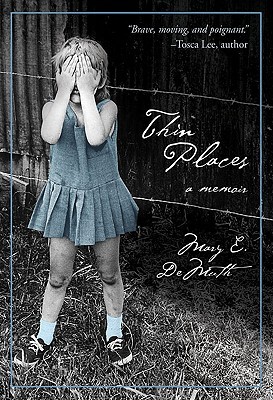
Book Review: Thin Places

Thin PlacesI don’t remember where or in what context I first heard of Mary DeMuth. I hadn’t read anything by her that I remember, but when I saw her book Thin Places: A Memoir on a Kindle sale, the name registered somehow, and I got it.

The title comes from a Celtic term for “a place where heaven and the physical world collide, one of those serendipitous territories where eternity and the mundane meet.” DeMuth uses it as a metaphor for “moments…when we sense God intersecting our world in tangible, unmistakable ways. They are aha moments, beautiful realizations, when the Son of God bursts through the hazy fog of our monotony and shines on us afresh.” “God woos me from behind the veil through the tragedies, beauties, simplicities, and snatches of my life I might overlook.”

It’s a wonder, with Mary’s upbringing, how she ever turned out with any sense of stability: she was raised by hippie-ish parents who regularly had friends over to get stoned, even passing their marijuana to her, had a series of step-fathers, was raped repeatedly at the age of 5 by neighbor teenage boys while supposedly under the care of a neglectful babysitter, suffered the loss of her father. All of this plus other circumstances made her feel unloved and unworthy and fueled a need for attention and approval and a fear of men.

She came to know Jesus as a teenager, some twenty-four years before the writing of this book, and sank down into His love and acceptance and cleansing. Yet some wounds heal slowly, and it took a long time of getting to know Him and His Word and walking with Him to transform her view of herself and others, a process still ongoing.

She wrote the book for several reasons: to help others feel they are not alone, to magnify God’s grace in saving and healing her, and to convey hope.

In the past I needed all the fragments of my life placed just so, like diamonds set in a tennis bracelet. The older I get, the more I see that Jesus wants me to trust Him for the missing pieces, the broken clasps, the counterfeit baubles–to relax in the unknowing, to be at peace with the tangles, to learn the art of living with mystery. He is more than capable of handling all my questions, and someday He will make things right.

I used to think that if God truly loved me, He’d give me everything I want, not realizing that getting everything I want will give me an idolatrous heart. And a meaningless life.

I would differ from Mary theologically in a few places, particularly in the area of tongues and visions, and a couple of places made me wince just a bit (“The grace of God is my Mary Jane,” a vision of Jesus “dancing like a crazy man” and offering her an invitation to join Him), though I know she didn’t mean them irreverently or disrespectfully.

But even though we would look at a few things in different ways, there is no denying the grace of God in her life and the way He has worked in and through her.

(Sharing at Semicolon‘s Saturday Review of Books)
Save

Save

Book Review: Pioneer Girl

Pioneer Girl

Before Laura Ingalls Wilder wrote her first book in the Little House on the Prairie series, perhaps before she even thought of writing her story in that format, she wrote her family’s history out in a draft called Pioneer Girl on Big Chief tablets by hand. She gave it to her daughter, Rose Wilder Lane, an established, well-known author at the time, to edit and shape up for publication. They made several attempts to have it published as a non-fiction book for adults, with no success. But that’s just as well, because if it had been published as it was, we likely would not have the Little House series.

Laura could not have known, when her first book was published in 1932, that years later people would diligently seek out information about her family, visit her family homes, try to discern fact from fiction, and have debates over whether she or her daughter wrote most of the books. To deal with some of these issues and bring Laura’s first book to light, Pamela Smith Hill edited and annotated Pioneer Girl: The Annotated Autobiography, which I am sure will be the definitive source on everything Laura Ingalls Wilder for years to come.

Hill did an amazingly through job. There are footnotes concerning every single person mentioned in the book all the way down to the flowers Laura referred to and the kind of crabs that nipped at Nellie Oleson’s toes. But my favorite notes are the ones that cite correspondence between Laura and Rose about the book or tell how an incident was phrased or expanded upon in the different manuscripts and the Little House books.

I mentioned the debate about authorship: some scholars (both professional and armchair) feel that Laura wrote the text and Rose just edited it for print and used her contacts to get the first book published. Others feel that Rose was basically a ghost-writer for the series, and, though the main story is Laura’s, Rose was the real writer. I’ve always believed it was closer to the former situation myself, and I think this book and the annotations confirm that. Rose was more involved than the average editor, and there was some collaboration, but the voice is definitely Laura’s. In many of their cited letters where there was a difference of opinion about what to include or how to frame a scene, Laura’s reasoning won out most, perhaps all the time.

Hill begins with the history of how Pioneer Girl came to be written, its search for a publisher, Rose’s involvement, and the different manuscripts that developed from it at different times. Then the text of Pioneer Girl itself is presented, with multiple annotations,  photos, and maps. Finally, four appendices include a manuscript of “Juvenile Pioneer Girl” that Rose rewrote for children.

There is so much to this book and I have noted so many points of interest, it’s hard to narrow it all down and decide what to share. It’s a large book: 9 1/4″ wide, 10″ long, and 1 18″ thick. It’s a gorgeous book: the front cover is just lovely, and there are numerous photos of Laura’s family and the places and things she writes about. It’s a historic book not just about Laura’s family, but also about the times and culture in which she lived.

But I wouldn’t call it a page turner, except in parts. Obviously the final Little House books are much better because the book went through five different revisions even before being turned into what became the Little House novels, and an incident that may have taken a page or two in Pioneer Girl was often expanded into a chapter in the final novels. Some readers might not want to read every single footnote and annotation. I did want to, because I have read so much about Wilder in the last few years, but I’ll admit sometimes it was a little tedious, and some notes were much more interesting than others. But overall I really did enjoy delving into all the minutia as well as Laura’s first attempts at a book.

I think I’ll share some points of interest by way of list:

  • There is much made of the fact that Laura got dates, names, and even her age at certain times wrong occasionally. But she didn’t start writing this book until she was in her sixties. I’m only in my fifties, and I can’t say for sure I’d know what incident from my childhood happened what year and how old I was at the time. Plus she didn’t have the resources we have now, and many of her family members she would have conferred with had passed on. So that doesn’t bother me.
  • She did, however, deliberately fictionalize some sections by the time she got to the LH books. Hill cites the reasons why where known. Sometimes it’s because she felt it would make a better story. For instance, during The Long Winter (referred to as the Hard Winter here), there was actually another family living with the Ingalls, a young couple and baby. The man was evidently lazy and selfish, and though Laura wrote about them in this book, she decided to leave them out of the LH books as they would distract from rather than advance the story. Also, in the scene in By the Shores of Silver Lake where Pa takes Laura to see the men working on building the railroad never happened, but framing it through the fictional Laura’s eyes seemed the best way to tell it for young readers.
  • She left out some parts because they didn’t fit “in the picture I am making of the…family” (p. 95, note 99). Besides, probably no one tells all in an autobiography.
  • I’m sorry to say I have never liked Rose. Some years ago I picked up a book about her (I forget which one), not knowing anything about her except that she was Laura’s daughter, and found she was quite a different person from her mother. What I read about her here only confirmed my initial impressions. “Lane had built her professional career by fictionalizing what she published as non-fiction…[She] wrote what was presented to her audience as ‘true’ stories, but they were loosely based on interviews and factual material that Lane embellished or re-imagined to heighten their market appeal” (p. xxx). “Henry Ford repudiated the biography Lane wrote about him for its inaccuracies, and [Charlie] Chaplin was apparently so outraged at the literary liberties she had taken…that he threatened to bring legal action” (p. xxxi). “Her aim was to get ‘at the truth rather than at the facts'” – as if you can bring forth truth from falsehood (p. xxxi). Plus she took information from her mother’s material to write her own fictionalized novel, Let the Hurricane Roar – without her mother’s knowledge or consent.
  • It may seem inconsistent that I’m ok with Laura’s fictionalizing but not Rose’s. But Laura’s were minor for the most part, and she argued with Rose quite a bit about maintaining historical accuracy. And the LH books were presented as fictionalized accounts of her family, whereas PG was non-fiction. Rose took her fictionalizing way too far and presented it as fact..
  • It’s interesting that though Rose was the “famous author” then, she is nowhere nearly as well known as her mother now, and I think people who do read her now do so because of interest in her mother.
  • One of the reasons Laura wrote was to preserve her father’s stories (p. 37, note 42). Expanding on the details of how the family lived came after a suggestion from an editor (p. 31, note 26). But also, “As she told the Detroit Book Fair audience in 1937, ‘I realized that I had seen and lived it all–all the successive phases of the frontier, first the frontiersman then the pioneer, then the farmers and the towns. Then I understood that in my own life I represented a whole period of American history'” (p. liv).
  • Nellie Oleson was based on a composite of three different girls in Laura’s life.
  • Laura couldn’t spell very well — odd since she was a teacher and even wrote of competing well in spelling bees. Then again, this was a rough draft written by hand. Probably she was just getting the information out there to shape up later.
  • I’ve often wondered exactly what Laura’s religious beliefs were. I think you could safely say the family was God-fearing in the old sense that they believed in God and the Bible generally, but one can do that and still not have trusted Christ for salvation from one’s own sins. But she had a heightened sense that religion was a private matter, so she doesn’t spell it out: she speaks of someone who testified “at prayer meeting every Wednesday night. It someway offended my sense of privacy. It seemed to me that the things between one and God should be between him and God like loving ones [sic] mother. One didn’t go around saying, ‘I love my mother, she has been so good to me.’ One just loved her and did things she liked one to do” (p. 136). These days one might speak of one’s mother in such a way, but maybe it wasn’t done then. I’ve written and mused more about Laura’s faith at Saving Graces: The Inspirational Writings of Laura Ingalls Wilder.
  • One section that is troubling to modern readers in Little Town on the Prairie is when a group of men, including Pa, dress up in blackface and perform minstrel songs. Hill has a good section explaining how it was viewed at the time, saying that “Before the American Civil War, many abolitionists embraced minstrelsy as a way to reach a broader American audience, and some minstrel troupes performed songs with distinctly abolitionist themes” (p. 254, note 62). It was not considered offensive then, though it is now.
  • Laura’s a little slow to warm up to Almanzo’s overtures, but I love when she says that after he had been away for three months, “I hadn’t known that I missed him, but it was good to see him again, gave me a homelike feeling” (p. 297).
  • Laura seemed to share her father’s urge to go West, saying on one trip that they were “going in the direction which always brought the happiest changes” (p. 145). But one of the most touching parts of the book for me came at the end, just after Laura and Almanzo were married, when she concluded: “I was a little awed by my new estate, but I felt very much at home and very happy and among other causes for happiness was the thought that I would not again have to go and live with strangers in their houses. I had a house and a home of my own” (p. 324).

I’m very thankful to Pamela Smith Hill and the South Dakota State Historical Society for publishing this book with all of the historical information it contains. It is truly a treasure.

(Sharing at Semicolon‘s Saturday Review of Books)

Save

Save

Save

Save

Save

Save

But That’s Not My Spiritual Gift!

IMG_1761Some years ago it was all the rage to do spiritual gift tests. Spiritual gifts are those particular abilities that the Holy Spirit gives people when they are saved by which He wants to work through them to edify the body of Christ. You can find lists of them in Romans 12:6-8; 1 Corinthians 12:8-10, 28-30; Ephesians 4:11; 1 Peter 4:9-11. They have been taught about in almost every church we have been a part of, and in two churches we actually did the test during a church service, with one of them having a subsequent series about them.

The idea was to help people identify their spiritual gifts so they’d know how they best fit into the ministry of the church and not waste their time frustrated and ineffective in an area where they’re not gifted. And that can be helpful. When I first started going to church regularly as a teenager and then was recruited for various ministries, it seemed like a young woman was just naturally gifted for working with children, right? I was usually asked to assist and then later to teach in the nursery, Sunday School, children’s church, Awanas, etc. I could do it, I learned from it, I hope God used me in it, but it wasn’t until I was asked to take on a more administrative role that I felt I had found my niche and just sank into it with a delight and joy I hadn’t previously found in ministry. As other opportunities have opened up over the years I’ve had a similar response in a few different areas.

I think that might actually be the better way to discern one’s spiritual giftings: trying different ministries to see which one “fits.” The tests can help to a degree, but sometimes they’re more like personality tests; sometimes their definitions can differ from one another and/or from my understanding of what a particular gift entails. Sometimes the particular ministry I am in hasn’t really fit in any category I’ve seen on a test.

Another fault with the tests and perhaps too much of a focus on what *my* gifts are is the “That’s not my job” syndrome. I don’t have the gift of evangelism, so I don’t have to do that, right? No, we’re all supposed to be a witness for Christ in some way within our sphere of influence, though there are some who are especially gifted in that way. It’s the same with giving, showing mercy, extending hospitality, helping others, and many of the other spiritual gifts.

And then sometimes God drops us into a situation that we don’t feel gifted for at all: in fact, we feel totally inadequate. Moses, Gideon, Jeremiah, Jonah, and others didn’t greet God’s call on their lives the the attitude, “Sounds great! That’s just the kind of opportunity I was looking for!”

That’s where I am with caregiving. Someone I knew said of their daughter, who was training to be a nurse, that she was a “natural caregiver.” Another friend who is a nurse spoke of loving to use the talents God had given her to minister to people in that way – another natural caregiver. That’s not me. I want people to be cared for, particularly my mother-in-law. But I have never been good with or felt inclined to the hands-on type of caregiving she is in need of now, except with my own children.

Yet here we are. Do I tell God, “There must be some mistake here. Not only am I not gifted for this, but it’s keeping me from what I feel I am gifted for.” Probably not a good idea.

I was convicted by this sentence as well as other truths in the True Woman blog post “Serving in Church: When Your Spiritual Gift Isn’t Changing Diapers“: “This doesn’t mean my gifts aren’t important. What it means is that “sometimes the need for a servant is greater than my need to use a specific gift.” And from another article on the same web site, What About Your Desire to Do Something Great For God?: “When the desire to do for God supersedes the desire to obey God, it reveals that God is no longer the source of joy. A heart delighted in God desires to obey Him. A heart delighted in self desires to see what self can accomplish. A person delighted in God doesn’t care so much how God uses her, but rather that she is useful to God, the object of her delight. A person delighted in self cares deeply about how God uses her, because seeing the self she loves underused causes grief.”

Though we need to rely on God’s help, grace, and strength even for those areas where we feel He has gifted us, there’s nothing like being totally out of our element to make us lean on Him and plea for His enabling like never before. And though the main point of caregiving isn’t about me, but rather about showing love and ministering to my mother-in-law, perhaps one reason He has allowed this opportunity is to teach me lessons about my own selfishness as well as serving and loving others in the way they most need it, not in the way I am “comfortable” showing it.

Even as the Son of man came not to be ministered unto, but to minister, and to give his life a ransom for many. Matthew 20:28

(Sharing with Inspire me Monday, Testimony Tuesday, Woman to Woman Word Filled Wednesday, Thought-provoking Thursday)

Save

Save

Save

Save

Save

Save

You Are Always Good

I love this song. The tune was written by Jonathan Hamilton, son of Ron and Shelly Hamilton (of Patch the Pirate fame, for those who know of him.) Jonathan died as a young adult, and Chris Anderson was commissioned to write this hymn to Jonathan’s melody. It’s sung by Jonathan’s sister and brother-in-law, Ben and Tara Farrell. The words are in the video, but you can see them all in one piece here along with some of the thinking behind the words.

Laudable Linkage

Here are some great reads discovered in the last couple of weeks:

America, I Still Believe in You (But, Only Because I Believe in Him)

Serving in Church: When Your Spiritual Gift Isn’t Changing Diapers. “Sometimes the need for a servant is greater than my need to use a specific gift.”

What About Your Desire to Do Something Great For God? “When the desire to do for God supersedes the desire to obey God, it reveals that God is no longer the source of joy. A heart delighted in God desires to obey Him. A heart delighted in self desires to see what self can accomplish. A person delighted in God doesn’t care so much how God uses her, but rather that she is useful to God, the object of her delight. A person delighted in self cares deeply about how God uses her, because seeing the self she loves underused causes grief.”

Elizabeth Prentiss: Joyfully Embracing Motherhood and Suffering. Elizabeth is the author of the hymn “More Love to Thee” and the book Stepping Heavenward.

Brexit and the Coming of the Last Days.

Assisted Suicide: A Quadriplegic’s Perspective.

A Well-Ordered Life and Scruffy Hospitality might seem like opposite viewpoints. But I think the key is balance. We don’t need to wait for a “Pinterest-perfect” house or party to have people over, but some degree of order makes life go more smoothly. Personalities are probably inclined more one way or the other.

How Schools Can Help Notice and Serve the Quiet Kids.

Finally, my oldest son posted this on Facebook. I don’t know who made it, but it’s good advice when watching and passing on news.

13626960_10153618154706820_7479503557540693697_n

Friday’s Fave Five

friday fave five spring

It’s Friday, time to look back over the blessings of the week with Susanne at Living to Tell the Story and other friends.

I start too many of these commenting on the passage of time, but, wow, it sure does seem to be going ever more quickly. I can’t believe we’re a week into July already! But here we are, and here are some of the best parts of the last week:

1. Great-Grandma’s 88th birthday. She can only eat pureed food, so we got her a caramel frappe from McDonald’s (one of her favorite things) and put her birthday candle in it. 🙂 We got cupcakes for the rest of us. Her favorite color is yellow, thus the yellow flowers.

13600024_10209436497566385_6391044515005328222_n

13439226_10209436497726389_2777056163182465468_n

13592829_10209436544087548_4552561093033037040_n

2. Independence Day. Though our country is not perfect and has its problems, I still would rather not llive anywhere else and I am thankful for it.

3. Neighborhood cookout. A couple of neighbors have organized this for the last few years for July 4. One neighbor grills hamburgers, hot dogs, and ribs, and everyone contributes a bit of money for the meat. Then everyone else brings side dishes, desserts, soft drinks, etc. Sadly, I am not as neighborly as I probably should be, so I am glad for this opportunity to get out in my community and talk with people. I especially enjoyed meeting some new neighbors.

Funny moment here: I’m not a huge fan of Sprite, but I drink it sometimes if there are no caffeine-free alternatives. Little Timothy and his parents had come for the cookout, and he had gotten hot running around. He came over to me and kept trying to get to the ice in my cup, but he had been petting a dog, so I didn’t want his fingers in it. 🙂 I asked if I could pour some for him in a cup. He took a drink, blinked, made a funny face, but said, “MMMMmmm!” And he kept doing that, like it was a bit strong, but he liked it. His mom said, “Why are you reacting like that? I said, “Has he not had Sprite before?” She said, “Oh, I thought you had water!” 😀

4. Ceiling fans. We don’t use them all that much, but for a couple of days it was so hot and humid that just the AC wasn’t cutting it. It felt lovely to come in and sit down under the fans.

5. Clean carpets. My husband cleaned my youngest son’s carpet because he had a pretty bad stain on it, and while he was at it, cleaned the carpet in the living room and office as well. The stain came out nicely, and it’s a nice feeling to know the carpets have been done.

Bonus. Rain. It’s been pretty dry lately, so a day or so of rain was a big relief.

Happy Friday!

Save

Book Review: They Almost Always Come Home

RuchtiI picked up They Almost Always Come Home by Cynthia Ruchti when it came up on a Kindle sale because I had seen some favorable reviews for some of her books. I couldn’t remember if this was one I had seen reviewed, but I did remember Ruchti’s name being mentioned favorably.

Libby’s husband, Greg, has been on a solo two-week wilderness trek. He does these often, roughing it in the Canadian wilderness, canoeing, camping, fishing. But this is the first time he has gone completely alone. And now he’s late.

As Libby takes the initial steps to call Greg’s dad and notify the authorities, she also wrestles with her own heart. She had actually planned to leave Greg. Their marriage had been fairly empty since their young daughter died some time before, with Libby holding Greg responsible for what happened  to her. In fact, she wonders if perhaps he took this opportunity to leave her.

As Libby, her best friend Jen, and Greg’s father, Frank, embark on a trip of their own to look for Greg, Libby faces her own assumptions and realizes she might just be wrong in a few areas.

A little over half-way through, the point of view shifted from Libby’s first person to Greg’s third person. I was a little jarred at first, but after I finished the book, I agreed that was probably the best way to unfold the story of what happened to him.

There were a few too many…I don’t know whether to call them object lessons or simile moments or what:

[After wiping crumbs off the counter] How long will it take me to figure out what to do with the crumbs of my life?

I pick up my wide-toothed comb and tackle the tangles in my hair. Working at them little by little, from the bottom up, the knots soon turn to wet but smooth silk. Where can I find a wide-toothed comb for marital tangles?

[After putting her backpack on] How clumsy I am with all those pounds on my back. Like the weight of grief, it makes me stumble on simple motions.

[When biting ants attacked her father-in-law] A tiny intruder can create a great deal of turmoil. Under the microscope, the small choices in my marriage might have seemed insignificant, too.

I just encountered a lot of this in another recent book: Please, please tell me this is not a new trend!

The Kindle formatting is worse than I have seen in other books – first words in sentences not capitalized, words smushed together or unrecognizable.

But overall I really enjoyed the book. There were a number of humorous moments as well as heart-grabbing ones. I was touched by the faith journey each character took.I read that this is the author’s first faith-based novel. I was just a touch disappointed in the ending: I don’t require that every little thing be wrapped up in a tidy bow to be satisfied, but I felt a couple of areas were unresolved. I almost wondered if a sequel was planned, but it doesn’t appear so. Maybe the idea was that once the characters got their hearts right, the circumstances didn’t matter as much because then they could get through anything.

 (Sharing at Semicolon‘s Saturday Review of Books)
 

Save

Book Review: Great British Short Stories: A Vintage Collection of Classic Tales

Classic short storiesI’m not a big fan of short stories, so when I saw a book of short stories listed as one of the options for the Back to the Classics Challenge, I perused a few sources, didn’t see anything that interested me, and decided I’d skip that one. But then I finished all the other options for the challenge and didn’t want to leave that one undone. I finally found an audiobook of Great British Short Stories: A Vintage Collection of Classic Tales, with tales from familiar names like Charles Dickens, Elizabeth Gaskell, Arthur Conan Doyle, and Robert Louis Stevenson as well as unfamiliar ones like Barry Pain, James McGovan, and William J. Locke.

There are ten stories in all:

“The Dog” by Arnold Bennett: A man from one class of a family takes out a girl from another class, and, as luck would have it, they have an accident in a very public place, causing trouble in both families. The title and description of the man man throughout as a dog confused me – I wasn’t sure what that meant at the time and whether it was good or bad. The young man seems to think it’s good; the story itself seems to indicate otherwise.

“Not On The Passenger List” by Barry Pain: A widow on a ship to meet the man she is going to marry keeps seeing her dead jealous former husband on the ship.

“The Old Man’s Tale About The Queer Client” by Charles Dickens: The wife and son of a  man in debtor’s prison die, and he vows revenge on the man responsible for putting him there and contributing to their deaths. Not my favorite from Dickens, who didn’t end this on a note of hope and optimism as he usually does, but I was surprised by the twist in who the responsible party was.

“The Half Brothers” by Elizabeth Gaskell: A man marries a widow with a small son; they have another son; the wife dies shortly thereafter; the man blames his step-son. Though the story ends in a tragedy, it brings resolution. A little predictable, at least by today’s standards, but nicely told.

“The Veiled Portrait” by James McGovan: A physician treating an older woman asks to see the painting that she has veiled in her room. It’s a portrait of her wayward son when he was an innocent child. The doctor, who really wanted to be an artist but couldn’t make a living at it, wants to borrow the painting and copy it, or at least make a sketch of it, but she refuses all requests concerning it. He happens to hear of a skilled thief and decides to have him steal the portrait long enough for him to copy and then return it, but things go in a very unexpected way. This was one of my favorite stories in the book.

“Markheim” by  Robert Louis Stevenson: The title character kills a man in order to get to money he has hidden in his business and then is unexpectedly confronted by what he thinks is a demon offering to help him. Shocked, thinking he hasn’t fallen that far, he refuses its help and promises this will be the last bad thing he ever does. Though the first part of the story took much longer than needed to tell, what’s interesting in this one is the moral argument: the being shoots down all of Markheim’s arguments, resolutions, self-deceptions one by one. But there is a surprising twist at the end.

“The Bottle Imp” by Robert Louis Stevenson: A man tries to sell a bottle containing, not a genie, but an imp. The imp will help it’s owner in any way requested, with two caveats: if the bottle isn’t sold before the owner dies, the owner will go to hell, and it must be sold for less than it was bought for.

“The Adventures Of The Kind Mr. Smith” by  William J. Locke: A case of mistaken identity lands an ex-French teacher in the middle of a plan to commit fraud. He keeps up pretenses until the person he is supposed to be shows up. But from there on out, the plot takes continuous surprising turns. Loved this one!

“The Man Of Mystery” by Barry Pain: a butler who keeps his own confidences is dismissed by his employer, until she realizes she wrongly accused him and tries to rectify the situation. Would have liked this one except for someone getting away with and profiting from doing wrong.

“The Brazilian Cat” by Sir Arthur Conan Doyle: A man in financial straits seeks out the help of a cousin who is married to an unfriendly Brazilian woman and keeps a large puma-like Brazilian cat. This was the first non-Sherlock Holmes story I’ve read by Doyle, and it was easily the most suspenseful and exciting in the book.

So, though I am still not likely to seek out short stories in general, this was not an unpleasant excursion. I listened to the audiobook, though there is a print version that can be found through used book sellers. The narrator’s voice and style was a little grating at first, but before long I got used to it and it didn’t bother me any more.

(Sharing at Semicolon‘s Saturday Review of Books)

Save

Save

Save

Happy Independence Day!

Our father’s God to, Thee,
Author of liberty,
To Thee we sing.
Long may our land be bright
With freedom’s holy light;
Protect us by Thy might,
Great God, our King!

~ Samuel Francis Smith, from “America” or “My Country, ‘Tis of Thee”

How to Pray For America

4th-of-july-wallpapers-1024x768

Mount TBR Reading Challenge Checkpoint #2

Mount TBR 2016

The Mount TBR Reading Challenge (to read books one already owned) has checkpoints every quarter where we can report how we’re doing. I read 9 books for this challenge during the first quarter of the year (listed at the last checkpoint here). So far this quarter I have read (each title links back to my review of it):

  1. A Slender Thread by Tracie Peterson
  2. The Reunion by Dan Walsh
  3. True Woman 201: Interior Design: Ten Elements of Biblical Womanhood by Mary Kassian and Nancy Leigh DeMoss
  4. What Follows After by Dan Walsh
  5. The Hardest Peace: Expecting Grace in the Midst of Life’s Hard by Kara Tippetts
  6. Beyond Stateliest Marble: The Passionate Femininity of Anne Bradstreet by Douglas Wilson
  7. One Perfect Spring by Irene Hannon
  8. Pride, Prejudice, and Cheese Grits by Mary Jane Hathaway
  9. The Renewing of the Mind Project by Barb Raveling
  10. Don’t Let the Goats Eat the Loquat Trees: The Adventures of an American Surgeon in Nepal by Thomas Hale
  11. Chateau of Secrets by Melanie Dobson
  12. Eight Twenty Eight: When Love Didn’t Give Up by Ian and Larissa Murphy

That’s 21 books so far, taking me up to Mont Blanc, the second of Bev’s challenge levels. Four of them (True Woman, Stateliest Marble, P&P & Cheese Grits, and Renewing the Mind) are from my original list of goals for the challenge. Only two more from that list to go!

I had only signed up for the first level, but I think I’ll probably pretty easily make the third by the end of the year.

Bev also lists some fun questions for this checkpoint. We’re not required to do all of them – but I did because I thought they were fun:

A. Choose two titles from the books you’ve read so far that have a common link. Chateau of Secrets and Searching for Eternity are both set during WWII in both France and America.

B. Tell us about a book on the list that was new to you in some way–new author, about a place you’ve never been, a genre you don’t usually read…etc.  Irene Hannon and Thomas Hale (this quarter) and Marilynne Robinson, Chad Williams, and Chris Fabry (last quarter) were all new-to-me authors. I didn’t like Robinson’s Gilead as much as I had expected to but still want to try some of her other books. I love Chris Fabry’s Not In the Heart and have already read another book by him and bought one or two more.

C. Which book (read so far) has been on your TBR mountain the longest? Was it worth the wait? Or is it possible you should have tackled it back when you first put it on the pile? Or tossed it off the edge without reading it all? Of what I’ve read so far, that would be The Reunion by Dan Walsh, bought in October of 2012. It’s one of my favorites of his books, and I wish I had read it sooner!

My Life According to Books
1. My Ex is/was Our Mutual Friend (by Charles Dickens)
2.
My best friend isTrue Woman (by Mary Kassian and Nancy Leigh DeMoss)
3. Lately, at work [I’ve been waiting for] What Follows After (by Dan Walsh)
4.
If I won the lottery, I’d have One Perfect Spring (by Irene Hannon)
5. My fashion sense [hangs by] A Slender Thread (by Tracie Peterson
6. My next ride [will take me to the] Chateau of Secrets (by Melanie Dobson)
7. The one I love is [inspires] Big Love: The Practice of Loving Beyond Your Limits (by Kara Tippetts)
8. If I ruled the world, everyone would [be] (Searching for Eternity by Elizabeth Musser)
9. When I look out my window, I see The Goats Eat the Loquat Trees (by Thomas Hale)
10. The best things in life are Beyond Stateliest Marble (by Douglas Wilson)

Thanks, Bev, for the spur to get into some of the books that I have been wanting to read (for years in some cases!)