Friday’s Fave Five

friday fave five spring

It’s Friday, time to look back over the blessings of the week with Susanne at Living to Tell the Story and other friends.

Wow, it’s the first of July already! Here are highlights from the last week in June:

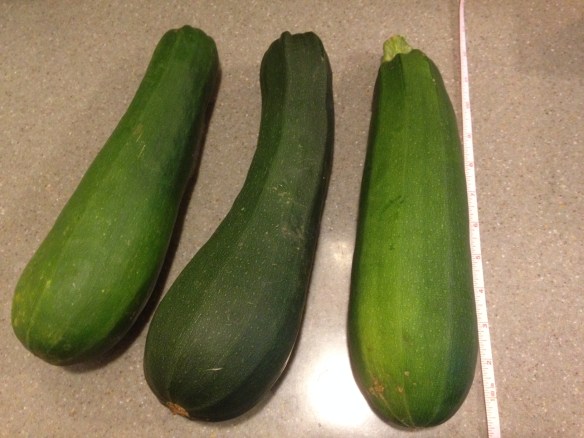
1. A neighbor’s bounty. This time of year our neighbor starts bringing over some of the excess from their garden. One batch contained these humongous zucchini. My little tape measure isn’t showing up well, but they were close to 12″ long.

IMG_1742

2. Two successful new zucchini recipes.Β  One night I tried these Zucchini Boats, and wow – we all loved them. I only made a half recipe at first to test them out, but next time I am making a full batch! I used the Jimmy Dean Turkey Sausage Crumbles because that’s what I had on hand, and also because the turkey sausage is so much less greasy. Plus they are already cooked, saving a step.

IMG_1743

I was trying to explain to my husband and son that normally for zucchini boats, you cut the zucchini in half lengthwise and scoop out the middle, so it ends up looking something like a canoe. But these were so big, I cut them into quarters instead of halves so the servings wouldn’t be so big and take longer to cook. My husband summarized, “So they’re zucchini rafts and not zucchini boats?” πŸ™‚Β  I also made zucchini muffins but didn’t get a photo. And both recipes just used one zucchini! Bonus: after typing in “zucchini” so much while searching for recipes, I now know how to spell it. πŸ™‚Β  I used to get mixed up as to how many c’s and n’s it had.

3. A finished fence! I am so proud of my hard-working husband both for finding it on Craig’s list and then spending so much time putting it up. Unfortunately with the loss of the diseased tress we had to cut down, the weeds along the tree line are shooting up rapidly since they’re getting so much more sunshine and rain. That’s the next phase: getting rid of the weeds and deciding what we want to plant in their stead.

IMG_1749

4. Successful surgery. My step-father had hip replacement surgery yesterday, and at the time of this writing I’ve heard the surgery went well and he’s in recovery. My sisters there with him in TX are keeping me updated. Praying for a quick and smooth recovery.

5. One of my favorite meals that my daughter-in-law makes is a chicken cordon bleu variation with chicken tenderloins, ham, bacon, and cheese, and she made that for us on Sunday along with au gratin potatoes and salad. Yum!

Happy Friday, and Happy Independence Day weekend to those in the USA!

Save

Book Review: Eight Twenty Eight: When Love Didn’t Give Up

828Ian and Larissa were like many college-age young couples, getting to know each other as friends, moving on to dating seriously, heading toward probable engagement. But then the unforeseen and unthinkable happened: Ian was in a car accident, receiving various injuries, but worst of all, damage to his brain. Larissa details their story from first meeting to eventual marriage, with the accident and all that it involved inbetween. Ian has come a long way but is still not fully recovered, so Larissa had to face whether her love was enough to handle being the wife of a man with serious needs. She’s fairly transparent about the struggle and difficulties involved, but both she and Ian have experienced God’s grace in their relationships with Him and each other.

I think I first became aware of their story through an article on the Desiring God Web site. and saw this video:

Just a few quotes from the book:

It’s good to have hope as long as we build the foundation correctly. This was a delicate balance for my young heart to make, believing that God could heal Ian, but knowing it wasn’t guaranteed. But I needed to learn God’s promises, trust that He would remain faithful, without knowing what His faithfulness would exactly look like. And I had to learn these things quickly, because fear was chasing closely behind e and constantly nipping at my heels.

I tried to dig myself into the Bible on my good days, and bury myself in Spurgeon on the bad ones. Because on the bad days, I simply couldn’t understand a God who was okay with shunts and feeding tubes, so I read the words of those who had Him more figured out than I did.

Yet I let myself focus on the giving up, the sacrificing, and didn’t see that Gd was caring for me as well. He had storehouses of riches at His feet if only I would see them, if only I would reach out and touch His garment. He wasn’t asking me to keep giving and giving and choosing the uncomfortable life of vulnerability without prefacing it with grace.

While waiting, we know, is a good thing — like the nine-month anticipation God creates inside the womb — the living of it is long and impatient. We were each being forced to learn that it’s inside the womb of waiting where beauty and character grows.

Isn’t this what I have been called to? This life of dependency on the One who made me? This life that doesn’t make me comfortable, because the discomfort is exactly what I need to make heaven more irresistible?

The title Eight Twenty Eight comes from three factors: Ian’s father, who developed a brain tumor and passed away during this time, had a birthday on 8/28; their wedding was on 8/28, and Romans 8:28: “And we know that for those who love God all things work together for good, for those who are called according to his purpose.”

Besides letting God’s grace shine through their journey, another aspect of the book that Larissa might not have had in mind is giving us a window inside the mind of a person whose loved one is severely injured. For instance, she wanted to be with Ian as much as possible, even moving in with his family to be part of his therapy. When she went anywhere else, her thoughts and heart were back with him. She writes of attending a conference after his injury that they had previously attended together, and how hard it was to be in such a setting without him. Her world basically shrunk to his room and whoever else was there. I think these things help us when we have friends going through similar trials, to understand some of what they’re thinking and to avoid well-meant but glib advice.

All in all, my heart was encouraged and blessed reading the truth and grace they experienced on this journey.

(Sharing atΒ Semicolonβ€˜s Saturday Review of Books)

Save

What’s On Your Nightstand: June 2016

What's On Your NightstandThe folks at 5 Minutes For Books host What’s On Your Nightstand? the last Tuesday of each month in which we can share about the books we have been reading and/or plan to read.

June has gone by so quickly! Here’s my reading activity for the month:

Since last time I have completed:

The Wind in the Willows by Kenneth Grahame, audiobook, reviewed here.

Gulliver’s Travels by Jonathan Swift, audiobook, reviewed here.

Don’t Let the Goats Eat the Loquat Trees: The Adventures of an American Surgeon in Nepal by Thomas Hale, reviewed here.

Chateau of Secrets by Melanie Dobson, reviewed here.

A Man Called Ove by Fredrik Backman, audiobook, reviewed here.

Be Faithful (1 & 2 Timothy, Titus, Philemon): It’s Always Too Soon to Quit! by Warren W. Wiersbe, not reviewed.

I’m currently reading:

Pioneer Girl: The Annotated Autobiography by Laura Ingalls Wilder and Pamela Smith Hill. Making steady progress!

Eight Twenty Eight: When Love Didn’t Give Up by Ian and Larissa Murphy

Great British Short Stories: A Vintage Collection of Classic Tales, audiobook.

Up Next:

Ten Fingers For God: The Life and Work of Dr. Paul Brand by Paul Brand. This will be a reread: I first read this in my 20s or early 30s.

Home to Chicory Lane by Deborah Raney

What are you reading these days?

Save

Book Review: Gulliver’s Travels

GulliverOne of the categories for the Back to the Classics challenge was a banned or censored book. After perusing several banned book lists, I thought I’d have to skip this category, because what few books I found interesting on the lists were ones I had already read. Then I spied Gulliver’s Travels on a couple of lists. I had heard of it, of course, but had never read it, so I decided to give it a try.

The full original title in 1726 was Travels into Several Remote Nations of the World. In Four Parts. By Lemuel Gulliver, First a Surgeon, and then a Captain of Several Ships. I’m thankful it was eventually shortened. πŸ™‚ It was written by Jonathan Swift, an Irish Anglican clergyman, politician, and writer best known for his scathing satire.

I knew about Gulliver’s waking up on an island and finding himself tied down by 6-inch people called the Lilliputians, but I hadn’t known of his other travels. The book opens with a very short account of his background, and then launches into his first voyage as a ship’s surgeon. The book is divided into four parts:

Part 1: Lilliput. Gulliver’s boat is shipwrecked and he appears to be the lone survivor. He washes up on an island and wakes up realizing that he can’t move. Swift’s writing is nice here in that he gradually makes us aware through Gulliver’s eyes of what has happened, with the realization that his every limb and even his hair is tied down, to noticing a little person making his way up his body to speak to him. Gulliver and the Lilliputians can’t understand each other, but they are able to make signs to one another, and they eventually take him to their king. Gulliver has a facility for languages, thankfully, and soon can communicate easily. Once he assures the king that he will be loyal to him and careful of his subjects, he’s given free reign to go about the land. In a war with the Lilliputian’s enemies inΒ Blefuscu, Gulliver saves the day by single-handedly capturing their fleet. The Lilliputian king wants Gulliver to help him subdue all his enemies, but Gulliver will not be persuaded to enslave a free people. The king says he understands, but things are not quite the same between them afterward. Then when the queen’s house catches fire, andΒ  people are passing along these pitiful thimble-sized buckets of water to Gulliver to pour on the flames, he realizes he has a better way: he needs to urinate and voluminously does so on the queen’s house, putting out the fire, but seriously offending her. A friend at court alerts Gulliver that plans are being made to put out his eyes and starve him, so he escapes to Blefescu and eventually find an abandoned boat in his size and returns home.

Part 2: Brobdingnag. After a short while at home, Gulliver sets out on another voyage, wherein storms blow his ship off course, and they stop at an island to search for fresh water. Suddenly Gulliver notices that his boat is quickly making out for sea without him, and then notices there is a giant twelve times the size of an ordinary human wading out into the sea after the ship. Gulliver runs the other way and finds himself in a field, where one of the workers notices him and at first thinks he is a bug or animal. He is taken to a farmer and goes through the same method of first signing, then pointing to objects and asking their names, to eventually being able to communicate quite well. The farmer decides to charge to “show” Gulliver several times a day to people for a fee, exhausting him. Eventually he is given an audience with the queen, who buys him from the farmer. The queen treats him well but views him almost as a doll. He encounters problems with flies, rats, and even a monkey. When Gulliver complains of anything, he’s not taken seriously. The king discusses the politics and history of England with Gulliver but belittles them, saying, β€œI cannot but conclude that the Bulk of your Natives, to be the most pernicious Race of little odious Vermin that Nature ever suffered to crawl upon the Surface of the Earth.”  A search is made for a woman of Gulliver’s size for him to mate with, but he is thankful that none is found, for he would not want to produce a family just to be shown like circus animals. There seems to be no escape for him. But one day a servant takes him in a little box that the queen had made for him to the seashore, where a bird snatches up the box by the clasp on top. When the bird is attacked by other birds, it drops the box into the sea, where it floats until it is found by a ship of men Gulliver’s own size, and he is returned home.

Part 3: Laputa, Balnibarbi, Luggnagg,and Glubbdubdrib. Gulliver’s wife does not want him to sail again, but his love of travel and desire to see the world sets him out once more. This time pirates attack his ship, and he maroons an another island. He notices something in the sky and realizes it is a floating island. He gets the attention of the people on it, and they lower a chair to bring him up. The people are his own size, but their “heads were all reclined, either to the right, or the left; one of their eyes turned inward, and the other directly up.” They were all so absorbed in their own thoughts that they had to hire “flappers” to bop their ears when they needed to listen and their chins when they needed to answer. It took Gulliver a while to convince them he didn’t need that aid. The island was called Laputa, and the king lived there, ruling over the land of Balnibarbi below. The island moves by a magnetic lodestone, and one of the ways the king exerts pressure on his subjects is by centering the floating island above an area so that it receives neither sun nor rain until the people acquiesce. When Gulliver asks to visit the land below, he finds academies and labs full of ludicrous experiments, such as “an operation to reduce human excrement to its original food,” “a new method for building houses, by beginning at the roof, and working downward to the foundation,” using spider webs instead of silkworms, a method of language reduced to nouns and using objects instead of words. Yet in practical matters, their clothes weren’t measured to fit, their buildings were were not built well, their fields were barren (and one man who worked his fields in the ‘ancient’ manner and had them lush and green was looked down upon.) He eventually finds a voyage back home.

Part 4: The Country of the Houyhnhnms. Gulliver sets sail once again, this time as the captain of a vessel. Several of his men die en route, so he hires men from islands he comes across on the way. But the new hires had been buccaneers and soon persuaded his men to mutiny against him and leave him on the first bit of land they came to. As Gulliver tries to find people on the island to trade with for supplies, he discovers some hideous creatures with long hair on their heads and chest and claw-like nails. They block his path, and he swings his sword to try to fend them off without cutting them. He races to a tree, but they climb up it and defecate on him. Suddenly they all run away, and Gulliver sees a horse on the path, looking at him with wonder. Another horse comes along, and they seem to be conversing. Soon he discovers that horses calledΒ Houyhnhnms are the ruling animals here. He is startled and horrified to discover that the creatures he first encountered, called Yahoos, are actually human. TheΒ Houyhnhnms think he isΒ  Yahoo as well, but agree that he has more reason than the others do. One takes him into his home. Gulliver admires the virtues and reasonableness of theΒ Houyhnhnms so well that he is ashamed to be a lowly Yahoo. TheΒ Houyhnhnms are something like Vulcans: big on reason but short on emotion. When Gulliver is grieved at being expelled from the area because it’s not seemly for aΒ Houyhnhnm to have a Yahoo in his home, and finds passage back to England, he can’t stand the sight and smell of other humans, associating them with Yahoos, even though they show great kindness, like the captain who finds and provides for him. He is repulsed by his wife and children, but buys a couple of horses and converses with them several hours a day.

Many points in this book would have been so recognized at the time that it was published anonymously and Swift’s publisher edited out some of the most offensive sections. In a later edition, Swift added a fictional letter as if from Gulliver to his cousin fussing about the alterations, saying. “I do hardly know mine own work.” Wikipedia, SparkNotes, Shmoop, and CliffsNotes all had good information about what the satire referred to, though they disagreed in a couple of particulars. Cliifsnotes was the most extensive, and their Philosophical and Political Background and Essay on Swift’s Satire and Gulliver as a Dramatis Persona were quite enlightening. Shmoop’s character list and analysis gave a fairly succinct explanation of who or what the different characters represented.

But Swift satirizes several things in this book that one can easily pick up on without knowing the references. Travel books, for one: he mentions several times that he is telling the “truth,” not like so many other travelogues that exaggerate and make up stories. He pokes fun at the fact that every government thinks it is the best form, at academia that is so wrapped up in the theoretical that it is impractical, at the bluster and self-importance of people like the Lilliputians, who could have been easily crushed if Gulliver had had a mind to, the arrogant exaltation of reason that lacks empathy and emotion, the tendency of “big government” to be so far removed from the needs of the “little people.” The silly rope dances that people who wanted to advance in the kingdom had to do easily makes fun of the hoops similar officials have to jump through that have little to do with skill. The conflicts between the Big Endians and Little Endians over the right way to break an egg and those who prefer high heels or low heels satirizes how ridiculous some conflicts between factions can be (as well as an heir to the crown who hobbles because he wears one big heel and one low heel to please both sides). And, finally, he satirizes man’s faults and foibles in general.

I can understand why the book has been censored, aside from the political views of its day. There’s quite a lot about bodily functions in addition to Gulliver’s urinating on the queen’s quarters to put out a fire. There are also some parts that would be considered risquΓ©.

Excepting one particular section, I enjoyed the book and am glad to know some of these cultural references. I hadn’t realized that the term yahoo as “an uncultivated or boorish person” originated here.

I enjoyed the audiobook narrated by David Hyde Pierce, who did an excellent job. I especially liked how he pronounced Houyhnhnm and some of the Houyhnhnm words with a little whinny in his voice. I also reread some sections more closely in the Gutenberg version online.

(Sharing atΒ Semicolonβ€˜s Saturday Review of Books)

Save

Laudable Linkage

It’s been a couple of weeks since I’ve shared noteworthy things discovered around the Web, so here goes:

Two Methods of Bible Study. Do you ever struggle with whether to read larger portions of the Bible or to camp out deeply in smaller passages? Both are needed, and this is the best explanation of the two methods I’ve seen.

The Value of Children. Love this. Great insight.

Afraid of the Unknown. Yes, I tend to be, and this was very helpful.

When My Work Is Marginalized, Unappreciated, or Belittled.

Today Is Not a DIY Project.

Laser Rays…and Moonbeams. Lovely piece on the power of words to tear down and build up, beautifully written.

His Wife, Not His Mother and Part 2: Practical Tips: Learning How To Be His Wife, Not His Mother.

Sexual Desire and the Single Girl (10 Tips For Purity)

How to Write Without Sounding Preachy.

Love this! Some nice film editing about what kids might be imagining in their play, HT to The Story Warren:

Happy Saturday!

Friday’s Fave Five

friday fave five spring

It’s Friday, time to look back over the blessings of the week with Susanne at Living to Tell the Story and other friends.

I love balanced weeks of getting things done yet having time for rest and fun as well, and this has been one of those weeks. Here are my favorite bits:

1. Father’s Day. I felt bad that I didn’t have a post here or on Facebook honoring my husband, dad, step-dad, and son, but I’m just not at the computer much on weekends any more, especially if the kids come over. But I enjoyed the opportunity to honor my husband, especially, on “his” day. And, my daughter-in-law made this awesome cake for the occasion!

IMG_1735It was funny that after the dads in the room opened their presents, little Timothy said, “Cake?” ‘Cause cake always follows presents! πŸ™‚

2. Decluttering done, at least for now. My husband and son took several boxes and bags full of things to donate to the local thrift store. Nice to have that done for now, and I’m enjoying the cleaned-out and more organized spaces.

3. Decluttering spreading. My youngest son got inspired to sort through his room as well. He threw away a couple of garbage bags full of stuff (papers, mostly), added to our donation pile, organized his shelves and closet, and even dusted! It had been…a while!

4. Take-out Mexican food. Yum!

5. Healing. My husband has been battling an infection for weeks now, with I don’t know how many different antibiotics. It’s not completely gone, but it finally seems to be well on its way out.

Happy Friday!

Save

Receiving Criticism

I recently heard it said of someone that he doesn’t receive criticism well. And I thought, not many people do.

I have to admit, when someone points out something in my life that needs possible correction or attention, my first response is not, β€œThank you! You’ve given me something to think about. I am so glad the Lord laid that on your heart to share with me.” It should be. But my first response to criticism (inwardly, at least) is more likely to be one of the following:

  • How dare you!
  • You just don’t understand.
  • Who do you think you are?
  • Oh yeah? Well, have you examined yourself lately?
  • What makes you think you’re right all the time?

Not very pretty, is it?

It should be no surprise to us that we’re not perfect, and no surprise that someone else notices that fact from time to time. We’re sinners β€” we naturally do wrong. We’d be the first to admit that we don’t have it all together. We’d never claim perfection. We probably know deep down that we have blind spots to some of our character flaws and that we tend to excuse or justify negative traits in ourselves that we see as faults in others (i.e., I’m determined but another who acts the same way is stubborn.)

Let someone try to correct us, and they are being hateful, petty, mean, or, one of the favorite adjectives in today’s Christianity, judgmental.

Here’s what Spurgeon had to say about being criticized:

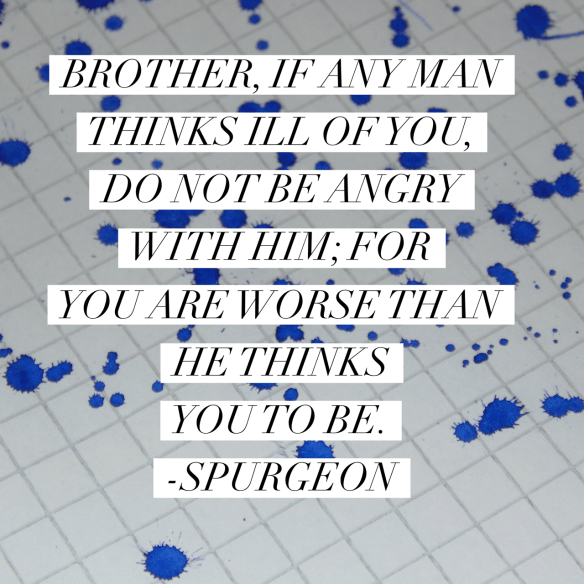
β€œBrother, if any man thinks ill of you, do not be angry with him; for you are worse than he thinks you to be. If he charges you falsely on some point, yet be satisfied, for if he knew you better he might change the accusation, and you would be no gainer by the correction. If you have your moral portrait painted, and it is ugly, be satisfied; for it only needs a few blacker touches, and it would be still nearer the truth.” (Source unknown).

IMG_1739

Isn’t that the truth? Sure,Β some people are judgmental. Some are busybodies. Some correct too much or too easily. Some people who really mean well can correct in an unkind or hurtful way. Some are even wrong in their critiques. But whatever they’ve said, they don’t know the half of it. There’s plenty of fodder for criticism in any of our lives.

Not surprisingly, the Bible has much to say about receiving criticism or reproof or correction. Here is just a sampling.

For the commandment is a lamp; and the law is light; and reproofs of instruction are the way of life. Proverbs 6:23.

Reprove not a scorner, lest he hate thee: rebuke a wise man, and he will love thee.
Give instruction to a wise man, and he will be yet wiser: teach a just man, and he will increase in learning. Proverbs 9:8-9.

He is in the way of life that keepeth instruction: but he that refuseth reproof erreth. Proverbs 10:17.

The way of a fool is right in his own eyes: but he that hearkeneth unto counsel is wise. Proverbs 12:15.

Poverty and shame shall be to him that refuseth instruction: but he that regardeth reproof shall be honoured. Proverbs 13:18.

A scorner loveth not one that reproveth him: neither will he go unto the wise. Proverbs 15:12.

The ear that heareth the reproof of life abideth among the wise. He that refuseth instruction despiseth his own soul: but he that heareth reproof getteth understanding. Proverbs 15:31-32.

A reproof entereth more into a wise man than an hundred stripes into a fool. Proverbs 17:10.

As an earring of gold, and an ornament of fine gold, so is a wise reprover upon an obedient ear. Proverbs 25:12.

I used to tell one of my sons who had trouble receiving correction that if he didn’t acknowledge that a certain action or attitude was wrong, he could not correct it or change it. I often shared with him Proverbs 28:13: β€œHe that covereth his sins shall not prosper: but whoso confesseth and forsaketh them shall have mercy.”

So what’s the best way to respond to criticism? Here are a few tips that I know I need to put into practice:

  • Believe that the other person has your best interest at heart, or at least he or she is trying to make you better in some way. Thank them for their interest and concern.
  • Receive it calmly. Beware of responding defensively,Β  in angry retaliation, or in a wounded closing in on oneself. You may need to ask for time to process what they’ve said.
  • Examine it to see whether it’s valid.
  • Pray about it. Maybe it doesn’t seem valid because you have a blind spot that God is trying to alert you to.
  • Criticism stings so much primarily because of pride. “God resisteth the proud, but giveth grace unto the humble…Humble yourselves in the sight of the Lord, and he shall lift you up” (James 4:6, 10).

Humble

  • If it is valid, do whatever you need to do to correct it. Confess it to the Lord if it is a sin (1 John 1:9) and to anyone else it has affected.
  • If it is not valid, explain to the person, kindly and calmly, why you feel you need to keep doing what you’re doing. There are times it will be invalid. For example, a pastor of a church of 200 may hear 25 (or more!) opinions of what he should do, some in direct conflict with each other.There is no way he can implement every suggestion or change everything to please everyone.

We can take comfort in the fact that God sees believers through His Son, Jesus Christ, and that once we savingly believe on Him, His righteousness is transferred to our account because He took our sinfulness on His. Because of His amazing grace, those who have believed on Christ for salvation become God’s children, and will have a home with Him in heaven. Our eternal life begins NOW, not when we die.

Yet until we get to heaven, we have a sin nature to contend with, and we’re instructed to β€œgrow in grace, and in the knowledge of our Lord and Savior Jesus Christ” (II Peter 3:18). II Timothy 3:16-17 tell us: β€œAll Scripture is breathed out by God and profitable for teaching, for reproof, for correction, and for training in righteousness,Β that the man of God may be complete, equipped for every good work” (ESV). Part of that growing, completion, equipping, is realizing those areas where we have a problem and then seeking God’s grace and relying on His Word to change us. So when we receive a criticism, instead of just brushing it off, we can see if God means to use it to show us something we need to know about ourselves. We can prayerfully examine it to see if it is just, then we can confess it to the Lord (and to whomever else we might need to confess it) and correct it and grow in wisdom and character β€” and stop causing a problem in other people’s lives by continuing on in the fault. Isn’t that much better than hanging on to our hurt and indignation? And even if the criticism is invalid, perhaps God allowed it to put us through a time of self-examination and humbling.

There is only one perfect person in the universe, and as we behold Him, He changes us to be more like Himself:Β  But we all, with open face beholding as in a glass the glory of the Lord, are changed into the same image from glory to glory, even as by the Spirit of the Lord. II Corinthians 3:18.

(Updated from the archives.)

(Sharing with Inspire Me Mondays, Literary Musing Mondays, Woman to Woman, Works For Me Wednesday, Thought-Provoking Thursday)

Save

Save

Save

Save

Save

Summer

IMG_1738

Yesterday marked the first day of summer, though it has been feeling pretty summery around here for a few weeks already.

Summer doesn’t have quite the sensation of joy, freedom, and expectancy that it does when you’re a child and school is out for three glorious months. With our kids no longer in school and our grandchild not yet in school, our schedules aren’t affected much by the school schedule – except it’s nice to be able to drive without having to worry about slowing to a stop in school zones at certain times of the day. And we do have to watch out more for kids playing in or near the neighborhood street.

Yet summer still retains a bit of charm, though it’s very hot and humid here in the South. It’s the season of grilling, sitting in the pool if you’re lucky enough to have access to one (we enjoy filling up a kiddie pool for Timothy), longer days, yard work, picnics, and vacations for some.

Here are a few favorite quotes about it:

Summer is the time whenΒ it is too hot to doΒ the jobs it was too coldΒ to do in winter. ~ Author Unknown

Β Rest is not idleness, and to lie sometimes on the grass on a summer day listening to the murmur of water, or watching the clouds float across the sky, is hardly a waste of time.Β  ~John Lubbock

A perfect summer day is when the sun is shining, the breeze is blowing, the birds are singing, and the lawn mower is broken.Β  ~James Dent

Someone’s sitting in the shade today because someone planted a tree a long time ago. ~ Warren Buffett

No price is set on the lavish summer;
June may be had by the poorest comer.
~James Russell Lowell, The Vision of Sir Launfal, 1848

IMG_1736

And most of my fellow Southerners can identify with this:

You know you are in the South in August when…

* The birds have to use potholders to pull worms out of the ground.

* The trees are whistling for the dogs.

* The best parking place is determined by shade instead of distance.

* Hot water now comes out of both taps.

* You can make sun tea instantly.

* You learn that a seat belt buckle makes a pretty good branding iron.

* You discover that in August it only takes 2 fingers to steer your car.

* You discover that you can get sunburned through your car window.

* You actually burn your hand opening the car door.

* You break into a sweat the instant you step outside at 7:30 am.

* Your biggest bicycle wreck fear is, “What if I get knocked out and end up
lying on the pavement and cook to death?”

* You realize that asphalt has a liquid state.

* The potatoes cook underground, so all you have to do is pull one out and add butter, salt, and pepper.

* Farmers are feeding their chickens crushed ice to keep them from laying boiled eggs.

* The cows are giving evaporated milk.

We’re experiencing some of that though it’s not August yet!

The Bible mentions summer a few times, among them:

While the earth remaineth, seedtime and harvest, and cold and heat, and summer and winter, and day and night shall not cease. Genesis 8:22

Thou hast set all the borders of the earth: thou hast made summer and winter. Psalm 74:17

Go to the ant, thou sluggard; consider her ways, and be wise:Β Which having no guide, overseer, or ruler,Β Provideth her meat in the summer, and gathereth her food in the harvest. Proverbs 6:6-8. And another one about industrious ants: The ants are a people not strong, yet they prepare their meat in the summer. Proverbs 30:25

He that gathereth in summer is a wise son: but he that sleepeth in harvest is a son that causeth shame. Proverbs 10:5

As snow in summer, and as rain in harvest, so honour is not seemly for a fool. Proverbs 26:1

Saddest of all: The harvest is past, the summer is ended, and we are not saved. Jeremiah 8:20

Β Now learn a parable of the fig tree; When his branch is yet tender, and putteth forth leaves, ye know that summer is nigh:Β So likewise ye, when ye shall see all these things, know that it is near, even at the doors. Matthew 24:32-33

No hint of summer as vacation there! That helps me not to be wistful of childhood’s long summers off. That must be a modern concept: it wasn’t that long ago that kids didn’t have school in summer for the express purpose of being available to help their parents during the busiest seasons on the farm, and even now, summer is a busy time for farmers and homesteaders. It would be interesting to study summer in other cultures: for instance, in areas near the equator where it’s excessively hot, I wonder if summer if more laid back because it would be harder to function in the heat.

But the Bible does encourage times of rest as well as diligence, so I am glad summer affords time for that.

We have no special plans for the summer except for a couple of events to look forward to. With my husband’s mom here, we can’t really travel. What I call our “birthday season” begins in July: five of us have birthdays between then and mid-September. But we enjoy grilling and sitting outside in the evenings when it’s not so hot, and we look forward to my oldest son coming for a week-long visit in a few weeks. Lately our neighborhood has been getting together for a group cook-out on the 4th of July. Summer used to be reading heaven for me when I was younger, and though I can’t spend the bulk of the day in a book anymore, I still do get a bit more reading in as there is not much on TV during the summer.

What are you doing this summer?


Save

Book Review: Chateau of Secrets

ChateauMelanie Dobson first came to my attention through Carrie. If you read Carrie much at all, you know that she does not like Christian fiction, yet she likes Melanie. Since I do like Christian fiction, I figured I would probably enjoy Melanie all the more. So when I saw her Chateau of Secrets come through on a Kindle sale last year, I snapped it up.

And indeed, I enjoyed it very much. Normally I read Kindle books on my iPad mini as I am getting ready to fall asleep and then when I have any waiting time away from home. But this one had me pulling my phone out several times during the day to read a few more paragraphs.

GisΓ¨le Duchant lives with her father in their ancient chateau on Normandy before the onset of WWII. As Hitler’s forces come ever closer, they decide to leave. But GisΓ¨le’s father is killed, and she then decides to stay. Her brother, Michel, is a leader in the underground resistance, and she has been helping him by secretly bringing food and supplies where he is hiding in the tunnels beneath their property.

Eventually the Nazis come to their area and take over the chateau for their local headquarters. They commandeerΒ GisΓ¨le to cook and keep house for them, so she’s walking a tightrope between doing what is required of her there yet still helping her brother and trying to keep the tunnels a secret.

The chapters alternate between her story in the 1940s and her granddaughter Chloe’s story in modern times. Chloe is a teacher engaged to Virginia gubernatorial candidate Austin Vale. Being the fiancee of a high-profile politician has its drawbacks, but their times alone convinces her that it’s worth it. Just a few weeks before her wedding, her parents ask her to go to France. A filmmaker is doing a documentary on the chateau and its role in the war, and Chloe seems to be the best person to go and be interviewed by him. Chloe doesn’t know much about the chateau, and her grandmother GisΓ¨le’s dementia confuses or hides much of her memory, so she’s not able to give her much information. But when she tells her grandmother that she’s going to the chateau in Normandy, GisΓ¨le urgently insists that she must find Adeline. Chloe has never heard of Adeline before. As she travels to France, stays in the chateau, and delves into her grandmother’s history, she uncovers a multitude of secrets, some of which will have an impact on her family now.

I enjoyed both GisΓ¨le’s and Chloe’s story lines. I liked the way the author wove in much detail about France in that era without making it too heavy or encyclopedic. I had not known that Jews served in the German Wehrmacht. Some probably did so to hide their Jewishness, but some did so out of coercion to protect loved ones. I loved the mystery of the story and thought the author did an expert job at unfolding it.

The story is loosely based on the life of Genevieve Marie Josephe de Saint Pern Menke. She lived in a chateau in France during WWII which was taken over by the Germans, and “risked her life to hide downed Allied airmen and members of the French resistance in this tunnel underneath the chateau,” among many other things.

GisΓ¨le is Catholic, and, not being Catholic myself, there were a few points here and there that I would disagree with, namely praying to Mary, St. Michel, and ever her dead mother (that’s not the biggest problem I have with Catholicism, but it’s the biggest one in this book, because nowhere in Scripture are we instructed or encouraged to pray to anyone but God Himself. Jesus said, “When ye pray, say, Our Father which art in heaven….” After all He did to create access for us to God, why would we try to go to Him through anyone else?) I don’t share what I disagree with in books just to be critical or contentious, but sometimes people tell me they read things I recommend, so I want to be careful that I don’t promote error. I would assume that GisΓ¨le’s Catholicism is accurate to the time, place, and person her character is based on. And I did find much good spiritual truth in the book otherwise.

Overall I loved the book and will keep my eyes peeled for more of Melanie’s books in the future.

(Sharing atΒ Semicolonβ€˜s Saturday Review of Books)

Save

Save

Friday’s Fave Five

friday fave five spring

It’s Friday, time to look back over the blessings of the week with Susanne at Living to Tell the Story and other friends.

It’s been a busy getting-things-done-at-home week and therefore not much of a blogging week. πŸ™‚ But it’s felt good to get some things accomplished. Here are some of the best parts of the last week:

1. A fun Saturday. We went with our kids and grandchild to a park, mainly to watch Timothy play in the fountain, or splash pad. Then we ate lunch at a nearby restaurant, came home and caught a nap, and then Jason and Mittu came over and made chicken nachos for dinner.

IMG_0012

2. A blow dryer with a “cool” setting. What’s funny is that it has been sitting in a closet for three years. It was among my mother-in-law’s things from the nursing home, but we don’t remember buying it for her (that was the case with a lot of things – some of her things missing, but a few things we’d never seen before were with her belongings. Sigh.) She has one in her room, so we just put this one in a box. Just recently mine started acting up, so I dug this one out – and really liked it! It has a lot more power than my old one. And this time of year when I get sweaty so easily, especially on days I go to the gym, it’s nice when I am finishing blowing my hair dry to turn on the cool setting for a minute or so. To think I could have been using it all this time!

3. Using gift cards. Last Friday night I felt totally uninspired to cook, or even to think about what to cook. I had a couple of gift cards for Cracker Barrel that I received at Christmas, and my husband indulged me in using them for dinner that night – we called an order in and then he picked it up. Then I went to look for a couple of things at our nearby Hobby Lobby that I had seen at another one. I didn’t find one, and decided against the other – but I did find a couple of other things! They all happened to be 40% off. And I still have gift card credit!

IMG_1719

4. Finally getting my hair cut. I have been meaning to for a few weeks and just haven’t made it til this one. It’s nothing new or exciting, but it’s just so much more cooperative at shoulder length, and I was about 2″ past that.

5. Progress in sorting out some things to donate to our local rescue mission thrift store. I had started a couple of weeks ago and gotten sidetracked, but determined to finish this week, as this stuff was piling up in my sewing room. It’s been fun to find some things I thought I had lost or had forgotten about, plus to tidy up and reorganize the spaces that have been cleaned out. I still have a bit to do, but I’m enjoying a sense of accomplishment.

Happy Friday!

Save