Laudable Linkage

Here is my periodic round-up of notable reads discovered the last week or so:

Ignore the Pundits and Keep Praying.

Divine Appointments. Neat account!

An Introduction to the Family Advent Art and Reading Guide. “I wanted us to think about Jesus and the nativity, but I had not provided a sense of his pending arrival. Meanwhile, everywhere we went, my kids were told Santa was on his way. Fortunately, I had a couple thousand years of church tradition to back me up, if only I knew how to draw on it. It was time to learn about Advent.”

9 Things You Should Be Doing to Support Your Pastor’s Wife.

12 Steps to Avoid Disappointment This Holiday Season.

28 Reasons Not To Hate Winter, HT to Lisa Notes. I come pretty close to hating it, especially in January, so this is a help.

Have a great weekend! I am behind visiting with blog friends – hope to catch up some time this weekend.

Friday’s Fave Five

It’s Friday, time to look back over the blessings of the week with Susanne at Living to Tell the Story and other friends.

It’s so hard to believe we’re into December already! Here are some highlights of the week:

1. Decorating for Christmas. It was a really enjoyable day all together. We found a new spot to get a tree (our previous place closed down, and getting a tree at Home Depot last year just wasn’t the same). Having a little helper this year was great fun, too. πŸ™‚

IMG_0014(1)

IMG_0004

2. Turkey Bone Soup. One of my favorite leftover turkey dishes.

3. Not having rain and cold on the same days. πŸ™‚ The beginning of the week was rainy and overcast, but temperatures were in the 50s. By the time we got down into the 30s later in the week, the rain had gone. If the situation had been reversed – we would have had a mess of icy and/or slushy roads. I’m sure we will at some point this winter, but I am glad we escaped it this week.

4. Online shopping. It was good to knock out the greater part of Christmas shopping at home all in one morning.

5. A turn for the better. My younger two sons both work in customer service in the same online company. Of course, Black Friday and Cyber Monday generated a lot of business, which they were expecting, but some problems in their system caused trouble for both them and their customers. Jesse came home Wednesday night quite discouraged – no matter how much he worked, the number of tickets they needed to answer kept rising by the hundreds. But a server upgrade Thursday plus the end of their extended Cyber Monday sales has made catching up look possible again, and he was in a much better frame of mind yesterday.

Happy Friday! Hope you have a great week ahead.


Book Review: Caregivers’ Devotions To Go

caregivers devotionsI got Caregiver Devotions To Go by Gigi Devine Murfitt from a Kindle sale a few years ago, and it has been sadly languishing on my Kindle app since then. I just recently rediscovered it and thought it was the perfect time to read it.

Gigi writes from the perspective of a daughter who helped her “widowed and disabled mother as she cared for her ten children” and then later cared for her mom when she was older, and then as a mother of a son with special needs. In some cases her definition of a caregiver broadens to include teachers, firefighters, etc. She shares here 30+ short (a little over 2 pages each on my device) devotional thoughts on various aspects of caregiving. Each one includes a Scripture verse, several paragraphs, a prayer, and activity ideas.

The devotionals cover a variety of topics, from acceptance to finding strength to showing love to our need and the provision for forgiveness when we fail. One of my favorites was when a friend wrote a letter to Gigi’s son after he was born with arms only 3 inches long, saying that he was as fearfully and wonderfully made as anyone else and that she was looking forward to see how God worked in and through him. Another was when her sister, after finding her mother in “a five pound, urine soaked diaper” at her nursing home more than once, even after speaking to the nurses about it, asked if she could visit with the staff. She thought she was just going to have a meeting with the nurses and aides who cared for her mom specifically, but she found when she arrived that she was the guest speaker for a staff meeting of about 60 people. She talked about what residents gave up to live in the nursing home – homes, pets, most possessions, autonomy, etc., and emphasized their need for compassion, pointing out that “for many of them, the caregivers were the only contact they had on a daily basis. A touch, a smile, a gentle response, an ‘I care about you’ attitude could make a bleak day brighter.” She asked them to treat the residents as they would want their own family members taken care of. When my mother-in-law was in various facilities, I often wished I could address her caregivers, but I never thought to ask. My husband did speak to the person in charge more than once, but I would have loved to gently urge everyone to remember that these are people they are dealing with, not just tasks, and to treat them as they themselves would want to be treated in the same situation. Now I find myself needing to be reminded of the same truths.

Though not every entry applied to my situation, and though I would differ with the author on a couple of issues, overall I benefited much from this book, and I think any caregiver would as well.

(This review will also be linked toΒ Semicolonβ€˜s Saturday Review of Books.)

Book Review: The Butterfly and the Violin

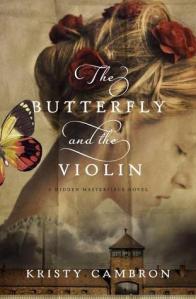
Butterfy and the ViolinIn The Butterfly and the Violin by Kristy Cambron, Sera James owns and manages an art gallery in Manhattan. For years she has been looking for a painting she saw as a child which held special meaning for her. She has finally found at least a copy of it, but hopes it will lead to finding the original. The owner, William Hanover, refuses to sell but wants to hire Sera because he also wants to find the original, but for very different reasons. They develop a relationship, but Sera is reluctant to open her heart again after having been left at the altar by her fiance two years ago. Unraveling the mystery of the painting at first brings them closer together but then suddenly brings a sharp division between them.

The painting portrays a young woman with piercing eyes, a shaved head, and a number tattooed on her wrist holding a violin. Cambron switches back and forth between the present day and Sera’s situation to the 1940s and the story of the woman in the painting, Adele von Braun, revealing more of Adele’s story in both narratives.

Adele’s father was a high-ranking official in the Third Reich, and she was a well-known violinist nicknamed “Austria’s sweetheart.” She loved a cellist named Vladimir, but her father would not sanction their relationship since Vladimir was only the son of a merchant. Adele kept seeing Vladimir in secret and eventually learned that he was part of a network that smuggled Jews out of the country to safety. Adele had hidden Jewish friends of her own that she secretly brought supplies to, but when she tried to help them escape, she was discovered, arrested, and sent to Auschwitz. There she became part of the prison orchestra, made to play every day as the prisoners were sent out to work, during executions, and occasionally at a Nazi social event. While she felt her spirit dying, her friend tried to help her see that there could be beauty and service to God even in such a place.

God is here. He sees. He knows what is happening in this place.

This, child, is our worship. To live and survive and play to God from the depths of our souls. This is the call that binds us. When we worship in the good times, it brings God joy. But worship in the midst of agony?…That is authentic adoration of our Creator.

One day we will be free. And we become free by living despite what they do to us. We live by working, and we work for God.

I had known that their were musicians among those in WWII prison camps who were made to play for the Nazis. And I knew that the Nazis had confiscated a lot of art during those years. But I hadn’t known that there were many paintings and other art by the prisoners themselves discovered after the camps were liberated – over 1,600 pieces in “partially destroyed warehouses and old barracks of Auschwitz,” according to the author’s note at the end. Those pieces still survive even now, though many of the artists are unknown. As one character muses in the story,

She told herself that to have something of worth in a world full of chaos was the very definition of beauty.Β  It felt like a spiritual liberation that couldn’t be silenced.Β  These prisoners, the ones who painted or wrote poetry or played in the orchestra – they refused to let that spirit die.Β  And this, she decided, is why the heart creates.

God plants the talent and it grows, sustained by a spirit-given strength to endure, even in the midst of darkness. It thrives in the valleys of life and ignores the peaks. It blooms like a flower when cradled by the warmth of the sun. It remains in a hidden stairwell in a concentration camp. It grows, fed in secret, in the heart of every artist.

I enjoyed both Sera’s and Adele’s stories and the themes of God’s presence in suffering and the need to create. This is Cambron’s first novel, and it has deservedly won many awards. My overactive internal editor stumbled over just a few minor places where I felt the writing was a little awkward, but I’m not even going to go into them because overall this was a gripping, fascinating, heart-breaking, yet beautiful story.

(This review will also be linked toΒ Semicolonβ€˜s Saturday Review of Books.)

A Few Grimm’s Fairy Tales

Rebekah at bekahcubed chose Grimm’s Fairy Tales for Carrieβ€˜s Reading to Know Classics Book Club for November – as many of them as one wanted and had time to read. I knew I would not be able to read a whole volume, but I wanted to read some of the more well-known ones to see how they compared.

GrimmI knew I would get to more of them via audiobook than regular book, and the edition I had chosen, The Original Folk and Fairy Tales of the Brothers Grimm: The Complete First Edition, was translated and edited by Jack Zipes in 2014. His introduction, though a bit wordy and repetitive, was quite interesting. I had not known that German brothers Jacob and Wilhelm Grimm had not actually traveled around the country collecting tales, as is commonly thought. They originally studied law, but one professor, Friedrich Carl von Savigny, believed in an interdisciplinary approach in that history, language, literature, law, religion, etc., all influenced each other. Thus “the brothers eventually came to believe that language rather than law was the ultimate bond that united the German people.”

I also had not known that the brothers themselves revised the stories a great deal from their first edition (in 1812) to the seventh (in 1857). The original stories had details that were thought unsuitable for children (gruesomeness in some, “adult” details in others like Rapunzel getting pregnant by the visiting prince). Later editions also excluded some stories from other countries and added other stories that the Grimms had collected in the meantime. I can’t fault the Grimms for continually revising their work: I tend to tweak things I have written nearly every time I look at them. This and the fact that there were varying versions of the tales even in their day makes me a lot more forgiving of the modern twists on them. In his introduction, Zipes includes the first several paragraphs of a couple of stories from a few different editions to note the changes. I did like hearing how some of the stories originated even while feeling later versions were probably better.

“Florid descriptions, smooth transitions, and explanations are characteristic of most of the tales in the 1857 edition.” This version is a translation of the 1812 and 1815 editions. I only listened to a few stories from the first, and they are sparse, mostly unembellished, and simply told.

Zipes translated the originals into “succinct American English.” While this makes them easily understood, I do miss the “fairy tale style” of the wording (for instance, the prince gives Cinderella her missing slipper and says merely, “Try it on. If it fits, you’ll become my wife.”) I don’t know how much of the lack of that is due to his translation or to the simplicity of the originals: perhaps that’s a product of later editions. There are also a lot of exclamations taking God’s name in vain: again, I don’t know if this is Zipe’s doing or if there are equivalent expressions in the originals.

I did get to listen to quite a few more tales than I had thought I would. Here are a few thoughts on the ones I read:

“The Frog King”: A beautiful princess plays with her favorite thing, a golden ball, until it drops into some water. She’s distraught until a frog comes up out of the water and promises to fetch the ball for her if she’ll take him to be her companion, letting him eat from her plate, drink from her cup, and sleep in her bed. She agrees, but in her excitement over getting her ball back, runs off to the castle, forgetting about the frog. He comes to the castle to claim her promise, which she resists until her father makes her keep her word. When she has had enough and throws the frog against her bedroom wall in disgust, he turns into a prince, and they marry and live happily ever after. There’s no “you have to kiss a lot of frogs before you find a handsome prince” here, not even true love’s kiss transforming the frog. In fact, if I were the prince, I would have thanked the princess after the transformation and moved on. πŸ™‚

“The Companionship of the Cat and Mouse.”: A cat and mouse lived together and stored some of their food under the altar in the church. Three times the cat leaves under false pretenses and eats some of the stored food until it’s gone. When the mouse discovers this, the cat eats the mouse. Zipes’ introductions says that many of the tales champion the underdog, but in this case the undermouse got the raw end of the deal.

“The Virgin Mary’s Child”: The Virgin Mary helps out a poor couple by taking their 3 year old daughter to care for her in heaven. Everything goes well until the girl grows, and Mary has to leave for a while. The girl is told not to go into a certain room, but she does. Mary knows she has disobeyed, but the girl won’t confess, so Mary makes her leave heaven and makes her mute. She’s discovered by a king, who marries her. When she has a child, Mary comes back and gives the girl – or young woman now – a chance to come clean. She doesn’t, so Mary takes her baby away. Some therefore think she’s an ogress who has eaten her own child – especially when this happens two more times. The third time, the woman is sentenced to die burned at the stake. She finally wants to confess to Mary that she lied and disobeyed, and then Mary restores her speech and her children.

“Rapunzel”: begins with a husband and wife wishing for years for a child. When the wife finally gets pregnant, she craves the rapunzel (a type of lettuce) in the neighboring garden. The husband gets some for her, but the wife’s craving increases. When he sneaks into the garden a second time, he finds the fairy (in later versions a sorceress) who owns the garden, and who is very angry over his theft. He explains why he is taking it, and the fairy says he can take all he wants as long as they give the baby to her when it is born. She takes the baby, and when the baby grown into a young woman, she locks her away in a tower with no doors. The fairy gets in and out by asking Rapunzel to let down her long hair, and then the fairy uses it to climb up. A prince happens by and hears Rapunzel singing, and is so taken with her voice that he wants to see her. He can’t find a way in, but he observes what the fairy says when she comes, and the next night when the fairy is gone, he calls up to Rapunzel to let down her hair. Rapunzel is frightened by him at first, but in a short time falls in love. They see each other every night. Finally Rapunzel asks the fairy why her clothes are getting so tight. The fairy perceives Rapunzel is pregnant (I don’t suppose you can fault Rapunzel if she has been locked away in a tower since she was 12. But the prince should’ve known better!) The fairy is so angry, she cuts off Rapunzel’s hair and banishes her. The fairy ties Rapunzel’s hair to a hook, and when the prince comes up, he finds the fairy instead. He is so distressed he throws himself out of the tower, and loses sight in both eyes. Eventually Rapunzel gives birth to twins in a desolate land. The prince, in his wanderings, hears her singing and finds her. Two of her tears fall on his eyes, and they are healed.

“Hansel and Gretal” are children of a poor woodcutter and his wife. There is not enough food, so the mother instructs her husband to take the children out into the woods and leave them. The children overhear, so Hansel takes some pebbles and drops them along the trail. When their parents leave them, the moon shines on the pebbles and they find their way back home. But the mother insists the father take them even deeper into the forest. Hansel is unable to get more pebbles, so this time he drops bread crumbs to mark the trail. But the birds eat the crumbs. Hansel and Gretel are distressed and try to get home for a couple of days, when they find a house made of bread “with cake for a roof and pure sugar for windows.” When the old woman inside discovers them, she feeds them well, but locks Hansel away to fatten him up to eat him. She was actually a witch who had built the house on purpose to lure children. She makes Gretel act as servant for several days, until she asks Gretel to check something in the oven, planning to shut her in. Gretel prays for help, feigns ignorance, and asks the witch to show her what she means, and when the witch is in the oven, Gretel shuts her in and locks the door. She rescues Hansel, they fill their pockets with the witch’s jewels, and go back home, where they are able to provide for their father. The evil mother had died.

“Herr Fix-It-Up” and and “The White Snake” have different settings but are similar in that the main characters help various animals who then help them on their quest to perform three tasks to win a princess.

“The Fisherman and His Wife”: The fisherman one day catches a talking flounder who claims to be an enchanted prince. The fish asks the man to spare him, which he does. When the fisherman tells his wife what happened, she says he should have wished for something in return. She sends him back to ask for a hut, which the flounder grants. The wife is content – for a week, when she sends her husband back to ask for a castle. He does, reluctantly, and the fish grants it. But the wife is still discontent. She sends him back to ask the fish to make her king, then emperor, and then pope. The fish grants each request until the wife admire a sunrise and decides she wants to be like God. When the fisherman reluctantly once again asks the fish, the fish sends them back to their original shack, where they are said to be living to this day.

“Cinderella” was pretty much as I had heard it, except the step-sisters were beautiful and were the main problem rather than the step-mother. There were three balls rather than one; no sewing mice but there were helpful pigeons; no fairy godmother, but a magic tree planted on Cinderella’s mother’s grave which she could wish on; no pumpkins turning into coaches; golden rather than glass slippers. Cinderella has to leave before midnight each night, and on the third night the prince pours pitch on the walkway so she can’t get away so fast (seems like that would be a problem for the other guests…). The step-mother did advise her daughters to cut off part of their feet to fit into the golden slipper, which they did, and almost fooled the prince, until the pigeons pointed out their bleeding feet. (This prince seems a little dim…) Finally he gets the shoe on the right foot and then finally recognizes Cinderella, the pigeons confirm she’s the one, and they live happily ever after.

“Little Red Cap” was exactly same as “Little Red Riding Hood.” The only thing different from the version I knew was that, after the fiasco with the wolf and being rescued by the huntsman, a second wolf attempts to distract Red, but she has learned her lesson and resists this time, and she and her grandmother trick the wolf into falling into a trough of water where it drowns.

“Death and the Goose Boy”: The goose boy is tired and wants to leave the world, and when he meets Death, he asks him to take him across the river out of the world. But Death can’t right them because he is on another mission. When he finishes that, he asks the goose boy if he still wants to go. He does. His geese turn into sheep, and he “heard that the shepherds of places like that become kings.” “The arch-shepherds, Abraham, Isaac, and Jacob,” give him a crown and take him to the castle of shepherds.

“Briar Rose” is the story of Sleeping Beauty and was pretty much as I remembered hearing it, though different than the Disney version.

“Little Snow White” was also close to the version I knew except it was her mother, not a step-mother, who was jealous of her beauty and had the magic mirror. She was changed to a step-mother in later versions. She also made three attempts on Snow’s life, the last one being the magic apple. In the end she was punished by being made to dance with burning shoes until she died.

“Rumpelstiltskin” was pretty much the story I knew. It’s never explained why the girl’s father tells the king his daughter can spin straw into gold: he is only mentioned in the beginning.

I hadn’t thought I would get to this many, but they are fairly short in this volume. I did enjoy both the familiar and unfamiliar ones. Now that I have started, I would love to hear or read the rest some time. But I don’t think that they are best enjoyed one right after another for several stories in a row, for me, anyway. I tended to lose details that way. Now that I have the audiobook, though, I can listen to 2 or 3 at a time in-between other books. I don’t know if I will ever listen to the whole thing, but there are several more stories I’d like to explore. I think they’d best be enjoyed either as individual children’s books with nice illustrations or as an illustrated collection of several of them. But I do think this original version is good for reference and for seeing how they started – at least the original written versions. Many of the stories themselves had been told orally for hundreds of years, so who knows what the actual originals were. But we’re indebted to the Grimms for writing them down for us.

(This review will also be linked toΒ Semicolonβ€˜s Saturday Review of Books.)

 

Laudable Linkage

If you, like me, are avoiding the Black Friday crowds, perhaps you’ll be interested in a little after-Thanksgiving reading. πŸ™‚ Here’s a round-up of interesting reading discovered in the last week or so:

Doctrine Matters: Eternal Life Depends On It.

Why Controversy Is Sometimes Necessary.Β  HT to Challies.”The only way to avoid all controversy would be to consider nothing we believe important enough to defend and no truth too costly to compromise.”

Seven Sentimental Lies You Might Believe.

Every Mormon’s Need For Rest.

Only You Can Determine If Caregiving Is a Burden or Blessing.

Forgiveness and Caregiving Create Amazing Changes.

Think Before Asking Why I Don’t Have Kids Yet.

Christan Fiction: No Wimps Allowed.

10 Things You Didn’t Know About “A Charlie Brown Christmas.” If you are interested in what Charles Schulz believed. some of it is detailed in A Charlie Brown Religion.

I saw this and loved it but don’t know the original source:

Insta Gram

Hope you have a great day, whatever your plans! We’re decorating for Christmas today!

Friday’s Fave Five

FFF fall background

It’s Friday, time to look back over the blessings of the week with Susanne at Living to Tell the Story and other friends.

Hope those of you in the US had a good Thanksgiving Day. Here are a few highlights of the week:

1.Β  The Galkin Evangelistic Team made our church their last stop of their fall term, and we enjoyed a feast from the Word in both music and message.

2. Central heating. We’ve had temperatures in the 20s this week – so nice to have a warm home.

3. Throw blankets. I don’t know how they make them just right, but they are perfect for cool evenings on the couch while reading or watching TV.

4. Thanksgiving. Ours was a little different this year: this was the first time our oldest son wasn’t here for it. I’ve been trying hard not to be emotional about it and to look on the good points, that he came in the spring for Timothy’s birthday and will be here at Christmas. And we did get to Face Time. Jason and Jesse both have to work Friday – we’re used to all of us having the whole weekend off. But we still have much to be thankful for: that Jason’s family was all well enough to come, after having been sick earlier in the week, that we had a great Thanksgiving feast and time with family, among multitudes of other things.

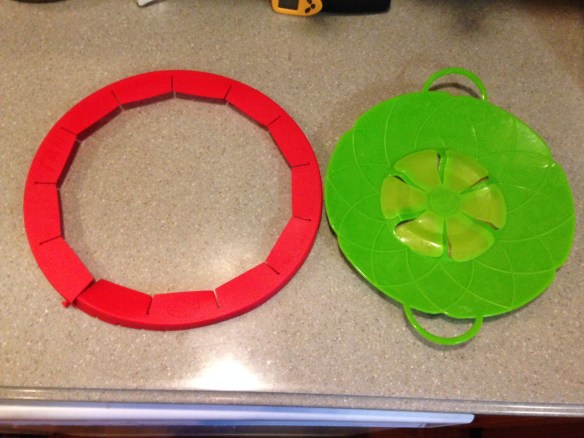
5. Silicon kitchen helpers. I had gotten these for presents earlier this year but hadn’t had an opportunity to use them yet until Thanksgiving.

IMG_1417

The left one is a pie guard, to put around the edges of a pie so they don’t get over-cooked. It worked well – smelled a little funny, but that didn’t affect the taste of the pie, and I am hoping the smell goes away after using it more. It has little notches on one end and slots on the other so you can adjust it to the size needed, and it’s easy to hook on. I always hate wrestling with foil strips and then trying to get them to stay in place, so this was nice. The other you put over a pan of whatever you have boiling and it keeps it from boiling over. That always happens when I am boiling potatoes for mashing: no matter how closely I watch them, as soon as my head is turned, they boil over. This did work really well. There was still a teeny bit of liquid that spilled over, but not nearly as much as usual.

No Black Friday shopping for us – for me, anyway. I’d rather shop weekdays when it’s not so crowded. πŸ™‚ We’re going to work on Christmas decorations this weekend. It doesn’t feel at all like it should be December yet, but maybe this will help. πŸ™‚ Happy Friday!

Happy Thanksgiving

19726-happy-thanksgiving-pumpkins-1440-x-900

Graphic Courtesy of crosscards.com

Is this the kind return,
And these the thanks we owe,
Thus to abuse eternal love,
Whence all our blessings flow?

To what a stubborn frame
Has sin reduced our mind!
What strange rebellious wretches we,
And God as strangely kind!

On us He bids the sun
Shed his reviving rays;
For us the skies their circles run,
To lengthen out our days.

The brutes obey their God,
And bow their necks to men;
But we, more base, more brutish things,
Reject His easy reign.

Turn, turn us, mighty God,
And mold our souls afresh;
Break, sov’reign grace, these hearts of stone,
And give us hearts of flesh.

Let old ingratitude
Provoke our weeping eyes,
And hourly as new mercies fall
Let hourly thanks arise.

~ Isaac Watts

May you experience hourly mercies and thanks! Have a wonderful Thanksgiving Day!

Book Review: The Yearling

YearlingThe Yearling by Marjorie Kinnan Rawlings is the story of twelve year old Jody Baxter, who lives with his family in a backwoods area of Florida known as “the scrub” in the years after the Civil War. His parents, Ezra (nicknamed Penny because of his small stature) and Ory, have previously lost six children in infancy. This and the fact that he had a hard upbringing himself makes Penny want to let Jody be a child for as long as he can and makes him even more dear. But Ory, though not totally lacking in affection, is somewhat detached from Jody, and has hardened somewhat after all the losses and hardscrabble existence. She says, “Seems like bein’ hard is the only way I kin stand it.”

Though “friendliness and mutual help in time of trouble” was more available in towns, Penny wanted the peace of the scrub:

He had perhaps been bruised too often. The peace of the vast aloof scrub had drawn him with the beneficence of its silence. Something in him was raw and tender. The touch of men was hurtful upon it, but the touch of the pines was healing. Making a living came harder there, distances were troublesome in the buying of supplies and the marketing of crops. But the clearing was peculiarly his own. The wild animals seemed less predatory to him than people he had known. The forays of bear and wolf and wild-cat and panther on stock were understandable, which was more than he could say of human cruelties.

Jody begins as a good-hearted but immature boy, off rambling in the forest when he should be hoeing the corn. He wants a pet, but his Ma is against it: it’s hard enough to keep the family fed. Although Penny wants Jody to be carefree as long as possible, he takes Jody on various forays like hunting, trading, planting, etc., teaching him and imparting wisdom along the way. When Penny wants to take Jody trading with their nearest neighbors (four miles away), the rowdy Forresters, he and Ma argue:

“Jody has got to mix with men and learn the ways o’ men,” Penny said.

“The Forresters’ is a fine place to begin. Do he learn from them, he’ll learn to have a heart as black as midnight.”

“He might learn from them, not to.”

The Baxters face perils from bears, particularly a smart, sneaky one nicknamed Ol’ Slewfoot because he’s missing a toe, panthers, wolves, catastrophic weather, and snakes, but there are also visits with friends and Christmas parties and fun times as well.

At one point when a doe is killed during an emergency, Jody discovers she had a fawn. When he pleads with Penny to take it home since they were responsible for its mother’s death, Penny relents. Jody and the fawn, named Flag by a friend, become fast friends. But of course, as Flag gets older, he becomes harder to handle and a menace to the family’s crops.

The title would suggest the story is about the fawn, as it starts becoming a problem when it becomes a yearling. But several times in the book Jody is called a yearling, and the book is something of a coming of age story. Though the main storyline is about his transformation from a boy to a responsible youth, there are so many facets to the book: Penny’s understanding of and relationship with Jody, his wisdom and decency, how different people respond to the trials of life, how people existed in such a place and time. There is a wealth of knowledge about animal ways and how all their parts were used (who knew panther oil was good for rheumatism?)

Marjorie Kinnan Rawlings won a Pulitzer prize in 1939 for this book, deservedly so, and it’s the work she is most known for. As I was reading I mused that she had to be from this area, because her knowledge flowed so naturally it couldn’t have come just from research into it, and I was was delighted to find I was right: I found this interesting article about the area where Rawlings livedΒ  in central Florida and where the movie based on the book was filmed. According to Wikipedia, her editor rejected several things she sent him and told her to “write about what she knew from her own life”; that advice led to The Yearling.

It has to be masterful writing that can include accented dialogue along with beautiful prose, almost poetic in places. Here are a few favorite spots:

He edged closer to his father’s bones and sinews. Penny slipped an arm around him and he lay close against the lank thigh. His father was the core of safety. His father swam the swift creek to fetch back his wounded dog. The clearing was safe, and his father fought for it, and for his own. A sense of snugness came over him and he dropped asleep (Chapter 4).

She clasped two fingers over her nose in a gesture of malodorous disgust (Chapter 11).

[After Jody threw a potato at the girl above], “Well, son, you cain’t go thru life chunkin’ things at all the ugly women you meet” (Chapter 11).

Grandma Hutto’s flower garden was a bright patchwork quilt thrown down inside the pickets (Chapter 11).

She drew gallantry from men as the sun drew water. Her pertness enchanted them. Young men went away from her with a feeling of bravado. Old men were enslaved by her silver curls. Something about her was forever female and made all men virile (Chapter 11).

A tenderness filled Jody that was half pain, half sweetness. In his agony, his father was concerned for him (Chapter 14).

At the house, Ma Baxter received the news stolidly. She had shed her tears and wailed her laments when the crops were ruined. As the going of too many of her children had wrung her dry of feeling, now the passing of the game was only another unprotested incident (Chapter 21).

“You got to learn takin’ keer o’ rations comes first of all–first after gittin’ ’em” (Chapter 22).

Ma Baxter rocked complacently. They were all pleased whenever she made a joke. Her good nature made the same difference in the house as the hearth-fire had made in the chill of the evening (Chapter 23).

Jody chewed on his licorice stick. The rich black juice filled his mouth and the talk filled another hunger, back of his palate, that was seldom satisfied (Chapter 25).

“You’ve seed how things goes in the world o’ men. You’ve knowed men to be low-down and mean. You’ve seed ol’ Death at his tricks. You’ve messed around with ol’ Starvation. Ever’ man wants life to be a fine thing, and a easy. ‘Tis fine, boy, powerful fine, but ’tain’t easy. Life knocks a man down and he gits up and it knocks him down agin. I’ve been uneasy all my life….I’ve wanted life to be easy for you. Easier’n ’twas for me. A man’s heart aches, seein’ his young uns face the world. Knowin’ they got to git their guts tore out, the way his was tore. I wanted to spare you, long as I could. I wanted you to frolic with your yearlin’. I knowed the lonesomeness he eased for you. But ever’ man’s lonesome. What’s he to do then? What’s he to do when he gits knocked down? Why, take it for his share and go on” (Chapter 33).

I think that last quote is one that resonated with me the most. We want to shield our children from hard things: even just telling them “No” when they’re toddlers can break our hearts. But we can’t. Hard times will come, and we hope that they’ll be resilient and keep hope and faith alive and let the hard times mature them without hardening them.

I had seen the film with Gregory Peck and Jane Wyman years ago and loved it and wanted to read the book someday, but just didn’t think of it when making reading plans for the year. When I finally thought about it a few weeks ago, I almost waited to include as a classics read for next year, but then decided I didn’t want to wait. And I am so glad I went ahead. I love this book. I’d like to see the movie again now as well.

For those who would want to know about objectionable elements, there is a smattering of “hells” and “damns” (usually from the Forresters), mentions of whiskey (also usually by the Forresters and sometimes the doctor, who took to drink after his wife died). There is an odd scene when Jody is spending the night with the Forresters, and they wake up in the night due to a commotion outside. He’s shocked to find that they are all naked, and then instead of going back to bed, they start playing music – still naked. I guess that’s to show just how untamed and unconventional they are. Because of these things I don’t think it is exactly a children’s book (at least not without some editing and/or discussions): young adults, maybe. But I enjoyed it as an adult while not condoning those aspects.

The book is not from a Christian standpoint, but as a Christian I like to see what aspects of faith and perceptions of God are in a story. There was an odd exchange about something the doctor said:

Buck said, “That Doc, he’d crack him a joke right in the Lord’s face.”

Penny said, “That’s why he’s a good doctor.”

“How come?”

“Well, he gits to fool the Lord now and agin.”

The one character depicted as a Christian, Penny’s father, was characterized unfortunately as “stern as the Old Testament God.” (It’s a common misconception that God in the Old Testament is aloof and stern but Jesus is kind and compassionate. But they are one, and there are many references to God’s love, mercy and compassion in the OT and His sternness in the NT.) There is a general respect for God’s providence and an occasional lament at what is seen as His hardness, but not really a closeness to Him. Penny’s prayer at a crippled boy’s burying are particularly sweet. I wish the characters could have known that “The eternal God is thy refuge, and underneath are the everlasting arms” (Deuteronomy 33:27) and “God is our refuge and strength, a very present help in trouble.” (Psalm 46:1).

As I was poking around looking at reviews and articles about The Yearling after I finished it, I discovered this song by Andrew Peterson called “The Ballad of Jody Baxter” based on the book (which made me teary). You can find the text online at Project Gutenberg Australia which includes some beautiful illustrations by N. C. Wyeth. I enjoyed listening to the audiobook very ably narrated by Tom Stechschulte and reread some passages online.

(This review will also be linked toΒ Semicolonβ€˜s Saturday Review of Books.)

What’s On Your Nightstand: November 2015

What's On Your NightstandThe folks at 5 Minutes For Books host What’s On Your Nightstand? the last Tuesday of each month in which we can share about the books we have been reading and/or plan to read.

I don’t know where this month has gone! But I’m glad for being able to squeeze in time to read even when the days fly by.

Since last time I have completed:

Knowing God by J. I. Packer, reviewed here. It well-deserves being called a Christian classic.

The Dead Secret by Wilkie Collins, the last of my classics challenge books, reviewed here. Enjoyed it quite a lot.

Come Rain or Come Shine, Jan Karon’s latest, reviewed here. Loved it!

Child of Mine by David and Beverly Lewis, reviewed here. Very good – different from her usual setting.

I’m currently reading:

Gilead by Marilynne Robinson. I’m afraid I’m having trouble getting into this one, but I have heard nothing but good about it, so I will persevere.

The Yearling by Marjorie Kinnan Rawlings audiobook. Just finished this and hope to review it tomorrow

The Butterfly and the Violin by Kristy Cambron. This one is a real page-turner so far!

Caregiver Devotions To Go by Gigi Murfitt

Next Up:

A few of Grimm’s Fairy Tales for Carrieβ€˜s Reading to Know Classics Book Club for November. I was planning on starting them after The Yearling but didn’t realize that one would take so long. But it’s good and the fairy tales are short, so we’ll see how many I can work in before the end of the month.

Unlimited by David Bunn

Something Christmasy: either Forever Christmas by Robert Tate Miller or Christmas Lessons by Patty Smith Hall – or both if time allows.

Happy reading!