Crafty Organization

I mentioned last week that I had been able to do a bit of reorganizing in the craft/sewing room, so I thought I’d give you a peek.

My dear husband very generously gave me a Cricut machine some years ago. It took up a good deal of space on my work table, so a couple of years ago I told about painting an inexpensive TV cabinet on wheels that would fit under the table and keeping the Cricut there. The only problem was that when I did start to make cards, I didn’t want to take the time to pull the Cricut out and plug it in and set it up. Plus all my cartridges were in a file box, which was ok, but not the best solution.

CIMG5824

Former location of Cricut cabinet

Cartridges in file box

Cartridges in file box

Finally somehow a light bulb went off over my head, and I pulled the cabinet out and placed it against an empty space on the wall. I put the cartridges on one shelf and the other things on the bottom shelf.

Newly organized cabinet in new location

Newly organized cabinet in new location

IMG_1358

Now the Cricut itself plus the cartridges are more accessible, so hopefully I’ll use them more. I feel guilty for having all this stuff and not using it. I’ve started making cards this year since even the basic ones at Wal-Mart have gotten up to$5 and $6 and since I do have stuff to make cards.

I feel like I need to say, too, that a lot of what is in this room has been bought with gift cards given by my family on various occasions and often on sale or with coupons. Plus this is the accumulation of 35+ years.

Also, I had my Cuttlebug embossing folders in a file box, but they didn’t need all that space.

Cuttlebug folders in file box

Cuttlebug folders in file box

I had this cute little plastic box I’d found at Target but hadn’t found a use for it yet, and they fit perfectly. Now they are much easier to flip through.

New Cuttlebug box

New Cuttlebug box

As you can see in one of the above pictures, the Cuttlebug, box of folders, and laminator all occupy the bottom shelf of the TV cabinet.

By the way, does anyone know what happened to Cuttlebugs? I don’t see them in craft shops any more. I guess they probably got replaced by some new machine that I don’t know about. But I love the Cuttlebug. I used it on this card for my son and daughter-in-law:
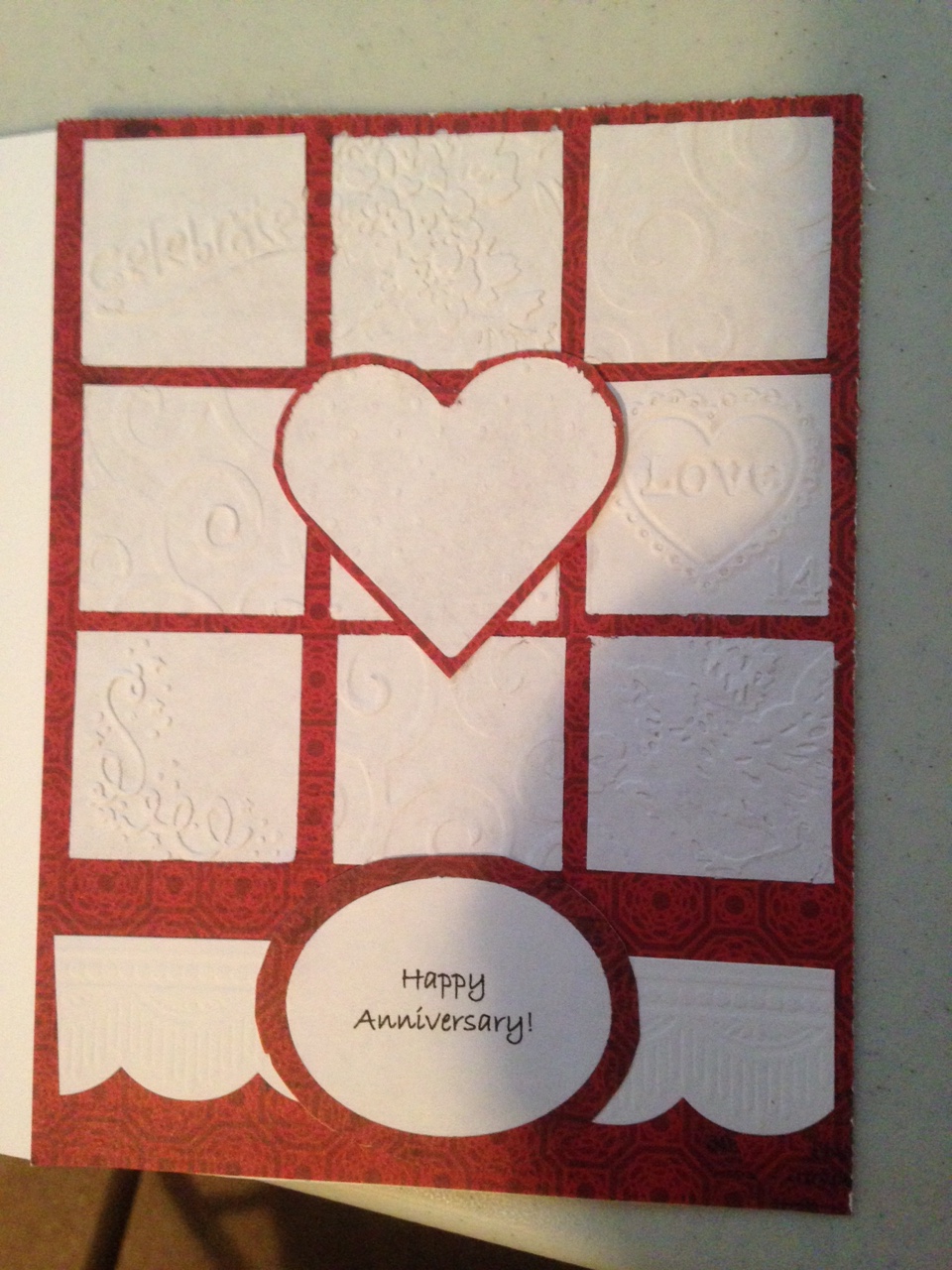
IMG_1304

I still like the idea of a storage cabinet under the table. though. They still have these cabinets at Wal-Mart, but only in black, and I am not fond of the idea of painting black cabinets white again. I’ve looked at kitchen carts (usually too tall) and other ideas, but everything else is either too expensive or doesn’t fit the space. So I’ll have to think about that a while.

Also, I didn’t think to take a “before” picture, but I did some work in the closet as well. I had a corner cabinet in there that was tipping forward because the stuff I had one it was too big and heavy. Jesse helped me put some pieces of cardboard under the front corner so it wouldn’t tip forward, and I traded all the smaller things that were in the middle bookshelf onto the corner shelf and put the big photo albums and such that I’d had on the corner shelf onto the middle bookshelf (one of those, “Duh, why didn’t I think of that before?” moments). Then I just had a bunch of stuff piled into the right corner. It just recently occurred to me that I could get another corner shelf for the right side (another “Duh!” moment!) I couldn’t find one like I already had on the left, but I found this one on Amazon and was able to get it free with accumulated cash-back points from the credit card. So picture the before photo with a mess in both corners, and now (I ended up having to take two “after” pictures because I couldn’t get both sides in the frame):

IMG_1355

Left closet corner

The pink plastic drawers on the left are two stacked on top of each other. I wasn’t sure if that would work or if they’d topple every time I opened a drawer, but they have worked wonderfully. I did think about them for that under-the-table space, but I was wanting more open shelves there. But they might work – still thinking. 🙂

IMG_1356

Right closet corner

I’m delighted that those corner shelves have really made the best use of that space.

Also, for good measure, I thought I’d show you this:

IMG_1357

All of those boxes on the left-hand shelves hold photos that, hopefully some day before I die, will make it into some of the albums I’ve accumulated through the years. That was before photos went digital.

So — getting things spiffed up in there is inspiring me to spend more time in there – if only I could!!! But getting it more organized will make it easier to do things in there when I do have time.

I am linking up with Tori‘s To-Do Tuesday.

todotuesdy

Some Bookish Questions

Photo courtesy of winnond at FreeDigitalPhotos.net

Photo courtesy of winnond at FreeDigitalPhotos.net

Sherry at Semicolon posted a few bookish questions a while back, and I have been waiting for an opportunity to borrow them. I am almost always up for talking about books 🙂

1. What propelled your love affair with books — any particular title or a moment?

Learning to read in first grade (kindergarten was not required then). I don’t remember if my mom read to me or if I had books before that – probably she did and I did. But learning to read opened up a whole new world to me and I have loved it ever since.

2. Which fictional character would you like to be friends with and why?

Elinor Dashwood of Austen’s Sense and Sensibility. I think we’re similar personalities, though she is more patient than I am.

3. Do you write your name on your books or use bookplates?

Neither unless I am loaning them and want them back. Then I often just right my name on the front flyleaf, but sometimes I put an address label there.

4. What was your favorite book read this year?

Probably Out of a Far Country: A Gay Son’s Journey to God. A Broken Mother’s Search for Hope by Christopher and Angela Yuan, a prodigal son and mother. The mom had as much to learn as the son. Wonderful to see God work in lives that we might consider the hardest cases. Nothing is impossible with Him!

5. If you could read in another language, which language would you choose?

Agree with Sherry here: Hebrew or Greek, to read the Bible in the original languages.

6. Name a book that made you both laugh and cry.

Oh my – there have been many, but I will go with the most recent one: Little Dorrit by Dickens.

7. Share with us your favorite poem?

That would be hard to narrow down. I love Robert Frosts’s meditativeness (is that a word?) in “Stopping By Woods on a Snowy Evening ” and “The Road Not Taken,” Richard Armour‘s lighthearted verse, Robert Burn’s thoughtfulness in “To a Mouse”  and other poems, Poe’s capabilities in rhythm and setting a scene in “Annabelle Lee” and “The Raven,” “October’s Party” by George Cooper, “The Blue Robe” by Wendell Berry, “To A Waterfowl” by William Cullen Bryant, much of Elizabeth Barret Browning and Christina Rossetti’s work. But I think I’ll mention here Anne Bradstreet‘s “By Night While Others Soundly Slept”:

By night when others soundly slept
And hath at once both ease and Rest,
My waking eyes were open kept
And so to lie I found it best.

I sought him whom my Soul did Love,
With tears I sought him earnestly.
He bow’d his ear down from Above.
In vain I did not seek or cry.

My hungry Soul he fill’d with Good;
He in his Bottle put my tears,
My smarting wounds washt in his blood,
And banisht thence my Doubts and fears.

What to my Saviour shall I give
Who freely hath done this for me?
I’ll serve him here whilst I shall live
And Loue him to Eternity.

I’d love to hear your answers to any of these questions!

Safely Through Another Week

Safely through another week God has brought us on our way;
Let us now a blessing seek, on th’approaching Sabbath day;
Day of all the week the best, emblem of eternal rest,
Day of all the week the best, emblem of eternal rest.

Mercies multiplied each hour through the week our praise demand;
Guarded by almighty power, fed and guided by His hand;
Though ungrateful we have been, only made returns of sin,
Though ungrateful we have been, only made returns of sin.

While we pray for pardoning grace, through the dear Redeemer’s Name,
Show Thy reconciled face, shine away our sin and shame;
From our worldly cares set free, may we rest this night with Thee,
From our worldly cares set free, may we rest this night with Thee.

Here we come Thy Name to praise, let us feel Thy presence near,
May Thy glory meet our eyes, while we in Thy house appear:
Here afford us, Lord, a taste of our everlasting feast,
Here afford us, Lord, a taste of our everlasting feast.

When the morn shall bid us rise, may we feel Thy presence near:
May Thy glory meet our eyes, when we in Thy house appear:
There afford us, Lord, a taste of our everlasting feast,
There afford us, Lord, a taste of our everlasting feast.

May Thy Gospel’s joyful sound conquer sinners, comfort saints;
May the fruits of grace abound, bring relief for all complaints;
Thus may all our Sabbaths prove till we join the church above,
Thus may all our Sabbaths prove till we join the church above!

By John Newton, 1774

Graphics courtesy of Creative Ladies Ministry

(I know that Christians meet on the Lord’s Day and not the Sabbath, but I still feel the text is appropriate for us to meditate on when we meet one day a week to worship God together.)

Friday’s Fave Five

 FFF tamara's

It’s Friday, time to look back over the blessings of the week with Susanne at Living to Tell the Story and other friends. Here are some highlights from this week:

1. A belated birthday present. One of the things I had suggested for a birthday idea was this doily. I had forgotten about it, but it arrived this week. I think it is so pretty, and it fits this space so well.

IMG_1350

IMG_1351

2. A three-day weekend is always a nice thing. It was pretty quiet as all but Jesse were away, but we still did the traditional Labor Day burger grilling. 🙂

3. A good blend of rest and getting things done both Saturday and Monday. I love when it works out that way. Some weekends are more restful, needed some times, but I feel guilty if I don’t get something done. But full-blown, non-stop busy weekends are exhausting. It’s nice when there is a balance.

4. Some organizing in the craft/sewing room. I may show you next week. It’s nice when a better idea for how to set something up pops in one’s head unexpectedly. And then having time to actually implement it is a plus!

5. Taking some first steps towards fitness and losing 2 lbs already!

A nice week overall, and a pleasant day today (Thursday) as I am writing, with some cooler temperatures and gentle rainfall off and one. Hope your week has been good as well.

I can’t let this day go back without remembrance of the events of 9/11 and those suffered most by losing a loved one or suffering harm physically, emotionally, or mentally. My prayers are with them and our nation.

Knowing God, Chapters 7 and 8

Knowing GodWe’re continuing to read Knowing God by J. I. Packer along with Tim Challies’ Reading Classics Together Series. This week we are in chapters 7 and 8.

Chapter 7, “God Unchanging,” opens with the scenario of reading the Bible but not getting much out of it because it seems so far removed from one’s own life. “We don’t live in the same world. How can the record of God’s words and deeds in Bible times, the record of His dealings with Abraham and Moses and David and the rest, help us, who have to live in the space age?” (p. 76).

Packers answers that it is true that we might experience a different “space, time, and culture,” but “the link is God Himself. For the God with whom they had to do is the same God with whom we have to do,” (p. 76), and He hasn’t changed in the meantime. He quotes A. W. Tozer as saying, “He cannot change for the better, for He is already perfect; and being perfect, He cannot change for the worse.”

Packer then elaborates on the points that God’s life, character, truth, ways, purposes, and Son do not change. He lists a few texts where God is said to have repented, but those refer to “a reversal of God’s previous treatment of particular people, consequent upon their reaction to that treatment. But there is no suggestion that this reaction was not foreseen, or that it took God by surprise and was not provided for in His eternal plan. No change in His eternal purpose is implied when He begins to deal with a person in a new way” (p. 80).

While it is a comfort that “fellowship with Him, trust in His Word, living by faith, standing on the promises of God, are essentially the same realities for us today as they were for Old and New Testament believers,” it is a challenge as well. “How can we justify ourselves in resting content with an experience of communion with Him, and a level of Christian conduct, that falls so far below theirs?” (p. 81).

Chapter 8 explores “The Majesty of God,”and Packer asserts that “Christians today largely lack” the knowledge of God’s greatness and majesty, “and that is one reason why our faith is so feeble and our worship so flabby…Modern people…cherish great thoughts of themselves” but “small thoughts of God” (p. 83). The emphasis today is on the personal interest and care God extends towards His loved ones, and while that is a blessed truth, it can’t offset His majesty and greatness. The rest of the chapter is a wonderful walk through the Scriptures that give us glimpses of His majesty and a reminder that we need to “‘wait upon the Lord’ in meditations on His majesty, till we find our strength renewed through the writing of these things upon our hearts” (p. 89).

First steps to fitness

Photo Courtesy of FreeDidigtalPhotos.net

Photo Courtesy of FreeDidigtalPhotos.net

I’ve known that I needed to and should lose weight for ages. I’ve made various fits and starts but haven’t stayed with a plan for more than a few months at a time. I keep thinking I’ll get to it – and before I know it another whole year has gone by, and my doctor gives me the same warnings he did last year.

Developing atrial fibrillation, though, and learning that diabetes is one of the risk factors for making it more of a problem, and being told once again that I am headed for diabetes if I don’t so something, has provided even more impetus than having watched my mom deal with the effects of Type II Diabetes.

So today (Tuesday) I started tracking what I eat with the MyFitnessPal app. It doesn’t “seem” like I eat that much – but obviously the evidence is to the contrary, and this will hep me pinpoint problem areas. I always find this part really tedious, which is probably one reason I don’t usually keep up with it very long. But it is eye-opening. (That has how many calories? A serving is only 1/2 cup?) I haven’t measured out those cups and tablespoons in the past, preferring to eyeball it, but I started doing so today, because approximating can be misleading. I imagine that after measuring servings for a while, one does get a better idea of what 1/2 cup of something looks like and won’t need to measure every time. One thing I really like about the app is that it has a scanner so you can use your iphone to scan the bar code of a food, and it puts all the nutritional information in there. Then when you use that food again, you can just click on it from your previous scans. Recipes will be a little harder to deal with, but, again, once they are entered, they are there to refer to again in the future, so hopefully the major part of the tedium will be just at the beginning.

I figured that was the best way to start, to target what I need to work on. My sweet tooth is one of my biggest problems, but I also tend toward comfort foods with sauces and cream-of-whatever soup, so I’ll be looking for ways to cut down on those kinds of things.

I did discover that the turkey sausage and hash brown breakfast I regularly have was not too bad calorie-wise if I kept the portion size down. With a tendency to low blood sugar, especially in the mornings, sometimes I feel like I need to eat a protein-based breakfast (which does hep) but also a really big breakfast. But the lower portions were satisfying without making me feel stuffed. I did have a sweet snack in the afternoon, but a smaller portion, and I had an apple for a later snack, something I haven’t done in ages. I was feeling pretty good about having 500+ calories left for dinner until I realized that, in listing the components of the leftover Labor Day burger I had for lunch, I had forgotten to include the burger itself. Duh.

Otherwise, the first day went well. Of course, the first day almost always goes well. 🙂 It’s staying with it after the first flush of motivation passes and I want the old habits back again that’s hard. And even though I know and to a certain extent am motivated by all the reasons I want to lose weight and get fit, I keep fooling myself by thinking, “Yes, well, this one snack or this one healthy meal or this one day (or several days) without exercise aren’t going to matter in the grand scheme of things.” But all together they do. A walk in any direction is made of of steps, and the more steps in the wrong direction, the farther from were we originally tended to be. So I am going to review my reasons to lose weight and use the I Deserve a Donut app (which helps you pinpoint why you think so and why you don’t need it) for help in keeping my motivation on track, as well as, first and foremost, prayer and trying to keep a Scriptural focus about it all.

I chafe at the time involved in driving to a gym, having to change into and out of special exercise clothes, exercising with other people, etc., so exercising from home works best for me now. I have several exercise DVDs, some from Leslie Sansone and some from the Biggest Loser, as well as a couple of exercise video games that I can cycle through so no one routine gets boring. Or more boring than it has to be. 🙂 I am familiar enough with most of them that I can turn off the sound and listen to an audiobook, but even with that I pretty much grit my teeth through exercising. I do feel better and have more energy when I exercise, but that’s not motivation enough to set aside things I enjoy doing more in order to exercise. But, I have heard other people say that they don’t really enjoy exercise, but they just make up their minds to do it. So I will do that knowing it is benefiting me no matter how I feel about it.

I had started a weight loss blog some years ago, and I don’t know that I will post regular updates here or there. But one reason I wanted to mention this is that I know some of you are on the same journey, some to lose weight or get fit in general, some specifically  to deal with diabetes. I’d love to hear any tips you have to share!

Book Review: Through Waters Deep

Through-Waters-DeepThrough Waters Deep is the first in the the Waves of Freedom series by Sarah Sundin. All of Sarah’s books so far have been set in the WWII era, and this one is no exception. I love how she weaves historical detail into the story.

It’s the time when Europe is involved heavily in combat but America has yet to join the fray. Strong feelings among the isolationists, who don’t want the US to get involved, and the interventionists, who do, run high and cause conflicts, especially at the Navy shipyard in Boston where Mary Stirling is a secretary. Minor problems increase until some people begin to suspect that they are deliberate acts of sabotage, but is it an isolationist or an interventionist, or one trying to frame the other in order to get sympathy for his side? Mary’s work takes her all over the premises and into various offices, and she hears a lot of talk. She decides to make notes in shorthand (which no one would suspect) in case she overhears anything useful. But when she shows her notes to the FBI, they dismiss them as gossip and hearsay.

At a ship’s christening, Mary runs into an old high school friend, Jim Avery, now an ensign in the Navy. They are both changed from what they remember: they had been the quiet ones of their group and Jim had pined away for someone who was in love with someone else, so they had not really known each other well, but as Mary shows him around Boston, they each realize there is more to the other than they thought. When a definite and dangerous act of sabotage is found aboard Jim’s ship, tensions and suspicions escalate.

One underlying issue Mary has to deal with is that she has a strong aversion to being the object of attention. She wants to avoid being prideful and self-promoting, but it is more than humility. As the story unfolds we find the reason for her reluctance and panic, and she wrestles with what it means to “let your light shine” yet not put yourself forward, along with not missing opportunities God would have her take due to her wanting to stay in the background. I found this aspect of her character fascinating because I have wrestled with some of the same issues, and I have never seen this addressed anywhere except just a bit in C. S. Lewis’s Mere Christianity.

Jim describes himself as a “floater.” His two brothers who went into the Navy before him have ambitions to move up the ladder. Jim does not have that goal and just wants to float where the current of life takes him. He’s a hard worker and a caring person, yet has to realize his tendency to “float” looks like laziness and a lack of initiative. A good captain sees his potential and helps draw out his good points. That and the potential of missing opportunities in his relationship with Mary help him see that sometimes he needs to direct his steps, under God’s leadership and direction, rather than “floating.”

I’m not usually interested in romances just for the sake of romance, and Sarah’s books always go beyond just the romance to the deeper character issues as well as fleshing out what it might have been like to live in the setting. I love what Jim and Mary both had to learn and go through on their journey as well as the underlying mystery of the saboteur. Sarah does a great job conveying the feel of the times in the conversations and interactions of the various characters.

I loved this book, and I am looking forward to the next one in the series!

(This review will also be linked to Semicolon‘s Saturday Review of Books.)

Friday’s Fave Five

FFF spring2It’s Friday, time to look back over the blessings of the week with Susanne at Living to Tell the Story and other friends.

This has not been a bad week, but the blessings haven’t been so overflowing and obvious as they have been the last two. But sometimes those kinds of weeks are when its best to go back and look for them lest we overlook them. So here are a few from this week:

1. Breakfast biscuits. I am up early, but not usually out and about til later morning. But I had to be one morning and rewarded myself with a breakfast biscuit on the way back home. Hadn’t had one in a while, and it was good!

2. Medical week is over! I have been thinking of this week that way because I had to go in early for fasting lab work one day (thus my early morning outing), had a visit with the heart doctor another day, and then my yearly physical another day. I chafed at having all that on the calendar in one week, but on the other hand, it was good to get it all done with.

3. Good visit with the heart doctor. Some of you have prayed for the situation with the heart rhythm problem and the attempted ablation from last month (thank you!). The visit this week was pretty anticlimactic. I was able to ask some questions and we talked about adjusting some medications a little. Other than that I don’t see him again for six months unless I am having problems. He advises not undergoing another procedure unless symptoms ratchet up significantly. We’ll hope that doesn’t happen. 🙂

4. A captivating new book, a true story based in my area. Will tell you more later!

5. FaceTime. I know I have mentioned it before, but I love being able to see my oldest son (who lives in another state) when we talk on the phone, and we even Face Time with little Timothy (and his parents 🙂 ) in-between visits sometimes even though we are in the same town. I love being able to do that.

Hope you’ve had a great week as well! Happy Friday!

Knowing God, Chapters 5 and 6: The Incarnation and the Holy Spirit

Knowing GodWe’re continuing to read Knowing God by J. I. Packer along with Tim Challies’ Reading Classics Together Series. This week we are in chapters 5 and 6.

Chapter 5, “God Incarnate,” is probably the most…I hate to say difficult or technical, because that immediately turns people off. It is a little more difficult and technical than the previous chapters, but not at all insurmountable. I love that Packer says, “This is the deep end of theology, no doubt, but John [in John 1] throws us straight into it” (p. 66). Some people prefer to avoid theological discussions and feel that, “We’re just supposed to love God and people. Why waste time on that stuff?” Because it matters. If people talk about loving Jesus but don’t know Him for Who He really is, they can be totally lost even while thinking all is right with the world. False steps either on the side of Jesus’ humanity or His deity lead to grave errors.

That said, I couldn’t possibly reproduce what Packer said in this chapter in distilled form. It would be long and involved and I just don’t have time this particular week. But it’s good reading to cement the truth that Jesus is totally God and totally man into our thinking, drawing primarily from John 1:1-14,  Philippians 2:5-11, and II Corinthians 8:9.

A section particularly interesting to me involved what it meant for Christ to “empty Himself” in Philippians 2:6-7: “who, though he was in the form of God, did not count equality with God a thing to be grasped, but emptied himself, by taking the form of a servant, being born in the likeness of men.” We know this doesn’t mean He set aside His deity, for He displayed omnipotence (still the storm, feeding 5,000+, raising the dead, etc.), omniscience (knowing others’ thoughts), and omnipresence (talking about being in heaven at the same time He was talking to people on earth – John 3:13)) while in human form. So what did He empty Himself of? “Does  it not imply that a certain reduction of the Son’s deity was involved in His becoming man?” (p. 59). No, answers Packer. Such a theory is called kenosis, and it has been around in various forms for years. Packer discusses it and its manifestations and implications more fully and then says:

When Paul talks of the Son as having emptied himself and become poor, what he has in mind, as the context in each case shows, is the laying aside not of divine powers and attributes but of divine glory and dignity, “the glory I had with you before the world began, as Christ puts it in His great high priestly prayer (p. 60).

We now see what it meant for the Son of God to empty himself and become poor. It meant a laying aside of glory (the real kenosis); a voluntary restraint of power; an acceptance of hardship, isolation, ill-treatment, malice and understanding; finally, a death that involved such agony – spiritual even more than physical – that his mind nearly broke under the prospect of it. It meant love to the uttermost for unlovely human beings, that they through his poverty might become rich (p. 63).

I like the way he applies this truth to Christmas, when we celebrate the incarnation, the fact that God came to us in the form of a baby, to grow up as a human, yet still fully God, for the purpose of dying on the cross for our sins:

We talk glibly of the ‘Christmas spirit,’ rarely meaning more by this than sentimental jollity on a family basis. But what we have said makes it clear that the phrase should in fact carry a tremendous weight of meaning. It ought to mean the reproducing in human lives of the temper of him who for our sakes became poor at the first Christmas. And the Christmas spirit itself ought to be the mark of every Christian all the year round.

It is our shame and disgrace today that so many Christians–I will be more specific: so many of the soundest and most orthodox Christians–go through this world in the spirit of the priest and the Levite in our Lord’s parable, seeing human needs all around them, but (after a pious wish, and perhaps a prayer, that God might meet them) averting their eyes, and passing by on the other side. That is not the Christmas spirit. Nor is it the spirit of those Christians–alas, they are many–whose ambition in life seems limited to building a nice middle-class Christian home, and making nice middle-class Christian friends, and bringing up their children in nice middle-class Christian ways, and who leave the sub-middle-class sections of the community, Christian and non-Christian, to get on by themselves.

The Christmas spirit does not shine out in the Christian snob. For the Christmas spirit is the spirit of those who, like their Master, live their whole lives on the principle of making themselves poor — spending and being spent — to enrich their fellow men, giving time, trouble, care, and concern, to do good to others — and not just their own friends — in whatever way there seems need (pp 63-64).

Chapter 4, “He Shall Testify,” is about the Holy Spirit. He asserts that preaching and teaching about the Holy Spirit has been sadly neglected but is vital, for He is fully God as well and testifies of Christ. “But the Helper, the Holy Spirit, whom the Father will send in my name, he will teach you all things and bring to your remembrance all that I have said to you.” (John 14:26).

Again, I am not going to list point by point his instruction about the Holy Spirit – you’ll just have to read the book. 🙂 But one section that stood out to me was this:

In the Old Testament, God’s word and God’s Spirit are parallel figures. God’s word is his almighty speech; God’s Spirit is his almighty breath. Both phrases convey the thought of his power in action (p. 67).

He then discusses the parallels are mentioned in the creation account and in reference to Christ. This caught my eye because I had noticed a long time ago that in the passages telling us to “Let the word of Christ dwell in you richly” (Colossians 3:16-25) and to “be filled with the Spirit” (Ephesians 5:18-33), the aftermath is remarkably similar: speaking to ourselves in psalms and hymns and spiritual songs, letting the Spirit and the word affect all our relationships, etc.

After showing that one of the Holy Spirit’s ministries is to illuminate and convict people of God’s truth:, Packer says:

It is not for us to imagine that we can prove the truth of Christianity by our own arguments; nobody can prove the truth of Christianity except the Holy Spirit, by his own almighty work of renewing the blinded heart. It is the sovereign prerogative of Christ’s Spirit to convince men’s consciences of the truth of Christ’s gospel; and Christ’s human witnesses must learn to ground their hopes of success not on clever presentation of the truth by man, but on powerful demonstration of the truth by the Spirit (p. 71).

That’s not to say we shouldn’t share the truth of Christ since opening people’s eyes is His job and not ours: no, we must. We’re commanded to, and the Spirit used the Word to open eyes. But we trust in His working, not our “clever presentation.”

These chapters were beneficial to study, even though they tossed us for awhile into the “deep end of theology.” It’s good to “gird up the loins of our minds” sometimes and exercise them beyond what we’re used to.

Book Review: Everyday Grace: Infusing All Your Relationships With the Love of Jesus

I’ve mentioned several times here that I read years ago in an old biography of a missionary who felt strongly the lack of love in her life, felt guilty about it, berated herself over it often, tried to spur herself on to do better, all to no avail. But when she began instead to meditate on God’s love for her, He began to transform her in ways she was unaware of until her husband told her people were commenting to him about the change in her.

Everyday GraceIn Everyday Grace: Infusing All Your Relationships With the Love of Jesus, Jessica Thompson takes this same principle and applies it to nearly every relationship we might have. She points out that most relationships operate on the basis of karma – I’ll do for you if you’ll do for me, or maybe I’ll do for you so that you’ll do for me in return. But Christianity operates on the basis of grace: God loved us and Jesus died for us when we were enemies, when we didn’t care, when we didn’t love Him, and He wants us to love others in the same way.

But how can we do that? He is God, and though he has saved and changed us, in our everyday lives our old fleshly nature too often evidences itself.

We are not basically good people who need a little instruction so that we can live up to our full potential. We are completely sinful people who need help from outside of ourselves in order to be made alive (p. 39).

We don’t just need a new list; we need a new heart. That is exactly what is promised to us in Ezekiel 11:19-20:

And I will give them one heart, and a new spirit I will put within them. I will remove the heart of stone from their flesh and give them a heart of flesh, that they may walk in my statutes and keep my rules and obey them. And they shall be my people, and I will be their God (p. 47)

We can operate from a basis of grace because Jesus lived a perfect life, keeping all God’s commands in our place, and died, taking all of our sin and its punishment in our place.

My hope is that this book will help you “taste and see that the Lord is good” (Psalm 34:8). That as I open up to you all that he is and all that he has done…as you taste this multifaceted relationship with God, it will transform all of your other relationships (p. 43).

Paul doesn’t just pray [in Ephesians 3:14-21] that the Ephesians would get their act together; he prays that they would somehow be able to comprehend the incomprehensible love of God in Christ (p. 49).

In subsequent chapters, Jessica discusses God as our Father and husband and how that influences our relationships with our spouse and children, Jesus as a friend, coworker, brother, and how that influences our relationships in each of those areas, as well as how our relationship with God directs our interactions with our communities and fellow church members. She ends with discussing the Holy Spirit’s help, dealing with difficult people, and “The Gospel for the Relationship Failure.”

In the chapter on friendship, she writes:

Jesus tells his disciples, “You are my friends if you do what I command you.”…It seems to be saying that he will be our friend only if we obey. But that isn’t what Jesus is saying at all. His friendship came first. This obedience is not what makes them friends; it is what characterizes his friends. I have lived most of my life under the assumption that if I am not obeying, then Christ doesn’t want any part of me. That is a terrible weight and it is a lie. God’s love for us in Christ always precedes our loveliness. His faithfulness always precedes ours, and his friendship is what brings us into relationship with him…If we are true believers in Christ, we will obey. That doesn’t mean we will obey perfectly…But it does mean that we will have a desire to obey. If your life is characterized by a growing desire to obey, you can be sure that you are a friend of Jesus. It is his very pronouncement of “my friend” that gives us the longing to be obedient to his commands. His love for us is what engenders a heart of obedience (pp. 76-77).

In a chapter on work, she writes:

While there is nothing wrong with doing a job you enjoy or looking for a job that you are passionate about, we have made a terrible point of our focus. We are setting out to fulfill ourselves instead of looking for ways to serve others. How often do we really think of our jobs as a way to be God’s hands, even if our job is just stacking books at the library? (p. 169)

[Jesus’] work wasn’t dependent on the one who received the benefit of his work. His work was only and always dependent on his love for God and his love for his people (p. 171).

I thought this from the chapter on church members was particularly lovely:

So we are humble with one another, not thinking we are better than others. We are gentle with each other, instead of beating each other over the head with a long list of “you-shoulds.” We can point out sin, when necessary, without distancing ourselves or acting like our friends have a disease that we might catch if they don’t get their acts together. We bear with one another in love, which is tough, especially if their sin affects us personally. And we are eager and excited to maintain peace, instead of eager and excited when we get a juicy bit of gossip about our friend. We remember that we are one body, and if I hurt you, I am actually hurting myself. We take a vested interest in each other and in loving one another. Lastly, we remember that all of our failures to live as one body have been paid for by the Savior. We don’t have to hide from our community when we sin against them. We confess and remember that even the sin of hurting others in the church was paid for on Christ’s cross. We pray for a new and deeper understanding of what he went through to make us one body; and we pray that this understanding changes who we are as individuals and as a community, one redeemed sinner at a time (pp. 161-162).

In the chapter on difficult people, she talks about not only people whose personalities rub us the wrong way or who have hurt us, but also those going through hard trials – not that they are difficult, but because we find it difficult to know what to say or how to comfort them. A few lines from that chapter were instructive to me:

Part of the reason I struggle to be around people who suffer is because I have to come to grips with my own inability to make everything better. I hate to see that I am actually not the Holy Spirit and I can’t bring them the comfort they need. I hate that I say the wrong things at times and I end up hurting more than helping. But I believe it is in embracing that very weakness that the Holy Spirit has more room to work. The more I try to make it better, the more I try to come up with the perfect verse, the more I am ultimately in the way. When I relinquish my desire to be the Savior and just grieve with my friends, the Holy Spirit does some pretty amazing work (p. 189).

While I found this book immensely helpful in many ways, I’m not eager to go out and buy everything Thompson has ever written. The truth grabbed me: for the most part, the writing did not. I haven’t spent a lot of time analyzing why, but it could have been a lot tighter and less wordy in places (and I realize I have no room to talk there. 🙂 ) There was a lot of repetition.  Plus I think she went way too far in her speculations in some biblical situations that the Bible doesn’t spell out, like the ways in which Jesus was tempted, the situation between Paul and Barnabas’ disagreement, what was going on in Mary’s mind the time she and her other children tried to get in and see Jesus, and instead of instructing them to be admitted or going to the door, He told those He was teaching that whoever does His will is is family. Saying, “Mary might have thought or reacted…” in a particular way is one thing. Saying Mary did think and feel in ways that the Scripture doesn’t say or even indicate she did is dangerous (Thompson postulates that Mary doubted or forgot who Jesus was for a time). This kind of thing keeps me from fulling trusting Thompson’s handling of Scripture, but she seems better in exegesis and application than in speculation. On the other hand, speculation and imagination do serve her well in some areas where she doesn’t go too far, such as picturing Jesus working as a carpenter and encountering the same kind of people we encounter in the workplace.

I found much more that I did like in the book than I didn’t like, and I feel I could recommend it with a caution about those sections.

(This review will also be linked to Semicolon‘s Saturday Review of Books.)