Adventures in Elder Care

Eldercare

Seven years ago my husband and I moved his mother 2,000 miles to be near us when she couldn’t live on her own any more. She lived in three separate assisted living facilities, a nursing home, and then came home to live with us about 2 years ago. In the posts below I detail some of that journey and pass along tips and truths that have helped us during this time. I hope you will find something to help you in your journey as well.

Helping Parents As They Age.

12 Things You Should Know About Caring for the Elderly.

Decisions.

Assisted Living and Nursing Homes.

The Introvert in Assisted Living (Ideas for one on one activities)

Caring For a Parent at Home.

Dealing With Caregiver Resentment.

A few more thoughts about caregiver resentment.

A Plea to Caregivers

Ministering To the Elderly and Their Caregivers.

It’s Not for Nothing.

Am I Doing Any Good?

But That’s Not My Spiritual Gift!

Remembering the Loved One Who Has Forgotten You

Bible Verses For Caregivers

Save

Save

Book Review: The Little Prince

the-little-prince.jpegThe Little Prince by Antoine de Saint-Exupéry was chosen by Amy for Carrie‘s Reading to Know Classics Book Club for June, and, at 85 pages, also happened to fit the novella or short classic category for my Back to the Classics Challenge. I read the 70th anniversary edition, which, thankfully, my library had, and which also includes a CD of the story read by Viggo Mortenson (Aragorn in the LOTR films). I listened a bit to one CD just to see what it was like, but this is a book you definitely want to read rather than listen to because of the illustrations.

On the surface, the story opens with the narrator reminiscing that as a child, when he drew a picture of a boa constrictor digesting an elephant, grown-ups could only see it as a hat and advised him to stop drawing and concentrate on school subjects. “That is why I abandoned, at the age of six, a magnificent career as an artist. I had been discouraged by the failure of my drawing…Grown-ups never understand anything by themselves, and it is exhausting for children to have to provide explanations over and over again” (p. 2). As an adult he still showed people his drawing, but if they said they only saw a hat, he “would put myself on his level and talk about bridge and golf and politics and neckties” (p. 3).

So he felt pretty lonely and misunderstood until he crash-landed his plane in the Sahara Desert and met, in the middle of the isolation, a little prince. He had a hard time at first learning anything about the prince because he didn’t answer direct questions. The narrator had to pick up clues from things he said in passing, and in that way he learned that the prince was from an extremely small planet (the size of a house). But best of all, the prince understood his drawings.

Over the next eight days – the length of time the narrator’s water supply lasted while he tried to fix his plane – he learned more about the prince’s planet, travels to different planets and the odd people he met there, and his first excursions on Earth.

One gets the definite sense while reading that this story means more than the adventures of a little prince on his travels, yet the meaning isn’t entirely plain. I didn’t feel too bad about not being to make it out when I saw on SparkNotes and Wikipedia that there are differences of opinion among those who have read and studied the book since it was published 70 years ago. Some see in it elements of WWII, since it was written during that time, the dangerous baobob trees of the prince’s planet, which can “overgrow the whole planet. It’s roots pierce right through. And if the planet is too small, and if there are too many baobobs, they make it burst into pieces” (p. 15) representing Naziism. But some dispute that. There is more agreement that the vain rose that the prince cared for on his planet represents Saint-Exupéry’s wife. Some see it as “an allegory of Saint-Exupéry’s own life—his search for childhood certainties and interior peace, his mysticism, his belief in human courage and brotherhood…. but also an allusion to the tortured nature of their relationship” (Wikipedia). Some see it as “metaphor of the process of introspection itself, wherein two halves of the same person meet and learn from each other,” the narrator and the prince both representing aspects of Saint-Exupéry (SparkNotes). It adds to the mystique of the story that Saint-Exupéry was a pilot and did indeed crash-land in the desert once, and went missing while on a mission in his plane.

Whatever it means or represents, there are a few themes that come to the forefront. One is that “One sees clearly only with the heart. Anything essential is invisible to the eyes,” as a fox tells the prince. Another major theme is the problem of limited viewpoints. First there are the adults not understanding the narrator’s drawings, then one planet the prince visits is inhabited only by a king who only sees others as subjects to be ruled and acts toward them accordingly, and on another planet there is only a vain man who only sees others as admirers of himself, and so on. When the prince comes to Earth and lands in the desert and sees no other people, he asks a flower where they are. In her life she had only seen a few pass by, so she thought that’s all there were and that “The wind blows them away. They have no roots, which hampers them a good deal” (p. 52).

But to me the crux of the book is in the concept of “taming.” When the fox tells the prince he isn’t tamed, and the prince asks what “tamed” means, the fox replies:

“It is an act too often neglected,” said the fox. “It means to establish ties.”

“To establish ties?”

“Just that,” said the fox. “To me, you are still nothing more than a little boy who is just like a hundred thousand other little boys. And I have no need of you. And you, on your part, have no need of me. To you I am nothing more than a fox like a hundred thousand other foxes. But if you tame me, then we shall need each other. To me, you will be unique in all the world. To you, I shall be unique in all the world….”(p. 59).

He goes on to say that, “If you tame me, my life will be filled with sunshine. I’ll know the sound of footsteps that will be different from all the rest…If you come at four in the afternoon, I’ll begin to be happy by three” (pp. 60-61), and that from now on a wheat field, which means nothing to a fox since he doesn’t eat wheat, will remind him of the prince since his hair is the same color, “And I’ll love the sound of the wind in the wheat…” (p. 60). The fox also says, “It’s the time that you spent on your rose that makes your rose so important. . . . People have forgotten this truth, but you mustn’t forget it. You become responsible for what you’ve tamed. You’re responsible for your rose” (p. 64). The prince had thought his only rose was special until he comes across thousands of them on Earth. But the time and care he spent on it was what made it unique and special. So I think probably the biggest takeaway is that relationships (“creating ties”) are worth both the investment of time and care and then the pain when those with ties are apart, as the narrator himself discovers at the end. When the prince has to leave the fox, and the fox is sad, the prince tells him it’s his own fault for wanting to be tamed. When the fox admits he will weep when the prince goes, the prince asserts the fox got nothing out of being tamed. The fox replies, “I get something because of the color of the wheat” (p. 61). That statement in context is so poignant it almost makes me teary.

What I first thought of as an odd little tale that I couldn’t quite make sense of, now, after a couple of days of pondering, seems a very sweet and touching story about love and relationships. I love books that do that – make you think and unfold themselves long after the last page is turned.

(This review will also be linked to Semicolon‘s Saturday Review of Books.)

What’s On Your Nightstand: June 2015

 What's On Your NightstandThe folks at 5 Minutes For Books host What’s On Your Nightstand? the fourth Tuesday of each month in which we can share about the books we have been reading and/or plan to read.

This being the fourth Tuesday of June, it’s time for another Nightstand post:

Since last time I have completed:

Christy by Catherine Marshall for Carrie‘s Reading to Know Classics Book Club for May, reviewed here. Nice reread.

Growing Up Amish: A Memoir by Ira Wagler, nonfiction, reviewed here. Very enlightening.

Strait of Hormuz by Davis Bunn, reviewed here. Very exciting!

The Little Prince by Antoine de Saint-Exupéry for Carrie‘s Reading to Know Classics Book Club for June. Just finished Monday, hope to have a review up in a day or two. Somewhat strange – I am still processing it.

The Incorrigible Children of Ashton Place, Book 5: The Unmapped Sea by Maryrose Wood, audiobook, reviewed here. Funny and clever as usual for this series, but a bit sad as well (which is, hopefully, a set-up for everything to come right again in the next book).

The Fairest Beauty by Melanie Dickerson, reviewed here. Nice retelling of Snow White.

I’m currently reading:

Walking With God in the Season of Motherhood by Melissa B. Kruger

Little Dorrit by Charles Dickens

Pioneer Girl: The Annotated Autobiography by Laura Ingalls Wilder, edited by Pamela Smith Hill.

The Captive Maiden by Melanie Dickerson, a retelling of Cinderella

Next Up:

The Narnian by Alan Jacobs for both the Reading to Know Classics Book Club for July and the Chronicles of Narnia Reading Challenge, both hosted by Carrie. Maybe Live Like a Narnian by Joe Rigney for these as well. Either one will finish up my TBR Challenge list.

After Little Dorrit, I have five more classics to chose from for my Back to the Classics Challenge. Thinking about One Day in the Life of Ivan Denisovich by Aleksandr Solzhenitsyn next.

Then I have some new books acquired since Christmas that I’d like to get to:

A Captain’s Duty: Somali Pirates, Navy Seals, and Dangerous Days at Sea by Richard Phillips

The River and Child of Mine by Beverly Lewis

Unlimited by David Bunn

Running Scared: Fear, Worry, and the God of Rest by Edward T. Welch

I think that will keep me busy for a while. 🙂 Sherry ay Semicolon wrote last weekend of a 48-hour reading challenge she was participating in. That made me think how nice it would be to have a reading vacation, whether at home, on the beach, or in a cabin somewhere. I don’t think anyone else in my family would go for it, though.

Happy reading!

Friday’s Fave Five

FFF spring2

It’s Friday, time to look back over the blessings of the week with Susanne at Living to Tell the Story and other friends. Here are some favorite parts of the last week:

1. Meeting with hospice. I mentioned earlier this week that we had met with a hospice provider for Jim’s mom just to see what services they provided. Previously we thought you didn’t call them in until death was imminent, and Jim’s mom is in good health except for losing her ability to move, so she might live years yet. But they offer nursing and a number of other services that will be helpful in her final years. We’re especially thankful that we have access to a nurse that will come to the house and that they’ll call in her prescriptions so we don’t have to bundle her up and take her to the doctor’s office or call his office multiple times to get refills taken care of. It’s been a whirlwind this week with all the people they have (nurse, bath aide, social worker, chaplain) coming to visit, but hopefully things will settle down into a routine soon. Plus Medicare pays for it and even pays for some things that we had been paying for out of pocket, so that should help her funds last a little longer.

2. Lettuce. Our neighbor brought by some lettuce and kale from his garden. I think the two varieties of lettuce were romaine and buttercrunch. So we’ve been having salads all week with dinner. I was impressed that Jesse said he actually liked these salads, where before he had just tolerated them. I don’t know if it is due to these different varieties or due to the freshness – probably both. I’ve never had kale before and have tried to make kale chips, but they haven’t turned out well so far (overcooked and overseasoned the first time, though I followed a recipe online). If you have any good kale recipes, let me know! I haven’t tried it in a salad – it seems a little strong for that.

3. Lactose-free ice cream. I’ve been lactose-intolerant for about 17 years. (I’ve never quite understood why you can eat or use something all your life and then suddenly develop problems, but around the same time I developed a lactose intolerance and allergies to penicillin and sulfa). I take Lactaid tablets with some dairy foods, but ice cream and straight milk always caused the worst reactions, so I have avoided them even with Lactaid. But a few days ago I discovered a lactose-free ice cream:

IMG_1227

It’s good, but I’ve found I don’t really crave it like I thought I might after so long. it’s nice to have the option now anyway.

4. Reminiscing about Elisabeth Elliot. After reading that Elisabeth Elliot passed away this week, a lot of posts have popped up about her life and influence. One of my favorites was Do the next thing, one of her sayings. Her influence on me was very similar to this author’s.

5. More reading time. We don’t follow all that many TV shows, but most of them are off for the summer, so I’ve had more time to read in the evenings.

And a bonus: I posted this Sunday but wanted to again here. This is actually one of my daughter-in-law’s photos from several weeks ago and is one of my favorites. Love his smile!

Tim Toys

Hope you’ve had a good week as well!

Book Review: The Fairest Beauty

FairestBeautyMelanie Dickerson writes Christian fiction retellings of fairy tales and sets them in medieval Germany. She says on her web site that she has “always loved fairy tales and been fascinated by the prospect of fleshing out traditional fairy tales and turning them into an in-depth romance. I was fascinated by the idea of taking a well-known fairy tale and making it real, with realistic characters and realistic reactions to their circumstances.” There are no magic wands or fairy godmothers in her stories, so the issues have to be worked out a bit more realistically. Having previously enjoyed The Merchant’s Daughter (based on Beauty and the Beast) and The Healer’s Apprentice (based on Sleeping Beauty), I snapped up The Fairest Beauty (based on Snow White and the Seven Dwarves) when it came up on sale for the Kindle app.

Sophie is a scullery maid for the wicked Duchess Ermengard, who throws her into the dungeon for things like rescuing the puppies that the duchess had ordered to be drowned. Sophie doesn’t see any way out of her situation, so she tries to make the best of it. Believing herself to be an orphan, the cook, Petra, is the closest person Sophie has to a mother, and another servant. Roslind, is her best friend. Somehow, despite her miserable upbringing, she is good and kind, and many love her (this is a fairy tale, after all. 🙂 )

What she doesn’t know is that she is the daughter of the presumed-dead husband of the duchess, and the duchess is actually her step-mother, who treats her as she does because she is insanely jealous of her. Only two servants in the entire castle know who Sophie really is, and one of them has just escaped and traveled several days’ journey to Hagenheim Castle, the home of the man Sophie was betrothed to years ago, Valten. Unfortunately Valten is laid up with a broken leg and can’t leave immediately to investigate this claim that the girl he thought had died years ago is alive. His younger brother, Gabe, decides on his own to go and rescue Sophie. Though he sincerely feels that God would have him do so and that Sophie might be in danger, his motives are primarily to best his brother this one time and to be the hero.

Once he finds Sophie, he has to ascertain whether she really is the daughter of a duke and then try to convince her of that. Then they face several days’ journey back to Hagenheim, facing dangers from the henchmen the duchess has sent after them and wolves. Along the way they begin to fall for each other, each fighting it at first because they are both betrothed to others.

Since this is based on Snow White, we know how the story will end, but it was fun to see how Melanie worked out the details of the issues the couple faced as well as the classic fairy tale elements, like the poisoned apple and the seven dwarves (I’ll let you discover that for yourself. 🙂 )

One thing I especially enjoyed in this book were the spiritual journeys. Sophie had to learn to trust and to let God heal her from the lies the duchess had been telling her all her life. Gabe had to realize that he had acted with wrong motives and that his impetuosity could put Sophie in danger physically and possibly hurt her reputation.

One little part I didn’t like was that, as they were becoming more aware of their interest in each other, there were mentions of Sophie noticing his muscles and being disconcerted when his shirt was off due to tending a wound. I don’t doubt that those things would happen in those situations, but I just don’t like to go there in books that I read. Thankfully, that was just a small part of the book.

I did also enjoy an unexpected tie-in with a couple of characters from A Healer’s Apprentice.

Overall I enjoyed this book quite a lot and look forward to a couple of others Melanie has written in this same vein.

(This review will also be linked to Semicolon‘s Saturday Review of Books.)

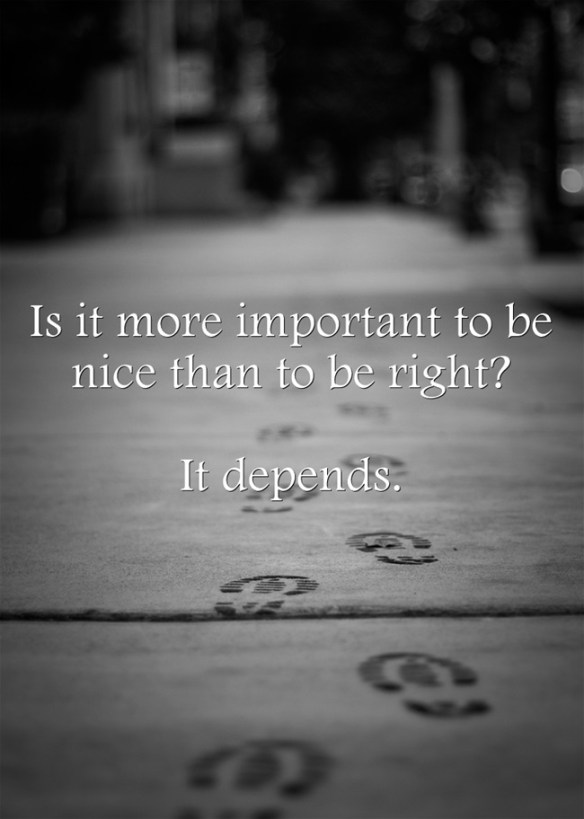
Is it more important to be nice or to be right?

I’ve seen this quote all over Pinterest in various forms, attributed to various authors: “Sometimes it’s better to be kind than right. We don’t need a brilliant mind that speaks, but a patient heart who listens.” Sometimes the word “nice” is substituted for “kind.”

I think what people who propose this have in mind is interpersonal relations. We probably all know someone who “always has to be right.” Now, most of us want to be right. No one wants to go around misinformed or holding onto opinions that are known to be wrong or foolish. But most of us have at least enough humility to realize that we might unwittingly be wrong sometimes. Some people are hard to be convinced of that, though.

This quote might also refer to those people’s little idiosyncrasies that can rub each other the wrong way. How the toilet paper goes on the roll. Where to squeeze the toothpaste tube. It’s usually best to let those things go and compromise for the sake of the relationship. The person who has to have everything his or her way because of course that’s the only right way can make everyone else miserable.

But in some cases, being wrong can be deadly. The wrong wire cut on the bomb. The wrong medical procedure or medicine. The wrong path to a broken bridge. The wrong opinion about who Jesus is or how one can know Him.

Unfortunately in my particular circles in Christendom, people can sometimes use truth like a steamroller or bullhorn or club. Arrogance does not make the gospel winsome or inviting; harshness can turn people off to the truth.

In addition, we need to care about the whole person, not just their response to our truth.  Years ago when my sister attended the church I was attending at the time, she had a number of people wanting to take her under their wing and advise her along the way. She needed the advice, but she felt like all anyone was interested in was telling her what she should be doing: no one wanted to just befriend her. When I first became a Christian, I had to realize that my relationship with my lost family couldn’t be just about my trying to witness to them. That only made them feel like a “project.” I needed to listen to them, do things with them, just love them.

Sometimes we have to wait until a person is ready before we can tell them things they need to hear. Jesus told the disciples once, “I have yet many things to say unto you, but ye cannot bear them now” (John 16:12).

On the other hand, Jesus rebuked the disciples for being fearful and not having faith in a situation where fear would seem like a natural response: being in a boat in a storm at sea.

And sometimes He shared truth that the other person did not receive, and He let him walk away, like the “rich young ruler.” He didn’t call him back, soften the message, or backtrack so the relationship could continue. When God brings a person to confront their dearest idol, it’s a crisis, and He wants them to see it for what it is and repent. Thankfully in His grace He’ll often bring a person to that point a number of times (I’ve always hoped that that man came back to the Lord at another time). Chris Anderson makes the point that in our day, there is a rush to get such a person to the “sinner’s prayer” and gloss over their heart issues: “How many such men have been led in a sinner’s prayer that salved their consciences but didn’t save their souls? How many have thus been unwittingly inoculated against the truth? How many have left churches lost and relieved rather than lost and sorrowful?” We need to allow time for godly sorrow to do its work toward repentance unto salvation.

In addition, God, through the New Testament writers, said that sometimes an issue is so important that His people need to take a stand and separate from others:

II Thess. 3: 6: Now we command you, brethren, in the name of our Lord Jesus Christ, that ye withdraw yourselves from every brother that walketh disorderly, and not after the tradition which he received of us.

II Thess. 3: 14-15: And if any man obey not our word by this epistle, note that man, and have no company with him, that he may be ashamed. Yet count him not as an enemy, but admonish him as a brother.

I Cor. 5:9-11: I wrote unto you in an epistle not to company with fornicators: Yet not altogether with the fornicators of this world, or with the covetous, or extortioners, or with idolaters; for then must ye needs go out of the world. But now I have written unto you not to keep company, if any man that is called a brother be a fornicator, or covetous, or an idolator, or a railer, or a drunkard, or an extortioner; with such an one no not to eat.

II Cor. 6: 14: Be ye not unequally yoked together with unbelievers: for what fellowship hath righteousness with unrighteousness? and what communion hath light with darkness? (This does not mean we’re not supposed to interact at all with unbelievers, but we’re not to be “yoked” together in situations like marriage).

And the apostles could also seem harsh in their warnings against false teachers, but the truth in question was so vital, and error in its regard so eternally deadly, that strong warnings were needed.

So is it more important to be nice or kind than to be right? It depends on the issue in question and the needs of the people involved. It’s best to be both if possible. The Bible speaks often of God’s kindness and admonishes us in many places to be kind. In interpersonal relationships, especially, we’re  to “Put on therefore, as the elect of God, holy and beloved, bowels of mercies, kindness, humbleness of mind, meekness, longsuffering; Forbearing one another, and forgiving one another, if any man have a quarrel against any: even as Christ forgave you, so also do ye” (Colossians 3: 12-13). In larger issues where a right view is essential, we don’t need to convey or defend truth in an unnecessarily harsh, negative, gripy, or cynical way. But cutting corners on the truth in an effort to be nice is neither kind nor loving.
Is-it-more-important-to

See also Does niceness really matter?

Sharing at Thought-Provoking Thursday.

Elisabeth Elliot in heaven

Elisabeth Elliot

Just this morning, Elisabeth Elliot passed through the “gates of splendor” into glory. She has been one of my heroes of the faith for almost 40 years. I first read her first book, Through Gates of Splendor, in college. It tells how her husband and five other men with their families came as missionaries to Ecuador and were burdened to reach a tribe of killers known then as the Aucas, now as the Waorani. The men devised ways to reach out to them, and then to meet them, and although the reception seemed friendly, later all five men were speared to death. Later Elisabeth, her young daughter Valerie, and Rachel Saint, sister to one of the slain men, were invited to go live with the Aucas, and many of them became believers in Christ as Savior and laid down their spears.

That book started me on a lifetime of reading missionary books and reading Elisabeth Elliot. Her commitment to simply reading the Bible, obeying it, and trusting God no matter what the circumstances were an inspiration.You know, it shouldn’t be: that should be normal Christian life for all believers. But sometimes having someone go before us and call back that though sometimes He calls us to go through deep waters and dark valleys, it’s ok, because He is with us, someone who knows those dark valleys by experience…well, there’s just nothing like it.

Besides her commitment to God and His Word, her views of what it means to be a Christian woman shaped my own thinking. Let Me Be a Woman was pivotal for me. The Shaping of a Christian Family influenced my own, Keep a Quiet Heart kept my focus where it needed to be. A Path Through Suffering was one of the books that helped me wrestle through questions on that subject. On Asking God Why was another favorite. The first chapter of The Savage My Kinsman, in which she talks about going on as a widow and quotes William Cullen Bryant’s poem “To a Waterfowl” has endeared that poem to me forever, especially the line: “He, who, from zone to zone, Guides through the boundless sky thy certain flight, In the long way that I must tread alone, Will lead my steps aright.” Back to the Bible used to send out daily e-mail devotionals taken from her books: I think I have kept a copy of most of them.

Just a few of my favorites of her quotes:

Don’t dig up in doubt what you planted in faith.

The fact that I am a woman does not make me a different kind of Christian, but the fact that I am a Christian makes me a different kind of woman.

Faith does not eliminate questions. But faith knows where to take them.

This job has been given to me to do. Therefore, it is a gift. Therefore, it is a privilege. Therefore, it is an offering I may make to God. Therefore, it is to be done gladly, if it is done for Him. Here, not somewhere else, I may learn God’s way. In this job, not in some other, God looks for faithfulness.

Obedience to God is always possible. It is a deadly error to fall into the notion that when feelings are extremely strong we can do nothing but act on them.

The secret is Christ in me, not me in a different set of circumstances.

To me, a lady is not frilly, flouncy, flippant, frivolous and fluff-brained, but she is gentle, she is gracious, she is godly and she is giving. You and I have the gift of femininity… the more womanly we are, the more manly men will be and the more God is glorified. Be women, be only women, be real women in obedience to God.

How can this person who so annoys or offends me be God’s messenger? Is God so unkind as to send that sort across my path? Insofar as his treatment of me requires more kindness than I can find in my own heart, demands love of a quality I do not possess, asks of me patience which only the Spirit of God can produce in me, he is God’s messenger. God sends him in order that he may send me running to God for help.

Leave it all in the Hands that were wounded for you.

This video shows a few clips from the documentary Beyond the Gates of Splendor (which I encourage you to see if you ever have a chance):

World Magazine reported in an article just last year that she “handled dementia just as she did the deaths of her husbands. ‘She accepted those things, [knowing] they were no surprise to God,’ Gren said. ‘It was something she would rather not have experienced, but she received it.'”

I was sorry to hear she passed away this morning. We’ve lost one of the greatest lights of the Christian world here, but I’m happy that now she is beyond the reach of dementia and old age. I pray for comfort for her family and the many who will miss her influence. May we each shine His light faithfully in the sphere of influence He gives us.

I am sure many articles and blog posts will be popping up about her over the next few days, but two I’ve read so far are:

From The Gospel Coalition: Elisabeth Elliot (1926-2015)

From Christianity Today: Missionary Pioneer Elisabeth Elliot Passes Through Gates of Splendor

From John Piper (love how he captures some of her personality): Peaches in Paradise.

From Nancy Leigh DeMoss: She Trusted and She Obeyed.

Just chatting

I’m home from church this morning not feeling very well, and even though I was awake for a couple of hours in the night, I am not really sleepy just now, so I thought I’d visit for a while. I am hoping for a nap while everyone is out.

We met with a hospice coordinator last Friday to discuss what their services involved for Great-Grandma. I had thought you didn’t call hospice in until death was imminent, but apparently that’s not the case. Technically one is supposed to have a terminal diagnosis of six months or less in order to use hospice, but certain diagnoses automatically qualify (like dementia), and they understand no one can predict when death might come in those cases. One of the biggest pluses with them is that she will be under a nurse’s care, and even a doctor can come to the house in an emergency. She had a low spell a couple of weeks ago where she was throwing up or gagging at meals, her heart rate was elevated, and she wasn’t smiling or interacting much at all. By the time her doctor could see her in his office, she was pretty much back to normal. Plus her doctor’s office is terrible about returning phone calls or handling prescriptions outside office visits. When we first moved to Knoxville and Jim was looking for a doctor for her, he had to call 31 doctors before he found one who would take a Medicare patient. 😦 So, all of that to say, it will be very nice to have someone we can call who can even come to the house if need be.They also send out a social worker who will help answer questions and help us prepare for all of that aspect of what we need to do to be ready for when her time comes. We were actually pretty amazed at all they do and wished we had known all this when we first brought her home almost two years ago. In fact, we really wondered why the social worker at the nursing home didn’t mention it as a possibility when she was making arrangements for her to come home.

I’ve been going back through some of my older posts, partly to see if there is anything I might be able to edit and use in our church ladies’ newsletter, partly because every now and then I think about gathering some posts into a book, and I wanted to take a look at what I had. I am amazed at how verbose some of those earliest posts are, and even more amazed that people read and commented on them! I don’t know that people would today. One of my purposes for blogging was to improve my writing by writing, and though I am still too wordy, I think I have improved in that regard.

I’m also sad about the folks I considered good blogging friends who are no longer blogging or commenting. I know it’s necessary some times, but I miss them.

Finally, I haven’t shared a picture of my favorite little guy in a while, and I just love this one of him:

Tim Toys

Hope you are having a great Sunday!

Friday’s Fave Five

FFF spring2

It’s Friday, time to look back over the blessings of the week with Susanne at Living to Tell the Story and other friends. Here are some favorite parts of the last week:

1. Friends and costumes. Jesse and some friends dressed up for a Fanboy Expo, where there are lots of guests usually from sci-fi shows or comic books. Last year Jesse and friends just attended: this year they dressed up as Batman villains – and won the first prize for group costumes! They won $100 and used it to go out to eat afterward. They had a lot of fun getting their costumes together. “Catwoman” found her boots at a thrift store for $4!

Jesse's friends in costume EDITED

Jesse is the Riddler, in the back with a green mask on.

2. Pools and Popsicles. We had set up the kiddie pool for Timothy once before when it was still a little too cool. We tried it again last Saturday and it was much better. He seemed to enjoy it. It also seemed a perfect time to try a popsicle. He hadn’t had anything with that much concentrated sugar before, so he screwed up his face at first, but then he liked it after a while.

3. Baby rabbit. There are some wild rabbits that visit our back yard to eat whatever is in the grass (clover?) that they like. We like to watch them: it’s almost like having pets without having to actually take care of them. 🙂 This week we saw a baby rabbit out there alone. It went away before I thought to try to get a photo. So cute!

4. A new phone cover. I like the rubber ones – I can’t hold on to them better – but my last one was so stretched out the phone sometimes fell out of it. Love this one:

Vintage phone case5. Grandbaby antics. I could probably list this every week. 🙂 He’s at such a fun age, learning, exploring, figuring things out, babbling.

Happy Frifay!

Book Review: Strait of Hormuz

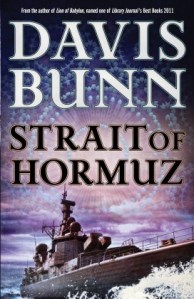
Strait of HormuzStrait of Hormuz by Davis Bunn starts off with a bang and keeps up a steady pace through most of the story. Marc Royce was formerly an intelligence operative for the State Department, but was fired by his boss. Since then, however, his former boss has called him for a couple of missions in which he needs someone off the grid. In this case, there is possible evidence that Iran is up to something involving nuclear bombs. The money trail leads to an art gallery in Geneva, which explodes just after Marc enters it.

Marc is unexpectedly reunited with Kitra Korban, whom he had met and fallen in love with in Israel in Rare Earth. He’s had to break off the relationship: she wanted him to stay and help lead the kibbutz her family led, but his calling was elsewhere. She had been notified by a stranger that she needed to warn Marc that he was in danger, and thus she became embroiled in his latest mission. While they both long to see each other, they also feel awkward and helpless, knowing nothing can change between them.

The Strait of Hormuz is an actual location, a narrow passage from the Persian Gulf to the ocean. In the story, American and other officials want to stop a ship they think contains components of an Iranian bomb before it gets to the Strait, but doing so will be interpreted as an act of war. In Marc’s investigation he finds unanticipated allies and enemies and follows trails that lead nowhere until he finally realizes what the actual Iranian operation and target is. But will he be in time to prevent it? And what casualties might occur in the process?

Action, adventure, espionage, an international flavor, and Christian faith elements woven in a natural and realistic way are hallmarks of this book. The pace is tense, fast most times, but Bunn handles even the stillness or times of uncertainty well. It’s a hard book to lay aside.

Strait of Hormuz is the third in the Marc Royer series, Lion of Babylon being the first and Rare Earth the second. I don’t think you have to have read those books to understand this one – enough information is given to comprehend the connections here – but you would probably enjoy this more fully for having read those.

(This review will also be linked to Semicolon‘s Saturday Review of Books.)