Friday’s Fave Five

 It’s Friday, time to look back over the blessings of the week with Susanne at Living to Tell the Story and other friends. Here are five favorite parts of the last week:

It has been quite the week here! My #1 favorite below will likely be the favorite part of this year!

1. The birth of my first grandson. Though he is very premature, and we would’ve liked for him to have waited a little while til his body was more ready to meet the world, it has been nice to be able to see him and touch him. Everything is going well so far, though he will probably be in the NICU for a couple of months yet. My latest update is here.

photo(2)

2. An in-house dinner date. My youngest was out last Friday night, so I called my husband and he brought home take-out from Red Lobster. Good stuff.

3. Working on a project together. My husband and I went together last Saturday to pick out plants to replace some bushes he took out as well as some for hanging pots and for a row in front of the rose bushes. Then we came home and worked on the hanging pots together, then he planted the rest. Often we have to “divide and conquer” to get things done, so it was fun to do this together.

4. Replacement bush. Some of you may remember a “fave five” from several weeks ago where I mentioned finally getting rid of a bush by the front door that I never liked. We replaced it with a hibiscus and added another planter. I like it much better! I was going to take a before and after picture, but we had some unexpected frost this week that is making the hibiscus look a little shriveled. I hope it can bounce back.

5. Pizza from a place that I love but my husband doesn’t care for. I was craving it on the way back from the hospital earlier today and sprang for one. 🙂

Hope you have a great weekend and a wonderful time reflecting on the meaning of this Easter season, that “Christ died for our sins according to the scriptures; And that he was buried, and that he rose again the third day according to the scriptures” (I Corinthians 15:3-4.)

Update on our little guy

Thanks so much for your kind words and especially prayers for our new little grandson. As I mentioned earlier, he was originally due in late June. He will probably be in the NICU for a couple of months, or until he meets certain milestones (maintaining body temperature, breathing well on his own, being able to eat on his own, etc.).

His breathing is doing pretty well. He was born crying, which all the doctors were surprised at with a preemie. That was a really good sign. They did put a tube down his throat the first day to put some medicine down in his lungs to keep them expanded, and he was on a CPAP for a few days which, if I understand it correctly, pushes air in something like gentle breaths. But as of Tuesday he was on just oxygen in a tube under his nose. He forgets to breathe every now and then until they stimulate him in some way, but overall he is doing well in that regard.

He’s a little jaundiced now, not unusual for even a full term baby. I don’t know if that is a little more critical for him since his liver isn’t fully developed yet, but they have him under a special light to help with that.

They put in a feeding tube yesterday to start giving him some formula, just a miniscule amount at first, to see if his digestive system handles it okay. Then they’ll gradually increase the formula or breast milk while decreasing his iv fluids. They say it will be a few weeks yet before he’s developed the skills to suck and then swallow and breathe all together without choking.

The first neonatal doctor who talked to my son and daughter-in-law said this will probably be more of an up and down journey, with highs and lows, good days and bad, rather than one of continual steady improvement. So far everything is going well, but it will be a long journey.

I’d appreciate your continued prayers for all of them: for the little guy, that he’d continue to improve and get to go home as soon as possible. for Mom as she recovers herself, for Dad as he tries to keep up with everything, for both of them as they pray and watch over him. I was thinking of my daughter-in-law last night in the sense that usually, when you have a newborn, you get to stay home in your pjs and cuddle and get to know him. Instead she is going out to the hospital a couple of times a day for several hours while still recovering and trying to get going with the breast pump, and she’s not able to hold him (other than just for a few minutes one day). Would appreciate your prayers for them for strength and stamina as well as grace for everything involved. They are doing well, but as the doctor said, this will be a long haul.

I did get to go to the NICU one night and then again this morning, and was able to touch him and talk with him. The rule in the NICU is that no one else can visit the baby unless a parent is there, so I have to coordinate going with when they are there (which is fine, because I want to see them, too. 🙂  ) and when someone is here to care for my mother-in-law. We had just cut her caregiver’s hours back a couple of weeks ago, mainly for financial considerations, so that limits what times I can go out. I may be able to get permission to see him by myself, but I’d still like to go when my son and d-i-l are there, too, as much as possible.

At this point I am not showing his face or sharing his name or any vital statistics on the blog, partly because I haven’t had a chance to ask his parents how they feel about it, but partly because things are just so vulnerable right now. My own kids were older when I started a blog, so as long as I wasn’t too specific about our location, I didn’t have a problem sharing pictures or their names. But it is different with a baby. 🙂 However, I’ll give you just a glimpse:

photo(1)

photo(2)

Isn’t he sweet? 🙂

Thanks again, so much, for your love, care, and prayers.

Someone decided to come early…

My little grandson, due late June, decided to make an early surprise appearance today!

He was crying as he came out, a good sign. But they will probably have to keep him in the NICU for possibly a couple of months.

Would appreciate your prayers for the little guy and the new parents.

I will probably not be on the blog for a few days 🙂

Friday’s Fave Five

 It’s Friday, time to look back over the blessings of the week with Susanne at Living to Tell the Story and other friends. Here are five favorite parts of the last week:

1. Safe travels for my son and daughter-in-law as they went to OK to visit her mom and attend a couple of baby showers folks were throwing for them. They had a little accident when someone scraped their car passing in a parking lot, but thankfully it wasn’t major and didn’t jolt the car enough to hurt anyone.

2. Baby things. It has been fun perusing my daughter-in-law’s baby registries and seeing all the cute things. I am looking forward to seeing what they got for their showers! I enjoyed receiving a video from my son showing us their new stroller/car seat combo – it was fun to see how excited he was about it. 🙂

3. Nice temperatures. When I’ve been out and about this week, the weather has been sunny and the temperatures a little on the cool side but not so much as to need a sweater – my favorite.

4. New schedule working out well. We had to cut back my mother-in-law’s caregiver’s hours so as to manage my mother-in-law’s finances better, and also because there was not enough for the caregiver to do to justify paying for 9 hours a day. That means those hours the caregiver is no longer working fall to me. I’m having to watch the clock a bit to try to get my errands done while she’s here, and in some ways I feel a little more tied down, but I’ve been surprised at how nice it feels to have the house to myself more.

5. Losing 6 lbs. over the last few months. Woot! I’ve just been changing one thing at a time (beginning exercising regularly, cutting back on sweets), and there are many more measures I need to take, but it has been encouraging to see some results just from what I have done so far.

Happy Friday!

Adventures in Elder Care: Helping Parents As They Age

Eldercare

Before I wrapped up this series, I wanted to share some odds and ends thoughts about helping parents as they age. This list would probably vary from person to person because parents age differently: we know a man well into his 80s who stills travels internationally and just got remarried a couple of years ago, but both of my parents had serious health issues in their 60s and died before they turned 70. Some parents are pretty self-sufficient as a rule whereas others need a little more help. Some want help, some don’t. These suggestions arose primarily from our own experience of seeing my mother-in-law through the last dozen years or so of living alone, then not being able to live alone, then going from assisted living to a nursing home to home with us. Some arose from friends’ experiences. By all means tailor any of this to fit your situation. I’d welcome any suggestions or experiences you’d like to share in the comments.

1. Have “the talk” – about finances. It’s hard to say when this should be done, but it should be well before finances become an issue and before any kind of dementia has set it. I’ve heard of some with dementia who thought their kids were “after their money” when they tried to work out power of attorney and such when the parent could no longer handle their own affairs. Some parents will be on top of things and will initiate the conversation with you (which is preferable). One suggestion would be to ask your parents as they get close to retirement how they’re set for the coming years and what their preferences would be if anything should happen to make them unable to take care of things.

In our case, my mother-in-law was the one who handled the finances in her marriage, and after her husband died she was happy to give her oldest son power of attorney. When she moved here, power of attorney was given to Jim since he would be the one actually handling her finances, paying for assisted living, supplies, etc. He got a joint bank account with her name and his on it so either of them could write checks. For years she wrote checks for church and for Christmas presents, but he wrote checks for bills. She would sometimes ask about how things stood but seemed content with how things were being handled.

2. Have the other talk – about end of life issues. This can be a difficult or awkward situation, and some parents will not want to discuss it at all. If something should happen and your parents have not made any living will or advanced directives, all you can do is try to make the best decisions you can. I’d advise you to do some research before having to make a decision in a crisis. For instance, we thought feeding tubes should always be offered if needed, but then discovered there are situations where it would cause more problems than it solved. When my dad needed a ventilator, one sister-in-law was adamantly against them because she had seen people who were for all practical purposes gone, but were kept alive on a ventilator; however, my father only needed one for about ten days. I once felt that CPR should always be performed, but on an elderly person, chest compressions can break bones. If you can gather information beforehand, you’ll be better prepared to make these decisions in a crisis.

3. Sibling involvement. It helps if everyone can be involved in the discussions and decisions that have to be made. Some of these, particularly end-of-life issues, can be especially delicate and emotional. If all the siblings are nearby, it’s best if they can all be involved in a parent’s care, but realistically it does not always work out that way. If the lion’s share of care falls to one sibling (often due to distance), continue to stay involved, show interest, ask how things are going, etc.  Abide by their decisions unless there is neglect or abuse. If there is an elderly family member with no children, others need to step in. We knew of a situation where an older lady in our church lived with a daughter who had some kind of mental issues, was a hoarder, had stuff stacked all over the house with only a narrow pathway for the older lady to get around in her walker, had something like 16 cats, some of whom she kept tied on strings in one room, which smelled horrible. When we knew of all this, we tried to help, but found out that unless there was active abuse, there was not much we could do as “outsiders.” Someone called animal control. and they came and took a few of the cats, but that is all. Another lady tried to help the older lady find a different place to live, but ultimately she did not want to leave her daughter. At her funeral when I saw rows and rows of her relatives, all I could think was, “Where have you people been the last several years?”

4. Help where needed, but unobtrusively. Long before parents get to a place where they can’t live alone any more, they might need help here and there with a variety of issues. They begin to lose steam or get to the place where they can’t see well and may not even know of some problems.

We lived 2,000 miles away from my husband’s parents, but the last several times we visited, my husband would seek for something to be done around the house (like rebuilding the roof on the carport, etc.)  and suggest doing it while we were there. It gave him and his dad some time to do something together, helped with something that really needed to be done, and kept his dad from climbing a ladder to do it himself. 🙂

We noticed the last several years that my mother-in-law was in her own home that things like dishes weren’t being done as well, not because she was letting them go, but because her eyesight and sense of touch was getting to the place that she didn’t realize she wasn’t doing as good of a job. I’m a bit germophobic, so when I’d drink a glass of ice water with “floaties” in it, I’d get pretty grossed out. This was before the days of readily available bottled water. She didn’t have a dishwasher, didn’t have room for one, and would not have wanted one anyway. We started getting paper plates and plastic cups when we visited, to “make things easier on her” – -which was technically true.  There were always piles of dishes after every meal, and sometimes she accepted help, but more often than not she liked to do them – it was her “thinking time.” Having some disposable products did help lighten that load, but it also helped us be assured that we were eating and drinking off clean utensils.

I mentioned earlier that sometimes household help can be hired, especially if the family doesn’t live nearby.

You may need to transfer things like Thanksgiving and Christmas to your house rather than the parents’ home, or at least spend time helping them get ready for it. You have to tread carefully with long-standing traditions like this: some might feel relieved not to have the pressure and work, but some might get their feelings hurt.

I mentioned helping unobtrusively: you don’t want to barge in and take over, or make them feel inadequate. Try to offer whatever help you think might be needed in a way that encourages them rather than demeans them.

And sometimes you just have to accept that things like the housekeeping might be at a lower standard than it once was. The last few years my mother-in-law lived alone, she pretty much let her dog have the run of the place, and every surface was covered with dog hair. It was a nuisance, but it wasn’t a safety or health issue, and his companionship meant a lot to her.

Sometimes helping means insisting on something they may not like. My mother-in-law was very much a status quo person who didn’t like to make any changes. Even when her hearing aid was not doing any good, she insisted it was fine, and we had to gently insist on going to the audiologist to be evaluated for a new one.

Sometimes helping may mean running interference. My mother-in-law had trouble with one physical therapist at the assisted living place (he had a Croatian accent and she couldn’t hear him well, couldn’t understand what he wanted her to do or why). He thought she was just being uncooperative. My husband had to take time to be with them for their first few sessions to help them interpret each other, but after they they got along great.

5. Help them to be as independent as possible as long as possible. At home or even in the lower-ranged assisted living care, there might be tools you can gets or little things you can do to help them be involved in their own care as long as possible: the seven-day pill holders to help keep their medications straight and help them remember what to take when; “reachers” to help them with hard-to-reach items (I use one of these myself!), an device to help open jars (I use one of those, too), etc. My husband tied bits of rope between his mother’s dresser drawer handles to make it easier for her to open them when she began to have trouble with them. He also put easier-to-read labels on the TV remote for the most-used buttons.

There will come a time when they will likely need help with just about everything, but for as long as possible let them do what they can do. We had elderly neighbors once, two sisters, who cut their own grass well into their 70s. One of them even painted her back steps at that age. My first impulse was, “Oh, we should go over and help them with that!” But one of them in particular liked being able to take care of herself. I just watched a Waltons episode when the grandmother came home after having a stroke, and every time she tried to do something, someone jumped up to do it and told her to relax. They meant well, but they made her feel helpless and useless. Even as their abilities diminish, let them do what they can safely do.

6. Don’t squelch talking about the past. As this post points out, they don’t have that much future left, and it may not look all that bright and cheery. This is a great time to ask them about their growing-up years – and a good time to write some of these things down for posterity. One of the things I regret with my mother-in-law is that I didn’t ask her more about these things and didn’t write down what she did say.

7. Help them find usefulness and purpose. This overlaps a bit with the above two points, but an older person can get pretty discouraged when they lose some of their abilities and even lose their home. Once when we had my mother-in-law here for dinner, a funny story from her past came up that we all enjoyed and laughed over: she did as well. Then she said, “Well, at least I’m good for a laugh.” It didn’t hit me until then that she might not have felt she was “good for” much of anything else. You can encourage a parent that as long as God has them alive, He has a purpose for them. Psalm 92:14 says, “They shall still bring forth fruit in old age; they shall be fat and flourishing.” Perhaps you can help them organize their photos into albums (something else I wish I had done) and hear the stories behind them. Remind them often that you’re glad they are here.

8. Always honor and respect them as your parents. I cringe a little at the phrase “parenting your parents” or the idea of “switching roles” with them. In one assisted living place, when we came to pick up Jim’s mom for something, one of the aides said, “It’s almost like you’re the parent now, isn’t it?” and then turned to his mom and said, “Your daddy is here.” Umm…no. Even as she has lost more of her abilities and we’ve taken on more of her care, we don’t think of her like that. As she has experienced a bit of dementia, Jim has had to remind her about some things from time to time (like using her fork rather than her fingers at meals or insisting her hands be washed), and sometimes that might have involved a sharper tone if she persists, but we don’t treat her as a child. I know family dynamics can be tricky and some parents can get more child-like, but as much as possible we still need to show them honor and respect.

9. Forgetfulness and dementia. My mother-in-law does not have Alzheimer’s, so I can’t really speak to that (and again, I’d welcome any perspectives you’d like to share in the comments). She has had a degree of dementia. It’s usually worse when under stress or when anything different is happening, and it has increased over the years.

As a general rule it doesn’t help to say, “Don’t you remember?” (Lisa suggests here to give them the answers rather than questioning them). Sometimes it does help to gently remind them of things: for instance, when Jim brought his mother here from ID, the folks at her church had all given her cards and told her good-bye, and all her kids and several grandkids had come to a combination 80th birthday/farewell party. Yet on the plane, she told Jim, “I think I’ll just stay for a few days and then head back home.” He wisely didn’t try to “set her straight” then and there, but later on he said, “Remember when all the folks at church gave you cards? Do you remember what those were for?” At some point she said, “Oh, that’s right. I’m moving to South Carolina.”

A nurse in the nursing home once told a member of a group from our church who were visiting that it is best not to alter their reality. Sometimes when they get “stuck” on something, distraction is the best tool. When Jim traveled with her, she’d say things like “I sure hope you know where we’re going” and get a little rattled by it all. Even though he is a seasoned traveler, instead of just telling her, “Don’t worry about it, I’ve got it covered,” he told her what gate he was looking for at the airport and asked her to help him look for it. That gave her something to occupy her thoughts. Recently she was “stuck” on needing to go to her daughter’s house. Jim wasn’t home when this started, and at first I tried to remind her that she lived in TN now and that her daughter was back in ID. But that wasn’t sinking in. It was one of our worst weather days this winter, and when Jim got home, he told her, “It’s snowing out now and the roads are icy, so we’re just going to stay here for the night.” He had to go over that a few more times, but after a while her thoughts turned a different direction.

Even in visiting in the “memory care” unit of assisted living, residents would stop us and ask us if we could help them get somewhere. At some level they knew they weren’t home, and some of them were constantly trying to figure out ways to get there. One lady stopped Jim once to say that something was wrong with her car and she needed to get to it. It was close to dinner time, and he said, “I tell you what, why don’t you stay and eat dinner, and we’ll see about your car later.” She felt so honored to be asked. 🙂 (On a side note, when visiting a nursing home or a memory care or Alzheimer’s unit in an assisted living facility, sometimes it is best to avoid engaging the residents in much conversation. When we visited my m-i-l in regular assisted living, we talked with the other residents quite frequently. But we quickly found that in the “memory care” unit, they often wanted you to help them with something, and when you couldn’t, they would get agitated, sometimes angry, and even start yelling and cussing, which not only disturbed themselves and others but made it hard on the aides to get everyone settled back down. We learned to just cheerfully say hello in passing without stopping to talk, and if we did get stopped and asked for something, we’d point out one of the aides and say, “Maybe she can help you.” )

10. Helping them deal with government agencies. Even if you have power of attorney, there are many situations where an agency will want your parent there. Once when my husband was trying to deal with one particular issue (I forget what it was), the man he was talking to wanted to talk to my mother-in-law on the phone. My husband tried to tell him she was very hard of hearing and especially  had trouble hearing on the phone, but the man insisted. So my husband went to her room at the assisted living facility, called the man, put the phone on speaker, and they tried to have a conversation. When she couldn’t hear and Jim was trying to convey to her what the man had said, the man shouted, “Don’t you dare tell her what to say!” Understand that they are trying to protect the elderly from being taken advantage of by unscrupulous relatives (unfortunately that does happen), but sometimes they do make it unnecessarily hard on those of us who are trying to help get necessary things done.

11. Smooth awkward moments. You don’t need to call attention to every mistake or fumble: if they’re aware of it, they probably feed bad enough already. Just help take care of spills or messes or whatever without making an issue of it. When they start needing help with personal issues, just handle it as matter-of-factly as possible – I took that cue from when I’ve had surgeries and illnesses and needed help with things I’d much rather have done on my own. Usually the nurses just came in and we got it done, and some of them were even cheerful about it. When my mother-in-law started needing help going to the bathroom, she’d say apologetically, “I bet you never thought when you got married that one day you’d have to help your mother-in-law go to the bathroom.” Well, no, I hadn’t. 🙂 And helping someone that way or changing dirty Depends later on is not really anyone’s favorite thing to do, but it helps to just look at it as meeting her needs and to handle it with as much grace as possible. My husband is great at easing awkward issues with humor.

12. Don’t neglect spiritual needs. Linda had a great post on this. When they can’t read the Bible for themselves any more, take time to read it to them. Some can handle CDs to hear the Bible read. Jim’s mom liked to attend church Sunday mornings until perhaps the last year or so when she just got too feeble and had little energy. When she was in the nursing home, a group from a church we were familiar with had a church service there Sunday afternoons, and Jim went over and accompanied her to it.

13. Have patience. There can be a multitude of frustrations as a parent gets older, even when we understand that they can’t help what they are doing and saying. This is probably the area that I most often prayed for while my mother-in-law was in assisted living, and often while driving there I often prayed and quoted to myself Colossians 1:11: “Strengthened with all might, according to his glorious power, unto all patience and longsuffering with joyfulness.”

The ultimate principle is to “do unto others as you would have them do unto you” (Luke 6:31). Put yourself in their place and treat them with as much love and grace as you would want others to show to you in the same situation.

Grandmother’s Beatitudes

Blessed are those who understand
My faltering step and palsied hand.

Blessed are those who know that my ears today
Must strain to catch the things they say.

Blessed are those who seem to know
That my eyes are dim and my wits are slow.

Blessed are those who looked away
When coffee spilled at table today.

Blessed are those with a cheery smile
Who stop to chat for a little while.

Blessed are those who never say,
“You’ve told that story twice today.”

Blessed are those who know the ways
To bring back memories of yesterdays.

Blessed are those who make it known
That I’m loved, respected, and not alone.

Blessed are those who know I’m at a loss
To find the strength to carry the Cross.

Blessed are those who ease the days
On my journey Home in loving ways.

– Esther Mary Walker

Related reading here at Stray Thoughts:

With All Our Feebleness.
Despise Not Thy Mother When She Is Old.
Caring For a Parent at Home.
Assisted Living and Nursing Homes.
Decisions for a Parent’s Care.
How Older Women Can Serve.
A Public Service Announcement Concerning Walkers.
Senior Version of “Jesus Loves Me
Am I Doing Any Good?
The Winter of Life.

Related reading on the Web:

Insignificant Is Beautiful.
Maintaining Sanity During Dementia’s Cognitive Decline.
8 Things Not to Say to Your Aging Parents.
Elders Who Abuse Relatives Taking Care of Them.
Adapting Your Home For An Older Parent.
10 Ways Caring For Parents Is Different Than Caring For Children.
You Are My Sunshine.
Alzheimer’s…My Reflections.
I’m Still Here.
A Psalm For Old Age.

Book Review: Crowded to Christ

Crowded to ChristThe first I remembering hearing of Crowded to Christ was in an online sermon from a former pastor that I think I listened to while home sick one Sunday. He must have mentioned it before, but this time he recommended finding a copy and reading it. It was first published in 1950 and is apparently out of print now, but I found an inexpensive used copy online.

Its author, L. E. Maxwell, was a co-founder, principal, and eventually president of Prairie Bible Institute in Alberta, Canada, which I don’t know much about except that Elisabeth Elliot attended there for a time and Don Richardson (author of Peace Child and other books) graduated from there.

Maxwell’s main theme is that God uses a variety of measures – the law of God as well as pain, pressure, and other means – to draw or to “crowd” people to Christ in the sense of realizing He is the only answer.

For instance, “In his determination to be humble, to love His enemies,… to be more than conqueror – in other words, to be like Christ –  the Christian may come sooner or later to a sense of crushing failure and defeat.” He realizes he can’t possibly do this on his own. Some go on half-heartedly, thinking full victory will just never be possible, while others, “not having made Paul’s deep discovery, ‘I know in me (that is, in my flesh), dwelleth no good thing,’ they redouble their efforts…They think that if they are only more watchful, more prayerful, more diligent, they will yet be able to attain. They strive and struggle; they fight and fast; they yearn and pray.” He quotes Hudson Taylor as saying, “I felt I was a child of God: His Spirit in my heart would cry: ‘Abba, Father’; but to rise to my privileges as a child I was utterly powerless.” Maxwell continues, “Not until they had come to an end of all self-righteousness and satisfaction in themselves, not until all their peace and joy and strength of will and resolution and purpose had been ‘slain by the law,’ could faith stretch forth her hands for victory. Only when they sensed the tragedy, the futility, the folly and failure of every human attempt to overcome the law of sin and death, were they shut up to Him who not only ‘justifies the ungodly’ but also ‘quickens the dead'” (pp 17-18).

He describes how God sometimes puts us in extenuating circumstances that result in a crisis of faith that drive us to Him as our only way through, like Jacob on his way home finding out Esau was coming to meet him, or Israel’s being caught between Pharaoh’s army and the Red Sea, or Israel when called to enter into Canaan but looked at the obstacles instead of God and failed.

I have far too many quotes marked to share, but here are a few that stood out to me:

“Have you ever had God lay hold of you in the wee hours and reduce you until you had ‘Nothing left to do but fling/Care aside and simply cling?'” (p. 29).

“God must secure our confidence, and…He tries us in order to make us trust where we cannot trace. Without faith it is impossible to please Him. ‘Thy way is in the sea.’ While, therefore, He has no pleasure in our agony and perplexity, He knows that it is in the trackless and traceless sea of trouble that we come to trust” (p. 38).

“To be self-centered is to be self-destroyed…The preservation of self is the surest path to self-destruction” (p. 128).

“When the Lord Jesus dealt with souls, His method was adapted to the need of the individual. However, it is remarkable that almost invariably He brought souls face to face with some one thing which in their own strength they could not do, and there demanded an act of obedience…In order to create a sense of sin and a need of divine strength Jesus gave command just where men were inclined to wander or argue or excuse themselves” (p. 150).

“If only the Saviour had asked me to do something else! But that something else would not have reached your heart. You could have done that other thing without faith and without grace; yes, without even being right with God. So, in asking you to do the one impossible thing, Christ crosses your will through your withered limb” (p. 178).

“Grace is no mere favour conferred upon the ungodly, but it is to be experienced as a ruling force and sufficiency, reigning in our hearts as the new, living ‘law of the Spirit of life in Christ Jesus,’ and enabling us to prove the no-more dominion of sin. Grace abounding is to lead at once to grace reigning” (p. 219).

In ways simple and inscrutable and fiery God must drain away the dregs of self-confidence. He must let the flesh fail…when all those remaining are convinced that God alone is their rescue and remedy…” (p. 256).

The New Testament is enfolded in the Old, and the Old Testament is unfolded in the New” (p. 272).

“Love and righteousness are not contrary principles” (p. 299).

He spends a good deal of space in the book talking about the law of God. Though Christ has fulfilled the law and we never could, and in this day of grace are not required to, still, God has uses for the law, which the Bible describes as “good” and “spiritual.” “By the law is the knowledge of sin.” His appendices on “The Old and New Testaments Compared” and “The Purpose of the Law” are some of the best parts of the book, especially on this point.

Overall I enjoyed, benefited from, and saw myself in the pages of this book. I wasn’t quite so interested in arguments about dispensationalism and ultra-dispensationalism or Calvinism vs. Armenianism: those seemed to make the book drag a bit, but I understand their necessity, especially with Maxwell coming from an academic background where students have debated these things back and forth for ages.

I think the only places where I disagreed with him were some such as when he described a man who did not want to go into a grove and pray as the folks in that place and time did when they wanted to meet with God after a service. He acknowledged that there is nothing in the Bible about doing such a thing and that one can get right with God without that action, but this man had no peace until he finally did so. I guess perhaps I could see that if it was just a matter of pride or something, but I’d still have trouble saying he should have done that when it is not a Biblical issue.

This book often brought to mind a quote from Hudson Taylor, though the quote itself is not in the book: “It doesn’t really matter how great the pressure is. What matters is where the pressure lies, whether it comes between me and God or whether it presses me nearer His heart.” As Maxwell says in the second quote listed above, God takes “no pleasure in our agony and perplexity.” He is not dreaming up ways to torture us, but He knows best what we most need in our inmost hearts to grow in our faith and relationship with Him.

(This will also be linked to Semicolon‘s Saturday Review of Books.)

Trusting God in the Dark

I often post hymns texts on Sundays, but I don’t have much time at the computer on Sunday itself, so if I don’t have a post ready beforehand I’m not usually able to get to it then. That dilemma was compounded yesterday when I had two different songs on my heart and couldn’t decide which one to share. 🙂

I’ve been rediscovering a CD that I’ve had for a while but somehow got buried in my little basket I keep on the kitchen counter for CDs: Beyond All Praising by the BJU Singers and Orchestra. One of the songs that stands out to me from this CD is “In Your Silence,” words by Eileen Berry and music by Molly IJames, on the theme of trusting God even when He seems silent and distant.

In Your word I find the echoes of the questions in my mind;
Have I fallen from Your favor, is Your ear to me inclined?
When Your silence is unbroken, though my prayer ascends each day,
Father, keep my faith from failing in the face of long delay.

While You wait in gracious wisdom and my doubts begin to rise,
I recall Your loving kindness, and lift my hopeful eyes.
While Your hand withholds the answer, I will not withhold my heart.
I will love you in Your silence, I will trust You in the dark.

When the troubled thoughts within me hold me wakeful in the night,
And the shadows that surround me seem to hide me from Your sight.
Father, bring to my remembrance mercies shown in days gone by.
Help me rest upon Your promise: You will not neglect my cry!

While You wait in gracious wisdom and my doubts begin to rise,
I recall Your loving kindness, and lift my hopeful eyes.
While Your hand withholds the answer, I will not withhold my heart.
I will love you in Your silence, I will trust You in the dark.

It is performed beautifully here:

I think many Christians go through times like this. Biblically Job and the psalmists share similar thoughts, and this song echoes some of the Psalms: the second stanza brings to mind Psalm 63. The last two lines of the chorus particularly resonate with me: “While Your hand withholds the answer, I will not withhold my heart. I will love you in Your silence, I will trust You in the dark.”

This song also brings to mind a section in Evidence Not Seen by Darlene Deibler Rose (linked to my review). The following occurred while she was in a Japanese prison camp, having been captured while a missionary to the New Guinea during WWII.

I knew that without God, without that consciousness of His Presence in every troubled hour, I could never have made it…Quite suddenly and unexpectedly, I felt enveloped in a spiritual vacuum. “Lord, where have You gone? What have I said or done to grieve You? Why have You withdrawn Your Presence from me? Oh Father—” In a panic I jumped to my feet, my heart frantically searching for a hidden sin, for a careless thought, for any reason why my Lord should have withdrawn His Presence from me. My prayers, my expressions of worship, seemed to go no higher than the ceiling; there seemed to be no sounding board. I prayed for forgiveness, for the Holy Spirit to search my heart. To none of my petitions was there any apparent response.

 I sank to the floor and quietly and purposefully began to search the Scriptures hidden in my heart…

 “Lord, I believe all that the Bible says. I do walk by faith and not by sight. I do not need to feel You near, because Your Word says You will never leave me nor forsake me. Lord, I confirm my faith; I believe.” The words of Hebrews 11:1 welled up, unbeckoned, to fill my mind: “Now faith is the substance of things hoped for, the evidence of things not seen.” The evidence of things not seen. Evidence not seen — that was what I put my trust in — not in feelings or moments of ecstasy, but in the unchanging Person of Jesus Christ. Suddenly I realized that I was singing:

When darkness veils His lovely face,
I rest on His unchanging grace.
In every high and stormy gale,
My anchor holds within the veil.

 On Christ the solid Rock I stand;
All other ground is sinking sand.

I was assured that my faith rested not on feelings, not on moments of ecstasy, but on the Person of my matchless, changeless Savior, in Whom is no shadow caused by turning. In a measure I felt I understood what Job meant when he declared, “Though He slay me, yet will I trust in Him” (13:35). Job knew that he could trust God, because Job knew the character of the One in Whom he had put his trust. It was faith stripped of feelings, faith without trappings. More than ever before, I knew that I could ever and always put my trust, my faith, in my glorious Lord. I encouraged myself in the Lord and His Word.

We don’t always know why God seems distant. Sometimes it is sin: though He is with us always, that fellowship can be broken when we’re sinning against Him. Sometimes, as in Darlene’s case, He is teaching us to trust in Him and His Word and not in our feelings. Sometimes, like for Daniel, answers are delayed due to spiritual opposition. There may be other reasons as well, but the answer is the same: reminding ourselves of and resting on His Word.

Though this is not a “dark” time for me, it is for a few friends, so I hope this encourages them, and I can shore these truths up for myself for when those times might come around in the future.

Who is among you that feareth the Lord, that obeyeth the voice of his servant, that walketh in darkness, and hath no light? let him trust in the name of the Lord, and stay upon his God. Isaiah 50:10


Laudable Linkage

On Saturdays I usually share a list of interesting links I’ve discovered the previous week. I have just a short list today.

When You’re Just Plain Tired of the Sacrifice.

Hoping Your Son Chooses a Godly Woman Some Day? Teach Them Whose They Are. “As my son searches for a spouse, may God’s light in her shine through…and catch his eye.”

World Vision Reverses Decision to Hire Christians in Same-Sex Marriages. I appreciated the way they responded to godly counsel (though it would have been better to have sought it beforehand) and appreciated that they mentioned loving ways it was pointed out that their actions had not been consistent with Scripture. I’ve seen a lot of not so loving responses, so this resonated with me.

Sympathy for the Devil. I’ve not seen the new “Noah” movie yet and don’t know if I will, but I’ve seen several reviews that mention plot points that leave me scratching my head. This post points out that the writers weren’t just taking creative liberties or being neglectful of the text: there is an underlying philosophy that dates clear back to the Gnostics. I had no idea that stuff was still alive and well.

When Women Start Saying “No” to Church Activities. I have mixed emotions about some of the points in this post, as I said in my comment there. I do think sometimes we need to adapt ourselves to the need rather than wanting everything adapted to us, on one hand, but on the other hand, yes, we do need to adapt to current lifestyles and find ways of ministry that edify rather than exhaust.

Virtuous Woman Subway Art.

Sherry at Semicolon is celebrating Poetry Month by sharing different types of poetry with an example each day this month.

Found this on Pinterest and it make me smile:

fooled by spring

Seems like it has gone that way this year! But I hope winter is gone for good now (at least until next year).

I’ve listened to this several times this week. One of the most beauitful pieces of music ever written, “Gabriel’s Oboe” from Ennio Morricone’s “The Mission” has been merged with one of the grand old hymns, “How Great Thou Art.” Just lovely.

Friday’s Fave Five

 It’s Friday, time to look back over the blessings of the week with Susanne at Living to Tell the Story and other friends.

I’m a little late to the party – it has been a busy week! Here are some of my favorite parts of it:

1. Springy days. The weather has been just perfect this week, not too hot or too cold. It’s been rainy and windy today, but I accept that it’s gotta do that some times. 🙂

2. Longer days – or more sunlight to the day, at least. It’s rejuvenating.

3. A productive week. I won’t bore with with the to-do list, but I got some things done I needed to and some things I wanted to. Some weeks I’m not sure where the time goes, but I don’t seem to have much to show for them, so it is nice to get some things accomplished.

4. Timely arrivals. I had ordered something for Jim’s mom’s weekday caregiver’s birthday and paid a little extra for it to get here today. By mid-afternoon I realized that “today” might not mean before she left at 5. I prayed it would get here before she left but was mentally preparing myself that I’d just have to give it to her Monday after her birthday. But it came today at 4!

5. Forty years of being a Christian. It just hit me last night that this year is the 40th year since I believed on Jesus Christ as my Savior. Unfortunately I didn’t write down the exact day and I don’t remember what time of year it was, but I do know how old I was. What a blessing to have known Him and His forgiveness, love, and care for so long. My testimony is here. I encourage you, if you don’t know Him, or you’re not sure, take time to find out more about it. This link explains more about becoming a Christian.

“Whoever has the Son has life; whoever does not have the Son of God does not have life.” I John 5:12

And this is eternal life, that they know you the only true God, and Jesus Christ whom you have sent.” John 17:3

Jesus said to him, “I am the way, and the truth, and the life. No one comes to the Father except through me.” John 14:6

Adventures in Elder Care: Caring For a Parent at Home

Eldercare

Some years ago I heard that one of the most delightful older ladies in a church we used to attend in another state had developed Alzheimer’s and that her son and daughter-in-law were caring for her in their home. One time when we had occasion to go back and visit, I asked her daughter-in-law how caring for her mother-in-law was going or what it was like. She smiled beatifically and said, “It’s our privilege!” I could only think, “Wow…she must be a better Christian than I am, because I think that would be hard.” It’s not that I wanted the nitty-gritty details, but I did want to know how God had given her grace for this ministry in case I ever had to do the same.

Our only experience with having a parent in our home for an extended time was when my dad came years before and got sick and ended up in ICU. I believe he was with us for about six weeks. He was not a Christian then (though he became one during that time), and he had lived alone so long that he had forgotten the give and take that there has to be with a number of people under one roof. I don’t mean to dishonor him by saying so, but he was quite cantankerous, especially when Jim was not home. The tension was so great that Jim said afterward we would never have a parent live in our home.

In my post on making decisions for elderly parents’ care, I mentioned that there are some relationships that thrive better when there is some distance. I share the experience with my dad mainly to say that I do understand it can be stormy to have a parent in the home, especially when age and dementia remove some the natural inhibitions. Some elderly parents can be abusive, and we heard enough even in assisted living places to know that bringing some parents home would be quite stressful. I wouldn’t even begin to know how to advise someone in such a case, especially when there don’t seem to be any other options, except to pray for a lot of grace.

In my mother-in-law’s case, we had been talking ever since we moved to TN about moving her home, because now we had a house with no stairs, and we had a room that would work well for her care (some of you may remember my talking about Jim finishing off a room from our L-shaped garage. My son and daughter-in-law lived there for a while when they first moved here, and ever since we had used it for Jim’s office and as a guest room). There was a small drop-off from the house to the garage for which we’d need to build a ramp, and we’d need to figure out shower issues. I was intimidated at first, partly because of my own health issues and partly because of the level of her needs: at the nursing home she had medical help right there. She is what the therapists call a “total assist”: she can’t walk, feed herself, go to the bathroom on her own, turn herself in bed, etc. At home it would be more complicated, and it would have a major impact on our lives. But as she seemed to sink lower and lower, we really felt the best alternative was to bring her home. So we got the room ready, the social worker at the nursing home set us up with renting a hospital bed, air mattress, and a Hoyer lift for transferring her. She also arranged for physical therapists, an occupational therapist, and a once-a-week RN visit, plus they had a couple of home health agencies they could recommend. Medicare wouldn’t spring for a Broda chair, but my husband found one on Craig’s list in a town 3 hours away for a good price.

So we brought her home at the end of July. Jim told me later he really thought we were bringing her home to die, because she had been at such a low place in the nursing home. But she has been thriving under one-on-one care. She had gotten down to 90 lbs. in the nursing home but now is well over 100 lbs. We have a home health aide here most of the day from M-F, and from 8-2 on weekends. The one who is here through the week is great: she has a lot of initiative and does a lot with her, makes sure to turn her every two hours to avoid bed sores, and they seem to get along great. She and I work together to give her a shower twice a week (actually she does the showering part, and now that we have done it several times, I’m more able to help with getting here ready for it and helping afterwards).

The physical and occupational therapists and nurse’s visits only lasted a number of weeks (about six, I believe.) The therapists told us that because she had been left contracted for so long in the nursing home, we would likely never get her straightened back out again, but doing some exercises with her would help stave off further contracting so we could dress, bathe, and move her.

The advantages of bringing her home have been:

• She’s thriving under one-on-one care. She gets more attention, time with meals to make sure she is eating adequately, stimulation of conversation and interaction with others.
• Since she has the same caregivers, they get to know her and her “quirks” as opposed to a high turnover in other facilities and having different people cycle through.
• We don’t have the long drive to see her (it had been about 20 minutes one way).
• We can see her more often through the day.

There are, of course, disadvantages, and I don’t share these to complain but rather just to be honest with anyone else reading:

• You can’t go anywhere without working around having someone else here with her.
• Caregivers cost $17 an hour with the agency we work with (more on that in a moment), so we can’t use them much more than we already use them. Consequently we rarely get to go out as a family to eat or to an activity.
• Caregivers are a big help, but the downside is having a stranger in your home (especially for an introvert like myself). Though none of the caregivers we have are strangers any more, it still feels awkward sometimes. I don’t want them to feel like they are servants who have to stay in that one area of the house: they do come into the house to do her laundry (I felt awkward about that at first, too, thinking I’d rather do it, but there is not that much for them to do since she sleeps a lot, so I relented), bring her lunch tray back, get water, go to the bathroom, etc., and everything except the bathroom involves coming through the areas where I usually am. Our regular weekday caregiver is very much a gregarious extrovert who I am sure has a hard time being in a room all day with someone who doesn’t say much, so she comes over just to chat sometimes. It’s funny – if I am up and around doing something, she doesn’t usually say much, but if I am at the computer, I guess it looks like I am “not doing anything,” so she is more inclined to come over and talk then, when that’s the time I would least like to be interrupted because I’m often trying to think through a blog post or writing a newsletter. But I’m supposed to be hospitable, so I try to be, and usually I don’t actually mind, but it’s just hard mentally to get some things done. There is one kind of freedom of having someone here and knowing her needs are being looked after; there is another kind when the caregivers are gone for the day and I feel like I can relax.
• When I am alone with my mother-in-law, there is often a certain amount of tension or pressure just in wondering if I should be over there with her if she looks like she’s awake (we have a video baby monitor). If I go in to feed or change her, I usually stay in there with her until she goes back to sleep, but often I still feel like I should be in there all day when it is really not necessary since she does sleep quite a bit.
• Changing her every two hours to avoid bedsores includes the nighttime hours, which Jim has taken on.
• If one of the regular caregivers can’t be here for some reason (going out of town, illness, etc.), there is not always a ready replacement, or we might not choose to use one because we’d spend so much time showing the new person what to do that it wouldn’t be a help to us.

I mentioned working with a home health care agency. The agencies who provide medical care (nurses, therapists) are different from the ones who provide regular day to day care like feeding, changing, etc. If we hired someone individually outside of an agency, we could probably pay them less while they would get more (I think of the $17 an hour we pay, they only get 10 or so). But we decided to use an agency for several reasons: if there is a problem with a caregiver, we can call the office instead of having to deal with it; if we don’t like how someone works, we can ask not to have that person again (which has only happened with one person); if the regular person can’t come we do have the option of having the agency send someone else out (there is one lady who is good as a fill-in); the agency checks out their background and skills before sending them out.

I haven’t mentioned finances: I can’t say much knowledgeably about them because my husband has dealt with that aspect. But I do know that neither Medicare nor insurance pays for home caregivers or assisted living: they did pay for the first 100 days in a nursing home (after a 3 day hospital stay) as long as there was some kind of skilled nursing going on (physical, occupational, or speech therapy). Once the therapies stopped, Medicare stopped paying. They did pay for the therapists who came to the house. They do pay for some of the equipment, such as the hospital bed. Actually they pay for the rental of it, and if we use it for I think 12 or 13 months, then we own it. They paid for a regular wheelchair but not the Broda chair (which she needs since she can’t sit up straight). They would not pay for the air mattress unless she currently had a bedsore (even though she’s had one before and we wanted one to help prevent another.) If her savings and monthly income were to drop to a certain level, then she’d have access to Medicaid. She receives Social Security, a small pension, and a VA benefit, which have not been enough to cover assisted living or nursing home or home health care costs, so we have had to dip into the savings from the sale of her house.

In fact, her savings has gotten down to a level that we feel we need to cut the weekday caregiver’s hours back. The weekend lady is here from breakfast til 2 p.m. since Jim is home on weekends, but the weekday lady we’ve had here til 5 p.m. To try to manage my mother-in-law’s funds better, we’re going to cut the weekday lady back to 1:30 p.m. We’re hoping that doesn’t mean she won’t be getting enough hours and will have to look for another situation: that’s one reason we haven’t cut back before now.

I’ll have to admit that even though I agree that we need to take this step, and though I can handle caring for her in the afternoon now, I don’t feel as beatific as my friend I mentioned at the beginning of this post. People act as if we’re doing something noble by caring for her at home, but it doesn’t feel so noble to spoon pureed food into someone’s mouth and clean up the other end, and there are some days (just like when a new baby is in the house) where it feels like that’s all you’re doing, even though you know it’s not. As I mentioned in talking about the “empty nest” recently, when your kids are grown and gone, you miss them, yet there is a side of you thinking, “maybe I can write that book now, or learn to quilt, or travel” (for some people – I am not a traveler myself). When a parent is in the home, some of those aspirations have to go back on the back burner.
But if this is God’s will, this is my ministry for now. In fact, the very night we decided that we would need to cut back on the caregiver’s hours, thereby increasing my own, God was so good to have these verses in my evening reading for Daily Light on the Daily Path:

Distributing to the necessity of saints. Rom. 12:13

David said, Is there yet any that is left … of the house of Saul, that I may shew him kindness for Jonathan’s sake? II Sam. 9:1

Come, ye blessed of my Father, inherit the kingdom prepared for you from the foundation of the world: for I was an hungred, and ye gave me meat: I was thirsty, and ye gave me drink: I was a stranger, and ye took me in naked, and ye clothed me: I was sick, and ye visited me: I was in prison, and ye came unto me. Inasmuch as ye have done it unto one of the least of these my brethren, ye have done it unto me. Matt. 25:34-36, 40

Whosoever shall give to drink unto one of these little ones a cup of cold water only in the name of a disciple, verily I say unto you, he shall in no wise lose his reward. Matt. 10:42

To do good and to communicate forget not: for with such sacrifices God is well pleased. Heb. 13:16

God is not unrighteous to forget your work and labour of love, which ye have shewed toward his name, in that ye have ministered to the saints, and do minister. Heb. 6:10

Another verse that often comes to mind with my mother-in-law is I Thessalonians 5:14b: “comfort the feebleminded, support the weak, be patient toward all men.” And I Corinthians 13 about love applies, too, as well as the verses I mentioned in my first post about our obligation to care for our parents.

I do need to look at it as my friend did, that it is my privilege to care for her. She does make it easy: she is sweet, rarely complains (except when someone’s hands are cold 🙂 ), and smiles and appreciates any little thing that is done for her.

Practical helps

I probably should make this part into a separate post as this is getting long, but I think I prefer to keep it all together.

I feel more confident about being able to care for her myself now after having observed and helped the aides with showering, changing, and moving her. I had been afraid of lifting her since my balance isn’t always stable, but with the Hoyer lift there is really no lifting involved. The aides started out using a draw sheet to move her from side to side or up in bed, but now we pretty much just use a large waterproof pad that is always underneath her.

Since she’s been home we’ve discovered a plethora of information available online (including videos on everything from feeding to using the Hoyer lift to repositioning) as well as resources. Just Googling ‘hospital gowns” and “waterproof pads” has led us to sites with those and other supplies. When she was having trouble staying in position in her shower chair, we tried using a gait belt, but that was a little too firm. I Googled “shower seat belt” and found just what we needed.

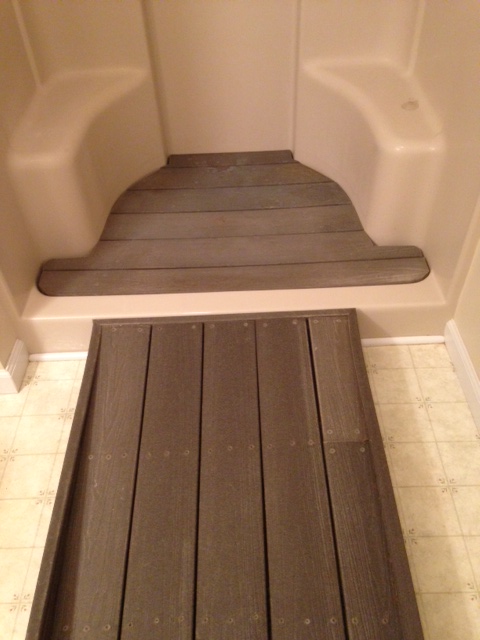
With other needs, Jim’s skills have been wonderful. I mentioned the shower situation. The therapist had recommended a sliding seat where the patient sits on one end and then is slid into the bath/shower area, but Jim’s mom wasn’t stable enough to do that. We have a step-in shower in one bathroom, so Jim built a platform in the bottom, so it was level with the step, and then a ramp leading up to it. We put her in her shower chair in her room, put a towel over her, and roll her backwards into the shower, then roll her back to her room afterward.

photo

We do put a towel under the ramp to absorb sprays and drips from the shower.

Transportation was another problem. Right after she moved home she needed to be established with a doctor since she was no longer under the care of the ones in the nursing home. Therapists, nurses, etc., make house calls, but not doctors. 🙂 There is a transport system here that can take patients in wheelchairs to appointments, but they don’t accommodate the Broda chair. So for that visit we had to prop her up in her wheelchair, be ready an hour before the time we needed them to pick her up, and be ready to wait an hour after being done with the appointment for them to come back and get her. Jim and the caregiver accompanied her, but it was a very long day, and there was no way to reposition her like we’re supposed to do every two hours to avoid pressure sores. So Jim found a ramp that would attach to the back side of our van, took out the back seats, and found that if he lowered her chair into almost a full reclining position, he could get her into the van, then raise her up into a sitting position. Then he had clamps to secure her chair into the place where the seat that he had removed usually plugged in, and he was able to secure the seat belt over her into the next seat. It’s hard to explain without photos and videos, but it worked very nicely and gives us more leeway in being able to take her places.

My man job since she has been home has been figuring out how to prepare a balanced diet that can be pureed. An immersion or hand blender works better than the big regular-sized blender (the big one works well but it leaves you with a bunch of bulky parts to wash). You can actually probably puree most anything if you add enough liquid, but some things work better than others (we even tried a tuna fish sandwich once. It did puree, but she didn’t care for it. :)). Almost any casserole purees well. Most vegetables we’ve tried work well, too (except corn and broccoli. They do well in casseroles but not so well by themselves, although creamed corn does fine). Canned vegetables and fruits work well. Mandarin oranges just turn into juice. Meats are probably the hardest. Soft meats like Salisbury steak do well. We keep a jar of prepared gravy on hand for that kind of thing. We add something called Thick-It if a food ends up too liquid. Usually we just puree whatever we’re having, but when we’re having things that would not puree well (like pizza and salad), we keep a few frozen and canned items on hand for her. Of course, things like pudding and ice cream that are already soft work great. We do supplement her diet with Ensure. It is probably not as necessary now that she has put on some weight, but we felt it was vital when she first came home and her weight was so low.

I hope some of this has been helpful. Let me know if you have any questions. As I’ve said before, I am certainly not an expert, but if I can share something I have learned along the way that will be helpful to anyone else, I’d be glad to.

Of course, the bulk of our experience has been with a parent who is pretty much bedridden. I’ve had friends who have brought parents home who are able-bodied but with Alzheimer’s or who are in good condition both physically and mentally but for various reasons can’t live alone any more. That would be a different set of adjustments, but it would include the need to incorporate a new person as an everyday family member rather than a guest and to make yourself available to that person. If you’ve had experience along those lines, please feel free to share in the comments.

In my next and probably last post in this series, I’ll discuss some ways to help parents as they age.