We follow our focus

Does anyone else have this experience…when you’re driving, and you look away from the road, do you start heading in the direction you’re looking, without trying to? I have had that happen often and have learned not to look away for long, or else I’ll end up in a ditch. I’ve had to be especially careful since we moved to TN: the hilliness makes for some steep drop-offs, and not all of them have guard rails. In fact, I was so afraid of veering off the edge of the road when we first moved here, that I kept a close eye on the edge, only to find myself drifting that way. Or I’d be so afraid of getting too close to the edge that I’d overcompensate and drift toward the lane of oncoming traffic. I had to learn to keep my eyes on the road ahead with only occasional glances in other directions. Of course, drivers do have to keep an eye out for other cars, pedestrians, cats and dogs (and ever deer in some places here), traffic lights, potential trouble situations, etc., but by and large, our eyes have to look straight out in front to keep us safely where we are supposed to be on the road.

800px-Million_Dollar_Highway_10_2006_09_13(Photo courtesy of Wikipedia)

I think the same holds true spiritually. We do have to watch out for potential dangers, we have to be aware of the “don’ts” in the Bible, we have to guard against temptation. But there is danger in a continual focus that direction. Solomon, who warned many times in Proverbs against strange women, ultimately had his heart turned away from the Lord by multiple wives and concubines. It is sadly not unusual for a preacher who majors often on immorality to succumb to temptation in that area. I remember reading in a biography of some famous preacher from years ago (unfortunately, I can’t remember which one) the advice that young people should have their purity meetings and then move on to something else. I don’t know what they did at purity meetings – I assume they heard preaching about it and then were encouraged to make their vows. But I thought the advice not to linger long on that one area, but to move on to the larger focus of the Christian life, was wise.

This applies in other areas besides morality. If I stare at a chocolate cake while trying to resist it, I am likely to fail. In one missionary autobiography, the author wrote that she struggled for years to truly love other people, and as long as she looked at herself and and her lack of love, she was defeated. But when she began instead to focus on God’s love for her, then gradually He enabled her to truly love others.

We’re told in Scripture not only to “flee also youthful lusts” but also to “follow righteousness, faith, charity, peace, with them that call on the Lord out of a pure heart” (II Timothy 2:22); “But thou, O man of God, flee these things; and follow after righteousness, godliness, faith, love, patience, meekness” (I Timothy 6:11). It is not enough just to try to avoid doing wrong: we need to actively pursue what is right.

Ultimately we are changed more and more into His image by beholding Him in His Word and in our prayer time. II Corinthians 3:18 says, But we all, with open face beholding as in a glass the glory of the Lord, are changed into the same image from glory to glory, even as by the Spirit of the Lord.

Looking unto Jesus the author and finisher of our faith;
who for the joy that was set before him endured the cross,
despising the shame, and is set down at the right hand of the throne of God.
Hebrews 12:2


Laudable Linkage

Here are some good reads from the last week:

On Homosexuality: It’s OK to Fight. Quote: “I had to believe either my feelings were lying to me or God was.”

She Yelled and Called Me Names. Neat story of one woman’s reaction to such a scenario.

Serving in Church: When Your Spiritual Gift Isn’t Changing Diapers.

A Beautiful Mess. God can use us despite our imperfections.

Caring For the Caregiver. All of these will not be needed by every caregiver, and definitely ask before jumping in, but there are some good ideas here.

The Case For Good Taste in Children’s Books.

She Chose Grace when a potential daughter-in-law wasn’t what she was expecting.

Pharisees and Fundamentalists. Are they the same? No, and Layton Talbert, whose books I have reviewed here, and whose scholarship, tact, and balance I greatly respect, points out the differences and the main problems of Phariseeism.

And a few on writing:

Be You.

Nurture the Heart of Your Story.

Squelch the Naysayers.

This is a neat story about someone who did the right thing when he didn’t realize anyone was watching:

And, for a couple of “Awwww” moments:

From the aptly named Cute Overload site, a baby panda meets its mom for the first time. The photos below the video of the baby panda are adorable.

And I saw this at Susanne‘s: a fireman rescues a kitten.

A news clip about it is here.

Happy Saturday!

Friday’s Fave Five

FFF delicate leaves

Welcome to Friday’s Fave Five, hosted by Susanne at Living to Tell the Story, in which we can share five of our favorite things from the last week, a wonderful exercise in looking for and appreciating the good things God blesses us with. Click on the button to learn more, then go to Susanne’s to read others’ faves and link up your own.

It’s been a busy day, and I am just now getting a chance to sit down at the computer long enough to write a post! Here are my five favorites from this week:

1. An excellent caregiver. The aide who cares for my mother-in-law Monday through Friday during the day goes above and beyond the call of duty. We’re blessed.

2. A new fall TV season. Call me shallow if you want. 🙂 It’s good to see the old favorites come back, cliffhangers resolved, etc. I don’t know if we will watch any of the new series – I have a couple on the Tivo but one only has so much time for TV.

3. Getting some small tasks done –  replacing a torn shower curtain, cleaning off the laundry room shelf, even some mending.

4. Lovely weather.

5. Hershey’s kisses. I’ve been trying to cut back on sweets by not buying the kinds I like. Having a couple of Hershey’s kisses with coffee has been nice to satisfy that chocolate craving at a minimum of calories.

Happy first fall Friday! You can check out others’ faves or link up your own here today.

Wanting Things To Be Perfect

file000184058237

You know how it is when company’s coming. Though you always want to keep your house to a certain level of cleanliness, and you do esteem your family members above everyone else, there is just something about having company that sets off a housecleaning frenzy.

I learned long ago that I can’t usually get everything done that I’d like to do before company comes, so I’ve learned how to prioritize and hit the most important things first. If I have enough warning, sometimes I can get some of those long overdue household projects done as well.

But no matter how much I do, it seems there is always something I miss. One time a friend of my son and daughter-in-law’s was in town visiting them, and I invited them all over for dinner one night. I was rejoicing in getting just about everything done that I wanted to before they came. Dinner was not quite ready when they got here (because I decided I needed to vacuum my room before I started dinner, even though it was unlikely she would go in there. It had been needing it anyway and it was a relief of mind to get it done). They offered to help and set the table, but dinner was just a matter of waiting on things to cook through. While they waited, our guest played some different hymns. It rejoiced my heart to hear the piano at home again: no one had played in months since we let Jesse drop out of lessons. We enjoyed a nice time of fellowship later with dinner.

The next day, I was picking up some things in the living room when I noticed some scattered debris on the piano next to the keys. “What in the world…?” I thought. I had just dusted it the day before. As I drew closer to inspect it, I saw it was needles from the Christmas tree. From last December. On my piano in May. We had had the cover over the piano keys closed for so long, I didn’t even think to open it to dust under there. And there it was for our guest to discover!

That reminded me of another time in early married years when we wanted to have the youth group over after church one Sunday night. We had furiously cleaned the day before until everything was gleaming. As the young people came in and then started singing, my eyes strayed behind them to the bookcase, on top of which was the can of dusting spray, on top of which was the dustrag, which happened to be an old pair of my husband’s underwear with the distinctive waistband showing. I was mortified, but I couldn’t do anything about it: if I went toward it to remove it, all eyes would see and notice it then. So I just left it and hoped no one saw it. If they did, they were too polite to say so. I couldn’t do anything but laugh about it afterward, since there was no way to correct it.

I’ve had what sometimes seems like more than my share of laughable, imperfect cooking experiences from disastrous cakes to green gravy to volcanic teriyaki.

I was reading a book on hospitality once where the author wrote about having a bit of time to relax, so she sat on the sofa and read the newspaper. Then someone came to the door, and when she answered it she saw it was an acquaintance who had dropped by unexpectedly. The author was embarrassed that things weren’t “picked up,” but invited her guest in anyway. When the guest saw the scattered newspapers, she smiled and said something like, “Now we can be friends.” When people are “perfect,” we can’t quite relate to them and they can even seem unapproachable. But when we see they have the same struggles we do, then they are more genuine to us and we can interact with them more comfortably.

Years ago when I first joined the Transverse Myelitis Internet Club, I wanted to be a good testimony there. It’s frowned upon to use such a forum as a “bully pulpit,” and I didn’t want to do that, anyway. But I did want to honestly relate how God helped me and I wanted to be a light for Him there while gaining information and support. Because of that, I tried to keep my posts upbeat and hopeful. Some months later another Christian lady joined, and I was blessed by how honest she was about her struggles. She wasn’t morose or complaining, but she shared her everyday struggles as well as her faith. I e-mailed her privately about how refreshing her posts were, and she wrote back that it wouldn’t pay to hide her struggles. By sharing that she struggled with the same things everyone else did, she was more genuine and had more of an open door with them.

In the chapter “Women of Like Passions” from her book Keep a Quiet Heart, Elisabeth Elliot wrote of a woman at a conference who had asked to speak to her, but was hesitant to “bother” her and was a little afraid of her. Elisabeth agreed to speak with her and tried to reassure her, and later the leader of the conference told Elisabeth that the woman had told her, “Oh, it wasn’t bad after all! I walked in–I was shaking. I looked into her eyes, and I knew that she, too, had suffered. Then she gave me this beautiful smile. When I saw that huge space between her front teeth, I said to myself, ‘it’s OK–she’s not perfect!’”

Then in the same chapter she wrote of a time when her daughter, Valerie, was speaking, lost her place in her notes, and after a long, awkward time span of not being able to find it again, did the best she could ad-libbing the rest. She was nearly in tears as she finished, but afterward one person told her it was the best class so far and another thanked her for what she had said that helped her. Later she told her mother, “I couldn’t understand why this had happened. I had prepared faithfully, done the best I could. But then I remembered a prayer I’d prayed that week (Walt told me it was a ridiculous prayer!)–asking the Lord to make those women know that I’m just an ordinary woman like the rest of them and I need His help. I guess this was His answer, don’t you think?”

We need to let go of perfectionism. Who are we trying to fool, anyway? We so want for things to be “just right” when we have company or have an event. And that’s a worthy desire. It shows care for the guests and care for one’s home and surroundings. I’ve been in places where there was no such care, and they were uncomfortable places to be! We shouldn’t be slovenly or careless, but we don’t need to beat ourselves up when things aren’t “perfect” even when we’ve done our best. It helps to just laugh at ourselves (with others, if they’re aware), learn from the situation (next time I will lift the piano key cover and dust under there, and put cleaning supplies away!), and, for serious offenses, go to Jesus for cleansing and restoration. Even though He is perfect, He is approachable because He bore our sin and its punishment so that we could be forgiven. We can never be perfect on our own, but by His grace we can be washed white as snow, pure and spotless.

For verily he took not on him the nature of angels; but he took on him the seed of Abraham. Wherefore in all things it behoved him to be made like unto his brethren, that he might be a merciful and faithful high priest in things pertaining to God, to make reconciliation for the sins of the people.  For in that he himself hath suffered being tempted, he is able to succour (help, aid) them that are tempted. Hebrews 2:16-18.

For we have not an high priest which cannot be touched with the feeling of our infirmities; but was in all points tempted like as we are, yet without sin. Let us therefore come boldly unto the throne of grace, that we may obtain mercy, and find grace to help in time of need.
Hebrews 4:15-16.

_______________________________________________________

Revised from the archives.

Photo courtesy of morguefile.com.

Related posts:

A Perfect Christmas.
Perfect Peace.
Imperfect Families.

What’s On Your Nightstand: September 2013

What's On Your NightstandThe folks at 5 Minutes For Books host What’s On Your Nightstand? the fourth Tuesday of each month in which we can share about the books we have been reading and/or plan to read.

Though there are a few days left in September, it is time for the monthly Nightstand post. I think I have a fairly eclectic list this time.

Since last time I have completed:

Daniel Deronda by George Eliot for Carrie’s Reading to Know Book Club for August, reviewed here. My first Eliot book, and I enjoyed it quite a lot.

The Fruitful Wife: Cultivating a Love Only God Can Produce by Hayley DiMarco, read twice! A study of the fruit of the Spirit in Galatians 5:22-23, applied to marriage, reviewed here. Excellent.

On Distant Shores by Sarah Sundin, second in the Wings of the Nightingale series, Christian fiction about WWII flight nurses, reviewed here. Very good.

The Boy in the Striped Pajamas by John Boyne, secular fiction set in WWII, about two boys who meet on opposite sides of a fence of a prison camp. Sweet, touching, sad and disturbing, reviewed here.

Ella Enchanted by Gail Carson Levine, audiobook, an interesting take on the Cinderella story, reviewed here. Very enjoyable.

Overcoming Overeating by Lisa Morrone, reviewed here. I disagreed with her basic premise but got a lot from the rest of the book. 😀

Fahrenheit 451 by Ray Bradbury, audiobook, reviewed here.

I’m currently reading:

A Severe Mercy by Sheldon Vanauken
Bonhoeffer: Pastor, Martyr, Prophet, Spy by Eric Metaxas. I had finished the audiobook of this a few months ago, but there was too much to grasp, so I am going through the Kindle edition.
Next up:

Lost and Found by Ginny Yttrup

Jennifer: An O’Malley Love Story by Dee Henderson

If I finish all of those, I should probably work on my backlog of downloaded Kindle books. 🙂

Happy Reading!

Book Review: Fahrenheit 451

F451Fahrenheit 451 is, as far as I can remember, the first book I have read by Ray Bradbury. It has the same feel as the old Twilight Zone series, but it was published a few years before.

The story takes place in a future version of America where most books are illegal. Fireman, instead of putting fires out, now start them by burning books and the houses of those caught with books. Society had lost its taste for deep thinking, preferring instead sporting events, fast driving, endless entertainment via earpieces they listen to and parlour walls that act as an expanded TV and directly involve the viewer. Concurrently, books were shortened, and then books that made people think fell out of favor and then were deemed upsetting to the peace and happiness of society, as different groups would protest what different books said, so they were banned. As a fire captain later explained, “We must all be alike. Not everyone born free and equal, as the constitution says, but everyone made equal . . . A book is a loaded gun in the house next door. Burn it. Take the shot from the weapon. Breach man’s mind.” It is interesting, and scary, that what passes for tolerance today is this idea of making everyone equal and unobjectionable to each other rather than a willingness to let others have their differences.

Guy Montag is a fireman who likes his job, until he meets a different, free-spirited teen-age neighbor named Clarisse. Though I don’t think they ever talk about books specifically, her unconventional approach to life and way of thinking spark something in him, a questioning, a wondering if there is more to life. Several things fan this spark into flame: his vapid wife overdoses on sleeping pills and has to have her stomach pumped, but remembers nothing about it the next day; Clarisse and her family disappear; and a woman whose house Guy and his crew are supposed to torch chooses to die with her books. What can there be in books that someone would die for them? Guy has secretly taken a few of them and intends to find out. But he can’t make sense of them himself, so he goes to an old professor named Faber for help.

I’ll leave the plot there so as not to spoil it for those who haven’t read it. Though it was written during the McCarthy era, when there was an increased sensitivity to anyone having the remotest possibility of a tie to Communism, and Bradbury was concerned about censorship, he  “usually claimed that the real messages of Fahrenheit 451 were about the dangers of an illiterate society infatuated with mass media and the threat of minority and special interest groups to books,” according to Wikipedia. He has an interesting afterward that tells how he came to write the book and something of the history of it. He also tells of one publisher wanting to publish one of his stories in an anthology with 450 others, including some from Twain and Shakespeare, all shortened, seeming a fulfilling of his predictions in the book. The book itself has been banned at times in the past due to language (many “damns,” “hells,” and taking of the Lord’s name in vain), its mention of one woman’s abortion, and its depiction of firemen. There were valid reasons for the mention of abortion and the firemen. The language I could have done without. I am not shocked by it: my father spoke that way, and I know people do, but I don’t want to fill my brain with it, so I usually avoid books with much of it. I have mixed emotions about censorship. I don’t think I believe in it at the government level, but I have no problem with reserving certain books from student’s required reading. There are some books and magazines that are just pure filthiness and at least shouldn’t be right out there next to Good Housekeeping and such. I would have no problem with censoring those, personally, but then other people would have no problem censoring some books I like: some parents protest their children having to read anything religious. Thus we have the problem Bradbury depicted: if everything can be banned that anyone would have some objection to, we’re left with nothing. As Christians, the best way to deal with the situation, I think, is not to necessarily to seek to ban everything objectionable, though there are times to protest certain actions (like one library I heard of that had the “adult” section next to the children’s section, or a required book for a student that a parent objects to, or unnecessary foul language and sex scenes in books I review): rather, if we concentrate on doing what Jesus told us to do – share the gospel and make disciples – people’s hearts will be changed and they won’t want the bad stuff. That’s not the main reason to share the gospel, but it is one side effect.

The book has a great many more layers to it than there would appear to be at first glance. SparkNotes helped me catch some of that that I missed at first and caused me to appreciate Bradbury’s skill as a writer. The book is one of those classics I had heard of for years and always wanted to get to someday: I am glad that now I have.

(This will also be linked to Semicolon‘s Saturday Review of Books.)

Book Review: Overcoming Overeating

Overcoming OvereatingThe subtitle to Overcoming Overeating by Lisa Morrone is It’s Not What You Eat, It’s What’s Eating You!, and therefore the thrust of the book is dealing with the underlying emotional reasons for overeating. I got the book either free or at a low cost as a Kindle deal, and I must have overlooked the subtitle at first: it actually made me angry, not that the book addressed emotional issues but that it seemed to deemphasize other related issues. In fact, several times she seems to ridicule or at least disbelieve people’s protestations that they overeat because they like food. But to just dismiss this with an “I know what your problem really is” attitude is to do people a disservice. When I am about to have my 6th cookie of the day or a third helping of lasagna, I am not thinking about any underlying emotions: I am thinking “This tastes good and therefore I want more!” I have never read a weight-loss book that adequately addressed that part of the problem, and that’s the problem that derails all the good intentions, all the knowledge about what is good and bad and best for you, etc.

But I gave the book another run-through after my first reading, and I did glean more helpful tips than I did the first time.

I don’t deny that people overeat for emotional reasons: even healthy people at a normal weight have their comfort foods. Lisa acknowledges that “everyone eats for emotional reasons at one time or another,” but for some – about 75%, by one statistic – “emotional eating has become chronic.” Chemicals like cannabinoids (same family as marijuana) and serotonin are produced by the digestion of some common “comfort foods” (potato chips, french fries, chocolate, cheeseburgers, to name a few), making the feel-good indulgence of those foods not just emotional but physical and chemical. She does do a great job addressing how to deal with those underlying emotional issues. She describes an emotional cycle leading to overeating and a couple of places from which to step off the cycle.

I especially appreciated her distinction between different kinds of guilt: there is a good, God-given guilt designed to lead one to repentance, and there is a destructive guilt that just furthers the emotional tailspin into more over-eating.

I really liked her treatment of controlling our thoughts and distinguishing what is true between the good and bad ones. A negative thought isn’t necessarily a bad one. For instance, “I shouldn’t have yelled at my son” is negative, but it is true, and therefore we can confess it, apologize, seek forgiveness and seek for better ways to respond. But “I’m so stupid, I never do anything right” is negative and destructive and needs to be corrected. Similarly, a positive, pleasing thought can be deceptive or it can be inspirational.

She also does address that there are other “triggers” to overeating: certain foods that are especially tempting or hard for us to control, family gatherings, social situations, convenience. etc. And she does address other practical tips: reading labels, wise shopping, getting used to adequate portions, etc. She addresses the problem that we seem to celebrate everything with food, and suggests other ways to celebrate: she also cautions against ever eating to feel better when down or disappointed, frustrated, angry, etc., because that is just setting one up for food addiction and hurts rather than helps whatever the underlying problem is.

In-between the chapters are testimonies from different individuals who have lost weight, and it was in one of those that I found a helpful response for the problem I mentioned at first, that of wanting to eat more just because it tastes so good: one woman mentioned that God gave her “a new understanding that living for the satisfaction of only one part of my body (my mouth) was unholy,” and when faced with temptations for unhealthy foods or amounts, she seemed to “sense Him saying to [her], ‘I will still love you if you choose that, but will it get you what you want?'”Something that Morrone said helps here, too: “Too much of a good thing can become a bad thing.” In another testimonial, a woman said, “God loves me so much He does not want me to damage the body He has given to me. He showed me that food was just a fleeting enjoyment, but a healthy body was so much more.”

Morrone concedes that food is intended for pleasure – otherwise God would not have given us many taste buds designed to gain the maximum enjoyment from what we eat – but she advises to think that food=fuel, and there are different “grades” of food just as there are different grades of gasoline. “Most everything ‘quick and easy’ you bring home is filled with nutritional shortcuts. Be good to yourself and your family: eat quality fuel.” The goal is “to become a truly well-balanced person, one who can enjoy food without guilt and who has so many interests and goals that food only holds its rightful place in the day – that of nourishment and pleasure, not a tranquilizer, Band-aid, or time-filler” (emphasis mine).  She compares a healthy relationship with food to a healthy friendship: if one member harmed the other, it would not be a healthy relationship. We need to find foods that promote health rather than jeopardizing it.

I really liked the section dealing with inevitable setbacks as well. “Each year the winning team of the Super Bowl loses some ground (yardage) throughout the game. Yet they always keep their minds fixed on the goal, push through the opposition, and, as a result, advance to victory in the end.” She gives a variety of tips for dealing with setbacks and getting back on track.

Though I am usually wary of books and weight loss programs that promote self-love, Morrone has, I believe, the best definition of it: “We can humbly appreciate who we are and who we’ve been created to be, and honor ourselves (and our Creator) by being devoted to the care and well-being of our physical bodies.”

I’m glad I gave this book another chance. I benefited from it. Some of what Lisa says about emotional overeating has been distilled into this document on her web site, but of course it is expanded on and fleshed out in the book. If you’ve not yet guessed, the book is written from a Christian vantage point and discusses the Biblical foundation and many Biblical principles of good health, but she also addresses the non-believer with principles he could relate to while encouraging him to look at the Bible’s point of view as well.

(This will also be linked to Semicolon‘s Saturday Review of Books.)

Laudable Linkage

Here are some great reads discovered in the last week or so:

Advice For Those Burned By the Church.

When Christians Mock Christians. Respectfully discussing issues where we differ is one thing, but unfortunately people on both sides of an issue can degenerate into mocking each other.

Putting an End to Spiritual Envy. I like this post not just for what it says, but how it is done: a wonderful example of Biblical exposition.

An Open Letter to an Older Woman. Sometimes it is hard to know how to be a Titus 2 older woman when younger women don’t seem to want our company and everyone wants things new and young and fresh. This is an encouragement to older women from a younger one along with some subtle, gentle suggestions as to the best ways to be a help.

Impatient With Grief.

A few posts on unanswered prayer for healing: Together Is A Beautiful Word, We Didn’t Get Healed…or Did We? and What If Your Healing Doesn’t Come? The last two are from a paralyzed wife and her husband.

10 Questions for Better Bible Study. Love this: simple and direct and unfluffy.

The Introverted Mother. Someone who recharges by time alone has a hard time when she’s never alone. Here is some encouragement.

The Science of What Makes an Introvert and an Extrovert.

The Holy Longings of Happily Ever After. Is a fairy-tale ending unrealistic or a beacon towards the ultimate best ending?

This Three Minute Commercial Puts Full Length Hollywood Films to Shame. I don’t know what country has three minute commercials – but this is a sweet short story in film. You could say it is about grace.

Hope you have a great weekend!


Friday’s Fave Five

Welcome to Friday’s Fave Five, hosted by Susanne at Living to Tell the Story, in which we can share five of our favorite things from the last week, a wonderful exercise in looking for and appreciating the good things God blesses us with. Click on the button to learn more, then go to Susanne’s to read others’ faves and link up your own.

I’ve been trying to hold out until the official first day of autumn to put anything fallish up, but it’s close enough now, I think. 🙂 It’s hard to believe September is 2/3 over when it seems like it just got here. Here are some favorites from the last official week of summer.

1. A hummingbird’s visit. I don’t have a hummingbird feeder, but maybe I should get one – a little hummingbird was fluttering outside my kitchen window the other day.

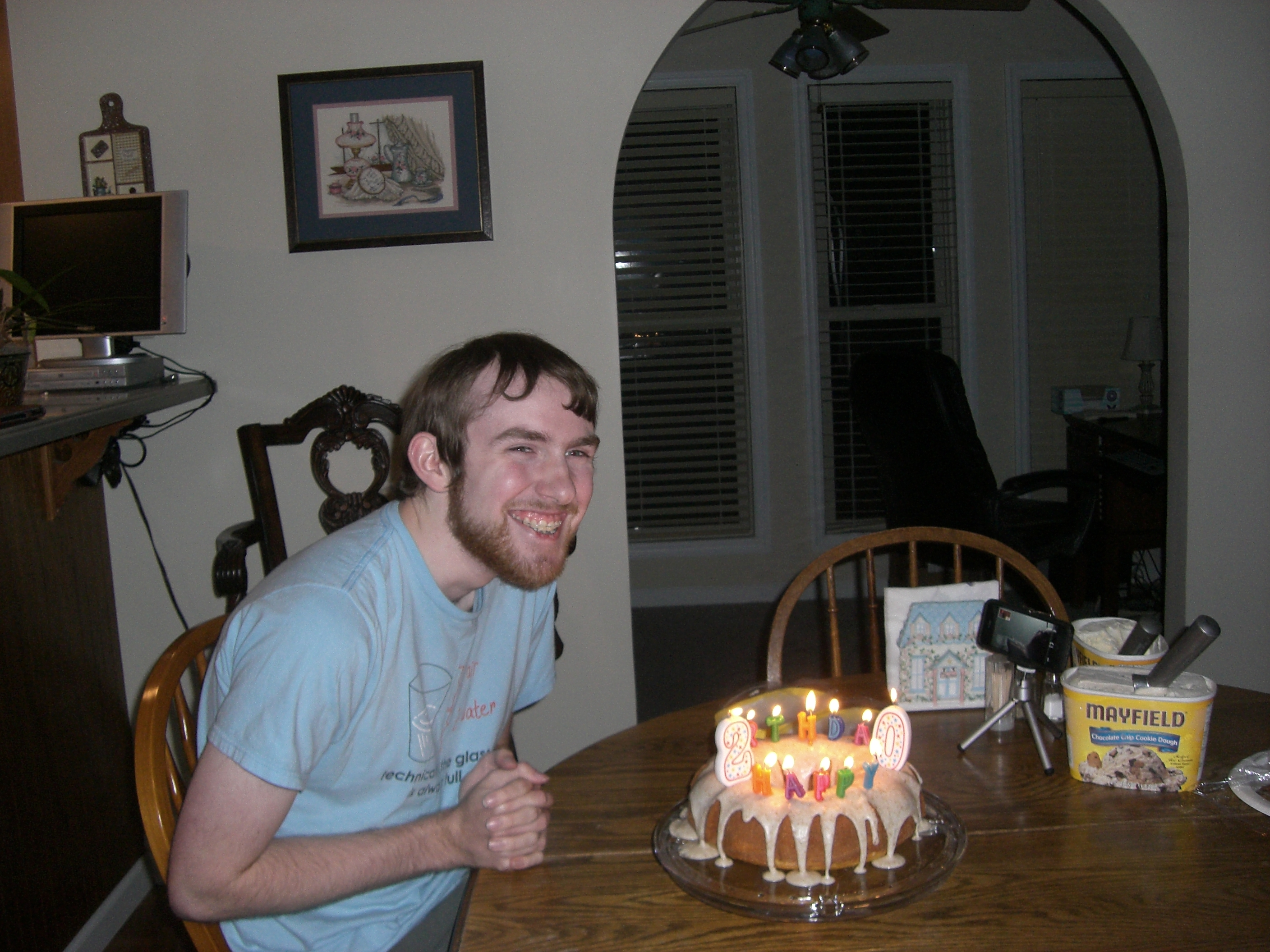
2. Jesse’s birthday was Monday. Always fun to celebrate a family member and to have everyone here.

CIMG5863

3. Lemon cake. Lemon isn’t one of my favorite flavors – I gravitate to chocolate – but Jesse has requested a lemon cake for his last few birthdays, and now I look forward to it that one time each year. I think it’s the glaze that makes it.

4. Take-out dinners. We can’t just go out to eat anymore, with Jim’s Mom here, but I had a hankering for Red Lobster’s popcorn shrimp recently, and Jim indulged me by bringing some home after work one night. Then he had a hankering for Asian food, and Jason and Mittu brought some over from a place near where they live.

5. An easy-going husband who is content with soup and sandwich on a night when I discover right at time to make dinner that I don’t have the chicken I was planning on using. I had thought there was a package near the back of the freezer – but there wasn’t!

Bonus:

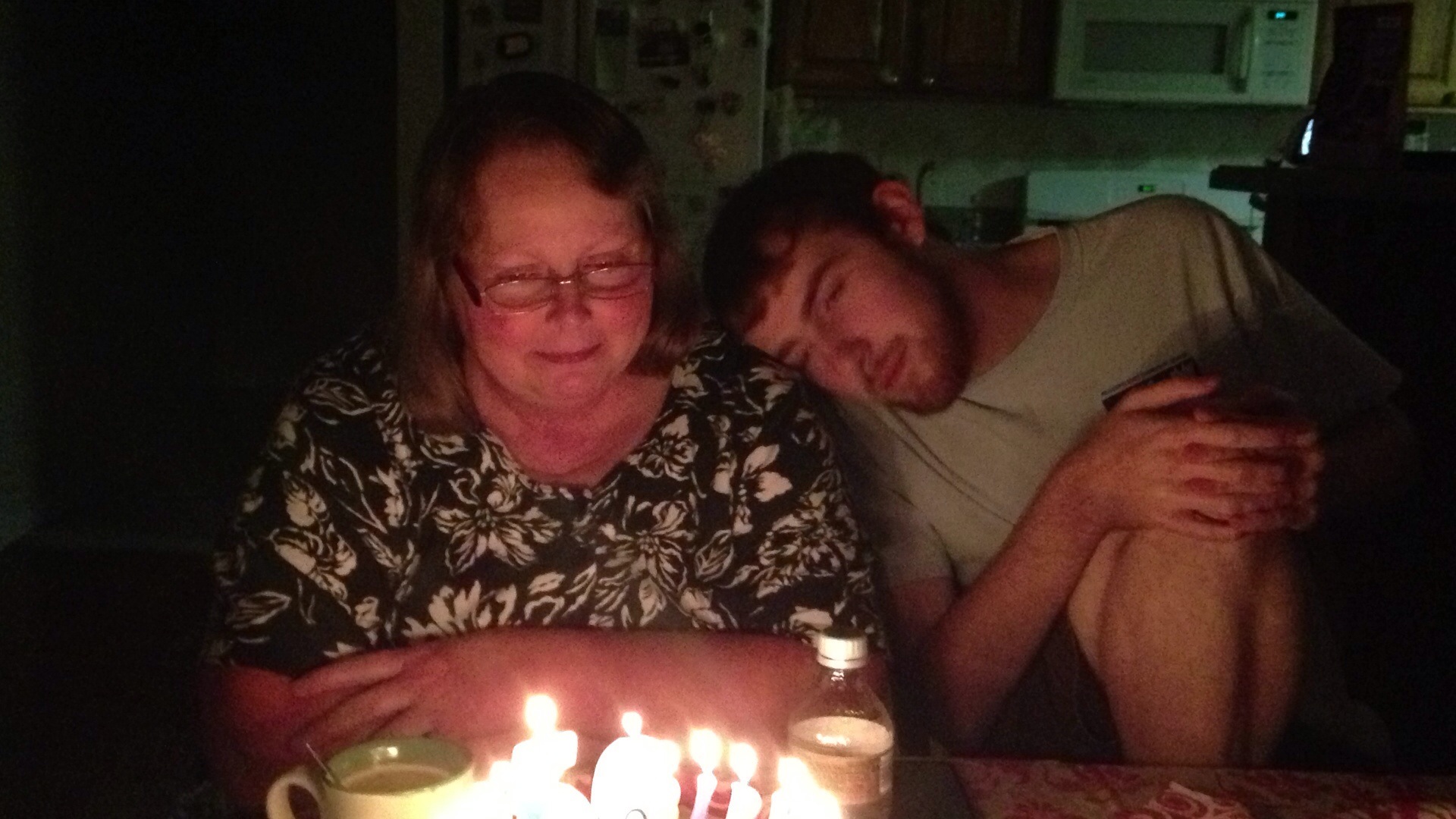
I just got some photos from the phone and camera onto the computer this morning. This is one of my favorites, taken on my birthday.

Barbara's Cell phone pics 273

Happy Friday!

Tension and Balance

This is a repost from May of last year. The topic has been on my mind again this week, so I thought I’d share these thoughts again. __________________________________________________________

A news item on this radio this morning about opposing viewpoints sparked a memory.

Some years ago, in  different town and church from where we are now, my husband had spoken to the pastor privately about what we sensed as a subtle shift. It wasn’t a major problem at that point, but if it continued it would lead to a major drift from the church’s position as it was when we had first come. The pastor graciously heard him, and at some point made the comment that the church needed the more conservative members to keep it from going too far and the more adventurous members to keep it from being stuck in the status quo.

I hadn’t thought about that before, but the idea came up again in a series at the same church on spiritual gifts. Everything I had ever read or any little “test” I had taken before all concentrated on you and finding out what your gifts are, but this particular study went further and studied the issue from various angles. One angle was the potential clash between people with various gifts.

There is a certain tension between opposing viewpoints: those who want change vs. those who want sameness; those whose natural stance is “Let’s do it now!” vs. those who who say, “Let’s think about it first.” This tension between opposing viewpoints, personalities, and gifts can exist in government, families, churches, clubs, any organization of more than one person.

But it’s not all bad. It keeps us in balance. It helps us consider other sides of issues, other consequences to actions. It helps expose our own weaknesses.

Years ago when a very big, important issue came up for a church vote, and everyone voted “yes” with no discussion, the pastor was concerned that people hadn’t really taken time to consider the issue. He would preferred to have the discussion out then rather than later on after action had been taken. He wanted unity, yes, but not “yes men” who do whatever the leadership thinks without thinking on their own. That can backfire: a dear pastor friend was voted out for “running the church into debt” when of course he had not done so singlehandedly. His church had voted every step of the way to all the projects being voted on, yet when crunch time came they blamed the leader. Most good leaders would much rather have the discussions, questions, doubts, etc., out on the table and have an opportunity to work them out ahead of time and then approach the action with unity, than to have everyone seem to be in unity at first and then fragment afterward.

In the area of spiritual gifts, those with the gift of mercy might be moved with compassion and immediately want to help in a certain situation while others with the gift of discernment want to hold back and check into the situation a little more thoroughly first. They keep each other in balance. That’s one of many reasons a church is made up of people with varying gifts working together as a whole. If a church’s members all had the gift of mercy, it would likely go bankrupt soon as it ran out of funds. If a church’s members all had the gift of evangelism, it would have a lot of new members but not much depth if there were none gifted to teach. Yet those different giftings and emphases can cause tension between them.

I’m thinking that the tension between two opposing forces might be the essence of balance. Think of a plane flying: there is the pull of gravity to keep it from flying off into space, but the tension of speed, wind, and air currents to enable it to fly. There is tension in a sewing machine to enable the threads from top and bottom to secure the fabric between: a tension set too tight or too loose causes problems. There is a certain tension in gears and machinery.

Within Christendom, we’re called to love those with an opposing viewpoints (I’m talking here about Christians with the same bedrock doctrinal truths who might differ in other ways, not taking a soft stance on false doctrine, though of course we’re to love folks in that situation, too, yet  love God’s truth enough to defend it), to remember they belong to the same God and the same family we do and to remember that we need each other and that God made us each with all our differences. We can, or should be able to, air differences of opinion without the heat and hatefulness the world displays. When the tension is set the right way, we keep each other in balance.