
31 Days of Missionary Stories: Whom God Has Joined

kuhn.jpgI mentioned Isobel Kuhn yesterday. her books By Searching and In the Arena are primarily autobiographical and contain some details about her marriage, but Whom God Has Joined focuses entirely on her relationship with her husband. It was originally titled One Vision Only, and the main part of it was Isobel’s own writings sandwiched in-between biographical remarks by Carolyn Canfield. It has been long out of print and was just reprinted not too long ago without Canfield’s part.

It begins with their first notices of each other at Moody Bible Institute and the attraction they felt despite their determination not to get “sidetracked” by the opposite sex.

As they got to know one another and grew in affection, John graduated from college first and went to China. At first they were interested in different areas of China, but the China Inland Mission assigned him to the area she was interested in. When he wrote to propose, she knew what her answer would be, yet she spread the “letter out before the Lord” with a problem. She wrote, “John and I are of very opposite dispositions, each rather strong minded. Science has never discovered what happens when the irresistible force collides with the immovable object. Whatever would happen if they married one another? ‘Lord, it must occur sooner or later. Are You sufficient even for that?’” The verse the Lord gave her was Matthew 6:33: “But seek ye first the kingdom of God, and his righteousness; and all these things shall be added unto you.”

Isobel was assigned and sent to China where they were to be married. One of the first problems they faced was that there were two ladies with very different personalities who each took charge of “helping” the young couple with their wedding plans — and neither plan was what the young couple wanted. God enabled them to very graciously navigate that situation without offending either party.

Isobel wrote in a very engaging way that lets us know missionaries are “of like passions” as we are. We feel like we are right there with her feeling what she is feeling. She not only had the adjustments of marriage but the adjustments of a new culture. Though she was ready and willing for both, sometimes it still threw her for a short while. One example was in her natural “nesting” as a new wife. The CIM way was to live directly with the people as they did, and Isobel was willing for that. She did have a few things to pretty up her home a little bit — nothing extravagant. She was excited to receive her first women guests, and as she began to talk with them, one blew her nose and wiped the stuff on a rug; the other’s baby was allowed to wet all over another rug. Isobel knew that they were not being deliberately offensive: those were just the customs of the country people in that time and place. Yet, naturally, resentment welled up and she had a battle in her heart. She wrote, “If possessions would in any way interfere with our hospitality, it would be better to consign them to the river. In other words, if your finery hinders your testimony, throw it out. In our Lord’s own words, if thine hand offend thee, cut it off. He was not against our possessing hands, but against our using them to holds on to sinful or hindering things.”

In their early marriage they had disagreements over the couple who were their servants (in primitive cultures it was not unusual for missionaries to employ helpers for the many tasks that would have taken up so much time). They were not only lazy, but helped themselves to some of the Kuhn’s own things. John was slower to see it because he had always gotten along fine with them before he was married. At one point when Isobel brought up something the man had not done, hoping for John to correct him, John instead sided with him against her. Angry and resentful, Isobel walked out of the house, not caring where she went, just to get away from it all. Gradually she came to herself and realized she was in a little village as darkness was nearing. In that time and culture that was not done: “good women were in their homes at such an hour.” She felt as if the Lord were saying to her, “You have not considered Me and My honor in all this, have you?” and then convicting her that she had not even invited Him into the situation. She confessed that was true, asked Him to work it out, and went home. And He did.

Isobel was more artistic and exuberant by nature, and once when she was telling a story she mentioned that it was “pouring rain.” John corrected her, saying it was “merely raining.” She was indignant that her story was being interrupted by such a minor detail and said, “I didn’t stop to count the raindrops.” He replied that that was just what she should do. He felt she exaggerated and wanted to break her of it. He began “correcting” her prayer letters and stories and began to use the catch-phrase, “Did you count the raindrops?” It was discouraging and distressing to her and she felt it had a stilted effect on her writing. She tells how over time the Lord used this to help her husband appreciate his wife’s gift of imagination and expression and helped her to be more accurate. She comments,

Similar situations are not uncommon among all young couples. If we will just be patient with one another, God will work for us…Until the Lord is able to work out in us a perfect adjustment to one another, we must bear with one another, in love…With novels and movies which teach false ideals of marriage, young people are not prepared to ‘bear and forbear.’ They are not taught to forgive. They are not taught to endure. Divorce is too quickly seized upon as the only way out. It is the worst way out! To pray to God to awaken the other person to where he or she is hurting us, to endure patiently until God does it: this is God’s way out. And it molds the two opposite natures into one invincible whole. The passion for accuracy plus a sympathetic imagination which relives another’s joys and sorrows—that is double effectiveness. Either quality working unrestrained by itself would never have been so effective. But it cost mutual forgiveness and endurance to weld these two opposites into one! Let’s be willing for the cost.

With humor and poignancy Isobel tells of further challenges and adjustments in the midst of ministry and growing love for each other and growth in the Lord.

(You can see a list of other posts in the 31 Days of Missionary Stories here.)

(This will also be linked to Semicolon‘s Saturday Review of Books.)

31 Days of Missionary Stories: Isobel Kuhn Learns to Put God First

isobelkuhnIsobel Kuhn was a missionary to China in the early to mid- 1900s, alongside her husband, John. She has written a number of books about the Lord’s working in their lives and ministry, all very readable and enjoyable. She has a very readable style and is quite honest and open about her faults and foibles, but her books are also laced with humor. By Searching was subtitled My Journey Through Doubt Into Faith and describes just that. She had grown up in a Christian family yet wasn’t truly saved. When a professor at college condescendingly told her she only believed because that was what her parents told her, she realized he was right, and thoroughly let herself go into the “worldly” activities she hadn’t been allowed to pursue. This book traces her journey to true faith in Christ and her first steps in her walk with Him. In the Arena is not exactly a sequel, but it highlights many decisions, experiences, and trials in which God manifested Himself. I reviewed both books together here.

One incident that had lasting effects occurred during Isobel’s training at Bible college. Many students did not have a quiet time or devotional time with the Lord, because they spent so much time studying the Bible. “But,” Isobel wrote in In The Arena, “reading the Scriptures for a technical grasp of the general argument in a book, and reading it as in the Lord’s presence, asking Him to speak a word on which to lean that day — those were two very different things. One was no substitute for the other. Yet I knew also that some students were trying to let classwork reading do for personal quiet time. Deadness of souls was inevitable.”

As she prayed about it, she felt led to form a habit of spending one hour a day, sometimes in two half-hour segments twice a day, “in the Lord’s presence, in prayer or reading the Word. The purpose was to form the habit of putting God in the centre of our day and fitting the work of life around Him rather than letting the day’s business occupy the central place and trying to fix a quiet time with the Lord somewhere shoved into the odd corner or leisure moment.”

She and nine others covenanted to do this for about a year and meet together monthly to worship together, confess failure, and encourage each other. She wrote, “It was never my thought that this covenant should become law. My thought was merely deliberately to form a habit which would allow the Lord to speak personally to us all the days of our lives….somehow news of [this covenant] spread, and others began to join. Then—it seems as if some human beings always have to go to extremes—some signed a covenant binding them to this hour a day for life. I did not sign it. What about days of illness or emergency, when it might be impossible to keep an hour quietly? There was no need to vow; there was only need to form a habit of putting God first.”

The following is from In the Arena and tells of how this decision was tested.

This is the background of my platform of secret choices. It was the evening of the Junior-Senior party. I was a junior and had been asked to lead the devotional with which all such parties closed. I was also on the programme as Grandma in a Dutch scene, off and on all through the banquet. The week before had been so full of work and study that I had not had one moment to sit down and prepare a devotional.  Work…had delayed me, and I arrived at the supper half-hour, hungry,  exhausted, and without any devotion prepared. Besides this, I still had half an hour due on my quiet time! After the party we juniors had to clean up and I would not get to my room til midnight — the day would be gone.

Here was my platform of secret choices. That supper half-hour. (1) Should I go down and eat my supper? (2) Should I skip supper and try to prepare the devotional message? (3) Should I put God first and give that half-hour to him? The supper bell rang, and my roommate left for the dining room. I stood for a moment irresolute; then, throwing myself on my knees by my bedside I sobbed out in a whisper, “Oh, Lord, I choose you!” As I just lay in His presence too weary to form words, the sense of His presence filled the room. The weariness and faintness all left me. I felt relaxed, refreshed, bathed in His love. And as I half knelt, half lay there, saying nothing, but just loving Him, drinking in His tenderness, He spoke to me. Quietly, but point by point, He outlined for me the devotional  message I needed to close that evening’s programme. It was an unforgettable experience and an unforgettable lesson. Putting Him first always pays.

In the exhilaration of that wonder I ran down to the banquet hall, slipped into my costume, and went through the programme. At the end, when the devotional message was needed, I gave very simply what He had told me during the supper hour. Such a quiet hush came over that festive scene, I knew He had spoken, and I was content.

More than twenty years passed. I was home on furlough and visiting the Institute. It was the day of the Junior-Senior party and a group of us were reminiscing. “One Junior-Senior party a always stands out in my memory,” said one. “I forget who led it but it was a Dutch scene and the devotional blessed my soul. I’ve never forgotten it.” She had indicated the date, so I knew. I was thrilled through and through. Of course I did not spoil it by telling  her who led that devotional. In God’s perfect workings, the instrument is [often] forgotten. It is the blessing of Himself that is remembered.

 (You can see other posts in the 31 Days of Missionary Stories here.)

31 Days of Missionary Stories: Gracia Burham and God’s Grace in Captivity

Several years ago I had heard of Gracia Burnham’s In the Presence of My Enemies and somewhere read an excerpt from it, but I avoided reading it. I couldn’t face it. I’m not sure why: maybe because it was too fresh, maybe because the people responsible for the Burnham’s captivity were still alive (maybe not the specific people, but the extremist Islamic groups are still active), maybe because in the portion that I read, Gracia was having to deal with something that I struggle with. But the youth pastor at the church we were attending saw a DVD presentation of Gracia sharing her testimony at another church where he was ministering and recommended it to me. I ordered it, watched it, and was so touched on so many levels. I then felt that I had to read the book. (Sadly, the DVD does not seem to be available any more – I couldn’t find it after searching the Web for a while.)

For those who might not be aware, Martin and Gracia Burnham were missionaries with New Tribes Mission in the Philippines: he was a missionary pilot who reminded me a lot of one of my former church’s missionaries who also pilots a small plane. They had gone for a quick weekend get-away to celebrate their anniversary at a resort. They didn’t usually go to the “touristy” areas, but decided to go this once. During their stay, an Islamic extremist group stormed the resort and took guests and a few staff members hostage. Several of the hostages were able to arrange for ransom and were released after a few months. Some were killed along the way. The Burnhams were held for over a year. Martin was killed in a rescue attempt by the Philippine military and Gracia was wounded.

I don’t want to take away from what she shares in the book, so I won’t go into the details of the story here. I do want to mention just a couple of impressions, though.

As the Burnhams struggled with negative thoughts and attitudes toward their captors, I kept finding myself thinking at first, “But they had a right to feel that way!” I knew better, but that was the thought that kept coming. They had to put into practice the Bible’s teaching about loving their enemies, praying for those who were despitefully using them, in a very real way and only by God’s grace.

I also was grieved that I did not pray for them more. Often when I hear reports of stories like theirs on the news, I try at least to pray right then in the midst of whatever I am doing. I may have prayed for them in that way, but I don’t remember. The scripture came to mind to remember those in bonds as if bound with them, and I failed to do that for the Burnhams, but this caused me to determine not to neglect that ministry again.

I was also struck by the Muslim group’s twisted sense of logic. They wanted Islam to rule the world so it would be ruled by “righteousness.” They advocated the cutting off of someone’s hand for stealing — but excused their own stealing because they “needed” the stolen items for their cause. When people died in the course of what they did, it was “their destiny.” They had a strong sense of “justice” but saw mercy as a weakness. When discussing that last point with one of their captors, Martin said, “You know, I hope my children don’t take up the attitude you have. I hope they don’t ever shoot some Muslims because of what you have done to us.” The man to whom they were speaking looked shocked. “Done to you? What is my sin against you? I have never done anything to you.” Martin and Gracia could only look at each other incredulously.

Gracia tells of her very human struggles, like depression, anger, and resentment over their situation and the realization that not only was her attitude not helping, but it was hurting. She writes, “I knew that I had a choice. I could give in to my resentment and allow it to dig me into a deeper and deeper hole both psychologically and emotionally, or I could choose to believe what God’s Word says to be true whether I felt it was or not.” That was a turning point for her as she chose to believe God and handed over her pain and anger to Him. I thought how often we get tripped up over pain, resentment, and anger over much lesser things.

She shares also how the Lord provided for them in unexpected ways, how she and Martin encouraged each other, how they had to battle a captive’s mindset, how they were able to talk about the Lord with their captors and other hostages, as well as the details of how she and Martin originally came together as a couple and what happened in the aftermath of her captivity.

A few years later Gracia wrote To Fly Again: Surviving the Tailspins of Life (linked to my review), which includes an update of how she and her children were doing after all that had happened to them, her recovery from the trauma, and encouragement to others who have gone through any kind of traumatic event.

I found this video on YouTube, and I think some of the footage is from the original DVD:

I also found this report of Gracia’s going back to testify against her captors.

God’s Word is true no matter what, and thankfully He doesn’t see fit to put all of us through that kind of experience, but when someone who has been through what she has speaks of God’s goodness and faithfulness, the truth of God’s Word and the reality of His Presence….it rings true. There is an authenticity about that person’s testimony. Their faith, their beliefs have been tried in the fires of testing. Gracia’s testimony touched me deeply. I don’t know if I could have gone through what she did – in fact, I’m pretty sure I couldn’t. But God gives His grace for various trials when we need it. Though I hope I never have to face that particular kind of trial, we will all face trials of some kind, and we can trust He will see us through them as he promised.

I Peter 1:6-8:

Wherein ye greatly rejoice, though now for a season, if need be, ye are in heaviness through manifold temptations:
That the trial of your faith, being much more precious than of gold that perisheth, though it be tried with fire, might be found unto praise and honour and glory at the appearing of Jesus Christ: Whom having not seen, ye love; in whom, though now ye see him not, yet believing, ye rejoice with joy unspeakable and full of glory…

(You can see other posts in the 31 Days of Missionary Stories here.)

(This will also be linked to Semicolon‘s Saturday Review of Books.)

31 Days of Missionary Stories: Darlene Deibler Rose, Missionary POW

Evidence Not SeenEvidence Not Seen: A Woman’s Miraculous Faith in the Jungles of World War II tells the story of a few eventful years in the life of Darlene Deibler Rose, who became a POW during WWII while she ministered in New Guinea. She and her new husband, Russell Deibler, left to minister in the field of New Guinea in 1938. They were pioneer missionaries in a quite rugged area.

On one of Russell’s survey visits, the chieftain he was talking with said he believed Russell and the others with him were spirits because they were all men. “Who gave birth to you?” he asked. Russell explained that he did have a wife, but his “chieftain” said she could not come because the trail was so dangerous that many men had died. The chieftain replied, “Your wife would have made it. Wherever we go, the women follow and carry the loads.” He said if she were so weak she could not make it, he would send men to help her. Meanwhile, others of the tribe decided to test whether some of the men were spirits or human by shooting arrows at them to see whether the arrows passed through or killed them, and, unfortunately, some of the tribe members were killed when the government officials who were along shot them in self-defense. On reading this in a letter from Russell, Darlene prayed, “Lord, if those people are ever to believe and understand about you, women are going to have to go there.” Immediately she felt an assurance that she was supposed to go. She dashed out to find their mission leader, who said he had a letter from Russell giving his consent for her to go.

At her first meeting with the people, they shoved her sleeve up to see if her arms were white “all the way up” and wanted to pinch her flesh to see if it was real. The chieftain did not believe she was a woman until she took off her hat and took the pins out of her heir, letting her hair fall over her shoulders. From the first moment she felt that these were her people, and she approached them and the living conditions with grace, courage, and humor.

By May of 1940, they heard that Nazis had invaded Holland; it fell within five days. Soon word came from government officials that their post must be evacuated, though they begged to stay.

They moved to another area, and within five months learned that their post was to be reopened. But then Russell was appointed assistant field chairman by a unanimous vote of the other missionaries. Russell and Darlene were both grief-stricken, but felt it was the Lord’s will, and reminding themselves that they had been willing to go anywhere, remained in Macassar.

Meanwhile, they heard news of war increasing until finally Pearl Harbor was attacked. They sought the Lord’s counsel as they continued to work and hear news reports of the Japanese taking islands near to them. One day a Dutch policeman came and told the missionaries that they had a ship on the coast and wanted to evacuate all foreigners as well as Dutch women and children. Their field chairman, Dr. Jaffray, encouraged them all to take time to pray about whether the Lord would have them stay or go so that they would have His assurance, whatever happened, that they were right where He wanted them to be. None felt led to leave. Three days later they learned that the ship had been torpedoed and sunk with no survivors.

By March 8, 1942, their island had been taken by the Japanese. They let them stay together for a while, until one day they suddenly came to take the men. Russell’s last words to Darlene were, “Remember one thing, dear: God said that he would never leave us nor forsake us.” She never saw him again.

The women were eventually taken to a prison camp, where the bulk of the book takes place. There is not space here to tell of many of the experiences, but God proved Himself faithful many times over, protecting, assuring of His Presence, answering prayer.

The camp commander, Mr. Yamaji, was notoriously cruel. Yet God gave Darlene some measure of favor in his eyes. When news came that Russell had died, Mr. Yamaji called Darlene to his office to try to encourage her somewhat. God gave her grace to tell him she did not hate him, that she was there because God loved her…and God loved him, and perhaps He allowed her to be there to tell him. She shared with him the plan of salvation, and Mr. Yamaji broke into tears and left the room. Yet from then on she felt he trusted her, and years later she heard a report of him that seemed to indicate he had trusted the Lord.

Some time later, Darlene was arrested by the secret police and taken to another prison for “questioning.” The conditions were horrible, to say the least, and Darlene also suffered from dysentery, cerebral malaria, and beriberi. She asked the Lord to heal her of dysentery — and He healed her of all three ailments. One day she saw out of her window someone secretly passing along some bananas to one of the other women. She was in solitary confinement and knew she would never receive one, but she began to crave bananas: though she had been healed, she was still starving. Then, Mr. Yamaji came to the prison to see how she was doing and to tell the secret police that she was not a spy, and after he left he had ninety-two bananas delivered to her! Days later, when she ate the last banana, she was returned to the prison camp.

The book goes on to tell of the end of the war, an opportunity to visit Russell’s grave and speak to some of the men who knew him, the process of getting back to America, rediscovering such “luxuries” as showers, fear upon arriving back in America and not knowing what to do or how to contact her family, the Lord’s provision for that as well. She recuperated at home for a long while, and eventually remarried and went back to New Guinea as a missionary.

Darlene’s story is a marvelous one of the grace of God and her courage, faith, and endurance in the midst of the most trying of circumstances.

(You can see other posts in the 31 Days of Missionary Stories here.)

(This will also be linked to Semicolon‘s Saturday Review of Books.)

31 Days of Missionary Stories: John Paton, Missionary to Cannibals

John Paton is the source of one of my all-time favorite missionary quotes. After a struggle, “dreadfully afraid of mistaking my own emotions for the will of God,” he offered himself and was accepted as a missionary to the New Hebrides (now Vanuatu). Most, including his pastor, were dead set against his “throwing his life away among the cannibals.” In a classic exchange, one “dear old Christian gentleman repeatedly exhorted me, ‘The cannibals! You will be eaten by cannibals!’ At last I replied, ‘Mr. Dickson, you are advanced in years now, and your own prospect is to soon be laid in the grave, there to be eaten by worms. I confess to you that if I can but live and die serving and honoring the Lord Jesus, it will make no difference to me whether I am eaten by cannibals or by worms. And in the great day my resurrection body will arise as fair as yours in the likeness of our risen Redeemer.’”

John and his wife, Mary Ann , arrived on the island of Tanna in 1858. The Tannese were curious about them and the Patons had to learn to communicate by gesture and trial and error until they learned the language. They found the people scantily clad, friendly but deceptive, thieving, glorying “in bloodshed, war, and cannibalism,” superstitious, and worshiping nearly everything. When the Patons began to teach them that God wanted them to ”throw away their idols and stop their wrongdoing,” persecution began.

Mrs. Paton and their baby boy died in the same month in 1859. “But for Jesus, and the fellowship He gave me there, I would certainly have gone mad and died beside that lonely grave.”

After a time some men came, like Nicodemus, at night to talk to John. A few believed, but persecution was the norm. John was in danger of his life many times. Sometimes he was led to hide somewhere, but other times, while men were facing him with spears, he kept on about his work as if he didn’t notice them, and God restrained their hands. Once he even directly challenged them to go through their rituals by which they curse people by making incantations over a piece of food from which that person has eaten, to prove that his God was greater than theirs, and God prevailed. He did have to leave the island eventually, escaping for his life. He went to Australia and Scotland to report to churches there. He came back with a wife and many new missionaries. The islanders were amazed that missionaries would return after the way they had been treated, and said, “If your God makes you do that, we may yet worship Him too.”

John and his new wife settled on the island of Aniwa. Though they faced some of the same problems as in Tanna, the Lord did bless them with a fruitful harvest there. Amazingly “the sinking of a well broke the back of dark religion on Aniwa.” The island did not receive much rain and much of the drinking water was not good. John decided to try to sink a well; the islanders thought he was mad. “Rain comes only from above. How could you expect our island to send us showers of rain from below?” The chief was afraid that Paton’s “wild talk” would cause the people to never listen to his word or believe him again. They were also concerned that he would die in the hole he was digging, and then the next English ship that came by would hold them accountable. He was able to persuade them to help him by offering fishing hooks for labor. They gladly labored, though they still thought he was going mad, until one side of the well caved in; then they were afraid and worried and would help no longer.

John was able to shore up the side of the well and take precautions against another cave-in. He had prayed about the location of the well and struggled with the fear that they might find salty water rather than fresh.

Finally the day came that he broke through and found good, fresh water. He filled a jug, climbed out of the well, and called the people over to taste it. They were amazed at the water he found and grateful that he would share the well with them. They offered to help him finish it in earnest. Later the islanders tried to sink several wells in various villages, but they either came to coral rock they could not penetrate or to salt water.

Chief Namakei asked if he could “preach” one Sunday. The book records one of the most beautiful sermons I have ever read. The essence of it was that, though they laughed and disbelieved when “Missi” (teacher) said he would find “rain coming up through the earth,” yet Jehovah God answered his prayers. “No God of Aniwa has ever answered prayers as the Missi’s God has done….The gods of Aniwa cannot hear, cannot help us like the God of Missi.” He felt that since what the Missi had said about the invisible water under the earth was true, then what he said about the invisible God was true, too, and he would worship Him. “He (Jehovah) will give us all we need for He sent His Son Jesus to die for us and bring us to heaven. This is what the Missi has been telling us every day since he landed on Aniwa. We laughed at him, but now we believe him.”

There followed a great burning of idols of many of the islanders and many were converted. They began to come to the church services and were baptized. John wrote, after a communion service, “At the moment when I put the bread and wine into those hands, once stained with the blood of cannibalism, now stretched out to Jesus, I had a foretaste of the joy of heaven that almost burst my heart in pieces. I will never taste a deeper bliss till I gaze on the glorified face of Jesus Himself.”

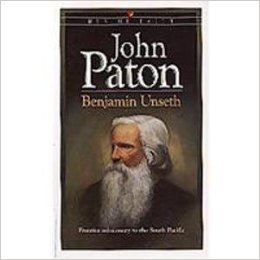
PatonJohn wrote his autobiography in three parts at three different times in his life. Benjamin Unseth used about one-fifth of the material in the three parts written by Mr. Paton to form a shorter biography simply titled John Paton, part of the Men of Faith Series published by Bethany House.

(You can see other posts in the 31 Days of Missionary Stories here.)

(This will also be linked to Semicolon‘s Saturday Review of Books.)

31 Days of Missionary Stories: Adoniram Judson, America’s First Missionary

I reviewed To The Golden Shore by Courtney Anderson about the life of Adoniram Judson a few years ago, but I can’t not include it in a month of missionary stories. It’s a missionary classic and compelling reading. So I hope those of you who have seen it before don’t mind the repost.

_____________

Imagine feeling so convicted and burdened by God’s command to go and share the gospel with every creature and so moved by the state of the lost in other countries that have never heard the gospel that you feel you must go yourself and tell them.

Now imagine doing so when you live in a country where no one has ever done so before.

To the Golden ShoreTo The Golden Shore by Courtney Anderson is a classic missionary biography of Adoniram Judson, America’s first missionary. I had read it years ago but felt an urge to revisit it.

Every missionary has to have dedication and has to be willing to make sacrifices, even in our day. But the amount of dedication and sacrifice and willingness to step into the unknown displayed by Adoniram and his wife and the small group who stepped out with them just amazes me. His wife, Ann Hassletine (also called Nancy) is one of the bravest women I have ever read of, going into the great unknown as she did and facing all that she did in later years. The letter Adoniram wrote to ask her father for her hand in marriage is an atypical proposal, but frank:

I have not to ask, whether you can consent to part with your daughter early next Spring, to see her no more in this world; whether you can consent to her departure, and her subjection to the hardships and sufferings of missionary life; whether you can consent to her exposure to the dangers of the ocean; to the fatal influence of the climate of India; to every kind of want and distress; to degradation, insult, persecution, and perhaps a violent death. Can you consent to all this, for the sake of Him who left His heavenly home and died for her and for you; for the sake of perishing immortal souls, for the sake of Zion, and the glory of God?

He was not being melodramatic: he was being realistic. It says a lot about Nancy that she accepted such a proposal.

There are several short biographies of Adoniram online, so I don’t want to retell his life story, but I just want to touch on a few highlights that stood out to me from the book.

I wrote before of his remarkable conversion. His innate intelligence, keen mind, and his own struggles coming to faith uniquely fitted him for the philosophical discussions with the Burmese that were preliminary to their understanding the gospel, and that same mind and the facility he developed with the language uniquely fitted him to translate the Bible into Burmese and to create a Burmese-English dictionary and grammar that were the standard for decades.

He had a stalwart, determined character. That could come across as stubborness in some instances, but when convinced as to the will of God, he was firm. During Adoniram’s studies over the long sea voyage, he became convinced that the Baptist mode of baptism, by immersion after a profession of salvation, was the Biblical way. That put him in a difficult position as a Congregationalist missionary. The subject was discussed and debated amongst the missionary candidates on board, but once Adoniram was convinced of the Scriptural position, he felt he had no choice but to resign as a Congregationalist missionary and seek support from the Baptists. Thankfully, in the providence of God, the situation was handled with grace, and God brought him into contact with Baptist men who took on his support. You may or may not agree about modes of baptism, but what stands out to me here was the character it took to act on what he believed even though it was going to cause difficulties.

The Burmese were open to discussion, but it was six long years before the first one believed. Progress was very slow: there was, of course, not the openness to a variety of religions as we take for granted today. Adoniram was careful not to impinge on their culture — he wasn’t trying to create an American church, but a Christian one. But slowly the gospel took root and grew. Oddly, at the time of greatest oppression by the imperialist Burmese king, when the Judsons feared they would have to leave, they had several inquirers. Some of the Burmese converts came forth as gold in the trials they faced where professing Christ cost something.

When war broke out between Burma and England in 1824, the Judsons thought that they would be safe as Americans. However, the Burmese did not understand the Western system of banking: because the Judsons’ checks were cashed through a British merchant, they were thought to be in league with the British, and Adoniram was imprisoned for twenty-one of the most grueling months of his life. A fastidious man, he dealt with filthy quarters and having his feet in fetters raised up toward the ceiling every night while his weight rested on his shoulders on the floor. Nancy daily sought help and favor for him everywhere she could: she even followed him and the rest of the prisoners on a tortuous march to another prison. As authorities searched their home, she hid what she could, especially the manuscript of the Burmese translation of the Bible over which Adoniram had been working so diligently. She hid it in a pillow and took it to Adoniram in prison. The jailer took a liking to the pillow and confiscated it for himself: Nancy made a nicer one, and Adoniram successfully offered it to the jailer in exchange.

As the war began to grind to an end, Adoniram was called on as a translator between the Burmese and British. Lack of nutrition, ill health, and extenuating circumstances all took their toll on Nancy, and she died, followed soon by their baby. None of their other children had lived.

Adoniram entered into the darkest period of his life. He threw himself into translation and missionary work, but wrestled with losses and grief: not only Nancy and all his children, but several missionary colleagues had died as well as his father back in America. Oddly, he felt guilty over his grief. He withdrew into a kind of asceticism for a while. He dug an open grave and spent long periods of time just staring into it. He requested at this time that his letters to others be destroyed, so we don’t know for sure what all he was thinking during this period. Several shorter biographies bypass this section of his life, but I think it is important to note that in his humanness, the losses he had sustained and the time in prison all had their effect on him, understandably, and it took him about three years to recover.

He eventually married Sarah Boardman, the widow of one of his colleagues, and had several more children. They had a happy eleven-year long marriage before she passed away on his only return trip to America, taken originally to try to help improve her health. God granted him another happy marriage to writer Emily Chubbuck for a few years before his own health failed in 1850 at the age of 61.

His legacies are the souls won to Christ in Burma and the churches started there, the Burmese Bible he translated, the Burmese-English dictionary and grammar, and the stirring testimony and influence of a life of character used by God.

(You can see other posts in the 31 Days of Missionary Stories here.)

(This will also be linked to Semicolon‘s Saturday Review of Books.)
31 Days of Missionary Stories: Adoniram Judson’s Conversion

The salvation story of a five year old who is saved from a lifetime of heartache and bad memories is every bit a work of grace as the salvation of the most debauched sinner (though we have to remember, too, that what we think of as the “bad sins” are no worse than our pride, envy, and lack of love). A person doesn’t have to have a dramatic salvation story to have true faith and depth.

That said, one of the most dramatic salvation stories ever is that of Adoniram Judson. He is not quite as well-known a missionary as Hudson Taylor and Amy Carmichael, but he was among the first missionaries sent by America to another country.  I’ll say more about his life and ministry tomorrow, but for today I want to tell how he was saved. All quotes are from To the Golden Shore by Courtney Anderson.

The way the Lord brought this young man to Himself has me on the edge of my seat even though I know the story well. Plus, I have known people in much the same situation as Adoniram, and the obvious hand of God in his life gives hope and encouragement that He is at work drawing them as well, bringing them to the influences and people through whom He can work in their lives.

Adoniram had been raised in a strict Congregationalist pastor’s home in the late 1700s. There was never any indication that he didn’t believe: everything outwardly indicated his lifestyle was in line with what he had been taught all his life. When it was time for him to go to college, his father chose one where he was sure his son wouldn’t be led away from sound doctrine.

Adoniram had a brilliant mind which evidenced itself early in life and which God later used in translation work. He did excellently at college. He fell in with some friends who were Deists, who “rejected all revealed religion…. All the Deist admitted was the existence of a personal God.” They believed the Bible as well as other religions’ texts were only the work of men and that Jesus “was not the Son of God except in the sense that all men are” (pp. 33. 38). One of his best friends who had much influence on him was free-thinking Jacob Eames.

When Adoniram graduated and came home, he felt he could not just quietly go along with the family’s beliefs and practices any more. He broke the news to his parents that he had chosen a different way. His father tried to reason with him. “Very shortly he realized with dismay that every argument he advanced was being met by two better ones. Not for nothing had Adoniram been valedictorian of his class. Exposing the fallacies of his father’s syllogisms was child’s play. Point by point, with crushing finality, he demolished every thesis his father set out to prove…So far as logics and evidence went, Mr. Judson had to concede…He still knew he was right, but he could not prove it” (p. 38). His mother’s tears seemingly had little effect, either.

Adoniram had decided he wanted to go into the theater and perhaps become a playwright, so he left home and made his way to New York.

He happened to arrive during a very quiet time for the theater, He couldn’t find work, and then when he did find a theater troupe that hired him, the morals of the group appalled him.

He left to travel some more and ended up at an uncle’s home during the time a visiting young preacher was filling in for him. He and this young man of God “spent several hours in conversation. Adoniram was struck by the fact that, although his host was as pious as his father, there was a warmth, ‘a solemn but gentle earnestness,’ in his speech which kindled an answering warmth in the heart. To be a devoted minister it was not necessary, it seemed, to be austere and dictatorial like the Reverend Mr. Judson. Adoniram rode away in the morning deeply impressed. …The young minister…would [not] experience the pain of Adoniram’s inner conflict. He was at peace with himself” (p. 42).

Later in Adoniram’s travels, he came to a country inn, looking for a room for the night. The only available room, the innkeeper explained apologetically, was next to a young man who was dying. Adoniram assured the innkeeper that was all right, but through the night, he heard the sounds from the next room, and his thoughts were greatly disturbed considering what might happen after death.

The next morning as Adoniram checked out, he asked about the young man and learned that he had indeed passed away. For some reason he asked the young man’s name, and was startled to hear it was Jacob Eames.

Adoniram was stunned. Though shocked and saddened at the loss of a dear friend , especially one so young, even more disturbing were the thoughts that his beliefs could possibly be wrong. Was his friend even now experiencing “the unimaginable torments of the flames of hell — any chance of remedy, of going back, of correcting, lost, eternally lost?” “For already, this moment, Eames knew his error — too late for repentance” (p.44).

He wasn’t converted immediately, but he did realize that no one but God could have orchestrated all of the events since he left home, that they weren’t mere coincidence: the unexpected conversation with young preacher, the failure and disappointment of his plans in New York, and his ending up in a room in an inn next door to his dying friend. He felt he must learn more.

He went home where, soon afterward, two leading Congregationalist pastors came to visit his father to discuss a new theological seminary. They spent several hours talking with Adoniram. He “made an instant impression on [them]. His personality was ingratiating, yet without false humility. His mind was of the finest order. He already knew more theology than many theological students. He was open to conviction. He understood that he must undergo inner regeneration before he could look forward to faith and personal salvation. But clearly this was not to be accomplished in a few hours of argument. The very qualities that made the boy so worth saving made him hard to save. Yet the visitors felt almost at once that if he could find conviction he could become a minister such as had not been seen since the days of Whitefield and Jonathan Edwards” (pp. 47-48).

Eventually “they suggested that Adoniram enroll in the new seminary, where he would have the materials he needed to study to make up his own mind, and the counsel of some of the best theologians in the country” (p. 48). He was enrolled “as a special student — not as a candidate for the ministry” (p. 48). He began his studies: “under Dr. Pearson, he began to read the sacred literature in the original [languages]. At the same time he began to thrash out his theological doubts with Professor Woods, who turned out to be fully his match as a dialectician” (pp. 49-50).

He “felt no blinding flash of insight,” but by November he “began to entertain a hope of having received the regenerating influences of the Holy Spirit,” and December 2 “made a solemn dedication of himself to God” (p. 50).

Friday’s Fave Five

FFF delicate leaves

Welcome to Friday’s Fave Five, hosted by Susanne at Living to Tell the Story, in which we can share five of our favorite things from the last week, a wonderful exercise in looking for and appreciating the good things God blesses us with. Click on the button to learn more, then go to Susanne’s to read others’ faves and link up your own.

It’s been quite a nice first few days of October, even though I still can’t believe it is October already. Here are some favorite parts of the last week.

1. Pizza and movie night with the family. It seems like it has been a while since we’ve done that.

2. My Fitness Pal. I especially like the little bar code reader on the iPhone app that inputs all the nutritional information from packaged items. Very handy!

3. Take-out from Cracker Barrel. My dear hubby brought some for me even though he doesn’t like anything from there. Especially loved the Coca Cola Cake. Mmmm…

4. Losing 5 lbs. Woot!! I haven’t been doing anything really drastic yet – walking 30 minutes 4-5 times a week and cutting back on sweets (except for occasional splurges like the Cracker Barrel cake. 🙂 ). There is more I need to work on, but it seems to work better for me to take small measures a little at a time rather than overhauling everything at once.

5. Hope for Jim’s eye. Some of you may remember that my husband had surgery for a detached retina back in April. Unfortunately his vision in that eye has been getting much worse. He saw his eye doctor and was told that he had a wrinkle on his retina now. That may fix itself over time, or it may require additional surgery – for now they advocate waiting on it. But they did say he had a cataract, which he had been told might happen due to the excessive laser work during the retina surgery. Now he is scheduled to have that removed in November, and it’s much less invasive, less recovery time, etc., than the retina surgery. We’re hoping we can get the date moved up, but we’re just glad that there is hope this will improve his vision.

Happy Friday!

31 Days of Missionary Stories: Answer to a Mother’s Prayer

I wanted to start off the 31 Days of Missionary Stories with God’s answer to an everyday, normal need. There are some dramatic missionary stories, but missionaries don’t spend all their time on the front lines fighting spiritual battles or out on the streets witnessing to everyone they meet. They have to deal with the same mundane affairs of life that we all do, and often those mundane affairs are more complicated than they are in America. That was especially true in previous centuries.

Jonathan and Rosalind Goforth were missionaries to China in the late 1800s and early 1900s. Mrs. Goforth has written Goforth of China, a biography of her husband; How I Know God Answers Prayer (I was delighted to find what appears to be all or most of the text of this book here, and it is free for the Kindle for a time here.); and Climbing, which includes many anecdotes she was requested to share as well as some of her own personal struggles. The following comes from Climbing.

The Goforths had just narrowly and traumatically escaped from the Boxer Rebellion in China to Shanghai. Until a ship left that they could find passage on, they had to stay in an empty house with little furniture. In the ten days they were there, her husband and son Paul bought some ready-made clothes, and she was able to have one dress made.

But the other three children! They were in rags given by the Chinese on the journey. How could I, without materials, without a machine, get an outfit made for even one, and the ocean voyage just ahead! Alone with the baby one morning I cast myself down by the little one and cried again and again to the Lord to send someone to help me. My distress was great. Help I must have, but I knew no one to whom I could turn. Then suddenly, while I was praying, the doorbell rang. On opening the door I found two women outside. They introduced themselves and told of having seen our names among those of the refugees. They were in charge of a Chinese girls’ school, but on account of the Boxer troubles, all the girls had been sent home. They then said, “We have nothing to do and thought you may need help.” Scarcely able to speak, I told them rapidly my story; how I was on my knees pleading for help when they rang the bell. A few moments followed in which we stood clasping hands, weeping, just too full for speech. Then they went away to get materials, for there was no time to lose.

In a very short time, they returned with a pile of materials of from three- to five- yard lengths. I cut out and gave directions for a number of garments. The women took all away and, with the help of some friends, made practically everything needed except for the baby, who, in the rush of getting others provided for, was forgotten! The day we sailed, I gathered a quantity of material together, planning to make the most necessary things for him on board ship. Then came the most beautiful proof of God’s overshadowing care.

We had been passing through the Inland Sea and were nearing Yokohama. I had been trying my utmost to get some necessary things ready for baby W., but my hands trembled so I could scarcely hold the needle. I struggled on, realizing my strength was going, but kept sewing til I could no longer see the needle. Rising, I folded the work, and, going down to the cabin, put it quietly, numbly into the trunk, saying, “Lord, I have done all I can. I can do no more. As you provided for the others, do so now for baby.” I then went on deck and lay down on a long chair exhausted. How long I lay there I do not know, but suddenly someone touched me and said, “There’s a large bundle come off the lighter for you: it is in your cabin.” Dazed at first, I could not take it in. Then it flashed into my mind, “It’s the answer.”

In the cabin, I found a letter attached to the bundle from Mrs. O. E., of the China Inland Mission, whose husband was at that time risking his life in China, seeking to bring out to safety women of the mission who were in peril. The letter stated that her little son, the same age as my baby, had died some months before and she felt it laid upon her to send me, for my child, his outfit. I opened the bundle to find not only a most beautiful, complete outfit for my little one, but also many things I needed for myself and the other children. It was indeed one of the Lord’s exceedingly abundant answers. Is it any wonder that those words written so long ago by the psalmist have always had a deep thrill of response in my heart?

I love the LORD, because he hath heard my voice and my supplications. Because he hath inclined his ear unto me, therefore will I call upon him as long as I live. – Psalm 116:1-2.

God cares about the souls of people and the affairs of nations. But He also cares about the needs of mother’s hearts and children’s bodies.

31 Days of Missionary Stories

I’ve seen that several bloggers are participating in a 31 Days series hosted by Nesting Place. The basic idea is to choose a topic that you write about each day of October. I thought, “Hmm, that sounds interesting…but what in the world would I write about?” Then it hit me this morning: I love to read missionary biographies or stories: when I first started my blog I did a series for a few weeks on different missionary stories or anecdotes, and I have been doing the same in a church ladies’ newsletter for years. What a great opportunity to share some of those here! Some times it will be an overview of a person’s life: some times it will be just one incident or anecdote.

Why missionary stories? Because it increases my faith to see men and women “of like passions as we are” who learn, grow, overcome, and are used by God. I wrote more about reading missionary biographies before, and an excerpt from that is:

We learn history for a number of reasons, among them: to better understand our current times, to appreciate our heritage, to avoid repeating mistakes. There are heroes in our national history who inspire us to a love of country and duty and courage. There are heroes of our spiritual heritage who inspire us in love and dedication to God and to greater faith in remembering that the God they served and loved and Who provided for and used them is the very same God we love and serve today and Who will provide for us and use us. Though times and culture change, human nature at its core doesn’t change much, and God never changes.

This poem, which I first saw in Rosalind Goforth’s book, Climbing, embodies my own thoughts and feelings as well.

Call Back!

If you have gone a little way ahead of me, call back-
It will cheer my heart and help my feet along the stony track;
And if, perchance, Faith’s light is dim, because the oil is low,
Your call will guide my lagging course as wearily I go.

Call back, and tell me that He went with you into the storm;
Call back, and say He kept you when forest’s roots were torn;
That when the heavens thunder and the earthquake shook the hill.
He bore you up and held where the very air was still.

O friend, call back, and tell me for I cannot see your face;
They say it glows with triumph, and your feet bound in the race;
But there are mists between us and my spirit eyes are dim,
And I cannot see the glory, though I long for word of Him.

But if you’ll say He heard you when your prayer was but a cry,
And if you’ll say He saw you through the night’s sin-darkened sky-
If you have gone a little way ahead, O friend, call back-
It will cheer my heart and help my feet along the stony track.

I hope you’ll join me as we look to those who have gone on before us and learn from them.

I’ll be using this post as a directory to list the posts in the series.

Day 1: This post
Day 2: Rosalind Goforth; Answer to a Mother’s Prayer.
Day 3: Adoniram Judson’s Conversion.
Day 4: Adoniram Judson’s biography: To the Golden Shore.
Day 5: John Paton, Missionary to Cannibals.
Day 6: Darlene Deibler Rose: Missionary POW.
Day 7: Gracia Burnham and God’s Grace in Captivity.
Day 8: Isobel Kuhn Learns to Put God First.
Day 9: Isobel Kuhn’s Marriage: Whom God Hath Joined.
Day 10: Don Richardson: How to minister to a culture that values treachery?
Day 11: Amy Carmichael: With All Our Feebleness: Victory Through Pain and Illness.
Day 12: Amy Carmichael Learns to Die to Self.
Day 13: Amy Carmichael and Singleness.
Day 14: Gladys Aylward: The Small Woman With Big Faith.
Day 15: Mary Slessor and the Power of a Woman’s God.
Day 16: Spirit of the Rainforest: A Yanomamo Shaman’s Story
Day 17: Eric Liddell: Olympian and Missionary.
Day 18: Dr. John Dreisbach: Modern Missionary Statesman and Surgeon.
Day 19: The “Cambridge Seven
Day 20: William Carey: “Attempt great things for God. Expect great things from God.
Day 21: Rosalind Goforth, A Woman “Of Like Passions” As We Are.
Day 22: J. O. Fraser: Pianist and Engineer Turned Missionary.
Day 23: Dallas and Kay Washer, Candles in the Darkness.
Day 24: Margaret Stringer: Missionary to Cannibals With a Merry Heart and a Faithful Spirit.
Day 25: Clint and Rita Vernoy: On Ethnocide and Raising Children in the Jungle.
Day 26: Verda Peet: Sometimes I Prefer to Fuss.
Day 27: Jim Elliot’s Journals.
Day 28: Hudson Taylor, Pioneer Missionary.
Day 29: Not Only Preachers Are Called To Be Missionaries.
Day 30: Different ways to support and encourage missionaries.
Day 31: Thoughts on pedestals and missionary biographies with a list of my favorites.

You can see what other people are writing about for this 31 day challenge here: there are nine different categories.

(Photo courtesy of MorgueFile)