Freedom to Lament

Freedom to Lament

When we were taking care of my mother-in-law at home, nothing quite helped like talking to others who were doing or had done the same. They knew by experience what was involved. It’s not that we wanted to gripe about our situation, but there were difficulties and pressures these friends would understand. It’s not that other friends weren’t a help, but with these we felt a freedom to talk like we didn’t always feel with others.

That’s one reason Paul says in 2 Corinthians 2:3-4, “Blessed be the God and Father of our Lord Jesus Christ, the Father of mercies and God of all comfort, who comforts us in all our affliction, so that we may be able to comfort those who are in any affliction, with the comfort with which we ourselves are comforted by God.” God comforts us through His Word, His Spirit, and His people.

When this passage came up in our recent ladies’ Bible study, someone pointed out that we need to feel free to be vulnerable with each other, to share when we’re struggling.

I came to that realization some years ago after I contracted transverse myelitis. We got our first computer a few weeks later, and transverse myelitis was the first thing I looked up. In that era before Facebook and message boards, I found a subscriber group of TM patients and caregivers. They were a lifeline to me as I navigated a little-known disease.

I wanted to be a good testimony there. I knew that would mean not hijacking conversations to “preach,” which would not have been well-received. But I wanted to give God the glory for the help and grace He gave and point others to Him. I thought the best way to do that was to always be cheerful and positive.

Some years later, another woman came into the group who was also a Christian. She was very transparent about her frustrations and struggles with TM. She wasn’t complaining, but she was honest. She gave God glory, and it rang true because we saw how He helped her.

I realized we’re not much help to others if we come across as always having everything all together. We’re more authentic when we share our struggles and burdens.

The Sunday after the Bible study session where we discussed these things, our care group met for lunch after the Sunday morning service. Our pastor emeritus had given an excellent message that morning about God’s grace through suffering–in his case, months in the hospital in isolation with Covid, a lung transplant, a blood clot, and more. The host of our care group asked if anyone had anything to share in connection with the message.

One woman shared how hard it was after her son committed suicide. When people asked her how she was doing, and she tried to tell them, she’d have to short-circuit what she wanted to say. She could see by their faces that they weren’t ready for what was on her heart. She pointed out that we need to allow for lament in the church such as the psalmists display. About a third of the psalms are laments, which are different from complaints. The writers conveyed a range of emotions based on their troubles. They eventually reminded themselves of God’s character and love, but they had to spend their grief and confusion first before they could receive it.

Granted, the psalmists did not have as much of the Word of God as we do now, which might have helped with some of their questions. But there are always mysteries as to why God allows certain painful things or doesn’t grant things that seem beneficial.

Paul was honest about his struggles as well:

. . . far greater labors, far more imprisonments, with countless beatings, and often near death. Five times I received at the hands of the Jews the forty lashes less one. Three times I was beaten with rods. Once I was stoned. Three times I was shipwrecked; a night and a day I was adrift at sea; on frequent journeys, in danger from rivers, danger from robbers, danger from my own people, danger from Gentiles, danger in the city, danger in the wilderness, danger at sea, danger from false brothers; in toil and hardship, through many a sleepless night, in hunger and thirst, often without food, in cold and exposure. And, apart from other things, there is the daily pressure on me of my anxiety for all the churches (2 Corinthians 11:23-38).

In Peter’s epistles, he was also quite frank about suffering believers experience.

When people are hurting, we want to fix their problems and make them better. But healing takes time. Sometimes pain drowns everything else out. We can’t help others when we apply Bible verses like band-aids over gaping wounds. There is a time to share Scripture. I’ve been greatly encouraged by a shared verse at just the right time. But first we need to listen and “weep with those who weep” (Romans 12:15). Sometimes the tender care and concern shared in the midst of someone’s pain will open their hearts to receive truth.

Someone has said that Job’s friends ministered to him much more when they sat with him in silence for a week than when they started talking.

Some years ago, in our early married life, someone at church shared a prayer request for a man who had just been diagnosed with cancer. The speaker went on to say that the wife wasn’t taking the news well.

I thought, “How does someone take that kind of news well?” Wrestling through pain, confusion, and grief doesn’t mean one doesn’t have faith. This woman needed someone to come alongside her, not judge for her initial reaction to devastating news.

There is no one formula for aiding people in their worst times. We need to ask God’s guidance for what to share when. But we need to give them space to grieve. We need to listen, empathize, support, and love without judgment and pat answers.
My soul is full of troubles. Psalm 88:3

(I often link up with some of these bloggers.)

Laudable Linkage

Laudable Linkage

Here are some of the good reads found this week:

Will God Forgive My Worst Sin? “When I hear this question that’s so filled with self-recrimination and doubt and fear and guilt, I want very much to introduce this woman — I wish I knew her name, as I could call her by name — to what I have for many years called ‘gutsy guilt.”

God Is Good to Forbid Sin. A helpful lens with which to view God’s commandments.

How Do Spiritually Mature Christians Handle Suffering? “Much of our thinking about suffering is unbiblical. We tend to think that spiritual maturity somehow inoculates us against the pain of suffering. We falsely imagine that the more spiritually mature we are, the less emotional pain we will experience when we suffer.”

What If the Worst Happens? “I found myself growing fearful. Not a heart-stopping, all-encompassing fear, but the kind of constant gnawing that occurs when you look at the discouraging trends of the present and assume things will never change. When you think about the future and wonder, ‘What if the worst happens?'”

John Piper on Brokenhearted Boldness: A Christian Alternative to Outrage Culture. “Boldness can become brash, harsh, severe, cruel, angry, impatient, contentious, belligerent, coarse, crude, snarky, snide, loud, garish, obnoxious — all in the name of Christian courage. Or more subtly, boldness in the cause of truth can become, even if less brash and severe, more all-consuming. It can become such a fixation that all other beautiful affections and dispositions are eaten away from within.”

How to “Get Over It” When You Taught Poorly. “If you teach the Bible regularly, you know the experience of wishing you had done better — sometimes much better — immediately after you finished.” This is true for writing as well as speaking.

Is That Person Male or Female? “Is there a scientific and effective way to discern whether someone is male or female? The answer is yes. There have been established methods for a long time. It’s only with the recent rise of transgender ideology that there has been any substantial pushback to these methods. Here are three ways to determine whether someone is male or female.”

How to Have Better Conversations. “The problem is that if asked, most of us would have no plan for how to improve our conversation skills. We have goals for our weight and physical exercise but not for what occupies more time than anything else in our day. If you don’t have ideas on how you can improve your conversation skills, you won’t.” This is something I have struggled with over the years. Numbers 1 and 2 have been the most helpful to me.

In the past, I’ve included a phrase a phrase behind the links in these posts—a “HT” to another site. Occasionally someone will ask me what “HT” means. It refers to “hat tip,” a way of giving a nod to the place where I saw the link I’m sharing. I used to see this designation in many places, but it occurs to me that I don’t anymore. So I decided to take it out. Let me know if you have a preference for it to remain.

God's shield and grace

God shields us from most of the things we fear, but when he chooses not to shield us,
he unfailingly allots grace in the measure needed.
–Elisabeth Elliot, Secure in the Everlasting Arms

Friday’s Fave Five

Friday's Fave Five

Fall is in the air. Leaves are starting to turn and drop. We had a warm spell this week, but enough coolness the week before to make us anticipate more. I’m joining Susanne and friends at Living to Tell the Story to reflect on the blessings of the past week.

1. Jesse’s birthday. We got together to celebrate my youngest son with stroganoff, his usual requested birthday dinner.

2. Jesse’s cake was made by Mittu, a lemon blueberry cake. I struggled with this one before, so Mittu has made it ever since. 🙂

Lemon blueberry cake

3. Jackbox games across the miles. We often play Jackbox games when we’re all together, especially Blather Round. Since we log in online and play on our phones or ipads, we were able to play with Jeremy in RI while FaceTiming him.

4. A productive day. Some events from last week put me behind schedule. I usually start my Sunday blog post earlier in the week, attempting to leave Saturday for proofreading and graphics. But I didn’t get started on it until Friday night! Then, I wanted to get Jesse’s card made and presents wrapped on Saturday so I wouldn’t feel rushed and pressured on his birthday Monday. I prayed that I might get everything done Saturday, and I did.

That turned out to be a good thing, as I had forgotten that Jesse had a dentist appointment Monday near us and planned to come here afterward for the rest of the day instead of going home and then back here for his birthday celebration in the evening. So I was especially glad all the birthday stuff was done except for dinner.

5. Sleep. I usually wake up a couple of times during the night, but somehow, this morning, I feel rested and refreshed.

How was your week?

Review: Martin Chuzzlewit

There are two Martin Chuzzlewits in Charles Dickens’ eponymous novel, originally titled The Life and Adventure of Martin Chuzzlewit.

The older Martin feels bitter because his relatives fight over his money. He tries to steer clear of them all, except his grandson with the same name. He has hired a young woman named Mary with no family as his caregiver and companion. He pays her well but promises that he will not put her in his will. He reasons that with no expectations after he is gone, she’ll be motivated to keep him alive.

Problems arise when young Martin, the grandson, falls in love with Mary. Grandfather and grandson have a falling out, resulting in young Martin leaving home and being disinherited.

Martin goes to apprentice with a distant relative, an architect named Seth Pecksmith. Mr. Pecksmith’s other apprentice is a good-natured but naive young man named Tom Pinch.

Old Martin asks Pecksmith to kick young Martin out, so he does, to curry old Martin’s favor. Young Martin decides to go to America to see if he can make a success of himself there.

The main theme of the novel is selfishness in various forms, displayed by two main villains as well as several minor characters. A few of the good characters, by contrast, are kind, considerate, and willing to help others. One character transforms from bad to good. One remains good but learns wisdom through painful circumstances. One who appears good at first is revealed to be bad. And one who is moderately bad becomes evil.

As always, Dickens weaves several minor plots and characters throughout the story, some more interesting than others.

Mr. Pecksmith has two daughters, Mercy and Charity, who do not live up to their names.

Anthony Chuzzlewit, the brother of the older Martin, has a son named Jonas. Jonas is surly and wishes his father would go ahead and die so he can get his inheritance. Anthony takes care of an elderly clerk named Mr. Chuffey.

Mark Tapley works at the local inn and likes to be “jolly,” a word he uses often. Oddly, he wants “credit” for being jolly in circumstances where happiness might be hard to come by. He decides to go to America with young Martin.

Sarah Gamp works at various jobs: midwife, caregiver, and one who helps prepare dead people for their funerals. She drinks alcohol often and takes advantage of the hospitality of those she serves.

John Westlock was a student of Pecksmith’s who does not like him and can’t fathom why his friend, Tom Pinch, likes him so well.

Montague Tigg is a swindler.

Mr. Nadgett is said to be one of the first private detectives in literature.

And those are just the English characters, not to mention the American ones.

Dickens wrote this novel not long after his own visit to America, where he was unimpressed. The American section is heavy with satire. He writes in the preface, “As I had never, in writing fiction, had any disposition to soften what is ridiculous or wrong at home, so I then hoped that the good-humored people of the United States would not be generally disposed to quarrel with me for carrying the same usage abroad. I am happy to believe that my confidence in that great nation was not misplaced.” This book was written in the 1840s, when slavery was still rampant in America. Dickens points out the irony of people bragging about their freedom while keeping so much of the population as slaves. Plus many of the American characters ask Martin what he thinks of their country and then get offended if he mentions its problems. They think they know more about England than he does. The newspapers threaten to ruin anyone who doesn’t do things their way. I wonder think Dickens may have had direct experience with this. He says in his preface:

Even the Press, being human, may be sometimes mistaken or misinformed, and I rather think that I have in one or two rare instances observed its information to be not strictly accurate with reference to myself. Indeed, I have, now and again, been more surprised by printed news that I have read of myself, than by any printed news that I have ever read in my present state of existence.

His portrayal of America won him no friends here and garnered much criticism. Dickens visited America again in 1868 and commented on the many positive changes he saw at that time. He gave a speech saying so and declaring that he would have an addendum added to all future publications of this book saying so as well.

I have to say that this isn’t one of my favorites of Dickens (those would be David Copperfield and A Tale of Two Cities). It took a very long time to get into it. But I knew the bad guys would get their comeuppance and everything would be brought together in the end. By the last part of the book, I was eager to listen to it as much as I could, and I loved how it ended.

The audiobook I listened to was read by Derek Jacobi, who did a marvelous job except when the older Martin and Sarah Gamp got excited–then he was a little hard to understand.

The audiobook also contained an introduction by a William Boyd, which I didn’t listen to until after finishing the book to avoid spoilers. He commented that this book did not sell well, and he felt it was because it was primarily comedic, with the serious and moral bits taking away from the fun parts. I heartily disagree. Most, if not all, of Dickens’ books contain some comedic elements even when dealing with some of the darkest elements of human nature. But I wouldn’t say the main thrust of this book is comedy.

Boyd also commented that young Martin is supposed to be the main character but only appears in about a fifth of the book. By contrast, in Dickens’ other books with a name in the title, like David Copperfield and Oliver Twist, we see much more of the main character throughout the book. He may have a point there, that readers expected Chuzzlewit to be more like those stories.

He also felt that the selfishness theme equaled lust for money. Not necessarily. Many of the selfish characters were after more money or someone else’s money. But Sarah Gamp, for instance, was selfish in other ways. Young Martin himself, even after being cut off from his inheritance, doesn’t seem concerned about money except that he wants to be able to marry and support Mary. His selfishness appears in the way he treats Mark Tapley as a servant.

Both Boyd and Wikipedia say this is a “picaresque” novel which centers on a lovable, appealing rogue.  I didn’t really see young Martin that way. He’s not a likeable character at first but has a transforming character arc, so he’s more appealing at the end.

For me, part of my dislike arose from the first chapter detailing Chuzzlewit lineage. It’s tongue in cheek and not meant to be dry, but we don’t really care enough about the Chuzzlewits enough yet to be interested in their family history. Then the story focuses on the Pecksmiths for a long time before the older Chuzzlewit makes an appearance. Mr. Pecksmith was hard to figure out at first, because he’s highly regarded in the town and seems moral and almost too polite. Yet there’s something off about him from the beginning. I don’t usually look up information on a classic before reading it because I want the story to unfold as it would have originally. But I did look up Pecksmith, and then understood where Dickens was going with him.

But, as I said, by the latter half of the novel, I started to enjoy it a great deal. Tom Pinch, especially, is a favorite character.

Have you read Martin Chuzzlewit? What did you think?

The Most Important Thing

The Most Important Thing

It’s so easy to get off-track as Christians.

For instance, we set up routines to help us get into God’s Word regularly. But we can find ourselves just going through the routine without really engaging with Scripture. Or we set up various programs for good at church, but then get lost in the minutia of maintaining the program, forgetting its purpose. There is nothing wrong with good routines and programs in themselves: we just need to keep the main things the main things.

I was struck in my recent Bible reading by the number of times phrases like “knowing God” or “the knowledge of God” came up. Among other things, these verses reminded me of the importance of getting back to basics. As A. W. Tozer wrote in The Pursuit of God:

The simplicity which is in Christ is rarely found among us. In its stead are programs, methods, organizations and a world of nervous activities which occupy time and attention but can never satisfy the longing of the heart . . . If we would find God amid all the religious externals, we must first determine to find Him, and then proceed in the way of simplicity.

I decided to explore more of what the Bible says about the knowledge of God. Here is some of what I found.

Do you want eternal life? Know God.

“And this is eternal life, that they know you, the only true God, and Jesus Christ whom you have sent” (John 17:3).

Do you want grace and peace? Know God.

“May grace and peace be multiplied to you in the knowledge of God and of Jesus our Lord” (1 Peter 1:2).

Do you want to know how to live a godly life? Know God.

“His divine power has granted to us all things that pertain to life and godliness, through the knowledge of him who called us to his own glory and excellence” (2 Peter 1:3).

Do you need wisdom? Know God.

“I do not cease to give thanks for you, remembering you in my prayers, that the God of our Lord Jesus Christ, the Father of glory, may give you the Spirit of wisdom and of revelation in the knowledge of him” (Ephesians 1:16-17).

“The fear of the Lord is the beginning of wisdom, and the knowledge of the Holy One is insight” (Proverbs 9:10).

“That their hearts may be encouraged, being knit together in love, to reach all the riches of full assurance of understanding and the knowledge of God’s mystery, which is Christ, in whom are hidden all the treasures of wisdom and knowledge” (Colossians 2:2-3).

Do you want to be more like Jesus? Behold Him.

“And we all, with unveiled face, beholding the glory of the Lord, are being transformed into the same image from one degree of glory to another. For this comes from the Lord who is the Spirit” (2 Corinthians 3:18).

Knowing God is more important than our rituals and duties.

“For I desire steadfast love and not sacrifice, the knowledge of God rather than burnt offerings” (Hosea 6:6).

Knowing God is worth more than anything else.

“I count everything as loss because of the surpassing worth of knowing Christ Jesus my Lord. For his sake I have suffered the loss of all things and count them as rubbish, in order that I may gain Christ and be found in him, not having a righteousness of my own that comes from the law, but that which comes through faith in Christ, the righteousness from God that depends on faith— that I may know him and the power of his resurrection, and may share his sufferings, becoming like him in his death” (Philippians 3:8-10).

“Thus says the Lord: ‘Let not the wise man boast in his wisdom, let not the mighty man boast in his might, let not the rich man boast in his riches, but let him who boasts boast in this, that he understands and knows me, that I am the Lord who practices steadfast love, justice, and righteousness in the earth. For in these things I delight,’ declares the Lord” (Jeremiah 9:23-24).

We know God through His Son.

“And we know that the Son of God has come and has given us understanding, so that we may know him who is true; and we are in him who is true, in his Son Jesus Christ. He is the true God and eternal life” (1 John 5:20).

“Jesus said to him, ‘Have I been with you so long, and you still do not know me, Philip? Whoever has seen me has seen the Father. How can you say, ‘Show us the Father?’” (John 14:9).

“For God, who said, ‘Let light shine out of darkness,’ has shone in our hearts to give the light of the knowledge of the glory of God in the face of Jesus Christ” 2 Corinthians 4:6).

We know God through His Word.

“His divine power has granted to us all things that pertain to life and godliness, through the knowledge of him who called us to his own glory and excellence, by which he has granted to us his precious and very great promises, so that through them you may become partakers of the divine nature, having escaped from the corruption that is in the world because of sinful desire” (2 Peter 1:3-4). (See also Proverbs 2.)

We know God through repentance.

“And the Lord’s servant must not be quarrelsome but kind to everyone, able to teach, patiently enduring evil, correcting his opponents with gentleness. God may perhaps grant them repentance leading to a knowledge of the truth, and they may come to their senses and escape from the snare of the devil, after being captured by him to do his will” (2 Timothy 2:24-26).

We know God through His people.

“But thanks be to God, who in Christ always leads us in triumphal procession, and through us spreads the fragrance of the knowledge of him everywhere. For we are the aroma of Christ to God among those who are being saved and among those who are perishing, to one a fragrance from death to death, to the other a fragrance from life to life. Who is sufficient for these things? For we are not, like so many, peddlers of God’s word, but as men of sincerity, as commissioned by God, in the sight of God we speak in Christ” (2 Corinthians 2:14-17).

We can get to know Him better all through life.

“Until we all attain to the unity of the faith and of the knowledge of the Son of God, to mature manhood, to the measure of the stature of the fullness of Christ” Ephesians 4:13).

“And so, from the day we heard, we have not ceased to pray for you, asking that you may be filled with the knowledge of his will in all spiritual wisdom and understanding, so as to walk in a manner worthy of the Lord, fully pleasing to him: bearing fruit in every good work and increasing in the knowledge of God” (Colossians 1:9-10).

“But grow in the grace and knowledge of our Lord and Savior Jesus Christ” (2 Peter 3:18).

Results of knowing God:

We’re enabled to keep His commandments. “And by this we know that we have come to know him, if we keep his commandments. Whoever says ‘I know him’ but does not keep his commandments is a liar, and the truth is not in him, but whoever keeps his word, in him truly the love of God is perfected. By this we may know that we are in him” (1 John 2:3-5).

“And this is his commandment, that we believe in the name of his Son Jesus Christ and love one another, just as he has commanded us. Whoever keeps his commandments abides in God, and God in him” 1 John 3:23-24).

We’re enabled to have victory over sin. “No one who abides in him keeps on sinning; no one who keeps on sinning has either seen him or known him” 1 John 3:6).

We’re enabled to love. “Beloved, let us love one another, for love is from God, and whoever loves has been born of God and knows God. Anyone who does not love does not know God, because God is love.” (1 John 4:7-8).

We trust God. “And those who know your name put their trust in you, for you, O Lord, have not forsaken those who seek you” (Psalm 9:10).

The Holy Spirit dwells within us. “By this we know that we abide in him and he in us, because he has given us of his Spirit” (1 John 4:13).

We’re strengthened to do things for God. “The people who know their God shall stand firm and take action” (Daniel 11:32; The KJV says they will “be strong and do exploits”).

I’m sure much more could be added.

I normally wouldn’t post primarily a list of verses. But I think the impact of them is stronger this way than if I tried to weave them together into a winsome post. I don’t think they need any more of my words added to them. They blessed me, and I hope you are blessed by them, too.

May we know our God, grow in our knowledge of Him, and make Him known to others.

And this is eternal life, that they know you, the only true God, and Jesus Christ whom you have sent.
John 17:3

(I often link up with some of these bloggers.)

Laudable Linkage

Laudable Linkage

Some of the thought-provoking posts found this week:

A Sycamore Tree. a Car Crash, and God’s Provision, HT to Challies. “When we think of God’s providential provision for his children, we often think in immediate terms—the unexpected financial gift that comes on the day the bill is due, the odds-defying recovery, or the new job starting right when the severance pay ended. These kinds of immediate interventions are marvellous. They should lead us to praise and give thanks to the God who gives them. But we should also be ready to see that many of God’s provisions are prepared for us long before our needs arise.”

Brussels Sprouts or Brownies? How Would You Describe Your Bible Reading? “I wanted to love my Bible, but I didn’t. It seemed more like brussels sprouts than brownies. Something I consumed because it was good for me, not because it tasted good. I wish I could say my attitude toward the Bible changed overnight. Instead, it was a slow but steady transformation that began when I read a passage the apostle James wrote to the church. There I learned how to position myself to learn from and love God’s Word.”

Let the Cursor Blink, HT to Challies. “The path of wisdom has footprints of restraint. It’s the idea of holding back or keeping back. There’s an intentional restriction of what is said. This is the self-control that knows that sometimes it’s better to be slow to speak (James 1:19) or even not to speak (or text, or email, or post).”

Are Christians Parents Too Protective of Their Children? HT to Challies. “As nervous Christian parents, we sometimes think our number one job is to make sure our kids are never exposed to any non-Christian thinking. We may be tempted to place them inside a sanitized theological bubble, safe from all forms of intellectual contamination. But, as for germ-conscious parents, this may not be accomplishing what we think.”

You Can Parent Teens with Hope in a Secular Age. “All this leads Christian parents to their greatest concern: Is it possible for my teen to develop a strong faith in God amid a culture that celebrates sin, promotes self, and declares truth to be whatever feels good in the moment?

Exercising an Idle Mind. “I see in myself the need to flee not just from idle hands but also an idle mind. As is true of many women, unless I’m sleeping, my mind is quite active. And if I do not give my mind a steady intake of good fuel to burn, I will often be burning whatever fuel I can find. The result? Lots of thoughts about aimless things.”

Walking Our Wives Through the Valley of Miscarriage: An Encouragement to Husbands, HT to Challies. “Miscarriage brings a unique grief in the valley of death; and it’s not an area well-known to us, especially us husbands. There are no maps; no entry and exit signs. There is only darkness, grief, and pain. And while, as fathers, we certainly grieve when our unborn children die, mothers seem to bear a far greater burden, a far deeper wound to the soul.”

Why We Worry When Choosing a Bible Translation, HT to Challies. There are difficulties but also benefits of having multiple Bible translations.

Why a Good God Commanded the Israelites to Destroy the Canaanites, HT to Challies. This is something atheists love to throw at Christians, and it’s something difficult to understand. This post raises some good points.

Elisabeth Elliot quote

This hard place in which you, perhaps, find yourself, is the very place in which God is giving you opportunity to look only to Him. –Elisabeth Elliot

Friday’s Fave Five

Friday's Fave Five

September just arrived, and we’re almost halfway through it already! Pausing on Fridays to look back over the blessings of the week gives us an opportunity to stop and savor these fleeting moments for a bit longer. Susanne is our hostess at Living to Tell the Story.

1. Recovered text messages. I’ve mentioned several times here that we have a family text thread that I love. Sometimes we share memes, tidbits about our day, interesting things we come across, news, etc. Thursday, I tried to scroll back through the thread to look for some photos, but it would only go back to Sunday. I would have been so sad to lose that collection of texts. I Googled the problem, and it was very easy to recover the texts out of the “Recently Deleted” file. I’ve been getting some junk texts lately and must have accidentally deleted the wrong thing.

Not only was I grateful to find such an easy fix, but I was very pleased that I did it without having to ask my kids. 🙂 However, I have to admit I was halfway through tapping out a text to them to ask what to do when it occurred to me to look it up myself.

2. Craft show and lunch. Last Saturday we went to a nearby craft show with Jason, Mittu, and Timothy, and afterwards ate a late lunch at a Mexican food restaurant we discovered recently. This craft show has been pretty small the last few times we’ve gone, but seemed to have a lot more vendors this time. Plus it was all crafts! I hate to pay to get into a craft show and then see booths for leaf gutters and such.

3. Grandparent’s Day last Sunday. Jason and Mittu brought flowers and made dinner, and we had a nice visit.

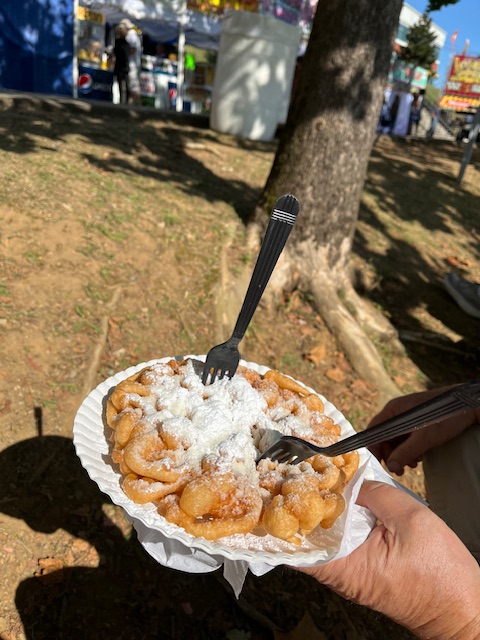
4. The Tennessee Valley Fair. We’ve always gone to this in the evening, but decided to go in the daytime this year with Jason, Mittu, and Timothy. The rides and food trucks didn’t open until just before we left, so it was much quieter and less crowded. We saw lots of animals and entries for art and photography contests as well as a lot of 4H projects. And it happened to be Senior Citizen’s Day, so Jim and I got in for free. 🙂 Jim and I did get to split our once-a-year fair funnel cake.

5. Coolness. We’ve had some lovely cool temperatures in the mornings and evenings this week.

And that’s our week–a little busier than usual, but enjoyable! How was yours?

Review: Be Hopeful (1 Peter): How to Make the Best of Times Out of Your Worst of Times

Be Hopeful: Commentary on 1 Peter by Warren Wiersbe

The book of 1 Peter was written to the “elect exiles of the Dispersion in Pontus, Galatia, Cappadocia, Asia, and Bithynia” by Jesus’ disciple, Peter. Warren Wiersbe shares his commentary on 1 Peter in Be Hopeful (1 Peter): How to Make the Best of Times Out of Your Worst of Times.

The folks Peter wrote to were suffering. “At least fifteen times in this letter, Peter referred to suffering, and he used eight different Greek words to do so” (p. 22, Kindle version).

Some of these Christians were suffering because they were living godly lives and doing what was good and right (1 Peter 2: 19–23; 3: 14–18; 4: 1–4, 15–19). Others were suffering reproach for the name of Christ (1 Peter 4: 14) and being railed at by unsaved people (1 Peter 3: 9–10). Peter wrote to encourage them to be good witnesses to their persecutors, and to remember that their suffering would lead to glory (1 Peter 1: 6–7; 4: 13–14; 5: 10). But Peter had another purpose in mind. He knew that a “fiery trial” was about to begin—official persecution from the Roman Empire (1 Peter 4: 12) (p. 22).

Peter wanted to encourage these believers in their faith. “We have noted that the theme of suffering runs throughout the letter, but so also does the theme of glory (see 1 Peter 1: 7–8, 11, 21; 2: 12; 4: 11–16; 5: 1, 4, 10–11)” (p. 24).

Wiersbe notes that the word “grace” appears in every chapter of 1 Peter.

Grace is God’s generous favor to undeserving sinners and needy saints. When we depend on God’s grace, we can endure suffering and turn trials into triumphs. It is grace alone that saves us (Eph. 2: 8–10). God’s grace can give us strength in times of trial (2 Cor. 12: 1–10). Grace enables us to serve God in spite of difficulties (1 Cor. 15: 9–10). Whatever begins with God’s grace will always lead to glory (Ps. 84: 11; 1 Peter 5: 10) (p. 24).

Peter reminds his readers that they were “born again to a living hope through the resurrection of Jesus Christ from the dead” (1 Peter 1:3), and they have “an inheritance that is imperishable, undefiled, and unfading, kept in heaven for you” (verse 4). The “the tested genuineness” of their faith was “more precious than gold” and would “result in praise and glory and honor at the revelation of Jesus Christ” (verse 7).

He reminds them of their call to holiness and of the example of Christ in His suffering and submission.

He tells them not to be “be surprised at the fiery trial when it comes upon you to test you, as though something strange were happening to you. But rejoice insofar as you share Christ’s sufferings, that you may also rejoice and be glad when his glory is revealed” (4:12-13). “Therefore let those who suffer according to God’s will entrust their souls to a faithful Creator while doing good” (4:19).

Along the way, Peter has instructions to servants, husbands, wives, and shepherds—shepherds of God’s flock, His people. He reminds the flock that they need to be submissive to authority and each other.

Clothe yourselves, all of you, with humility toward one another, for “God opposes the proud but gives grace to the humble.” Humble yourselves, therefore, under the mighty hand of God so that at the proper time he may exalt you, casting all your anxieties on him, because he cares for you (1 Peter 5:5-7).

And, in one of my favorite verses in the book, Peter says, “And after you have suffered a little while, the God of all grace, who has called you to his eternal glory in Christ, will himself restore, confirm, strengthen, and establish you” (5:10).

More of Wiersbe’s comments:

Trials produce what he called “heaviness.” The word means “to experience grief or pain.” It is used to describe our Lord in Gethsemane (Matt. 26: 37) and the sorrow of saints at the death of loved ones (1 Thess. 4: 13). To deny that our trials are painful is to make them even worse. Christians must accept the fact that there are difficult experiences in life and not put on a brave front just to appear “more spiritual” (p. 34).

When God permits His children to go through the furnace, He keeps His eye on the clock and His hand on the thermostat (p. 34, emphasis mine).

How can we grow in faith during times of testing and suffering? The same way we grow in faith when things seem to be going well: by feeding on the Word of God (Rom. 10: 17). Our fellowship with Christ through His Word not only strengthens our faith, but it also deepens our love. It is a basic principle of Christian living that we spend much time in the Word when God is testing us and Satan is tempting us (p. 36).

We do not study the Bible just to get to know the Bible. We study the Bible that we might get to know God better. Too many earnest Bible students are content with outlines and explanations, and do not really get to know God. It is good to know the Word of God, but this should help us better know the God of the Word (p. 48).

What does it mean to “sanctify Christ as Lord” in our hearts? It means to turn everything over to Him, and to live only to please Him and glorify Him. It means to fear displeasing Him rather than fear what men might do to us. How wonderfully this approach simplifies our lives! It is Matthew 6: 33 and Romans 12: 1–2 combined into a daily attitude of faith that obeys God’s Word in spite of consequences. It means being satisfied with nothing less than the will of God in our lives (John 4: 31–34) (p. 97).

Christ is with us in the furnace of persecution (Isa. 41: 10; 43: 2). When the three Hebrew children were cast into the fiery furnace, they discovered they were not alone (Dan. 3: 23–25). The Lord was with Paul in all of his trials (Acts 23: 11; 27: 21–25; 2 Tim. 4: 9–18), and He promises to be with us “to the end of the age” (Matt. 28: 20 NASB). In fact, when sinners persecute us, they are really persecuting Jesus Christ (Acts 9: 4) (p. 132).

In my current trek through the Bible, going back and forth between OT and NT books, I would normally be in Thessalonians next. But our pastor is going through 1 Peter on Sunday mornings, so I thought it might be beneficial to study through that book during this time. It has been!

Wiersbe’s ” Be” books are about the same length. So a book like Isaiah, which has 66 chapters, would be discussed in much less detail. 1 Peter only has five chapters, so each chapter of Wiersbe’s only covered a few verses. Most of the epistles are so packed, it’s good to slow down through them.

All of God’s Word is good, important, needful, and helpful all the time, but I think 1 Peter will be especially applicable to us in the postchristian era of our country and in the days ahead.

When Trying to Avoid Pain Creates More Pain

When trying to a

When we first brought my mother-in-law, Colleen, home from the nursing home several years ago, the muscles in her legs and left arm were contracted due to her being bedridden and not having her arms and legs stretched. We had not thought to ask if that was being done, both because we didn’t know it needed to be, plus we assumed the staff was doing what they were supposed to.

Colleen’s arm was contracted to the point that it was usually folded at the elbow, with her hand up by her chin. One problem, besides discomfort, of having her arm folded against itself all the time was the danger of moisture creating a prime dwelling spot for bacteria to grow, causing skin problems and possible infections. It was hard to clean the area as well. She could open her arm, if we could get across to her that’s what we wanted. But normally, the atrophied muscle kept her arm folded.

On top of that, Collen developed Dupuytren’s contracture in one hand where two fingers are bent in toward the palm and can’t straighten.

An occupational therapist was sent to our home to work with Colleen’s arm and hand. As you can imagine, trying to work contracted muscles was painful, no matter how gentle the therapist was.

Colleen was not a very talkative person except among family or close friends. But when the therapist came, Colleen would start chattering, telling him about her family or anything else she could think of, trying to delay the inevitable. As he worked, Colleen would say he was hurting her, and she’d get more agitated the longer he went on. The therapist, aide, and I tried to encourage her to relax and work with him, but in her mental state at that time, she couldn’t take in the idea that the momentary discomfort would eventually pay off and her arm would feel better.

Her discomfort increased to the point that she’d tense even when the therapist entered her room, making progress even harder. Therapy eventually stopped.*

Sometimes our efforts to avoid getting hurt create more pain. I took a tumbling class for one college P. E. course. The teacher advised that if we ever found ourselves falling, we should roll with it. She said most injuries from falls occur as we try to stop ourselves from falling. That happened to a guy I knew–he was playing soccer, slipped, threw out his arms to catch himself, and broke his wrist.

When God starts working with our tight places, we recoil from the pain. We want to pull away. We want it all to stop.

When we anticipate bad things that could happen, we tense with fear and dread.

When we face difficult situations with tension, we miss the good that our situation is accomplishing and make the experience all the more difficult.

Our pastor recently said something like worry is fear that God won’t get things right. I had to think about that. I was convicted of its truth.

We know from His Word that He has a purpose in all He allows, even suffering. We know He has promised to be with us and give us grace to help in every situation.

But even knowing those truths, knowing He always does what is right, sometimes the problem is we’re afraid we’re not going to like what He allows. As C. S. Lewis said, “We are not necessarily doubting that God will do the best for us, we are wondering how painful the best will turn out to be.”

Look at Job, after all. Who among us would want to go through all he did? Or Joni Eareckson Tada, who has spent more than fifty years in a wheelchair due to a diving accident and then dealt with cancer and chronic pain on top of that. Or Elisabeth Elliot, whose first husband was murdered and whose second husband lost a horrific battle with cancer.

We can scare ourselves to death with “what ifs.” If what we fear comes true, then we’ve doubled our angst by worrying about it ahead of time plus dealing with it when it happens. And if the worst never happens, then we’ve wasted all that time and energy worrying about it.

I’ve known some occupational therapists who are warm and kind. I’ve known others who are not unkind, but their manner is matter-of-fact and down-to-business. But I think any of them would tell us they don’t torture people because they enjoy it. Rather, they know the temporary pain of stretching and working reluctant muscles will lead to greater usefulness and movement and will prevent further deterioration or, in some cases, infections.

God is not just a doctor putting us through the paces for our health. He’s a kind and loving Father. He’s not capricious. He doesn’t act on a whim. Everything He allows is for a purpose. He understands our lamentations. He’s promised to be with us and give us grace every step of the way.

Amy Carmichael wrote a poem about not finding peace in forgetting, endeavor, aloofness, and even submission, but in acceptance. The last stanza goes:

He said, ‘I will accept the breaking sorrow
Which God tomorrow
Will to His son explain.’
Then did the turmoil deep within me cease.
Not vain the word, not vain;
For in acceptance lieth peace.

Instead of tensing at what God might do and allow in my life, I need to trust my good and loving Father and seek His grace all along the way.

Be assured that the testing of your faith [through experience] produces endurance [leading to spiritual maturity, and inner peace]. And let endurance have its perfect result and do a thorough work, so that you may be perfect and completely developed [in your faith], lacking in nothing.
James 1:3-4, Amplified Bible

The testing of your faith produces steadfastness. . .  James 1:3-4

Revised from the archives

(I often link up with some of these bloggers.)

  • For those who might wonder, we dealt with Colleen’s bent arm by cutting the foot portion off an old tube sock and sliding it up to cover the middle part of her arm to help keep from chafing or getting too moist. Thanks be too God, she never got a skin infection there the five years she lived with us.

Laudable Linkage

Laudable Linkage

Here are some of the thought-provoking reads found this week:

Abortion vs. Free Speech. “Which of these election issues is more important to a believer?” The writer gives some compelling reasons why free speech might be, partly because we need it to speak out about abortion and other things. Some of the links to incidents curtailing free speech are frightening.

Suicide–When Hope Runs Out, HT to Challies. Reason people commit suicide, reasons not to.

When Resilience and Grit Aren’t Enough, HT to Challies. “I have pretty high odds, statistically, of having numerous, overwhelming problems as an adult, whether mental or physical, relational or marital, financial or housing-related. But in all of those areas, despite the odds, I’m doing okay—and immensely better than the generation before me in my family. Why is that?”

Where Are the Children? HT to Challies. “For many of us, apprehension about the faith of our children and the young people we care about runs deeper than concerns about how they will provide for themselves, whether they will find a spouse, or even if they will enjoy good health. Nothing is more critical than where they stand on this issue because it undergirds and informs everything. Yet, despite its importance and the significant influence God has given parents in guiding children’s faith, we struggle to wield that influence well.”

What a Rare Brain Tumor Is Teaching Me about the Art of Remembering and Forgetting, HT to Challies. God tells us to remember some things and forget others, but we so often get it backwards. A brain tumor affecting memory and cognition has taught the writer more along these lines.

How Do I Serve Without Becoming a Doormat? HT to Challies. “’How do you serve without becoming a doormat?’ This question, posed to me during a marriage counseling session, gets to the heart of a common misunderstanding of the biblical call to serve others. The short answer is that Jesus’s call never entails allowing another person to assert their will over you as you passively obey. However, we often struggle to understand key distinctions due to our failure to properly define our words.”

The Dutiful Introvert. “There was a time in my life when I allowed introversion to provide a ready excuse when I did not want to do something—when I did not want to accept an invitation, attend a gathering, or meet a new person. After all, why would I do something that clashes with my personality, that drains me, and that I can find exceedingly difficult?”

An Upside-Down Guide to High School, HT to Challies. “Within moments of high school, my subconscious was flooded with expectations, ideals, and possibilities for a happy life. Fast forward four years and I now have my diploma in hand and high school in the rear view mirror. Looking back I can confidently say my hopes were not all they were cracked up to be (but there is truth in all of them).”

Writing Prayers for Others, HT to Challies. “Especially when someone is suffering, I’ve found that a written prayer that includes the kinds of things I’m already praying ministers more effectively to my hurting friends than simply writing: “I’m praying for you.” I’ve also found that it is a helpful way of communicating to Christian friends the kinds of virtues that I’ve been praying will develop in their lives.”

Why We Haven’t Turned Off Our Live Stream. Stephen Neale responds here to a post by Tim Challies asking Is It Time to Stop Steaming Your Service? Both raise good points, and there is no one-size-fits-all solution. My own two cents: we have appreciated live stream quite a lot both in visiting churches and in being able to watch while home sick. I don’t think we have to worry about whether we’re enabling people to avoid being part of a church. That’s not our purpose when we live stream, and if people misuse it, that’s between them and the Lord. I also don’t think we need to turn the service off during communion to emphasize that the people at home aren’t actually there–they’re aware and feel out-of-it as it is. I also think it’s good to acknowledge those who are watching online, though not entirely necessary. In our current church, the person making announcements will sometimes say something like, “We’re glad you’re here, in person or online.” At one church we visited for several weeks, the pastor would look into the camera directly and invite watchers to come in person or to call him if they had a need.

A Season of Singleness: Confronting the Coaches. I don’t know if we realize how much we wound young people when we try to “fix” their singleness with glib, thoughtless advice. Katie shares some godly responses.

How to Ask a Girl Out, HT to Challies. “If you are rolling your eyes about whether or not we even need this article, you may be losing touch with the current cultural climate and the effects of the internet-age.” It’s one of my parental regrets that we spent more time emphasizing to the boys not to pair off too soon, but didn’t go into the positive aspects of how to date and build relationships.

Tozer quote: Jesus is the only way to God

Jesus is not one of many ways to approach God, nor is He the best of several ways;
He is the only way.–A. W. Tozer