Review: The Winter Rose

The Winter Rose by Melanie Dobson is a dual-timeline novel.

Grace Tonquin is an American Quaker woman living in Vichy France during WWII. She had left behind the lifestyle of her actress mother, Ruby. Now she works with a network of others to help Jewish children escape France over the Pyrénées mountains into Spain. Grace has been told by Roland, her friend and leader, this must be her last group. Previously she had gotten the children to those who would take them over the mountains; now she must go with them. It was no longer safe for her to remain in France.

One boy, Louis, ends up having to remain behind in hiding with Helene, a woman who worked with Grace. Grace takes the remaining eleven children through various dangers until they finally arrive in Spain.

Most of the children are sent to live with relatives. Grace takes two of the children, siblings Elias and Marguerite, home with her to Oregon. She and Roland marry, and they raise the children as their own.

In 2003, Addie Hoult comes to Tonquin Lake in OR to look for any remnants of the Tonquin family. Her mentor and father-figure, Charlie Tonquin, is desperately ill and needs a transplant preferably from someone related. Charlie has always steadfastly refused to share anything about his family or his past. But Addie is determined to try to find his relatives, hopefully even his long lost sister.

I had seen films about people who helped Jewish children escape over the mountains. However, those movies ended with the children getting safely over, where it was assumed they lived happy and stable lives afterward. This book deals with the aftermath some of them faced. Even getting to safety, many of them couldn’t help but be traumatized by having to leave their homes and families, travel in difficult conditions, and witness things children should not have to see.

Some of the quotes I liked best:

She didn’t understand, nor would she ever, why God didn’t rescue everyone in this life, but it was her job, her grandfather had often reminded her, to be faithful in caring for those God gave to her (p. 37, Kindle version).

No one wants to hold you against your will. We want you to master your will so you can be in control of yourself (p. 189).

Living, I think, defies the loss. Loving well defies it, too (p. 301).

I enjoyed Melanie’s notes at the end where she told some of the history the novel was based on as well as what was fictional. She included some of that information on her website here.

When I’ve shared Melanie’s books before, some have wondered if she was related to or connected with the Dobsons of Focus on the Family. The “About the Author” page at the back of the book says, in part, “Melanie is the previous corporate publicity manager at Focus on the Family, owner of the publicity firm Dobson Media Group, and a former adjunct professor at George Fox University.” Since her husband’s last name is Dobson and she worked at Focus, I assume he is related somehow–unless the same last name is just a coincidence.

Overall, I thought this was a good book. I got a little lost in some places, unusual for Melanie’s books. But I appreciated getting to know “the rest of the story,” as Paul Harvey wold have said, behind some of the displaced children of WWII and the people who helped them. However, they aren’t the only ones in the story dealing with past wounds and needing to heal from their experiences. That seems to be the common theme among many of the characters.

How Can We Love Like God Loves Us?

How can we love like God loves us?

This time of year, our hearts are drawn toward love. Whether one celebrates Valentine’s Day or not, we can’t help but hear about it and see displays in stores.

Valentine’s Day is one of my favorite holidays. I love to make cards for my family, prepare a special meal, and bake heart-shaped cupcakes served on festive, heart-covered paper plates. I love receiving cards, flowers, and my favorite candy. I don’t often listen to mushy love songs, but I’m more inclined to in February.

As fun as those things are, we know real love goes deeper. It shows up “for better or worse, for richer or poorer, in sickness and in health.” Love can feel giddy or warm and fuzzy. But love can also feel like hard work..

Jesus told us to “love one another just as I have loved you” (John 13:34; 15:12). What’s more, He told us to go beyond loving those who please us or love us back, but also to love those who persecute us and hate us.

How can we do that? After all, He is God, and we are not. Oswald Chambers said in the April 30 reading from My Utmost for His Highest, “The springs of love are in God, not in us. It is absurd to look for the love of God in our hearts naturally; it is only there when it has been shed abroad in our hearts by the Holy Spirit.”

I’m far from perfect in this, but I’ve found these things to help:

Pray for more love

I was encouraged when I realized there were passages in the Bible about praying to be more loving. That indicates God knows we’re not perfectly loving yet and we need to grow in love. I sometimes pray these for myself and need to do so more often.

Now may our God and Father himself, and our Lord Jesus, direct our way to you, and may the Lord make you increase and abound in love for one another and for all (1 Thessalonians 3:11-12).

And it is my prayer that your love may abound more and more, with knowledge and all discernment (Philippians 1:9).

That Christ may dwell in your hearts through faith—that you, being rooted and grounded in love, may have strength to comprehend with all the saints what is the breadth and length and height and depth, and to know the love of Christ that surpasses knowledge (Ephesians 3:17-19).

May the Lord direct your hearts to the love of God and to the steadfastness of Christ (2 Thessalonians 3:5).

Abide in Him

Trying to love as Jesus did will show us soon enough that we can’t do it in our own power. “Abide in me, and I in you. As the branch cannot bear fruit by itself, unless it abides in the vine, neither can you, unless you abide in me. I am the vine; you are the branches. Whoever abides in me and I in him, he it is that bears much fruit, for apart from me you can do nothing” (John 15:4-5).

We have come to know and to believe the love that God has for us. God is love, and whoever abides in love abides in God, and God abides in him” (1 John 4:16).

Be Filled with the Spirit

Ephesians 5:5 tells us, “God’s love has been poured into our hearts through the Holy Spirit who has been given to us.” Part of the fruit of the Spirit is love, so when we’re filled with Him, we’ll be filled with His love.

Behold Him

It makes sense that to love as Jesus loved, we need to consider how He loved.

He took initiative. God loved us even before we knew Him, before we turned to Him, even before the foundation of the world (Ephesians 1:3-6). “We love because he first loved us” (1 John 4:19).

He showed grace. “God shows his love for us in that while we were still sinners, Christ died for us” (Romans 5:8). He loved us when we were most unlovable and undeserving. He didn’t wait for us to “clean up” or get “good enough.”

His love was sacrificial. “For God so loved the world, that he gave his only Son, that whoever believes in him should not perish but have eternal life” (John 3:16). God gave not just a pittance, not just a fraction, but rather what was most dear to Him. 

His love is active. The Father and Son love not just in word, but in deed. “By this we know love, that he laid down his life for us, and we ought to lay down our lives for the brothers” (1 John 3:16). “Greater love has no one than this, that someone lay down his life for his friends” (John 15:13).

He gave of Himself. “Therefore be imitators of God, as beloved children. And walk in love, as Christ loved us and gave himself up for us, a fragrant offering and sacrifice to God” (Ephesians 5:1-2). That giving involved inconvenience, weariness, misunderstandings, false rumors, humiliation, pain, and death. He ministered to others when He was the only One who deserved to be ministered to.

His love is kind. “For we ourselves were once foolish, disobedient, led astray, slaves to various passions and pleasures, passing our days in malice and envy, hated by others and hating one another. But when the goodness and loving kindness of God our Savior appeared, he saved us, not because of works done by us in righteousness, but according to his own mercy, by the washing of regeneration and renewal of the Holy Spirit, whom he poured out on us richly through Jesus Christ our Savior” (Titus 3:3-6).

He is longsuffering. “The Lord is slow to anger and abounding in steadfast love” (Numbers 14:18a).

His love corrects us. “My son, do not despise the Lord‘s discipline or be weary of his reproof, for the Lord reproves him whom he loves, as a father the son in whom he delights” (Proverbs 3:11-12). God’s love is not indulgent. Sometimes love involves doing the hard thing of bringing sin to the surface so it can be dealt with.

More than just observing how He loved, we need to observe His glory. 2 Corinthians 3:18 tells us, “And we all, with unveiled face, beholding the glory of the Lord, are being transformed into the same image from one degree of glory to another. For this comes from the Lord who is the Spirit.” We’re changed to be more like Him as we behold Him.

Once a missionary was troubled because she didn’t love others the way she knew she should. For years she berated herself with the need to be more loving, but she continually failed, leaving her continually discouraged. Finally she started to meditate on God’s love for her. Without realizing it, her life was transformed so much that people asked her husband what had happened to her.

If we just tell ourselves over and over, “I need to be more loving,” we’re going to get discouraged because we’re focusing on ourselves and setting ourselves up for failure. But when we concentrate on His love for us, our hearts will overflow with that same love to others. No wonder Paul prays that we might know the love of Christ (Ephesians 3:19).

He took the first step in loving me, so I should not wait on others to make the first move. His love came at a great sacrifice, so I should not be surprised when love costs me. He loved me at my most unworthy and forgave a multitude of my offenses, so how can I withhold love from others? When I meditate on His love for me, His love flows through me to others.

Love one another as I have loved you. John 15:12

(Revised from the archives)

(I often link up with some of these bloggers.)

Laudable Linkage

Here are some of the good posts seen this week:

How Do I Find the Main Point of a Psalm (or a larger passage of Scripture), HT to Knowable Word. John Piper likens understanding larger passages of Scripture to working a jigsaw puzzle. Great illustration.

How to Prepare for a Great Morning Routine. “I’ve had the unique privilege of helping thousands of Christians refine their own Christ-honoring morning routines. And there are certain patterns that show up again and again with those who are struggling to stick with a routine like this. They all boil down to one thing: Lack of preparation.”

Be a Woman Hidden in the Church. “We live in a culture captivated by the idea of ‘making a name for yourself.’ From pop culture celebrities to Christian influencers, the world around us seems to say that in order to make any real difference you first need to have a large sphere of influence and a certain number of followers. And your name on the cover of a book doesn’t hurt. This is not the path to significance that Jesus taught.”

What to Do When You Long for Encouragement. “When it comes to my own reactions to perceived slights, I’m inclined to bypass the Golden Rule and proceed straight to feeling sorry for myself.

Why We Cannot Cast Them Aside. “As I’ve watched my precious mom deteriorate from the devastating effects of early onset Alzheimer’s, I’ve also had to face our world’s deeply entrenched beliefs about what gives people value.

Repairing Old Books by Deconstructing Them, HT to Steve Laube. This is a ten-minute video about a woman who restores old books by taking them apart, repairing them, and putting them back together. I worked at the university library while in college. One lady there did book repair, but not as extensive as this. I found it fascinating.

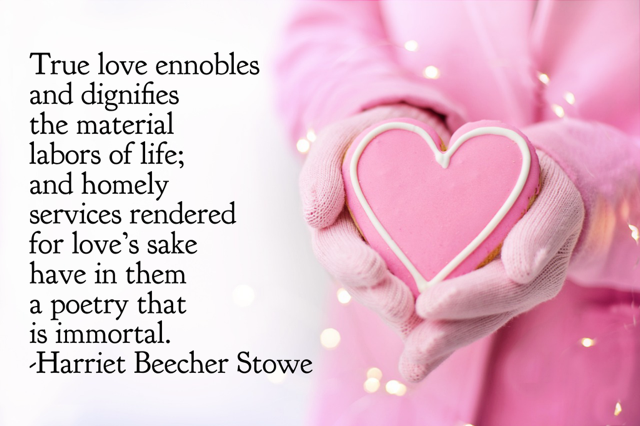
True love

True love ennobles and dignifies the material labors of life; and homely services rendered for love’s sake have in them a poetry that is immortal. ~ Harriet Beecher Stowe

Friday’s Fave Five

Friday's Fave Five

The Fridays just keep coming faster and faster. I’m thankful Susanne at Living to Tell the Story encourages us to pause for a few minutes every week and focus on the good things that have happened. This practice reminds us that good things have happened, that we can be thankful for them, and helps them last a bit longer before we pass to the next week.

1. Dinner and game night. Last week, Mittu and Jason brought over dinner and Settlers of Cataan. They had taught Timothy to play while they were snowed in a couple of weeks ago. We had not played it often as a family the last few years because it’s a long game, and we didn’t want to leave Timothy out while the rest of us were playing. So it’s nice he can participate now.

2. Gas discount. This happened last week, but I forgot to mention it. Getting gas was among my errands one day. We shop at two different grocery stores, both of which have gas stations and gas reward points. I usually get gas at one, but this time decided to stop at the other. I didn’t know that I had enough points for $1.20 off per gallon. Plus they expired the next day! The other station only allows $1 off at a time, no matter how many reward points you have. But this one allowed for the whole $1.20. This amounted to about $18 savings for almost a full tank of gas.

3. Jesse’s house. I mentioned that my youngest, Jesse, has been house-hunting. He put an offer on one, and things have been falling into place. The inspection showed a few problems, but nothing major. The seller was willing to take care of the one thing we most wanted her to. Then the appraisal came in just a bit below the asking price, but the seller was willing to drop the price to the appraisal rate. So it looks like everything is a go!

4. Nice weather. We’ve been in the 50s most days, even the 60s some days. I know winter hasn’t had its last hurrah yet, but I am enjoying the moderate temperatures while we have them.

5. New routines. I don’t like a rigid schedule: it feels too pressured. But I operate best with some kind of routine. Since Jim retired at the end of last year, and with all the sickness of January, we’ve not known what to expect every day. But now we seem to be settling into something of a flexible pattern.

How was your week?

Review: When I Close My Eyes

When I Close My Eyes, a novel by Elizabeth Musser

When I Close My Eyes by Elizabeth Musser is told from three different viewpoints.

Henry Hughes is ex-military with a wife and young son, Jace. Jace has had heart problems most of his young life and needs open-heart surgery. Henry doesn’t know how he’s going to pay the medical bills. His friend mentions he could get him a “job” with another friend–a job as a hit man. Henry is so desperate, he agrees to take on such a job just this once.

He stakes out the lady he has been hired to kill on a street in Asheville, NC, takes aim as she goes to her car—but she turns her head just as he fires. Consequently, the bullet that went through her brain puts her in a coma, but doesn’t kill her. He won’t get his money if she doesn’t die, but he can’t do anything else since people come running.

Henry hadn’t known anything about the woman he tried to assassinate, but when her name is splashed all over the news, he learns she is a best-selling author, Josephine Bourdillon. He begins to read her books and wonders if she really believes what she’s written about faith and forgiveness. He vacillates between wanting to ask her and needing to finish the job.

In her coma, Josephine remembers her past: society parents who kept up appearances despite fighting, alcoholism, and philandering behind the scenes, a rebellious, dramatic sister, and her own struggle with depression. She felt she had to be the perfect daughter to maintain the family myth and had to carry the weight of helping her sister, who, more often than not, didn’t want help.

Josephine’s daughter, Paige, has rejected the faith of her parents due to the hypocrisy of her grandfather and another family friend. Paige is a junior in high school but mature for her age. Her sister, Hannah, comes home from her year of studying in France to be with the family in the wake of Josephine’s shooting.

As police investigate, Paige is concerned that they’ll find out about what the family calls “the awful year.” Besides the death of her mother’s parents that year, there are hints of a secret that Paige doesn’t want to get out, a secret that might implicate someone in the family.

The “whodunnit” part of the story was handled well. Henry, of course, pulled the trigger, but once police find him, they want to know who hired him. I was sure it was one character—not the character the story points to at first—but I was wrong.

Depression is a big part of the book. Elizabeth said in a couple of interviews (here and here) that though her family was different from Josephine’s, her journey with depression was very similar. She wanted to bring light to that topic and show that even people of deep faith can struggle with depression. I would caution readers who might be sensitive to this that there is a suicide attempt in the book.

Other themes are hypocrisy and God’s grace.

I love that Elizabeth draws from her own experiences. She grew up in Atlanta, and she and her husband have been missionaries to France for several decades. Both Atlanta and France are featured in this book. The bulk of the story takes place in Asheville, NC. I’m not sure if Elizabeth has connections there, but that’s a city I love to visit. The drive some of the characters took on I-40 through the mountains is very familiar to me.

Some of my favorite quotes:

Mama always said that the painful things of life got redeemed in her stories.

The bad stuff hadn’t been able to snuff out the good stuff, or maybe it even happened because of the bad stuff.

My parents knew a lot about real, deep-down love. They knew it hurt. They knew it cost something valuable. They knew it was worth keeping.

There were just a couple of things I didn’t like. One was the use of a couple of words that aren’t profanity, but aren’t usually found in Christian books (though one is in the KJV. However, it’s not used there like it is used today). The other was bedroom scenes with Josephine and her husband, and mention of Henry’s wife in a see-through nightie. Nothing explicit was shown, but it was still more than I wanted to read. None of these things needed to be in the book. They only make up maybe half of one percent of the total book, but they still marred it a little.

Overall, however, the story was very good and the characters were well-developed.

I listened to the audiobook nicely read by three different narrators.

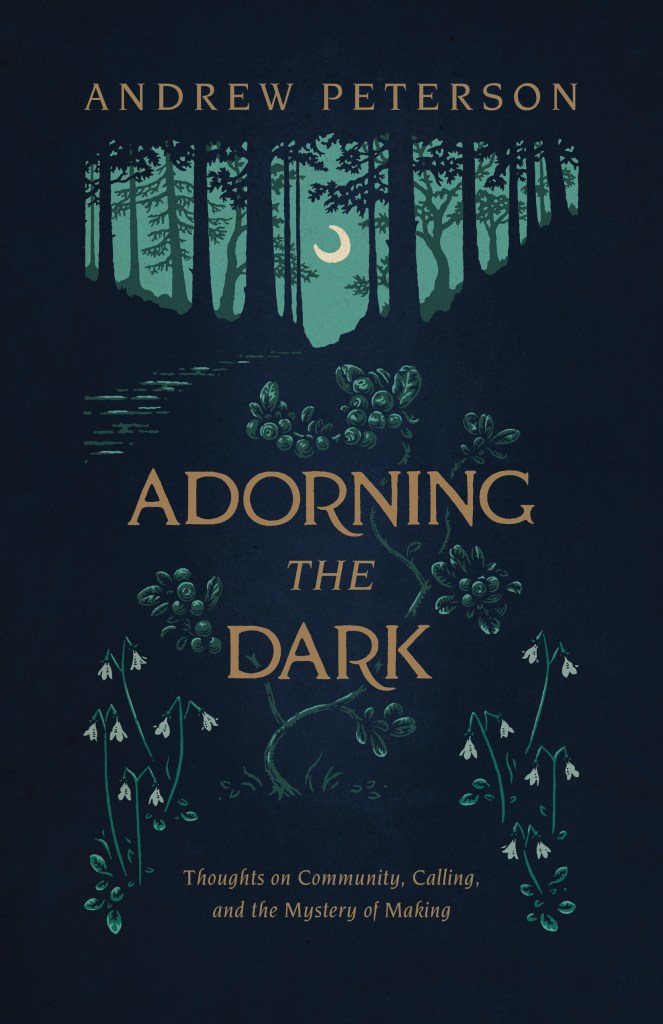
Review: Adorning the Dark

Adorning the Dark by Andrew Peterson

My first encounter with Andrew Peterson’s music was when a friend put the music video for “Dancing in the Mine Fields” on Facebook. The song is sweet one about marriage, and the video features several older couple holding their wedding portraits.

Then when I read The Yearling by Marjorie Kinnan Rawlings, I loved it so much I looked up some background information about it. I discovered another music video of Andrew’s called “The Ballad of Jody Baxter,” Jody being the main character in The Yearling.

Those songs are folksy, but many of you might be familiar with a contemporary song of Andrew’s titled “Is He Worthy?” We sing this at church sometimes.

I knew that Andrew had written a series of fantasy novels for children called The Wingfeaher Saga. I have not read them yet, but I want to. I’ve heard good things about them.

And somewhere along the way, I learned that Andrew was instrumental in forming The Rabbit Room, a site dedicated to “Cultivating and curating story, music, and art to nourish Christ-centered communities for the life of the world.” I have read a few articles there.

Even with that limited knowledge, I was interested when I saw Andrew’s Adorning the Dark: Thoughts on Community, Calling, and the Mystery of Making come up for a Kindle sale.

Andrew says he writes and speaks on this topic as “a practitioner, not an academic,” which means he “learned by doing, which is a nice way of saying that that I learned by doing it wrong half the time” (p. 4, Kindle version).

But not writing as an academic made the book extremely relatable. Andrew shares his journey, his testimony, and what he learned along he way.

Though he writes frequently of song-writing, many of of illustrations work for other kinds of writing and artistic expression as well.

In the first chapter, Andrew shares that many people know Bach wrote S. D. G., standing for Soli Deo Gloria (“glory to God alone”) on his manuscripts. But Andrew shares what few people know: that Bach also wrote “Jesu Juva,” Latin for “Jesus, help!” on his manuscripts as well. That’s an emphasis throughout the book. Andrew says is calling is “to use whatever gifts I’ve been given to tell the truth as beautifully as I can” (p. 4), and “to make known the heart of God” (p. 5).

He writes about battling self-doubt, creating as an act of worship, the fact that creating is work, not magic, that writing what we know doesn’t mean the polished end, but the struggle. He writes about humility, self-consciousness, and the fact that we don’t create to draw attention to ourselves even though “art is necessarily created by a Self” (p. 28). He references Lewis and Tolkien and others and talks about imagination, serving the work, and serving the audience.

One of the references to Lewis described his use of the word sehnsucht, an inconsolable longing which is evidence we were made for something more than we see and experience in this world.

One favorite section was about the tension between art and agenda and what makes Christian art Christian.

One great problem with much art that’s called “Christian” is agenda, which is to say that it’s either didactic, or manipulative, or merely pragmatic—in other words, the artistic purity of the work tends to take a back seat to the artist’s agenda (p. 47).

Art and agenda can and do coexist . . . Agenda is bad when it usurps the beauty. Christian art should strive for a marriage of the two, just as Christ is described as being “full of grace and truth” (John 1: 14). Truth without beauty can be a weapon; beauty without truth can be spineless. The two together are like lyric and melody (p. 47).

He describes revision, or selectivity, as “[pulling] the weeds before they choke the flowers” (p. 61) and being “able to discern what’s necessary to the aesthetic of the song and what isn’t. Then lose what isn’t” (p. 59). He points out that it takes forty gallon of maple sap to make one gallon of maple syrup. You wouldn’t put the sap on your pancakes. But once it’s boiled down, it’s perfect. On the other hand, “Revision is crucial . . . but it’s possible to monkey with something so much that the magic dies” (p. 99).

He writes that creating is not just inspiration, but also discernment and discipline—or dying to self.

He tells how art nourishes community and community nourishes art.

One of my favorite sections talks about how creativity isn’t just being “artsy.” We’re creative because we’re made in the Creator’s image. Andrew says the Rabbit Room’s conference, Hutchmoot, was meant to “encourage people to look for the glimmer of the gospel in all corners of life, that they would see their God-given creativity in both their artistic works and their front gardens, in their home repair and the making of their morning coffee, and that they would call out that glorious creativity in everyone they meet” (p. 89). His wife would “never claim to be an artist, but she’s one of the most creative people I know. Her song is our family” (p. 104).

I have multitudes of quotes marked besides what I’ve already shared. Here are a few:

Who do I think I am, anyway? We need not look anywhere but to the eyes of our Savior for our true identity, an identity which is profoundly complex, unfathomable, deep as the sea, and yet can be boiled down to one little word: beloved. That’s it. And that’s why it’s so silly (and perilous) to use your gifting to clothe yourself with meaning. Those clothes will never quite fit (p. 15).

Living as we do in dying bodies in a dying world, our best work always falls short of the initiating vision (p. 16).

If you wait until the conditions are perfect, you’ll never write a thing (p. 26).

Jesus, you’re the source of beauty: help us make something beautiful; Jesus, you’re the Word that was with God in the beginning, the Word that made all creation: give us words and be with us in this beginning of this creation; Jesus, you’re the light of the world: light our way into this mystery; Jesus, you love perfectly and with perfect humility: let this imperfect music bear your perfect love to every ear that hears it (p. 10).

The reintroduction of fairy tales to my redeemed imagination helped me to see the Maker, his Word, and the abounding human (but sometimes Spirit-commandeered) tales as interconnected. It was like holding the intricate crystal of Scripture up to the light, seeing it lovely and complete, then discovering on the sidewalk a spray of refracted colors. The colors aren’t Scripture, nor are they the light behind it. Rather, they’re an expression of the truth, born of the light beyond, framed by the prism of revelation, and given expression on solid ground (p. 41).

Somewhere out there, men and women with redeemed, integrated imaginations are sitting down to spin a tale that awakens, a tale that leaves the reader with a painful longing that points them home, a tale whose fictional beauty begets beauty in the present world and heralds the world to come. Someone out there is building a bridge so we can slip across to elf-land and smuggle back some of its light into this present darkness (p. 42).

The real flash of inspiration came not before they started working, but during the process (p. 47).

Keep working, keep straining toward a level of excellence that will most likely elude you forever, but it’s the only way your songs are ever going to move from bad to decent to good (p. 74)

Become a student of the craft. Have conversations with people whose insight dwarfs your own; they’ll teach you what to look for (p. 74).

Constraints are wonderful things, and lead you down paths you might not otherwise take (p. 99).

One holy way of mending the world is to sing, to write, to paint, to weave new worlds. Because the seed of your feeble-yet-faithful work fell to the ground, died, and rose again, what Christ has done through you will call forth praise from lonesome travelers long after your name is forgotten. They will know someone lived and loved here.

Whoever they were, they will think, they belonged to God. It’s clear that they believed the stories of Jesus were true, and it gave them a hope that made their lives beautiful in ways that will unfold for ages . . .

This is why the Enemy wants you to think you have no song to write, no story to tell, no painting to paint. He wants to quiet you. So sing. Let the Word by which the Creator made you fill your imagination, guide your pen, lead you from note to note until a melody is strung together like a glimmering constellation in the clear sky. Love the Lord your God, and love your neighbor, too, by making worlds and works of beauty that blanket the earth like flowers. Let your homesickness keep you always from spiritual slumber. Remember that it is in the fellowship of saints, of friends and family, that your gift will grow best, and will find its best expression (p. 98).

My only tiny quibble with the book is the title. Andrew speaks throughout the book of pushing back the darkness by shining light. To me, that sounds more accurate than adorning or decorating or enhancing the darkness.

Even though our tastes in music are different and I didn’t know many of the artists or songs Andrew referenced, I got so much from this book. I did add several of the books he mentioned to my want-to-read list. Parts of this book brought me to tears. But it also stirred my soul, fired my imagination, and left me with a burning desire to keep writing.

(I often link up with some of these bloggers.)

When Small Frustrations Boil Over

When Small Frustrations Boil Over

Often it’s not the big issues of life that trip me up: it’s the little everyday irritations. Anger and frustration can go from 0 to 60 in seconds over some dumb little problem.

Recently I was working on a blog post when my mouse started sticking. Either it wouldn’t move on the screen, or it wouldn’t highlight what I needed. I tried to highlight a phrase, and the mouse jumped to another part other than what I was trying to work on.

I checked my battery: it was fine. I checked that the USB sensor was within range and moved it closer anyway. Nothing helped.

I’m sorry to say I was so frustrated that I banged the mouse on the desk several times and shouted at it.

I know that doesn’t help. But it felt good. For a few moments.

Then, of course, I was ashamed of myself. I thought, “I’m glad no one was around to see that.”

But someone was.

Proverbs 15:3 says, “The eyes of the LORD are in every place, keeping watch on the evil and the good.” That’s a comfort, that He sees all that goes on, knows what is happening to us, will meet our needs, and provide grace for whatever He allows.

But it’s also a reminder that we don’t “get away with” anything.

I was reminded, too, of Ephesians 3:10: “Through the church the manifold wisdom of God might now be made known to the rulers and authorities in the heavenly places.” It’s odd to think of angels and creatures from Ezekiel looking down at God’s people on earth and learning about His wisdom. I have to wonder what they learned by seeing the temper tantrum of one of God’s children over such a minor issue.

I’m thankful that “with You there is forgiveness, so that You may be feared” (Psalm 130:4), that “If we confess our sins, he is faithful and just to forgive us our sins and to cleanse us from all unrighteousness” (1 John 1:9), that “As a father shows compassion to his children, so the Lord shows compassion to those who fear him. For he knows our frame; he remembers that we are dust” (Psalm 103:13-14).

I’m rebuked by the fact that since I don’t act like that when other people are around, it shows I do have some measure of self-control even though it didn’t feel like it in the moment.

And I’m convicted by remembering that giving way to temper and frustration in a little thing makes it that much easier to give way in other situations.

I reasoned that if the testing of our faith by trials is supposed to produce steadfastness, as James says, and we’re to “let steadfastness have its full effect, that you may be perfect and complete, lacking in nothing” (James 1:3-4), that’s true of small trials as well as large ones.

I thought of verses about anger, like Ecclesiastes 7:9: “Be not quick in your spirit to become angry, for anger lodges in the heart of fools.” I thought how God is “merciful and gracious, slow to anger and abounding in steadfast love” (Psalm 103:8; 145:8; 86:15). I remembered once again that as we “behold His glory,” we’re “transformed into the same image from one degree of glory to another” (2 Corinthians 3:18). I need to behold Him more in His Word.

Practically, I was motivated to remember to tell my husband the problem with my mouse. If I had done that one of the last several times I had problems, it would’ve prevented my little blow-up.

As I thought through all these things, I considered writing a blog post. Then I thought, “Nah, lesson learned, pick up and go on.” But the next day or so, the Daily Light on the Daily Path reading for the day was filled with verses linked to and including the Proverb mentioned above about God seeing us. That seemed a confirming nudge to go ahead with this blog post.

How about you? Do you ever lose it over little things? What have you found to help? Do any of these thoughts resonate with you?

Proverbs 14:29

(I often link up with some of these bloggers.)

Laudable Linkage

Laudable Linkage

Here are some of the good reads discovered this week:

Remember His Faithfulness. “When we look back at what God has done in the past, He fills us with hope for today and the days to come.”

Three Reasons Christians Should Oppose Abortion, HT to Challies. “We live in a highly charged political environment, and many Christians view abortion as more of a political issue than a theological and spiritual issue. This perspective often leads to prioritizing political solutions even at the expense of theological truth and spiritual power.”

Listening Well to Domestic Abuse Survivors, HT to Challies. “Domestic abuse (DA) is likely the most complex and difficult problem most counselors will ever face. Perhaps one reason for this is that these issues can be extremely counterintuitive.”

An Ordinary, Everyday Life, HT to Challies. We’re “Bought by His death and resurrection, yes. But also by His everyday, ordinary, sinless life.”

Lead Your Heart, HT to Challies. “We are to incline our hearts to God. I’m not sure if you know this, but your heart will not naturally incline itself that direction. We must posture our hearts towards God. And we must cry out to God for this inclination. Just as the Psalmist prays, ‘Incline my heart to your testimonies’” (Psa 119:36).”

Is ‘Gentle Parenting’ Biblical? HT to Challies. “If gentle parenting were just a mood board for solving parenting difficulties in nonconfrontational ways, I’d have nothing to say against it. But when you dig more deeply into the underlying concepts of gentle parenting, you find at least two that stand opposed to the Bible’s teaching about parenting.”

Confessions of a Secretly Introverted Mom, HT to The Story Warren.

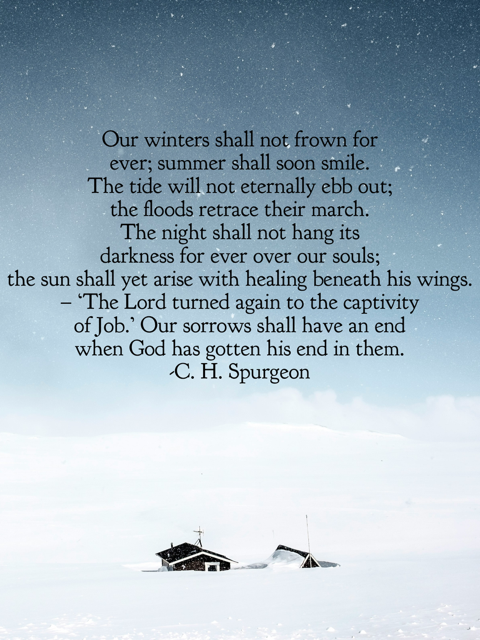
Spurgeon quote about winter

Our winters shall not frown for ever; summer shall soon smile. The tide will not eternally ebb out; the floods retrace their march. The night shall not hang its darkness for ever over our souls; the sun shall yet arise with healing beneath his wings. – ‘The Lord turned again to the captivity of Job.’ Our sorrows shall have an end when God has gotten his end in them.
—C. H. Spurgeon

Friday’s Fave Five

Friday's Fave Five

Yay for the first Friday in February! The weather is cold, but after single digits in January, 30+ degrees doesn’t feel so bad. I’m joining Susanne and friends at Living to Tell the Story in sharing five good things from the past week.

1. Bird feeders. I had been neglecting them, but my husband filled them the last couple of weeks. The birds are slowly finding them again, mainly chickadees and cardinals so far.

2. Getting back to church. I’m abundantly thankful church is available live online. We benefited from it through weeks of illness. But it was so good to be able to be there in person again.

3. An outing. I had a doctor’s appointment Tuesday, then went to Hobby Lobby to get some supplies for Valentine’s cards. I had a gift card, so I indulged in some pretties for the kitchen as well.

Kitchen decorations

4. A long overdue haircut does wonders in helping me feel put together rather than a mess.

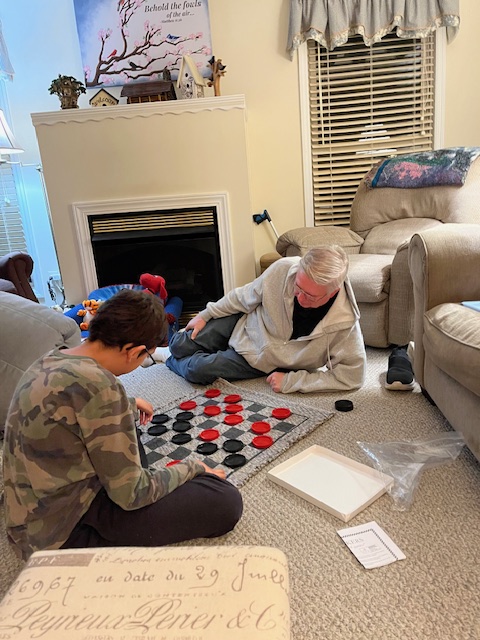
5. A good visit with Timothy. I mentioned in my end-of-month wrap-up that our church held a parenting seminar last weekend. We watched Timothy so Jason and Mittu could go. Though he’s comfortable with us, he had never been with us quite that long before–one evening plus the next morning and early afternoon. But he did fine. He and his Granddad played games, including checkers–the standard way at first, then making up their own rules. 🙂

Playing checkers

How was your week?

Review: The Cost of Betrayal

The Cost of Betrayal: three suspense novellas.

The Cost of Betrayal is a trio of romantic suspense novellas by Dee Henderson, Dani Pettrey, and Lynette Eason.

In Betrayed by Dee Henderson, Paul and Ann Falcon (from Full Disclosure) are at an auction just for fun. Ann buys a box of perfumes and scarves as inspiration for painting. But when Ann looks through the box at home, she discovers an engraved jewelry box with a ring stuck in it and an engraved pink pocketknife. A retired Midwest Homicide Investigator, Ann puts her skills to work to search for the owners to try to return those items. She discovers the knife belongs to a Janelle Roberts, imprisoned for killing her boyfriend after a bad breakup.

But the more Ann looks into the case, the more she thinks Janelle is innocent. Ann’s husband, Paul, is the head of the Chicago FBI office, and they pool their resources to look into Janelle’s case. They find enough to free Janelle, but not enough to convict the person they think is guilty.

They graciously provide for Janelle to hide out on an island with a friend and psychiatrist who can help her process what has happened to her and help her decide what to do with her future. Meanwhile, they watch the suspected guilty party, waiting for her reaction to Janelle’s release.

In Deadly Isle by Dani Pettrey, Tennyson (“Teni”) Kent’s fiance has just broken up with her. Joining her cousin, Julia, for their regular swim, Teni falls behind due to her emotions. When she gets to their usual stopping place, she doesn’t see her cousin. But she does see her boyfriend from years ago, Callum. He picks her up in his boat and joins the search for Julia. Sadly, they find her body.

Teni is an underwater investigator and Maryland NRP officer, so she sets about documenting the accident, not realizing at first that Julia’s death resulted from foul play.

Then, back at home, Teni’s house explodes due to a cut gas line. Teni happened to be out investigating a noise, so her life is mercifully spared. But she and Callum wonder—is someone out for her family? Or was Teni the target in Julia’s murder?

As a storm rolls in, landlines are down and Teni and Callum are on their own trying to figure out what happened and avoid getting killed.

In Code of Ethics by Lynette Eason, trauma surgeon Ruthie St. John works on Detective Isaac Martinez when he comes into the ER with a gunshot wound. Hours later, when she goes to check on him before leaving for vacation, she finds an unknown orderly attempting to put something in Martinez’ IV. After a scuffle, Ruthie learns that Isaac has been investigating some bad cops. He had reported one for stealing money and drugs from the evidence room. But the security footage was altered, and Isaac has no proof. Now many of the cops on the force have turned against him. He needs to look for evidence, but he’s in no shape to.

Ruthie is the only medical person in a family of cops. She sneaks Isaac out of the hospital and takes him to the cabin she had rented for her vacation. She calls her two brothers for help and reports to her mother, the chief of police. Ruthie helps Isaac track down his main lead, only to discover she isn’t who he though she was.

Of these three authors, I’ve only read Dee before (except for another trio of novellas by these ladies which I had forgotten about). I’ve read and loved most of Dee’s novels. If you love suspense, she’s your girl. It was fun to “visit” with characters Paul and Ann again. (As an aside, I have heard that some of Dee’s theology is somewhat wonky in her nonfiction and a couple of her novels. I’ve not read those, and I don’t remember seeing anything amiss in the novels of hers that I’ve read. But, with any author, exercise discernment.)

I’ve seen some of Dani’s posts on Inspired by Life and Fiction (a group blog where ten authors take turns posting) and Lynette’s on The Write Conversation and the Steve Laube Agency blog. But I have not read their books yet.

The main connection with each of the novellas is the fact of betrayal. Dani’s was the scariest to me, making me jump at creaks in the house and such. Lynette’s story appears to feature characters from other books as well.

I was a little frustrated that the case in one of the stories remained unsolved. But that would happen in real life. I’m not sure if the author plans any more stories on those particular characters.

I’ve had the book on hand for a while, but when I saw the audiobook for free through Audible’s Pus Catalog, I decided to get it. It was nicely read by Susan Bennett.

If you like suspense, I am sure you’d like this compilation. Collections of novellas are a nice way to try out new authors.