Wow, this week sure went by fast. I’m thankful Susanne atLiving to Tell the Story started this habit of pausing on Fridays to reflect on the blessings of the week. Here are a few of mine:
1. Mother’s Day. My family does a good job making me feel special on Mother’s Day. We had a mostly “man-made” meal, though Mittu said she and Timothy helped with the dessert. Jim grilled his trademark teriyaki chicken, Jesse made homemade baked macaroni and cheese, and Jason made Chocolate Pretzel Pie. Jim and Jesse worked together on corn on the cob. It was all so good! I didn’t get a picture of the whole dinner, but here’s the dessert:
2. Hanging baskets. Jim traditionally gets the baskets of flowers that hang outside the front door, the kitchen windows, and “office” windows for Mother’s Day if I have not gotten them beforehand. I love seeing flowers outside most of the windows.
3. Front door decoration. I finally traded out my spring tulips for a different look. I had this container up before, but the flowers had gotten mildewed. I had more but just got around to replacing them. This hangs beside, rather than on, our door because the door has an oval glass insert.
4. An unscheduled week. It was nice to have nothing on the schedule this week after Sunday and nothing that had to be done besides the regular everyday stuff.
5. A special answer to prayer. I can’t discuss the details, but it was wonderful to see God intervene, in answer to my husband’s prayer, in a situation that, humanly, looked very much like it would go a different direction.
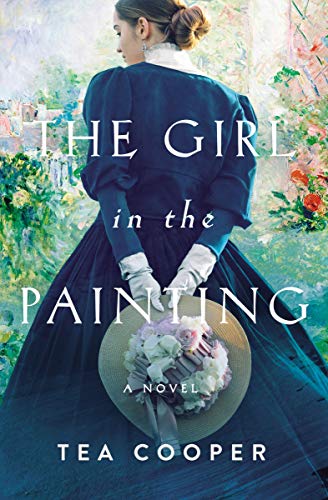
In The Girl in the Painting by Australian author Tea Cooper, Michael and Elizabeth Quinn are orphaned siblings who immigrated from England to Australia in 1862. Their parents had gone on ahead to take advantage of free passage for married couples and left them with an aunt. But the aunt died before the children left and they had to go to a workhouse until time for departure. Then they found, upon arrival, that their mother had died, and the father passed away, too, before long.
The father had established himself in an area of gold seekers. But he didn’t mine gold for himself: he started a business servicing the miners, especially hauling their things around. Michael, a teenager by this time, took over the business and built it up, leaving Elizabeth in the care of a woman they’d met on the ship until he could establish a home for them..
By 1906, the Quinns were wealthy business people and philanthropists in Maitland Town. One of their outreaches was to the local orphanage, in memory of their own time as orphans. One of the orphans, Jane, has an exceptional aptitude for math. The Quinns offer to take Jane in and pay for her education in exchange for her working for their company. She eventually becomes their bookkeeper as well as taking over many of Michael’s duties.
One day Jane and Elizabeth visit a one of their buildings where they’ve invited an artist to hold an exhibition. Suddenly the ultra self-controlled Elizabeth is on the floor, shaking in terror, hat off, mumbling unintelligible words.
After a while, Elizabeth seems back to normal and insists everything is fine. But she’s not back to normal, and everything’s not fine. Odd snatches of memory and terror keep coming back to her mind.
Jane makes it her mission to find out what caused Elizabeth’s episode and discovers some unexpected long-held secrets.
This was an enjoyable book, especially in trying to figure out the mystery behind Elizabeth’s reaction to a painting. It was nice to read something set in a different time and place than a lot of historical fiction (so much of which centers around WWII). We get a picture of what immigrants were up against in those times, not only the English, but also the Chinese who were treated mainly as servants and the lowest workmen.
I loved the cover.
My only minor complaint is that the change between happy and adjusted Michael and Elizabeth and unraveling Elizabeth and brooding Michael seemed rather sudden. I guess that’s an indication that the past was a well-kept secret. But it just seems that, in a literary sense, there would have been more hints throughout the book that everything was not as we thought. I only caught one, and that was only after finishing the book and going back to reread the siblings entry onto the ship taking them to Australia. But, again, it’s a minor complaint and can be explained by the reaction to the painting that set off that aspect of the story.
I had thought this was a Christian fiction book because I bought it from a Christian site. But it wasn’t in any real sense of the word. That’s fine—I don’t restrict myself to Christian fiction. It just meant the book wasn’t what I expected at first. The orphanage Jane comes from is Catholic. Some of the Chinese religious practices are explained when Elizabeth befriends the Chinese man who works for them. But there’s not much other religious content. I would disagree with one statement that it doesn’t matter what gods people prayed to and one person’s thought that a dead relative was looking out for them from heaven.
The book is remarkably clean for modern secular fiction. Michael took the Lord’s name in vain a couple of times and a couple people said “what the hell.”
My husband has no idea how much he owes Sandra Felton.
I did not come to marriage very organized in either my time or my stuff. In college, I wasn’t lazy, but I was always running behind. Many of my grades suffered from late deductions. And I can’t tell you how many times I got frustrated over not being able to find an item or paper I needed.
Sometime during early marriage, I came across Sandra Felton’s book, The Messies Manual. Then I subscribed to her newsletter for years until I knew by heart what each one was going to say.
I put a lot of Sandra’s principles into practice. I can’t say I became a paragon of organizational virtue, but I definitely improved from where I was.
But I learned something else about organization on my own. We can’t make up a workable schedule and put everything in its rightful place and then be done organizing. We have to maintain our systems and adapt them to new demands on our time and new items in our home.
So I have decided organization is not a destination. It’s a journey. And, therefore, I continue to occasionally reads books or articles about organization.
The authors state that “One of the goals of this book is to help you accomplish easily and quickly those necessary but uninspiring activities that comprise much of our daily lives so you can turn your attention to the significant things you want to do” (p. 9).
They point out how the advent of modern technology eased life in some ways but created a lot more things to do, some necessary and some distracting.
They say some authors “downplay organizing systems and indicate that if you have enough focus and self-control, you’ll be okay. Not so. You need good skills as well” (p 21.) So they point out overarching principles but also offer practical tips.
They remind us often that “time management is not the art of getting everything done. It is the art of getting the most important things done. To put it another way, it is priority management.” (p. 63).
The authors offer a variety of ways to determine priorities, make schedules, etc. I love that. Some time management books promote a very rigid system. I don’t usually like everything about other people’s systems, so I appreciate the variety of methods to experiment with to find one that works best.
They also tackle multitasking, interruptions, procrastinating, delegation, time wasters, schedules, developing good habits.
They apply principles to home and business.
Each chapter has several vignettes of people with organizing problems and the solutions they found.
The end of each chapter and the end of the book contain questions and activities to help implement the principles. The sessions at the end of the book could be done alone or with a group.
Here are a few more quotes that stood out to me:
Creative people have more ideas and interests than any one person can do in a lifetime, and we accumulate the paraphernalia to prove it. (p. 54.)
A word of explanation is necessary to those who fear setting up a schedule because it feels rigid and stifling. Scheduling is not an inflexible list that is written in stone. It is a statement of what regular tasks are important to accomplish each day and when you plan to do them during the day. As you become experienced in using and tweaking your schedule, you will find it meets your needs more and more successfully and will become your friend. (pp. 163-164).
When you create a schedule for routine tasks, you open a tap through which good time management can flow. A schedule is absolutely necessary because 1. It keeps you from forgetting what needs to be done. 2. It protects you from the unsuccessful “What do I feel like doing today?” approach (p. 164).
Although I would not classify this as a Christian book overall, the authors do employ some biblical principles.
There was only one place I strongly disagreed with the authors.
Organized people work dispassionately. That frees them from a lot of stress. Disorganized people wear themselves out by investing emotion in the things they have to do. They work while saying, “I hate making the bed every day” or “Unloading the dishwasher is such a drag.” The way to take the emotion out of doing what you need to do regularly is to make the activity into a habit (p. 196).
I can’t say that making activities into habits takes the emotion out of them. I still chafe at a lot of things that have to be done. However, making them a habit gets them over with rather than pushing them to the background. And I look forward to the satisfaction of getting them done.
I don’t think I learned much that was totally new to me from the book. But many of the principles I had formerly learned were applied in new ways, and all of the book was a much-needed reminder.
If you need to organize your time better or need to brush up on organizing principles, this book would benefit you.
“If only I didn’t have to [cook, do dishes, sweep, dust, do laundry, go to the grocery store, etc., etc. etc.], I could get something meaningful done.”
Have you ever thought something like that? Or said it out loud?
Life is full of necessary but mundane tasks.
And whatever we do today likely has to be done again in a few days, if not tomorrow.
I was struck recently by how often I have to refill things: the salt shaker, the tea pitcher, the napkin holder, the toothpick holder, the paper towel and toilet paper holders, the pantry, the refrigerator, the dishwasher, the clothes washer and dryer, the toiletry closet.
When we want to write or participate in some kind of ministry, it’s hard to make time without leaving something else undone.
Yet when I look at the “virtuous woman” of Proverbs 31, most of her day revolved around what would have been everyday tasks of her time: sewing for herself, her family, and her home (no department stores or online ordering in those days), cooking, seeking food “from afar,” buying a field, planting, working “willingly with her hands” late at night and early in the morning, making items to sell to supplement her family’s income. “She looks well to the ways of her household and does not eat the bread of idleness.” She fears the Lord. “She opens her hand to the poor and reaches out her hands to the needy.” She does all of this with strength, kindness, faith, wisdom and dignity.
A couple of blog friends remind me of this lady. Sadly, they are no longer blogging. But they used to write about their everyday activities in their homes: house projects, gardening and canning, sewing, cooking, etc. They didn’t write devotionals or Bible lessons, but they shared observations in passing about God’s dealings with their lives. Their spirit shone through even in the “homey” activities. They brought a “sense of Him” in everything they did, not just the “spiritual” activities.
The one lady I count as my main mentor was the same way. We never studied through a book together. She never sat me across the table for a lesson. There is nothing wrong with those things. But she taught me plenty by how she managed her home (which she graciously invited me to) and conducted her life. She may have said a few things on purpose as a means of guidance or instruction, but if she did, they were so mild and gentle that I didn’t know I was being “taught.”
When my kids were younger, I regretted that I didn’t have more time for just playing with them. Oh, we played. We’d make Lego creations, read tons of books, go to the park, throw a blanket over the kitchen table and picnic underneath. But I felt guilty because it seemed like I never spent “enough” one-on-one time with them.
Then I thought about this Proverbs 31 lady, or Ma Ingalls from Little House on the Prairie. Laura Ingalls Wilder writes of times that her mother played with her children, and I am sure the Proverbs 31 lady played with hers as well. But they didn’t spend all day at it. They didn’t just play together: they worked together. And Mother passed on to children characteristics they would need not only by direct teaching, but by example.
1 Corinthians 10:31 says, “So whether you eat or drink or whatever you do”—ordinary, everyday activities—“do it all to the glory of God.”
Of course, we have to be careful not to be like Martha, so busy that we neglect what Jesus called the one needful thing of spending time with Him.
And It’s fine to seek ways to do our work as efficiently as possible so we do have time for other activities. If God opens the door for writing, speaking, organizing gatherings, or whatever, great!
But we can glorify God and minister to others in those everyday activities as well. ______
For those of you reading this on Mother’s Day, I hope you have a happy day honoring your Mom. If, like me, your mom is no longer living, I hope you have sweet memories.
For those who are moms, I hope your family gives you some relief from those everyday duties and pampers you today.
I realize that though this day is joyous for some, it’s painful for others—those who did not have a good relationship with their moms, who have lost children, who don’t have children but long to. My heart goes out to you, and I pray God will specially minister to your heart today.
Here’s my almost-weekly round-up of good reads found this week:
The Secret to Not Being Manipulated. “We take it in, often uncritically. Yet right on the surface are aspects that should make us question what’s going on. . . . The key word is uncritically. We don’t stop to question. Thinking critically about what we read or hear doesn’t mean being critical in the sense of finding fault. It means asking questions.”
How to Kill Your Love for God’s Word. ‘Green thumb, black thumb, or somewhere in between—many of us are following these steps, and I’m not just talking about houseplants or gardening. If you want to kill your love for God’s Word, the same steps apply. “
As You Pray About Roe v. Wade. “But as we pray for America, I want to encourage us to widen our gaze a little bit and pray for the matter of abortion in other countries as well. Because, strange though it may be, the potential overturning of Roe v Wade, which is the law of the land in only one country, is already having ripple effects around the globe.”
Growing Up to Be Mom, HT to Challies. “Little hands on mighty hips, my seven-year-old face-offed with her teacher. The innocent question, ‘What do you want to be when you grow up?’ torched the classroom. It seems out of the entire class only my daughter thought the response, ‘I want to be a Mom,’ worth defending.”
A Mother’s Prayers. ‘Being a mother is a great joy—but also a heavy responsibility. And that’s why this Mother’s Day, I wanted to give the gift of prayer to each of our readers. I asked several mothers to share with me a specific way they pray for their children.”
Finally, this video of cakes that look like other objects is fascinating, HT to Steve Laube. I can’t even make regular old cakes that well. I watched a show with my son and daughter-in-law that was a contest like this: people had to choose everyday objects and then make a cake to look like their objects, then judges were brought in to determine which was the cake and which was the object. Amazing!
Yikes! I fell asleep in my desk chair this morning and woke up very late. Thankfully, I had most of this post written yesterday.
It’s hard to believe we’re through the first week of May already. It’s time to stop and reflect on the good things of the week with Susanne and others atLiving to Tell the Story.
1. Raises. Jesse, my youngest son, received some new responsibilities at his job, which included a nice raise. Then Jim told me last night that he had also gotten a raise.
2. Celebrations. We turned a family gathering into a celebration for Jesse. Mittu made his favorite meal (hamburger stroganoff) ad some gorgeous and delicious gluten-free lemon cupcakes.
3. Important paperwork. We got our wills, living wills, and powers of attorney all set and notarized this week–something that’s been on our to-do list for ages. It’s nice to have them done.
4. Planters planted. Just today (Thursday), I got my front and back planters planted. We’re supposed to have thunderstorms tonight, so I hope the plants don’t get pummeled. I not only love the flowers themselves, but both areas look neater with plants rather than the residue from last year. Update: we had rain and storms all night, and we’re supposed to have them all day as well. The flowers look okay but a little bedraggled. Unfortunately, I didn’t take a picture of them when I first planted them, and they’re too droopy for photos now. But, my roses are blooming!
5. Ceiling fans. The temperatures have not been high at night, and we have central AC anyway, but I have been waking up very hot. The ceiling fans help without my having to turn the AC down and freeze Jim out.
Winnie-the-Pooh is a creation of A. A. Milne based on the teddy bear of his son, Christopher Robin. Milne had written many other genres: plays, magazine articles, books for adults. But these days he is best known for Pooh and Christopher Robin and their friends.
My kids grew up with the Disney version of Winnie the Pooh and company. There were four individual videos at the time: Winnie the Pooh and the Honey Tree, Winnie the Pooh and the Blustery Day, Winnie the Pooh and Tigger Too, and Winnie the Pooh and a Day for Eeyore. The first three videos have since been combined into The Many Adventures of Winnie the Pooh. Then there was a Saturday morning cartoon called The New Adventures of Winnie the Pooh which we watched regularly for many years. We had stuffed Poohs (and Tiggers and Piglets) and Pooh picture books. If there were Pooh sheets or jammies, we would have had them.
But somehow, I never read the original Pooh books by A. A. Milne to my kids, and I have always regretted that. I’m not sure why I never read them. I had not read them in my own growing-up years: perhaps if I had, I would have made it a point to read them to my children just as I searched out some of the Little Golden Book titles that I’d had as a child. I dipped into one of the volumes at some point, but I don’t remember which one or if I completed it.
There are four books that specially deal with Pooh.
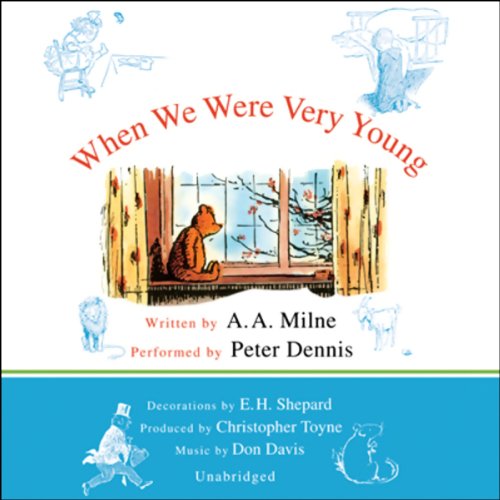
When We Were Very Young is a book of children’s poems. Christopher Robin’s bear there is named Edward. Some time after that, he renamed his toy bear Winnie-the-Pooh (with hyphens when his whole name is written, though he is often called just Pooh or Pooh Bear. The Disney version dropped the hyphens). “Pooh” was after a swan that Christopher had previously given that name to, and Winnie after a bear by that name in a zoo. Some of the poems feature Christopher, but all of them were probably inspired by him. One of the most famous is “Vespers” about Christopher saying his prayers.
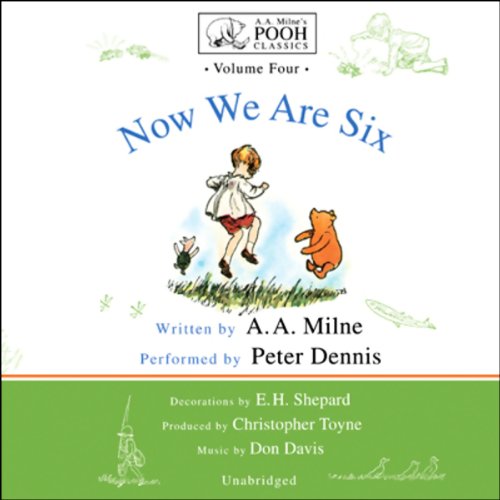
Winnie-the-Pooh is a collection of short stories about Christopher Robin and Pooh and the other animals/toys. The House at Pooh Corner, another collection of stories, was published next, and finally there was another collection of poems, Now We Are Six. “Forgiven” is one of my favorite poems from this volume.
One of the things I had liked about the videos and TV series was that they were quiet. There were conflicts and predicaments and misunderstandings, yes. But the shows weren’t full of noise and razzle-dazzle like other kid’s shows were (that was something I liked about Mister Rogers as well).
The books are the same way. The characters are endearing. Pooh is “a bear of very little brain,” but he is kind, thoughtful, and a faithful friend. He likes to make up rhymes and take time for “smackerel” of “a little something—usually “hunny.” Christopher Robin is the one everyone looks up to and the one who rescues the others when they get in trouble over their heads. Piglet is small and timid, but also kind and thoughtful. Rabbit is bossy, but has everyone’s best interests at heart. Eeyore is gloomy (actually, he’s a little harsher in the books). Owl is wise (he can even spell Tuesday!), Kanga is motherly, Roo is spunky.
One of my favorite quotes is from Pooh in The House at Pooh Corner about how poems come to him: “But it isn’t easy,’ said Pooh. ‘Because Poetry and Hums aren’t things which you get, they’re things which get you. And all you can do is to go where they can find you.” Another is this: “Sometimes,’ said Pooh, ‘the smallest things take up the most room in your heart.” And these:
Some people care too much. I think it’s called love.
People say nothing is impossible, but I do nothing every day.
It is more fun to talk with someone who doesn’t use long, difficult words but rather short, easy words like “What about lunch?”
“What day is it?” asked Pooh. “It’s today,” squeaked Piglet. “My favorite day,” said Pooh.
Piglet noticed that even though he had a Very Small Heart, it could hold a rather large amount of Gratitude.
I love how Kanga is described as carrying her family in her pocket (something Rabbit thinks strange at first).
And I dearly love this exchange between Eeyore and Pooh, read in Eeyore’s deadpan voice, when Eeyore thinks everyone has forgotten his birthday:
“Good morning, Pooh Bear, if it is a good morning. Which I doubt.”
“Why, what is the matter”
“Nothing, Pooh Bear, nothing. We can’t all, and some of us don’t, and that’s all there is to it.”
“Can’t all what?” said Pooh, rubbing his nose.
“Gaiety. Song and dance. Here we go round the mulberry bush.”
I was very glad to see that the films and videos, for the most part, told the stories almost completely as the books did. The series went on to develop their own stories based on the characters, but kept the same tone.
Milne captures childhood innocence and ways of thinking well with playfulness and gentleness. I was very sad to learn that Christopher came to resent the books about him as he became an adult, perhaps due to teasing from others when he went to boarding school. Christopher said in his own books that his father wasn’t very expressive in person: his inner thoughts came out in his writing. But his father’s obvious delight in his son and how he thought shines through in these stories and poems. I think Christopher must have come to terms with that at some point since he provided a favorable introduction to the audiobook of When We Were Very Young, saying family friend Peter Dennis’ narration presents Pooh “as he [Christopher] knew him.”
All four volumes of the books were available as part of my Audible subscription. I listened to the stories via audiobook, but read the poetry collections via Kindle (which included, thankfully, E. H. Shephard’s original illustrations).
One thing I didn’t like about the audiobooks was the long musical interludes between chapters.
But otherwise it was a sweet experience to visit these characters their original settings.
The Back to the Classics Challenge allows us three children’s classics. So I am going to count Winnie-the-Pooh as one for the “Classic that’s been on your TBR list the longest.”
It’s a shock to the system when you realize someone thinks of you as “old.”
For me, it happened when a fast-food cashier rang up my order with a senior discount—and I was only 50.
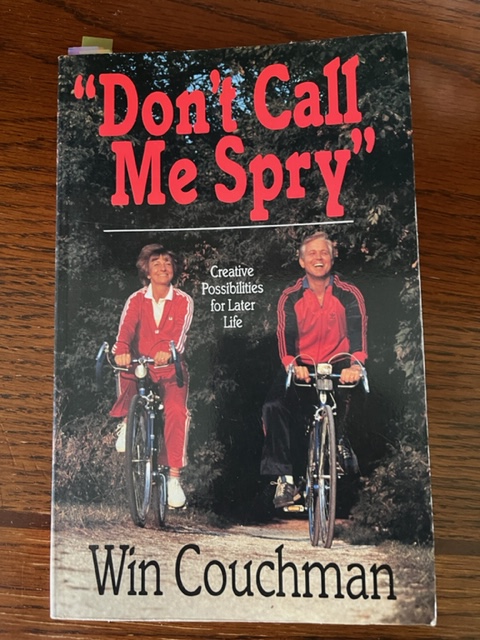
For Win Couchman, it happened when she ran into an old friend who commented, “You’re so spry!” “Spry” was a “compliment reserved for exclusively for old people.”
As the shock of this well-meant statement brought Win to tears, she began to consider aging.
I am at the young end of old: junior-high old. Youth is gone and now, also, middle age. My life at sixty-four is rich, adventurous, blessed, and full of joy (p. 2).
I am not only wrinkling. I am growing. And while I am forgetting some things, I am learning much that is new. This season of my life is as fearsome and exciting as turning fourteen. Nobody told me it would be this way (p. 3).
She decided to investigate “what it means to grow old” from the Bible, culture, the examples of older people in her life (“Not everything I learned from Grandmother about aging was glamorous, but all of it was valuable” [p.84]). She wanted to “notice and enjoy the perks that come with old age” (p. 4).
The results of her study and contemplation is “Don’t Call Me Spry”: Creative Possibilities for Later Life.
Win noted, “The halves of my life each merit my attention. The tension between the material and spiritual aspects of reality are normal. The struggle is to keep a balance: to live in light of the unseen while resetting the washer from ‘permanent press’ to ‘delicate fabrics.’ In order to live for God’s glory and not lose heart, I have the perspective of the eternal as a gift” (p. 4).
In their fifties, Win and her husband, Bob, began to pray and consider what to do when he retired. For many years, they had hosted a ministry called Forever Family which combined hospitality, mentoring, counseling, and teaching. But they were sensing maybe the time had come to do something different.
Through a series of events and contacts, the door eventually opened for them to minister in a variety of other countries eight months out of the year. They enjoyed the novelty and the opportunities to minister, resulting in some never-to-be forgotten experiences.
But they also experienced stresses with travel and continual adjustments, and they handled them differently. She liked to talk things out when stressed or anxious; he withdrew and became quiet. I’m sure those tendencies were always a part of their personalities, but these new experiences brought them to the forefront and required them to meet each other half-way.
Bob’s retirement brought other stresses and adjustments, like sharing space that she had previously had to herself.
Then new stresses arose when Win developed a heart issue which brought not only their international travel to a close, but their full-time active ministry as well. She had to rethink what she could do within her new reality. “It grieved me to give up thinking I could do anything anyone even a generation or two younger than I can do” (p. 45).
It saddened me to give up the illusion that I could always push myself a bit more if I needed to, that pushing was the thing to do. I could no longer be casual about getting too tired. I was newly aware of another true separation between me and those who are younger (p. 46).
She tells how God led her to other types of ministry, mainly mentoring, prayer, being involved with her grandchildren. She still taught and spoke on a limited basis.
One of my favorite chapters is “The Downside,” dealing with some of the negative aspects of aging. “When you ask me how I am, sometimes it is a little hard to know how to answer” (p. 107).
But even though Win describes herself as a pessimist, overall the book is hopeful and positive. The Bible assures that God’s care and love and grace will always be with us. In addition:
As I have looked repeatedly into the mirror of these verses, I have not only been provided with new assurance of God’s caring for me, but I have a greatly enhanced concept of the possibility of lifelong usefulness (p. 136).
While searching for more information about Win, I came across this video of her.
I had not heard of Win before until I read a chapter by her in The Wonder Years: 40 Women over 40 on Aging, Faith, Beauty, and Strength compiled by Leslie Leyland Fields. I didn’t discover until recently that her chapter, “The Grace to Be Diminished,” originally came from a magazine here. Then I found her poignant article, “The Beds I Have Known,” about living separately from her husband of 72 years when she could no longer care for him. I saw somewhere that she had written this book, so I searched for it. It’s out of print, but I found a used copy in good condition for $5 at Amazon.
I am glad to have found and read it. It gave me much encouragement as I look ahead.
In 1940, Isobel Kuhn found herself hitchhiking on an obscure Chinese road. She “had always thought that womanly women did not do such things,” but there was no other way to get where she needed to go. She caught a ride with a truck driver, “cringing with humiliation inside.”
She asked God why she had to be put in such situations. The verse came to mind, “For I think that God hath set forth us the apostles last, as it were appointed to death: for we are made a spectacle unto the world, and to angels, and to men” (2 Corinthians 4:9). A spectacle was just what she felt like. She was a little comforted. Even though this particular incident was a small one, she felt she endured it for His sake since she was a missionary.
Isobel felt that the spectacle Paul probably had in mind was the Arena in Rome, where Christians were thrown to the lions for sport. Later, she wrote:
Through the several years which followed, years of war strain and danger, this thought kept returning to me. The different trials of us Christians of the twentieth century are like so many platforms in the world’s Arena of today. The unbeliever looks on at our struggles and is only impressed or influenced if he sees the power of God working there. The purpose of the Arena experience is not for our punishment; it is that God might be revealed.
. . . God taught me through the years to view my own trials as platforms in today’s Arena. I thought this concept was original with me, but one day my husband found that Hudson Taylor had formed the same opinion many years ago. He said, “Difficulties afford a platform upon which He can show Himself. Without them, we could never know how tender, faithful, and almighty our God is.” I found it so, too. . . It seemed that my most valuable lessons have been learned on these platforms.
Her book In the Arena was written with this idea in mind, showcasing how God manifested Himself through obstacles, frustrations, strain, necessities, danger, and illness.
In 2 Corinthians 12, Paul had been praying for deliverance from a “thorn in the flesh.” Commentators offer good evidence for the different possibilities as to what that “thorn” might have been, anything from some physical ailment to actual demonic oppression. I agree with what Warren Wiersbe said in his commentary: it’s good we don’t know exactly what it was, so we can apply it to any kind of “thorn” in our lives.
Paul said God gave him this thorn in response to some special revelations He had given Paul. Paul mentioned earlier in this chapter that he had one experience in the “third heaven” that he was not even allowed to tell the details about.
We’re easily prone to pride when we hit spiritual heights, as though we had anything to do with them. So God gave this “thorn” to Paul “to keep me from becoming conceited” (verse 7). Paul asked God three times to remove the thorn. But God said no. Instead:
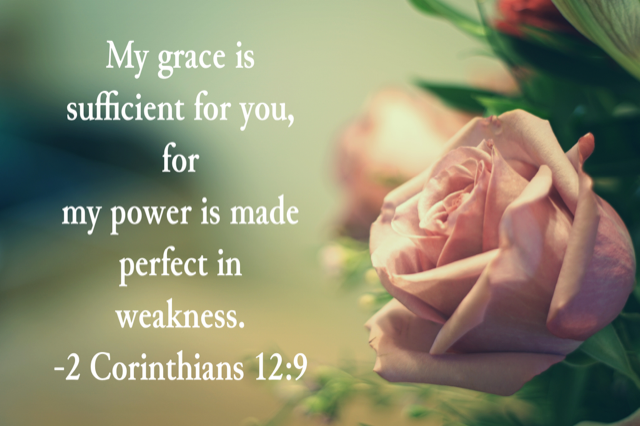
He said to me, “My grace is sufficient for you, for my power is made perfect in weakness.” Therefore I will boast all the more gladly of my weaknesses, so that the power of Christ may rest upon me.For the sake of Christ, then, I am content with weaknesses, insults, hardships, persecutions, and calamities. For when I am weak, then I am strong (2 Corinthians 12:9-10).
The ESV Study Bible says twice that “Paul’s earthly weaknesses, not his revelations, are to be the platform for demonstrating the Lord’s power and grace” (p. 2238).
That’s just the opposite way we think it should work, isn’t it? We think some mountaintop experience, some spiritual high point, will “show off” God’s power. And God does use those moments in people’s lives. But we don’t reach those heights in our own strength. Moses spent 40 days alone with God, and his face shown afterward. David went from the depths of despair to the heights of praise in the psalms. Elijah faced off with the prophets of Baal for a showdown of their respective deities. Yet spiritual highs don’t keep us from sin. Relying on God’s power does. Each of these men had very human weaknesses for which they needed God’s grace.
Paul’s thorn not only kept him humble; it kept him dependent. God had told him, “My grace is sufficient for you, for my power is made perfect in weakness.” When we’re tempted to go off on our own, our weaknesses remind us we can’t: we need God’s help. When a trial is more than we can handle, we’re reminded to give it to the One who can handle it.
The ESV Study Bible points out that in 2 Corinthians 12:9, when God says His grace is sufficient for Paul, the word “sufficient” is in the present tense, “underscoring the ever-present availability and sufficiency of God’s grace” (p. 2238).
Sometimes we don’t want people to get close enough to see our weaknesses. We think our weaknesses will mar our testimony. But people see our blind spots that we’re unaware of: they know we’re not perfect. When they see God’s grace and power in our lives, they know there is hope and help for themselves as well.
Seeing those needs in people’s lives makes them more relatable. When we see them recover from a stumble or struggle with human weakness, it encourages us that we can access God’s grace and carry on.
Even our Lord Jesus, though He never sinned, experienced weakness that draws us to Him. The fact that He stooped to experience humanness for our sakes shows us how much He loves us. We know He understands our weaknesses and needs, not just from omniscience, but from experience.
Since therefore the children share in flesh and blood, he himself likewise partook of the same things, that through death he might destroy the one who has the power of death, that is, the devil, and deliver all those who through fear of death were subject to lifelong slavery. . .Therefore he had to be made like his brothers in every respect, so that he might become a merciful and faithful high priest in the service of God, to make propitiation for the sins of the people. For because he himself has suffered when tempted, he is able to help those who are being tempted (Hebrews 2:14-15, 17-18).
Since then we have a great high priest who has passed through the heavens, Jesus, the Son of God, let us hold fast our confession. For we do not have a high priest who is unable to sympathize with our weaknesses, but one who in every respect has been tempted as we are, yet without sin. Let us then with confidence draw near to the throne of grace, that we may receive mercy and find grace to help in time of need (Hebrews 4:14-16).
Paul said he was not only content with “weaknesses, insults, hardships, persecutions, and calamities,” but he boasted in them (gloried, the KJV says). Some translations say “delight” instead of “am content.”
My first response in any trial is to pray for deliverance, and maybe secondarily to ask that I might learn what I am supposed to from it. But to be content in it? Even more, to delight in it? I can’t say I am there yet.
But maybe I’d be closer if I looked at the situation like I am supposed to, as a way for God’s power to be displayed.
One guest preacher at my college spoke of giving everything he had over to the Lord. When the car broke down, he prayed, “Lord, Your car needs help.” That’s probably a good way to look at it.
So we can be content with our thorns and even glad for them, because:
They keep (or make) us humble.
They remind us our strength is not in ourselves.
They keep us dependent on God’s grace and help.
They’re a testimony to others.
They make us more relatable.
They showcase God’s power.
How about you? Do these truths help you with your “thorns in the flesh”?
This song written by Mike Harlan and Cary Schmidt has helped me carry these truths with me:
Here are some good reads that ministered to me this week.
How to Hold Fast to Jesus in a World That’s Spinning Out of Control. “I could easily spiral into hopelessness and despair. But like my daughters, I learned at an early age to hold fast to Someone. I don’t get it right all the time, and I’ve spent time wandering and lost. But that urge to hold fast keeps me close to the only Solution I know.”
No One Knows My Pain, HT to Challies. “Rather than inviting others into my pain and grief, I’ve often pushed them away. I’ve felt a vague sense of self-righteousness, confident that no one could speak into my life except God himself. I’ve dismissed others’ experiences, even the comfort of friends, because they couldn’t fully relate to my suffering.”
Mentoring Our Next Generation. “Looking back, I am amazed to think that none of these people were a part of the youth staff at my church. They did not have a position that would have prompted their involvement in my life. What they did have was a heart that was burdened for me and a big enough concern to pursue me and challenge me to walk with God. They mentored me!”
Keep It Simple, HT to Challies. “What do you feel when someone asks you to disciple them? I imagine you’re excited because a hungry, likely younger Christian, wants to grow. I imagine there’s probably also stress because you don’t know where to begin. A wealth of good resources is at your fingertips, but that can make things more complicated. So where do you start?”
“I’m so sorry”—“Thank You,” HT to Challies. “When I sat down to write those obligatory notes of thanks, I never expected to receive so much in return. What I thought would be a tedious, hand-aching process instead was cathartic and healing.”
The Virtue of Argument, HT to Story Warren. “As I sat down to write this, my daughter asked me what I was writing about. Adequately explaining virtue to a 9-year-old seemed like it might take more time than I wanted to devote at the moment, so I simply said, ‘I’m writing about how argument can be good.’ She instantly responded vehemently with, ‘No, it can’t!? Arguing is a bad thing?!'” We’d probably all react that way to the writer’s premise. But she’s calling for “an exchange of ideas” in a virtuous way rather than “winning at any cost.” Since we constantly come across people with different ideas than we have, it’s good to think about how to talk about our ideas while still respecting the other person’s.
6 Lessons for Tending Your Time. “You ever feel like that? Like you can’t win with your schedule? Like you’re swinging between laziness and frenetic activity? Maybe you’re looking, like I was, for a better relationship with time.”
This was a funny video about the difference between mothering toddlers and teens:












 Stray Thoughts