Book Review: Be Rich (Ephesians) Gaining the Things That Money Can’t Buy

Warren Wiersbe’s Be Rich commentary on the book of Ephesians does not a promote the “prosperity gospel”—insert prayers and gifts to televangelists and receive health and wealth. No, as the subtitle goes on to say. “Gaining the Things That Money Can’t Buy.”

Ephesians 1:3 says God “has blessed us in Christ with every spiritual blessing in the heavenly places.” Just some of those blessings:

  • Chosen in Him (verse 4)
  • Adopted as sons (verse 5)
  • Redemption through his blood, the forgiveness of our trespasses (verse 7)
  • An inheritance (verse 11)
  • Believers are “sealed with the promised Holy Spirit, who is the guarantee of our inheritance until we acquire possession of it, to the praise of his glory” (verses 13-14).

Wiersbe says, “‘In Christ’ is the most frequently used phrase in the book of Ephesians, and the point is clear: If you’re in Christ, you have everything.”

Another theme in the book is unity. Not a unity that ignores truth, but unity based on truth. Paul, the author of the letter to the Ephesians, says God’s plan was “to unite all things in [Christ], things in heaven and things on earth” (1:10). The first half of chapter 2 tells how we can be reconciled with God; the second half says that God, through Christ, broke down the barriers between Jew and Gentile. “For through him we both have access in one Spirit to the Father. So then you are no longer strangers and aliens, but you are fellow citizens with the saints and members of the household of God … ” (2:18-19). Chapters 4-6 share practical ways that unity in Christ is worked out in the church community, in the home, and in the workplace.

I’ve got dozens of quotes marked, but here are a few:

The Bible is our guidebook; the Holy Spirit is our Teacher. As we search the Word of God, we discover more and more of the riches we have in Christ.

Salvation is a gift, not a reward. Salvation cannot be “of works” because the work of salvation has already been completed on the cross. This is the work that God does for us, and it is a finished work (John 17: 1–4; 19: 30). We can add nothing to it (Heb. 10: 1–14); we dare take nothing from it.

By His death and resurrection, Christ overcame the world (John 16: 33; Gal. 6: 14), and the flesh (Rom. 6: 1–6; Gal. 2: 20), and the Devil (Eph. 1: 19–23). In other words, as believers, we do not fight for victory—we fight from victory! The Spirit of God enables us, by faith, to appropriate Christ’s victory for ourselves.

The Christian life is not based on ignorance but knowledge, and the better we understand Bible doctrine, the easier it is to obey Bible duties. When people say, “Don’t talk to me about doctrine—just let me live my Christian life!” they are revealing their ignorance of the way the Holy Spirit works in the life of the believer. “It makes no difference what you believe, just as long as you live right” is a similar confession of ignorance. It does make a difference what you believe, because what you believe determines how you behave!

Of course, there’s much more to Ephesians and Wiersbe’s book.

Ephesians contains two of my favorite Biblical prayers that I sometimes pray for myself and others. I’ll leave you with those

For this reason, because I have heard of your faith in the Lord Jesus and your love toward all the saints, I do not cease to give thanks for you, remembering you in my prayers, that the God of our Lord Jesus Christ, the Father of glory, may give you the Spirit of wisdom and of revelation in the knowledge of him, having the eyes of your hearts enlightened, that you may know what is the hope to which he has called you, what are the riches of his glorious inheritance in the saints, and what is the immeasurable greatness of his power toward us who believe, according to the working of his great might that he worked in Christ when he raised him from the dead and seated him at his right hand in the heavenly places (1:15-20).

For this reason I bow my knees before the Father, from whom every family in heaven and on earth is named, that according to the riches of his glory he may grant you to be strengthened with power through his Spirit in your inner being, so that Christ may dwell in your hearts through faith—that you, being rooted and grounded in love, may have strength to comprehend with all the saints what is the breadth and length and height and depth, and to know the love of Christ that surpasses knowledge, that you may be filled with all the fullness of God. (3:14-19).

(Sharing with Worth Beyond Rubies, Carole’s Books You Loved, Booknificent Thursday)

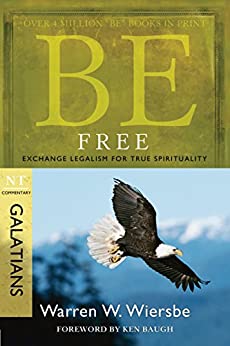
Book Review: Be Free (Galatians): Exchange Legalism for True Spirituality

 Be Free (Galatians): Exchange Legalism for True Spirituality by Warren Wiersbe is a commentary or study guide to read alongside the New Testament book of Galatians.

Paul wrote a rather strongly-worded letter to the Galatians with none of his usual thanksgiving and commendation for his readers. That’s because the Galatians were confusing law and grace.

The first Christians were Jewish and were quite stunned when Gentiles became believers. There was a lot of confusion at first about whether Gentile believers had to follow the same practices as the Jews (see Acts 10, 11, and 15).

The apostles and the elders were gathered together to consider this matter. And after there had been much debate, Peter stood up and said to them, “Brothers, you know that in the early days God made a choice among you, that by my mouth the Gentiles should hear the word of the gospel and believe. And God, who knows the heart, bore witness to them, by giving them the Holy Spirit just as he did to us, and he made no distinction between us and them, having cleansed their hearts by faith. Now, therefore, why are you putting God to the test by placing a yoke on the neck of the disciples that neither our fathers nor we have been able to bear? But we believe that we will be saved through the grace of the Lord Jesus, just as they will. (Acts 15:6-11, emphasis added).

The initial confusion was understandable. But some, called Judaizers, persisted in teaching that Gentile believers must keep the OT law, especially the Jewish rite of circumcision. Paul insisted this was trusting in works, not grace, and we’re not saved by works.

It wasn’t that circumcision was good or bad in itself. Paul mentions bringing Titus, a Gentile believer to Jerusalem with no thought of having him circumcised (Galatians 2:1-5). But later in Acts 16:1-3, Paul had Timothy circumcised. Was Paul being inconsistent? No, Timothy was half Jewish, half Greek, and Paul wanted to bring him along on his missionary journeys. As a part Jewish man, Timothy would never have been accepted or listened to by the Jews without being circumcised. So in his case, circumcision was a matter of not being a stumblingblock to those he wanted to minister to. (John Piper goes into this more here.) The difference was that neither Paul nor Timothy were trusting in circumcision as a means to salvation or to earn favor with God. The Judaizers were.

So Paul argues against law and for grace, appealing to the Galatians personally, doctrinally, and practically. They were in danger of teaching false doctrine, of forsaking and perverting the gospel. It was serious enough for Paul to write as he did.

I won’t go into all the details or Wiersbe’s outline here. But Wiersbe makes application to our day. Probably few of us are tempted to observe Jewish law for salvation as the Judaizers were. But we can easily lapse into trusting in the rules or standards of whatever faith group we’re a part of instead of trusting Christ alone for salvation.

Millions of believers think they are “spiritual” because of what they don’t do—or because of the leader they follow—or because of the group they belong to. The Lord shows us in Galatians how wrong we are—and how right we can be if only we would let the Holy Spirit take over.

When the Holy Spirit does take over, there will be liberty, not bondage—cooperation, not competition—glory to God, not praise to man. The world will see true Christianity, and sinners will come to know the Savior. There is an old-fashioned word for this: revival.

Here are a few other quotes.

We must never forget that the Christian life is a living relationship with God through Jesus Christ. A man does not become a Christian merely by agreeing to a set of doctrines; he becomes a Christian by submitting to Christ and trusting Him (Rom. 11: 6).

We not only are saved by grace, but we are to also live by grace (1 Cor. 15: 10). We stand in grace; it is the foundation for the Christian life (Rom. 5: 1–2). Grace gives us the strength we need to be victorious soldiers (2 Tim. 2: 1–4). Grace enables us to suffer without complaining, and even to use that suffering for God’s glory (2 Cor. 12: 1–10). When a Christian turns away from living by God’s grace, he must depend on his own power. This leads to failure and disappointment. This is what Paul meant by “fallen from grace” (Gal. 5: 4)—moving out of the sphere of grace and into the sphere of law, ceasing to depend on God’s resources and depending on our own resources.

God revealed Christ to Paul, in Paul, and through Paul. The “Jews’ religion” (Gal. 1: 14) had been an experience of outward rituals and practices, but faith in Christ brought about an inward experience of reality with the Lord. This “inwardness” of Christ was a major truth with Paul (2: 20; 4: 19).

Ever since Paul’s time, the enemies of grace have been trying to add something to the simple gospel of the grace of God. They tell us that a man is saved by faith in Christ plus something—good works, the Ten Commandments, baptism, church membership, religious ritual—and Paul made it clear that these teachers are wrong. In fact, Paul pronounced a curse on any person (man or angel) who preaches any other gospel than the gospel of the grace of God, centered in Jesus Christ (Gal. 1: 6–9; see 1 Cor. 15: 1–7 for a definition of the gospel). It is a serious thing to tamper with the gospel.

Justification is an act of God; it is not the result of man’s character or works. “It is God that justifieth” (Rom. 8: 33). It is not by doing the “works of the law” that the sinner gets a right standing before God, but by putting his faith in Jesus Christ.

Reading this book was a little different from reading the author’s Be Reverent on Ezekiel. Ezekiel has 48 chapters, so Wiersbe’s commentary covered broader sections in his chapters. But Galatians only has six chapters, so Wiersbe took two chapters to discuss each chapter of Galatians. If I had been reading this on my own, I would have just read one chapter of Wiersbe’s commentary on half a chapter of Galatians a day. But because I was reading one chapter a day of Galatians for our church Bible study, I had to read two chapters of Wiersbe to keep on track. It had my head spinning a couple of days, especially in the more doctrinal parts of the book. But Wiersbe in generally pretty easy to follow and comprehend.

(Sharing with Carole’s Books You Loved, Booknificent Thursday)

Book Review: Be Reverent

Warren Wiersbe has written a “Be” series commenting on almost every book of the Bible. The individual books cover more than a study Bible would, but they are not as in-depth as some commentaries. They are good study aides. Wiersbe gives background information, word meanings, different interpretations for passages as well as his reasons for the interpretation he chooses, and applications for modern-day believers. His style is easy to read.

The books are available in paperback, but I often see a few at a time on Kindle app sales for 99 cents to $1.99. I’ve collected most of them, but, I’m sorry to say, they stayed tucked away and forgotten in my app.

Our church has been reading trough Ezekiel for the last several weeks. Ezekiel is known for having some of the toughest passages in all of Scripture to understand and interpret, so I figured perhaps a bit more help than my study Bible might be needed.

Wiersbe sets the theme for Ezekiel right in the title: Be Reverent (Ezekiel): Bowing Before Our Awesome God. Judah had been taken over by the Babylonians, and most of the nation was sent to Babylon in three different deportations. God had called Jeremiah to warn the people before the kingdom fell to Babylon. He called Ezekiel to preach to the people in Babylon.

Many prophets would act out object lessons for the people. But Ezekiel seems to have been given not only the most of what the ESV Study Bible calls “street theater” messages, but also the most unusual. Wiersbe calls them “actions sermons.”

One of our former pastors taught that many of the prophets prophesied during the same era, and one reason was that different people responded to different personalities. Some may have thought Ezekiel a little weird or might have been uncomfortable watching him, but others would have been drawn especially because he was different.

Wiersbe points out several repeated phrases in the book:

  • God is called “Lord God” (“ Sovereign Lord” NIV) over four hundred times.
  • “I am the Lord” occurs fifty-nine times.
  • “You will know that I am the LORD” (6:7 NIV) . . . is found seventy times.
  • Ezekiel is called “son of man” ninety-three times.
  • “The phrase ‘the word of the Lord came’ is used fifty times in his prophecy and speaks of the authority of his message, and ‘the hand of the LORD’ is found also in Ezekiel 3: 14, 22; 8: 1; 33: 22; 37: 1; and 40: 1. The word of the Lord brings enlightenment and the hand of the Lord enablement (see Eph. 1: 15–23).”

Wiersbe notes that “The Jews were sinning against a flood of light” in that they had the books of Moses, “knew the terms of the covenant,” had heard the messages of several prophets, “yet persisted in disobeying God’s will.” “The attitude of the people wasn’t that of militant opposition but rather passive indifference.” “In their pride, they had cultivated a false confidence that the Lord would never allow His people to be exiled or His temple destroyed, but their sin had now ‘matured’ and both were now about to happen.”

We must correctly distinguish regret, remorse, and true repentance. Regret is an activity of the mind; whenever we remember what we’ve done, we ask ourselves, “Why did I do that?” Remorse includes both the heart and the mind, and we feel disgust and pain, but we don’t change our ways. But true repentance includes the mind, the heart, and the will. We change our minds about our sins and agree with what God says about them; we abhor ourselves because of what we have done; and we deliberately turn from our sin and turn to the Lord for His mercy.

Ezekiel assured the people that “Though His people were in exile and their nation was about to be destroyed, God was still on the throne and able to handle every situation. In His marvelous providence, He moves in the affairs of nations and works out His hidden plan.”

Ezekiel had to deal with the people about their sin and idolatry, but he also held out hope that one day God would set up a future shepherd (34:22-24), a covenant of peace (34:25-31), and His presence with them (34:30; 48:35).

One of the applications Wiersbe says Ezekiel brings out for us is “Too much so-called worship is only a demonstration of man-centered religious activity that fails to bring glory to the Lord.” He warns against falling into the trap Judah did in keeping outward forms of worship and religious activity without engaging the heart.

There is a lot of controversy in Ezekiel, too, especially over what the details of the new temple mean in the last few chapters.

There’s so much more, both to Ezekiel and Wiersbe’s comments. But perhaps this gives you taste of both. I’m looking forward to exploring more of the “Be series” in the future.

(Sharing with Carole’s Books You Loved, Booknificent)

Laudable Linkage

IMG_0195

I don’t want to “laud” my own writing, but I wanted to let you know The Perennial Gen published a piece I wrote titled “Limitations Don’t Limit Your Ministry.”

Here are some great reads discovered this week:

How to Study Your Bible in 2020.

How a “You do You” Culture Has Made Us Vulnerable to the Coronavirus, HT to Challies. “We can only stop the virus by doing what is best for others not just for ourselves.”

A Life That Points Others to Christ. “My most earnest prayer is that when someone hears my testimony, they would be compelled to go find Jesus and His Word for themselves.”

God Is Always Good. “We evaluate God’s character based on our circumstances, when we should evaluate our circumstances based on God’s unchanging character.”

Safe, HT to Challies. A poem by Paul Tripp.

‘Progressive’ Christianity: Even Shallower Than the Evangelical Faith I Left, HT to Challies. “I’ve walked in both shoes: the shoes of those who deserted and the shoes of Peter who couldn’t leave, no matter how hard it seemed to stay. I was an #exvangelical who left the faith of my youth for ‘progressive Christianity.’ Then I returned. Here’s my #revangelical story.”

Was Jesus Married to Mary Magdalene? Revisiting a Stubborn Conspiracy Theory, HT to Challies. In a word, no. This post debunks some of the false claims.

Surrendering Control When Facing Coronavirus, or any other situation where we don’t have control. “I’ve found it helpful, when facing out-of-control situations that cause me anxiety, to sort my concerns into two categories: 1. What I Can Control; 2. What I Cannot Control.”

3 Ways of Confronting the Problem of Diminishing Attention Spans Through the Great Books, HT to Challies. Good reasons to read the classics.

Guides for Kids and Middle-Schoolers to Take Notes During the Sermon, HT to Challies.

The Story Warren has a round-up of “awesome good-priced, free, discounted, livestreamed, giveaway, etc., stuff” being offered online during our “sheltering at home.”

Finally this video shows How Soap Kills the Coronavirus, HT to Challies.

Have a good Saturday, and stay safe.

Laudable Linkage

These are some online reads that gave me much to think on:

5 Bible Study Techniques for Busy Moms. “We make it so complicated sometimes with rules and regulations, but the most important thing about being in God’s Word is to just actually be in it.”

And on that note, 10 Ways to Engage With Scripture. “How do you engage with Scripture? Since the key to knowing God’s heart is through His Word, I pondered her question.”

Can My Calling Really Be That Simple? “It’s easy, especially in Christian circles, to get grandiose ideas of what calling looks like. It’s easy to look for people who make a big difference, give up everything, and have the numbers (or passport stamps) to prove it.”

Ten Exhortations Concerning Gossip Blogs and Online Speech, HT to Challies. I would add, don’t pass on tweets or posts that contain this kind of thing, and don’t share something with the thought, “I don’t know if this is true, but just in case…” Check it out first.

James 3:1 and the Trembling Teacher. If you’ve ever tried to teach a Sunday School class, lead a Bible study, speak (or even write) about spiritual things, you can likely identify with this post.

To the New Parent, HT to True Woman. “What a gift you have in your hands and really, the best is still ahead of you. There’s no ‘Just wait until…’ God’s grace will equip you for each new season, even if his grace simply equips you to fall to your knees.”

This Is Your Body Today, HT to Challies. “What does it mean to bear on our bodies the marks of living in this world, to experience all that life and God will give and throw at us, and to not blame the sleeplessness or stretch marks on being a mother—or to find pride in them either because they birthed live children? To not blame the creaks and groans on laziness or lack or time. To not see ourselves as a victim of some perverse injustice, but to simply say to the body that holds us today and to the God who made it: ‘Thank you’ and also ‘This hurts’?”

Max Lucado’s Endorsement of Jen Hatmaker: What it Means and Why it Matters, HT to Challies. I don’t know much about either of these two people and have not read their stuff, but I agree with the principles discussed here. The same God who calls people to unity calls out those who preach something other than biblical truth.

Finally, I had not heard of the group 40 Fingers, but stumbled across this very pleasant video this morning:

Happy Saturday!

Ways to Both Read and Study the Bible

When I first became a Christian, the church I was in urged people to read the Bible through in a year. I’m so glad, because I believe that grounded me in my faith more than anything else.

In later years, pastors often emphasized the need to read passages of the Bible in context and encouraged to read a book of the Bible through at a time rather than scattering our reading all around. I mentioned last week Drew Hunter‘s quote that we wouldn’t read only page two of a friend’s three-page letter. Nor would we read a paragraph on page three and a line on page one. The Bible isn’t a book of random quotations. Each book is a coherent whole, and all together they present a unified message.

Reading the whole Bible helped me keep things in context and see the grand themes of the Bible. It helped me get into books like Leviticus and Chronicles, which I probably would not have drifted into. I found some nuggets there I would have missed. Reading all of the Bible helps you interpret it, as some passages shed light on other passages.

Kelly Needham says:

Most Christians I talk to have never read the entirety of the Bible. They may read it frequently but only parts of it. But daily reading parts of the Bible doesn’t mean you know it any more than daily reading the first chapter of Moby Dick makes you an expert on the famous novel. Ignorance of the whole of God’s Word makes us easy targets in the war Satan has waged against God. Lies can slip through undetected like poison gas because we’re just not that familiar with the truth.

I still believe in reading the Bible through, but I don’t do it in a year any more. Sometimes I wanted to slow down, but felt I couldn’t or I’d fall behind schedule. Once one does fall behind, it’s hard to catch back up. So now I just go at my own pace. I don’t even know how long it takes me. Sometimes I read a couple of chapters a day. Other times I read more or less. I usually read the shorter epistles a few times through before moving on because they’re packed so full and go by so quickly.

I’ve seen some two-year or other plans. John O’Malley said in Overcoming Your Devotional Obstacles, “If it takes you five years to read through the Bible, you are not less of a Christian. Read it at a pace that you can comprehend it and receive something from it.”

Some folks I know have tried “binge-reading” the Bible occasionally. Joel Arnold says, “A pretty average reader can finish in 100 days by reading just 40 minutes a day.” My friend Kim once read the whole Bible in 90 days and shared her experience here.

Joel once read the whole Bible in a week, 10-12 hours a day. Afterward he noted:

The Bible is the most intertwined body of literature I’ve ever read. The books cite, quote, allude and echo each other constantly. It’s like a city, built up layer by layer, strata by strata, so that each later addition rests on every layer that came before … We don’t usually sense these relationships because we’ve forgotten 95% of the OT before we ever get to the New. But having it all out in front of your brain at once changes that completely. You find yourself flipping back and forth constantly between the testaments, jumping across thousands of years of history to study the same teachings and sometimes even the same phrases (Meditations from Binge-Reading the Bible).

Obviously no one can read 10-12 hours a day every week. But if we can use vacation time to binge watch a TV series, why not use it to read the whole Bible?

However, if we only read the Bible in great chunks, we miss something. We’re also told to study it, meditate on it, chew on it. Sometimes we need to slow down and spend more focused time on a smaller passage. Charles Spurgeon is quoted as saying, “Some people like to read so many [Bible] chapters every day. I would not dissuade them from the practice, but I would rather lay my soul asoak in half a dozen verses all day than rinse my hand in several chapters. Oh, to be bathed in a text of Scripture, and to let it be sucked up in your very soul, till it saturates your heart!” Sometimes there’s nothing like honing in on one or a few verses for an extended amount of time.

Remember, the early churches did not have the entire Bible bound in one book for a long while. They had the Old Testament and gospels, but they would have spent a great deal of time on the one letter sent to their congregation and others as they came around.

I mentioned last week that Tim Challies said the larger blocks of reading were for familiarity, and reading for intimacy was slowing down and meditating on or studying shorter passages. Kelly Collier calls these two methods plow work (which “moves through large portions of Scripture more quickly,” like reading the Bible in a year or two) and trowel work (“taking a passage or verse of Scripture and settling in to dig for a long time,” like inductive Bible Study). I likened the two styles to a panoramic or macro lens. Or we could simply call them reading and studying.

I wrote a few years ago about finding time to read the Bible. Some seasons allow for both reading and studying, and it’s great to do both each day if you can. With the friend’s letter I mentioned earlier, we usually read the whole thing once or twice and then go back over it section by section. That’s good to do with a Bible passage as well. But it’s hard enough some days to get a few minutes to read the Bible at all. How can we possibly employ both reading and studying?

Here are some ideas:

Take turns. Often after I’ve finished a book of the Bible, I’ve taken a break to do a shorter study. Then I go back to the next book of the Bible.

Alternate days. Use a few days of the week for general reading, the others for more focused study.

Do the opposite of your church. For several years we were under a pastor who took a very detailed, thorough approach to preaching through a book of the Bible at a time. It took us years to get through Romans. But that was great, because then we knew it well. Since the preaching I heard was the in-depth, verse or two at a time style, my personal reading was more general. By contrast, when in other churches where the preaching covered more ground, I liked to do in-depth studies on my own.

Join a Bible study group. Bible studies tend to be slower and more focused (unless they’re topical), so I did in-depth study for the group and more general study on my own.

Adjust as needs arise. Once, chagrined and ashamed after an angry outburst, I set aside my regular Bible reading to look up and mediate on passages dealing with anger. That kind of thing has happened several times: an issue came up that I had to study out now.

Slow down and speed up as you feel led. In reading the Bible through, if I feel the need to put the breaks on in a certain passage and camp out for a while, I do so. Then I’ll pick up the pace for more general reading later.

There are going to be days when your regular routine flies out the window: illness, traveling, company, emergencies. God gives grace for those. I have a small devotional book called Daily Light on the Daily Path that is a few verses on a certain theme each day. Usually I use it to start my devotions, but some days that’s all I get to.

There are going to be seasons in life when finding time for quiet study is nearly impossible, like when young children are in the house. Just like we sometimes grab a protein bar instead of having a sit-down lunch, so our spiritual feeding sometimes has to be grab-and-go rather than a leisurely meal. When I truly only had time for a verse or two, God fed my soul with just those verses. Anything is better than nothing. One writer proposed a micronutrient Bible reading plan for those times.

We need to keep in mind the goal for reading the Bible isn’t just to get through it in a specified time. Instead, we read to learn it, learn from it, get to know God and His Word better.

Our current church has us read through a book of the Bible together. We’re asked to read five chapters of the Bible a week, one a day Monday-Friday with Saturdays to catch up. Then the preaching focuses on a short passage of a different book. Then we all learn a verse each month. So we incorporate the general overview reading, have a more in-depth study of a short passage, and spend a longer time meditating on one verse. That’s not a bad practice for one’s personal reading as well.

What ways have you find to incorporate both reading and studying the Bible? Do you tend toward one more than the other?

(Sharing with Inspire Me Monday, Global Blogging, Hearth and Soul, Senior Salon, Purposeful Faith, Happy Now, Tell His Story, InstaEncouragement,
Recharge Wednesday, Worth Beyond Rubies, Share a Link Wednesday,
Let’s Have Coffee, Heart Encouragement, Grace and Truth, Faith on Fire,
Blogger Voices Network)

You don’t have to choose a word for the year

If you read many blogs, you’ll find a lot of people writing about a word they’ve chosen for the year. I don’t know how long this has been a thing, but I’ve been reading about it for several years now.

For many, choosing a word for the year replaces a list of resolutions. That one word gives them focus for the year. Christians who do this usually pray about it leading up to the new year and feel this word has been given them or impressed on them by God. They often plan their Bible study around their word.

Many share that this emphasis has been a great blessing to them. Some have been amazed at how God intersects their study and circumstances around their word. Some, like my friend Lisa, purposefully read several books involving their word over the course of a year. Others, like Crystal, plan activities to incorporate their word.

But perhaps you’ve never felt led to choose a word for the year and you wonder if you’re missing out. Or perhaps you’ve chosen one in the past but, like a soon-forgotten New Year’s resolution, it faded out of memory.

I just want to assure you of a few truths.

God never tells anyone in the Bible to choose a word, a theme, or even a verse for the year. That doesn’t mean the practice is wrong. It’s just one method of focus and of studying and applying God’s Word.

God may lay on your heart to study a certain topic, truth, characteristic, etc. from the Bible, and that may or may not coincide with January 1 and may or may not last a year.

Psalm 119:105 says “Your word is a lamp to my feet and a light to my path.” Commentary I’ve read for that verse said that with the lighting they had in Bible times, they could only see a step or two ahead. God may well prepare you for something that only He knows is ahead through a word for the year. But often you don’t have that much notice. God’s guidance and provision is often moment by moment, day by day.

What’s more vital than a word for the year is daily seeking God in His Word.

I’ve never felt led to choose a word for the year. I’ve often said that God usually has more to say to me than one word. And, to be fair, those who choose a word for the year don’t claim that’s the only thing God wants them to deal with. They do read other books and other parts of God’s Word as well.

A topical Bible study on a certain word or concept can be highly valuable. But we also need the daily reading of Bible passages in context. Drew Hunter says:

If you received a three-page letter from a distant friend, you wouldn’t just read page 2. You could spend all day “studying” that page, but until you read pages 1 and 3, you will not fully (or perhaps even rightly) understand your friend’s message.

The human authors of the Bible organized their books intentionally. So, we step back and think through the author’s flow of thought. Studying the Bible involves thinking paragraph-by-paragraph, section-by-section, and seeing how everything fits into the overall structure and flow of the book.

We need the panoramic lens to take in the beauty and wonder of the big picture of God’s Word. We also need the macro lens for close-ups, for camping out with a verse at a time and mining its truths. Tim Challies calls these reading for familiarity (reading longer passages in a sitting) or intimacy (slowing down and meditating on or studying shorter passages) and says we need both approaches. Kelly Collier calls these two methods plow work (which “moves through large portions of Scripture more quickly,” like reading the Bible in a year or two) and trowel work (“taking a passage or verse of Scripture and settling in to dig for a long time,” like inductive Bible Study).

Choosing a word for the year shouldn’t replace contextual Bible study.

There are many who choose and study a word for the year and employ both these other methods of studying the Bible in context. That’s ideal. For some, the word for the year is their close-up, slowed-down study. That’s fine.

While many people find great value in choosing a word for the year, those who don’t use that method shouldn’t feel they’re missing out or somehow not as spiritual.

Jesus said, “Man shall not live by bread alone, but by every word that comes from the mouth of God” (Matthew 4:4). Let’s be faithful to partake of that bread every day.

Morning by morning he awakens; he awakens my ear to hear as those who are taught (Isaiah 50:4).

Your words were found, and I ate them, and your words became to me a joy and the delight of my heart, for I am called by your name, O LORD, God of hosts.  (Jeremiah 15:16)

____________________________________________

(Sharing with Inspire Me Monday, Global Blogging, BOSS Blog Share, Hearth and Soul, Happy Now, Tell His Story, InstaEncouragement, Anchored Abode,
Recharge Wednesday, Worth Beyond Rubies, Share a Link Wednesday,
Let’s Have Coffee, HeartEncouragement, Grace and Truth, Faith on Fire)

Book Review: Engaging the Scripture

I enjoyed Deborah Haddix‘s Journaling for the Soul so much, I bought her new Engaging the Scripture: Encountering God in the Pages of His Word not long after I first saw it.

I love that Deborah emphasized engaging the Scripture—not just reading an assignment, not just searching for information. Rather, “we are to read intentionally with the purpose of hearing from God, knowing Him, deepening our relationship, and nourishing our soul” (p. 28).

Deborah has chapters on the importance of God’s gift of His Word, dealing with distractions, further explanation about what’s involved in engaging the Scripture. Then she has a chapter for each aspect of engaging Scripture: reading, writing, meditating, memorizing, and praying it. A later chapter shares ways to interweave these practices (meditating while memorizing, praying verses while writing them, etc,)

Each chapter is fairly short: three to six pages of text, a page of personal reflection about the chapter, a section on resources for implementing the chapter, and a practice page or two.

Each chapter includes multiple ideas for engaging, with the encouragement to chose which works best with your wiring, schedule, and season of life. Tidbits of advice, encouragement, and wisdom are interspersed throughout the pages. Just a few:

Experiencing distractions during our quiet time does NOT make us a failure (p. 34).

Overwhelm often results in total abandonment. Start small. Experience success. Then incorporate additional ideas as you move forward (p. 39).

The physical food we take into our physical body does not nourish us unless we properly digest it and take it into our cells. Just as physical food is needed for physical strength, spiritual food is necessary for spiritual strength. The Word you read (the spiritual food) must be chewed, digested, taken into your being, and one way to chew your food is by memorization (p. 100).

Deborah has mastered the art of writing the way writers for the Internet are advised to: short paragraphs and lots of white space. The book isn’t long, but its style makes it seem even more manageable.

This is a wonderful resource that I highly recommend.

(Sharing with Carole’s Books You Loved, Recharge Wednesday, Booknificent,
Grace and Truth, Senior Salon, Global Blogging, Inspire Me Monday,
InstaEncouragment, Worth Beyond Rubies, Heart Encouragement)

Laudable Linkage

I found some great reading this week. Maybe one or two of these would appeal to you.

From Christians Who Formerly Identified as LGBTQ: A “Thank You” to Our Allies, HT to Proclaim and Defend. “To be publicly acceptable, our faith must affirm LGBTQ behavior and identity, as if Christ came soothingly to tell us there is no such thing as sin. Yet, in truth, embracing and celebrating a tendency toward that for which our Maker did not make us leads us away from Him. Basing our identity on that which is false is not the will of the One who is faithful and true. Over many years of struggle, what transformed the stigma for me was neither shame nor pride, but surrender—a surrender to the Savior’s embrace. I slowly began to unite the wounds of my sin and my struggles with same-sex attraction with the wounds of Jesus.”

The Scatter-Brained Girls Guide to Bible Study. “One second I’m pondering a deep thought, and the next I’m watching bunnies frolic in the back yard while thinking about the report I have to accomplish at work later.”

The Problem With “Spiritual but Not Religious,” HT to Challies.

Hospitality Is Not Homebound. “Hospitality is not centered only around our homes. The truth is that hospitality is about YOU, not your house or your schedule or your cooking skills. What people want is an openness, a kindness, and a posture that says that you are available and you care, and you can offer that wherever you go.”

In the House of Tom Bombadil, HT to Story Warren. This was a lovely piece about a section in Lord of the Rings that many either puzzle over or skip over. “Why do this? Why break up the action with a story of a Bed and Breakfast joint run by a man who sings like Kenneth Williams’ Rambling Sid Rumpo? As I reflected, it dawned upon me that this is so often what God provides for us. Perhaps not the faldi-singing host, but certainly the moment to pause when we’ve felt hardly able to catch a breath.”

My Face Became a Meme, HT to Challies. I often wonder what people think when their face becomes an often-used meme. Here’s one man’s experience.

This Twitter thread starts out: “Three years ago my husband’s grandmother moved in with us and on her first night, she put a dress on the dish soap. My life hasn’t been the same since.” The comments and photos are so funny. My granny made crocheted toilet paper holders like some of the ones shown, only hers looked like a poodle. HT to Laura.

Artist Pokes Fun at Literature in 30 Cartoons. about artist John Atkinson. I loved these, especially the one or two sentence synopses, like this one:

Happy Saturday!

Laudable Linkage

This is my latest collection of thought-provoking online reads:

Is the God of the Bible a Genocidal Maniac? HT to Challies. No, but some have made that accusation. Here is a thoughtful response.

When Joy Feels Far Away, HT to True Woman. “What do you do when you have tried everything, but joy still feels far away?”

How to Study the Bible. I have not had a chance to watch these videos yet, and I normally wouldn’t post something I haven’t checked out for myself first. But Jen Wilkin’s Women of the Word is one of my favorite books. An updated version has just been released, and Jen published a series of videos showing how to use the Bible study method she writes about.

A Stack of Bibles. “The power of the Reformation was the power of the Word of God in the hands of normal people.”

How to Hope in God When a Door Closes.

My Love Cannot Save You, HT to Challies. As deep and wide and strong as a mother’s love is, we’re still limited in how much we can protect our children. “I can’t prevent her pain or her tears, but I know the One who wraps his arms around her and catches every tear in a bottle, present and attentive to each one.”

How TO (and how NOT to) Raise a Monstrous Son, HT to Lou Ann. “For his own good, and for the good of all the women he will encounter in life, he needs you to stand up to him when he crosses the line, especially in regard to using his physical strength to harm others.”

Four Things the Princess Culture Gets Wrong, HT to True Woman. “Rather than jumping on the bandwagon of the mommy wars—to princess or not to princess—I’ve opted to reframe the concept according to biblical truth.”

Why NO ONE Should Object to Clean Teen Fiction. Believe it or not, some do! These are good reasons they shouldn’t.

I don’t follow many comics online, but xkcd is one. Here are a couple of recent entries:

Happy Saturday!