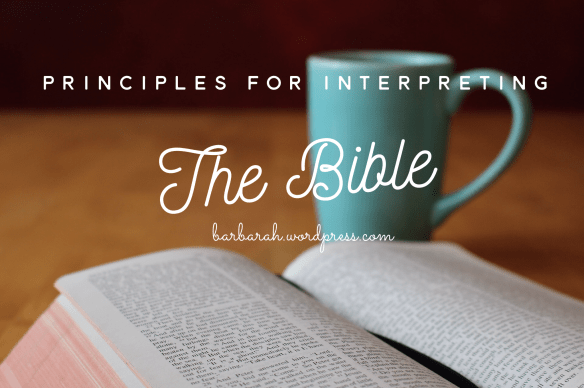
Principles For Interpreting the Bible

IMG_0039

Have you ever wondered why two people can take the same Bible passage and come up with different meanings for it? Have you ever heard anyone say, “Oh, you can make the Bible say anything you want it to say,” especially when you’re trying to bring spiritual truth to bear on a situation? It’s true that people wrest Scripture to make is say something it wasn’t meant to say. Whole false religions have been created by doing just that. How can we guard against doing that ourselves? By applying good principles of interpretation, called hermeneutics.

 “Biblical hermeneutics is all about finding the correct interpretation of the inspired text. The purpose of biblical hermeneutics is to protect us from misapplying Scripture or allowing bias to color our understanding of truth.” (http://www.gotquestions.org/Biblical-hermeneutics.html).

Some of you might think something like, “I will never be a preacher; I’m not even a teacher—so what does it matter how I interpret Scripture?”

It matters, first of all, because we’re instructed to “Study to shew thyself approved unto God, a workman that needeth not to be ashamed, rightly dividing the word of truth.” (II Timothy 2:15). Even though that verse was written as instruction to a preacher, it’s also God’s inspired Word to us. Really, is there anyone who shouldn’t rightly divide the Word or study it aright? We want to understand what God said to us and not be led stray by misunderstanding His Word.

It matters, secondly, because each of us has a sphere of influence. Whether we ever stand in front of a classroom or audience or not, we come across people in our daily walk, we have relatives, friends, neighbors. What we read and how we read Scripture forms our understanding of spiritual matters (and our spiritual understanding of practical matters) and will influence our views, which in turn will affect our conversations and character and witness and influence.

Besides paying attention to the words themselves and how they are put together grammatically, like you would do with any reading, here are a few principles for rightly interpreting Scripture:

  • Pray. In Psalm 119:18, the psalmist prayed, “Open thou mine eyes, that I may behold wondrous things out of thy law.” Several times he asked for God to give him understanding or teach him. In How to Master the English Bible, James Gray said, “The most important rule is the last. Read it prayerfully. Let not the triteness of the observation belittle it, or all is lost. The point is insisted on because, since the Bible is a supernatural book, it can be studied or mastered only by supernatural aid. … Who is so well able to illuminate the pages of a given book as the author who composed it?” (I don’t know anything about the author or book than this, but thought the last two lines especially good.
  • Take the passage literally unless it’s obviously not meant to be literal. Someone once said about understanding the Bible, “When common sense makes good sense, seek no other sense.” There are some who “spiritualize” much of the OT, saying that the creation account, among other things, is just a myth and there was no real historical Adam. But the Bible presents creation and OT history as literal events in the lives of real, literal people. In Genesis 1, there is no reason to interpret the days of creation as anything other than 24-hour days. But when Jesus speaks of eating His flesh and drinking His blood, we know He is speaking figuratively, partly because of the reaction of the disciples—or lack of reaction they would have had if they thought he was speaking literally.
  • Context, context, context. Taking a verse or passage out of context is one of the biggest violators of its meaning. Just one example: You can find nice plaques or Pinterest quotes that take Exodus 14:13-14 (“And Moses said unto the people, Fear ye not, stand still, and see the salvation of the Lord, which he will shew to you to day: for the Egyptians whom ye have seen to day, ye shall see them again no more for ever. The Lord shall fight for you, and ye shall hold your peace”) and condense it down to a pithy saying like, “Be still! Your God will fight for you.” But in the very next verse, God says, “Wherefore criest thou unto me?” And then He tells them what to do. Later, though there were times God supernaturally gave Israel the victory, most of the time they had to take up swords, spears, and shields, and fight. They still couldn’t win unless they were depending on Him rather than their own strength, but they trusted God to work through them.

Sometimes even good people will defend a stand or draw a good principle from a passage that isn’t teaching that principle. If the person you’re speaking with then does go back to look up the passage mentioned, your whole position is weakened if the context doesn’t support it. If the principle arises from the context, however, it is all the stronger and more enriching.

  • Don’t imprint your thoughts onto the text, but let the text reveal its meaning. A former pastor used to say that when he first started preaching, as he studied the passage he was going to preach on, he would ask himself, “What can I say about this passage?” After some time he realized that was the wrong question. The right one was, “What does this passage say?” For example, for years I heard that the people’s surprise at Peter’s release at the prayer meeting in Acts 12 was evidence that they weren’t praying in faith. But Dr. Layton Talbert, in his book Not By Chance: Learning to Trust a Sovereign God, brings up a different viewpoint. We don’t know that they were praying for Peter’s deliverance from prison. He points out that the text doesn’t say. James was killed by Herod earlier in the chapter: since he was not delivered they may not have expected Peter to be, either. “The only precedent we have for the church’s prayer under similar circumstances is in Acts 4:23-30. There, in the face of recent imprisonment, persecution, and renewed threats, the church made only one request. And it wasn’t for deliverance from prison or persecution; it was for boldness in the face of both (4:29)” (p. 203).
  • Compare Scripture with Scripture. The Bible is the best commentary on itself. One of the most important reasons for reading it through is to keep balanced and to keep the “big picture” in mind. A lot of theological error comes from emphasizing one part of a truth and neglecting or deemphasizing of the rest of it. Sometimes seemingly contradictory passages balance one another out or present different sides of the same truth. For instance, Proverbs 26:4-5 says, “Answer not a fool according to his folly, lest thou also be like unto him. Answer a fool according to his folly, lest he be wise in his own conceit.” Those sound like two different instructions, but there is a time to answer and a time it would be unwise to answer, and we need God’s wisdom to discern when and how.
  • Consider the genre. Though all the Bible is inspired and true, we would read Deuteronomy, Proverbs, Ecclesiastes, Romans, and Revelation all a bit differently, taking into account the different kinds of literature each is as we seek to understand them.
  • Consider the historical setting or culture of the passage. Understand that OT Israel was under a theocracy and was given specific promises (like the promise of a particular piece of land) and were under certain restrictions that New Testament believers are not (Acts 15:1-31). Even though some situations discussed in the Bible, even in the NT, are not ones we have to deal with today (like eating meat offered to idols), it’s still important to read them and discern the principles involved.
  • Note the difference in passages of direct instruction and passages of example. I once heard a message that used Abraham’s seeking out a bride for his Isaac as a springboard for telling parents how to find spouses for their children. While there are good principles to glean (like seeking a godly spouse, praying, seeking God’s guidance, etc.), it doesn’t mean that since Abraham found a wife for Isaac, parents today need to find spouses for their children. That was the culture then (see #7), but nowhere in the Bible are parents instructed to find spouses for their children in this way.
  • Note what is said to whom, determine what it meant then, and then determine how it applies to us today. For instance, as a younger Christian I wrestled with whether what Jesus said to the “rich young ruler” in Matthew 19:16-26 about selling his possessions and giving to the poor was something every Christian should do. But then I realized no on else wads told to do that. Though the Bible has a lot of instruction about our possessions (“compare Scripture with Scripture”), that particular admonition was to convict that particular man about his core problem.
  • Don’t “surface” read. Take time to read carefully and meditate on the passage. Biblical meditation isn’t an emptying of your mind, but rather thinking over and over a passage and “chewing” on it.

There is much more that could be said. In fact, every time I come back to this post I think of something else to add. Whole books have been written about this, so I can’t possibly cover every aspect in one blog post. But this gives us plenty to ponder.

Even with these principles in mind, sometimes good people can differ in their interpretations. There are some mysteries that we won’t be able to resolve until we get to heaven. We need to pray, study it out for ourselves, and consult commentaries of those who have had more time and tools to study. Where the Bible speaks clearly, we need to stand firm. But in those areas that are less clear but aren’t a matter of heresy, we need to give grace to those who might not see it exactly like we do.

I’ve wondered through the years why God did not spell everything out so there could be no mistaking the meaning or application of it. Perhaps one reason is to test our own hearts, to encourage our study, our dependence on Him, and grace toward each other.

(Sharing with Inspire Me Mondays, Literary Musing Mondays, Works For Me Wednesday, Woman Word Filled Wednesday, Thought-Provoking Thursday)

Save

Save

Save

Save

Save

Save

Laudable Linkage

Here are some good reads discovered recently:

Women: Trade Self-Worth For Awe and Wonder. Yes!

Trouble, We’ve Been Expecting You. Excellent.

Stop Trying to Make the Bible Relevant to Teenagers, HT to Challies, by which he means, you don’t have to present it in a way to try to make it “cool” to them. Its truth relates to all of us: just show them how it speaks to their needs.

Back to the Early Church? Excellent. Sometimes people idealize the early church in Acts, but it had its problems, too.

On Bible study:

What Is Bible Study?

4 Reasons Why Every Bible Reader Should Do Word Studies.

On prayer:

The Busy Mom’s Guide to Prayer. Good tips not just for moms.

4 Ways to Keep a Fresh Prayer Life.

On caregiving and dealing with aging parents:

What I’ll Say to My Children If I’m Diagnosed With Alzheimer’s.

What Caregivers Know and You Can, Too.

Her New Happy.

On parenting:

As Seemed Best to Them. Yes! Parenting is not a one-size-fits-all endeavor.

Why We Don’t Punish Our Kids. Not advocating not dealing with sin, but explaining the difference between punishment and discipline.

And to end on a smile…I saw this on Pinterest and cracked up:

Lego

Happy Saturday!

Save

Laudable Linkage

It’s been a couple of weeks since I’ve shared noteworthy things discovered around the Web, so here goes:

Two Methods of Bible Study. Do you ever struggle with whether to read larger portions of the Bible or to camp out deeply in smaller passages? Both are needed, and this is the best explanation of the two methods I’ve seen.

The Value of Children. Love this. Great insight.

Afraid of the Unknown. Yes, I tend to be, and this was very helpful.

When My Work Is Marginalized, Unappreciated, or Belittled.

Today Is Not a DIY Project.

Laser Rays…and Moonbeams. Lovely piece on the power of words to tear down and build up, beautifully written.

His Wife, Not His Mother and Part 2: Practical Tips: Learning How To Be His Wife, Not His Mother.

Sexual Desire and the Single Girl (10 Tips For Purity)

How to Write Without Sounding Preachy.

Love this! Some nice film editing about what kids might be imagining in their play, HT to The Story Warren:

Happy Saturday!

Laudable Linkage

Here are some noteworthy reads discovered recently:

Antidote to False Teaching: Stability and Growth in The Knowledge of Christ. Quote: “The single most effective method for studying any book of the Bible is accessible to every believer.”

3 Truths to Speak to Your Temptation

Imagination and Evil. Quote: “Children’s books that scrub any evil from the story are burgeoning. The conflicts are based on misunderstandings or due to a different perspective. They are easily solved with a pleasant discussion. It’s very sanitary! But are we telling our children the truth by painting an evil-free, pain-free world? Stories are not innocuous; they convey a worldview just as powerfully, if not more so, than direct statements.”

Me Before You: Dear Hollywood, Why Do You Want Me Dead? “11-year-old wheelchair athlete tells the culture to get over itself”

Check Your Words at the Door

My Husband Doesn’t Put the Kids to Bed, and It’s Really Okay

I’m not sure why I keep reading Jess Connell. I enjoy her posts but she mainly writes about raising children, and I am past that stage. Maybe to recommend her to others? Anyway, here are three that struck a chord with me lately:

Motherhood 101: The Class We Never Got. Learning “on-the-job” while feeling overwhelmed.

How To Set Your Kids Up For Obedience.

Is Homeschooling a Safeguard Against Rebellion?

Praise Him in the Hallway.

More Weird Things Writers Say.

Imagine If Ebooks Came First.

And to end with a smile…

Cover squirrel

Husky
Happy Saturday!


Laudable Linkage

Here are some noteworthy reads discovered in the last week or so:

The Christian Life Isn’t Meant to Be Effortless. Very helpful, especially dealing with a couple of ways of looking at Christian life that I thought were a little off but I couldn’t quite articulate why.

When God Gives Us Too Much to Handle.

Love and Entitlement. “But, you’re getting it all wrong, girls. Love isn’t a laundry list of behavior requirements.”

Member of the Family. Interesting thoughts about the difference between books where a child character feels like he is contributing to the family vs. the ones popular with the “misfit/outcast archetype in children’s literature. There is a strong trend in fiction for young people that consists of jettisoning of one’s God-given family and cobbling together a new one on a road trip.” I agree we need more of the former.

Expositional Imposters. Though this is written to preachers, I think the points he makes are good for general Bible study as well. We can pull the wrong lesson from a passage if we’re not reading it carefully.

I’m Done Making My Kid’s Childhood Magical, HT to Ann. Nothing wrong with a lot of what is mentioned, but I agree every day, every lunch, etc. doesn’t need to be Pinterest-worthy, and there’s a lot of magic for childhood in everyday life.

Your Middle-Aged Brain Is Not on the Decline, HT to Janet. That’s encouraging!

Bringing the Prairie to the Hood. “Black people (at least the ones I know) do not watch Little House on the Prairie.…So how did Little House on the Prairie mosey its way into my Southeast D.C. home?”

And to end with a smile:

Paper

spiderHappy Saturday!

Laudable Linkage

It’s been a little while since I have been able to share some noteworthy reads I’ve discovered the last few weeks online. Here is my latest accumulation:

Good Principle, Wrong Text. From my favorite in-real-life former Sunday School teacher. ” Every time we derive an interpretation and application of a text that is not native to the context — no matter how Biblical the concept itself may be — we are robbing that text, and ourselves in the process, of the meaning and applications that God intended when He gave it. The key is not to read any verse as a devotional island, isolated from its immediate and larger context.”

Getting Women Into the Word.

Love Serves: Showing Christ’s Love on Valentine’s Day. Ways a family can minister to others on that day in particular, but the ideas are good for any time.

4 Ways to Love Someone With Dementia or Alzheimer’s, Like God Loves Us.

To the Grown Daughter Who Has Failed to Love Her Mother Well.

In the Bleak Midwinter: When Your Heart Loses Its Song.

How Caring For Children Changes the World. Interesting consideration of the five women involved in saving the life of Moses.

Five Ways Christian Fiction Builds Faith.

Hillary, Bernie, Donald, and Me. Neat article by John Piper, not about these people’s politics, but about their and other people’s goals and accomplishments in their 60s and 70s. Encouraging as I am in the far side of my 50s.

And to end the day with a smile:

birth weight

Happy Saturday!

Book Review: Knowing God

Knowing GodEven though I’ve been posting weekly summaries of my reading from Knowing God by J. I. Packer, I still wanted to do a general review, partly for those who did not want to keep up with the weekly readings, and partly for me to have a general review to link back to.

Even though this book has been considered a classic and has been in print for over 40 years, somehow I had never gotten around to reading it before, though I had heard of it and wanted to.

Packer says the most basic definition of a Christian is that he or she is a person who has God as Father. We are not all God’s children: we become His when we believe on Jesus Christ as our Lord and Savior.

Packer begins with the virtues of studying about God as well as the warning not to stop with just the academics, but to use what we learn to get to know God personally.

To be preoccupied with getting theological knowledge as an end in itself, to approach Bible study with no higher a motive than a desire to know all the answers, is the direct route to a state of self-satisfied self-deception. We need to guard our hearts against such an attitude, and pray to be kept from it (p. 22).

The psalmist [of Psalm 119] was interested in truth and orthodoxy, in biblical teaching and theology, not as ends in themselves, but as means to the further ends of life and godliness. His ultimate concern was with the knowledge and service of the great God whose truth he sought to understand (pp. 22-23).

He talks about what it means to know God, how knowing Him differs from knowing others, the different analogies the Scriptures use to illustrate our relationship to Him.

John 17:3: “And this is life eternal, that they might know thee the only true God, and Jesus Christ, whom thou hast sent.”

Knowing God is more than knowing about him; it is a matter of dealing with him as he opens up to you, and being dealt with by him as he takes knowledge of you. Knowing about him is a necessary precondition of trusting in him (‘how could they have faith in one they had never heard of?’ [Romans 10:4 NEB]), but the width of our knowledge about him is no gauge of the depth of our knowledge of him (pp. 39-40).

He discusses the need to know God as He truly is, not as our mental picture of Him is nor as He has been falsely portrayed by others.

All speculative theology, which rests on philosophical reasoning rather than biblical revelation, is at fault here [emphasis mine here]. Paul tells us where this sort of theology ends: “The world by wisdom knew not God” (1 Cor 1:21 KJV). To follow the imagination of one’s heart in the realm of theology is the way to remain ignorant of God, and to become an idol-worshipper, the idol in this case being a false mental image of God, made by one’s own speculation and imagination (p. 48).

He discusses what it means to believe that Jesus is God Incarnate and yet also fully man, the person and ministry of the Holy Spirit, the truth of the Bible, the need for and nature of propitiation, what the Bible means by adoption, how God guides us, why we still have trials if we know Him and He loves us, and His full adequacy to handle whatever He allows in our lives. He covers in great detail several of God’s attributes: His immutability (His unchanging nature), His majesty, wisdom, love, grace, judgment, wrath, goodness, severity, and jealousy. Each of those topics is the subject of a whole chapter, and it’s impossible to give an overview of them here, but they were quite beneficial and helpful.

As I said in one week’s summaries, sometimes in the middle of a given chapter, it was easy to get occupied with the individual topics or chapters and forget that they are there in connection with how we know God, so it helped me to stop periodically and remember to tie the individual chapters back to the main point of the book. They do all have that connection even though it might not seem like it from the titles.

Though I didn’t agree with every single little point, especially those emphasizing a Calvinistic viewpoint, I did benefit from and can highly recommend the book. I appreciate that it is not full of theologicalese – terminology that only an academic could understand. I wouldn’t call it simple reading: there were a few places that were a little hard to follow. But for the most part I think an average reader could handle it fairly easily.

I am glad I finally made time for this book and thoroughly understand why it is considered a Christian classic. There were multitudes of places I marked and many memorable and helpful quotes in the book, many more than I can possibly recount here. But I’ll close with this one:

In the New Testament, grace means God’s love in action toward people who merited the opposite of love. Grace means God moving heaven and earth to save sinners who could not lift a finger to save themselves. Grace means God sending his only Son to the cross to descend into hell so that we guilty ones might be reconciled to God and received into heaven (p. 249).

For more information, my thoughts on a couple of chapters a week are as follows:

Chapters 1 and 2, “The Study of God” and “The People Who Know Their God”
Chapters 3 and 4, “Knowing and Being Known” and “The Only True God”
Chapters 5 and 6: “God Incarnate” and “He Shall Testify”
Chapters 7 and 8: “God Unchanging” and “The Majesty of God”
Chapters 9 and 10: “God Only Wise” and “God’s Wisdom and Ours”
Chapters 11 and 12: “Thy Word Is Truth” and “The Love of God”
Chapters 13 and 14: “The Grace of God” and “God the Judge”
Chapters 15 and 16: “The Wrath of God” and “Goodness and Severity”
Chapters 17 and 18: “The Jealous God” and “The Heart of the Gospel” (Propitiation)
Chapters 19 and 20: “Sons of God” and “Thou Our Guide”
Chapters 21 and 22: “These Inward Trials” and “The Adequacy of God”

(This review will also be linked to Semicolon‘s Saturday Review of Books.)

Laudable Linkage

It has been a few weeks since I have been able to share with you some interesting things found around the internet. Perhaps you’ll find something of interest in the following:

3 Things to Tell Yourself When Others Prosper While You Suffer.

Thank God for Your Normal, Boring Life.

Grieving Over the Holidays – What You Need to Know.

14 Reasons to Memorize an Entire Book of the Bible. Though some of this addressed to preachers, other parts of it are applicable to us all.

“Mama, What Does $*@#%! Mean?” Wise advice for how to handle those times when, no matter how protective you’ve been, your child overhears a bad word.

Why I Show Children Hospitality (Even Though I Am Not a Parent), HT to The Story Warren.

Please Don’t Be Intolerant. As Inigo Montoya says, I think many people use that word without knowing what it really means.

You keep using that word...

Why Readers Are Skipping Crucial Parts of Your Story.

The Most Instagrammed Location In Every State.

12 Ridiculously Warm Products For People Who Are Always Ridiculously Cold. I am usually warmer than everyone else, but I know people who are always cold and could use some of these.

There were so many more Write 31 Days series than I could possibly read, and I dipped in here and there with quite a few, but a few I kept up with almost daily were:

Tools to Memorize a Bible Chapter.

31 Days of Hope for Caregivers.

31 Glimpses Into the Unquiet Mind. A mother and daughter share the daughter’s journey with bipolar disorder and the long journey to diagnosis and treatment.

31 Uplifting Quote Graphics.

31 Ways to Snag a Literary Agent.

Happy Saturday!

Laudable Linkage

With the 31 Days With Elisabeth Elliot series going on every day, I wasn’t sure whether additional posts during the week might be a bit much to keep up with; on the other hand, I don’t want to have an excessively long list of links to share at the end of the month, because I know that can be a bit much, too. So here are a few things I found of interest in the last couple of weeks:

How Your Bible Study Shapes Your Theology.

Hand in Hand, Heart Linked to Heart. A sweet piece about C. H. Spurgeon and his wife.

Why Modesty Scares Me.

Why Christians should Paint, Dance, Quilt, Act, Compose Music, Write Stories, Decorate Cookies, and Participate in the Arts.

The Pinterest feed changes: How to see more of what you want to see. And why you’ll never see all of it. If, like me, you have been frustrated with changes at Pinterest, this article shares how to fix a couple of them, and the powers that be at Pinterest seem to have reached out to this blogger with an interest, so maybe some of the comments there will reach the ears of someone who can and will do something about it.

Happy Saturday!

Reading Classics Together: Knowing God

Knowing GodSomehow I have never read Knowing God by J. I. Packer, though I have heard it is wonderful. The title came to my attention again a few weeks ago, and I thought it might be a good time to start it. Then I saw that Tim Challies was leading readers through the book for his Reading Classics Together Series on Thursdays, and that added impetus to read it now, along with the fact that a few blog friends will be reading it at this time as well.

I’ve only participated in Tim’s Reading Classics Together one other time, with The Disciples of Grace by Jerry Bridges. I had decided I wasn’t going to blog about this book every week like I did then, especially since Tim has closed comments on his blog and readers can only participate via a Facebook group for that purpose. I’m really sad about that, for a number of reasons. But as I read the first chapter, I decided it would help me get more out of it and cement what I was learning to keep notes from each chapter rather than just trying to tie it all together at the end.

Chapter 1 is “The Study of God.” I don’t think I am going to summarize or outline each chapter, as Tim will probably do that. I’m just going to share a few things that stood out to me.

Packer starts out with a lengthy quote from Spurgeon extolling the virtues of studying God, reproduced here. Packer counters charges that such a study would be boring, impractical, and irrelevant and instead asserts that “it is the most practical project anyone can engage in” (p. 19).

He talks in the preface and some in the chapter about the spirit of the modern age of skepticism, and here comments, “I ask you for the moment to stop your ears to those who tell you there is no road to knowledge about God, and come a little way with me and see. After all, the proof of the pudding is in the eating, and anyone who is actually following a recognized road will not be too worried if he hears nontravelers telling each other that no such road exists” (p. 19).

Packer warns that, “To be preoccupied with getting theological knowledge as an end in itself, to approach Bible study with no higher a motive than a desire to know all the answers, is the direct route to a state of self-satisfied self-deception. We need to guard our hearts against such an attitude, and pray to be kept from it” (p. 22).

“There can be no spiritual health without doctrinal knowledge; but it is equally true that there can be no spiritual health with it, if it is sought for the wrong purpose and valued by the wrong standard” (p. 22). I very much appreciate that he doesn’t downplay Bible study or knowledge – too many people today, trying to make the same point Packer does, tend to set up false dichotomies about whether we love God or the Bible when we actually learn to love God through the Bible. Rather, he says, yes, study God’s Word – that’s how we learn what He wants us to know about Him – but don’t stop with the academics and the facts. Yearn to get to know God Himself through your study of His Word.

The psalmist [of Psalm 119] was interested in truth and orthodoxy, in biblical teaching and theology, not as ends in themselves, but as means to the further ends of life and godliness. His ultimate concern was with the knowledge and service of the great God whose truth he sought to understand (pp. 22-23).

One of the ways we do this is by meditation, “the activity of calling to mind, and thinking over, and dwelling on, and applying to oneself, the various things that one knows about the works and ways and purposes and promises of God. It is an activity of holy thought, consciously performed in the presence of God, under the eye of God, by the help of God, and as a means of communion with God. Its purpose is to clear one’s mental and spiritual vision of God, and to let His truth make its full and proper impact on one’s mind and heart. It is a matter of talking to oneself about God and oneself; it is, indeed, often a matter of arguing with oneself, reasoning oneself out of moods of doubt and unbelief into a clear apprehension of God’s power and grace” (p. 23).

Chapter 2, “The People Who Know Their God,” Packer expands on the theme of knowing God vs. just knowing about Him. Daniel 11:32b says, “the people that do know their God shall be strong, and do exploits,” or, as another version states it, “shall stand firm and take action.” Drawing from the book of Daniel, he notes and discusses that:

Those who know their God have great energy for God.
Those who know their God have great thoughts of God.
Those who know their God have great boldness for God.Those who know their God have great contentment in God.

It’s not too late if you’d like to join in on this study. We’re reading and discussing two chapters a week, and the chapters are easy to read and not long. I am finding it very beneficial so far.