Cultivating Awe of God’s Word

Cultivating awe of God's Word

Are you in awe of God’s Word?

If you’re like me, you’d probably say, “Not as often as I’d like to be.”

There are times when our meeting with God is special, when He gives us just what we need in the moment, we notice something new, or we’re blessed by an old, familiar, but beloved passage.

But other times—we’re sleepy, distracted, hurried, or we’re slogging through a book like Leviticus.

I was struck recently by a quote from G. K. Chesterton in Winter Fire: Christmas with G.K. Chesterton: “The world will never starve for want of wonders; but only for want of wonder.” Though he wasn’t talking about the Bible there, I felt what he said was true of the Bible as well.

Chesterton’s quote reminded me a couple of verses:

How precious to me are your thoughts, O God! How vast is the sum of them! (Psalm 139:17.

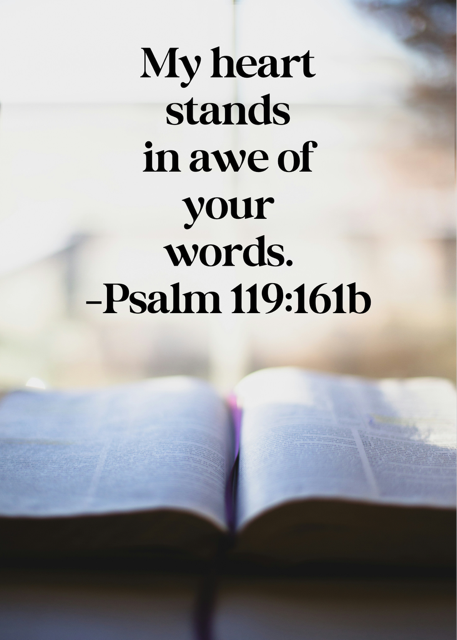
My heart stands in awe of your words. I rejoice at your word like one who finds great spoil (treasure, plunder) (Psalm 119:161a-162).

So what can we do when we feel less than awed by God’s Word?

Employ practical helps. It’s hard to be awed when we’re sleepy or distracted. Getting enough sleep, choosing a more wakeful time of day, taking a shower or doing a few minutes of exercise first can help us be more alert. Removing distractions as much as possible helps: turning off the phone, choosing a time you can be somewhat alone, etc.

Pray. Psalm 119:18 is an apt prayer: “Open my eyes, that I may behold wondrous things out of your law.” When we’re dull in spirit, we can appropriate another of the psalmist’s prayer: “I am greatly afflicted; Renew and revive me [giving me life], O LORD, according to Your word” (Amplified Version).

Remember:

Who is speaking to us. I’m inspired by what George Guthrie says here: “I am still blown away by the idea that the God of the universe wants to communicate with us on a daily basis and that he has chosen to do so in this miraculous book we call the Bible.” As we meditate on who He is and the ways He has worked in our lives, our hearts will warm towards Him and His Word.

That God chose these specific words for us. Psalm 139:17-18 says God’s thoughts are vast, more than the sand. One of our former pastors used to say that the Bible is divinely brief. Out of the multitudes of things God could have said, He inspired and preserved in the Bible what He wants us to know. So each sentence has a purpose.

The cost and privilege of having a Bible in our own hands. Most people didn’t until after the printing press was invented in 1440 AD. Even when it became widely used, books were too expensive for many people to have. When books became more widespread, brave men like William Tyndale labored and gave their lives to have it translated into English that everyday people could read.

Past experiences with the Bible. Remembering some of those special times in the Bible that I mentioned at the beginning can reawaken our desire for it to speak to us again.

Our enemies: the world, which tries to turn our heads; our flesh, prone to wander, to laziness, to self-indulgence; and the devil, who wants to deceive and distract us. It’s no wonder we often have to fight for time and attention while reading the Bible. But the struggle is worth it.

Slow down. Sometimes we rush through our time in the Bible just to get it done or to get to other tasks. Reading a smaller amount and taking time to reflect on it is better than zipping through several chapters without retaining anything.

Ask why this passage is in the Bible. If God inspired all of Scripture, each passage is there for a purpose. What does it tell us about God?

Begin with hymns or praise. I’ve often been encouraged by missionary and writer Elisabeth Elliot’s confession in On Asking God Why: “When I stumble out of bed in the morning, put on a robe, and go into my study, words do not spring spontaneously to my lips–other than words like, ‘Lord, here I am again to talk to you. It’s cold. I’m not feeling terribly spiritual. . . .'” She found help by reading through hymns or psalms.

Get help from a good study Bible, commentary, or study group. All three have helped me by giving some background or explanation of the passage or pointing out things I overlooked in my own reading.

Keep reading in spite of feelings, or the lack of them. Another former pastor said that one of his best times of prayer began with his confession that he didn’t feel like praying. It often happens that way with Bible reading, too. We might not feel awe-inspired as we begin. But the Bible says it is living and active (Hebrews 4:12). As we read, God speaks to us and enlivens us. Even if we don’t feel any differently after reading, God has fed us.

Thank God for what we read. We often divide our quiet time with the Lord into prayer and Bible reading. But we can integrate those activities. When we read of God’s love, we can thank Him for sharing His love with us. When we read an example of His love, power, or wisdom, we praise Him for them right as we read. We can turn some of the verses into prayer and praise. Awe of God’s Word is not an end in itself, but leads us to awe of our God.

In the Everyday Gospel Christmas Devotional, Paul David Tripp says:

The beginning of Matthew presents us with a majestic one-time moment in history that you shouldn’t run past in your desire to complete your daily Bible reading. God has recorded and preserved it for you because he wants it to leave you in gratitude and awe. And that awe is meant to capture your heart with such force that it changes the way you think about who you are and how you live your life. (December 16 reading).

Awe in our Bible reading doesn’t just help us enjoy it more. As Tripp says, awe captures our hearts in order to change us. Awe is part of beholding Him: “And we all, with unveiled face, beholding the glory of the Lord, are being transformed into the same image from one degree of glory to another” (2 Corinthians 3:18).

“The world will never starve for want of wonders; but only for want of wonder,” Chesterton said. There is much to inspire awe and wonder in the Bible. May God give us eyes to see and hearts to understand.

awe of God's words

(I often link up with some of these bloggers.)

Laudable Linkage

Laudable Linkage

I hope you are warm and snug this cold winter morning (if you’re in the northern hemisphere–if it’s summer where you are, stay cool!) Here are some good reads found this week:

Reading the Bible to Meet God, HT to Challies. “In my book Help My Unbelief: Why Doubt is Not the Enemy of Faith I wrote about how important it is to read the Bible to meet God, to read it relationally and as sustenance for the soul. Often we simply read it for information, to follow a rule, or as an academic pursuit. Reading to meet God sounds like a great idea and the ideal for a Christian, but how do we actually do it”

Life Beyond the Spiritual Shallows. “There is a depth to God’s character that cannot be assessed with quick glances and fleeting thoughts. We will never become the kind of women who face the lion’s den without a deep understanding of God’s character. We will never know that depth if we cannot find ways to circumnavigate our brain’s wiring and study God’s Word for longer than eight second bursts.”

Preparing for the Storm, HT to Challies. “We don’t acknowledge the likelihood of impending trials, so we don’t prepare for them. It’s only after the trial has passed, when we’re left trying to pick up the shards of hope and put our lives back together, that we realize we need to stockpile emergency supplies for the next time Sorrow comes knocking at our door. Having lived through one storm, we realize we’ll need a reservoir for the next one.”

Why Pray for Protection When Suffering Keeps Coming? John Piper answers a difficult question from a listener about praying for protection when it seems pointless, when God let bad things happen in the past.

Are You Your Spouse’s Biggest Cheerleader? HT to Challies. “It works both ways. Wives need their husbands to encourage and affirm and cheer for them as well. In healthy, thriving marriages, husbands and wives are cheerleaders for one another. Smart husbands and smart wives know that the Bible is right on target when it says, ‘Death and life are in the power of the tongue’ (Proverbs 18:21). Spoken words can destroy or empower.”

Little People with Big Emotions: 5 Strategies for Emotionally Healthy Kids. This is excellent, something I wish I’d had when mine were young. “I wish I had been better equipped to help my kids when they experienced big emotions. How can we help our children manage their feelings without stuffing them down, prettying them up, or feeling like there’s no room for them?”

Four Reasons Acts 2:38-39 Does Not Imply Infant Baptism. “Though this passage mentions both children and baptism, Acts 2:38–39 leaves no room for infant baptism. Here are four reasons why.”

Sin and repentance

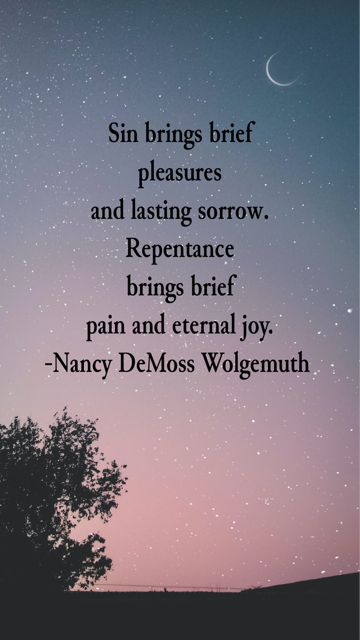
Sin brings brief pleasures and lasting sorrow.
Repentance brings brief pain and eternal joy.
Nancy DeMoss Wolgemuth

One Book That Can Speak to Everyone

One Book That Can Speak to Everyone

A few years ago, I attended my first writer’s conference. I hadn’t given any thought to attending one until I learned of a small one in a town where I used to live. I decided to try it out, and it spurred me to get serious about my desire to “write a book someday.”

I kept hearing at that conference that publishing was not what it used to be. Writers could no longer simply finish a manuscript and send it to a publisher, who would do the rest. Now publishers want potential authors to have an audience before their company will consider taking on a book.

Since shortly before that conference, I’ve been reading books, blog posts, magazine articles, and listening to podcasts about writing and publishing.

One piece of wisdom I’ve seen over and over is that telling a potential agent or publisher our manuscript is for “everyone” is a fast route to a closed door. Authors are advised to be as specific as possible in the audience they aim for.

I confess I struggle with this a little. For several years I wrote a newsletter for the ladies of the church we attended. I’m used to writing to women of all ages and stages. Occasionally we’d have an article focusing on one aspect of womanhood or another–single women, young wives and moms, older women—but most of what was written was applicable across the board. I’ve had the same approach with this blog.

Some of my favorite books seem the same way. The authors may have had a specific age group in mind, but it’s not obvious to me as I read their books. People of various ages and situations have bought certain books for years.

This trend towards specific audiences has led some books, like Gary Chapman’s Five Love Languages, to be transformed into versions for parents of children. parents of teens, singles, couples, men, and women. I wondered how he managed to write the same material for all these different groups. The illustrations would likely change in each, but it seems the basic principles would be the same.

Similarly, Stormie Omartian’s The Power of a Praying Wife led to the power of a praying husband, praying woman, praying mom, praying kid, praying teen, praying grandparent, and more.

In my more cynical moments, I wonder if this converting general books to several different audiences is a ploy of publishers and their marketers to sell more books.

But I can see that it would be helpful to take general principles and apply them to different specific situations.

These musings led me to this thought: there is one book that’s good for any age, gender, or life situation. The Bible is inspired and “for teaching, for reproof, for correction, and for training in righteousness” (2 Timothy 3:16).

There are study Bibles packaged in camouflage or sports paraphernalia for boys and pink or unicorns for girls. Bibles have been designed and illustrated for teens, women, men, even outdoorsmen.

The packaging would appeal to different specific groups, as would any devotional material or added notes. Those things can be useful. But I wouldn’t say they are truly necessary. The Holy Spirit can help us understand and apply the Bible at any age and stage of life.

Someone has said that the Bible is shallow enough for a child to wade in, but deep enough for an elephant to swim in. (1)

There are parts a child can understand. God told parents in the Old Testament to teach His Word to their children and grandchildren. Paul says Timothy has “from childhood . . . been acquainted with the sacred writings, which are able to make you wise for salvation through faith in Christ Jesus” (2 Timothy 3:15).

Of course, there are parts a child would not understand. There are parts the wisest theologian doesn’t understand completely. But I can testify, coming up on fifty years of reading the Bible with some degree of regularity, that it speaks to us and is applicable to us all through life. As we read it through different life stages, we continue to find applications to our situations.

The Bible is even good for those who oppose it. Psalm 119:130 says, “The entrance of Your words gives light; It gives understanding to the simple.” Viggo Olsen tells in his book, Daktar, how he and his wife promised her Christian parents that they would look into the claims of Scripture. However, they secretly planned to disprove the Bible so they could get her parents off their backs about Christianity. Instead, they became convinced the Bible was true and God was real. They became Christians and later went as missionaries to Bangladesh.

The same thing happened to Lee Strobel. He and his wife were both atheists and planned to remain that way. When his wife became a Christian, he tried to disprove the Bible’s reliability and claims with the zeal of the investigative reporter he was. He says in his book, The Case for Christ, that the more he searched, the more convinced he became that the Bible was true after all. He became a Christian and went on to become a minister and wrote several more books about Christianity.

There are multitudes of reasons for reading the Bible: it provides light, joy, comfort, encouragement, builds our faith, helps us fight sin, tells us more about God. But the primary reasons for reading Scripture are that it is God’s message for us and our main means of getting to know Him.

If you’ve never read the Bible, I encourage you to. You might start with one of the gospels. John gives the most in-depth look at the Son of God and His ministry.

If you’ve had a stop-and-start pattern of Bible reading, don’t be discouraged. Many of us tried in fits and starts before getting into some kind of regular pattern of Bible reading. I shared tips for finding time to read the Bible here. I’d advise starting small and simple. Too often, we make grandiose plans but then can’t keep up with them.

If you’ve been reading the Bible regularly for years, wonderful! Keep at it! There’s always more to learn, but we need the reminders of old lessons, too. If you feel you’re in a devotional rut, these tips might help.

Whatever stage of life you are in, the Bible can speak to you.

Psalm 119:130

_____

(1) Variations of this statement have been attributed to Augustine, Gregory the Great, Jerome, and John Owen, among others. Andy Naselli tells why he thinks Gregory the Great is the original source here.

(I often link up with some of these bloggers.)

Laudable Linkage

Laudable Linkage

I have just a short list to share with you today:

The Living and Abiding Word of God, HT to Challies. “A farmer doesn’t cause seeds to grow but faithfully plants and waters them. Despite his careful tending, the seeds he sows sometimes lay dormant for a long time—which is Peter’s point. It’s not our cleverly devised arguments or our life’s example that brings about new life but the powerful life-producing work of God’s imperishable and never-fading Word.”

Look Up In Faith, HT to the Story Warren. “On my way to school, I drove with my eyes fixed on the road, praying I would be ready to meet my twenty-six early morning students in just a few minutes. And then I saw it, a pinkish orange hue highlighting a sky full of cotton puffs. I couldn’t believe it. How many years had I been making this drive and I just now noticed? If I’m honest, I’ve always had a hard time looking up.”

Does the Bible Blame Women for Rape? HT to Challies. Wendy Alsup thinks through a difficult passage in Deuteronomy.

Why Is Proverbs So Negative About Women? “So a fairly new believer asked me a simple question afterward. ‘Why is the Bible so hard on women?’ I am glad she felt the freedom to ask the question. I would much rather get it out in the open than have women wonder silently. Let’s tackle the question for a moment.”

How to Identify a Great Deacon, HT to Challies. Churches have different ways of choosing deacons: some appoint them, others have the congregation vote on them. If you’re in the position of nominating or voting on deacons, this article has great points to consider.

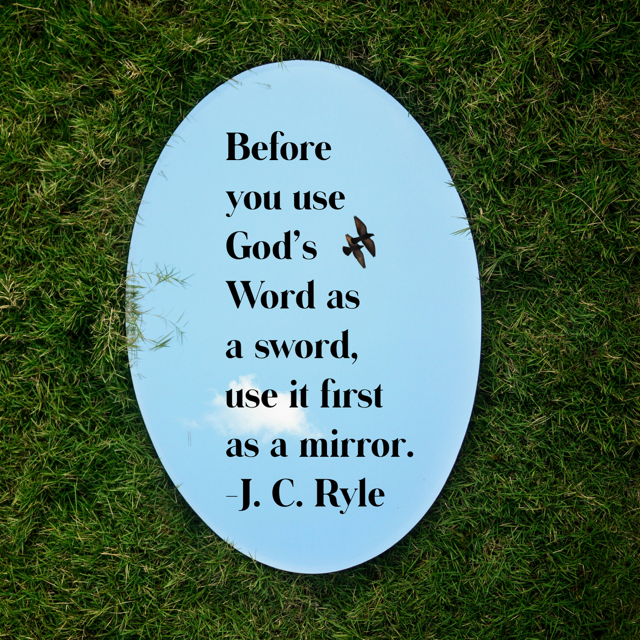
J. C. Ryle quote

Before you use God’s Word as a sword, use it first as a mirror.
J. C. Ryle

Song of Solomon

Song of Solomon

Long-time readers know that I have been using Warren Wiersbe’s “Be” commentaries as companions on my current trek through the Bible. I thought he had written one for every book of the Bible. But when I came to the Song of Solomon, I couldn’t find a corresponding “Be” commentary for it. I searched all the titles. Since SoS is a smaller book, I figured its commentary was probably tucked in with another book’s. But I looked at the table of contents for all the Be books I thought it might be included with, and didn’t see it.

Then I found The Bible Exposition Commentary: Wisdom and Poetry by Wiersbe which covered Job through Song of Solomon. I found a used copy online for $3.99, so I went ahead and got it. As it turns out, the Bible Exposition Commentary series is made up of Wiersbe’s “Be” commentaries. The part dealing with SoS is only about eleven pages.

The subtitle of Song of Solomon says “The Song of Songs, which is Solomon’s.” Both Wiersbe and the ESV Study Bible notes say this means something like “the greatest of songs”—similar wording used in King of kings and Holy of holies.

There are a number of different ways to interpret SoS. Wiersbe thinks Solomon is the bridegroom in the book. The ESV notes say it’s more likely that the book was written in Solomon’s honor or during his reign, but the bridegroom in the story is a shepherd. Both sources also disagree on when exactly in the book the couple marries. But neither of these are major factors in understanding the book.

They do agree that, to some extent, the book is an allegory of God’s love for His people (Ephesians 5:31-21 also says marriage pictures Christ and the church), and on another level it’s a celebration of married love.

While the Song of Solomon illustrates the deepening love we can have with Christ, we must be careful not to turn the story into an allegory and make everything mean something. All things are possible to those who allegorize—and what they come up with is usually heretical.

It’s almost laughable to read some of the ancient commentaries (and their modern imitators) and see how interpreters have made Solomon say what they want him to say. The language of love is imaginative and piles one image on top of another to convey its message. But to make the bride’s breasts represent the two ordinances, or the garden stand for the local church, or the voice of the turtledove mean the Holy Spirit speaking, is to obscure if not destroy the message of the book. Other texts in the Bible may support the ideas expressed by these fanciful interpreters, but their ideas didn’t come from what Solomon wrote (p. 542).

(I love that line—“All things are possible to those who allegorize.” 🙂 )

There are different speakers in the book: the shepherd, shepherdess, and a chorus of others, often referred to as the daughters of Jerusalem. Thankfully, the editors of the ESV and most other modern versions puzzled out who was speaking when and provided us with designations.

We follow the bride and groom through various troubles (she doesn’t open her door to him one night and regrets it, then goes searching for him), deepening love, marriage, and admiring descriptions of each other

Both sources give helpful details in understanding the text. For instance, the bride is compared to a “mare among Pharaoh’s chariots”–but that probably means “the best of its kind,” not that she looked like a horse. Wiersbe says of some of the other descriptions of the bride in Chapter 4:

Doves’ eyes would reflect peace and depth. The bride’s teeth were clean, even beautiful. When you remember that ancient peoples didn’t quite understand dental hygiene, this was an admirable trait. Healthy teeth would also affect her breath (7:8). She had a queenly neck and a posture with it that exuded control, power, and stability. She was a tower of strength! (p. 546).

Another comment that stood out to me came from 2:10, 13), where the bridegroom says, “Arise, my love, my beautiful one, and come away.”

“Come” is the great word of the Gospel of God’s grace. It is God’s loving invitation to the weary who need rest (Matt. 11:28-30), the sin-stained who need cleansing (Isa. 1:18), the hungry who need nourishment (Luke 14:17), and all who thirst for the water of life (Rev. 22:17). But “come” is also His invitation to His own people: “Come and see” (John 1:39), “Come and drink” (John 7:37-38), “Come and dine” (John 21:12). In this text, the king invited his beloved to  leave her home and work and go with him to enjoy an adventure in the country (p. 544).

Chapter 2:3-4 says, “As an apple tree among the trees of the forest, so is my beloved among the young men. With great delight I sat in his shadow, and his fruit was sweet to my taste.
He brought me to the banqueting house, and his banner over me was love.” Elizabeth Poston wrote a beautiful song based on this passage called “Jesus Christ the Apple Tree:

The first time I read SoS, which was probably in high school, I was surprised that it contained some graphic phrases and images. The Bible is often quite frank about the body and its functions.

In early married years, I was comforted by SoS. Growing up even in an unchurched family, about all I heard about sex growing up was “DON’T.” This book and passages like Hebrews 13:4 (“Marriage is honorable among all, and the bed undefiled; but fornicators and adulterers God will judge,” NKJV) helped me understand that God created sexual love to be enjoyed by a husband and wife.

In his last couple of paragraphs, Wiersbe acknowledged the difficulty of preaching or teaching Song of Solomon in such a hyper-sexualized society as we have these days. He advised its use in premarital or marital counseling. He closed by saying:

In using this book in public ministry, we must be wise as serpents and harmless as doves and not allow our good works to be classified as evil. Some people are against anything in the pulpit that deals with sex, while others wonder where they can get the help that they desperately need. Wise is the minister and teacher who can keep the right balance (p. 550).

It had been a long while since I read Song of Solomon. It was a blessing to spend time there again, aided by the ESV Study Bible and Wiersbe’s commentary.

(I often link up with some of these bloggers.)

Laudable Linkage

Laudable Linkage

Here are some of the thought-provoking reads discovered this week:

Why Doesn’t God Make His Existence More Evident? HT to Challies. “God is not interested in merely proving His existence. But for those with eyes to see, and ears to hear, God has made Himself known. He has offered sufficient evidence for rational faith. The question is—Will we trust Him?

Soft Discipleship Through Friendship, HT to Challies. “It wasn’t through formal, set up discipleship, but what I call ‘soft discipleship’ by my college roommates that I lived with for 3 years: Charissa, Lucy, and Julianne. They didn’t even know that they were discipling me, but because we shared a home together, I was able to see how they lived and walked with the Lord, and understand what it looks like and feels like to have intimacy with God.” I love that term.

How to Talk to Your Kids About Taylor Swift’s New Album, HT to Challies. I’m not familiar with most of her music, but I have been hearing lots about her new album. “It feels like I’m making a moral decision when I listen to her music. How will it affect my girls to hear and see a beautiful young woman sing about a lifestyle that isn’t only objectionable but is in outright defiance to God? Even though my daughters have had a strong Christian upbringing and hold their own personal convictions, will they be able to discern the subtle influences and outright lies they’ll be exposed to when listening to Swift’s music?”

Hospitality Toward the Indwelling God. “This indwelling is not something we earn, nor is it something we lose. It is a gift of grace, added on to the gracious gift of salvation. Still, it’s worth asking, how can I show hospitality to the God living within me? What kind of heart is He pleased to dwell in?”

Preaching Goliath’s Sword, HT to Challies. I’ve heard sermons like the one described–full of “conjecture, guesswork, and speculation,” but not accurately representing the passage. This was written for preachers, but I think it’s applicable to teachers, Bible study students, bloggers—anyone who shares truth from God’s Word.

A Mother’s Love: God’s Love on Display. “Throughout the Bible, God (Who is not human, so neither male nor female) consistently reveals Himself as Father rather than Mother, King rather than Queen, Shepherd rather than Shepherdess, and Husband rather than Wife. However, there are a few occasions when He reveals the greatness of His love by comparing Himself to a mother.”

This Piece of Land, HT to Challies. This is lovely writing. “But isn’t that the way of it? We all crouch down at every starting line, clueless as to what lies ahead. The unknowns start with our first cry and extend to every beginning to come: The turn of the tassel, a job acceptance, the walk down the aisle, two pink lines, or an empty home. What will come of our own piece of land called life? Like Abraham, we hold only a promise.”

A Time We Never Knew, HT to Redeeming Productivity. “I think there is something distinctly different and deserving of our attention about online forums filled with Zoomers wishing that they lived before social media. Wishing it didn’t exist. These are children grieving their youth while they are still children. These are teens mourning childhoods they wasted on the internet, writing laments such as “I know I’m still young (14F), and I have so many years to make up for that, but I can’t help but hate myself for those years I wasted doing nothing all day but go on my stupid phone.” I think this site is a secular resource, but this piece was quite thought-provoking.

Make the Internet Modest Again, HT to Challies. This has nothing to do with hemlines or necklines. “Constantly exposing ourselves online desensitizes us, making it difficult to honor the sacredness of our lives. Modesty may run counter to prevailing wisdom, but I believe it works for the good of my soul.”

How to Love Every Version of Your Wide. This almost made me teary. “I could share so many stories about all of the versions of me that Chad has dealt with through the years. But if I could tell husbands one thing about how to not just deal with your wife in all of her many forms, but to love her well, the way Christ loves the church as you are commanded, I would say this. To truly love all the versions of your wife, you have to develop endless amounts of grace.”

And just for fun: one of my youngest son’s favorite games when he was little was Guess Who? Each player has a tray of cards with people on them. Each player chooses one, and the other player has to guess which one the other chose by asking about clues on the cards (Does he have black hair? A red shirt? and so on). Well, I saw an ad on Instagram the other day for a Jane Austen “Guess Who?” game. I don’t know if there’s anyone I know in real life who would enjoy playing it with me. But perhaps some of you might know fellow Jane fans. (This is not an affiliate link. I just saw it and thought it was a neat idea.)

A. W. Tozer quote about the Bible

The Bible is not an end in itself,
but a means to bring men to an intimate and satisfying knowledge of God,
that they may enter into Him,
that they may delight in His Presence,
may taste and know the inner sweetness
of the very God Himself in the core and center of their well-being.

A. W. Tozer, The Pursuit of God

Laudable Linkage

Laudable Linkage

Here are some of the good posts found this week. The list is a little longer since I’ve had a chance to catch up on blog reading.

When You Don’t Want to Read the Word. “Remember when you couldn’t get enough of the Bible? Lately though, you make your coffee and start your morning; you’ve missed a few days of devotional reading. It’s not that you don’t love God’s Word—it’s just that in the busyness of life it doesn’t seem to have the same hold on you it once did. The craving isn’t there. The desire has dried up.”

Tunawa Leah. “Friends, another year has passed, and my heart remains burdened for this precious child of God. I first shared Leah Sharibu’s story of faith in the face of extreme persecution with you in January 2020. This year marks the sixth anniversary of this young lady’s captivity and enslavement at hands of ISIS-WA (aka Boko Haram) in Nigeria.”

4 Lesser-Known Women of the Bible {And What They Can Teach Us Today} “Sometimes in our day-to-day lives, in the struggles, we can feel unseen and underappreciated. More like those in the Bible who are not as well-known. Today I’d like to look at several of those lesser-known women in the Bible: Jehosheba, Abigail, Lois, and Eunice. You may not even recognize their names right off, which makes them perfect to discuss today.”

The Evangelist on the Titanic. “While the story of the Titanic is one of disaster, it is also a story of great heroism and of great faith. Numbered among those who drowned in the tragedy was a Scottish Baptist evangelist named John Harper.”

Worse Than Any Affliction: Why I Refuse to Grumble, HT to Challies. “My flesh is wasting away, and who would blame me if I complained? Certainly not the world — it’s natural for them to expect an old lady in a wheelchair to grumble over her losses. But followers of Jesus Christ should expect more from me. Much more.”

When the Walk Becomes a Crawl, HT to Challies. “The key to getting a long view of sanctification is to understand direction. What matters most is not the distance you’ve covered. It’s not the speed you’re going. It’s not how long you’ve been a Christian. It’s the direction you’re heading.”

Jesus Didn’t Diss the Poor: Making Sense of Matthew 26:11, HT to Challies. “In perhaps one of the oddest moments of the passion narrative, Jesus seemingly sets himself at odds with his disciples’ concern for the poor. Breaking ranks with the twelve, Jesus did not think Mary should have ‘given to the poor’ the money that she had used to purchase the oil needed to anoint Jesus’s feet.”

Westminster Abbey and the Danger of Inhospitality, HT to Challies. “Biblical hospitality forefronts our neighbor, not ourselves. Hospitality is about making someone else feel honored, loved, and comfortable.”

Applying Paul’s Great Commission Lifestyle Principles. “As we observe Paul’s life and teachings, especially 1 Corinthians 9, we see that he willingly laid aside ‘rights’ to his preferred lifestyle to be a more effective servant of Christ.” The context here is cross-cultural missions, but this is how we should be thinking and praying in all our interactions.

Why We Always Need More Books on Every Subject, HT to Challies. “‘Because we already have several good books on subject X, we do not need more books on subject X,’ the logic goes. I will push back on this logic for the following reasons below. You may not agree with all my reasons, but hopefully, they will deeper your appreciation for books.”

The Neurodivergent Believer, HT to Challies. “As believers, we acknowledge that God created each brain uniquely. The Apostle Paul describes this diversity within the body of Christ, emphasizing that each member has a distinct role (1 Cor. 12:12–27). Despite this diversity, being neurodivergent in a predominately neurotypical world can present unique challenges.”

Elisabeth Elliot The Secret is Christ in Me

The secret is Christ in me, not me in a different set of circumstances.
–Elisabeth Elliot

Laudable Linkage

Here are some of the good posts seen this week:

How Do I Find the Main Point of a Psalm (or a larger passage of Scripture), HT to Knowable Word. John Piper likens understanding larger passages of Scripture to working a jigsaw puzzle. Great illustration.

How to Prepare for a Great Morning Routine. “I’ve had the unique privilege of helping thousands of Christians refine their own Christ-honoring morning routines. And there are certain patterns that show up again and again with those who are struggling to stick with a routine like this. They all boil down to one thing: Lack of preparation.”

Be a Woman Hidden in the Church. “We live in a culture captivated by the idea of ‘making a name for yourself.’ From pop culture celebrities to Christian influencers, the world around us seems to say that in order to make any real difference you first need to have a large sphere of influence and a certain number of followers. And your name on the cover of a book doesn’t hurt. This is not the path to significance that Jesus taught.”

What to Do When You Long for Encouragement. “When it comes to my own reactions to perceived slights, I’m inclined to bypass the Golden Rule and proceed straight to feeling sorry for myself.

Why We Cannot Cast Them Aside. “As I’ve watched my precious mom deteriorate from the devastating effects of early onset Alzheimer’s, I’ve also had to face our world’s deeply entrenched beliefs about what gives people value.

Repairing Old Books by Deconstructing Them, HT to Steve Laube. This is a ten-minute video about a woman who restores old books by taking them apart, repairing them, and putting them back together. I worked at the university library while in college. One lady there did book repair, but not as extensive as this. I found it fascinating.

True love

True love ennobles and dignifies the material labors of life; and homely services rendered for love’s sake have in them a poetry that is immortal. ~ Harriet Beecher Stowe

You Can Throw Your Weight on God’s Testimony

You can throw your weight on God's testimony.

Often I’ll turn the radio on while I make my breakfast, and usually Dr. Stephen Davey’s program, Wisdom for the Heart, is on at that time.

One day last week, Dr. Davey was speaking from Psalm 19. It’s a familiar passage to many of us. It starts with “The heavens declare the glory of God, and the sky above [firmament in the KJV] proclaims his handiwork,” and then goes on to develop that theme for the next several verses.

The last half of the psalm talks about how God’s character is seen through His Word. Verse 7 starts off another familiar passage: “The law of the Lord is perfect, reviving the soul. . . ” Perhaps you remember, as I do, a song made of these words.

The passage is so familiar, in fact, that it’s easy to zip right through it without stopping to take it in.

But Dr. Davey pointed out something that stopped me in my tracks.

The latter half of verse 7 says, “The testimony of the LORD is sure, making wise the simple.”

Dr. Davey said:

This is legal language; whenever someone is called into court by the prosecution or defense, they give their testimony.  They testify to what they know – what they’ve seen – what they’ve heard.

David writes in legal terminology – God is testifying . . . and whatever and whenever He does, David writes here, The testimony of the Lord is sure.

In other words, you can count on it.  One author* wrote, “You can throw your weight on God’s testimony and it will hold up.”

You can throw your whole weight on God’s testimony.

Does that impact you like it does me?

It’s not that this truth was new to me. But hearing it put that way brought my understanding to a whole new level.

God’s Word is sure. It’s trustworthy. We can stake the whole weight of our souls on it.

BibleStudyTools.org says the Hebrew word translated “sure” here means “to support, confirm, be faithful; made firm, sure, lasting; verified; reliable, faithful, trusty .”

What God tells us about Himself, the world, and ourselves is dependable.

His promises won’t break when we lean on them. That doesn’t mean all our prayers will be answered just the way we hoped, or that life will have a fairy-tale ending. But when He tells us who He is and that He will be with us and take care of us, we can rely on His Word without worry.

I did not grow up in areas where ponds freeze over. But I am familiar with the concept of testing the ice to make sure it’s solid before walking or skating on it. And I have stepped on a bridge, fallen log, or even a piece of flooring and felt it give, wondering if it would hold my weight.

But we’ll never have that experience with God’s Word. It is sure.

Is there a passage you’re staking your soul on today?

Psalm 19:7: The testimony of the LORD is sure.

* Donald Williams, Mastering the Old Testament: Psalms 1-72 (Word Publishing, 1986), p. 153), quoted in Psalm 19:7-9) God’s Inspired Little Book by Stephen Davey on the Wisdom for the Heart Radio Broadcast, 1/22/2024.

(I often link up with some of these bloggers.)

Laudable Linkage

Laudable Linkage

I’m almost caught up after being several weeks behind with blog reading. So I have a longer than usual list of good reads to recommend. Perhaps one or two will pique your interest.

The Boy at the Front Desk. “I think I will always remember those ten minutes—that conversation that I wasn’t even part of—as a shining example both of what pain children are capable of feeling and of what hope and comfort we adults are capable of offering them.”

Tasting Heaven Now, HT to Challies. “‘If you died tonight, where would you spend eternity?’ I once completed an evangelism training course that taught us to initiate spiritual conversations with strangers by asking that question. . . . The promise of eternal life is a powerful motivator for faith and a precious promise of hope and comfort for God’s people. However, I fear that the church has so emphasized ‘going to heaven when you die’ that we sometimes give the impression that’s all faith is good for.” I’ve often thought that might not be the best question to start with, for reasons mentioned here.

20 Benefits of Being in God’s Word According to Psalm 119. “The Word of God is my anchor. It tethers my mind to the truth when the lies of the enemy are readily available. It wraps me with security when my future is uncertain. It pulls me back into the presence of God when I’ve sought the company of lesser pursuits.”

On Being a Heroic Man. “Rather than waiting and pining for an opportunity to display your heroism on a world stage, be willing and eager to display it on a small stage. Be heroic before your wife. Be heroic before your children. Be heroic before the few people God has called you to serve.”

Counseling Troubled Dreams, HT to Challies. “What do we make of these nighttime mini-movies that we can’t really control; are they just random neural impulses, strung together in some semblance of a narrative by our cerebellum, or are they messages from the “other side” to be painstakingly studied and interpreted? Or might there be some middle-of-the-road understanding that has practical importance in our Christian and counseling lives.”

Time Out: Do Clocks Keep Ticking in Eternity? This was so interesting to consider. I’d always heard that time as we know it will cease in eternity. It turns out that’s not the case.

It Is Bible Reading Time! Ways to keep a Bible Reading Journal plus various Bible reading plans.

When We Hurt Those Who Are Hurting, HT to Challies. “Those who hear these words might overlook the offense yet resolve to never again share their hearts with the perpetrators. Others assume that the comments are representative of the culture of God’s people, in which Christians should always be thankful and never complain. Either way, we isolate those who already feel alone, and we misrepresent the kingdom of God.”

Plan to Grow, HT to Challies. “In no area of my life have I ‘arrived’. I am being sanctified more and more, but there is a long way to Christlikeness. Don’t get me wrong, I’m not hopeless. God has given me His great and precious promises that He has predestined to conform me to the image of Jesus (Rom 8:29). But even still, I’ve learned that if I don’t plan to grow, I’ll be less like Jesus than I could be.”

7 Practical Areas of Christian Stewardship. “The topic that’s been on my mind is a big one: stewardship. Now if you’ve grown up in the church, you may be tempted to roll your eyes, groan, and/or be filled with a general sense of dread. You probably associate this word with a request to open your already tight wallet, since many churches devote one or two months a year to what they call “stewardship” where the main topic is giving to the local church. But there is more to stewardship than money. Yes, it’s part of it, but there is so much more. As Christians, we are stewards of all that God has given us.”

God With Us on the Escalator, HT to Challies. Though this is a Christmas remembrance, it’s excellent reading for any time of year.

Not Neurotypical: A Love Story, HT to Challies. “With my firstborn, I learned that my child was not a problem to be solved or fixed, but a person to be loved and understood as God made him. I came to believe in my heart that this child was given to us for a reason—because God knew that we were exactly the parents and the family that he needed.”

This Is a Gift You Can Give, HT to Challies. On a family visiting a nursing home at Christmas, but true not just at Christmas: “I want you to know how much kindness and presence means to people. It may be awkward to sing carols or visit with people you don’t know, but this is a gift we can give . . .Our time, our love, our kindness, ourselves. Jesus gave us everything, His very life. His life for ours.”

Face the New Year with the old Book

Face the New Year with the Old Book.
Face the new needs with the old promises.
Face the new problems with the old Gospel.
– Author Unknown