Song of Solomon

Song of Solomon

Long-time readers know that I have been using Warren Wiersbe’s “Be” commentaries as companions on my current trek through the Bible. I thought he had written one for every book of the Bible. But when I came to the Song of Solomon, I couldn’t find a corresponding “Be” commentary for it. I searched all the titles. Since SoS is a smaller book, I figured its commentary was probably tucked in with another book’s. But I looked at the table of contents for all the Be books I thought it might be included with, and didn’t see it.

Then I found The Bible Exposition Commentary: Wisdom and Poetry by Wiersbe which covered Job through Song of Solomon. I found a used copy online for $3.99, so I went ahead and got it. As it turns out, the Bible Exposition Commentary series is made up of Wiersbe’s “Be” commentaries. The part dealing with SoS is only about eleven pages.

The subtitle of Song of Solomon says “The Song of Songs, which is Solomon’s.” Both Wiersbe and the ESV Study Bible notes say this means something like “the greatest of songs”—similar wording used in King of kings and Holy of holies.

There are a number of different ways to interpret SoS. Wiersbe thinks Solomon is the bridegroom in the book. The ESV notes say it’s more likely that the book was written in Solomon’s honor or during his reign, but the bridegroom in the story is a shepherd. Both sources also disagree on when exactly in the book the couple marries. But neither of these are major factors in understanding the book.

They do agree that, to some extent, the book is an allegory of God’s love for His people (Ephesians 5:31-21 also says marriage pictures Christ and the church), and on another level it’s a celebration of married love.

While the Song of Solomon illustrates the deepening love we can have with Christ, we must be careful not to turn the story into an allegory and make everything mean something. All things are possible to those who allegorize—and what they come up with is usually heretical.

It’s almost laughable to read some of the ancient commentaries (and their modern imitators) and see how interpreters have made Solomon say what they want him to say. The language of love is imaginative and piles one image on top of another to convey its message. But to make the bride’s breasts represent the two ordinances, or the garden stand for the local church, or the voice of the turtledove mean the Holy Spirit speaking, is to obscure if not destroy the message of the book. Other texts in the Bible may support the ideas expressed by these fanciful interpreters, but their ideas didn’t come from what Solomon wrote (p. 542).

(I love that line—“All things are possible to those who allegorize.” 🙂 )

There are different speakers in the book: the shepherd, shepherdess, and a chorus of others, often referred to as the daughters of Jerusalem. Thankfully, the editors of the ESV and most other modern versions puzzled out who was speaking when and provided us with designations.

We follow the bride and groom through various troubles (she doesn’t open her door to him one night and regrets it, then goes searching for him), deepening love, marriage, and admiring descriptions of each other

Both sources give helpful details in understanding the text. For instance, the bride is compared to a “mare among Pharaoh’s chariots”–but that probably means “the best of its kind,” not that she looked like a horse. Wiersbe says of some of the other descriptions of the bride in Chapter 4:

Doves’ eyes would reflect peace and depth. The bride’s teeth were clean, even beautiful. When you remember that ancient peoples didn’t quite understand dental hygiene, this was an admirable trait. Healthy teeth would also affect her breath (7:8). She had a queenly neck and a posture with it that exuded control, power, and stability. She was a tower of strength! (p. 546).

Another comment that stood out to me came from 2:10, 13), where the bridegroom says, “Arise, my love, my beautiful one, and come away.”

“Come” is the great word of the Gospel of God’s grace. It is God’s loving invitation to the weary who need rest (Matt. 11:28-30), the sin-stained who need cleansing (Isa. 1:18), the hungry who need nourishment (Luke 14:17), and all who thirst for the water of life (Rev. 22:17). But “come” is also His invitation to His own people: “Come and see” (John 1:39), “Come and drink” (John 7:37-38), “Come and dine” (John 21:12). In this text, the king invited his beloved to  leave her home and work and go with him to enjoy an adventure in the country (p. 544).

Chapter 2:3-4 says, “As an apple tree among the trees of the forest, so is my beloved among the young men. With great delight I sat in his shadow, and his fruit was sweet to my taste.
He brought me to the banqueting house, and his banner over me was love.” Elizabeth Poston wrote a beautiful song based on this passage called “Jesus Christ the Apple Tree:

The first time I read SoS, which was probably in high school, I was surprised that it contained some graphic phrases and images. The Bible is often quite frank about the body and its functions.

In early married years, I was comforted by SoS. Growing up even in an unchurched family, about all I heard about sex growing up was “DON’T.” This book and passages like Hebrews 13:4 (“Marriage is honorable among all, and the bed undefiled; but fornicators and adulterers God will judge,” NKJV) helped me understand that God created sexual love to be enjoyed by a husband and wife.

In his last couple of paragraphs, Wiersbe acknowledged the difficulty of preaching or teaching Song of Solomon in such a hyper-sexualized society as we have these days. He advised its use in premarital or marital counseling. He closed by saying:

In using this book in public ministry, we must be wise as serpents and harmless as doves and not allow our good works to be classified as evil. Some people are against anything in the pulpit that deals with sex, while others wonder where they can get the help that they desperately need. Wise is the minister and teacher who can keep the right balance (p. 550).

It had been a long while since I read Song of Solomon. It was a blessing to spend time there again, aided by the ESV Study Bible and Wiersbe’s commentary.

(I often link up with some of these bloggers.)

Laudable Linkage

Laudable Linkage

Here are some of the thought-provoking reads discovered this week:

Why Doesn’t God Make His Existence More Evident? HT to Challies. “God is not interested in merely proving His existence. But for those with eyes to see, and ears to hear, God has made Himself known. He has offered sufficient evidence for rational faith. The question is—Will we trust Him?

Soft Discipleship Through Friendship, HT to Challies. “It wasn’t through formal, set up discipleship, but what I call ‘soft discipleship’ by my college roommates that I lived with for 3 years: Charissa, Lucy, and Julianne. They didn’t even know that they were discipling me, but because we shared a home together, I was able to see how they lived and walked with the Lord, and understand what it looks like and feels like to have intimacy with God.” I love that term.

How to Talk to Your Kids About Taylor Swift’s New Album, HT to Challies. I’m not familiar with most of her music, but I have been hearing lots about her new album. “It feels like I’m making a moral decision when I listen to her music. How will it affect my girls to hear and see a beautiful young woman sing about a lifestyle that isn’t only objectionable but is in outright defiance to God? Even though my daughters have had a strong Christian upbringing and hold their own personal convictions, will they be able to discern the subtle influences and outright lies they’ll be exposed to when listening to Swift’s music?”

Hospitality Toward the Indwelling God. “This indwelling is not something we earn, nor is it something we lose. It is a gift of grace, added on to the gracious gift of salvation. Still, it’s worth asking, how can I show hospitality to the God living within me? What kind of heart is He pleased to dwell in?”

Preaching Goliath’s Sword, HT to Challies. I’ve heard sermons like the one described–full of “conjecture, guesswork, and speculation,” but not accurately representing the passage. This was written for preachers, but I think it’s applicable to teachers, Bible study students, bloggers—anyone who shares truth from God’s Word.

A Mother’s Love: God’s Love on Display. “Throughout the Bible, God (Who is not human, so neither male nor female) consistently reveals Himself as Father rather than Mother, King rather than Queen, Shepherd rather than Shepherdess, and Husband rather than Wife. However, there are a few occasions when He reveals the greatness of His love by comparing Himself to a mother.”

This Piece of Land, HT to Challies. This is lovely writing. “But isn’t that the way of it? We all crouch down at every starting line, clueless as to what lies ahead. The unknowns start with our first cry and extend to every beginning to come: The turn of the tassel, a job acceptance, the walk down the aisle, two pink lines, or an empty home. What will come of our own piece of land called life? Like Abraham, we hold only a promise.”

A Time We Never Knew, HT to Redeeming Productivity. “I think there is something distinctly different and deserving of our attention about online forums filled with Zoomers wishing that they lived before social media. Wishing it didn’t exist. These are children grieving their youth while they are still children. These are teens mourning childhoods they wasted on the internet, writing laments such as “I know I’m still young (14F), and I have so many years to make up for that, but I can’t help but hate myself for those years I wasted doing nothing all day but go on my stupid phone.” I think this site is a secular resource, but this piece was quite thought-provoking.

Make the Internet Modest Again, HT to Challies. This has nothing to do with hemlines or necklines. “Constantly exposing ourselves online desensitizes us, making it difficult to honor the sacredness of our lives. Modesty may run counter to prevailing wisdom, but I believe it works for the good of my soul.”

How to Love Every Version of Your Wide. This almost made me teary. “I could share so many stories about all of the versions of me that Chad has dealt with through the years. But if I could tell husbands one thing about how to not just deal with your wife in all of her many forms, but to love her well, the way Christ loves the church as you are commanded, I would say this. To truly love all the versions of your wife, you have to develop endless amounts of grace.”

And just for fun: one of my youngest son’s favorite games when he was little was Guess Who? Each player has a tray of cards with people on them. Each player chooses one, and the other player has to guess which one the other chose by asking about clues on the cards (Does he have black hair? A red shirt? and so on). Well, I saw an ad on Instagram the other day for a Jane Austen “Guess Who?” game. I don’t know if there’s anyone I know in real life who would enjoy playing it with me. But perhaps some of you might know fellow Jane fans. (This is not an affiliate link. I just saw it and thought it was a neat idea.)

A. W. Tozer quote about the Bible

The Bible is not an end in itself,
but a means to bring men to an intimate and satisfying knowledge of God,
that they may enter into Him,
that they may delight in His Presence,
may taste and know the inner sweetness
of the very God Himself in the core and center of their well-being.

A. W. Tozer, The Pursuit of God

Laudable Linkage

Laudable Linkage

Here are some of the good posts found this week. The list is a little longer since I’ve had a chance to catch up on blog reading.

When You Don’t Want to Read the Word. “Remember when you couldn’t get enough of the Bible? Lately though, you make your coffee and start your morning; you’ve missed a few days of devotional reading. It’s not that you don’t love God’s Word—it’s just that in the busyness of life it doesn’t seem to have the same hold on you it once did. The craving isn’t there. The desire has dried up.”

Tunawa Leah. “Friends, another year has passed, and my heart remains burdened for this precious child of God. I first shared Leah Sharibu’s story of faith in the face of extreme persecution with you in January 2020. This year marks the sixth anniversary of this young lady’s captivity and enslavement at hands of ISIS-WA (aka Boko Haram) in Nigeria.”

4 Lesser-Known Women of the Bible {And What They Can Teach Us Today} “Sometimes in our day-to-day lives, in the struggles, we can feel unseen and underappreciated. More like those in the Bible who are not as well-known. Today I’d like to look at several of those lesser-known women in the Bible: Jehosheba, Abigail, Lois, and Eunice. You may not even recognize their names right off, which makes them perfect to discuss today.”

The Evangelist on the Titanic. “While the story of the Titanic is one of disaster, it is also a story of great heroism and of great faith. Numbered among those who drowned in the tragedy was a Scottish Baptist evangelist named John Harper.”

Worse Than Any Affliction: Why I Refuse to Grumble, HT to Challies. “My flesh is wasting away, and who would blame me if I complained? Certainly not the world — it’s natural for them to expect an old lady in a wheelchair to grumble over her losses. But followers of Jesus Christ should expect more from me. Much more.”

When the Walk Becomes a Crawl, HT to Challies. “The key to getting a long view of sanctification is to understand direction. What matters most is not the distance you’ve covered. It’s not the speed you’re going. It’s not how long you’ve been a Christian. It’s the direction you’re heading.”

Jesus Didn’t Diss the Poor: Making Sense of Matthew 26:11, HT to Challies. “In perhaps one of the oddest moments of the passion narrative, Jesus seemingly sets himself at odds with his disciples’ concern for the poor. Breaking ranks with the twelve, Jesus did not think Mary should have ‘given to the poor’ the money that she had used to purchase the oil needed to anoint Jesus’s feet.”

Westminster Abbey and the Danger of Inhospitality, HT to Challies. “Biblical hospitality forefronts our neighbor, not ourselves. Hospitality is about making someone else feel honored, loved, and comfortable.”

Applying Paul’s Great Commission Lifestyle Principles. “As we observe Paul’s life and teachings, especially 1 Corinthians 9, we see that he willingly laid aside ‘rights’ to his preferred lifestyle to be a more effective servant of Christ.” The context here is cross-cultural missions, but this is how we should be thinking and praying in all our interactions.

Why We Always Need More Books on Every Subject, HT to Challies. “‘Because we already have several good books on subject X, we do not need more books on subject X,’ the logic goes. I will push back on this logic for the following reasons below. You may not agree with all my reasons, but hopefully, they will deeper your appreciation for books.”

The Neurodivergent Believer, HT to Challies. “As believers, we acknowledge that God created each brain uniquely. The Apostle Paul describes this diversity within the body of Christ, emphasizing that each member has a distinct role (1 Cor. 12:12–27). Despite this diversity, being neurodivergent in a predominately neurotypical world can present unique challenges.”

Elisabeth Elliot The Secret is Christ in Me

The secret is Christ in me, not me in a different set of circumstances.
–Elisabeth Elliot

Laudable Linkage

Here are some of the good posts seen this week:

How Do I Find the Main Point of a Psalm (or a larger passage of Scripture), HT to Knowable Word. John Piper likens understanding larger passages of Scripture to working a jigsaw puzzle. Great illustration.

How to Prepare for a Great Morning Routine. “I’ve had the unique privilege of helping thousands of Christians refine their own Christ-honoring morning routines. And there are certain patterns that show up again and again with those who are struggling to stick with a routine like this. They all boil down to one thing: Lack of preparation.”

Be a Woman Hidden in the Church. “We live in a culture captivated by the idea of ‘making a name for yourself.’ From pop culture celebrities to Christian influencers, the world around us seems to say that in order to make any real difference you first need to have a large sphere of influence and a certain number of followers. And your name on the cover of a book doesn’t hurt. This is not the path to significance that Jesus taught.”

What to Do When You Long for Encouragement. “When it comes to my own reactions to perceived slights, I’m inclined to bypass the Golden Rule and proceed straight to feeling sorry for myself.

Why We Cannot Cast Them Aside. “As I’ve watched my precious mom deteriorate from the devastating effects of early onset Alzheimer’s, I’ve also had to face our world’s deeply entrenched beliefs about what gives people value.

Repairing Old Books by Deconstructing Them, HT to Steve Laube. This is a ten-minute video about a woman who restores old books by taking them apart, repairing them, and putting them back together. I worked at the university library while in college. One lady there did book repair, but not as extensive as this. I found it fascinating.

True love

True love ennobles and dignifies the material labors of life; and homely services rendered for love’s sake have in them a poetry that is immortal. ~ Harriet Beecher Stowe

You Can Throw Your Weight on God’s Testimony

You can throw your weight on God's testimony.

Often I’ll turn the radio on while I make my breakfast, and usually Dr. Stephen Davey’s program, Wisdom for the Heart, is on at that time.

One day last week, Dr. Davey was speaking from Psalm 19. It’s a familiar passage to many of us. It starts with “The heavens declare the glory of God, and the sky above [firmament in the KJV] proclaims his handiwork,” and then goes on to develop that theme for the next several verses.

The last half of the psalm talks about how God’s character is seen through His Word. Verse 7 starts off another familiar passage: “The law of the Lord is perfect, reviving the soul. . . ” Perhaps you remember, as I do, a song made of these words.

The passage is so familiar, in fact, that it’s easy to zip right through it without stopping to take it in.

But Dr. Davey pointed out something that stopped me in my tracks.

The latter half of verse 7 says, “The testimony of the LORD is sure, making wise the simple.”

Dr. Davey said:

This is legal language; whenever someone is called into court by the prosecution or defense, they give their testimony.  They testify to what they know – what they’ve seen – what they’ve heard.

David writes in legal terminology – God is testifying . . . and whatever and whenever He does, David writes here, The testimony of the Lord is sure.

In other words, you can count on it.  One author* wrote, “You can throw your weight on God’s testimony and it will hold up.”

You can throw your whole weight on God’s testimony.

Does that impact you like it does me?

It’s not that this truth was new to me. But hearing it put that way brought my understanding to a whole new level.

God’s Word is sure. It’s trustworthy. We can stake the whole weight of our souls on it.

BibleStudyTools.org says the Hebrew word translated “sure” here means “to support, confirm, be faithful; made firm, sure, lasting; verified; reliable, faithful, trusty .”

What God tells us about Himself, the world, and ourselves is dependable.

His promises won’t break when we lean on them. That doesn’t mean all our prayers will be answered just the way we hoped, or that life will have a fairy-tale ending. But when He tells us who He is and that He will be with us and take care of us, we can rely on His Word without worry.

I did not grow up in areas where ponds freeze over. But I am familiar with the concept of testing the ice to make sure it’s solid before walking or skating on it. And I have stepped on a bridge, fallen log, or even a piece of flooring and felt it give, wondering if it would hold my weight.

But we’ll never have that experience with God’s Word. It is sure.

Is there a passage you’re staking your soul on today?

Psalm 19:7: The testimony of the LORD is sure.

* Donald Williams, Mastering the Old Testament: Psalms 1-72 (Word Publishing, 1986), p. 153), quoted in Psalm 19:7-9) God’s Inspired Little Book by Stephen Davey on the Wisdom for the Heart Radio Broadcast, 1/22/2024.

(I often link up with some of these bloggers.)

Laudable Linkage

Laudable Linkage

I’m almost caught up after being several weeks behind with blog reading. So I have a longer than usual list of good reads to recommend. Perhaps one or two will pique your interest.

The Boy at the Front Desk. “I think I will always remember those ten minutes—that conversation that I wasn’t even part of—as a shining example both of what pain children are capable of feeling and of what hope and comfort we adults are capable of offering them.”

Tasting Heaven Now, HT to Challies. “‘If you died tonight, where would you spend eternity?’ I once completed an evangelism training course that taught us to initiate spiritual conversations with strangers by asking that question. . . . The promise of eternal life is a powerful motivator for faith and a precious promise of hope and comfort for God’s people. However, I fear that the church has so emphasized ‘going to heaven when you die’ that we sometimes give the impression that’s all faith is good for.” I’ve often thought that might not be the best question to start with, for reasons mentioned here.

20 Benefits of Being in God’s Word According to Psalm 119. “The Word of God is my anchor. It tethers my mind to the truth when the lies of the enemy are readily available. It wraps me with security when my future is uncertain. It pulls me back into the presence of God when I’ve sought the company of lesser pursuits.”

On Being a Heroic Man. “Rather than waiting and pining for an opportunity to display your heroism on a world stage, be willing and eager to display it on a small stage. Be heroic before your wife. Be heroic before your children. Be heroic before the few people God has called you to serve.”

Counseling Troubled Dreams, HT to Challies. “What do we make of these nighttime mini-movies that we can’t really control; are they just random neural impulses, strung together in some semblance of a narrative by our cerebellum, or are they messages from the “other side” to be painstakingly studied and interpreted? Or might there be some middle-of-the-road understanding that has practical importance in our Christian and counseling lives.”

Time Out: Do Clocks Keep Ticking in Eternity? This was so interesting to consider. I’d always heard that time as we know it will cease in eternity. It turns out that’s not the case.

It Is Bible Reading Time! Ways to keep a Bible Reading Journal plus various Bible reading plans.

When We Hurt Those Who Are Hurting, HT to Challies. “Those who hear these words might overlook the offense yet resolve to never again share their hearts with the perpetrators. Others assume that the comments are representative of the culture of God’s people, in which Christians should always be thankful and never complain. Either way, we isolate those who already feel alone, and we misrepresent the kingdom of God.”

Plan to Grow, HT to Challies. “In no area of my life have I ‘arrived’. I am being sanctified more and more, but there is a long way to Christlikeness. Don’t get me wrong, I’m not hopeless. God has given me His great and precious promises that He has predestined to conform me to the image of Jesus (Rom 8:29). But even still, I’ve learned that if I don’t plan to grow, I’ll be less like Jesus than I could be.”

7 Practical Areas of Christian Stewardship. “The topic that’s been on my mind is a big one: stewardship. Now if you’ve grown up in the church, you may be tempted to roll your eyes, groan, and/or be filled with a general sense of dread. You probably associate this word with a request to open your already tight wallet, since many churches devote one or two months a year to what they call “stewardship” where the main topic is giving to the local church. But there is more to stewardship than money. Yes, it’s part of it, but there is so much more. As Christians, we are stewards of all that God has given us.”

God With Us on the Escalator, HT to Challies. Though this is a Christmas remembrance, it’s excellent reading for any time of year.

Not Neurotypical: A Love Story, HT to Challies. “With my firstborn, I learned that my child was not a problem to be solved or fixed, but a person to be loved and understood as God made him. I came to believe in my heart that this child was given to us for a reason—because God knew that we were exactly the parents and the family that he needed.”

This Is a Gift You Can Give, HT to Challies. On a family visiting a nursing home at Christmas, but true not just at Christmas: “I want you to know how much kindness and presence means to people. It may be awkward to sing carols or visit with people you don’t know, but this is a gift we can give . . .Our time, our love, our kindness, ourselves. Jesus gave us everything, His very life. His life for ours.”

Face the New Year with the old Book

Face the New Year with the Old Book.
Face the new needs with the old promises.
Face the new problems with the old Gospel.
– Author Unknown

Review: Be Exultant

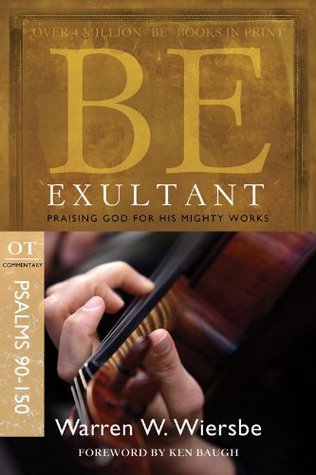
Be Exultant: Wiersbe commentary on Psalms

In my current trek through the Bible, I’ve just finished the book of Psalms. I had not planned to end the book right before Thanksgiving, but I was glad it worked out that way.

Once again, I used Warren Wiersbe’s short “Be” commentary as a companion, along with the ESV Study Bible notes.

Since Psalms is the longest book of the Bible at 150 chapters, Wiersbe divided his commentary on the book into two parts. I reviewed the first one here: Be Worshipful (Psalms 1-89): Glorifying God for Who He Is. The second is Be Exultant (Psalms 90-150): Praising God for His Mighty Works.

As I said in the earlier review, the book of Psalms is Israel’s songbook. The passages cover Israel’s history from creation to the latest happenings of the day, their return after being exiled in Babylon for seventy years.

Though David wrote a majority of the psalms, various other authors contributed as well.

The writers composed in caves, in hiding, in their rooms, under persecution, in celebration.

Many of the psalms are deeply personal, yet benefit the whole congregation.

The psalms are deeply doctrinal, some prophesying of the Messiah to come, many quoted in the New Testament.

But many people value the psalms most for their wide range of emotion, from the highest praise and exaltation to the lowest depths of misery. The psalms give us many examples of someone pouring out their heart to God in confusion, sorrow, pain, or guilt, then reminding themselves of what they know to be true about God.

Here are some of the quotes from Wiersbe’s book that most stood out to me:

Life is brief, so Moses prayed, “Teach us.” Life is difficult, and he prayed, “Satisfy us.” His work at times seemed futile, so he prayed, “Establish the work of our hands.” God answered those prayers for Moses, and He will answer them for us. The future is your friend when Jesus is your Savior and Lord (p. 25, Kindle version).

It is better to suffer in the will of God than to invite trouble by disobeying God’s will (1 Peter 2: 18–25) (p. 26).

This hidden life of worship and communion makes possible the public life of obedience and service (p. 26).

To rely on our faith is to put faith in faith, but to rely on God’s faithfulness is to put faith in the Lord. Our assurance is in the Word of God and the God of the Word (p. 102).

The Word of God performs many wonderful ministries in the life of the devoted believer. It keeps us clean (v. 9), gives us joy (vv. 14, 111, 162), guides us (vv. 24, 33–35, 105), and establishes our values (vv. 11, 37, 72, 103, 127, 148, 162). The Word helps us to pray effectively (v. 58) and gives us hope (v. 49) and peace (v. 165) and freedom (vv. 45, 133) (p. 110).

What a precious treasure is the Word of God (vv. 14, 72, 127, 162; 61: 5)! It is like a deep mine filled with gold, silver, and precious gems, and we must take time to “dig” for these treasures (Prov. 2: 1–9; 3: 13–15; 8: 10–11; 1 Cor. 3: 9–23). A mere surface reading of Scripture will not put spiritual treasure into our hearts. Mining treasure is hard work, but it is joyful work when we “mine” the Bible, as the Spirit guides us into truth. Then, the Spirit helps us to “mint” the treasure so we can invest it in our lives (obedience) and in the lives of others (witness) (p. 131).

Wrong ideas about God will ultimately lead to wrong ideas about who we are and what we should do, and this leads to a wrong life on the wrong path toward the wrong destiny
(p. 193).

I’m thankful once again for Dr. Wiersbe’s insights.

Is It More Important to Read the Bible Together or Alone?

Is it more important to read the Bible together or alone?

What’s more important: having regular personal time alone with the Lord or hearing the Bible read and taught in community at church?

You might respond, “We need both. Why pit them against each other?”

That’s my question. Why, indeed?

Nevertheless, I’ve seen a couple of recent articles positing that the church service is to be our main spiritual meal.

One author’s reasons for her premise was that in Scripture, God spoke to groups through a prophet or preacher, and the New Testament epistles were written to churches.

But God spoke to individuals as well. And many NT letters and books were written to individuals (Luke, Acts, Titus, Philemon, 1 and 2 Timothy).

I suspect this idea that we need to hear the Word gathered together more than we need to read it on our own arose for a couple of reasons. One is the drifting away of many from church and the desire to stress to believers the importance of meeting together.

Another is the almost universal guilt people feel about their time in the Bible. Every time this topic comes up, I hear disappointment or frustration or disillusionment. People feel guilty if they miss a day (or several days), if they fall asleep or get distracted while praying or reading the Bible, if they didn’t particularly get anything out of it or felt bored.

It’s true there’s nothing in the Bible that tells us to read it every day or prescribes exactly how a quiet time or devotions should be practiced.

But Psalm 1 tells us that the stable, fruitful person meditates on God’s law day and night. God specifically told Joshua to meditate on the book of the law day and night. We’re told throughout Scripture to remember what God said. We can’t meditate on (think about, turn over in our minds) what we have not heard or read.

The psalms in the Bible are songs which were sung by the children of Israel. Some of them have plural pronouns, but many have personal pronouns. That means even though the congregation is singing about the truths of the passage together, the passage was written by someone’s experience with the Lord alone. Psalm 119:148, the writer actually anticipates “the night watches, that I may meditate on Your word.”

Our time alone with God should feed into our time together, and our time in the Word together should edify our inner souls and equip us in our daily walk.

Time with other believers learning God’s Word is vital and wonderful. But we only meet together once or twice a week. The Bible is our spiritual food, and we need to eat more than that.

We don’t relate to God only as “one of the kids.” In a family with multiple children, each child relates to the family as a whole. But each child also relates to the father and mother as individuals.

We’re to meet together frequently (Hebrews 10:25), “stir one another up to love and good works” (Hebrews 10:24), learn from the incredible gifts God gave to the church in pastors and teachers (Ephesians 4:11-13), sing worshipful, Scripture based songs together (Colossians 3:16).

But just as children are born into a family individually, no matter who else might be there, we’re born again by personal repentance and faith in Christ as Lord and Savior. We get to know Him by spending time with Him, listening to Him, alone and with others. Though our brothers and sisters in Christ are great encouragements, sometimes we stand with God alone and encourage ourselves in God alone, like David did. We praise and meditate on Him alone in the middle of the night (Psalm 63:5-7). We’ll each give account of ourselves to God (Romans 14:11).

What about the disappointment we feel when our devotional time is less than stellar?

We need to remember the point of a devotional time is not to get through an assignment, to feel proud that we’ve completed our plan for the day, or to turn in a great performance. The point of a devotional time is to get to know God better.

When we get to know other people, we spend time with them, learn about them, listen to them, talk with them. Just like with others in our lives, those conversations will vary. Some interactions are long and deep, some are hurried and surface-level.

I like to think of it this way: every time in the Bible is not going to be like a Thanksgiving feast, where we’re filled to bursting with all our favorite things. But every meal nourishes us, even the tuna casseroles or peanut butter sandwiches and their spiritual equivalents.

God knows we’re only human. “As a father shows compassion to his children, so the Lord shows compassion to those who fear him. For he knows our frame; he remembers that we are dust” (Psalm 103:13-14).

And feeling sleepy, bored, or not with it on a given day happens in church as well as home alone with our Bibles.

When the Bible was being written, no one had a completed copy of it. And most people did not have their own copy of any part of it. Listening to the Bible being taught was the main way, often the only way, they were exposed to it. Even when the Bible was completed, it was a long time before individuals had their own.

But we do have the completed Bible. And most of us have several copies, as well as apps to read or listen to. William Tyndale, John Wycliffe, and others gave their lives to provide people with copies of the Scripture they could read in their own language.

If every word in the Bible is God-breathed, shouldn’t we spend time taking it in as much as we can?

A couple of older saints inspire me to read God’s Word for myself:

Above all theologies, and creeds, and catechisms, and books, and hymns, must the Word be meditated on, that we may grow in the knowledge of all its parts and in assimilation to its models. Our souls must be steeped in it; not in certain favorite parts of it, but the whole. We must know it, not [only] from the report of others but from our own experience and vision. . . Another cannot breathe the air for us, nor eat for us, nor drink for us.—Horatius Bonar from They Walked With God

You all have by you a large treasure of divine knowledge, in that you have the Bible in your hands; therefore be not contented in possessing but little of this treasure. God hath spoken much to you in the Scripture; labor to understand as much of what he saith as you can. God hath made you all reasonable creatures; therefore let not the noble faculty of reason or understanding lie neglected. Content not yourselves with having so much knowledge as is thrown in your way, and as you receive in some sense unavoidably by the frequent inculcation of divine truth in the preaching of the word, of which you are obliged to be hearers, or as you accidentally gain in conversation; but let it be very much your business to search for it, and that with the same diligence and labor with which men are wont to dig in mines of silver and gold.—Jonathan Edwards

Granted, the articles I mentioned earlier did not say we should only read and hear the Bible in church and never read it on our own. They encouraged private devotions as well, but elevated church reading and teaching above them. However, I would say reading and studying the Bible alone is not second fiddle to hearing it taught at church. Both are good and needed ways to get to know our God and His will better.

Let the word of Christ dwell in you richly - Colossians 3:16a

(I often link up with some of these bloggers.)
Laudable Linkage

Laudable Linkage

I found a lot of good reading this week:

A Comforting Resource for People Who Have Lost Parents. My friend, Lois, lost both parents within five weeks of each other a few year ago. Some of her blog posts since then have been about processing their loss and working through grief. She found a lot of resources for losing a child or a spouse, but not much on losing parents. That seemed to be treated as just a normal part of life. Though the death of one’s parents is inevitable, grief still runs deep. Lois has just pulled these posts together in one resource page. She tells about it and links to the Help for Parent Loss page there.

How Can I Cultivate a Listening Life in a Noisy World? “Do we demonstrate through our choices that we truly believe that we NEED God’s Word? Are we still ‘the people of the Book?'”

Can a Christian Have Mental Illness? HT to Challies. “Some Christians believe that Christians cannot have mental illness. If a professing Christian is depressed, anxious, or bipolar, they think it’s because they are not a real Christian, or that there is some terrible sin they haven’t repented of, or that they need to repent of the depression or whatever the problem is. Nearly half (48 percent) of evangelicals believe that serious mental illness can be overcome with prayer and Bible study alone. The result of this condemnation of mental illness as sin is that many Christians do not admit they have a mental illness, they don’t talk about it, and they don’t reach out for help.”

We Need Every Word, HT to Challies. “I want to feast on the Bible passages I love, the ones that make me feel some note of pleasure or comfort. I want the reminders that I’m loved, the encouragements to hold fast, and the songs of praise that remind me of God’s faithfulness. I don’t always want the lists or the history or the stories that don’t seem to affect me.”

Why We Are Tempted not to Pray, HT to Challies. “Prayer should stupefy us. ‘You mean, this all-powerful God who keeps galaxies spinning is interested in you telling him about your day and might alter the course of the entire cosmos because you asked him if you could have a parking space?’”

Being Involved in Church as a Teen, HT to Challies. “But being born into a church as a baby, and then growing up through Sunday school and youth group, can often make it hard to be taken seriously. Even older Christians with the best intentions can miss the mark. It can feel a bit awkward when they ask you the same questions every time they see you in church. It takes time and effort from both sides to help and encourage one another, and ultimately, have more meaningful relationships.”

Is the Lord’s Day the Christian Sabbath? HT to Challies. “At the outset, I need to say that this issue is one that I think Christians should not divide over. The view I present below is not the one I grew up with, but I have no particular ambition to convert people to my view — except that, with regard to those who have the duty to teach God’s word, it is important to do so properly, ‘rightly handling the word of truth’, preaching the full counsel of God with all His authority, but never giving human ideas that same authority.”

The Ritual of Rearranging Books, HT to Linda. “Taking all the books down was a chance to organize and cull, but primarily, it was an experience in simply remembering what was there, how it got there, and why. You can look at shelved books until the cows come home, but it’s not the same as actually taking them off the shelves.”

Seeing the Light on Religious Fiction, HT to Linda. “As I complete my 40th year working with books, I’ve changed my mind about an entire publishing genre that I once held at arm’s length at best, and treated with something akin to critical dismissal at worst. I feel like the proverbial old dog who has suddenly learned a new trick. The genre? Religious fiction.” I especially loved this one!

Routine leads to devotion, especially in Bible study.

The quote here is from “Just Not Feeling It”: How Routine Awakens Devotion.

Laudable Linkage

Laudable Linkage

Some good reads found this week:

Just Not Feeling It”: How Routine Awakens Devotion. “To some, the word routine carries the stiffness of stale bread and the rot of dead plants, the stuffiness of library books never opened and attics dusty with age. The very thought of routine spirituality — planned, scheduled, disciplined — seems to undermine the ministry of the life-giving, freedom-bestowing Spirit. ‘Where the Spirit of the Lord is, there is freedom’ (2 Corinthians 3:17) — and where the spirit of routine is (we may think), there is bondage. The dichotomy, however, is self-imposed, self-imagined. If routine smells stale to us, the problem lies in our own sniffer.”

Delays Are as Much a Part of God’s Plan as Answered Prayers. “At times, we may find ourselves in situations where we are eagerly waiting for answers to our prayers, hoping for our dreams, goals, and aspirations to come to fruition. However, it’s during these moments of uncertainty and delay that we may become overwhelmed with frustration, anxiety, and even a sense of disillusionment.”

2 Ways Anxiety Affects Parents, HT to Story Warren. “In my thirty-plus years of counseling, I’ve never seen parents feel as much pressure or as much like failures as they do today. I’ve never had as many parents in tears in my office. And I’ve certainly never seen as many parents who live in a perpetual state of worry.”

5 Lies Teenagers Believe & Biblical Truth to Set Them Free. “I sometimes fear this generation of young people is stuck in a giant game of Where’s Waldo? They only see the things they are looking for. When you fear rejection, you see it on every face in the crowd. When you want to escape your responsibilities, you spot exits everywhere. When you crave affirmation, you will find it in all the wrong places. 1 Peter 5:8 HCSB says, ‘Be sober-minded, be alert. Your adversary the devil is prowling around like a roaring lion, looking for anyone he can devour.’ Sadly, teens are primary targets in the enemy’s strategy to dismantle the kingdom of God.”

Purposes of Predicative Prophecy. “Why has God given revelation in the form of prophecy? And why so much? What is the goal of prophecy? Or are there multiple intended effects? A number of passages answer these questions. The answers are surprisingly diverse.”

Lists are Menus, HT to Linda. I don’t have the negative feelings this writer has about working through a list. But there is something appealing about looking at a list like a menu. “These menus also help clarify a critical way a menu differs from a to-do list: picking just one or two items from a menu is something you get to do, not something you have to do. The myriad things you could order – so far in excess of your capacity to consume them – don’t constitute a problem.”

The Bible has to go through our head to affect our heart and life.