You might think, from my remarks on Growing Up Amish, that I don’t read Amish fiction, and it is for those reasons that I don’t read much of it. But I was reading Beverly Lewis long before Amish fiction started exploding on the Christian fiction market. Since her books were based on or inspired by some of her grandmother’s experiences, and since she didn’t idealize the Amish lifestyle but delved into some of its problems and hardships, I’ve enjoyed all of her books that I have read. (Some other authors of Amish fiction may do the same, but I am not interested in expanding my reading of that genre.)
The River is about two sisters from an Amish family who had left the Amish years before to “go fancy” into the world of Englischers. They receive word from a brother that there is a celebration planned for their parents’ 50th wedding anniversary, and both sisters are invited. They’re not inclined to attend until they hear that their father has a serious heart condition and is resisting the idea of surgery. They decide to go, with some trepidation.
Tilly, the older sister, had left the Amish first. There had always been tension between her and her father, and when her youngest little sister, Anna, had drowned in a river, that tension was exacerbated because Tilly blamed herself for not watching her sister closely enough and felt her father blamed her as well. Her sister Ruthie left a few years later primarily due to a hard breakup with a beau. Since their leaving, Tilly married and had two children; Ruthie was single but actively involved in a good church.
As they return, Tilly has the harder time, feeling that she is blamed not only for Anna’s death, but also for influencing Ruthie away from the Amish. Her father is not hostile but is not welcoming, either. Ruthie runs into her old boyfriend and at first wants to avoid him, but then decides she should at least hear him out when he wants to talk with her. Both women struggle with the parts of their former lives that are good and familiar vs. the parts that are painful.
Strong themes in the book are the need to look at another person’s side of things and the need for forgiveness, both extending and receiving.
I very much enjoyed the book and felt the struggles that were faced were realistic.
Beverly mentioned in her note at the end that she had made a documentary called “Glimpses of Lancaster County.” Part 1 is here and Part 2 is here. Each is only a few minutes long. The end of Part 2 mentions a Part 3, but I didn’t see it on the site (later I did find Part 3 on YouTube.) It was enjoyable to hear Beverly describe her childhood, her grandmother who was shunned for marrying outside of her father’s will, and to see some of the places where she and her family grew up and where some scenes for her books take place.
For those who enjoy book trailers, here is the one for The River.
A Captain’s Duty: Somali Pirates, Navy Seals, and Dangerous Days at Sea by Richard Phillips first came to my attention through Lisa. I vaguely remembered this incident in 2009 and knew a movie had been based on it, which I’ve not seen. But I decided I wanted to read the story behind it.
Captain Phillips tells a bit of his own background and a bit of merchant marine history. I had a step-uncle in the merchant marines and didn’t know much about it, so I found this quite informative. I liked that Phillips read a lot of merchant marine history and regarded his position as not just a job to earn a paycheck and pay bills, but rather a continuation of that tradition. This information as well as some background into his family is told mostly in flashbacks in conjunction with getting ready for his next trip. He also tells of the danger of pirates, particularly in certain hot spots, but said there had not been an instance of pirates taking an American ship in 200 years. However, he notes, “Sailors are bringing the world’s most vital resource through the world’s most unstable region, which had turned the area around the Gulf of Aden and the Somali coast into a shooting gallery. Anyone sailing there would be under constant threat of attack from pirates, who were getting smarter and more violent by the month” (p. 26).
The chapters are set up in a countdown fashion leading up to the day the pirates did overtake his ship. He talks about training his men in what to do in case of a pirate attack and shoring up security. They had two uncanny close calls with pirates, and then, suddenly, when the Somali pirates did come after his ship, it happened incredibly fast. They had time to sound an alarm so that most of the men could go into a prearranged hiding place and so that Phillips could turn dials and switches that would disable the radar and many of the functions on the ship. They wanted as few people as possible to be visible so that the pirates could not kill them or hold them hostage.
The way it usually worked was that the pirates had a larger “mother ship” nearby which they could communicate with once a ship was taken, and negotiations would begin to demand a ransom. But Phillips had made it so that the radar wasn’t detecting their ship and had turned the radio channel so their hails were on a little-used frequency. He convinced them that many of the ship’s operations were broken and he couldn’t fix them and didn’t know where the rest of the crew was, and they believed him. They threatened to kill the four men on the bridge but did not carry out their threat after two deadlines, and finally stopped threatening. They took Phillips through the ship to try to find the missing crew, but he was able to keep them away from their hiding place, or, in a couple of instances, the one or two crewman who were at large heard them coming and hid in time. When they began taking the other crewmen on the bridge to do the same thing, those men were able to get away into hiding places of their own. Finally Phillips was able to convince the pirates to take the lifeboat, and him along with them. I had not realized that the bulk of this ordeal occurred with just Phillips and the pirates on the lifeboat, but he succeeded in getting ship and crew free.
The pirates thought they could still hold out for a ransom. They actually all got along pretty well, even joking together, until Phillips tried to escape. Then they turned on him, kept him tied up, and began beating him. After four more long days, Navy SEALs rescued him (no spoiler there since that was in the news. 🙂 ) In fact, during some of the tenser moments in the book, I had to keep reminding myself, “It’s going to be ok. He makes it our alive.”) The SEALs did admit, though, that the outcome was better than they thought it was going to be.
Phillips weaves in to the story what was going on with his wife and family during this situation as well, how friends came to be with his wife and help in various ways, how the media made a nuisance of itself by camping in front of their house.
Even knowing the outcome, this was a riveting story.
One major problem with the book, however, is a heavy smattering of bad language. I had set it aside for a time, not sure if I should go ahead with it. I finally decided to pick it back up again, and large chunks of it would be profanity-free, then I would be blasted with it again. Of course, it’s his story, and he is telling it like it happened. “Cussing like a sailor” is a known idiom, though I don’t know why they have a penchant for or think they’re free to engage in such speech. I know it’s real to the story: I just don’t like to fill my brain with it so that it comes into my own mind in tense moments.
I am always interested in the spiritual side of things, even though spirituality is not a major component of the book. Phillips and his wife were Catholics, but, by his admission, not good ones. He talks about being a believer in some sense of the word, and says that this incident helped his wife come back to her faith. He calls one of his crewman a born again Christian, so he seems to acknowledge that that’s something different from himself. He says he prayed:
“God, give me the strength and the patience to see my chance and to take it. I know I’m going to get only one shot. Give me the wisdom to know it.” I never prayed to get away. I just prayed for strength and patience and knowledge to know when to make my move. I believe God helps those who help themselves. Asking for Him to do all the work is just not my style (p. 191).
What a wonderful opportunity that would have been to completely humble himself and abandon himself to God. I’m glad he had the measure of faith he did and pray God will continue to grow it.
Another interesting thing he discusses near the end is what he calls “the H word: Hero.” He was very uncomfortable with people calling him that and noticed that other people in a similar position would also comment that they didn’t feel they were. I have noticed that, too, in those kinds of interviews. People will say things like, “I wasn’t a hero – I just did what I had to do.” Phillips theorizes that “we are stronger than we think we are” and we can handle far more than we think we can (p. 284). He feels that everyone has “this potential inside you, too. If fate put you in my shoes, you’d have done the same thing” (p. 285). He acknowledges that “mental toughness” and “training your mind never to give up” are a part of it (pp. 284-284).
I’ll close with one quote I especially liked that he opened the book with from John Paul Jones, who was also a merchant mariner and Revolutionary war hero:
If fear is cultivated, it will become stronger. If faith is cultivated, it will achieve mastery.
(This review will also be linked to Semicolon‘s Saturday Review of Books.)
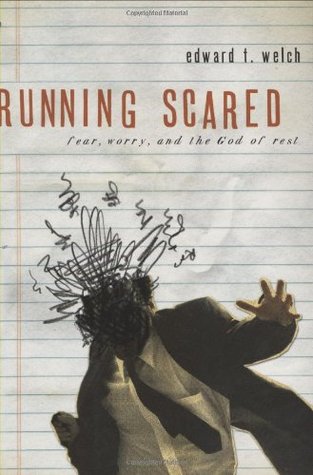
Edward T. Welch aims Running Scared: Fear, Worry, and the God of Rest primarily at himself as a “fear specialist,” but thankfully he lets us in on what he has learned. He notes that “Fear not” is the most often repeated command in the Bible and can be taken either as “a judicial warning, which has a threatening overtone” or as a “parental encouragement, which aims to comfort.” He says, “Luke places the accent on parental encouragement,” and Welch does as well. The thirty meditations are not an outline or in linear form — there’s a bit of overlap — but reading a chapter a day is doable and helps build on the principles he discusses.
The first couple of chapters set the scene, and, if you didn’t think you were fearful or had anything to worry about, these will convince you! One problem with dealing with fears in a conventional way is that they don’t usually submit to logic, and some techniques for dealing with them are only temporary and don’t get to the heart of the matter.
The heart of the matter, Welch asserts, is that our fears and worries reveal something to us about ourselves. Most of them focus on not getting something we think we need, or fearing something that might happen. Both involve a fear of not being in control and reveal what we value. So he encourages us to “Rather than minimize your fears, find more of them. Expose them to the light of day because the more you find, the more blessed you will be when you hear words of peace and comfort.”
“Worriers are visionaries without the optimism.” Most worriers would qualify as false prophets because our predictions don’t come true more often than not.
“The sheer number of times He speaks to your fears says that He cares much more than you know…The way He repeats Himself suggests that He understands how intractable fears and anxieties can be. He knows that a simple word will not banish our fears.”
“Search Scripture and find that our fears are not trivial to God. ‘Do not be afraid’ are not the words of a flesh-and-blood friend, a mere human like yourself. They are not the words of a fellow passenger on a sinking ship, who had no experience in shipwrecks, can’t swim, and has no plan. These words are more like those of captain who says, ‘Don’t be afraid. I know what to do.’ When the right person speaks these words you might be comforted.”
There is so much that is helpful in this book and so many places I have highlighted that it’s hard to know which ones to share without quoting half the book here. I’ll try to just share some of the things that were most helpful to me.
One was the “manna principle,” lessons drawn from God’s providing Israel with manna in the wilderness. One lesson was that the Israelites weren’t really models of prayer in that instance. They were complaining. That doesn’t give us the right to complain, but it does highlight the fact that God answers because of His grace, not because of “the quality of our prayers.” Another I shared earlier is that the Israelites were to gather what they needed for each day. If they tried to hoard enough to last, the excess would rot. So for us, we depend on God’s grace for each day’s needs. Most worry is about what is going to happen in the future, but Jesus said, “Therefore do not be anxious about tomorrow, for tomorrow will be anxious for itself. Sufficient for the day is its own trouble” (Matthew 6:34). That doesn’t mean we never plan ahead — there are Scripture verses about that, too — but we don’t worry or become anxious about them, trusting God will provide what is needed when the time comes. We won’t have grace for a future event because we don’t need it yet. Another was that the principle of Sabbath rest was built into their system and served, among other things, as a test of faith and a way to honor God and acknowledge His control. Just as they had to trust that the manna would be there every morning, they had to trust that when they gathered enough on Friday to last through the Sabbath, it wouldn’t rot like it usually did when they gathered extra. This is a principle largely lost on modern Christians. True, we’re not under the specific Sabbath restrictions that Israel was, but a Sabbath rest was exemplified by God in the first week of creation. Businesses feel they can’t afford to lose the business that they would if they were closed on Sundays, and individuals feel they can’t possibly get everything done they need to do if they take a day of rest. We don’t realize what we’re missing out on.
Another chapter, “The God of Suspense,” deals with the fact that sometimes God delivers before we even know we have a need, sometimes He seems to deliver at the last minute, and sometimes He delivers after the fact, “after hope dies,” as with the death of Lazarus and the widow’s son. In those cases. God had a greater purpose in mind: to show people that Christ had power over even death. He cites some cases in which the very thing someone feared came upon them (as Job said), and God didn’t deliver in the way hoped for, yet He did something greater in drawing the person closer to Himself and helping them know Him in ways they would not have otherwise. He cites many Biblical examples that God does not shield us from every hardship, but “If the difficulty you anticipate comes upon you, you will receive grace” to deal with it.
He talks a great deal about the Sermon on the Mount and being taken up with God’s kingdom:
Are you worried? Jesus says there is nothing to worry about. It isn’t our kingdom, it’s God’s. We take our cue from the King, and the King is not fretting over anything. He is in complete control.
When you know that the Kingdom is God’s alone (though He gives it to us), that is the only thing that can lead to peace and rest. Owners are the ones who do all the worrying; stewards simply listen to the owner’s desires and work to implement them. Owners are responsible for the outcome; stewards strive to be faithful.
A few more favorite quotes:
“Worry is focused inward. It prefers self-protection over trust…It can reveal that you love something more than Jesus. It crowds Jesus out of your life.” It can even “choke the word” of God in our lives (Mark 4:19), so it is nothing to be ignored or treated lightly. “Anxiety and worry are wake-up calls that must be handled by spiritual means.”
“Worry’s magnetic attraction can only be broken by a stronger attraction, and David is saying [in Psalm 27] we can only find that attraction in God Himself.”
“When you call out, you might feel like He isn’t present or easily found. That is the nature of pain. The worse it is, the more alone you feel. But this is a time when the words of God must override your feelings. There are times when we listen to our feelings and times when we don’t. This is a time when we don’t. Instead, whenever there is a clash between our sensory experience and the promises of God, the promises of God win. The one who says, ‘verily, verily’ can be trusted. Call out and He will be found when you need Him.”
Welch deals with not only the anxiety and worry over physical needs, like money and provision, but with personal needs like approval and love, fear of death and judgment. He discusses prayer and what it means to have died in Christ and what freedom that can bring us. He points to our need to find and focus on our calling from God, what God’s peace, or shalom, means, and His instructions to be peacemakers. In short, I think he pretty much covers every base he can think of that might be related to anxiety and worry and points us to Christ in each instance.
There were a few places I disagreed with him about some particular, but I don’t fell the need to delineate all of that here. Overall I found this one of the most helpful books I have ever read. I mentioned before that I had bought it as a Kindle sale and forgotten about it, then came across it about a month before my recent surgery and decided to read it in the days leading up to the procedure. Combined with the prayer of friends, it helped me keep my mind on God and off the “what ifs,” and I know I will return to it often in the future.
(This review will also be linked to Semicolon‘s Saturday Review of Books.)
Pygmalion by George Bernard Shaw wasn’t really on my radar, but one of the categories for the Back to the Classics Challenge was a play. At first all I could think of was Shakespeare, and I wasn’t quite up to him just now. Then, perusing a list of classic play titles, I saw Pygmalion. Perfect!
The play opens with a number of people in front of Covent Garden late on a rainy night. All different classes of people are represented here. Someone trying to find a cab runs into a flower girl and knocks her basket out of her hand, spilling her wares and thus ruining her income for the night. In trying to sell her flowers, someone points out a man taking notes. She fears he is with the police and starts protesting her innocence and right to be there. As it turns out, he is not with the police. He is Henry Higgens, a professor of phonetics who can tell everyone where they are from by their accent. One of the crowd is a Colonel Pickering, who, as a student of Sanskrit, had just come from India to confer with Higgens. In their conversation, Higgens remarks offhandedly that he could take the flower girl’s “depressing and disgusting sounds” that would “keep her in the gutter to the end of her days,” and within three months’ time pass her off as a duchess.
To his surprise and consternation, the flower girl. Eliza Doolittle, shows up at his house the next day to take him up on what she perceived as an offer. She’d like to work in a flower shop instead of on the streets, and needs to know how to talk better to do so. Pickering encourages Higgens to take her on, saying that if he can teach her to pass for a refined member of society by an ambassador’s garden party, he’ll pay for her lessons. Despite the protests of his housekeeper that “You can’t take a girl up like that as if you were picking up a pebble on the beach,” Higgens agrees.
Thus begins their work, with much clashing of wills and opinions, triumphs and not-quite triumphs. A couple of my favorites of the Professor’s instructions:
Remember that you are a human being with a soul and the divine gift of articulate speech: that your native language is the language of Shakespeare and Milton and The Bible; and don’t sit there crooning like a bilious pigeon.
Remember: that’s your handkerchief; and that’s your sleeve. Don’t mistake the one for the other if you wish to become a lady.
If you’ve ever seen the musical My Fair Lady, you may know that it is based on Pygmalion. The ending is vastly different, and the actual scene of Eliza’s ultimate test is shown in the film whereas it is only referred to in the book, but otherwise for the most part it follows the play pretty closely (at least as far as I can remember – I haven’t seen the musical in a long time). Pygmalion is based in turn on a Greek mythological character of the same name who falls in love with a statue he created and gets his wish for it to come to life.
The end of My Fair Lady has Eliza and Higgens falling in love: Pygmalion does not. In fact, the end of Pygmalion seems a little unsatisfying at first. I thought that was just because I was used to My Fair Lady’s ending, but according to a number of sources I read, many who produced or directed the play varied the end slightly to at least hint that Eliza and Higgens came to some understanding. Shaw got so disgusted that he wrote a very long afterward explaining why they could not possibly have married, whom she does marry, and what happens to the major characters after the end of the play. Though this Pygmalion does not fall in love with his creation, he does “bring her to life.” In one of their final scenes together, when they’re arguing over what’s to become of her now, she shows she has gone from simpering and whining about it to having a plan, even if it means standing up to Higgens. He replies, “It’s better than snivelling; better than fetching slippers and finding spectacles, isn’t it? By George, Eliza, I said I’d make a woman of you; and I have. I like you like this.” So if we can set aside the desire to see a “romantic” ending, it is a conclusive ending in that now his “creation” is truly complete. Cliff notes says:
Consequently, with the conflict clearly stated for Higgins, the essence of human life is through mutual improvement; for Eliza, it is through human loving and commitment — then only the most sloppy, sentimental reader could ever think that their relationship will ever change.
In Shaw’s afterward he says, “The rest of the story need not be shown in action, and indeed, would hardly need telling if our imaginations were not so enfeebled by their lazy dependence on the ready-makes and reach-me-downs of the ragshop in which Romance keeps its stock of ‘happy endings’ to misfit all stories.” SparkNotes suggests Shaw was trying to deconstruct the typical fairy tale. If he was, he did a good job. Henry Higgens is no Prince Charming. He’s gruff, conceited, ill-mannered and self-centered. Though Eliza is transformed, she’s not exactly a Cinderella. And their ending, if not “happily ever after,” is probably more realistic (“What is Eliza fairly sure to do when she is placed between Freddy and Higgins? Will she look forward to a lifetime of fetching Higgins’s slippers or to a lifetime of Freddy fetching hers?”)
Other sources say Pygmalion is a satire of the social classes, and I can see that angle, too, especially in the subplot with Eliza’s father. And though each class is shown to be ridiculous in some ways, Shaw makes some poignant observations as well. Eliza tells Colonel Pickering:
Your calling me Miss Doolittle…That was the beginning of self-respect for me. And there were a hundred little things you never noticed, because they came naturally to you. Things like standing up and taking off your hat and opening doors — yes, things that showed you thought and felt about me as if I were something better than a scullery maid…
The difference between a lady and a flower girl is not how she behaves, but how she’s treated. I shall always be a flower girl to Professor Higgens, because he always treats me as a flower girl, and always will; but I know I can be a lady to you, because you always treat me as a lady, and always will.
Shaw says in his preface, though, that it is primarily about speaking English and based on well-known phonetics specialists. He says, “The English have no respect for their language, and will not teach their children to speak it. They spell it so abominably that no man can teach himself what it sounds like…German and Spanish are accessible to foreigners: English is not accessible even to Englishmen. The reformer England needs today is an energetic phonetic enthusiast: that is why I have made such a one the hero of a popular play.” He says later:
I wish to boast that Pygmalion has been an extremely successful play all over Europe and North America as well as at home. It is so intensely and deliberately didactic, and its subject is esteemed so dry, that I delight in throwing it at the heads of the wiseacres who repeat the parrot cry that art should never be didactic. It goes to prove my contention that art should never be anything else.
As I said earlier, I had no thoughts of reading this play until I saw the title and thought it would be good for the Back to the Classics play category, and indeed it was. It was nice to have lighter fare after some longer and heavier works. Though I missed the musical numbers, I did enjoy finding out what the original story was like. I enjoyed listening to the audiobook delightfully read by a full cast but also got the free Kindle version to go back over some parts more thoroughly.
Some readers will want to know that it has a smattering of “damns” in it.
And even though these are not part of the original play, especially the last two, they’re on my mind after finishing the story, so I will share them here:
The folks at 5 Minutes For Books host What’s On Your Nightstand? the fourth Tuesday of each month in which we can share about the books we have been reading and/or plan to read.
I love when the Nightstand posts occur actually near the end of the month, as they do this time. It’s been a busy month, but let’s see what’s been accomplished on the reading front.
In addition, last time I had finished The Little Prince by Antoine de Saint-Exupéry but hadn’t reviewed it yet. That review is here. Ended up liking it quite a lot, though I thought it was odd at first.
I also started two books that I set aside due to language. I haven’t decided yet whether to finish them or lay them aside permanently. One was a classic, one was a modern true story that I had really wanted to read.
If I finish those I have a stack of unread books on the bookshelf in my bedroom as well as a lengthy TBR list and a multitude of Kindle books to choose from.
In The Narnian, Alan Jacobs wanted to write a biography of C. S. Lewis, but not one that brought out a lot of extraneous details of his life. He wanted to concentrate mainly on what made him “the Narnian” – the intellectual, imaginative, and spiritual developments in Lewis’s life that led to his creating Narnia.
He begins with Lewis’s early life and family: the death of his mother and the fact that afterward “all settled happiness, all that was tranquil and reliable, disappeared from my life”; the imaginary worlds he created with his brother (separately first, then they joined them together), his problems with his father, the solitary days playing alone in his home after his brother went to boarding school. When Lewis’s own turn came for boarding school he didn’t get on very well socially and eventually thrived under a private tutor. Jacobs then progresses through Lewis’s time in the military, in academia, His conversion from atheism, his apologetic writing, his fame as a defender of the faith, and his turning from that genre to children’s stories, and closes soon after telling of the end of Lewis’s life.
Along the way he pulls up information from Lewis’s published writings, letters, diaries, and other people’s letters, diaries, comments, and a few other people’s biographies of him.
I didn’t “discover” Lewis until in my early 40s (I know, how did that happen? My education was definitely deficient!) Some time after my first reading of The Lion, the Witch, and the Wardrobe, I read a biography of Lewis, but I don’t remember which one. I’m thinking it must have been one geared to children, because his childhood is what I mostly remembered from it, but then maybe that’s just due to a faulty memory. At any rate, I enjoyed being reminded of elements I knew and then learning new details of his older life.
I liked the way Jacobs juxtaposed elements of Lewis’s life with the Narnia books, quoting some of the sections about schooling along with talking about Lewis’s schooling, doing the same with his early childhood and military service. There is not much more than basic information about Lewis’s time in the military – he seems to have kept thoughts about it close to his vest – but some of the passages in the Narnia books about having to fight, particularly from Peter’s viewpoint, probably grew from his own experiences. Digory Kirke was based on Lewis’s private Professor Kirkpatrick (sometimes called Kirk), though Kirk was a staunch unbeliever (“Digory Kirke is a picture of what William T. Kirkpatrick might have been – had he ever found a way into Narnia.”) Of course, Jacobs isn’t saying that everything in the books is based on something from Lewis’s life explicitly. Much in the stories came from his imagination, but that’s going to be based on his own experiences as well as those he had read about.
I especially appreciated his defense or explanation of where Lewis was coming from in a couple of areas where some are critical of him. He has been called a misogynist because of his views on women, particularly in regard to teaching that the man is the woman’s head in a relationship, and racist because the Calormen people, the “bad guys” in Narnia, are dark-skinned. Tolkien was also accused of racism in LOTR, and Jacobs explains:
The imaginations of those two men were shaped before the great wars of the twentieth century: they belonged indeed to an Old Western culture to which the chief threat, for hundreds of years, had been the Ottoman Empire. The Calormenes and the Haradrim are but slightly disguised versions of the ravaging Turk who filled the nightmares of European children for more than half a millennium — but whose “exotic” culture (manifested in images of elegant carpets, strong sweet coffee, slippers with turned-up toes, and elaborate story-telling traditions) had also been an endless source of fascinated delight.
Jacobs asserts, and I agree, that most readers “can tell the difference between, on the one hand, an intentionally hostile depiction of some alien culture and, on the other, the use of cultural differences as a mere plot device,” and he puts Lewis’s comments on both topics within the context of the culture of his time and his own upbringing.
What I strongly disliked about this book was Jacobs’ frequent arguing with Lewis’s own reasons for saying certain things. For instance, Lewis asserted that his having prayed for his mother to be cured and not receiving the answer he sought did not influence his eventual conversion one way or the other. He had thought of praying not so much as a religious exercise but as a formula in those days and assumed he didn’t have the right formula or it hadn’t worked. Her death affected him in many ways, but it wasn’t a particular factor in that decision. Jacobs is incredulous and posits that perhaps Lewis’s “insistence must be his attempt to uphold a set of beliefs about what Christianity really is, or really should be” or he had “a great resistance to anything like a ‘Freudian’ explanation of his spiritual history – and in the Freudian account, childhood experiences are usually definitive for later life.” On another subject Lewis “seemed to think that [certain experiences] were not related; I have a sense that they may be.” Jacobs finds it “rather difficult to believe that Lewis’s description of [his first meeting with his tutor] is wholly accurate.” He feels Lewis’s claim that his wartime experiences “‘show rarely and faintly in memory’ – is either something less than fully honest or something less than fully self-knowing.” He quotes Lewis as saying those experiences “haunted my dreams for years” as proof, but Lewis says for years, not for the rest of his life, so at the time he said they were only rare and faint memories, that could have indeed been the case at the time of that writing. He questions Lewis’s account of his conversion and what stage of belief he was in at what point. He questions his relationship with Janie Moore, the mother of a friend who died in WWI. He and this friend had promised each other that if anything happened to one of them, the other would care for the dead one’s parent. This man did die, and Lewis took care of his mother for the rest of her life. He often refers to her as “the woman I call my mother.” But Jacobs insists that the relationship was romantic and even sexual at first (he is not alone in that view, but I am not convinced). When Lewis asserted that he had no “romantic feelings” at first for Joy Davidman Gresham, whom he married in a civil ceremony so she could stay in the country, Jacobs notes that his other biographers “take his word for it” and exclaims, “This seems crazy to me,” and explains why. (Lewis did come to love her, but who is to know at one point that happened.” About a third of the way into the book, Jacobs says as an aside, “Autobiography is, of course, often suspected.” I don’t think that’s the best way to look at autobiography, as if as a reader or researcher one has to disbelieve or suspect or prove what is written. Sure, the viewpoint of an autobiography may be limited: I feel it’s the best source for learning what is going on in the author’s head, what his motives and concerns were, etc., yet it can only show his own point of view. I’m sure there are autobiographies where the material is deliberately slanted, but I don’t think it’s healthy to have a suspectful view of autobiographies in general.
Mr. Jacobs not only disagreed with Lewis’s own views about his life, he also disagreed with some of his biographers, some of whom knew Lewis personally. In one of my snarkier moments I felt that an apt subtitle to his book could have been, “Why I Am Right About C. S. Lewis and Everyone Else Is Wrong, Including Lewis.”
But though this seeming attitude or perspective of Jacobs really bugged me, I did enjoy the book overall and enjoyed getting a fuller picture of the “The Life and Imagination of C. S. Lewis.”
I’ll close with one of my favorite quotes from Lewis in the book:
“We may ignore, but we can nowhere evade the presence of God. The world is crowded with Him. He walks everywhere incognito. And the incognito is not always hard to penetrate. The real labor is to remember, to attend. In fact, to come awake. Still more, to remain awake.”
Like many Dickens’ novels, Little Dorrit starts off kind of slow with different scenes, characters, and conversations that don’t seem connected. But if you’ve read much Dickens, you know everything is connected in his books and trust it will all make sense in time, and it does.
One of the early scenes involves a group of people in quarantine after a trip from China to England. One of them, Arthur Clennam, has been living and working with his father for several years. His father has died, and Arthur is returning home. He goes to visit his mother and to tell her he does not want to continue in the family business. He also says he has reason to suspect that his father has perhaps wronged someone without having a chance to make it right, and asks if she would know whom, so that Arthur can do this kindness for his father. His mother and her butler-turned-business-partner Mr. Flintwich takes great offense at the suggestion.
Arthur is in his 40s and his home has never been a happy one. His parents have never gotten along, and his mother is rigidly and unmercifully religious, seeing everything that happens in terms of God’s punishment.
Arthur notices what he thinks is a young girl doing needlework at his mother’s house, but when he looks at her more closely, he sees that, though she is small, she is actually a young woman. He notices that his mother treats her with a modicum of kindness, unlike how she treats everyone else, and wonders if perhaps this girl or her family are ones that his family or their business has wronged. He follows her as she leaves to try to find out more about her.
He discovers that her father has been in Marshalsea debtor’s prison for some 23 or so years. The girl, known to everyone as Little Dorrit, was born there. Evidently prison at this time, at least this prison, allowed inmates’ families to live with them and come and go. Little Dorrit’s (her given name is Amy) mother died years ago. She has an older sister who has learned how to dance and works in that way, and an older ne’er-do-well brother. Her father has the distinction of having lived in the prison the longest of anyone there and is regarded as “the Father of the Marshalsea.” What is odd about all the family except Amy is that they put on airs (later Amy’s sister remonstrates with her about embarrassing the family and their position by walking home with an old pauper).
Arthur tries to discover the details of Mr. Dorrit’s case to see if there is anything he can do to help the family. He goes to the Circumlocution Office – Dickens’ satirical treatment of the epitome of bureaucracy and red tape – and gets nowhere.
Book I of the novel is called Poverty; Book II is Riches, which tells you that the Dorrit family’s fortune changes, but not their character.
Amy has fallen in love with Arthur, but Arthur, although he comes to care for her deeply, calls her “my child” and seems to see himself as a father figure. Meanwhile, he is in love with a girl named Pet, whom he met on the trip from China, along with her family, the Meagles. He has become friends with her family and visits them often. But she loves someone else.
Along with these threads, there are a few more: two prisoners seen in the opening chapter show up in different perspectives later in the book; a Miss Wade who was also on that first ship from China is a bitter woman whose path crosses that of the Meagles, Arthur, and one of the prisoner’s many times; there are several businessmen who play key roles, some good and some bad; there are a couple of Society women who do the same; there is a convoluted mystery involving Arthur’s mother, her butler, one of the prisoners, and Little Dorrit.
At 800+ pages, there is a lot to this novel. It was originally published in monthly installments over two years in the 1850s. Dickens’ own father had been a Marshalsea prisoner. Most of his novels deal with some sort of social injustice, and this one touches on the plight of the poor, governmental inefficiency, and the falseness of high society. He says in the preface that the major investment failure in the book that affects many is based on an actual bank failure.
It’s a little hard to sum up in one sentence what the book is about, but, going by the title character, I’d say it probably has to do with a character who stays good and kind whether her circumstances are good or bad, whether people treat her well or poorly. When her father’s fortune changes, she “lay her face against his, encircled him in the hour of his prosperity with her arms, as she had in the long years of his adversity encircled him with her love and toil and truth; and poured out her full heart in gratitude, hope, joy, blissful ecstasy, and all for him.” She reminds me a lot of Nell in The Old Curiosity Shop, caring for a fairly foolish parent (or grandparent in Nell’s case), except she is older and wiser and comes to a better end. That is one gratifying thing about this novel: the good characters win out in the end, even though some of them go through some low spots and trials, and most of the bad ones get their just desserts.
Even though Dickens deals with serious issues, he sprinkles quite a bit of humor throughout the book. In one of the sections dealing with a high society dinner, and having commented often on the highly powdered wigs of the footmen, he says that at the dinner “There was so much Powder…that it flavoured the dinner. Pulverous particles got into the dishes, and Society’s meats had a seasoning of first-rate footmen.” In telling about a Mr. Pancks, who is sort of the man who gets things done behind the respected figurehead of his business, he describes him as a tugboat who pulls the big ship where it needs to go, and uses phrases harkening back to that metaphor almost every time he mentions him, like, “Pancks opened the door for him, towed him in, and retired to his own moorings in the corner” and “On taking his leave, Pancks, when he had shaken hands with Clennam, worked completely round him before he steamed out the door.” The family in charge of the Circumlocution Office are slyly named Barnacle.
There are also some very tender, poignant moments, as when Arthur, after accepting that Pet loves someone else, tells Amy that he’s too old now to think about love, and Amy doesn’t want to show her feelings toward him but is dying inside. Arthur had decided early on that it would be best not to fall in love with Pet, and there are several statements along the lines that, “It’s a good thing he made that pact not to fall in love with her,” but he actually had. Later, after Pet tells him she’s going to marry another and he’s alone again, he takes the flowers she had picked and given him and gently tosses them in the river, where his hopes and dreams float away with them. And another young man, coming to grips with a great disappointment, “the heart that was under the waistcoat…swelled to the size of a gentleman, and the poor common little fellow, having no room to hold it, burst into tears.”
A favorite moment late in the book is a confrontation between Arthur’s mother and Little Dorrit, in which the latter tries to convince Mrs. Clennam that she doesn’t have to punish herself for her wrongdoing:
“Even if my own wrong had prevailed with me, and my own vengeance had moved me, could I have found no justification? None in the old days when the innocent perished with the guilty, a thousand to one? When the wrath of the hater of the unrighteous was not slaked even in blood, and yet found favour?”
“O, Mrs Clennam, Mrs Clennam,” said Little Dorrit, “angry feelings and unforgiving deeds are no comfort and no guide to you and me. My life has been passed in this poor prison, and my teaching has been very defective; but let me implore you to remember later and better days. Be guided only by the healer of the sick, the raiser of the dead, the friend of all who were afflicted and forlorn, the patient Master who shed tears of compassion for our infirmities. We cannot but be right if we put all the rest away, and do everything in remembrance of Him. There is no vengeance and no infliction of suffering in His life, I am sure. There can be no confusion in following Him, and seeking for no other footsteps, I am certain.”
I mostly listened to the audio version wonderfully read by Simon Vance, but near the end I switched back and forth with the Kindle version, both because I was getting eager and impatient to see how everything came out, and I could read at times that I couldn’t listen. I’ve been trying to read some Dickens work that I was not familiar with, so I’m glad to have completed Little Dorrit in that vein. Though I can’t say this is one of my favorites of his, I did enjoy it, and Amy and Arthur are among my favorites of his characters. There was a BBC miniseries made of it in 2009 (starring Matthew McFadyen, who played Mr. Darcy in the Kiera Knightly version of Pride and Prejudice, as Arthur) that I would love to see some time, but as it is several hours long, I’d probably have to break it up into segments as it originally aired. Here’s a trailer for that series:
Have you read Little Dorrit? What did you think?
(This review will also be linked to Semicolon‘s Saturday Review of Books.)
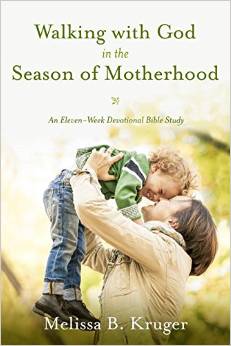
This study grew out of Melissa’s desire for “a Bible study that intersected who I was as a believer with the role I had been given as a mother.” It’s not necessarily a “how to be a better parent” study. It’s more of a “how to walk with God and then let that relationship impact your ministry to your children” study.
She begins with our purpose – to glorify God and enjoy Him forever – then reminds us of our responsibility to teach the same to our children and our inability to do so for ourselves or for them on our own. Succeeding chapters discuss walking in faith, wisdom, prayer, carefulness, and then each facet of the fruit of the Spirit, ending with a discussion of the Perfect Mom Syndrome.
The study is laid out over eleven weeks, with four days of study per week and a fifth wrap-up summary of the truths covered in that week. I really like that the Bible verses are included within the study, so a busy mom trying to feed a baby or grab a few minutes of study while waiting for piano lessons or ball practice to end has everything needed right there within the book. There is an additional study guide at the back that would be great for a group study but is also helpful for personal use.
I have several quotes marked but will try to pull out just a few:
It is important to assess regularly whether my family is suffering from an overly busy calendar. However, rather than simply removing activities, my greatest need is to add one particular meeting to my schedule. Every day I need time with Jesus. While it seems counterintuitive, the addition of this one meeting promises to positively affect every other part of my day (pp. 30-31).
When impatience, anger, or discontent well up in our hearts, these are signs that we are mothering in our own strength. Rather than dealing only with our outward behavior, we need the Lord to renew and recharge our hearts…our souls find renewed energy only by abiding in Jesus. Without this time we will find ourselves depleted, discouraged, and unable to bear fruit (p. 33).
[Re the Proverbs 31 woman], We can view her as an older woman to learn from rather than a standard against which to measure ourselves (p. 73).
An additional benefit of a home at peace is that it overflows into loving care and service for our community. The goal is not to create a place to escape or avoid the world but to carefully build our home so that it is a light to the world, shining the grace of Christ to those who are without hope. A peaceful home offers a place of respite and care in the midst of a weary world (p. 76).
When we receive the abundant love of Christ, we are free to pursue others with love, not to gain their affection but to give back what we have already received (p. 93).
True joy does not discount real suffering; it shines all the greater in the midst of it (p. 115).
The ability to extend kindness requires an other-awareness. We are apt to miss the needs of those around us if we remain self-focused. Helping children to see the needs of others will bless them with perspective on their own lives, as well as propel them toward good works that display the kindness of God (p. 157).
God uses these moments to grow our hearts in grace. We can only bear the fruit of patience when we have something to be patient about (p. 164).
In Jesus the performance pendulum stops — both the pride of success and the despair of failure are absorbed by grace (p. 208).
I cannot protect my children from my weaknesses. As hard as I may try, at some point my sin will affect their lives. However, the way I deal with my failure can provide an example for them to follow. I am a sinner raising sinners. Each of my children will face the weight and sorrow of his or her own sins. Just as we teach daily hygiene habits like brushing teeth, our children need instruction on how to find cleansing for their souls. By teaching our children about confession and repentance as well as grace and forgiveness, we bless their lives for years to come (p. 213).
At some points the study seemed a bit long, both in number of weeks and in how long it took to complete the day’s reading and answer the questions. But it’s not, really – eleven weeks is a good length of time for a study. I went through the book in less time than that because I used it six days a week and went on to the next chapter after finishing one rather than reading one chapter per week, but I think the latter would be the better course, to really soak in the truths for that week before going on. And each day’s lesson only took about fifteen minutes. One could spend longer – I tend to answer the basic questions in writing but answer some of the more thoughtful ones in my head. If one did more with the writing sections, one could spend more time with each lesson. And if a day’s reading and questions take more time than one has, there is no reason you can’t take a couple of days or whatever time is needed to complete it. It’s better to go at one’s own pace and really dig into it than barrel through just to get it done. Melissa’s summaries at the end of each week’s lessons really help to review the material and help tie it all together.
I really enjoyed going through this study, found it very beneficial, and am happy to recommend it to you in whatever season you are in.
(This review will also be linked to Semicolon‘s Saturday Review of Books.)
The Captive Maiden by Melanie Dickerson is a retelling of Cinderella set in Germany of the 1400s. Gisela’s father has died and her step-mother has taken over and treats Gisela like a servant. While Gisela submits when she has to, she is spirited and uncowed When a big tournament is held in town, Gisela sneaks away to see the games and unexpectedly runs into Valten, the duke’s son. They had met years ago when she was seven and he and his father had bought one of her father’s horses, and she has thought about him ever since.
Valten is the older brother of Gabe from The Fairest Beauty but quite different in personality. Where Gabe is glib-tongued, especially with the ladies, Valten never knows quite what to say and seems aloof. Valten excels at winning tournaments, particularly in jousting, but is beginning to think there has to be something else in life.
Valten also has an enemy in Ruexner, his main challenger in the tournaments. When Ruexner observes that Valten has an interest in Gisela, Ruexner sees her as a means of getting back at Valten. And of course Gisela’s step-mother hinders her attempts to pursue a relationship with Valten, so, to paraphrase Shakespeare, the course of their true love is not going to run smoothly. But I won’t spoil the details.
Along the way, Valten has to realize that he needs to rely on God’s strength rather that his own, and they both have to wrestle with the vengeance belonging to the Lord rather than being theirs to exact.
I didn’t think the writing in this story flowed quite as smoothly as in some of Melanie’s other books, and, although it is normal for couples to have some misunderstandings at first as they are getting to know each other and learning to read each other, the misunderstandings and misreadings here seemed excessive. But overall I did enjoy the story. I think anyone who likes fairy tale retellings and/or clean Christian romances would like this book.
(This review will also be linked to Semicolon‘s Saturday Review of Books.)
The Little Prince by Antoine de Saint-Exupéry was chosen by Amy for Carrie‘s Reading to Know Classics Book Club for June, and, at 85 pages, also happened to fit the novella or short classic category for my Back to the Classics Challenge. I read the 70th anniversary edition, which, thankfully, my library had, and which also includes a CD of the story read by Viggo Mortenson (Aragorn in the LOTR films). I listened a bit to one CD just to see what it was like, but this is a book you definitely want to read rather than listen to because of the illustrations.
On the surface, the story opens with the narrator reminiscing that as a child, when he drew a picture of a boa constrictor digesting an elephant, grown-ups could only see it as a hat and advised him to stop drawing and concentrate on school subjects. “That is why I abandoned, at the age of six, a magnificent career as an artist. I had been discouraged by the failure of my drawing…Grown-ups never understand anything by themselves, and it is exhausting for children to have to provide explanations over and over again” (p. 2). As an adult he still showed people his drawing, but if they said they only saw a hat, he “would put myself on his level and talk about bridge and golf and politics and neckties” (p. 3).
So he felt pretty lonely and misunderstood until he crash-landed his plane in the Sahara Desert and met, in the middle of the isolation, a little prince. He had a hard time at first learning anything about the prince because he didn’t answer direct questions. The narrator had to pick up clues from things he said in passing, and in that way he learned that the prince was from an extremely small planet (the size of a house). But best of all, the prince understood his drawings.
Over the next eight days – the length of time the narrator’s water supply lasted while he tried to fix his plane – he learned more about the prince’s planet, travels to different planets and the odd people he met there, and his first excursions on Earth.
One gets the definite sense while reading that this story means more than the adventures of a little prince on his travels, yet the meaning isn’t entirely plain. I didn’t feel too bad about not being to make it out when I saw on SparkNotes and Wikipedia that there are differences of opinion among those who have read and studied the book since it was published 70 years ago. Some see in it elements of WWII, since it was written during that time, the dangerous baobob trees of the prince’s planet, which can “overgrow the whole planet. It’s roots pierce right through. And if the planet is too small, and if there are too many baobobs, they make it burst into pieces” (p. 15) representing Naziism. But some dispute that. There is more agreement that the vain rose that the prince cared for on his planet represents Saint-Exupéry’s wife. Some see it as “an allegory of Saint-Exupéry’s own life—his search for childhood certainties and interior peace, his mysticism, his belief in human courage and brotherhood…. but also an allusion to the tortured nature of their relationship” (Wikipedia). Some see it as “metaphor of the process of introspection itself, wherein two halves of the same person meet and learn from each other,” the narrator and the prince both representing aspects of Saint-Exupéry (SparkNotes). It adds to the mystique of the story that Saint-Exupéry was a pilot and did indeed crash-land in the desert once, and went missing while on a mission in his plane.
Whatever it means or represents, there are a few themes that come to the forefront. One is that “One sees clearly only with the heart. Anything essential is invisible to the eyes,” as a fox tells the prince. Another major theme is the problem of limited viewpoints. First there are the adults not understanding the narrator’s drawings, then one planet the prince visits is inhabited only by a king who only sees others as subjects to be ruled and acts toward them accordingly, and on another planet there is only a vain man who only sees others as admirers of himself, and so on. When the prince comes to Earth and lands in the desert and sees no other people, he asks a flower where they are. In her life she had only seen a few pass by, so she thought that’s all there were and that “The wind blows them away. They have no roots, which hampers them a good deal” (p. 52).
But to me the crux of the book is in the concept of “taming.” When the fox tells the prince he isn’t tamed, and the prince asks what “tamed” means, the fox replies:
“It is an act too often neglected,” said the fox. “It means to establish ties.”
“To establish ties?”
“Just that,” said the fox. “To me, you are still nothing more than a little boy who is just like a hundred thousand other little boys. And I have no need of you. And you, on your part, have no need of me. To you I am nothing more than a fox like a hundred thousand other foxes. But if you tame me, then we shall need each other. To me, you will be unique in all the world. To you, I shall be unique in all the world….”(p. 59).
He goes on to say that, “If you tame me, my life will be filled with sunshine. I’ll know the sound of footsteps that will be different from all the rest…If you come at four in the afternoon, I’ll begin to be happy by three” (pp. 60-61), and that from now on a wheat field, which means nothing to a fox since he doesn’t eat wheat, will remind him of the prince since his hair is the same color, “And I’ll love the sound of the wind in the wheat…” (p. 60). The fox also says, “It’s the time that you spent on your rose that makes your rose so important. . . . People have forgotten this truth, but you mustn’t forget it. You become responsible for what you’ve tamed. You’re responsible for your rose” (p. 64). The prince had thought his only rose was special until he comes across thousands of them on Earth. But the time and care he spent on it was what made it unique and special. So I think probably the biggest takeaway is that relationships (“creating ties”) are worth both the investment of time and care and then the pain when those with ties are apart, as the narrator himself discovers at the end. When the prince has to leave the fox, and the fox is sad, the prince tells him it’s his own fault for wanting to be tamed. When the fox admits he will weep when the prince goes, the prince asserts the fox got nothing out of being tamed. The fox replies, “I get something because of the color of the wheat” (p. 61). That statement in context is so poignant it almost makes me teary.
What I first thought of as an odd little tale that I couldn’t quite make sense of, now, after a couple of days of pondering, seems a very sweet and touching story about love and relationships. I love books that do that – make you think and unfold themselves long after the last page is turned.
(This review will also be linked to Semicolon‘s Saturday Review of Books.)

 The River is about two sisters from an Amish family who had left the Amish years before to “go fancy” into the world of Englischers. They receive word from a brother that there is a celebration planned for their parents’ 50th wedding anniversary, and both sisters are invited. They’re not inclined to attend until they hear that their father has a serious heart condition and is resisting the idea of surgery. They decide to go, with some trepidation.