I was surprised to hear in a song recently the line “Love doesn’t need any words.”
The song went on to say that love is “proven by the things we do and not say — for actions speak louder than words.”
Well, it’s true that actions can belie words. It’s true that actions and words need to line up. It’s true that love needs actions as well as words.
But I wouldn’t say that love doesn’t need words.
If you’re familiar with the five “love languages” as taught by Gary Chapman, you know that words are one of the five. The rest are quality time, gifts, acts of service, and physical touch. Chapman’s premise is that we all give and receive love in these ways, but usually one or two of them make us most feel loved. He tries to make people understand that if you do things for your loved one all day (acts of service), but their love language is words of affirmation, they are not going to feel loved. Conversely, if their love language is acts of service, and you tell them several times a day that you love them, the words are going to ring hollow if you never help them in the kitchen or do anything for them. So we should try to find the way our loved one most perceives love and express our love that way.
But this idea of not needing words reminds me of a quote attributed to St. Francis of Assisi: “Preach the gospel at all times. If necessary, use words.” I just saw that Francis is not known to have said this. I am not surprised, because it always bothered me. It’s true that our lives should demonstrate what we believe. But someone likened this to saying, “Feed starving children; when necessary use food.”
The gospel is made up of words. It’s “the power of God for salvation” (Romans 1:16).
Jesus Himself is called the Word of God. He said, “The words that I speak unto you, they are spirit, and they are life” (John 6:63). He also said, “Now ye are clean through the word which I have spoken unto you” (John 15:3).
Paul said, “So faith comes from hearing, and hearing through the word of Christ.” (Romans 10:17). Paul also said the gospel is the power of God unto salvation.
The Bible has much to say about words.
There is one whose rash words are like sword thrusts, but the tongue of the wise brings healing (Proverbs 12:18).
Death and life are in the power of the tongue, and those who love it will eat its fruits (Proverbs 18:21).
I tell you, on the day of judgment people will give account for every careless word they speak,for by your words you will be justified, and by your words you will be condemned (Matthew 12: 36-37).
Let no corrupting talk come out of your mouths, but only such as is good for building up, as fits the occasion, that it may give grace to those who hear (Ephesians 4:29).
There are times not to use words. Ecclesiastes tells us there is “a time to keep silence, and a time to speak” (3:7). When Elijah was so discouraged after his encounter with Jezebel, an angel let him sleep and fed him before his encounter with the Lord. Jesus told His disciples at one point, “I still have many things to say to you, but you cannot bear them now” (John 16:12).
The Bible says so much more about words: the power of the Word of God, how we use words, what we use them for.
We’re to speak true words, but we’re not to browbeat with them.
A soft answer turns away wrath, but a harsh word stirs up anger (Proverbs 15:1).
With patience a ruler may be persuaded, and a soft tongue will break a bone (which Pulpit Commentary says means, “gentle, conciliating words, overcome opposition, and disarm the most determined enemy, and make tender in him that which was hardest and most uncompromising) (Proverbs 25:15).
A gentle (wholesome, healed, soothing in other translations) tongue is a tree of life, but perverseness in it breaks the spirit. (Proverbs 15:4).
Words can tear down, wound, and deceive. Words can build up, sooth, and encourage,
May God give us wisdom to know when to speak and when to be silent and grace to help our words and actions to honor and rightly reflect Him.
At a recent ladies’ Bible study, the topic of worship came up. We agreed that worship wasn’t just singing in church. But some of the women wondered how we can maintain a worshipful attitude while correcting our children or cleaning the house.
That’s where the rubber meets the road, doesn’t it? It’s one thing to worship while reading an inspiring passage, singing in church, or hearing preaching that opens our eyes to truth about God.
But how can we carry that into everyday life? Cleaning, errands, traffic, and computer problems don’t seem conducive to worship.
It helps to consider once again what worship actually is. I heard a preacher define worship as “worth-ship,” ascribing to God His worth.
Dictionary.com defines worship as: “reverent honor and homage paid to God or a sacred personage, or to any object regarded as sacred; adoring reverence or regard.”
Our Bible study is going through Isaiah using Tim Chester’s Isaiah for You: Enlarging Your Vision of Who God Is. Chapter 3 focuses on Isaiah 12, which is an example of worship even though the word isn’t used.
Isaiah had previously discussed God’s great anger towards His people who had disobeyed Him and sought help from godless people rather than Him.
Verse 1 thanks God that “though you were angry with me, your anger turned away, that you might comfort me.
Verse 2 declares, “Behold, God is my salvation; I will trust, and will not be afraid; for the Lord God is my strength and my song, and he has become my salvation.”
Verse 3 assures, “With joy you will draw water from the wells of salvation.”
Verse 4 reminds us to thank the Lord, call upon His name, make known His deeds, proclaim His name among people.
Verses 5 and 6 tell us to sing and make known His greatness and the glorious things He has done.
Thinking of who God is and what He has done for us turns our hearts to worship.
But what about those moments that seem contrary to worship?
We can do these things in the midst of traffic snarls, dusting, or waiting on hold on the phone. In fact, worship would redeem the time and change our mood and frustration. As we remember His salvation, our joy will overflow. As we remember who He is and what He has done, our hearts turn to praise. As we remember His greatness, we sing His praise with joy and tell others about Him. Those things can infuse all we do.
Since God is our strength and my song, we can ask His help and strength.
We have to remember, too, that worship is an act, not a feeling. After Job lost everything, “Then Job arose and tore his robe and shaved his head and fell on the ground and worshiped. And he said, ‘Naked I came from my mother’s womb, and naked shall I return. The Lord gave, and the Lord has taken away; blessed be the name of the Lord'” (Job 1:20-21). In the psalms of lament, the writers acknowledge who God is even while pouring out their hearts to Him about their problems. In fact, it’s because of who He is that they can tell Him what’s wrong. They know that He cares and can be trusted to help.
Singing not only springs from worship, but it can lead us to worship. Sometimes when we come into church Sunday mornings from a busy week and the trials of getting ready that always seem to come up on Sunday mornings, we plop down in our chairs and don’t feel worshipful. But once we start singing, our hearts are turned to God. We can do that at home, too. I love to have Christian music playing while I’m puttering around the house.
Another aspect of worship is yielding our whole selves to God. Romans 12:1-2 says, “I appeal to you therefore, brothers,by the mercies of God, to present your bodies as a living sacrifice, holy and acceptable to God, which is your spiritual worship.” When we give Him everything, we’re acknowledging that He is worth yielding all to.
He redeems not only our souls, but our work. Elisabeth Elliot said in A Lamp for My Feet:
The job has been given to me to do. Therefore it is a gift. Therefore it is a privilege. Therefore it is an offering I may make to God. Therefore it is to be done gladly, if it is done for Him. Therefore it is the route to sanctity.
Here, not somewhere else, I may learn God’s way. In this job, not in some other, God looks for faithfulness. The discipline of this job is, in fact, the chisel God has chosen to shape me with–into the image of Christ.
We could substitute task, responsibility, or even ministry for the word “job” there.
When dealing with a fretful little one, we can appreciate God’s fatherly care of us when we’re fussy. When a child is being stubborn, we can be thankful for God’s patience with us and seek His help to be patient with our children. We can remember that we’re modeling parental love and care that our children will hopefully one day translate into their relationship with God.
When cleaning the house, we can rejoice in imitating His bringing order out of chaos. We’re reflecting a God who does things “decently and in order” (1 Corinthians 14:40). We’re caring for our family by creating a safe, sanitary place, and a peaceful home. When I’ve gotten irritated at how often things need to be cleaned, I sometimes think about God’s patience in cleansing me every day.
When the car or oven or computer break down, it’s a reminder that this world and everything in it is temporary. All we have is His, and we can trust Him to supply our needs. Meanwhile, we lay up treasure in heaven, where moth and rust don’t corrupt and thieves don’t break through and steal (Matthew 6:19-21).
If we regularly spend time reading and thinking about God’s Word, reasons for worship and examples will come to mind throughout the day.
These things remind me of one of my favorite poems:
Lord of all pots and pans and things, since I’ve not time to be A saint by doing lovely things or watching late with Thee Or dreaming in the dawn light or storming Heaven’s gates Make me a saint by getting meals and washing up the plates.
Although I must have Martha’s hands, I have a Mary mind And when I black the boots and shoes, Thy sandals, Lord, I find. I think of how they trod the earth, what time I scrub the floor Accept this meditation Lord, I haven’t time for more.
Warm all the kitchen with Thy love, and light it with Thy peace Forgive me all my worrying and make my grumbling cease. Thou who didst love to give men food, in room or by the sea Accept this service that I do, I do it unto Thee.
—Klara Munkres
How can we worship during everyday, mundane, or even negative circumstances? By acknowledging His worth and doing all we do as unto Him.
How about you? What helps you keep a worshipful attitude in everyday life?
Often I’ll turn the radio on while I make my breakfast, and usually Dr. Stephen Davey’s program, Wisdom for the Heart, is on at that time.
One day last week, Dr. Davey was speaking from Psalm 19. It’s a familiar passage to many of us. It starts with “The heavens declare the glory of God, and the sky above [firmament in the KJV] proclaims his handiwork,” and then goes on to develop that theme for the next several verses.
The last half of the psalm talks about how God’s character is seen through His Word. Verse 7 starts off another familiar passage: “The law of the Lord is perfect, reviving the soul. . . ” Perhaps you remember, as I do, a song made of these words.
The passage is so familiar, in fact, that it’s easy to zip right through it without stopping to take it in.
But Dr. Davey pointed out something that stopped me in my tracks.
The latter half of verse 7 says, “The testimony of the LORD is sure, making wise the simple.”
Dr. Davey said:
This is legal language; whenever someone is called into court by the prosecution or defense, they give their testimony. They testify to what they know – what they’ve seen – what they’ve heard.
David writes in legal terminology – God is testifying . . . and whatever and whenever He does, David writes here, The testimony of the Lord is sure.
In other words, you can count on it. One author* wrote, “You can throw your weight on God’s testimony and it will hold up.”
You can throw your whole weight on God’s testimony.
Does that impact you like it does me?
It’s not that this truth was new to me. But hearing it put that way brought my understanding to a whole new level.
God’s Word is sure. It’s trustworthy. We can stake the whole weight of our souls on it.
BibleStudyTools.org says the Hebrew word translated “sure” here means “to support, confirm, be faithful; made firm, sure, lasting; verified; reliable, faithful, trusty .”
What God tells us about Himself, the world, and ourselves is dependable.
His promises won’t break when we lean on them. That doesn’t mean all our prayers will be answered just the way we hoped, or that life will have a fairy-tale ending. But when He tells us who He is and that He will be with us and take care of us, we can rely on His Word without worry.
I did not grow up in areas where ponds freeze over. But I am familiar with the concept of testing the ice to make sure it’s solid before walking or skating on it. And I have stepped on a bridge, fallen log, or even a piece of flooring and felt it give, wondering if it would hold my weight.
But we’ll never have that experience with God’s Word. It is sure.
Is there a passage you’re staking your soul on today?
* Donald Williams, Mastering the Old Testament: Psalms 1-72 (Word Publishing, 1986), p. 153), quoted in Psalm 19:7-9) God’s Inspired Little Book by Stephen Davey on the Wisdom for the Heart Radio Broadcast, 1/22/2024.
You’re probably familiar with the parable of the Good Samaritan in Luke 10: a man is traveling, robbed, beaten, and left for dead. First a priest, then a Levite (someone who had temple duties) saw the man, but passed by on the other side of the road. Finally a Samaritan, who was of a race in conflict with Israelites and the unlikely one to stop, took care of the man at his own expense.
Jesus told this story in response to another conversation: a lawyer, knowing that he was supposed to love God supremely and love his neighbor as himself, wanted to know just who his neighbor was. Verse 29 says he asked this “desiring to justify himself.” He probably thought he was doing a pretty good job.
But Jesus’ story upended the lawyer’s assumptions. Our neighbor is anyone in need, even strangers, even enemies. Ultimately, the Good Samaritan pictures Jesus’ rescue of us spiritually.
Even though those are the primary lessons of the parable, I was recently instructed by a secondary consideration.
We like to rag on the priest and the Levite as being typically self-absorbed, “don’t want to get involved” people. We shake our heads at their lack of compassion toward their fellow countryman.
But there is another layer here. Under Levitical law, if a priest or Levite came in touch with a dead body, they would be ceremonially unclean for a certain amount of time. They couldn’t attend to their duties in the temple if they were unclean without performing certain rituals.
So they didn’t even want to take the chance to see if this beaten man was alive. To protect their calling of serving in the temple, they denied their greater calling of caring for a fellow Israelite in great need.
We’ve probably seen this happen in other situations as well. A father feels so responsible to provide for his family’s needs that he becomes a workaholic, neglecting their greater need of his guidance and presence. An overburdened doctor has so many patients that he shortchanges each one of time and attention in order to get through them all. A pastor bypasses a troubled church member seeking his counsel because he’s scheduled to eat lunch with the visiting guest speaker.
I was convicted years ago when I got short-tempered with one of my children when they interrupted me while I was reading a book. Ironically, the book was How to Be a Good Mom.
We can get so fixated on fulfilling what we think is our calling that we miss it entirely.
I struggle with this most now in desiring to write. I feel writing is something God wants me to do. But I’m discovering most writers struggle with making the time to write. I was encouraged in Elisabeth Elliot’s biography that even she struggled with this.
So the natural response is to stake a claim on my time, push people away, and resent interruptions.
But my first calling is to the people under my own roof. It would be wrong to push them away or resent them when they need me.
And if I want to write to encourage other people, particularly women, in their walk with the Lord, I can’t do that by selfishly manipulating my schedule, grasping for time.
So what’s the answer?
I’m still working on that.
But one thing I need to keep in mind is that my first calling is to love God with all my heart, soul, mind, and strength, and to love others as I love myself.
And then I need to remember that God’s callings are not in conflict. They seem like they are sometimes. But if He wants us to do something, He’s going to make a way to do it.
We don’t need to be manipulative and grasping. We can prayerfully seek God’s will and leading. We may have to lay aside lesser pursuits.
Instead of being territorial with my time, I need to be generous, trusting God to make it enough.
There is a principle throughout the Bible that if we’re generous, we’ll be blessed. But if we grasp and hoard for ourselves, we tend to lose whatever we’re holding onto so tightly.
There is one who scatters, and yet increases all the more, And there is one who withholds what is justly due, and yet it results only in poverty. A generous person will be prosperous, And one who gives others plenty of water will himself be given plenty (Proverbs 11:24-25, NASB).
For whoever would save his life will lose it, but whoever loses his life for my sake will find it (Matthew 16:25).
Give, and it will be given to you. Good measure, pressed down, shaken together, running over, will be put into your lap. For with the measure you use it will be measured back to you (Luke 6:38).
But seek first the kingdom of God and his righteousness, and all these things will be added to you (Matthew 6:33).
On the other hand, being generous with our time doesn’t mean we are always available for everyone else’s whims and can never make plans.
Once, after a busy evening of healing many people, Jesus got up early the next morning to pray alone. The disciples searched for him and told Him, “Everyone is looking for you.” “And he said to them, ‘Let us go on to the next towns, that I may preach there also, for that is why I came out'” (Mark 1:35-39). He didn’t go back to do more healing in the place where they were looking for Him. Healing was part of His calling, but His greater mission was to preach.
How we need to pray for wisdom and guidance as we seek to serve Him and others each day. As we seek His grace to love Him and others well, He will guide us moment by moment.
Commit your work to the LORD, and your plans will be established (Proverbs 16:3).
To this end we always pray for you, that our God may make you worthy of his calling and may fulfill every resolve for good and every work of faith by his power,so that the name of our Lord Jesus may be glorified in you, and you in him, according to the grace of our God and the Lord Jesus Christ (2 Thessalonians 1:11-12).
Resolutions. “Jesus does not need your resolutions, your recommitments, or your promises to try harder this year. If your resolve to obey God last year did not help you to be faithful, it will not make you successful this year. Jesus asks for your love.”
Christmas Is Over. Now What Do We Do with Jesus? “Celebrating the birth of that baby with the beautiful story of the stable and the manger is easy. But once the nativity sets are packed away (ok, ALL of my decorations aren’t put away yet), do we still think about Him?”
Leaving Christianity: How an Old Man Helped Save My Faith, HT to Challies. “If He was so good and so kind, why, despite my greatest efforts and consistent faith, was nothing working out? I was the kid who always kept his nose clean, had his act together, and tried to do the right thing. Why wasn’t I prospering?”
Prayer for My Heart This Election Year, HT to Challies. “Whether we’re interested in political science or not, this year with all of its candidates and craziness, will bring with it a raft of temptations. As I consider the year ahead, I know I need to guard my heart against the enemy’s attacks. Will you join with me in preparing your heart for whatever might happen in the months leading up to November 5?”
A Little Story about Worship. Dan Olinger shares a neat story about a worship experience in the Kenyan bush. It didn’t take place during the singing, but the offering time.
Chasity as Worship, HT to Challies. “I heard the message loud and clear: girls don’t struggle like boys do. So when I discovered that I had a sex-drive, I felt nothing but shame. I have carried that shame throughout most of my life and still, to this day, have to wrestle it down sometimes and triple-punch it with the truth of the Imago Dei, the God-created goodness of sexuality, and the full forgiveness in Christ for all our sins. But I want more for my daughter.”
I’m almost caught up after being several weeks behind with blog reading. So I have a longer than usual list of good reads to recommend. Perhaps one or two will pique your interest.
The Boy at the Front Desk. “I think I will always remember those ten minutes—that conversation that I wasn’t even part of—as a shining example both of what pain children are capable of feeling and of what hope and comfort we adults are capable of offering them.”
Tasting Heaven Now, HT to Challies. “‘If you died tonight, where would you spend eternity?’ I once completed an evangelism training course that taught us to initiate spiritual conversations with strangers by asking that question. . . . The promise of eternal life is a powerful motivator for faith and a precious promise of hope and comfort for God’s people. However, I fear that the church has so emphasized ‘going to heaven when you die’ that we sometimes give the impression that’s all faith is good for.” I’ve often thought that might not be the best question to start with, for reasons mentioned here.
20 Benefits of Being in God’s Word According to Psalm 119. “The Word of God is my anchor. It tethers my mind to the truth when the lies of the enemy are readily available. It wraps me with security when my future is uncertain. It pulls me back into the presence of God when I’ve sought the company of lesser pursuits.”
On Being a Heroic Man. “Rather than waiting and pining for an opportunity to display your heroism on a world stage, be willing and eager to display it on a small stage. Be heroic before your wife. Be heroic before your children. Be heroic before the few people God has called you to serve.”
Counseling Troubled Dreams, HT to Challies. “What do we make of these nighttime mini-movies that we can’t really control; are they just random neural impulses, strung together in some semblance of a narrative by our cerebellum, or are they messages from the “other side” to be painstakingly studied and interpreted? Or might there be some middle-of-the-road understanding that has practical importance in our Christian and counseling lives.”
Time Out: Do Clocks Keep Ticking in Eternity? This was so interesting to consider. I’d always heard that time as we know it will cease in eternity. It turns out that’s not the case.
It Is Bible Reading Time! Ways to keep a Bible Reading Journal plus various Bible reading plans.
When We Hurt Those Who Are Hurting, HT to Challies. “Those who hear these words might overlook the offense yet resolve to never again share their hearts with the perpetrators. Others assume that the comments are representative of the culture of God’s people, in which Christians should always be thankful and never complain. Either way, we isolate those who already feel alone, and we misrepresent the kingdom of God.”
Plan to Grow, HT to Challies. “In no area of my life have I ‘arrived’. I am being sanctified more and more, but there is a long way to Christlikeness. Don’t get me wrong, I’m not hopeless. God has given me His great and precious promises that He has predestined to conform me to the image of Jesus (Rom 8:29). But even still, I’ve learned that if I don’t plan to grow, I’ll be less like Jesus than I could be.”
7 Practical Areas of Christian Stewardship. “The topic that’s been on my mind is a big one: stewardship. Now if you’ve grown up in the church, you may be tempted to roll your eyes, groan, and/or be filled with a general sense of dread. You probably associate this word with a request to open your already tight wallet, since many churches devote one or two months a year to what they call “stewardship” where the main topic is giving to the local church. But there is more to stewardship than money. Yes, it’s part of it, but there is so much more. As Christians, we are stewards of all that God has given us.”
Not Neurotypical: A Love Story, HT to Challies. “With my firstborn, I learned that my child was not a problem to be solved or fixed, but a person to be loved and understood as God made him. I came to believe in my heart that this child was given to us for a reason—because God knew that we were exactly the parents and the family that he needed.”
This Is a Gift You Can Give, HT to Challies. On a family visiting a nursing home at Christmas, but true not just at Christmas: “I want you to know how much kindness and presence means to people. It may be awkward to sing carols or visit with people you don’t know, but this is a gift we can give . . .Our time, our love, our kindness, ourselves. Jesus gave us everything, His very life. His life for ours.”
Face the New Year with the Old Book. Face the new needs with the old promises. Face the new problems with the old Gospel. – Author Unknown
We usually put the wise men with the Nativity scene, representing their part of the Christmas story. But the wise men didn’t arrive to visit Jesus and His family until some time later.
After the wise men gave Jesus their gifts, they were warned in a dream not to go back the way they had come, the way to king Herod. He had said he wanted to know where the new king was, so he could pay Him homage, too. But he actually wanted to destroy what he saw as his rival.
Joseph, meanwhile, had been warned in a dream to take Mary and Jesus and flee to Egypt until the danger was past. So, thankfully, Jesus was safe.
When the wise men did not return and Herod realized he’d been tricked, he was so furious that he had all the male babies under the age of two in the region of Bethlehem killed.
How jarring, after all the talk about peace on earth and good will toward men, to have this horrible, senseless thing happen.
Satan is a defeated foe: “Since therefore the children share in flesh and blood, he himself likewise partook of the same things, that through death he might destroy the one who has the power of death, that is, the devil” (Hebrews 2:14).
Satan is something like a general who gets word that the war is over; the army has been defeated. But until the authorities come for him, he’s going to wreak as much havoc and destruction as he can.
Or he’s like a snake that a neighbor in my childhood killed after getting it out of our house. Though she chopped off its head, its body still writhed and its mouth still opened and closed. It was not a poisonous snake, thankfully. But if it had been, it would have still been dangerous for a while even after death.
Satan’s targets are anything belonging to God. Revelation 12 gives us an allegorical picture:
When the dragon saw that he had been thrown down to the earth, he persecuted the woman who had given birth to the male child. . . . So the dragon was furious with the woman and went off to wage war against the rest of her offspring—those who keep the commands of God and hold firmly to the testimony about Jesus (Revelation 12: 13,17, CSB) (p. 146).
So what about peace on earth? Does that not come until Jesus returns? Does mankind just hold on until then, trying not to drown in violence, injustice, and oppression?
No. Colossians 1:19-20 says, “For in him all the fullness of God was pleased to dwell, and through him to reconcile to himself all things, whether on earth or in heaven, making peace by the blood of his cross.” He carried the weight of all sin on Himself, paying its penalty in our stead.
He gives us peace with Him when we believe on Him as our Lord and Savior.
Then He gives us peace in the midst of life’s storms and trials because He is with us.
He gives us peace because He is our peace: “Now in Christ Jesus you who once were far off have been brought near by the blood of Christ. For he himself is our peace” (Ephesians 2:13-14a).
Ultimately, the day will come when Satan will be done away with completely. Violence and oppression will cease. Someday, “The wolf shall dwell with the lamb,and the leopard shall lie down with the young goat,and the calf and the lion and the fattened calf together;and a little child shall lead them” (Isaiah 11:6).
Until then, Jesus says, “Peace I leave with you; my peace I give to you. Not as the world gives do I give to you. Let not your hearts be troubled, neither let them be afraid” (John 14:27).
We may have faced sorrows and troubles even at Christmas time. We don’t know what the year ahead might hold. But we can face whatever comes with God’s peace.
We moved when I was in junior high, and my new school was the most clique-ish place I have ever seen. Very distinct groups rarely interacted with each other except when required to for class. I spent weeks, maybe months, eating alone and walking around the grounds in tears during lunch break until finally I found a friend.
So that’s one option when we feel unwanted: cry. 🙂
Another option might be to become a pathetic sycophant, doing anything to be accepted into the group. Kids get drawn into gangs this way.
A third option could be embracing the opportunity to be a maverick, with a “Who needs them, anyway” attitude.
Unfortunately, some people seek revenge on the group for making them feel like an outsider.
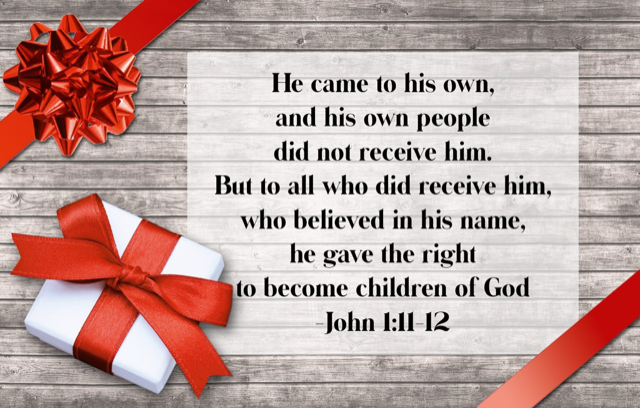
One of the saddest Bible verses to me is John 1:11: “(Jesus) came to his own, and his own people did not receive him.”
The world was inhospitable to Him since He was in the womb.
There was no room for Him to be born (Luke 2:1-7).
Herod tried to kill Jesus by having all the male babies under two years of age in Bethlehem killed (Matthew 2:13-23).
Satan tried to tempt Jesus to do away with Himself (Matthew 4:1-11).
During His public ministry, Jesus had “nowhere to lay His head” (Matthew 8:19-21).
His own half-brothers did not believe in Him (John 7:3-5).
People listened while He healed and gave them food. But when He started to say “hard things,” they left (John 6:60-71).
Some tried to throw Him off a cliff (Luke 4:28-30).
His disciples often didn’t understand or argued over which of them would be the greatest.
The scribes and Pharisees publicly debated and baited Him and eventually called for Him to be crucified.
He was the Messiah they had been promised and were expecting for centuries. But He wasn’t quite the kind of Messiah they were looking for. They didn’t just ignore Him or overlook Him: they rejected Him. Some went even further than rejection: they sought to do away with Him.
Jesus, thankfully, did not choose any of our listed options when people ignored, rejected, despised, or threatened Him.
He loved.
“God shows his love for us in that while we were still sinners, Christ died for us” (Romans 5:8).
He didn’t wait to die for us until we had cleaned up our act. He knew when He came that people would reject Him. But He loved them anyway. He took the initiative and sought to turn their hearts to Himself.
John 1 goes on to say that, though His own people did not receive Him, “But to all who did receive him, who believed in his name, he gave the right to become children of God” (John 1:12).
“For if while we were enemies we were reconciled to God by the death of his Son, much more, now that we are reconciled, shall we be saved by his life” (Romans 5:10).
He goes beyond acknowledging and saving us. He makes His home with us. “Jesus answered him, ‘If anyone loves me, he will keep my word, and my Father will love him, and we will come to him and make our home with him'” (John 14:23). He rejoices over us with joy, prepares a place for us.
Even once we come to know Him, we can sometimes let the cares of this life crowd Him out. We celebrate His coming with such frenzied activity that we neglect the very One whose birth we’re celebrating.
Room for pleasure, room for business, But for Christ the Crucified, Not a place that He can enter, In the heart for which He died? – D. W. Whittle, “Have You Any Room for Jesus?”
His love is perfect and perseveres despite all obstacles.
Joy to the world, the Lord is come! Let earth receive her King! Let every heart prepare Him room, and heav’n and nature sing. – Isaac Watts
May our hearts be hospitable to our Savior. May we not only make room for Him in our minds, affections, and time: may we give Him first place. And may we let His initiating, persevering love flow through us to others.
I’m not sure where or when or how the phrase originated, but the last few years I’ve seen many women fretting over not being “enough.”
My first thought on hearing this was “Enough for what?” Enough for their responsibilities? For the demands on their time? Enough spiritually? Enough in their relationships?
My second thought was “Of course we’re not ‘enough.'”
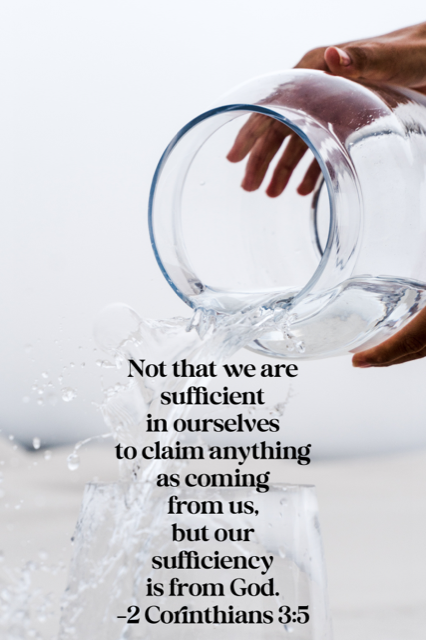
In speaking of his ministry to the Corinthians, Paul states, “Not that we are sufficient in ourselves to claim anything as coming from us” (2 Corinthians 3:5). In place of “sufficient,” some other translations use “competent,” “qualified,” “adequate”—all synonyms for “enough.” The dictionary definition for “sufficient” uses the word “enough.”
One commentary said this verse hearkened back to a question Paul asked in chapter 2, verse 16. After speaking about spreading the “fragrance of the knowledge of him everywhere,” Paul asks, “Who is sufficient for these things?”
The answer is given in the second part of verse 5 in chapter 3: “But our sufficiency is from God.”
Other passages bring out these same truths.
In John 15:5, Jesus said, “I am the vine; you are the branches. Whoever abides in me and I in him, he it is that bears much fruit, for apart from me you can do nothing.”
Jesus told His disciples in Matthew 26:41, “Watch and pray that you may not enter into temptation. The spirit indeed is willing, but the flesh is weak.”
Paul agrees in Romans 7:18: “For I know that nothing good dwells in me, that is, in my flesh. For I have the desire to do what is right, but not the ability to carry it out.”
But, he says in Philippians 4:13: “I can do all things through Christ who gives me strength.”
And he said God told him, in 2 Corinthians 12:9, “My grace is sufficient for you, for my power is made perfect in weakness.”
And you know what’s even more amazing? God doesn’t do just what’s enough.
In 2 Corinthians 9:8, Paul says, “And God is able to make all grace abound to you, so that having all sufficiency in all things at all times, you may abound in every good work.”
In Jeremiah 31:25, God says, “For I have satiated the weary soul, and I have replenished every sorrowful soul” (KJV and NKJV). Other versions say God satisfied the weary soul. The idea is being saturated, drinking one’s fill.
When Jesus fed 5,000 people in Matthew 14, there were twelve baskets of leftovers above and beyond what the crowd ate.
In Luke 6:38, Jesus said, “Give, and it will be given to you. Good measure, pressed down, shaken together, running over, will be put into your lap.”
In Ephesians 3:20, Paul says, “Now unto him that is able to do exceeding abundantly above all that we ask or think, according to the power that worketh in us” (KJV and NKJV).
So, dear friend, don’t worry about your not-enoughness. Let it turn you to His all-sufficiency. Abide in Him like the branch abides in the vine, letting His Spirit work in and through you. Rest in His grace, His strength, His provision for every need, physical, spiritual, mental, emotional. He is enough. He is more than enough.
In my early Christian life, whenever something went wrong, I would doubt God’s love for me. When preachers said God did things for His glory and our good, I would think, “His glory maybe, but my good? How is this good for me?”
There may be many reasons for that reaction, too many to explore here. But surely one was being spiritually immature and not knowing my Bible well enough. Another was the mistaken (and also immature) notion that if God loved me, I wouldn’t have problems. A popular book at the time was If God Loves Me, Why Can’t I Get My Locker Open? I never read the book, but I identified with the feeling.
Satan has capitalized on those feelings since the beginning. When he came to tempt Adam and Eve, he questioned what God said, contradicted it, and insinuated that God didn’t really have their best in mind.
Perhaps that’s one reason Paul prays in Ephesians 3 that God would “grant you to be strengthened with power through his Spirit in your inner being, so that Christ may dwell in your hearts through faith—that you, being rooted and grounded in love, may have strength to comprehend with all the saints what is the breadth and length and height and depth, and to know the love of Christ that surpasses knowledge, that you may be filled with all the fullness of God.” It’s interesting that the next well-known verse in that passage comes in this context: “Now to him who is able to do far more abundantly than all that we ask or think, according to the power at work within us, to him be glory in the church and in Christ Jesus throughout all generations, forever and ever. Amen.”
God wants us to know and rest in His love.
Why?
Well, anyone who loves wants the other person to know it.
But also, when we’re secure in God’s love, we’ll be less inclined to believe Satan’s lies. We can go forward through whatever trial is ahead knowing God is with us and has allowed it for some good purpose. We can obey Him because we know He is good, righteous, kind, and loving. We can love others out of the overflow of God’s love to us.
So how can we remind ourselves of God’s love when we might not feel it?
Remember what He did to save you. God would not have put up with all He did throughout humanity’s history, and Jesus would not have come to earth to live and die for us, if they did not love us. John 3:16, probably the most famous Bible passage in the world, tells us, “For God so loved the world, that he gave his only Son, that whoever believes in him should not perish but have eternal life.”
God’s law convicted me of my sin and showed me my need for a Savior. But it was His love that drew me, that convinced me He would receive me. He loved me when I was still in sin, His enemy, and uninterested. “God shows his love for us in that while we were still sinners, Christ died for us” (Romans 5:8).
Chas. H. Gabriel expressed this beautifully in his hymn “He Lifted Me”:
He called me long before I heard, Before my sinful heart was stirred, But when I took Him at His word, Forgiven, He lifted me.
From sinking sand He lifted me, With tender hand He lifted me, From shades of night to plains of light, O praise His name, He lifted me!
In Hosea, God says He drew Ephraim with “gentle cords, bands of love.” James Grindlay Small captures this in “I’ve Found a Friend”:
I’ve found a Friend, oh, such a Friend! He loved me ere I knew Him; He drew me with the cords of love, And thus He bound me to Him. And round my heart still closely twine Those ties which naught can sever, For I am His, and He is mine, Forever and forever.
Get to know God better. Jesus said, “And this is eternal life, that they know you, the only true God, and Jesus Christ whom you have sent” (John 17:3). Eternal life begins with knowing God. But we come to know Him increasingly more through our lives. We learn about Him from nature and other people, but the primary way of knowing Him better is through His Word. The more we know Him, the more we rest in His character and love.
Remember how He has blessed you. I’ve mentioned before “Ebenezers,” those times in your life when you especially saw God move and work in your behalf.
Meditate on His Word. I’ve referred to a few verses about God’s love. Here are a few more:
The LORD delights in you (Isaiah 62:4).
Can a woman forget her nursing child,that she should have no compassion on the son of her womb?Even these may forget,yet I will not forget you.Behold, I have engraved you on the palms of my hands;your walls are continually before me.(Isaiah 49:15-16).
The Lord takes pleasure in those who fear him, in those who hope in his steadfast love (Psalm 147:11).
The Lord your God is in your midst, a mighty one who will save; he will rejoice over you with gladness;he will quiet you by his love; he will exult over you with loud singing (Zephaniah 3:17).
But you, O Lord, are a God merciful and gracious, slow to anger and abounding in steadfast love and faithfulness (Psalm 86:15).
As the Father has loved me, so have I loved you. Abide in my love (John 15:9).
See what kind of love the Father has given to us, that we should be called children of God; and so we are (1 John 3:1).
In all these things we are more than conquerors through him who loved us.For I am sure that neither death nor life, nor angels nor rulers, nor things present nor things to come, nor powers,nor height nor depth, nor anything else in all creation, will be able to separate us from the love of God in Christ Jesus our Lord (Romans 8:37-39).
May the Lord direct your hearts to the love of God and to the steadfastness of Christ. (2 Thessalonians 3:5).
Listen to Scripture-based songs about God’s love, or read the lyrics. I’ve mentioned a few already. Here are some more:
Could we with ink the ocean fill, And were the skies of parchment made; Were every stalk on earth a quill, And every man a scribe by trade; To write the love of God above Would drain the ocean dry; Nor could the scroll contain the whole, Though stretched from sky to sky.
Here is love, vast as the ocean, Loving-kindness as the flood, When the Prince of Life, our Ransom, Shed for us His precious blood. Who His love will not remember? Who can cease to sing His praise? He can never be forgotten, Throughout heav’n’s eternal days.
“How Deep the Father’s Love For Us” by Stuart Townend (This is still under copyright, so I won’t post its lyrics, but you can find them here).
“O Wondrous Love” by Steve and Vikki Cook is also still under copyright: the lyrics are here.
Loved with everlasting love, Led by grace that love to know; Spirit, breathing from above, Thou hast taught me it is so. Oh, this full and perfect peace! Oh, this transport all divine! In a love which cannot cease, I am His, and He is mine.
In heavenly love abiding, No change my heart shall fear; And safe is such confiding, For nothing changes here: The storm may roar without me, My heart may low be laid; But God is round about me, And can I be dismayed?
Remember God’s love and truth work hand in hand. Some people emphasize God’s love to the exclusion of His righteousness and holiness. They see God as a doddering old grandfather who overlooks any wrongdoing and slips them sweets when their mother isn’t looking. They don’t understand that God is a God of truth as well as love, that it wouldn’t be loving of Him to let us go on in our sin without chastening.
A loving parent has to say no sometimes, or require hard things. A child might feel the parent would show more love by giving everything the child wants or making life easy. But that kind of behavior is selfish rather than loving, wanting the child’s approval (or wanting to avoid a tantrum) instead of doing what would build the child’s character.
Remember God’s love is based on His character, not ours. When we’re doing what we’re supposed to, we “feel” loved by God. But when we fall and fail, we feel maybe His love has dimmed a little, if not evaporated.
But the Bible tells us that “As a father shows compassion to his children, so the Lord shows compassion to those who fear him. For he knows our frame; he remembers that we are dust (Psalm 103:13-14). Verse 17 goes on to say, “But the steadfast love of the Lord is from everlasting to everlasting on those who fear him.”
He chastens us like a father because He loves us (Hebrew 12:5-11).
Though John 3:16 says God loves the world, that doesn’t mean the whole world has automatically become His. Some reject or ignore God’s love and gifts.
“God gave us eternal life, and this life is in his Son. Whoever has the Son has life; whoever does not have the Son of God does not have life” (1 John 5:11-12).
If you do know God, rest in His love, remind yourself of it often.
May you “come to know and to believe the love that God has for us. God is love, and whoever abides in love abides in God, and God abides in him” (1 John 4:16).