I didn’t think I’d have a Laudable Linkage this morning. It’s been a busy week, and I am way behind on blog reading. But I had a little free time yesterday afternoon and found these good reads.
Picture Perfect Christmas. “Every time I look awful, I run into my most together friend. HER. That altogether all together friend. I try not to let it, but it surely can make me cranky. And angsty. Crangsty.”
Victim Blaming and the Rich Young Ruler, HT to Challies. “The way that Jesus responded to the rich young ruler is so different from what comes naturally to me. When I see someone suffering, my mind often seeks to figure out how they are at fault for their own suffering. And that response is wrong for two main reasons.”
Grace in Afflictions. “I have been meditating for several weeks on 2 Cor. 4:15-18. The expression “light affliction” has been returning to my mind as I deal with daily, nagging physical conditions that are burdensome and uncomfortable. I’m seeking relief, improvement, and help from any source available. Even though I’m plagued by real challenges and wearing out, I’m still striving for healing and personal progress in my body and my soul. To respond I’m fleeing regularly to my study of God’s grace as revealed in scripture.” I especially love the last paragraph here.
Repeat Forever. “Can we linger just a little longer on thanksgiving before we move onto Christmas? ‘I will bless the Lord at all times; His praise shall continually be in my mouth.‘ (Psalm 34:1, NASB). One of the definitions of ‘continually’ is ‘without an intermission’ (dictionary.com). In other words, ongoing.”
Though we are keenly aware of the abuses that have grown up around the holiday season, we are still not willing to surrender this ancient and loved Christmas Day to the enemy. – A. W. Tozer
How to Prevent a Spiritually Dry December. “Busy days mean our schedules get squeezed. Work and school hours don’t change, so this means there’s a competition for our time at the margins. And, if you’ve been a Christian for any length of time, you know that devotional time is often a casualty in this battle.”
I’m Adopted, HT to Challies.. “For me, those heavy questions needed to be asked, then answered, before I would be able to see my adoption for the gift it is.”
Am I a Good Mom? HT to Challies. “Every day, I am faced with opportunities to fail or succeed but there is no one other than my three kids under three to see. For the last three years, I have constantly strived to be the best and most God-honoring mother I can be. In my striving, I have never, ever felt more like a failure.”
Before You Go On the Attack. “A classic strategy in times of warfare is to dehumanize the enemy. No sooner has a conflict broken out than the two sides begin to refer to one another as animals rather than men, as mere creatures rather than human beings.” I had been thinking of writing a post along these lines: now I don’t have to.
Seek, as a plain duty, to cultivate a buoyant, joyous sense of the crowded kindnesses of God in your daily life. – Alexander Maclaren
In the Middle of the Greatest Story, HT to Challies. “Veterans Day has me thinking of a time I stood in the middle of a story and felt like an imposter there, an imposter in someone else’s story.”
Widows: The Untapped Resource in Your Church, HT to Challies. “Widows aren’t delicate knick-knacks to put on a shelf and dust every now and then; they’re vital ministers to be deployed in the life of the church. They can teach the church a great deal about faith, devotion, service, and prayer.”
The Church: A Family of Redemption, HT to Challies. “The local church paints a picture of a greater reality: God takes broken people and makes them whole through the family of God. He has sent his son Jesus Christ to redeem a people—his people—to himself that they might enjoy him forever. This is an eternal and unfading family, but it’s also a family for the not-yet season that we live in.”
From Shadow to Substance: Aaronic Priesthood’s Transformation, HT to Challies. Some OT practices were declared to be “perpetual.” But we don’t practice them today. Why not? Randy Alcorn deals with some specific OT practices to show that we don’t just pick and choose what OT passages to follow and demonstrates how they are fulfilled in Christ. This is an excellent demonstration in interpreting the OT in the light of the NT.
Will We Know Everything in Heaven, or Will We Learn, also from Randy Alcorn, HT to Challies. “Paul, in Ephesians 2:6-7, writes, ‘God raised us up with Christ and seated us with him in the heavenly realms in Christ Jesus, in order that in the coming ages he might show the incomparable riches of his grace.’ The word translated show means ‘to reveal.’ The phrase in the coming ages clearly indicates that this will be a progressive, ongoing revelation, in which we learn more and more about God’s grace.”
The purpose of prayer is not to get man’s will done in heaven but to get God’s will done on earth. Warren W. Wiersbe
Here are some of the posts that resonated with me this week:
Don’t Forget the Gospel During Bible Study. “We tend to hear this exhortation about remembering the gospel and think immediately of our moral behaviors—our successes or failures in the realms of pride, anger, lust, jealousy, and the like. But we need reminders about God’s love, Jesus’s work, and our new identities throughout our lives, and we need to connect these truths to our every endeavor, including studying the Bible.”
The Unexpected Blessing of a Rural Church, HT to Challies. “Though the preaching of the Word changed my heart, the people drew me in to hear it. The love of these Christians made this outcast feel welcome and enabled me to let my guard down and Christ in.”
Scripture Over Systems. “While these various systems can be helpful, I would suggest that adherents to them should not be so anchored to their system that they ignore or misrepresent Scripture that seems to challenge or contradict their systematic understanding. They must be wrestled with and humbly acknowledged.”
Avoiding Quick Repairs in Counseling, HT to Challies. “We all wrestle with the challenge of wanting to fix anything and everything. That’s true not just in terms of our broken ‘stuff’ but also in our broken lives and relationships. If we are honest with ourselves, we can probably admit to times when we have crudely applied spiritual duct tape to situations that needed more skill, love, patience, and grace.” Though this was written to professional counselors, we can all benefit from it.
Merciless in the Name of Mercy, HT to Challies. “It’s a mark of the church to embody a fierce commitment to welcoming sinners and exalting the Father who lavishes grace on the prodigal. But what form should mercy take? What does mercy look like? What does it require?”
Dare to Be a Daniel, HT to Challies. “Maybe you’ve been exposed to the kind of teaching from the Old Testament that uses its stories to highlight moral examples. Is that kind of teaching bad? Should we do such a thing? Should it be avoided for the sake of christological interpretation?”
Ambitious for the Quiet Life. “I find myself thinking a lot about 1 Thessalonians 4:11, ‘make it your ambition to lead a quiet life: You should mind your own business and work with your hands, just as we told you.’ I love the juxtaposition of ‘ambition’ with ‘quiet life’ in how the NIV renders it. It almost feels oxymoronic. How can you be ambitious for a quiet life? But notice that it doesn’t say to be ambitious for a lazy life, though; just a quiet one.”
When You Feel Cast Aside. I love this account of Gideon’s army from the viewpoint of a rejected soldier.
Holiness is not the way to Christ; Christ is the way to holiness. – C. H. Spurgeon
In Made for More: An Invitation to Live in God’s Image, Hannah Anderson writes, “the goal of this book is to call women to recover an understanding of ourselves that is more basic than our gender. It’s a call to recover the image of God in our lives—to re-imagine not simply what it means to be a woman but what it means to be a person made in the very likeness of God Himself” (Location 131, Kindle version).
We tend to link our identity to various categories: gender, religion, vocation, location, political affiliation, etc. But such labels not only can’t embrace all of what we are, they can be divisive with people in other categories.
In order to know who we really are, we must first know who our Creator is—“accepting Him for who He is, not who we can conceive Him to be” (Location 287). Acts 17:28, Paul said, “In him we live and move and have our being.” “Simply put, there is one God and He is the Giver of all life. He created the world, and everything in it finds its source, its purpose, and its goal in Him” (Location 263).
Literally translated, imago dei simply means “in the image of God.” But in reality, imago dei means so much more. Imago dei means that your life has purpose and meaning because God has made you to be like Himself. Imago dei means that your life has intrinsic value, not simply because of who you are as an individual, but because of who He is as your God. Imago dei means that your life is sacred because He has stamped His identity onto yours (Location 402).
Yet God did not make us all alike. “We are different from each other and therefore dependent on each other. In other words, while each of us is fully made in the image of God, none of us can fully reflect and represent God alone. Instead we reveal the nature of God together; and as a result, we also find identity together” (Location 470).
Even though God created humans in His image, the first two sought their identity elsewhere, creating an identity crisis for the rest of the human race. “If they disobeyed, they would not simply be rejecting Him—they would be rejecting everything that was true about themselves as well. By choosing to turn from God to something else for knowledge, they would blind themselves to their own nature. And they would die because they would cut themselves off from the only thing that made them alive in the first place—God Himself” (Location 580).
Now, “Instead of living in dependent communion with Him, we fight for autonomy and the ability to rule our own lives; instead of loving and serving each other, we manipulate others to serve our own purposes; instead of exercising creative care of the earth, we consume it in our own greed and lust. Instead of unity, there is disunion; instead of harmony, there is brokenness” (Location 615).
The only way to get back to living in God’s image was for Jesus to identify with us that we might identity with Him.
The greatest identity shift that has ever happened was when God Himself became human and lived and died for us so we once more might live in Him. . .
[Jesus] is both the Image and the perfect Image Bearer, the Creator who deigns to live in His own creation. Despite being God, Jesus humbled Himself, took on human flesh, and came to live and die so that through His very life, death, and resurrection—through His metamorphosis—we ourselves might be changed (Location 764).
However, “Finding identity in Christ cannot be confined to one moment, because union with Christ is not simply an event; it is a state of being, a way of existing” (Location 810).
And that’s just the first third of the book. Hannah goes on to show how being made in God’s image affects what and how we love, our desires, roles, relationships, how we care for creation. Being made in God’s image, reflecting Him, guides our intellect, work, talents, and gifts.
The first book I read of Hannah’s was her advent book, Heaven and Nature Sing: 25 Advent Reflections to Bring Joy to the World, last December. I liked it so well, I wanted to read her other books. Though I didn’t do this on purpose, I ended up reading her books published at that time (two more have been written since) in reverse order according to my interest. Made for More was her first, but I read it last. Every time I considered it, I thought, “But I know what it means to be made in God’s image.” However, even though I knew basically what it meant, I had not considered it in all the depth and fullness and implications Hannah detailed here.
This is a book I should probably reread at regular intervals to remind myself of its truths.
I highly recommend this book to you, whether you have a working knowledge of what it means to be made in God’s image or not. If not, Hannah will explain it well. If so, you’ll understand it more fully and beautifully.
It’s easy to get whipped into anger and indignation these days. With social media, we hear people’s conflicting opinions more than we used to. News outlets keep the injustices of the world constantly before our eyes.
Some time ago, I noticed the harmful effect of stirred-up women in Acts 13:50. In the KJV this passage says: “But the Jews stirred up the devout and honourable women, and the chief men of the city, and raised persecution against Paul and Barnabas, and expelled them out of their coasts.” Some other translations use the word “stirred”; some say “incited.”
In this chapter, Paul and Barnabas had come to Antioch and shared the gospel, and many believed. “But when the Jews saw the crowds, they were filled with jealousy and began to contradict what was spoken by Paul, reviling him,” verse 45 (ESV). Then by verse 50 the Jews stirred up others to expel the preachers.
I know the passage refers to men as well, but it struck me both as a woman reader and as someone who has seen the results of getting stirred up woman both in others and in myself.
One can be stirred up in a bad way (all references are from the ESV unless otherwise noted):
All day long they injure my cause; all their thoughts are against me for evil. They stir up strife, they lurk; they watch my steps, as they have waited for my life (Psalm 56:5-6).
Deliver me from those who work evil, and save me from bloodthirsty men. For behold, they lie in wait for my life; fierce men stir up strife against me. For no transgression or sin of mine, O Lord, for no fault of mine, they run and make ready (Psalm 59:2-3).
Deliver me, O Lord, from evil men; preserve me from violent men, who plan evil things in their heart and stir up wars continually (Psalm 140:1-2).
Hatred stirs up strife, but love covers all offenses (Proverbs 10:12).
A soft answer turns away wrath, but a harsh word stirs up anger (Proverbs 15:1).
A hot-tempered man stirs up strife, but he who is slow to anger quiets contention (Proverbs 17:18).
A greedy man stirs up strife, but the one who trusts in the Lord will be enriched (Proverbs 28:25).
A man of wrath stirs up strife, and one given to anger causes much transgression (Proverbs 29:22).
And they stirred up the people and the elders and the scribes, and they came upon him [Jesus] and seized him and brought him before the council (Acts 6:12).
Then all the city was stirred up, and the people ran together. They seized Paul and dragged him out of the temple, and at once the gates were shut. And as they were seeking to kill him, word came to the tribune of the cohort that all Jerusalem was in confusion (Acts 21:30-31). (There are several passages in Acts about people being stirred up after the apostles preached.)
As for a person who stirs up division, after warning him once and then twice, have nothing more to do with him, knowing that such a person is warped and sinful; he is self-condemned (Titus 3:10-11).
Or one can be stirred up in a good way:
And they came, everyone whose heart stirred him, and everyone whose spirit moved him, and brought the Lord‘s contribution to be used for the tent of meeting, and for all its service, and for the holy garments (Exodus 35:21).
And every skillful woman spun with her hands, and they all brought what they had spun in blue and purple and scarlet yarns and fine twined linen. All the women whose hearts stirred them to use their skill spun the goats’ hair [for the tabernacle] (Exodus 35:25-26).
And Moses called Bezalel and Oholiab and every craftsman in whose mind the Lord had put skill, everyone whose heart stirred him up to come to do the work (Exodus 36:2).
Then rose up the heads of the fathers’ houses of Judah and Benjamin, and the priests and the Levites, everyone whose spirit God had stirred to go up to rebuild the house of the Lord that is in Jerusalem (Ezra 1:5).
Let us hold fast the confession of our hope without wavering, for he who promised is faithful. And let us consider how to stir up one another to love and good works, not neglecting to meet together, as is the habit of some, but encouraging one another, and all the more as you see the Day drawing near (Hebrews 10:23-25).
Wherefore I put thee in remembrance that thou stir up the gift of God, which is in thee by the putting on of my hands (2 Timothy 1:6, KJV).
Therefore I intend always to remind you of these qualities [in verses 3-11], though you know them and are established in the truth that you have. I think it right, as long as I am in this body, to stir you up by way of reminder…(2 Peter 1:13).
This is now the second letter that I am writing to you, beloved. In both of them I am stirring up your sincere mind by way of reminder, that you should remember the predictions of the holy prophets and the commandment of the Lord and Savior through your apostles (2 Peter 3:1-2).
Furthermore, “stirring” can be done by God, by ourselves, by other people, and by situations.
Sometimes we need stirring. Hosea speaks of sinful people “like a heated oven whose baker ceases to stir the fire” (7:4b). A fire that’s not stirred might go out. Food that isn’t stirred while cooking will heat unevenly.
But sometimes we’re stirred up to the point of getting out of hand. Whipping cream is supposed to be stirred into a frenzy, but not scrambled eggs or vegetable soup. We can be rightly stirred up about an issue and handle it wrongly.
So when I feel “stirred up,” I need to ask myself:
What is stirring me up? Is this from God, from myself, from others?
What emotions are stirred up? Anger, spite, selfishness, jealousy? Or love and compassion?
Am I being stirred up to a mindless, destructive frenzy or to purposeful usefulness?
What am I stirred up to do? Lash out? Exact vengeance? Harm? Put someone in their place? Use my gifts to help others? Serve? Love?
I think of Amy Carmichael, stirred to compassion and action when a young Indian girl came to her care, rescued from being sold into prostitution at a temple in India. Amy eventually directed the building of an entire compound to house and teach both boys and girls.
Or William Wilberforce and Hannah More, who not only prayed against the evil of slavery but were stirred up to fight against it.
When I first read of the stirred-up women in Acts13, I only saw the danger. Their stirring led to the persecution of God’s messengers.
But after this study, I see being stirred up not just as a danger, but as a power for good or evil. Self examination in the light of God’s Word will help me understand whether that stirring is something I need to yield to or to confess and repent of.
Moses wrote, “The years of our life are seventy, or even by reason of strength eighty; yet their span is but toil and trouble; they are soon gone, and we fly away” (Psalm 90:10).
World events show just how quickly a skirmish can turn into a war, an illness can lead to a pandemic, problems with the supply chain have a ripple effect.
Then we have personal troubles: finances, illnesses, job, relationships.
And some troubles seem minor in the grand scheme of things, but loom large at the time.
Sometimes, in the midst of trouble, God seems far away. Job wished he could have a one-on-one meeting with God (which eventually happened, though the exchange didn’t go as Job envisioned it.). Many of the psalmists said things like “Why, O Lord, do you stand far away? Why do you hide yourself in times of trouble?” (Psalm 10:1).
But God is not far away.
“God is our refuge and strength, a very present help in trouble” (Psalm 46:1).
When he calls to me, I will answer him; I will be with him in trouble; I will rescue him and honor him (Psalm 91:15).
Most of the psalmists worked their way back to that reality before they ended. They didn’t contradict themselves or each other, but, like us, they needed to reorient their thoughts from how things felt to eternal truth.
God invites us to “call upon me in the day of trouble; I will deliver you, and you shall glorify me” (Psalm 50:15).
Be not far from me, for trouble is near, and there is none to help (Psalm 22:11).
The troubles of my heart are enlarged; bring me out of my distresses. Consider my affliction and my trouble, and forgive all my sins (Psalm 25:17-18).
He hides, protects us in trouble.
For he will hide me in his shelter in the day of trouble; he will conceal me under the cover of his tent; he will lift me high upon a rock (Psalm 27:5).
You are a hiding place for me; you preserve me from trouble; you surround me with shouts of deliverance (Psalm 32:7).
He’s our stronghold in trouble.
The Lord is good, a stronghold in the day of trouble; he knows those who take refuge in him (Nahum 1:7).
The salvation of the righteous is from the Lord; he is their stronghold in the time of trouble. (Psalm 37:39).
He delivers us out of trouble.
This poor man cried, and the Lord heard him and saved him out of all his troubles. . . .When the righteous cry for help, the Lord hears and delivers them out of all their troubles (Psalm 34:6, 17).
Then they cried to the Lord in their trouble, and he delivered them from their distress (Psalm 107:6).
We need to keep our focus on Him:
But the Lord answered her, “Martha, Martha, you are anxious and troubled about many things,but one thing is necessary. Mary has chosen the good portion, which will not be taken away from her” (Luke 10:41-41).
Let not your hearts be troubled. Believe in God; believe also in me (John 14:1).
Since He is with us in trouble and helps, protects, strengthens, and delivers, we can have peace.
Peace I leave with you; my peace I give to you. Not as the world gives do I give to you. Let not your hearts be troubled, neither let them be afraid (John 14:27).
And we can praise and glorify Him.
Let the redeemed of the Lord say so, whom he has redeemed from trouble (Psalm 107:2).
Call upon me in the day of trouble; I will deliver you, and you shall glorify me (Psalm 50:15).
May we always know God’s presence, protection, and peace in trouble.
Here’s some of the good blogging that particularly resonated with me this week:
The One Thing We All Need Right Now. “Never mind for a minute about platforms and hashtags, soap boxes and sides, movements and slogans. There’s really only one solution, one remedy, one antidote to the sickness that plagues our world today.”
Fighting for Faith When Doubts Abound, HT to Challies. “If my child is in danger, I would do whatever I could to rescue him or protect him from it. If I were to sit idly by and do nothing, I certainly wouldn’t be a very good and loving parent. But I’ve learned that I too often come to conclusions about who God is by interpreting a circumstance through the limited understanding of my humanity.”
A Hope-Filled Message for the Tired, Worn, and Overwhelmed. “It’s been a tough season, hasn’t it? I don’t know your specifics, but the effect those circumstances are having on your heart, body and mind? I think I can make some experience-informed guesses about that, and here’s what I want to say about it. Don’t equate how you feel today with your worth, your usefulness, your attractiveness or your future fruit-bearing potential.“
Treasures in Jars of Clay, HT to Challies. “As a missionary, I often feel like family members, friends, and supporters put us on a pedestal. That my sacrifice and calling as a missionary in Uganda are far beyond what any “normal” Christian would be able to manage. 2 Corinthians 4 gives a beautiful description of reality though. I am only a clay jar. A plain, fragile clay jar.”
Rescuing Abraham, HT to Challies. A different and interesting take on the two situations in which Abraham said Sarah was his sister rather than his wife.
Three Powerful Reasons You Should Tell Your Story. “The way you live your days will be, when all is said and done, the sum total of your story. Your story puts the gospel in context, demonstrates God’s generosity, and proves His faithfulness.”
A Comforting Resource for People Who Have Lost Parents. My friend, Lois, lost both parents within five weeks of each other a few year ago. Some of her blog posts since then have been about processing their loss and working through grief. She found a lot of resources for losing a child or a spouse, but not much on losing parents. That seemed to be treated as just a normal part of life. Though the death of one’s parents is inevitable, grief still runs deep. Lois has just pulled these posts together in one resource page. She tells about it and links to the Help for Parent Loss page there.
Can a Christian Have Mental Illness? HT to Challies. “Some Christians believe that Christians cannot have mental illness. If a professing Christian is depressed, anxious, or bipolar, they think it’s because they are not a real Christian, or that there is some terrible sin they haven’t repented of, or that they need to repent of the depression or whatever the problem is. Nearly half (48 percent) of evangelicals believe that serious mental illness can be overcome with prayer and Bible study alone. The result of this condemnation of mental illness as sin is that many Christians do not admit they have a mental illness, they don’t talk about it, and they don’t reach out for help.”
We Need Every Word, HT to Challies. “I want to feast on the Bible passages I love, the ones that make me feel some note of pleasure or comfort. I want the reminders that I’m loved, the encouragements to hold fast, and the songs of praise that remind me of God’s faithfulness. I don’t always want the lists or the history or the stories that don’t seem to affect me.”
Why We Are Tempted not to Pray, HT to Challies. “Prayer should stupefy us. ‘You mean, this all-powerful God who keeps galaxies spinning is interested in you telling him about your day and might alter the course of the entire cosmos because you asked him if you could have a parking space?’”
Being Involved in Church as a Teen, HT to Challies. “But being born into a church as a baby, and then growing up through Sunday school and youth group, can often make it hard to be taken seriously. Even older Christians with the best intentions can miss the mark. It can feel a bit awkward when they ask you the same questions every time they see you in church. It takes time and effort from both sides to help and encourage one another, and ultimately, have more meaningful relationships.”
Is the Lord’s Day the Christian Sabbath? HT to Challies. “At the outset, I need to say that this issue is one that I think Christians should not divide over. The view I present below is not the one I grew up with, but I have no particular ambition to convert people to my view — except that, with regard to those who have the duty to teach God’s word, it is important to do so properly, ‘rightly handling the word of truth’, preaching the full counsel of God with all His authority, but never giving human ideas that same authority.”
The Ritual of Rearranging Books, HT to Linda. “Taking all the books down was a chance to organize and cull, but primarily, it was an experience in simply remembering what was there, how it got there, and why. You can look at shelved books until the cows come home, but it’s not the same as actually taking them off the shelves.”
Seeing the Light on Religious Fiction, HT to Linda. “As I complete my 40th year working with books, I’ve changed my mind about an entire publishing genre that I once held at arm’s length at best, and treated with something akin to critical dismissal at worst. I feel like the proverbial old dog who has suddenly learned a new trick. The genre? Religious fiction.” I especially loved this one!
I was reading of a grandmother who planned specific activities when her grandchildren came to visit. She’d plot a course and assemble supplies. Some of their endeavors were simple, some elaborate. Her grandchildren looked forward to whatever fun event would be happening at Grandma’s house that day.
The last time my only grandson, Timothy, stayed with us without his parents, we sat on the couch while he showed me his toy and told me about it. We talked about a number of other things. He broke into spontaneous, imaginative play while we watched and commented. And I wondered, “Should I have planned something special to do together?”
Sometimes we might do a planned activity, but usually we’re pretty laid back. I’m sure the activity-planning grandparent probably has low-key times with her grandchildren as well.
There are no right or wrong styles of grandparenting . . . well, setting aside negative examples of abuse or neglect. But how we interact will depend a lot of personalities, circumstances, energy levels, etc.
However, most Christian grandparents want, above all else, to be a godly example to their grandchildren and to influence them for the Lord.
Sometimes it’s difficult to know how to do that. We’re not with our grandchildren all the time. Teaching them is primarily their parent’s responsibility. How can we have the best influence?
I’ve only been a grandparent to one child less than a decade, so I am not an expert. But observations of other grandparents plus my own reading and thoughts have resulted in these ideas.
Engage with them. Sometimes we bring our grandchildren into what we do: gardening, baking, fishing, riding bikes, and so on. Sometimes we enter into what they like to do, whether playing games, coloring, building with Legos, or going to a playground or children’s museum. One of my favorite memories with Timothy involved boxes of Little People toys saved from our kids’ childhoods, especially the Grandma and Baby figures. Once a stray dinosaur had gotten tucked away with them. We had the dinosaur chasing Little People all over the place.
However we go about it, we need to spend time with them, get to know them, and let them get to know us. We would do this anyway just because we love them. But we also aren’t going to be able to speak into their lives without that underlying relationship. If our only interaction with them is didactic, they’re probably going to avoid us.
Pray for them regularly. Pray for wisdom in being an influence to them.
Point out God’s hand in creation and circumstances. One friend is a master at this, regularly pointing out God’s creativity in the sky, insects, even onions.
Share how God has worked in and through His people. Deuteronomy 4:9 says, “Only take care, and keep your soul diligently, lest you forget the things that your eyes have seen, and lest they depart from your heart all the days of your life. Make them known to your children and your children’s children.”
Share personal stories. This is something I wish I had done more with our children. School, Sunday School, and Awanas focused on doctrine, so at home we dealt more with character development. But doctrine and character are integrated, and both are personal, not just academic.
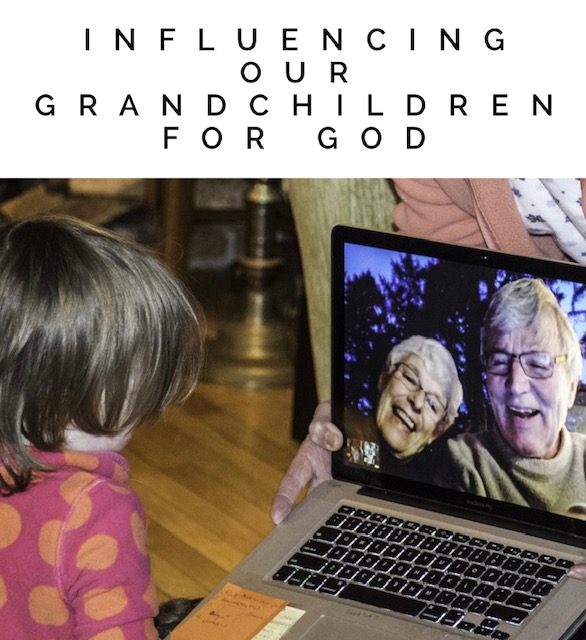
These things are harder to do when we don’t live near our grandchildren. I have fond memories of writing letters to and receiving letters from my grandmother. We have multitudes of ways to keep in touch these days.
If parenting instruction is more “caught” than “taught,” I think grandparenting influence is even more so. Sharing how God has worked in our own lives, leading us, and providing for us, helps them learn that God is personally interested in us, a friend that sticks closer than a brother (Proverbs 18:24). In Deuteronomy 6, God wants “you and your son and your son’s son” to fear Him and keep His commandments. He wants families to “talk of them when you sit in your house, and when you walk by the way, and when you lie down, and when you rise” (verses 2-7).
Most of us aspire to be like Timothy’s grandmother, Lois. “I am reminded of your sincere faith, a faith that dwelt first in your grandmother Lois and your mother Eunice and now, I am sure, dwells in you as well” (1 Timothy 4:5).
We want to share “things that we have heard and known, that our fathers have told us. We will not hide them from their children, but tell to the coming generation the glorious deeds of the Lord, and his might, and the wonders that he has done” (Psalm 78:3-4).
Some of us don’t have grandchildren (or even children). Or we might have only one or two. But we can minister to other children and young people in our sphere of influence by showing an interest, getting to know them, and speaking a word for God as He leads.
How about you? What ways have you found to influence your grandchildren or any of the next generation for the Lord?