When People Are Late to Church

When People are Late to Church

There was a period of time in another church and state when I was sometimes late to services. One man in particular noticed and commented. For instance, one day when I walked in before the service started, he handed me a bulletin and said, “Once in a row!”

I honestly wasn’t late that often. I don’t know if he was teasing or meant his comments as a prod or jab. I don’t know why it didn’t anger or hurt me. I had to work with him in various capacities, so maybe subconsciously I didn’t want there to be trouble between us.

What he didn’t know was that during that time, I started developing IBS (Irritable Bowel Syndrome). I didn’t know that’s what it was at the time. I just knew I was having unexpected, unexplained digestive problems. No matter how much extra time I gave myself to get ready, I couldn’t count on my body cooperating with me.

Granted, I was sometimes late for other reasons. But all too often, my lateness was due to physical issues that I didn’t want to explain.

In fact, the pressure of trying to get there on time, not wanting to draw attention to myself, not wanting to distract anyone by being late, all made the physical issues worse.

Friends who have traveled to other countries talk about the different regard for time in various places. Seeing someone you know and stopping to talk to them is considered more thoughtful and respectful than rushing past them to get somewhere on time.

But in our Western culture, lateness is regarded as disrespect for those you’re meeting with and a lack of discipline.

And that’s often true. It is frustrating to go to a meeting that doesn’t start for fifteen to twenty minutes because several people weren’t there on time. Then the meeting gets done twenty minutes later than planned. Plus, people streaming in late can be distracting.

But sometimes it just can’t be helped.

Once in another church in another state, we were waiting on one of my sons to get done in the bathroom so we could leave for church. We lived in a split-level, and the door leading downstairs was open. As my son in the bathroom upstairs flushed the toilet, we saw water pour from that bathroom floor through the ceiling below in what was our laundry and workroom. The toilet had clogged, and I guess we had never told my son not to keep flushing the toilet in that case. Somehow we mopped up the mess and miraculously still made it to church on time. We hadn’t told anyone about our morning scenario, but the only thing I remember the guest speaker saying that day was “We just don’t know what it takes for some people to get to church.”

While we don’t want to have a casual attitude about arriving at church (or anywhere else) on time, we shouldn’t have an overly judgmental attitude, either.

Sometimes when I am running late due to stomach issues, especially in the first church I mentioned, I’ve thought, “You know, if I am late, everyone is going to notice. But not many will notice if I don’t show up at all. Maybe I should just stay home.”

I saw a meme recently that went something like this: The writer was late to church, and people scowled and frowned at him for disturbing the service. But when he was late to an AA meeting, everyone was concerned and asked, “Is everything okay?” They realized that his lateness may have indicated he almost didn’t make it, and they knew how desperately he needed to be there.

Hopefully we can find a balance between encouraging people to be on time for church for smoother functioning of the body, yet not judging them when they’re not. We should do our best to be at church on time, just as we would for our jobs or catching an airplane (for me, I’ve found I have to get up four hours before leaving in order for medicine to kick in on time). But, as the guest speaker at my former church said, we don’t know what some people go through just to get to church. A latecomer needs to be met with welcoming smiles of “We’re glad you’re here,” not frowns, scowls, or remarks that make them feel they should not have come.

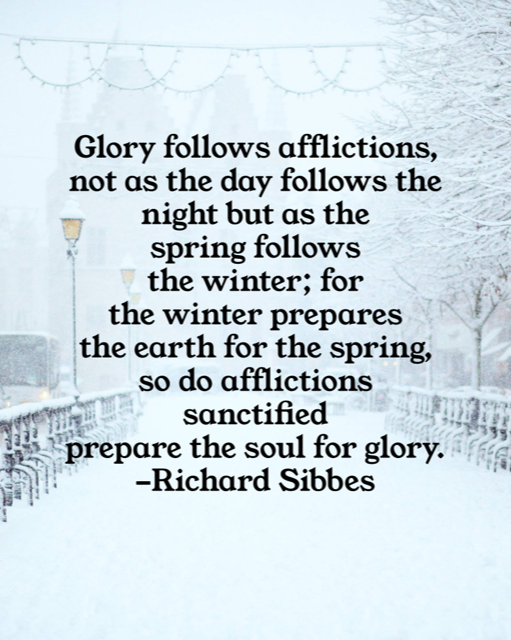
1 Thessalonians 5:14

(I often link up with some of these bloggers.)

When Habits Hinder Rather Than Help

When habits hinder

Someone has said that if you don’t make a plan, all you have is a wish. When we want to establish spiritual disciplines or meet a need at church, we set up routines or programs.

But then sometimes those routines themselves can get in the way of meeting needs.

I see this on several levels:

We follow routine and forget purpose.

To try to be more self-disciplined, we establish habits to aid in godliness, like regular times of reading the Bible or prayer, church attendance, etc. And that’s a good thing. But we all know what it is to have days when we’re just going through the motions, when our eyes are dragging across the page. We check “Have devotions” off our list of things to do but haven’t really engaged with the text or been affected spiritually. Or we “feel spiritual” if we’ve crossed that duty off or don’t “feel spiritual” if we haven’t.

Sometimes we feel we can’t stop and ponder a passage of Scripture because we need to get through our planned reading for the day.

One book I read on Bible study strongly emphasized application. That’s good: Jesus said to be doers, not just hearers. This author recommended specific, measurable results. For instance, instead of saying “I need to pray more,” he advocated praying for a certain number of minutes, and then slowly increasing the time.

That may be a good beginning. But it seems to me that the more natural approach would be to list things to pray about–usually once we get started, the list increases. Another idea would be to study prayers of the Bible, like Colossians 1:9-14.

Likewise, if we read about loving our neighbor, we might take them a plate of cookies or shovel snow from their sidewalk and think, “There! I’ve loved my neighbor today.” But then we forget about the need to love our neighbor when he forgets to return a tool or plays loud music at midnight.

It’s not that measurable results are wrong, but they are only one aspect of applying Scripture. Sometimes measurable responses can lead to outward actions without accompanying inward change. Sometimes we need to carry the truth we learned, like loving our neighbor, with us all through the day and pray for grace to implement it when it’s difficult.

We seek formulas rather than truth.

We’ve all seen clickbait titles like How to Be a Better Wife in Three Easy Steps or Follow These Steps to Curb Your Temper. Many raised children according to the plan of the day and were surprised to find their children did not respond in the expected way.

I saw a post sharing a routine for visiting the sick. But every sick person might not have the same needs. And if they sense we’re just going through a script, they are not going to feel ministered to.

I’ve sometimes gotten good results (or so I thought) by praying a certain way in a particular situation, only to have that prayer not “work” the next time that situation arose. I finally learned God doesn’t work by formulas, because then we trust in formulas and not Him. He wants our hearts.

Our routine hinders our purpose.

One church we visited had a greeting time during the service. No one interacted with us or even looked at us until the greeting time. Then, while someone played the piano, everyone smiled, shook hands, and spoke to visitors. But as soon as the music stopped, it was like someone flipped a switch, and everyone closed up again.

Other examples: we feel like our obligation to witness is fulfilled when we go to our church’s visitation night. Or, because our church has official greeters at the door, we feel no one else needs to greet visitors. Or we don’t pick up trash on the floor because someone is paid to do that.

Once when we were visiting my husband’s parents, a couple of women from church came by to see my mother-in-law. They brought a plant and card and conversed for a few minutes. When my mother-in-law thanked them profusely, one of the women said, “Well, you were on our list today.” My mother-in-law never discussed the comment, but I felt it deflated any good feelings about the visit since it seemed to be only motivated by a list.

We try to force results.

Bible study leaders naturally want people to participate. But we had a pair of leaders who felt everyone had to say something every time. If you didn’t speak up, they were going to make you! So instead of interaction and conversation happening naturally, the quieter people felt nervous, on edge, or put on the spot.

Small group leaders want people to “go deep” in their conversations and relationships, so some have “turn to your neighbor and bare your heart on command” sessions instead of letting those opportunities arise in a more natural way.

Or would-be mentors feel they need to work through an artificial list of probing questions instead of developing a personal relationship with their mentee.

We don’t think we can change what we do.

For years, I followed the same Bible reading plan because it was what I was taught. It took years to realize that there are many ways to engage with the Bible, and changing things up helped me stay engaged and see new things in the Word.

For many years, churches in my area had Sunday evening services at 7 o’clock. Then one church changed their service time to 6. It was amazing how many conversations there were about whether that change was right or wise. Eventually, other churches did the same. These days, I am happy to see a variety of services in churches, like small groups in the afternoon or lunch together after the morning service and a short time together before everyone goes home. But forty years ago, those solutions would have been unheard of.

Some programs are useful for a while, but fizzle out after a time. It’s vain to keep them just because “that’s what we’ve always done.”

Routines have a purpose.

It’s true, sometimes we need systems and routines because we don’t always “feel like” doing what we need to. A former pastor once said that one of his best times of prayer occurred when he had to start by confessing to the Lord that he didn’t feel like praying. Sometimes just doing what we should whether we feel like it or not is the first step to feeling like it.

But we should seek God’s grace to serve not just out of duty, and not to check off all the designated boxes, but with a right heart. The mechanics of ministry and spiritual disciplines are tools, but not the main focus, not the end-all of our efforts.

Our ministry isn’t boxed into a particular time, place, or group of people. Our programs don’t take care of all of our obligations. There is a sense in which we should always be “on,” always ready to serve. Even if there are official greeters at church, we can greet people when we see them or help a confused visitor find the right class. Even if there is someone designated to send cards to sick Sunday School class members, we can send one, too. If God has placed on our hearts that we need to help someone else in the church, we need to pray about how to do that rather than just dismissing it because our church has a benevolence committee to take care of those things.

On the other hand, sometimes we can perfectly follow all of our routines, and our programs can seem to be going swimmingly, but we’re unaware that we’re missing something vital. The Pharisees were famous for this. All through the Bible, God reminds His people not to serve Him only with outward performance, but with their hearts.

A. W. Tozer said this in The Pursuit of God:

The simplicity which is in Christ is rarely found among us. In its stead are programs, methods, organizations and a world of nervous activities which occupy time and attention but can never satisfy the longing of the heart. The shallowness of our inner experience, the hollowness of our worship and that servile imitation of the world which marks our promotional methods all testify that we, in this day, know God only imperfectly, and the peace of God scarcely at all. If we would find God amid all the religious externals, we must first determine to find Him, and then proceed in the way of simplicity.

Routines, habits, and programs can be a great help. But they are an avenue of ministry, not an end in themselves. May God give us grace to keep our hearts engaged and our focus on others’ needs and His glory.

Ephesians 6:6

(Revised from the archives)

(I often link up with some of these bloggers.)

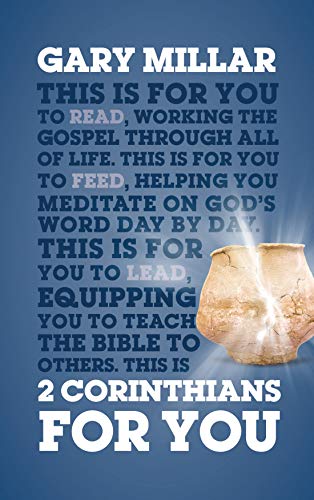
Review: 2 Corinthians for You

2 Corinthians for You by Gary Millar

The Corinthian church was one of the messiest ever known. Factions divided over favorite preachers. Their church dinners became feasts for the well-off members, while the poor ones were left out. Some were involved in such blatant sin as a man sleeping with his mother-in-law. Their culture honored eloquence in public speaking and scorned Paul because he didn’t speak or write that way. They rejected his authority as an apostle.

Most of us would avoid a church like that. But God hadn’t given up on them. He inspired Paul to lovingly rebuke, plead with, teach, and encourage them toward a right relationship with God, each other, and himself.

2 Corinthians is actually the fourth letter Paul wrote to the church. 1 Corinthians was the second. We don’t have the first and third, but Paul refers to them. Between the second and third letter, Paul made a “painful visit” to them to try to set things right and sent some of his coworkers to them as well. His care was evident: he didn’t just dash off a rebuke and leave it at that.

Gary Millar guides us through Paul’s letter in 2 Corinthians for You. He takes an expository approach, covering anywhere from a few verses to a chapter and a half from 2 Corinthians in each of his chapters. He explains the culture of Corinth at that time, a Grecian city with heavy Roman influence and a large number of Jewish exiles. He puts the pieces together from 1 Corinthians and Acts to help us understand this letter of Paul’s better.

Though he gives us a lot of helpful information, his style is easy to read and not academic. He does an excellent job pulling out application from the Corinthians and Paul to our lives hundreds of years after 2 Corinthians was written.

One of the themes throughout the book is weakness. The Corinthians thought Paul was weak, and he said, in effect, “That’s right.” He refers to his weakness thirteen times in this letter. One reference is the famous passage many of us lean on in 12:9-10, where, after praying three times for God to remove whatever his “thorn in the flesh” was, Paul writes, “But he said to me, ‘My grace is sufficient for you, for my power is made perfect in weakness.’ Therefore I will boast all the more gladly of my weaknesses, so that the power of Christ may rest upon me. For the sake of Christ, then, I am content with weaknesses, insults, hardships, persecutions, and calamities. For when I am weak, then I am strong.”

Paul repeatedly points out to the Corinthians that the church is God’s, to be conducted the way He wants. And ministry is done for Him and through His power.

Throughout both letters, Paul demonstrates Christian love, which mourns over sin, rebukes when needed, pursues even those who think we’re enemies, and gives of itself. One of many verses that stood out to me was “I will most gladly spend and be spent for your souls” (2 Corinthians 12:15). At times I have felt utterly spent after ministering in some way, and this verse reminds me, yes, it’s supposed to feel that way. As God pours into us, we give out to others.

I have mnay places underlined and noted in Millar’s book, but here are a few quotes that stood out to me.

When the gospel is our absolute priority, we will be predictably, reliably faithful to the gospel, even if it means that our plans may change when the progress of the gospel demands it. And how can we pull that off? Once again, it’s because God hasn’t simply told us to be like Christ, he has intervened in our lives powerfully and dramatically to enable us to be like Christ (p. 35).

When Christ is preached, God works by the Spirit to show people how stunningly, gloriously beautiful Christ is. We should keep going because the ministry which God has given us reveals the glory of God in the face of Christ, and there is no greater beauty, no greater privilege, no greater experience for human beings than this (p. 57).

A basic step in a lifetime of gospel ministry is to get over ourselves, to realise that ultimately whether people like us or not doesn’t really matter. Whether we’re perceived as successful or not doesn’t matter. Whether we’re recognised or not doesn’t matter. All that matters is preaching Christ as Lord. We keep going because it’s about him, not us (p. 67).

Ministry that isn’t borne out of love for people will be miserable for you and miserable for the people you are supposedly serving! (p. 114).

Investing in people is costly and time-consuming. The hardest this about ministry is always people. It doesn’t matter how extrovert or introvert you may be, it doesn’t matter how much you like the person or you struggle with them. Investing in people always drains energy and sucks up time. But remember—people don’t take you away from your ministry; they are your ministry (p. 115).

We must do everything in our power to remember that we never get past needing God to work in us (and through us) by his grace (p. 146).

Every time we look at another person and measure ourselves against them—we are throwing the door wide open to pride (if we can find a way to score ourselves higher than them) or its twin sister, self-pity (if we can’t). Every time we compare, we throw living by grace through faith out the window and start to run with a gospel of good works. Every time we compare, we swap living to please God with living to please ourselves, under the guise of impressing other people—and it stinks! (p. 151).

Let me challenge you right now to set yourself to hold onto the truth, and to ask God to give you a highly sensitive theological radar for the sake of the church in years to come. Be ready to think through the implications of every new idea, and be ready to fight for the truth . . . don’t swap the truth for lies (p. 160).

Real ministry is always accountable to God, saturated in and motivated by Christ himself, and has the clear aim of building up the church. Everything Paul did was done with the clear purpose of building up the Corinthians (p. 178).

There were a couple of minor points where I disagreed with Millar, but overall, I thought this book was a great companion and aid in getting the most out of 2 Corinthians.

(Sharing with Bookish Bliss Quarterly Link-Up)

Enjoy the 80 Percent

Enjoy the 80%

Many of you know that writer Elisabeth Elliot has been my “mentor from afar” for over forty years.

One of my favorites quotes comes from her book Love Has a Price Tag:

My second husband once said that a wife, if she is very generous, may allow that her husband lives up to eighty percent of her expectations. There is always the other twenty percent that she would like to change, and she may chip away at it for the whole of their married life without reducing it very much. She may, on the other hand, simply decide to enjoy the eighty percent, and both of them will be happy

That’s so true, isn’t it? We tend to fixate on the small things that bug us rather than the great majority of things we love.

I was thinking recently that this principle applies to more than marriage.

Take friendship, for instance. My best friend in high school had a lot of good qualities, but she was slow-moving, especially when we were to go somewhere together. Any attempts to hurry her led to even more slowness. Constant harping on this one issue would only have driven a wedge between us.

Or neighbors. A good neighbor is a treasure. A bad neighbor is a pain. We don’t want to offend the person who is going to live right next door to us for years, maybe decades. So we pick our battles. We can live with some irritants to keep peace.

We might love our work, but it’s not all sunshine. Even with the best job, there are always a couple of unpleasant aspects.

And what about churches? None is perfect. You’ve probably heard the old cliche: “If you find a perfect church, don’t join it, because then it won’t be perfect any more.” No one church will be and do everything we might like.

When I hear of people leaving church because of some disappointment, I often think of the Corinthians, the epitome of dysfunctional churches. If we had visited such a church in our searches, we would not have gone to this one twice.

Yet every time I read 1 and 2 Corinthians, I am amazed at how patient the apostle Paul is in dealing with them. They had much more than 20 percent that needed to be dealt with, but he never gave up on them.

Enjoying the 80 percent of any relationship doesn’t mean we can never address the aspects we don’t enjoy. But sometimes, as the KJV puts it, we need to forbear with one another. Other translations say bear with, make allowance for, tolerate, or even put up with each other.

And the Bible goes beyond just bearing with each other. Ephesians 4:1-3 says: “I therefore, a prisoner for the Lord, urge you to walk in a manner worthy of the calling to which you have been called, with all humility and gentleness, with patience, bearing with one another in love, eager to maintain the unity of the Spirit in the bond of peace.”

Humility, gentleness, patience, love, unity, and peace: these are all more important than whatever irritates us about each other.

A couple of other thoughts that help me with this: there’s probably more than 20 percent about me that others have to “put up with,” yet they graciously do. My husband and friends don’t constantly find fault and criticize or insist I do things their way. I can extend that grace to them.

Also, even though God is in the business of correcting and sanctifying us, He does it with patience and grace. He doesn’t pile up everything we need to deal with all at once. We’d be crushed under the load.

One caveat to this 80 percent principle: it depends on what’s in the 20 percent. If a wife likes everything about her husband except the fact that he beats her, that behavior is not something that should be overlooked or ignored. If one friend learned that the other was embezzling his company, or cheating on his wife, he would be wise to step in. If we love the music, fellowship, people, and preaching of a church, yet the leadership denies that Jesus is God, or tells us we get to heaven by doing good works, then we need to find another church.

But in most cases, the 20 percent we don’t like is comprised of smaller issues. Can we not overlook them, for God’s glory and for the love and fellowship of His people?

Ephesians 4:2-3: bear with one another in love

(I often link up with some of these bloggers.)
Laudable Linkage

Laudable Linkage

I hope you’ll find something of interest in this collection of good reads.

Love the Church Like Jesus, HT to Challies. “Imagine you see a bride early on the morning of her wedding day — and she is a mess.” But she’ll look very different at the wedding, and it would be wrong and foolish to tell others how awful she looked that morning. The author provides an interesting comparison to the imperfections of the church and what it will be someday, and how we look at it as Jesus does.

Why Am I So Spiritually Dry? HT to Challies. “As I crunched my way through my neighborhood and watched the clouds for rain, I realized that dry seasons can be for our good. Sometimes spiritual dry spells come with a diagnosis and sometimes they don’t, but the only way through them is through them.”

Do You Feel Overwhelmed When You Pray? 3 Reasons not to Lose Heart. “Take heart, weary prayer warrior. When our feelings overwhelm us and the trials of life threaten to drown us, we can look to the unchanging truths of the Bible for strength and hope.”

Responding When Those We Respect Disappoint Us, HT to Challies. “While we understand intellectually that every person we meet is fallen and desperately needs God’s grace, that knowledge gets tested when someone we deeply respect disappoints us.”

The Spiritual Gift Inventory I Believe In. “In many churches, it is standard practice to have Christians take some kind of a spiritual gift inventory. Through a series of questions that probe an individual’s interests, passions, and successes, these tests claim to help people discover the ways the Holy Spirit has gifted them to better love and serve his people. Much has been written about such inventories and many people have expressed a degree of skepticism about their usefulness or accuracy.”

Marriage Happy, Marriage Holy. I really don’t like the saying that marriage is to make us holy, not happy. Scripture depicts marriage as happy. Yet when two sinners live together, they are bound to have differences and irritations. Tim Challies shares some of the surprising ways marriage can help sanctify us.

God’s Good Gift of Hobbies, HT to Redeeming Productivity. Steve Lindsey discusses many valuable benefits of hobbies. .

Why I’m Grateful to Live in 2024. Though there’s a lot wrong in the world, we’re also immeasurably blessed.

The Criticized Leader, HT to Challies. Good advice even for followers.

I mentioned a couple of weeks ago Ciara Dierking, who lost all four limbs after a near-fatal illness. Revive Our Hearts has two episodes of a podcast with her. You can listen to or read the transcript of Part 1: What Did I Do to Deserve This? here, and Part 2: More Grateful Than Before, here.

He makes us wait. He keeps us on purpose in the dark. He makes us walk when we want to run, sit still when we want to walk, for He has things to do in our souls that we are not interested in. Elisabeth Elliot, Secure in the Everlasting Arms

He makes us wait. He keeps us on purpose in the dark. He makes us walk when we want to run, sit still when we want to walk, for He has things to do in our souls that we are not interested in. –Elisabeth Elliot, Secure in the Everlasting Arms

Laudable Linkage

Laudable Linkage

Comfort and Joy: How God Used the Loss of a Loved One to Save the Life of Another, HT to Challies. “Grief is painful, angry, messy, and real. But God does not abandon us in the midst of it. In fact, from soil soaked by tears, He can cultivate healing, goodness, and beauty—even if our broken hearts can’t see it right away.”

Christianity Is not Colonial: An Autobiographical Account, HT to Challies. “According to this ‘Christianity is colonial’ narrative, Christianity is the ‘white,’ ‘western’ religion which permitted all the above. Therefore, the Christian God is himself a racist colonialist who deserves, not to be worshiped, but to be denounced. This association of Christianity with colonialism is so out of step with reality as to be literally ridiculous.”

COVID’s Gift: The Gem We Should Now See We Were Missing. “If I asked you to make a list of the ten two-word phrases most common in the New Testament, the phrase ‘in Christ’ wouldn’t make it on most of our lists. Yet that phrase and its variants occur more times in the New Testament than the phrases ‘the cross,’ ‘eternal life,’ or even ‘Jesus Christ.'” The author posits that understanding our unity in Christ would reignite our love and understanding of the church. The best part of the article is under the heading “How are believers unified with Jesus?”

I’m Fine! “How are you today? No, I mean really, how are you today? I know you know the socially, western culturally correct response is that you are fine, however, that’s not what we’re about here, in this space.”

Purposes of Predictive Prophecy. “Certainly prophecy is intended to have a present impact on the believer’s faith and practice. No one should dispute that. But some posit that viewing eschatological prophecy as a detailed prediction of specific events short-circuits the ethical intention of such prophecy. I am positing that God tells us about the future because He actually wants us to know what is going to happen and expects us to believe that it is going to happen just as He says.”

We Need to Sing More Than Songs of Praise, HT to Challies. I agree, though I think singing does more than express emotion.

Sanctification and Sexual Purity: God’s Will for Your Life, HT to Challies. “There is a direct link between our holiness and our sexual purity. There’s a direct link between your body which is united to Christ and what you do with your body. And that my friends is not popular.”

Finally, I don’t know David and Ciara Dierking, but evidently many of my friends do, because I started seeing requests for prayer all over Facebook back in December when Ciara and her young son Colton became ill. Colton had COVID and strep, I believe, and two abscesses of infection in his neck. Once he had surgery to drain those, he was well on the road to recovery. Ciara had influenza B, group A strep, severe pneumonia, which sent her into toxic shock (sepsis). She nearly died. The medicine to treat the sepsis narrowed her blood vessels to the point that her extremities couldn’t get enough oxygen. She ended up having both arms and both legs amputated.

You can imagine how devastating that would be, especially for a young wife and mother. As I have prayed over and ached with this sweet family these last several months, there have been so many signs of God’s hand on them.

Ciara was rereading Nancy DeMoss Wolgemuth’s book, Choosing Gratitude, when all of this happened. As her family put excerpts from the book that Ciara had underlined on their Facebook page, somehow Nancy learned of it and asked if she could interview Ciara and David. That episode will air November 11 and 12 on the Revive Our Hearts app or website or podcast. But as part of that interview, ROH made this video. I encourage you to watch, be encouraged, and pray for this family. They’ve all overcome many challenges, but still have many more ahead. I’m going to leave this here in place of my usual Saturday morning graphic.

Laudable Linkage

Laudable Linkage

Here’s my latest roundup of good reads found online:

Courage for Those with Unfatherly Fathers. HT to Challies. “This is our Heavenly Father. Though our earthly dads were meant to reflect him, he in no way mirrors them. Take courage, and run with abandon to the open arms of your Father.”

Should Ethnicity and Race Never Cross Our Minds When We Meet Another Believer? “The notion of being ‘colorblind’ doesn’t lend itself to oneness but to blindness. It suggests that if we recognize or admit differences, we would be forced to say some are better than others. No, we should recognize the differences and celebrate that God’s image-bearers come in all shapes and sizes and colors, and we are the beneficiaries of His providence in creating us this way.”

4 Reasons You Shouldn’t Be Colorblind. This was referenced in the above post but was so good I wanted to list it separately. “I’d like to suggest that we aren’t colorblind, we don’t need to be colorblind, and we actually should strive to not be colorblind. Colorblindness leads us in the wrong direction. Instead, I want to encourage us to be colorsmart.Here are four reasons why.”

Theology and the Eclipse. “An eclipse is more than a cool phenomenon of nature. It is an extra gift that God built into the structure of the universe to arrest the attention of humans amid their busy little ant-like activities long enough to listen to creation’s silent, speechless declaration of the Creator’s glory (Ps 19:3).”

What to Expect When a Loved One Enters Hospice. “With a million and a half people in the U.S. receiving hospice care annually, many families will walk this troubling road, suffering doubts and heartache along the way. How do we shepherd caregivers and families as they aim to love the dying? How do we walk with them through the valley of the shadow of death, reminding them all the while of the Good Shepherd whose love covers them when the light dwindles (Ps. 23:4)?”

Lessons Learned from a Wolf Attack, HT to Challies. “Some of the most painful lessons of ministry are learned when a wolf in sheep’s clothing infiltrates your church. We had a wolf once, a local man I’ll call Ahab*, and it has taken me years to know how to write about it. The things we learned from exposing him, trying to counter him, and then responding to the carnage he caused have been forever branded on my soul.”

It’s Okay to Be a Two-Talent Christian. “There is no shame in being a one-talent servant when God gave you one-talent ability. There is no need to compare yourself unfavorably to those who have achieved more success on the basis of their greater gifts. And that’s because God’s assessment of you is made on the basis of what you did with what he gave you.”

Hospitality Is not a Personality Trait. “If you limit your idea of hospitality to what can be flawlessly presented in social media squares, you’ll miss her: the woman who is more comfortable working a spreadsheet than a room full of people . . . the woman who is analytical and introverted and a hospitable force for the kingdom of God. “

Quite . . . Able to Communicate,” HT to Challies. A sweet story from Brother Andrew’s book, God’s Smuggler, about a time when he and his contacts didn’t speak the same language.

Robert Murray McCheyne

No amount of activity in the Father’s service
will make up for the neglect of the Father Himself.
– Robert Murray McCheyne

Laudable Linkage

Laudable Linkage

Here are a few thought-provoking posts from the last week:

7 Blessings Older Saints Offer the Church, HT to Challies. “My grandparents, with their godly example, aren’t alone. Their example of faithfulness is afforded to every saint who lingers on this earth into old age. In fact, older Christians have some of the most important lessons to teach the local church today.”

Be the Church Member You Want Your Church to Have. HT to Challies. “Paul addresses the Romans who are having some disputes, and he starts with this glorious phrase: ‘so far as it depends on you’ (Rom 12:18). In other words, he deflects the attention away from ‘those people’ and shines the light on ‘you’. Paul knows that focusing on ‘those people’ is a dead end street. You can’t do anything, not really, about anyone else. But do you know who you can affect? YOU!”

Visible Grace in Disagreements, HT to Challies. “Here are three things we should strive for: Christians who are willing to confront but aren’t eager for controversy. Christians who pursue a gentle revival, not a holy war. Christians who eavesdrop on Jesus’ intercession instead of joining Satan’s accusations.”

Do You Want My Opinion? HT to Challies. “In the past week, I’ve had two experiences that confirm a need to get a better grip on how I share what I think about current events.”

Elisabeth Elliot, My Dear Mother. This was a blog by Elisabeth Elliot’s daughter, Valerie, and this particular post was written just after Elisabeth passed away in 2015. I don’t remember if I have seen it before, but it was shared this week on the Elisabeth Elliot Quotes Facebook page.

Doesn’t a Library-Themed Hotel sound ideal for a book-lover’s vacation? It’s expensive, and it’s located in NYC, not a place I have any desire to go to. But maybe this idea will catch on with more accessible places and prices. HT to Dan Balow.

Thomas Watson quote about flawed saints

A saint in this life is like gold in the ore, much dross of infirmity cleaves to him, yet we love him for the grace that is in him. A saint is like a fair face with a scar: we love the beautiful face of holiness, though there be a scar in it. The best emerald has its blemishes, the brightest stars their twinklings, and the best of the saints have their failings. You that cannot love another because of his infirmities, how would you have God love you?” Thomas Watson

Laudable Linkage

Here are some of the good posts seen this week:

How Do I Find the Main Point of a Psalm (or a larger passage of Scripture), HT to Knowable Word. John Piper likens understanding larger passages of Scripture to working a jigsaw puzzle. Great illustration.

How to Prepare for a Great Morning Routine. “I’ve had the unique privilege of helping thousands of Christians refine their own Christ-honoring morning routines. And there are certain patterns that show up again and again with those who are struggling to stick with a routine like this. They all boil down to one thing: Lack of preparation.”

Be a Woman Hidden in the Church. “We live in a culture captivated by the idea of ‘making a name for yourself.’ From pop culture celebrities to Christian influencers, the world around us seems to say that in order to make any real difference you first need to have a large sphere of influence and a certain number of followers. And your name on the cover of a book doesn’t hurt. This is not the path to significance that Jesus taught.”

What to Do When You Long for Encouragement. “When it comes to my own reactions to perceived slights, I’m inclined to bypass the Golden Rule and proceed straight to feeling sorry for myself.

Why We Cannot Cast Them Aside. “As I’ve watched my precious mom deteriorate from the devastating effects of early onset Alzheimer’s, I’ve also had to face our world’s deeply entrenched beliefs about what gives people value.

Repairing Old Books by Deconstructing Them, HT to Steve Laube. This is a ten-minute video about a woman who restores old books by taking them apart, repairing them, and putting them back together. I worked at the university library while in college. One lady there did book repair, but not as extensive as this. I found it fascinating.

True love

True love ennobles and dignifies the material labors of life; and homely services rendered for love’s sake have in them a poetry that is immortal. ~ Harriet Beecher Stowe

Laudable Linkage

Laudable Linkage

Here are some of the blog posts that spoke to me over the last few weeks:

Will Following my Heart Set Me Free? HT to Challies. “I think that summarises a story that our culture loves to tell: that success in the world means presenting your truest self, pushing off what society tells you to be, to be you. It’s almost like that’s the meaning of life. You are free to be yourself.”

Life Without Romans 8:28. “I have often heard it said that Romans 8:28 is the wrong verse to bring to the attention of those who are grieving, that while it is true in our especially difficult moments, it does not necessarily become helpful until some time has passed. And while I can only speak for myself, it has been my experience that in my lowest moments I have feasted on Romans 8:28, I have run to it like a starving man runs to a meal and I have drunk from it like a parched man drinks from an oasis. I have needed Romans 8:28 and it has both comforted my soul and directed my grief.”

The Irreplaceable Encouragement of Intergenerational Relationships, HT to the Story Warren. “I took a seat at my assigned table for my first Bible study at our new church and was surprised to see a number of gray and white heads dotted among the tables. I wondered, what would it be like to study alongside women who were 20, 30, or more years older than I? Up until this point, my close friendships consisted of almost exclusively people in or near my stage of life.”

3 Verses for Your Work. “If you are reading this right now, you have work to do. I’m not only talking about a paid job but any work you do—paid or unpaid, noticed or behind the scenes. I spend my days working on many things; most of my tasks do not result in a paycheck. Payment does not validate work; God does. Here are three truths and verses that have absolutely transformed my work.”

Can You Be Too Productive? “There seems to be a tension in the way people view productivity these days. On the one side, there is the push to do more, be more efficient, work harder. But in the last few years, another view has grown in popularity. On this side is the pull to slow down, do less, and get more rest.”

On Being an Ambassador: Walking the Tightrope of cultural differences. “As Christians, we get our instruction from the Scripture. We find there early examples of how Christians crossed cultural boundaries in taking the gospel to ends of their world. One instructive example is the preaching of the Apostle Paul. Since God called him to be the apostle to the Gentiles, we should expect that he would deal with widely diverse cultures—and he does.”

The Dress, HT to Challies. A touching meditation on a daughter’s upcoming marriage.

Consider Your Attitude Toward the Local Church, HT to Challies. “We can notice all the problems with our local church on some days and rejoice at God’s goodness to our local church on others. As many people consider the big issues in their lives during January, make sure you are thinking rightly about church this year.”

Why I’m a Better Pastor (for you) than . . . HT to Challies. “Not only do we have unfettered access to the Bible, but we have almost limitless access to some of the very best Bible teaching. What a gift we have. And yet, that begs a question: how is a normal pastor like myself supposed to compete? Why should you even bother with attending your local church?”

Sent to Need. HT to Challies. This is such a good perspective on missions. “I’m not saying that prayerfully planning, dreaming, and casting vision with expectation of what God can do is wrong. I am only asking if it strikes anyone else as odd that we get ‘sent to serve’ before being ‘sent to learn.’  I wish it was more like this: ‘Hi. I am sent to need.‘”

Afflictions sanctified prepare the soul for glory. Richard Sibbes