
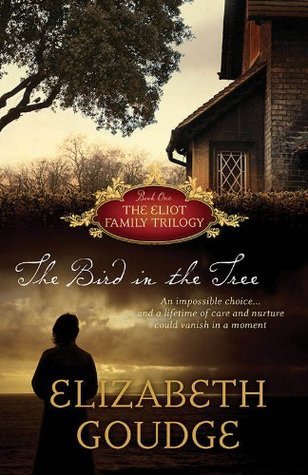
The Bird in the Tree by Elizabeth Goudge is the first in a trilogy of novels about the fictional Elliot family in England between the two world wars.
Lucilla is the widowed matriarch of the family. She lives with her daughter, Margaret, and long-time maid, Ellen. Currently three of her young grandchildren are staying with her as well. Their parents, her son and daughter-in-law George and Nadine, have been divorced. George is out of the country and Nadine is establishing her own life. Lucilla hopes they will restore their marriage.
Her favorite grandson, David, lived with her from the time he was a boy after his parents died. He’s grown now, an actor, and is coming for a visit. However, when he arrives, she senses something is wrong. It’s not until the next day that he tells her he is in love with Nadine and they plan to marry. They’ve not told anyone else yet.
If it sounds strange that he’s in love with his aunt–she’s several years younger than her husband (his biological uncle) and a few years older than David.
Lucilla is distressed, as David knew she would be. She asks that Nadine come for a visit so she can talk with both of them. She shares why she doesn’t think they should marry: their union would be a blow to family unity, would make it impossible for Nadine and George to reconcile, and would destroy David’s special relationship with Nadine’s children, who loved and missed their father and would have difficulty if David tried to step into that role. Lucilla doesn’t press the issue after that, though she worries and prays.
Then the question becomes whether David and Nadine will follow their passions or do what’s right.
Parts of the book sound like it could have been written today:
His love for Nadine was the most shatteringly real thing that had ever happened to him. It was the truth, and it must be served…
Truth. He would have to try to make Lucilla understand how he felt about it, how it was to him the lamp that lit all life. It would be difficult, for her generation and his felt so differently about this truth. Her generation had built from without inwards, had put the reality of law and tradition above the reality of personal feeling, but his built from within outwards, the truth of personal feeling must come first; when there was no longer reality in a union, smash the union; never mind what laws were broken or what lives were crippled; live the truth.
The young people think that Lucilla, wrapped in “law and tradition,” can’t possibly understand their “truth.” But as we learn more about Lucilla’s past, we see she had her own long struggle between desire and duty.
The family home, Danrosehay, is almost a character of its own in the story. I liked how Lucilla wanted the home to always be a refuge from the storms of life for her present and future family.
There’s an interesting backstory of a historic storm and a sea captain who crashed into the marshes and lived in the area afterward. The story is told near the beginning as just village lore, but it turns out to have great significance for the family later on.
A few other quotes that stood out to me.:
She tried very hard to teach her grandchildren how to extract the last drop of beauty out of all the small things of life, words and scents and sounds.
In times of storm and tempest, of indecision and desolation, a book already known and loved makes better reading than something new and untried. The meeting with remembered and well-loved passages is like the continual greeting of old friends; nothing is so warming and companionable.
I realize now that there is such a mixture of good and evil in all we think and are that everything, every instinct and thought, needs to be tested by the teachings of Christ.
All bereavement, whether fate inflicts it on you or whether the relinquishment is your own, changes you . . . Don’t people say that nature abhors a vacuum? Something lost in the present means something new flowing from the future; often a new and stronger faith.
This was his first big trouble and she hardly knew how to bear it; when she had been young she had borne her own troubles, now she was old she bore her children’s and grandchildren’s and found them far worse to put up with than her own had been.
There is mention of a blackbird singing in an ilex tree about twelve times. With that, and the bird in the title, I felt it had to have some significance. I searched online for a while but didn’t turn up much opinion on that front, though some sources said the ilex tree (mentioned 28 times in the book), a type of holly, was thought to be representative of Christ’s sacrifice. I felt the last line of the book finally gave some insight; but, of course, I can’t share that without spoiling the story.
This book started out with tons of description, of the main characters, the house, the village, and its history. But, once again, once it got into the story, I loved it. The characters are so well drawn that they seem real and relatable. And, though some of the language and situations are a little old-fashioned, the underlying truths are eternal.

