
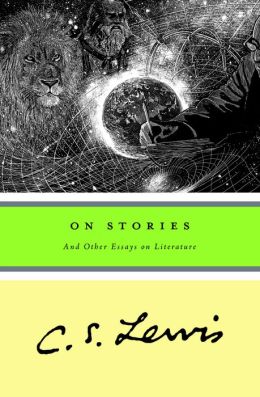
 Someone recommended On Stories and Other Essays on Literature by C. S. Lewis some time last year. I asked for and received it for Christmas, but then set it aside when I entered a number of reading challenges for this year. But something in How to Read Slowly touched off a train of thought that reminded me of Lewis’s book, so I was happy to pick it up recently. Then realizing it could qualify for Carrie’s Narnia Reading Challenge for July made me push a little harder to try to get through it by the end of the month.
Nineteen of Lewis’s essays were compiled for this book by Walter Hooper, one of his biographers, his private secretary for a time, and eventually the literary executor of his estate. The last selection in the book is a transcript of a discussion recorded with Lewis and two colleagues. Many of the essays were previously published in magazines or in Lewis’s books: others had been unpublished until this book. Some are Lewis’s thoughts on fiction, science fiction, writing for children, etc., while others are critiques of other writers’ work (Dorothy L. Sayers, Rider Haggard, George Orwell, Tolkien, and others).
There is no way to really review a book like this, so I am just going to share some observations.
I hadn’t known and was fascinated to learn in Hooper’s mini-biography which introduces the book that in Lewis’s time “the most vocal of the literary critics were encouraging readers to find in literature almost everything, life’s monotony, social injustice, sympathy with the downtrodden poor, drudgery, cynicism, and distaste: everything except enjoyment. Step out of line and you were branded an ‘escapist'” (p ix). I’m glad Lewis not only stepped out of the box but succeeded and made it okay to enjoy stories as stories.
Lewis states many times in various essays that he did not write the Narnia series or his science fiction trilogy with morals or symbolism in view, as many people in his time and since have thought. They started with certain pictures in his mind (a faun carrying an umbrella) and developed from there. “Never…did he begin with a message or moral, but…these things pushed their own way in during the process of writing” (p. xv). He says in the transcript at the end, “The story itself should force its moral on you. You find out what the moral is by writing the story” (p. 145).
Reepicheep and Puddleglum the Marshwiggle were his favorite characters (p. xi).
He decried the kind of fiction where “the author has no expedient for keeping the story on the move except that of putting his hero into violent danger. In the hurry and scurry of his escapes the poetry of the basic idea is lost” (p. 10). Of course he had no problem with putting the hero in danger, as you know if you’ve read Narnia or the Space Trilogy: sometimes that’s a necessary part of the plot. But if that’s all the story is, it might be enjoyable to some, but there’s no deeper meaning.
He also believed that the “marvels in a good Story” should not be “mere arbitrary fictions stuck on to make the narrative more sensational” (p. 12). In other words, the story itself should be intrinsic to the “world” in the story. A story about pirates should have a different feel and problems than a story about giants and dragons. The plot shouldn’t be such that it could be stuck into any setting.
He quotes Dorothy L. Sayers as saying, about the assumption that she wrote to “do good”: “My object was to tell that story to the best of my ability, within the medium at my disposal — in short, to make as good a work of art as I could. For a work of art that is not good and true in art is not good and true in any other respect” (p. 93).
When asked what he thought of a certain book, he replied, “I thought it was pretty good. I only read it once; mind you, a book’s no good to me until I’ve read it two or three times” (p. 146).
I found his thoughts on critiques and book reviews quite interesting in “On Criticism” and in his answering of some criticisms of his work in “On Science Fiction.” Then to see/read him “in action” critiquing other books was enlightening. He didn’t pull any punches, but he wasn’t mean or belittling, and he complimented and praised the good while sharing honestly what he thought was bad. He made a strong case for truly evaluating what was good and bad and not deeming a book bad just because one doesn’t like a particular genre.
He thought The Lord of the Rings would “soon take its place among the indispensables” (p. 90). He was right. 🙂
I didn’t look up every word I didn’t know in this book, but I should have, especially with a dictionary app at hand on my phone. I eventually started doing so partway through the book.
Though Lewis has such a wealth of knowledge, I found him very readable and not hard to follow for the most part. I’d love to have sat in on one of his classes.
And here are some of my favorite quotes:
“It might be expected that such a book would unfit us for the harshness of reality and send us back into our daily lives unsettled and discontent. I do not find that it does so….Story, paradoxically enough, strengthens our relish for real life. This excursion into the preposterous [speaking here of The Wind in the Willows] sends us back with renewed pleasure to the actual” (p. 14).
“No book is really worth reading at the age of ten which is not equally (and often far more) worth reading at the age of fifty – except, of course, books of information” (p. 14).
On the topic of frightening elements in children’s literature, he agreed that “we must not do anything likely to give the child those haunting, disabling, pathological fears against which ordinary courage is helpless,” but to withhold “the knowledge that he is born into a world of death, violence, wounds, adventure, heroism and cowardice, good and evil…would be to give children a false impression and feed them on escapism in the bad sense. There is something ludicrous in the idea of so educating a generation which is born to the Ogpu and the atomic bomb. Since it is so likely they will meet cruel enemies, let them at least have heard of brave knights and heroic courage. Otherwise you are making destiny not brighter but darker. Nor do most of us find that violence and bloodshed, in a story, produce haunting dread in the minds of children…Let there be wicked kings and beheadings, battles and dungeons, giants and dragons, and let villains be soundly killed at the end of the book…I think it possible that by confining your child to blameless stories of child life in which nothing at all alarming ever happens, you would fail to banish the terrors, and would succeed in banishing all that can ennoble them or make them endurable” (pp. 39-40) (emphasis mine).
On The Lord of the Rings: “Here are beauties which pierce like swords or burn like cold iron; this is a book that will break your heart” (p. 84).
“‘But why,’ some ask, ‘why, if you have a serious comment to make on the real life of men, must you do it by talking about a phantasmagoric never-never land of your own?’ Because, I take it, one of the main things the author wants to say is that the real life of men is that of mythical and heroic quality” (p. 89).
“The value of myth is that it takes all the things we know and restores to them the rich significance which has been hidden by the ‘veil of familiarity.’ The child enjoys his cold meat (otherwise dull to him) by pretending it is buffalo, just killed with his own bow and arrow. And the child is wise. The real meat comes back to him more savory for having been dipped in a story…If you are tired of the real landscape, look at it in a mirror. By putting bread, gold, horse,apple, or the very roads into a myth, we do not retreat from reality: we rediscover it. As long as the story lingers in our mind, the real things are more themselves. This book [LOTR] applies the treatment not only to bread and apple but to good and evil, to our endless perils, our anguish, and our joys. By dipping them in myth we see them more clearly” (p. 90).
I love that – that by seeing truth in stories we sometimes see it more clearly than we otherwise would have.
If you like Lewis or like literature, I highly recommend this book to you.

(This will also be linked to Semicolon‘s Saturday Review of Books.)



