
Review: The Bitter End Birding Society

The Bitter End Birding Society

In Amanda Cox’s newest novel, The Bitter End Birding Society, Bitter End is a small town in eastern Tennessee with a variety of legends about how it got its name.

Ana Leigh Watkins, the most recent newcomer to Bitter End, plans to spend the summer helping her great aunt Cora sort through her belongings in preparation for selling her house and moving to a retirement community. In reality, Ana needs time away to recuperate from her year of teaching kindergarten. She’s regarded as a hero for confronting a school shooter who entered her classroom. But she remembers the fear in the young man’s eyes and feels she escalated a situation that could have been resolved peacefully. She can’t forgive herself for the young man’s fate and the trauma caused to her students. The praise she receives only weighs her down further.

Ana gets adopted by a stray dog. While taking him for a walk one day, she runs into a neighbor with a group of birdwatchers who invite her to join them. She learns her aunt is bitter enemies with the head of the bird-watching group. As Ana gently investigates further, she discovers a story over sixty years old of a moonshiner’s daughter, Viola, who falls in love with a preacher’s son. The tragedies that befell them are still having repercussions.

The narrative switches back and forth between Ana’s and Viola’s points of view.

I just discovered Amanda a few years ago and have read all of her books except a novella. I’ve loved every one. The stories are well-written and the characters are easy to identify and empathize with and root for. Their situations tug on the heartstrings, but gentle humor is laced throughout as well. Grace and redemption are underlying themes.

Some of the quotes that stood out to me:

I thought I could fit everything into tidy boxes and sort right from wrong. But now I see that sometimes a saint acts like a sinner. And sometimes a sinner acts like a saint.

Those lines can seem pretty blurry sometimes. One can look just like the other from the outside. I’d say that the difference comes down to the heart. A lost sheep wants to come home but can’t for some reason. Something is getting in their way. But a prodigal is running in the opposite direction on purpose. You can’t make someone come home if they don’t want to. 

It was a mystery how some trinkets and knickknacks were alive with meaning and memory while others were soulless souvenirs. 

Did he know that what he needed for his pain was healing, not an anesthetic? The numbness he felt was not a cure. Anesthesia was not the sort of thing a body could live on.

Healing was an ongoing journey without a fixed destination.

Sometimes things don’t come to a tidy conclusion. Words are left unsaid. Things are left undone. But this life is not the end. . . . . Our present circumstances, our perceived failures, they are not final.

I loved that the birding society visited the Seven Islands State Birding Park, which I have been to.

I listened to the audiobook read by Rachel Botchan, who had a distracting habit of taking a breath in odd places. But otherwise, I enjoyed her narration.

The audiobook does not include the author’s notes, but Amanda has linked to a few interviews she did about this book here, and I found another one here.

Laudable Linkage

Links of interest to Christians

Here’s my latest list if laudable links to good, thought-provoking, beneficial reading.

Staying on Your Feet is Really All About Grace. “God is not asking you to single-handedly plan a VBS, execute elaborate parties for your children, or maintain a spotless house.  He is not impressed by heroic efforts or long days or endless lists. He wants you to bend your knees.  He wants you to relax into the rhythm of his keeping.”

A Few Thoughts about Daily Devotions. “Taking time every day to draw near to God through His Word and prayer might be one of the most life-changing disciplines we can cultivate. Below are a few thoughts that I pray will help you develop the discipline of daily devotions.”

Read the Bible in Bigger Chunks, Too, HT to Challies. “Reading the Bible exclusively, or primarily, in small chunks is like that. When we do this, we’re spending our time focusing on the trees. And not only the trees, but the branches, and individual leaves of the trees. And we’re right to do this, of course. Those ‘small’ details matter. But when that’s all we focus on, if we don’t zoom out once in a while, we can miss the forest.”

7 Biblical Truths Countering the False Gospel of “Emotional Health and Wealth,” HT to Challies. We hear a lot about what’s wrong with the “prosperity gospel,” the false idea that God blesses those who obey Him with health and wealth. But sometimes we falsely believe that if we do everything “right,” God will take away any emotional distress as well.

Ten Diagnostic Questions for the Potential Ideologue, HT to Challies. “While boiling political positions and strategies down to binary choices may make for effective political campaigns, biblical faithfulness may not be so easily reduced.” Though this is mainly about handling differing political viewpoints with fairness and grace, the principles hold true for differences of opinion in any category.

When Your Kids Make Poor Parenting Choices, Do You Feel Like a Failure? “We forget that fulfillment for our kids and grandkids will be found only in obedience to God and not elsewhere. This may require that we get out of God’s way and trust his perfect parenting of our adult children.”

Laudable Linkage

With family here this week, I haven’t been at the computer as much as usual. But here are a few good reads I discovered.

The Appropriate Blessing. “We are each sons and daughters of God, our Father. We are each unique and different from one another. Our personalities, quirks, talents, and purposes are as varied as the colored crayons in a 64 Crayola box of crayons.”

Our Understanding of Earth and Our Assumptions of Heaven. “Jesus told us to be like little children, not like great celebrities. He didn’t tell us to be famous, but to be faithful, not to revel in the applause of men but to long for the affirmation of God. Our responsibility is to exercise the gifts and embrace the duties God has given us, no matter what they are, no matter how public, no matter how visible.”

Healthy Distrust of Self. “Paul was not self-focused; he didn’t spend his days beating himself up mentally for his failures and shortcomings. But he did have a healthy distrust of his own inclinations, and he saw to it that the circumstantial doors to those inclinations were kept closed.”

Don’t Let “Discernment” Give Doctrine a Bad Name, HT to Challies. “I get frustrated sometimes by the lack of discernment I see from people who fly the ‘discernment’ banner. Isn’t the whole point of discernment to be able to discern truth from error? To see clearly what is good and right as opposed to what is bad and wrong?”

Steps of Assurance Counseling. “Just like the check engine light on my truck might be caused by any number of issues, doubts as to one’s salvation may be caused by any number of spiritual issues. Because of that, it is very important when counseling someone who is struggling with assurance to properly diagnose the problem.”

Home Library Management: Weed Out the M.U.S.T.Y. Titles, HT to the Story Warren. “Deacquisition. Um, yes…this is also known as ‘culling’ or ‘weeding.’ A painful subject for booklovers, but it is true that some books outlive their usefulness to you. The purpose of weeding is to cultivate the quality of your collection.” Megan shares an acronym to help make those decisions.

The Incredible Privilege of Drawing Near to God

The privilege of drawing near to God

In Old Testament times, God’s people were aware of a great distance between themselves and God.

One of the first times God met with the Israelites after they came out of Egypt, the experience was scary: “a blazing fire and darkness and gloom and a tempest and the sound of a trumpet and a voice whose words made the hearers beg that no further messages be spoken to them. For they could not endure the order that was given, ‘If even a beast touches the mountain, it shall be stoned.’ Indeed, so terrifying was the sight that Moses said, ‘I tremble with fear’” (Hebrews 12:18-21).

Getting a glimpse of God’s holiness brought people to their knees and made their sin stand out all the more in contrast. Isaiah reacted by saying, “Woe is me! For I am lost; for I am a man of unclean lips, and I dwell in the midst of a people of unclean lips; for my eyes have seen the King, the Lord of hosts!” (Isaiah 6:1-7). Peter responded to Jesus, “Depart from me, for I am a sinful man, O Lord” (Luke 5:1-11). John, called the beloved disciple, “fell at his feet as though dead” (Revelation 1:9-19).

The children of Israel had to go through detailed rituals to have their sin forgiven. In Exodus they were instructed to build a tabernacle with an inner Holy of Holies which only the high priest could enter once a year. Leviticus had instructions for the different kinds of sacrifices. The tabernacles, sacrifices, and priesthood all carried wonderful symbolism of what Jesus would come to be and do. But at the time, the clearest message was that the people could not draw near to God without sacrifces and mediators because God was holy and they were not.

But even with all those rituals, “since the law has but a shadow of the good things to come instead of the true form of these realities, it can never, by the same sacrifices that are continually offered every year, make perfect those who draw near. (Hebrews 10:1).

But then Jesus came. The Savior, the Messiah promised ever since the first sin separated man from God. He fulfilled all the OT prophecies about Himself. His death was the reality pictured by the OT sacrifices for sin. At His death, the veil covering the Holy of Holies was torn open, signifying that the way was open to God.

Therefore, brothers, since we have confidence to enter the holy places by the blood of Jesus, by the new and living way that he opened for us through the curtain, that is, through his flesh, and since we have a great priest over the house of God, let us draw near with a true heart in full assurance of faith, with our hearts sprinkled clean from an evil conscience and our bodies washed with pure water. (Hebrews 10:19-22)

The OT sacrifices had to be offered continually because they were insufficient to take care of sin for ever.

But when Christ had offered for all time a single sacrifice for sins, he sat down at the right hand of God, waiting from that time until his enemies should be made a footstool for his feet. For by a single offering he has perfected for all time those who are being sanctified. (Hebrews 10:12-14)

The OT priests died and had to be replaced.

But he holds his priesthood permanently, because he continues forever. Consequently, he is able to save to the uttermost those who draw near to God through him, since he always lives to make intercession for them. (Hebrews 7:24-25)

Though Jesus was God, He was also man. He was holy, but He faced temptation and weakness and dread.

For we do not have a high priest who is unable to sympathize with our weaknesses, but one who in every respect has been tempted as we are, yet without sin. Let us then with confidence draw near to the throne of grace, that we may receive mercy and find grace to help in time of need. (Hebrews 4:15-16)

Jesus fulfilled the prophecies and symbolism given to the Jews. But what about the rest of us?

Remember that you were at that time separated from Christ, alienated from the commonwealth of Israel and strangers to the covenants of promise, having no hope and without God in the world. But now in Christ Jesus you who once were far off have been brought near by the blood of Christ. For he himself is our peace, who has made us both one and has broken down in his flesh the dividing wall of hostility by abolishing the law of commandments expressed in ordinances, that he might create in himself one new man in place of the two, so making peace, and might reconcile us both to God in one body through the cross, thereby killing the hostility. And he came and preached peace to you who were far off and peace to those who were near. For through him we both have access in one Spirit to the Father. So then you are no longer strangers and aliens, but you are fellow citizens with the saints and members of the household of God, built on the foundation of the apostles and prophets, Christ Jesus himself being the cornerstone, in whom the whole structure, being joined together, grows into a holy temple in the Lord. In him you also are being built together into a dwelling place for God by the Spirit.

How do we draw near? The verses above mention faith and cleansing: faith Jesus is who He claimed to be, faith that His atonement took care of our sins. This privilege is open to anyone willing to repent of sin and believe on Jesus as Lord and Savior.

And without faith it is impossible to please him, for whoever would draw near to God must believe that he exists and that he rewards those who seek him. (Hebrew 11:6)

If we say we have fellowship with him while we walk in darkness, we lie and do not practice the truth. But if we walk in the light, as he is in the light, we have fellowship with one another, and the blood of Jesus his Son cleanses us from all sin. If we say we have no sin, we deceive ourselves, and the truth is not in us. If we confess our sins, he is faithful and just to forgive us our sins and to cleanse us from all unrighteousness. (1 John 1:6-9)

We have the incredible privilege to draw near to God—for salvation, for cleansing, for fellowship, for grace and help.

What a privilege to come into God’s presence,
Just to linger with the One who set me free.
As I lift m eyes and see His awesome glory,
I remember who He is and bow the knee.

-Ron Hamilton

For more information, see 4 Conditions to Draw Near to God.

(Sharing with Scripture and a Snapshot, Hearth and Soul, Inspire Me Monday, Senior Salon, Tell His Story, InstaEncouragements, Recharge Wednesday, Let’s Have Coffee, Share a Link Wednesday, Heart Encouragement, Grace and Truth)

Flawed people in a cancel culture

flawed people in a cancel culture

I have not seen the musical Hamilton. But I watched a special on TV called Hamilton’s America, which interlaced how Lin Manuel Miranda became interested in Hamilton’s story, early American history, the road to writing and production, clips from the musical, and commentary from several actors and observers. It was a fascinating special, and I learned much that I hadn’t known about our history.

The musical is famous for is using an ethnically diverse cast. As Miranda said in one interview, he wanted to represent what America looks like today.

In one of the most moving parts of the documentary to me, Christopher Jackson, a black actor who portrayed George Washington, visited Mount Vernon, George Washington’s home. He sat in Mount Vernon’s slave quarters, pondering the disparity of such a great man owning people.

Several of the actors portraying founding fathers wrestled with the fact that these men did both great and terrible things The only conclusion they could come to was that people are are flawed. Appreciating their contributions didn’t mean endorsing everything they said or did.

It doesn’t take much searching to find that most historical figures were flawed. Even most Bible people were flawed. My favorite Bible character, David, was guilty of some of the most heinous sins.

In our fiction, we don’t like a hero or heroine who isn’t flawed because they aren’t realistic.

But somehow, in our modern day, we can’t seem to allow for the fact that people can have sides of themselves that we don’t like or agree with. In today’s “cancel culture,” if you make a single mistake in the public eye, you’re out. People have lost jobs and even been personally threatened when a simple reprimand or correction would have been effective.

Last week when I opened Twitter, I noticed a particular celebrity’s name trending. I don’t follow many celebrities, and am not even all that interested in this man. But I was curious, so I clicked on the hashtag of his name. A backlash had erupted over one of his tweets, which probably could have been worded better. One of those enraged by his comment wrote of “taking great delight in destroying his career.”

It’s horrifying that anyone would enjoy destroying someone’s career in the first place. But it’s even worse to do so while swept along by the mob without taking the time to clarify what was meant or give the benefit of the doubt.

The cancel culture offers no understanding, empathy, forgiveness, or redemption. Just instant judgment, mob rule, and destruction.

We need to hear first.

It’s true, sometimes we need to take a stand or call people. But “If one gives an answer before he hears, it is his folly and shame” (Proverbs 18:13).

By contrast, James 1:19 says, “Know this, my beloved brothers: let every person be quick to hear, slow to speak, slow to anger.”

People post links and commentaries fast and furiously online. We should give the benefit of the doubt and not assume. It’s always a good idea to fact-check, to wait to hear the whole story, before forming an opinion.

We need to be careful in judgment

Jesus said, “For with the judgment you pronounce you will be judged, and with the measure you use it will be measured to you” (Matthew 7:2). He went on to talk about the ridiculousness of trying to get a speck out of someone else’s eye when we have a log in ours. He also said that if we don’t forgive others, we won’t be forgiven.

Some things are obviously wrong. But if someone is on the opposite side of the political fence than we are, or has a different opinion on a major societal issue, the tendency these days is to write that person off completely. It’s all or nothing.

We need to react redemptively.

Maybe someone made an insensitive remark. Instead of trying to ruin their career or lives, wouldn’t it be better to tell them what was wrong with what they said and give them a chance to see the light?

In the passage mentioned above, Jesus did not say that everyone should just live with logs and specks in their eyes. “First take the log out of your own eye, and then you will see clearly to take the speck out of your brother’s eye” (Matthew 7:5). We’re supposed to help each other see clearly, after we see clearly ourselves. 

Our church has been reading through the major prophets in the Old Testament, and now we’re working our way through the minor prophets. Though God threatened judgment on His sinning people, His preference was that they repent and change their hearts and ways. Repentance would avert the judgment, as was the case with Nineveh in the book of Jonah. In the New Testament, chastening and discipline was not destructive but refining. If God gives undeserving people grace, shouldn’t we?

We need to accept each other as flawed.

We know that we are not perfect. We know that no one is perfect. So why do we have trouble accepting people who are not perfect? As the actors of Hamilton came to grips with, good people can do bad things. We all have our blind spots. That doesn’t make wrongdoing okay. But we have to recognize that most people aren’t all or nothing, politically or any other category.

Granted, there are some people with whom it’s impossible to live peaceably. “If possible, so far as it depends on you, live peaceably with all” (Romans 12:18). I have unfriended or hidden toxic people on social media because there is just no peace with them. But that was not after the first disagreement; it was after long years of interaction.

There are even times the Bible tells us to separate from someone else. Again, that’s not for every difference or infraction, and it’s with the ultimate hope for the person’s salvation. But most situations don’t need to go that far.

And we need to remember, if we cancel each other out because of our sins, flaws, and mistakes, there will be no one left.

(Sharing with Inspire Me Monday, Global Blogging, Senior Salon, Hearth and Soul,
Literary Musing Monday, Purposeful Faith, Tell His Story, InstaEncouragement,
Recharge Wednesday, Worth Beyond Rubies, Share a Link Wednesday,
Let’s Have Coffee, Grace and Truth, Faith on Fire, Blogger Voices Network)


Laudable Linkage

Here’s my first collection of noteworthy reads for the new year:

Six Tips for Dealing with Difficult Relatives. “As I’ve had time to think and pray over the situation, I’ve been reminded of the story of Abigail in 1 Samuel 25. She had a difficult person in her life, too—one whose foolishness went way beyond that of my distant relative! But her story gives me guidance for how I can approach these situations in the future.”

Laughing at the Days to Come. The Proverbs 31 woman “laughs at the time to come” (31:25, ESV). How can we face the future with that kind of confidence rather than fear?

Parenting with Authority, Affection, and Affirmation. Yes. Some parenting sources tend to emphasize one or the other, but they’re all important.

More Gospel, Less Trolls in 2020, HT to Challies. “If you don’t want to become an orthodoxy troll, don’t take non-essential doctrines and make them your rubric for attacking the orthodoxy of others. Make the gospel your main focus. Give liberty on those issues that are not essential for historic orthodoxy. Discuss these issues, for sure. But don’t act like they are on the same level as the gospel. And above all, for crying out loud, don’t be a jerk. Assume the best of others and act in love.”

The Real Scam of ‘Influencer,’ HT to Challies. “The things you need to do to be popular (the only metric the platforms share) aren’t the things you’d be doing if you were trying to be effective, or grounded, or proud of the work you’re doing. When there’s a single metric (likes/followers), we end up looking in the rear-view mirror when we should be driving instead.” I’m wrestling with this in light of seeking to be published next year. I’ve heard some publishers want authors to have tens of thousands of followers before they’ll even consider the author’s manuscript. Yet chasing online popularity can take away from writing.

This was a quote from a Spurgeon book I’m reading:

Happy Saturday!

How to Have a Steady Soul

Unsteady.

I became well acquainted with unsteadiness after contracting transverse myelitis 23 years ago. For a few months afterward, I couldn’t walk on my own. I progressed from a walker to a cane to finally walking without support. But for a long time afterward, anything from uneven ground to someone walking by me quickly or brushing against me would throw me off balance. I had a few falls if I couldn’t grasp anything firm. Though my internal balance mechanism has vastly improved since then, I still have moments of unsteadiness now.

So the phrase “unsteady souls” stood out to me in a recent reading of 2 Peter 2 in the ESV. Other translations say unstable, unestablished, unsettled.

Peter is talking in this chapter – throughout this whole epistle, really – about false prophets and teachers. Chapter 2, verse 14 says “They entice unsteady souls.”

How do false teachers entice these souls? 1 Peter speaks of the false prophets’ sensuality, lust, greed, passion, so they “entice by sensual passions” (verse 18). James 1:14 uses the same Greek word for “entice,” which carries the idea of baiting, alluring, deceiving, when it says, “But each person is tempted when he is lured and enticed by his own desire.” They “despise authority” (verse 10). “They promise them freedom, but they themselves are slaves of corruption” (verse 19). They “exploit you with false words” (verse 3). They’re blasphemous (verses 10-13).

Probably most of the people who fall away to false teachers are not saved in the first place, but weak or new believers are susceptible as well. A true Christian can’t lose his or her salvation, but a believer can get tangled in false doctrines to their own confusion as well as that of everyone on their sphere of influence. But even those of us who think we’re strong need to “take heed lest we fall.” (1 Corinthians 10:12).

How can we make sure we’re not unsteady or unstable spiritually? Peter tells us:

  • Believe on Jesus as Savior and Lord . “Be all the more diligent to confirm your calling and election” (2 Peter 1:10).
  • Know His Word. “His divine power has granted to us all things that pertain to life and godliness, through the knowledge of him who called us to his own glory and excellence,  by which he has granted to us his precious and very great promises, so that through them you may become partakers of the divine nature, having escaped from the corruption that is in the world because of sinful desire” (2 Peter 1:3-4, ESV). Know it not just for facts, but to know Him (2 Peter 1:2-3)
  • Live out God’s Word. Be doers, not just hearers. Because of the above, “make every effort to supplement your faith” with virtue, knowledge, self-control, steadfastness, godliness, brotherly affection, love (2 Peter 1:5-7, ESV)
  • Rest on the Bible’s sure foundation. Know that God’s Word is not “a cunningly devised fable,” but is a “more sure word of prophecy” than even the transfiguration Peter was an eyewitness to. (2 Peter 1:16-19, KJV)
  • Know that Scripture comes from God. “Knowing this first of all, that no prophecy of Scripture comes from someone’s own interpretation. For no prophecy was ever produced by the will of man, but men spoke from God as they were carried along by the Holy Spirit” (2 Peter 1:20-21, ESV)
  • Look to Him. After listing several instances of punishment coming to wrongdoers, Peter assures us “The Lord knoweth how to deliver the godly out of temptations” (verse 2 Peter 2:9, KJV).
  • Confess sin to Him, seek His grace to overcome and resist it: “be diligent to be found by him without spot or blemish, and at peace.” (2 Peter 3:14, ESV).
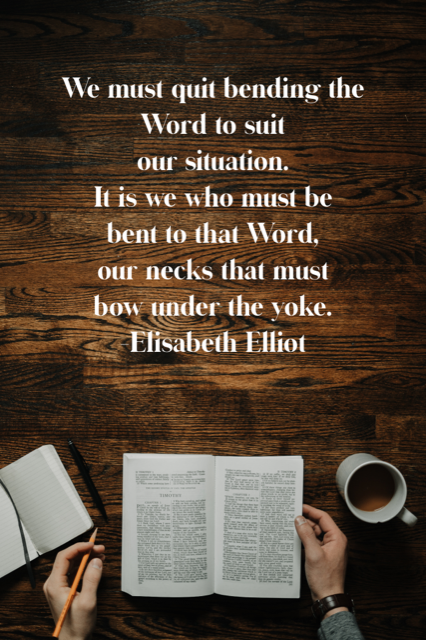
  • Don’t twist the Scriptures as the unstable do. “There are some things in them that are hard to understand, which the ignorant and unstable twist to their own destruction, as they do the other Scriptures” (2 Peter 3:15-16). The unsteady twist (wrest in the KJV) the very thing which could stabilize them. We read it in context so we understand its meaning. We don’t wrangle it to make it say what we want it to say. We don’t adjust it to us: we adjust ourselves to it.
  • Be watchful. “Take care that you are not carried away with the error of lawless people and lose your own stability (2 Peter 3:17, ESV).
  • Grow in the grace and knowledge of our Lord and Savior Jesus Christ (2 Peter 3:18, ESV)
  • Listen to sound teaching. Contrast the characteristics Peter lists of false teachers in 2 Peter to what he says about godly shepherds in 1 Peter 5. Paul tells Timothy in 2 Timothy 4: “preach the word; be ready in season and out of season; reprove, rebuke, and exhort, with complete patience and teaching. For the time is coming when people will not endure sound teaching, but having itching ears they will accumulate for themselves teachers to suit their own passions, and will turn away from listening to the truth and wander off into myths.” Seek to feed our souls His truth rather than feeding our own desires.

Jesus said the one who hears his words and does them is like a man who built his house on a rock which was unshaken by winds and flood waters.

So we watch ourselves, that we’re not being led away of wrong desires. We read and listen to God’s Word as it’s written, in context, not trying to twist it. We listen to pastors and teachers who faithfully proclaim God’s Word. We we obey it. We get to know our Savior better and better and remind ourselves of His truth. and we keep growing spiritually. Doing all of these things might bring persecution, which Peter discusses often in both of his letters. But we can trust God to keep us and deliver us.

Keep steady my steps according to your promise, and let no iniquity get dominion over me. Psalm 119:133, ESV

(Sharing with Inspire Me Monday, Literary Musing Monday, Tell His Story, Wise Woman, Let’s Have Coffee, Porch Stories, Faith on Fire)

Laudable Linkage

IMG_0195

I’ve been mostly absent from the blog this week. It’s rare for me not to do a Friday’s Fave Five, even if I don’t post anything else. But it has been a busy week: card-making and present-shopping and wrapping for a baby shower and my oldest son’s upcoming birthday, house-cleaning for my son’s visit from out of state, buying tons of food for family get-togethers, etc, etc. It’s amazing what you can done when you’re not blogging! 🙂 I am not sure how much I will be online the next week. My oldest son is here, my husband is off, we’ll have more time with the whole family. But, in the past when I have thought I would not be posting much, I have been surprised. Our whole family likes our computer time, so we’ll see.

Meanwhile, I have collected in odd moments online the last week some thought-provoking, helpful reads I wanted to share with you.

Poor Interpretation Lets Us “Believe” the Bible While Denying What It Actually Say, HT to Challies. “Historically, theological liberals denied Scripture, and everyone knew where they stood. But today many so-called evangelicals affirm their belief in Scripture, while attributing meanings to biblical texts that in fact deny what Scripture really says. Hence they ‘believe every word of the Bible’ while actually embracing (and teaching) beliefs that utterly contradict it.”

Grace Comes With Refills.

Love Is Not a Feeling.

Praying the Words of Jesus for Your Teen.

Pants on Fire. The folly of the “I don’t know whether this is true or not; but I just wanted to get it out there” type of post.

Are We All “Harmless Torturers” Now? HT to Challies. “When we think of the savagery of social media, we often think of awful individual behavior…Harmless Torturers never go that far; we just like, retweet and add the occasional clever remark. But there are millions of us, and we’re all turning the dial.”

Why Getting Lost in a Book is So Good for You, HT to Linda.

Finally, you might be blessed by this video even if you don’t know Ron and Shelly Hamilton (of Majesty Music, aka Patch the Pirate and Sissy Seagull) and Shelly’s parents, Frank and Flora Jean Garlock. I had no idea the Garlocks were in this situation or that Ron had been diagnosed with dementia. This is not only an update of how they are doing, but a sweet testimony of a man caring for his wife.

When God wants me to do something I don’t want to do

img_0047

I had another interesting intersection between my devotions, messages at church, and my other reading last week.

I’m in Exodus in my Bible reading just now, and I can always empathize with Moses’s reaction when God calls him to lead the children of Israel out of Egypt. Overwhelmed, he he responds with all the reasons he couldn’t possibly do such a thing, and God graciously promises His provision in every facet.

Who am I? Why would they listen to me? I will be with thee.

What if they ask me what God sent me to them? I AM THAT I AMThus shalt thou say unto the children of Israel, the Lord God of your fathers, the God of Abraham, the God of Isaac, and the God of Jacob, hath sent me unto you

They will not believe me, nor hearken unto my voice: for they will say, The Lord hath not appeared unto thee. God provided three signs to demonstrate before Israel.

O my Lord, I am not eloquent…I am slow of speech, and of a slow tongue. Who hath made man’s mouth? or who maketh the dumb, or deaf, or the seeing, or the blind? have not I the Lord? Now therefore go, and I will be with thy mouth, and teach thee what thou shalt say.

God was very patient with Moses until, at this point, Moses says, “O my Lord, send, I pray thee, by the hand of him whom thou wilt send.” I’m not sure exactly what all that means, but it seems to indicate he’d really rather God sent someone else. God tells him his brother Aaron will be his spokesperson, and sends him on his way.

I would probably have had all the same objections Moses did, and more. They make sense and seem quite valid, except that God promises to overcome each one, no matter how the situation seems to appear at this vantage point.

Some of our Sunday evening services have dealt with Jonah, who, as you know, disobeys God’s command to preach to the Ninevites and goes in the opposite direction. His reasons are less sympathetic; in fact, they are wholly unnoble. The Bible doesn’t say he was afraid of them or afraid to speak to them. He was afraid they would actually respond to his message, and he was so prejudiced against them that he did not want that result. His chastening was pretty severe, and he repented in the belly of a fish. But his heart still wasn’t entirely right. “It displeased Jonah” when the people of Nineveh repented. In fact, he tells God that was why he didn’t want to come to them in the first place, because “Therefore I fled before unto Tarshish: for I knew that thou art a gracious God, and merciful, slow to anger, and of great kindness, and repentest thee of the evil” (Jonah 4:2).

Then, when I’ve had time after my devotions, I’ve been reading in The Women of Christmas: Experience the Season Afresh with Elizabeth, Mary, and Anna by Liz Curtis Higgs. Around the time I was reading about Moses in my Bible and hearing about Jonah in church, I came to the section about Mary in this book. What a contrast. She may have had concerns and fears, but didn’t voice them. Or she may have just believed that God was sufficient to take care of whatever the repercussions would be. No objections. No “what ifs.” No apparent anxieties or apprehensions. Just, “Behold the handmaid of the Lord; be it unto me according to thy word.

I found in my quote file this from Elisabeth Elliot, though I failed to note which book or newsletter it came from:

The story of the glory of heaven brought into a common, little house in Nazareth to a simple peasant girl, who must have been amazed and baffled, but she was instantly obedient. How often you and I insist on explanations and understanding before we’re willing to be obedient. There are many things in God’s world that will never be understood until we obey. Her response, Mary’s response—”Let it be to me according to your word. I am the handmaid of the Lord” — should be our response, too, shouldn’t it? Whatever He asks us to do.

I haven’t been called to anything of the magnitude of these three, but sometimes my response is more like Moses’s to what God has called me to do. First, “Who, me?!” Then, “I can’t, for all these very good reasons.” Sometimes, “That’s not my spiritual gift.” And sometimes, sad to say, “I know You will be with me; I know You will enable and provide. But I’d really rather not.” I’d like my nice, quiet, even life with very few and very minor bumps in the road, if that’s ok.

But that’s not ok. My life is not about my ease and comfort, or at least it’s not supposed to be. It’s about glorifying God and allowing Him to work through me in whatever way He wants to. I may not feel equal to the task, but that’s ok. That reminds me the strength to do it is not my own, but His. His provision and enabling usually comes at the time of obedience, not before. And what times I have cooperated with Him in this way, it has been wonderful to see how He has worked and to experience His presence through those things. When we believe on Jesus Christ as our Savior, we know God is with us by faith even if we don’t always feel it. But somehow when we trust Him through difficult things, we experience His presence and help and grace in ways not known before.

Sometimes I get to the, “Yes, Lord, I am Yours: Your will be done” after reluctance, objections, repentance, and reassurance. I hope, like Mary, to get to the place where I can go there directly.

(Sharing with Inspire Me Monday, Literary Musing Monday, Testimony Tuesday, Woman to Woman Word-Filled Wednesday, Thought-provoking Thursday)

Save

Save

Save

Save

Laudable Linkage

I found quite a bit of good reading the last couple of weeks. Hope something here piques your interest:

Grace Incognito. “What if the point isn’t sprinting across the finish line in record time, but knowing God in every halting, baby step along the way?”

Grace-paced Living in a Burnout Culture. The “Mrs. Grace” illustrations were probably the best I’ve seen showing what life lived with an overflow of God’s grace to us is looks like.

What Should Be One of My Chief Aims at Church?

3 Ways Understanding Jesus’s Cultural Context Helps Me.

Here’s How I’m Fighting the Lies of Self-pity.

19 Spurgeon Quotes for Coping With Stress and Anxiety.

When the Doctor Says to Terminate.

Children and Sleep-overs: What Parents Need to Know.

Master Your Time: 5 Daily Scheduling Methods to Bring More Focus to Your Day, HT to Challies.

The Things All Women Do That You Don’t Know About, HT to Lisa. Sad, but true. (Warning: a bit of bad language).

Here’s What Goodwill Actually Does With Your Donated Clothing.

5 Reasons You Need Fiction, HT to Lisa.

Did you know they were making a new live-action version of Beauty and the Beast? With Dan Stevens (Matthew on Downton Abbey) as the Beast? Here are some photos from it, HT to Carrie. This is one of my favorite fairy tales and the Disney film one of my favorite Disney movies. I hope they do this well and don’t toss in anything objectionable. Looks good so far.

And finally, my oldest son posted this video called “Unsatisfying,” and right at first I thought it was frustrating, but before long I was laughing. Some of the little touches, like the squeaky windmill, are great and the soundtrack, though I love the piece (Samuel Barber’s Adagio for Strings), is perfect.

Happy Saturday!