Laudable Linkage

Laudable Inkage

Some of the good reads found this week:

Awaken Your Hunger, HT to Challies. “Like tamping down my appetite as I’m tasting and assembling ingredients for dinner, I find myself quieting my hunger for God by tasting too many things that don’t satisfy. Sometimes it’s not the quality so much as the quantity: a half hour of mindless scrolling here, a couple of hours of Netflix bingeing there, the incessant input of a podcast or audiobook every time it gets quiet. I keep filling up my soul with so many things that leave me hungry but not for what I need.”

What Martha’s Problem Really Was. “Martha’s problem had nothing to do with her to-do list and everything to do with how she handled her thoughts. Luke didn’t include this account to caution women away from vacuuming, doing dishes, or cooking a nice meal for company. He included it as a warning against unguarded thoughts. Thankfully, he does include a solution.”

You Are “The Next.” “Who will be the next Nancy? The next Charlie? The next John, James, Voddie, or Kay? This may come as a surprise, but there is an answer. The answer is no one. And it’s also . . . you. Confused? Let me explain.”

When Dad Will Not Lead in the Home, HT to Challies. “One of the saddest verses of the Bible is Genesis 3:6 where God’s Word records, ‘[Eve] took of it and ate, and she also gave some to her husband who was with her, and he ate.’ In other words, Adam was standing with Eve when Satan tempted her. The one who should have defended his wife from the tempter, didn’t do anything. He was passive. And that’s what we’re talking about. Instead of spiritual leadership and initiative, we have passivity. How do we approach this problem?”

DO Something When You Are Maligned, HT to Challies. “When stressed through the ill-will or stinging insults and persistent opposition by someone who wants to cause you trouble, we know there is something to think. We are to think the truth about God and ourselves. We don’t take their evaluation as true, but only God’s. Also, we are to think of God’s loving and purposeful sovereignty over his children, meaning that difficulties can bring about good results in character and progress for the gospel. But there is also something to DO.”

The Worst Kind of Parenting Advice, HT to Challies. “I’m grateful to God that I learned early on to chew the meat and spit out the bones regarding much of the Christian parenting advice I was given, and instead to do what was right for our kids and our family. But when it comes to formulaic parenting advice, it sure is interesting that the more things change, the more they stay the same.”

Social Media Pushes Pornography on Children Within Minutes, Report Finds, HT to Challies. “Social media is now one of the primary pipelines to porn addiction for both children and young adults. Global Witness, a campaign organization that investigates the impact of Big Tech on human rights, recently conducted a number of tests to determine how quickly children could access pornography on social media platforms. According to the Guardian, Global Witness conducted one test before the implementation of the U.K.’s Online Safety Act in July, and one after. In just a few clicks, TikTok directed children’s accounts to pornography.”

Spurgeon re the Bible

“Visit many good books, but live in the Bible.”–Charles Spurgeon

When You’re Not Number One

When You're Not Number One

Fans of ball games across the country shout, “We’re Number One!” from the stands.

In reality, everyone can’t be number one. Someone has to be the second banana, play the second fiddle, act as the sidekick.

Many of us have the sad experience of not even being second. We were the last ones chosen for any kind of physical game.

One of the most dramatic battles for first place occurred between twins Jacob and Esau. In Old Testament times, the oldest son received the most inheritance, a blessing from his father, and the chosen leadership of the family.

Esau was the oldest. But God chose Jacob for a special blessing. Jacob would someday become Israel, head of the family through whom God blessed the world.

Did God choose Jacob to show a distinction, a way of saying “I am doing something different here” so it would stand out? Or did he choose the younger child because he knew the oldest was not fit to carry out His will? I don’t know—there may be a number of reasons.

However, instead of waiting and trusting God to work out His purposes, Jacob’s mother, Rebekah, felt they had to “help” orchestrate the circumstances by deceit, which did not work out well. Jacob got what he wanted, but he had to flee from Esau’s life-threatening anger. Esau seemed to have mellowed out a bit when Jacob returned twenty years later, but the Edomites, Esau’s descendants, were Israel’s enemies for centuries.

Jacob had twelve sons. Instead of learning from the tragedy of his family’s favoritism, he perpetuated it by having a favorite son: Joseph. Joseph’s brothers hated him and took the first opportunity to get rid of him.

There were other factors in both these cases besides the chosen status of a younger brother, factors which caused understandable anger. But they caused me to think of others in the Bible who found they were not the chosen ones.

Bad examples from the Bible

Cain was angry God accepted Abel’s offering and not his. Instead of repenting and adjusting his ways, he killed Abel.

Miriam and Aaron were jealous of Moses’ position. So were the sons of Korah. Each suffered God’s wrath.

King Saul had been chosen by God to be Israel’s first king. But his pride and disobedience led God to set Saul aside for David. Saul responded in anger, jealousy, and further sin.

Ahithophel was a counselor to David who deserted him when David’s son, Absalom, revolted against his father and staged a coup (2 Samuel 16-17). When Ahithophel’s counsel was not taken, he set his affairs in order and killed himself.

Absalom tried to take the throne by force. He was killed despite his father’s wishes.

The apostle John warned about Diotrephes, who “likes to put himself first” and did not respect the apostles’ authority.

Good examples from the Bible

Jonathan was Saul’s son, next in line to become king. But when Jonathan recognized God’s hand and calling on David, he readily acquiesced and helped David escape Saul’s wrath.

David planned to build a temple for God, but God said no. David’s son was to build the temple instead. David didn’t complain. He rejoiced that God blessed his house and did everything he could to aid Solomon.

Barnabas was instrumental in introducing Paul to other Christians when they were afraid of him. But he didn’t seem to resent when Paul became the leading spokesperson.

Andrew was Simon Peter’s brother. He faithfully served, often pointing people to Jesus. Though the disciples sometimes argued over who was the greatest, by and large they did not seem to mind that Peter was their leader.

John the Baptist was not offended when his followers left to follow Jesus. He pointed them to Him and said, “He must increase, but I must decrease.”

Examples from history

Many people are familiar with D. L. Moody, a famous evangelist in the 1800s. What’s not as well-known is that Moody was led to the Lord by a faithful Sunday School teacher, Edward Kimball.

In fact, that visit set off a series of events. Under Moody’s preaching, a man named Wilbur Chapman was saved and became an evangelist. Under Chapman’s ministry, Billy Sunday was saved and also became an evangelist. Mordecai Ham was converted under Sunday’s influence. And Ham led Billy Graham to the Lord (sources here and here).

Many people know of Jim Elliot, one of five missionaries killed in 1956 when the tribe they were trying to reach speared them to death. The news went out across the globe. Jim’s wife, Elisabeth, told the men’s story in Through Gates of Splendor. Many books and articles have been written about the five men, their wives, and the tribespeople who eventually came to know the Lord. Many lives have been touched and surrendered to the Lord because of these events.

Jim had an older brother, Bert, who was a faithful missionary in Peru for some sixty years with his wife, Colleen. Bert told Randy Alcorn, “Jim and I both served Christ, but differently. Jim was a great meteor, streaking through the sky.” Randy described Bert as “a faint star that rose night after night, faithfully crossing the same path in the sky, to God’s glory.” Both were used by God, but He led them along different paths.

Sometimes God pushes people into the limelight who didn’t want to be there at first, like Moses and Gideon. He gives grace for that, but He also gives grace for the fainter stars, the lesser-known, who faithfully serve Him with the talents He has given.

Once when someone asked Edith Schaeffer, wife of Francis Schaeffer, founder of L’Abri, who the most influential Christian woman of the day was. Edith replied something like “Whoever she is, nobody knows her. She’ll be a woman whose calling is to be behind the scenes praying.” I’ve heard variations on this answer–another source quotes her as saying, “We don’t know her name. She is dying somewhere in a cancer ward or living in India.”

Whichever way Edith worded her answer, the principle is true: we don’t know who the most influential Christians are. That’s not our business. Our business is to keep our eyes on Him and serve Him with all our hearts.

No leader or CEO or head of anything can accomplish much without support staff. Christendom is the same: “Now there are varieties of gifts, but the same Spirit; and there are varieties of service, but the same Lord; and there are varieties of activities, but it is the same God who empowers them all in everyone. To each is given the manifestation of the Spirit for the common good” (1 Corinthians 12:4-7).

Elisha was said to pour water on the hands of Elijah (2 Kings 3:11), a way of saying he ministered to Elijah’s needs. Elisha became the primary prophet after Elijah’s death, but he served just as well in whatever capacity he was called to at the time.

Imagine if one person in the chain between D. L. Moody and Billy Graham hadn’t done their part. There are unseen connections like that in all of our lives. We don’t know when a kind word, a shared verse, or a prayer might be part of a long series of steps leading a person to meet the Lord or know Him better.

May God give us grace to serve Him in whatever way He wants us to, ministering to others in large or small ways, whether seen or unseen.

“As good stewards of the manifold grace of God, each of you should use whatever gift he has received to serve one another” (1 Peter 4:10, BSB).

1 Peter 4:10

(I often link up with some of these bloggers.)

Sharing Our Struggles, not Our Perfection

Sharing our struggles

Several years ago, our ladies’ group asked some older married women in the church to be on a panel for discussion about marriage at a ladies’ meeting. We didn’t want to put them on the spot: we just figured they had more experience, and we wanted to glean their wisdom.

However, we had the hardest time getting anyone to agree to be on the panel. Some ladies didn’t want to participate because they thought their own marriages were far from perfect. Some felt that they were still learning: rather than answering other women’s questions, they still had plenty of their own.

In hindsight, it probably would have been better not to have particular women on a panel in front of everyone. One advantage to a panel is having known and trusted people there, whereas opening questions to the crowd in general might lead to some questionable answers. But perhaps the disadvantages outweighed the advantages.

Still, the evening ended up going very well (details are here). One even said we needed a session like that once a year.

Many of us would shy away from portrayal as an expert in most areas, especially areas of Christian life. We know we fall short. We don’t want anyone looking to us for answers, because we still struggle ourselves.

But an experienced Christian is not the same as an expert Christian.

When we’re struggling in a given area–marriage, devotions, hospitality, motherhood, work environments, or life in general–we’re not drawn to those who have their act together, whose lives are perfect, who never seem to struggle.

We want to hear from people who have been in the trenches, who know how we feel, who won’t give us pat answers, who have experienced the things we have and overcome them.

Andrew Peterson writes in Adorning the Dark: Thoughts on Community, Calling, and the Mystery of Making:

“O God,” you pray, “I’m so small and the universe is so big. What can I possibly say? What can I add to this explosion of glory? My mind is slow and unsteady, my heart is twisted and tired, my hands are smudged with sin. I have nothing—nothing—to offer.

Write about that.

“What do you mean?”

Write about your smallness. Write about your sin, your heart, your inability to say anything worth saying. Watch what happens (p. 11, Kindle version).

Though Peterson was praying about song-writing here, the principle is true in any area of life.

We can’t bless others with packaged advice from a position of perfection. Even if we could, our ministrations would probably be rejected as cold and unfeeling.

But God says His power is made perfect in our weakness (2 Corinthians 12:9).

One day on a hillside, over 5,000 people came to hear Jesus teach. Jesus had compassion on their physical needs as well as their spiritual needs. He told the disciples, “You give them something to eat.”

Of course, the disciples didn’t have the means to feed so many people. Philip indicated they didn’t have enough money to buy even a little food for everyone. Andrew found a boy with five barley loaves and two fish, but then asked, “what are they for so many?”

Jesus already knew what He was going to do to provide for the people. But He wanted the disciples to realize that they could not meet the need on their own.

Jesus had the people sit down, gave thanks, and then distributed the food to the disciples, who gave it to the people. Not only did they have “as much as they wanted,” but they gathered twelve baskets of leftovers.

We don’t have the wherewithal to feed people spiritually. But when we give ourselves to Him, He can work through us to help others. He will take our not-enoughness and work through us to display His more-than-enoughness.

2 Corinthians 12:9

(I often link up with some of these bloggers.)

The Mission for My Remaining Years

My Mission

After age 30 or so, each milestone birthday becomes more sobering. Age 60 hit me particularly hard. There’s no question that there are more years behind me than ahead of me. Though I hope to still have another two or three decades, my strength and stamina show obvious signs of slowing down.

I’ve never had trouble admitting my age until I turned 60. I was past the time of claiming to be middle-aged, yet I didn’t consider myself to be really old yet. I still felt relevant, but I was afraid younger people would see me as past my prime, no longer worthy to be listened to.

One frustration of aging is increasing health problems. I suppose most people don’t go full steam until the day they die. Most of us undergo a gradual breaking down of various functions. I heard a radio preacher say one reason our bodies start failing is to make us willing to let go of them. We have a strong instinct to survive, but at some point, this body will get to a place where we’ll realize it’s no longer worth trying to preserve it. But even long before that time, doctor’s visits and medications increase.

What’s even more unsettling for me is that the age I will turn this August is the same age both my parents died. They had bad health habits and conditions that I don’t have–but I have some that they didn’t have. I am reminding myself that my times are in God’s hands.

I’m encouraged by reports of people my age and older achieving great things. Laura Ingalls Wilder was 65 when she published her first book. Grandma Moses began serious painting at the age of 78. Harlen Sanders established the Kentucky Fried Chicken restaurants when he was 65. Peter Mark Roget published his first thesaurus at the age of 73.

Most of us don’t have such lofty goals for our later years (although I would like to publish a book). We’d be happy just to be able to get around on our own steam and not be a burden to anyone.

In a recent post by Tim Challies, he included a quote by De Witt Talmage that arrested me:

. . . there is something for you yet to do. Perhaps it may be to round off the work you have already done; to demonstrate the patience you have been recommending all your lifetime; perhaps to stand a lighthouse at the mouth of the bay to light others into harbor; perhaps to show how glorious a sunset may come after a stormy day.

Those are things any of us could do. With however many years I have left, I want to share with my family, readers here, and friends at church and elsewhere, that God is faithful, God is good, and God is worth knowing.

When it feels like God is silent or absent, He is not. He has promised never to leave or forsake His own. 

When answers to prayer seem a long time coming, God’s timing is best. 

When you feel forsaken, God is with you.

He is the truest friend, the wisest guide, the strongest ally, the most loving Father.

His Word is a treasure chest. Delve into as often as you can, not just as an exercise or ritual, but to know the Author. 

On all of my sons’ graduation materials, whether a card or the “senior page” in their yearbooks, I shared the first part of this verse:

And you, Solomon my son, know the God of your father and serve him with a whole heart and with a willing mind, for the LORD searches all hearts and understands every plan and thought. If you seek him, he will be found by you, but if you forsake him, he will cast you off forever. (1 Chronicles 28:9).

I usually share this verse on graduation cards:

You make known to me the path of life; in your presence there is fullness of joy; at your right hand are pleasures forevermore (Psalm 16:11).

I’ve also often shared this with others:

And now I commend you to God and to the word of his grace, which is able to build you up and to give you the inheritance among all those who are sanctified (Acts 20:32).

These are the messages I want to share and demonstrate for as long as I live. 

Rosalind Goforth shared this poem at the beginning of her book, Climbing: Memories of a Missionary Wife. It has stayed with me for years and epitomizes what I want my life, ministry, and legacy to be:

If you have gone a little way ahead of me, call back;
‘Twill cheer my heart and help my feet along the stony track;
And if, perchance, Faith’s light is dim, because the oil is low,
Your call will guide my lagging course as wearily I go.

Call back, and tell me that He went with you into the storm;
Call back, and say He kept you when the forest’s roots were torn;
That when the heavens thundered and the earthquake shook the hill,
He bore you up and held you where the very air was still.

O friend, call back and tell me, for I cannot see your face;
They say it glows with triumph, and your feet bound in the race;
But there are mists between us, and my spirit eyes are dim,
And I cannot see the glory, though I long for word of Him.

But if you’ll say He heard you when your prayer was but a cry,
And if you’ll say He saw you through the night’s sin-darkened sky
If you have gone a little way ahead, O friend, call back
‘Twill cheer my heart and help my feet along the stony track.

Author Unknown

Whatever else we can or can’t do as we get older, we can join with the psalmist in praying:

I will open my mouth in a parable;
I will utter dark sayings from of old,
things that we have heard and known,
that our fathers have told us.
We will not hide them from their children,
but tell to the coming generation
the glorious deeds of the Lord, and his might,
and the wonders that he has done.

He established a testimony in Jacob
and appointed a law in Israel,
which he commanded our fathers
to teach to their children,
that the next generation might know them,
the children yet unborn,
and arise and tell them to their children,
so that they should set their hope in God
and not forget the works of God,
but keep his commandments . . . 

Psalm 78:2-7

Psalm 78:4

(I often link up with some of these bloggers.)

When You’re Not the Chosen One

When you're not the chosen one

We probably all know what it’s like not to be chosen in some way.

Some of us were always among the last chosen for any kind of physical game. Others were chosen last for the spelling bee.

We might not have been chosen for cheerleader, class president, or homecoming queen. Perhaps the person we liked in college chose someone else.

As adults we might not get the expected promotion or desired assignment.

As writers, we watch others get agents or contracts or win contests while we don’t seem to be making any progress.

I thought of this in the contrasting reactions of Esau and Jonathan in the Bible. In the normal scheme of things, each would have succeeded his father as leader. But God chose someone else instead.

Esau was the oldest son in his family, a position of privilege and honor in Bible times. Yet before he and his twin brother, Jacob, were even born, God said “the older shall serve the younger” (Genesis 25:23). Neither of them were ideal sons, but this pronouncement was made before they had done anything.

What was Esau’s response when Jacob received the birthright and blessing that would normally have gone to Esau? He hated Jacob and planned to kill him after their father died. (Genesis 27:41). Granted, Jacob obtained those things by deception and manipulation rather than waiting for God’s timing. But Esau had shown by his previous actions where his values were.

Jonathan was the oldest son of Israel’s first king, Saul. God rejected Saul due to his disobedience (1 Samuel 15). Jonathan could have ranted and raved that it wasn’t his fault that his father disobeyed God. Jonathan had good character and a good reputation. Why not make him king instead of his father?

But Jonathan didn’t grouse and complain and whine. He protected David from the machinations of Saul.

Years later, David had his own “not chosen” moment.

David wanted to build a temple where people could worship God. Nathan, the prophet of God, thought that was a good idea.

But that night, God told Nathan that David was not to build the temple. One of his sons, Solomon, would. God had other things, great things in store for David.

Did David sulk? No, he responded in humility, thankfulness, and love. Then he did everything in his power to help and prepare Solomon.

What are some things we can learn from not being the chosen one?

Sometimes not being chosen has nothing to do with merit. Jonathan was a fine, godly young man. But God had chosen David to be the next king.

But sometimes not being chosen does result from one’s actions. Saul lost his kingship because of disobedience. He still could have repented and gotten right with God, even if he was never reinstated as king. But he didn’t. Others in Scripture were removed from their positions for disobedience as well.

God sets up one and puts down another (Psalm 75:6-7). Sometimes we’ve prayed hard and long for election results that did not go the way we thought they would. All we know is that God has the big picture in mind.

God gives gifts and abilities. Though I probably could have worked hard and improved in playing some athletic game, if I had wanted to, I would never have been a star athlete. My gifts were elsewhere.

One of my favorite passages tells how God gifted different people to do various kinds of work on the tabernacle, even down to those who worked with metal, wood, weaving, and embroidery. The New Testament lists different spiritual gifts God distributes to Christians. One of those passages is 1 Corinthians 12, where Paul goes on to compare the church to a body, where it would be strange if we were all eyes or hands. We need different parts of the body to perform their function.

God has a plan for us. He may have chosen someone else for the particular opportunity we had in mind. But that doesn’t mean we’re on the bench. We need to seek His will for us and serve in the capacity He brings before us.

We can help and support the chosen one. Just as Jonathan helped David and David helped Solomon, we can aid the person chosen to do what we wanted to do.

One of our former pastors said he viewed his position as that of Elisha, who “poured water on the hands of Elijah” (2 Kings 3:11). That phrase conveys service and attending to the needs of another. This associate pastor wanted to serve and help the senior pastor as much as he could.

We can be content in God’s will and calling. In the book On Asking God Why, Elisabeth Elliot tells of a time when missionary Amy Carmichael was to attend a missions conference with a dear friend, nicknamed Twin. But when she saw the list of assigned seats for dinner, Twin was to be seated next to another friend, Mina. Amy wrote to her family:

Well, I was very glad that dear Mina should have Twin, and I don’t think I grudged her to her one little bit, and yet at the bottom of my heart there was just a touch of disappointment, for I had almost fancied I had somebody of my very own again, and there was a little ache somewhere. I could not rejoice in it. . .I longed, yes longed, to be glad, to be filled with such a wealth of unselfish love that I should be far gladder to see those two together than I should have been to have had Twin to myself. And while I was asking for it, it came. For the very first time I felt a rush, a real joy in it, His joy, a thing one cannot pump up or imitate or force in any way. . .Half-unconsciously, perhaps, I had been saying, ‘Thou and Twin are enough for me’–one so soon clings to the gift instead of only to the Giver.

It’s all about God’s glory and purposes. When Israel was going to fight against the Midianites who were oppressing them, God told Gideon his army was too big (Judges 7). They would be proud and attribute their win to their own abilities. God told Gideon to tell everyone who was afraid to go home: 22,000 did, leaving 10,000 still ready to fight. God said that was still too many. He sent them all to some nearby water to get a drink. Some of the men bent down and lapped the water like a dog. Others knelt down and cupped the water into their hands to drink. I’ve heard many sermons where the preacher read between the lines and proposed all kinds of reasons why God chose one group over the other. But that’s just speculation. The Bible doesn’t give us God’s reasoning. Personally, I think God just chose whichever group was the smallest. The 300 who lapped went on and won a miraculous victory that showcased God’s power, not their own.

Amy Carmichael’s original ministry in India involved evangelizing women. God used her remarkably in that capacity. Then she learned that little girls were being sold into temple prostitution.  Elisabeth Elliot writes that Amy “prayed that God would enable her to find a way to rescue some of them, even though not one had ever been known to escape. Several years later, God began to answer that prayer…and in a few years Amy Carmichael was Amma (“Mother”) to a rapidly growing Indian family that, by the late 1940s, numbered about 900.” Amy struggled a bit with the fact that this ministry to girls (which later included boys) was quite different from what she had been doing. She was even criticized in some corners. But she felt that teaching, training, protecting, and taking care of children was only a different ministry, not  lesser one.

Elisabeth Elliot wrote this about jobs, but it’s true for positions and ministries and opportunities as well:

This job has been given to me to do. Therefore, it is a gift. Therefore, it is a privilege. Therefore, it is an offering I may make to God. Therefore, it is to be done gladly, if it is done for Him. Here, not somewhere else, I may learn God’s way. In this job, not in some other, God looks for faithfulness.

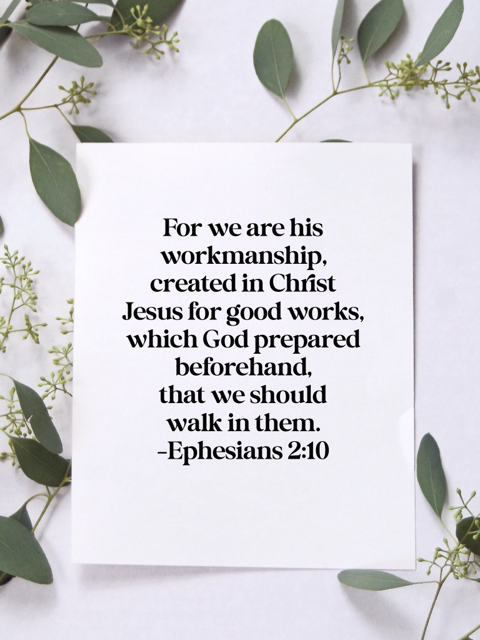
In a sense, we’re all chosen. We may not have gotten what we originally wanted. But for those who trust in Christ’s saving work on the cross to atone for their sins, “we are his workmanship, created in Christ Jesus for good works, which God prepared beforehand, that we should walk in them” (Ephesians 2:10). Whether we serve out in front or in obscurity, in a desired or unwanted position, with people who love us or people who try us, we can serve God by His grace, for His honor and glory.

Ephesians 2:10

(I often link up with some of these bloggers.)

Ministry Beyond Church Membership

When we knew we were going to move from GA to SC several years ago, we checked into churches and schools as well as housing long before time to go. One church had a Christian school that we liked. But on our first day visiting the church after our move, the pastor announced his resignation due to health problems.

We continued visiting for a while to make sure the school would be a good place for our kids. But we didn’t feel we could make a decision about the church until they chose a new pastor and we could see what kind of man he was and what direction they were going.

So we continued to visit around. We finally settled our choice between this church, still without a pastor, and one other. At this second church, we were invited to attend a membership class to learn what the church was all about. The class was supposed to run about four weeks, if I remember correctly. But the class discussions stretched the length of the class out for several more weeks. We got to know a few people and were asked to participate in various church functions.

In the meantime, the first church called a new pastor. We went back to that church a few times and met with the pastor. Both churches were good, but we felt this first church was a better fit for us.

My husband called the pastor of the second church to let him know we wouldn’t be attending any more. The pastor asked if they had done anything wrong that would cause us not to join there. No, my husband said. Theirs was a fine church. We just felt the first church was where we should be at this point in time.

Any time we ran into the second pastor in town, the encounter felt a little awkward. We hadn’t meant to “lead them on.” In hindsight, perhaps we should not have attended the membership class until we knew we were ready to take that step. On the other hand, the class was presented as the best way to learn about the church. We also didn’t feel we should have abstained from church fellowships, the Missions banquet, etc., until we joined. Going to those events is part of getting to know the church.

I know it can be frustrating to feel like you’ve invested time in people who visit your church, only to have them join somewhere else.

But if I had a chance to speak to the pastor or anyone from the second church now, I would love to tell them your ministry counted, even if we didn’t join. The teaching, kindness, invitations, and conversations were not wasted. They still ministered to us.

Most pastors and church members know that, deep down. They are kind to people for the Lord’s sake, not just to gather church members. Yet I understand the potential for frustration and disappointment.

Our pastor in GA used to faithfully visit people and talk to them about the Lord. He once commented that when someone he talked to became a Christian or decided to get back into church, suddenly relatives seemed to come out of the woodwork to fold the person into their church. He was tempted to think “Where were you before now?” But he knew the principle that one person plants the seed, another waters, but God is the one who brings a soul to Himself (1 Corinthians 3:5-9). While experiencing a pang that his own church was small, ultimately he wanted the new believer or reclaimed backslider to be where God wanted them, where they could best get established and grow in Him. And I’m sure most ministers and church members want the same.

The last time we searched for a new church, we noticed that not many people greeted first-time visitors. The pastor always made it a point to meet us (with one exception). But often only one other person spoke to us beyond a nod. Perhaps they think the occasional new face is just passing through. It’s usually after a few visits, especially to smaller services like Wednesday prayer meetings, before people seem to loosen up. I don’t think they are consciously thinking, “We”ll see if they’re going to stick around first before we open up to them,” but it can feel that way. I know greeting strangers in church feels awkward except to the most outgoing extroverts. One of the hardest things for me to do is greet someone I don’t know. I’m usually fine once I get started, but that initial contact can be daunting. But it’s always worth it.

So many churches sound the same on their websites. Even churches with almost identical statements of faith can have vastly different personalities and emphases. My husband said that “no” concerning a potential church is relatively easy to come to, but a “yes” takes longer. Sometimes on the very first visit, we can tell a church is not for us. But other times, it takes a while to really get a feel for where the church is and where it’s going. I suppose it’s an embarrassment of riches that in most American cities, we have so many options to choose from.

No church is perfect, of course. None will tick every little preference. Church visitors know that.

But as they seek the place God has for them, where they can best grow and serve, they might have to try several places. Choosing one doesn’t necessarily mean there’s anything “wrong” with the others.

So as people come through our doors, we welcome them, we minister to them as unto the Lord, we want God’s best for them. If they don’t stay in our church, they’re still “family,” if they are believers. If they don’t know the Lord, we lovingly try to point them to Him. We hope they all stay on. But if they don’t, we want to be able to rest in the fact that we’ve helped them draw closer to Him in the time they were with us.

(I often link up with some of these bloggers.)
Are You a Big Z or an Ordinary N?

Imagine getting a Scrabble tray with the following letters:

JQZXKVW

Wow! All the highest-scoring letters! You’ll surely win this time!

Except there are a couple of problems.

First, there are no vowels. You’d only be able to play off vowels in your opponent’s words.

And most words are not made up of just the high-point letters. Usually you have to combine them with an ordinary D or T or N.

Too, I’ve often found that the words that use all the tiles and earn bonus points are most often made up of the more common letters.

Life is like that with people, too. The ones out front or with heavy responsibilities don’t operate alone. Stars have their publicists, make-up crew and stylists, agents, drivers. Executives have administrative assistants, mailroom workers, technicians. Presidents have cabinets, advisors, security details. Mills, factories, and manufacturers are mostly made up of everyday workers. Every company has those who keep the premises hygienic and pleasant by keeping it clean.

Have you noticed this principle in the Bible as well? Moses had Aaron and Hur. David had his mighty men. Elijah thought he was alone standing against the prophets of Baal, but God had 7,000 who had not bowed the knee to a false god. The obscure names among Jesus’ twelve closest followers were just as much disciples as Peter, James, and John.

Besides the Bible heroes we all know and love, lesser-known servants of God played key roles. A little servant girl told Naaman about the prophet in Israel who could heal him of leprosy. Unnamed prophets appear in only one scene, but deliver vital messages. “A certain man drew his bow at random” and killed King Ahab, one of Israel’s wickedest rulers. A woman only known as a Shunammite provided a respite for the prophet Elisha in his travels. A little boy gave his lunch of loaves and fishes to Jesus, who multiplied them to feed a multitude. “Joanna, the wife of Chuza, Herod’s household manager, and Susanna, and many others, who provided for” Jesus and the disciples “out of their means” alongside Mary Magdalene. Paul’s nephew brought news of an ambush planned against Paul, prompting his guards to beef up security.

Everyone has an important part to play in God’s kingdom, whether it’s a large or small part. If we envy another’s role, we forget they have their own set of problems and temptations. If we’re discontent with our role, we forget God sees and values it.

Have you ever had one tiny cog mess up a machine’s functions? A few wrong keystrokes in computer code can throw a whole program off. A little virus can wreak havoc in computers and bodies and communities. One person not doing their job right in the process of bringing a product to market can cause the end product to fail or even be unsafe. One customer service representative can make the difference in solving or causing problems, in our relief or frustrations with a company. One kind greeting at church can make a visitor feel welcome. One word of encouragement can change someone’s outlook.

The Bible uses the metaphor of the body to describe the church in 1 Corinthians 12:14-31. The body has a number of parts, but all are important. This passage has us imagine how ridiculous it would be if the whole body were an eye–how would it eat or walk or speak? Equally ridiculous is the thought of doing without one member or another. One part can’t say it doesn’t need another. Each part working together with the others helps the body function rightly, which aids all the parts. Ephesians 4:1-16 uses the same imagery, closing with, “Rather, speaking the truth in love, we are to grow up in every way into him who is the head, into Christ, from whom the whole body, joined and held together by every joint with which it is equipped, when each part is working properly, makes the body grow so that it builds itself up in love.” I’ve spoken of not thinking less of ourselves if we don’t have a big role to play, but Romans 12, also speaking of the church as a body, warns “not to think of himself more highly than he ought to think, but to think with sober judgment, each according to the measure of faith that God has assigned” (verse 3). There is no room for pride or discouragement with God’s giftings. But “having gifts that differ according to the grace given to us, let us use them” for His honor and glory and for the good of the rest of the body (Romans 12:6). We can be content in the place He has us.

My grandfather used to say, “God must love common folk, He made so many of us.” Sometimes God pushes us out of our comfort zones, like Moses, Jonah, Gideon, Esther, and others. But most of us won’t be the mega-best-selling author, the speaker followed by the masses, the hero about whom epics are written. Yet we can glorify God in our homes, churches, cars, businesses, neighborhoods. In fact, back to our Scrabble analogy, if we’re an N or T or an I, we can be used more often and in more places than a Q.

(I often link up with some of these bloggers.)

“At least I’m still good for something.”

When we first moved my mother-in-law over 2,000 miles to live in an assisted living facility near us, we would have her over for dinner sometimes, take her to my youngest son’s basketball games, and take her to church and other outings.

At one dinner, a favorite family story came up. Some years ago, my mother-in-law inadvertently said something inappropriate, using a term with double meaning of which she was unaware. Everyone laughed because they knew she hadn’t meant it in the way people would take it today. The incongruity of such a thing coming from her made it all the more funny.

As we told the story to our kids, who had either not heard it before or had forgotten it, we all laughed, even my mother-in-law.

After the laughter died down, though, she quietly said, “At least I’m still good for something.”

I don’t know if anyone else heard her say it or caught the significance. But her sentence went like an arrow to my heart. She wasn’t complaining or blaming anyone, but she didn’t feel useful any more.

When we first moved her into assisted living, my husband told her, “You’ll never have to cook to clean again.” That sounded pretty good after 70 or years of those activities.

Her only hobby was reading, and she delighted in being able to read all day to her heart’s content. She had always been a homebody, and just going to meals three times a day with a room full of other people taxed her. When aides would knock on her door to see if she wanted to go see the musicians, the magicians, the church choir, or whomever, she politely declined.

I don’t think she was discontent with her circumstances. But we all want to feel we’re of use in the world. There is a feeling of satisfaction and pleasure when we’ve accomplished something, but she didn’t have anything to accomplish any more.

In “The Grace to Be Diminished,” Win Couchman wrote of turning 80 and having to give up driving, changing from their usual place in the balcony at church to a place on the main floor where they didn’t have to fear falling, her husband’s hearing loss and short-term memory loss which caused him to be “silent and isolated at social functions.” But the “diminishment” that particularly touched my heart was when “one of the women who coordinates the potlucks called me and said with winsome authority, ‘Win, enough already. You have been involved with these evenings for about twenty years now, I think. You have done your bit. We want you and Bob to be at every one, but you are not to bring any more food, you hear?'”

Only then did I realize how the slowness with which I function now, and the accompanying late afternoon fatigue, was beginning to color my anticipation with some dread.

Gladly I responded, “Okay.” It’s awkward to walk into someone’s house on potluck Saturdays empty-handed just as another couple arrives loaded with goodies. In that moment, I silently look to God for the grace to be diminished.

Win and her husband, and I am sure my mother-in-law as well, graciously accepted the decline that comes with age, knowing that:

 So we do not lose heart. Though our outer self is wasting away, our inner self is being renewed day by day. For this light momentary affliction is preparing for us an eternal weight of glory beyond all comparison, as we look not to the things that are seen but to the things that are unseen. For the things that are seen are transient, but the things that are unseen are eternal (2 Corinthians 4:16-18).

Yet I think we should be careful not to diminish them unnecessarily.

In Atul Gawande’s book Being Mortal: Medicine and What Happens in the End, he writes of a woman who was responsible for her father’s care when he could no longer live alone. Yet her desire to keep him safe culminated in his living in a small room with nothing to do, “safe but empty of anything [he cared] about” (p. 109). 

What touched off this train of thought today was a section in Anthony Trollope’s The Last Chronicle of Barset, the sixth and last in his Chronicles of Barsetshire series. Mr. Harding was the main character in the first book, The Warden. Now, in the last book, he has become very old and increasingly feeble. He used to love to play the violincello, but can’t manage it any more. “He had encountered some failure in the performance of the slight clerical task allotted to him, and the dean had tenderly advised him to desist.” He loved going to the cathedral every day, to listen to the organ, read a theology book, or just walk around. But his feebleness caused his fearful housekeeper to write to his daughter, who came to encourage him that perhaps his days of walking alone to the cathedral might need to come to an end. He replied, “I do not like not going;—for who can say how often I may be able to go again? There is so little left, Susan,—so very little left.”

That line was heartbreaking—that there was so little left. Eventually Mr. Harding made peace with the fact that God had given him a good life and he had a better one to look forward to. He found the “grace to be diminished” and decline.

Another line in Gawande’s book says, “Making life meaningful in old age…requires more imagination and invention than making them merely safe does” (p. 137).

Hindsight is always so much clearer, of course, but I wish I had made my mother-in-law’s life more meaningful. When she was still able, I wish I had thought of small tasks she could do to help with meals. Cooking had been her love language of sorts. Though we thought we were honoring her by doing for her, perhaps she would have felt more useful with a way to contribute. I could have made a project of putting her photos in albums with her. I did ask about her early life—high school, how she met her husband, etc.–and even learned some things I hadn’t known before. But I wish I had done that more. Although our visiting almost every day and then bringing her home for her last years showed how much we regarded her, I wish I had often told her that we loved her and were happy to have the opportunity to care for her. Though she had intrinsic value as a being created in God’s image, we should have let her know more often that she was valued and important.

As I look ahead to growing older, a couple of passages especially comfort me. One is Isaiah 46:4: “even to your old age I am he, and to gray hairs I will carry you. I have made, and I will bear; I will carry and will save.”

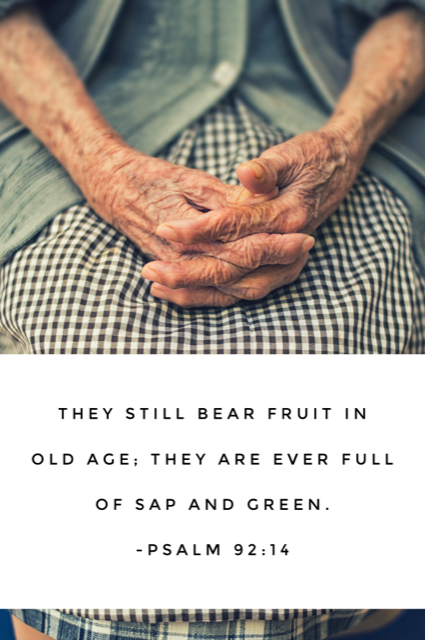
Another is Psalm 92:12-15:

The righteous flourish like the palm tree
and grow like a cedar in Lebanon.
They are planted in the house of the Lord;
they flourish in the courts of our God.
They still bear fruit in old age;
they are ever full of sap and green,
to declare that the Lord is upright;
he is my rock, and there is no unrighteousness in him.

During my mother-in-law’s last years, when she slept most of the time, I wondered what kind of fruit she was bearing in that state. A few came to mind. Her godly life—not perfect, but steadily walking with God and seeking to serve Him the best she could in her circumstances. Her uncomplaining patience. Her taking things with humor. Her willingness to “go with the flow.” Her testimony of peace and joy before her caregivers.

I wish these things had come to mind when she wondered what she was “good for.” I trust her Lord’s, “Well done, thou good and faithful servant” assured her that He was able to use her in many ways. And I hope that these thoughts will remind me to let others know the ways God used them in my life.

(I often link up with some of these bloggers.)
Treasures of Encouragement

Although Treasures of Encouragement: Women Helping Women is not primarily about author Sharon W. Betters, the book grew out of her situation. Her teenage son and his friend were killed in a car accident within minutes of leaving the Betters’ home in 1993.

The book’s theme verse comes from Isaiah 45:3, where Sharon found hope in her deep grief: “I will give you the treasures of darkness and the hoards in secret places, that you may know that it is I, the Lord, the God of Israel, who call you by your name.” Though God sometimes leads through dark valleys, treasures are there that can’t be found anywhere else.

Sharon writes:

The healing balm of encouragement eventually stopped the spread of despair’s infection and began replacing it with hope’s healthy glow. God’s Word was the healing balm, and God’s people applied it lavishly to sooth the searing pain in my soul. Biblical encouragement is soul work. God unleashes its mysterious power every time a child of God follows the Holy Spirit’s direction and steps into the suffering of another person (pp. 9-10).

Each chapter starts with one or two women’s testimonies about being either on the receiving or giving end of encouragement.

Throughout the book. two points are repeatedly emphasized. First, encouraging someone else spiritually is the outgrowth of our own walk with the Lord and time spent in His Word. Second, because we have those resources–God’s Word to inform and guide us and His Spirit within us—we have what we need to encourage others.

Part 1 of the book explores thinking Biblically: defining and exploring what encouragement involves and what our responsibilities are as believers to each other.

To ease the guilt of noninvolvement, we charge the church with the job of meeting needs. We forget that we are the church! (p. 18)

Biblical encouragers know that their role is part of a process; it is seldom, if ever, the solution. They understand God is doing soul work through the interaction of members of His body. They recognize that He uses circumstances to strip people of obstacles that keep them from knowing Him, and so they ask themselves, How can I help this person through the peeling process of sanctification without hindering what the Holy Spirit is doing?

Often we want to rush into a difficult situation and make everything better. But that is not God’s method. He uses the rough spots of life to sand away the rough spots in character so that the reflection of “Christ in us” becomes increasingly clear (p. 73).

Because of who our Father is, and because of the riches of our inheritance, we always have something to offer to others (p. 37).

Part 2 covers living Biblically: the necessity of prayer, listening well, helpful vs. non-helpful words, spiritual mothering, pursuing restoration rather than judgment, Biblical exhortation, letting God use your spiritual gifts in large or small ways, offering practical help.

The church, like a home, is not a place where perfect people enjoy each other’s company. It’s a place where spiritual nurture, training, and discipline help imperfect people take on the image of their perfect heavenly Father. The church is not a place for hibernation; it’s a place where we learn, grow, take risks, make mistakes, and get up and try again (p. 99).

Will it be easy? No. Initially, obedience is hard, but in the long run, disobedience is harder (p. 131).

When we have a clear picture of our own sinfulness and inadequacies, we may conclude that we are unfit to carry the great gospel message. But our wrong conclusions will not thwart God’s purposes. For reasons we do not understand, God has chosen us to spread His message of hope and redemption (p. 198).

Spiritual mothering often happens more around a kitchen table that in a structured study (p. 213).

Though the book can be read by individuals, it’s designed for a twelve-week group study. Each chapter ends with six day’s work of questions or exercises. On one hand, I didn’t want to take twelve weeks to read the book. But on the other, I didn’t want to skip over the “homework” between chapters. I felt the time exploring further or meditating on each chapter’s truths would help the ideas take firmer root. I did sometimes combine some of the individual days’ exercises, though.

One appendix shares 50 very practical ideas for extending encouragement to others. All 50 won’t appeal to or be possible for everyone, but they give a rich variety to choose from.

I appreciated the address to older and younger women in the church with encouragement to settle the differences that can sometimes arise between the two groups (pp. 137-138).

This book was originally published twenty-five years ago. It was updated and reprinted in 2021.

Just occasionally, I found the tone in the book got a little more authoritarian than encouraging. One example from the exercise questions after the first chapter: “Who will you encourage today? Write a brief statement about how Christ, through you, can encourage that person. Now do it!” (p. 26).

But overall, I found much good food for thought on both the necessity to be an encourager and the ways God can work in and through us. This is a book I am sure I will return to in the future.

(I often link up with some of these bloggers.)

15 Favorite Posts from 15 Years of Blogging

I mentioned in my end-of-July post that I forgot my blogging anniversary until WordPress sent me a reminder. It’s been fifteen years!

Often in the past I’ve done something special to observe my blogiversary. Since it caught me off guard this year, I didn’t have anything prepared.

I had been pondering ways to bring some of old posts back to the forefront, since they were published before I knew some of you. Then, voila! The idea came to list fifteen of my favorite blog posts to commemorate my fifteenth year of blogging. There won’t be one from each year—that would have taken too much time to search out. But these were either fun to write or were special to me in some way.

So here we go, in no particular order:

  1. Coping when a husband is away. This is my top-viewed post of all time. I had no idea it would touch such a chord. My husband had to travel heavily for at least half, maybe as much as two-thirds of our 41-year marriage. Though I didn’t like it, I am thankful God used what He taught me to help others.

2. How Not to Become an Old Biddie. After seeing examples of different kinds of older ladies, I realized I needed to start working on what kind of older lady I want to be now. (Related: Why Older Women Don’t Serve and Ways Older Women Can Serve.)

3. With All Our Feebleness. Reflections on serving God with physical and other limitations.

4. My Ebenezers. In 1 Samuel 7:12: “Samuel took a stone . . . and called its name Ebenezer; for he said, ‘Till now the Lord has helped us.’” “Ebenezer” means “stone of help.” In this post, I listed some of my verbal “Ebenzers,” commemorations of the Lord’s special help in my life.

5. Having Devotions When You’re not Feeling Very Devoted. We’ve all been there, I’m sure. (Related: When There Is No Hunger for God’s Word.)

6. Strong Women. What feminine strength means and doesn’t mean, with literary and Biblical examples.

7. Encouragement for Mothers of Small Children in the area of trying to find quiet time with the Lord.

8. The Back Burner. The stuff on the back burner is all the more flavorful for its time sitting and simmering. So with the things in our lives we have to set on the back burner: they’ll be all the better for the wait.

9. Why Read? Why Read Fiction? Why Read Christian Fiction? Every reason I could think of for reading all of them.

10. Can Frugality Go Too Far? Even good traits can be carried too far.

11. It’s Not For Nothing. Caregiving can seem monotonous and futile when the patient sleeps most of the time, can’t speak, and isn’t interested in food, as was the case for my mother-in-law her last two years in our home. These were truths that encouraged me. (Related: Remembering the Loved One Who Has Forgotten You.)

12. Manufactured Spirituality. Routines and programs can help us spirituality, but sometimes we focus on them to the detriment of real spirituality.

13. The Quiet Person in the Small Group. How not to torture your introverts.

14 Going to a Church with Problems. They all have them, even the ones in the Bible. (Related: What You Miss When You Turn Your Back on Church.)

15. Myths and Maxims of Ministry gleaned over many years. Myth #1: “Since this is being done for the Lord, everything should go smoothly.” Nope!

These are the posts that floated to mind. If I had actually searched every year’s posts, I might have had a different list. But there’s probably a reason these are the ones that came to mind.

As you’ve noticed, I cheated stretched my numbers a bit. Sometimes I couldn’t decide between a couple of posts on a similar topic, so I included one as “related.”

I’ve noticed that I should probably go back and edit some of the older posts. One of the tendencies my first critiquer at a writer’s conference pointed out was “long, convoluted sentences” that should be broken into two sentences (or three or four). Hopefully some day I can correct those in my older posts.

Thank you so much to all of you who read and comment. Without you, this would just be an online journal. Nothing makes me day like hearing that something here has blessed and helped someone.

(I often link up with some of these bloggers)