I’ve had this draft sitting here since last July, and had jotted some notes and spent a lot of thought on it even before that. I’ve (obviously) had a hard time bringing my thoughts into a cohesive and coherent unit. I thought about calling it form vs. function, or the mechanics of ministry, or using artificial means to accomplish spiritual ends. Finally what seemed most apt was manufactured spirituality.
I see this on three different levels:
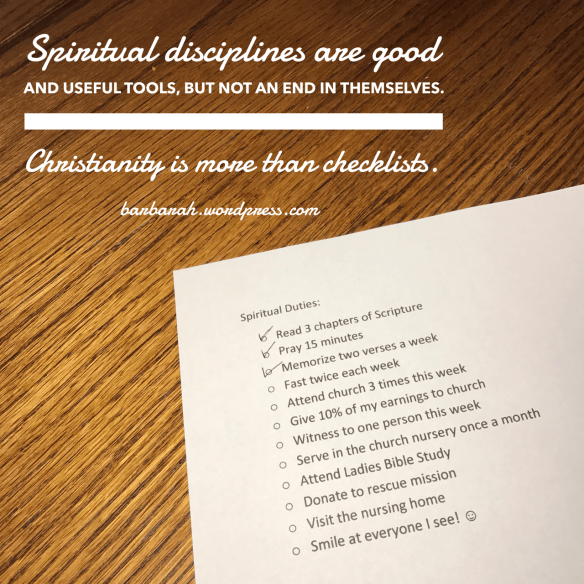
1. To try to be more self-disciplined, we establish habits to aid in godliness, like regular times of reading the Bible or prayer, church attendance, etc. And that’s a good thing. But we all know what it is to have days when we’re just going through the motions, when our eyes are dragging across the page and we check “Have devotions” off your list of things to do for the day but haven’t really engaged with the text or been affected spiritually. Or we “feel spiritual” if we’ve crossed that duty off or don’t “feel spiritual” if we haven’t.
2. To try to minister more effectively as a church, we set up various programs or committees. But sometimes our routines and programs not only don’t accomplish the ministry for which they are intended, they can even hinder them. For instance, we’d all agree it’s a good thing for church members to greet visitors. But once when we were visiting a new church, no one spoke to us or even looked at us the whole time we were there – except at the hand-shaking time built into the service.They had squeezed all their greeting into that few moments, leaving visitors feeling awkward and not really greeted at all.
We can fall into the trap of thinking that when we show up for church visitation, then we’ve gotten our witnessing obligation in for the week, or because we have official greeters at church, none of the rest of us needs to greet new people, or because there is a committee to take care of x, y, or z, we don’t have to be involved.
3. We try to force results. For instance, we can feel that small groups would be good for the congregation to get to know one another better, and they work best if everyone participates. So we “make” the quiet person participate by putting undue pressure on them to say something, calling them out and putting them on the spot. Then we feel self-satisfied that the group went quite well today because everyone spoke, when we left the quiet person miserable and determined not to come back. Or, as happened to us once in a new church, whatever the pastor was talking about (I’ve forgotten now), at the end he asked everyone to break into family groups and discuss and pray right then and there about how to implement what he preached on. That seemed to my husband and me like forcing the issue or “making” people respond instead of letting God use His Word to convict and change. Another example: we want people to “go deep” in their conversations and relationships, so we have “turn to your neighbor and bare your heart on command” sessions instead of letting those opportunities arise in a more natural way. We’ve known people who made a profession of faith after a zealous Christian buttonholed them and would not back off until the person responded, yet there was no life change, no interest in the Lord afterward. By contrast, Jesus let people walk away sometimes.
Setting up good habits and routines and even programs can greatly aid us in our walk with God. But we have to keep in mind what they are for and not get lost in them for their own sake.
A book I read recently about getting more from our reading of God’s Word emphasized applying what we learn. That’s a good thing: we’re told to be doers of the Word, not just hearers. But his illustration went something like this: we need to apply God’s Word in measurable ways, not vague ones. So if, say, we come to a passage about prayer, instead of saying to ourselves, “We really should pray more,” according to this book, we should instead make plans to pray six minutes every day. As if God cared how many minutes we pray. The better approach, in my opinion, would be to stop and think about what I could and should be praying for. That in itself would generate a longer prayer list than I could probably keep up with (some people divide their prayer lists into categories over several days). Then the next step would be to study the prayers in the Bible, particularly in the epistles. Paul’s prayers in Philippians 1, Ephesians 1 and 3, and Colossians 1 are wonderful examples. Granted, that author probably intended that, if a person planned to pray six minutes and ran out of things to pray in three, that would lead him to these other ways of expanding his prayer life. But the emphasis on “measurable results” can lead to outward exercises without always the accompanying inward change. Similarly, if I read a passage and am convicted about needing to be more loving and less selfish, it might help to think of specific ways in which I need to do those things. But it would be wrong to check those off my list at the end of the day and think, “There! Done! Good work!” Sometimes instead I need to carry those thoughts with me all throughout the day and apply them in ways I couldn’t know I would need to when I first read them.
Years ago we were visiting my in-laws, and a couple of ladies from the church came by to visit my husband’s mother. I think it may have been her birthday, or maybe they were just visiting her as an “older” church member, but they brought a small plant, and, I believe, a card. She tended to be profuse in her thanks, and perhaps to counteract that a bit after she thanked them several times, one of them responded, “Well, you were on our list.” Wow, what a way to deflate any good feelings about someone coming to visit. She never said anything about it after they left, but it would have been understandable if she had thought, “They don’t really care: they just came because I was on ‘a list’ to visit.”
Our ministry isn’t boxed into a particular time, place, or group of people. Our programs don’t take care of all of our obligations. There is a sense in which we should always be “on,” always at the ready to serve. Even if there are official greeters at church, we can greet people when we see them or help a confused visitor find the right place. Even if there is someone designated to send cards to sick Sunday School class members, we can send one, too. If God has placed on our hearts that we need to help someone else in the church, we need to pray about how to do that rather than just dismissing it because our church has a benevolence committee to take care of those things. If there is trash on the floor, we can pick it up instead of thinking, “There is a custodian for that.”
On the other hand, I’ve known women who felt terrible for not “serving” in church when their whole lives were ministering in “unofficial” ways. One lady would often apologize for not being more involved in our ladies’ group, but she lived next to and helped her elderly mother, cared for a disabled son, was the go-to baby-sitter for the rest of the family. She sang in the choir and took an interest in people, yet felt she wasn’t really being used of the Lord because she couldn’t plug into some of the ministries. Another had to step down from a position for which she was uniquely qualified, and I watched and was blessed as she found various other ways to minister: greeting newcomers, inviting ladies over for lunch, and other ways that didn’t fit in with any particular official ministry in the church, but ministered very well to the people involved.
Habits, routines, programs help greatly in organizing a ministry, and we need to use whatever systems are set up (reporting a plumbing problem to whoever is in charge, signing up for taking a meal to someone so she doesn’t receive two or three in one night or receive something she’s allergic to, etc.). And sometimes we do need those systems and routines because we don’t always “feel like” doing what we need to. A former pastor once said that the best time of prayer he ever has was when he didn’t feel like praying and had to confess that to the Lord right off the bat. Sometimes just doing what we should whether we feel like it or not is the first step to feeling like it.
But we should seek God’s grace to serve not just out of duty, and not to check off all the designated boxes, but with a right heart. The mechanics of ministry and spiritual disciplines are tools, but not the main focus, not the end-all of our efforts. Routines, habits, programs are an avenue of ministry, not an end in themselves, and ministry doesn’t take place only within those parameters. On the other hand, sometimes we can perfectly follow all of our routines, and our programs can seem to be going swimmingly, but we’re unaware that we’re missing something vital.
The simplicity which is in Christ is rarely found among us. In its stead are programs, methods, organizations and a world of nervous activities which occupy time and attention but can never satisfy the longing of the heart. The shallowness of our inner experience, the hollowness of our worship and that servile imitation of the world which marks our promotional methods all testify that we, in this day, know God only imperfectly, and the peace of God scarcely at all. If we would find God amid all the religious externals, we must first determine to find Him, and then proceed in the way of simplicity. Now, as always, God discovers Himself to “babes” and hides Himself in thick darkness. ~ A. W. Tozer, The Pursuit of God
God created whole systems of programs and routines for Israel in the Old Testament. But there were times He told them He hated their sacrifices and feasts – the very sacrifices and feasts He had commanded them (here, here, and here, for a few). Why? Sometimes because they harbored sin in their hearts even while performing their religious duties outwardly. Sometimes because they missed the main point, like those who kept the systematic observations but failed to minister on a personal level, or like Pharisees whose religious zeal was wrapped up in keeping not just God’s law, but their additions to it. God said to them through Hosea, “For I desired mercy, and not sacrifice; and the knowledge of God more than burnt offerings” (6:6). We’re no longer under those systems, but in the same way I think He would want us to implement whatever habits, routines, systems, or programs are helpful, yet not get lost or fixated on them for their own sake, and to keep in mind that the main point is to know Him and make Him known and minister to others in their need in His Name and by the power of the Holy Spirit.
And this is eternal life, that they know you, the only true God, and Jesus Christ whom you have sent. John 17:3
Not by the way of eye-service, as people-pleasers, but as bondservants of Christ, doing the will of God from the heart. Ephesians 6:6
(Sharing with Inspire me Monday, Testimony Tuesday, Woman to Woman Word-Filled Wednesday)




 But after just a few visits with my husband there to interpret for her and urge her on, and showing the therapist how to communicate with her, they got along quite well.) We didn’t want our own visits with her to be all about exercising, so it would have been nice if there was someone on staff, or even someone who worked with different facilities, to come in and help people with their exercises.