Laudable Linkage

Laudable Linkage

Some of the blog posts that stood out to me this week:

Why Christian Kids Leave the Faith. “Few things are sadder to witness than people who once professed faith leaving it all behind. This is especially true when those people were raised in Christian homes by God-fearing parents. These children were given every opportunity to put their faith in Jesus but determined instead to turn their backs on him. Why would they make such a tragic choice?”

Beauty Bears Witness to God, HT to the Story Warren. “Art is haunted by beauty, and beautiful things point beyond themselves to more perfect beauty. Psalm 50 says, “Out of Zion, the perfection of beauty, God shines forth” (v. 2). We’re meant to trace this world’s splendor back to its Creator.”

What to Consider When a Loved One Is Critically Ill, HT to Challies. “The Bible remains a lamp to our feet and a light to our path even in the ICU (Ps. 119:105). Although Scripture doesn’t explicitly mention CPR or ventilators, it does offer key guidance on the sanctity of mortal life, God’s sovereignty over life and death, mercy, and our resurrection hope. These four truths can provide a framework as we strive to honor God at a loved one’s bedside.”

Gratitude In the Midst of Grief: Finding Hope in the Lord’s Kindness. “Gratitude doesn’t cancel grief—it coexists with it, transforming sorrow into worship.”

Three Thanksgivings In Heaven. “While we celebrate Thanksgiving on earth below, what’s going on in heaven? We could answer this question in part by examining the three instances of the word “thanks” in the book of Revelation.” Interesting–I never thought about this before.

No Heart Too Hard: Thanksgiving and the Power of God’s Mercy. “Somewhere along the way, have you stopped expecting that God is able to move in their story? What if this year, gratitude includes trusting that God is still softening hearts—even the ones that seem impossible to crack open?”

Why Contentment in Christ Is the Best Gift This Season. “Paul found contentment in prison. Eve lost it in paradise.”

Negativity Bias and the Praying Imagination, HT to Challies. “Negative information has a greater impact on our thoughts and emotions than positive. If you give a person three bits of good news and one bit of bad news, he or she will likely zoom in on the bad news so much that the good news has little impact. Bad news sticks like Velcro.” The author shares the Christian antidote to negativity bias.

Just for fun, 27 Best Thanksgiving Facts to Impress Your Family, HT to So She Reads. One example–apparently Black Friday was originally called that to discourage shopping on that day.

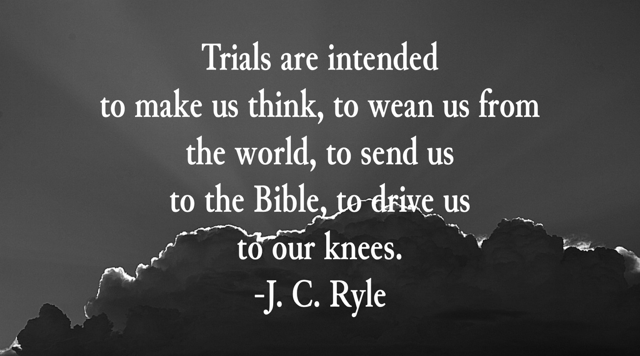
Reason for trials

Trials are intended to make us think, to wean us from the world, to send us to the Bible, to drive us to our knees.–J. C. Ryle

Laudable Linkage

Laudable Linkage

Some of the good reads found this week:

Can Satan Put Thoughts Into Our Heads? “‘Can Satan himself put thoughts into our heads?’ Yes, he can and he does. And of course, the urgent questions then are, How do we recognize them? And how do we resist them and not get controlled by them?”

10 Things to Pray for Children Who Have Walked Away from Jesus, HT to Challies. “God is never too busy or preoccupied to receive you when you bring your burdens into his presence. God cares for your children. That is such an encouragement when we are struggling to persevere in prayer. But it’s hard to know what to pray sometimes; or we’ve been praying for so many years that we’ve run out of steam and lost momentum. So, to reinvigorate your prayers for your children, here are ten ways you can pray.”

Making Space for Others In Our Conversations. “I walk into church and spot a new person. I know I should go over and engage her, but such actions often end in stilted exchanges or awkward pauses. Making conversational space for people I don’t know well takes much more effort than the comfort of finding my seat or chatting easily with friends. Do I take the path of least resistance and avoid eye contact? Maybe I offer an acknowledging smile, but continue to my familiar chair? Or do I practice Christ-like hospitality and in love, make my way over to her?” The author includes ideas for conversation starters besides the usual “How are you?” and “What do you do?”

To My Almost-Adult Kids: Don’t Be Afraid of These Three Words, HT to Challies. “I try not to tell you about all my worries. But one fear that I want you to know about? I worry you will be afraid to say these three words.”

How to Provoke Your Children to Anger. “Apparently if you want to be a good parent, the thing that Paul is most concerned about is that you not provoke your children to anger. The somewhat frustrating part of this, though, is that he doesn’t stop to explain what he means by this phrase or explain how it should be done! So what does it look like to provoke your children to anger?”

The Cost of Slowing Down. “Recently a friend asked me when we start ‘locking in’ activities for our daughters. ‘When does it become their thing?’ he wondered, meaning when do we encourage them to commit to a single sport and dig in deep.”

How Can We Bless the Lord? “God’s blessings abound, but we can’t return these favors because He needs nothing from us. Yet, Scripture contains the concept of blessing the Lord.”

10 Ways to Pray for Your Pastor. “I’m sure a million requests could be added, but here is a brief post to offer at least 10 ways that you can pray for your pastor, compiled by a pastor.”

Time Is NOT Money: Redeeming the Hours God Gives Us. “While many modern translations have chosen to steer away from the financial metaphor, Paul’s Greek word choice for ‘making the most’ of time is actually a money word, used like our English word ransom or redeem. Thus, we can legitimately make the case that time and money have correlations. But let’s hit pause right there and consider the many contrasts between the two.”

The Art of Thankfulness. I enjoyed seeing a piece of art here that was discussed in Russ Ramsey’s Rembrandt Is In the Wind: Henry Ossawa Tanner’s The Thankful Poor. This post ties in observations about the painting with Philippians 4: 6-8.

Hudson Taylor quote

God uses people who are weak and feeble enough to lean on Him.–Hudson Taylor

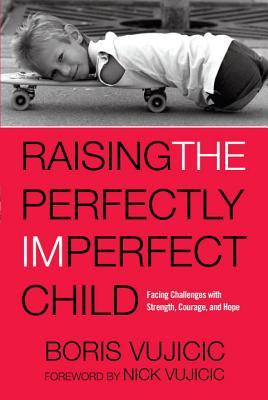
Review: Raising the Perfectly Imperfect Child

Boris Vujicic

Imagine what your reaction would be if you gave birth to a child born without arms or legs. You would likely grieve and then wonder how in the world you would raise him to live any kind of normal life.

Boris and Dushka Vujicic experienced those reactions when their son, Nick, was born. “We were burdened not by Nick but by our doubts and our fear that we were not capable of giving him all he needed to succeed (p. 163).

Nick grew up to become an internally known evangelist and motivational speaker, telling his story in Life Without Limits. But there were many hurdles and trials before that happened.

Boris shares their experience in Raising the Perfectly Imperfect Child: Facing Challenges with Strength, Courage, and Hope. The book is part memoir, part encouragement to other parents.

After the Vujicics got over their initial shock at Nick’s condition, they found that, in many ways, he was a baby like any other. He needed love, cuddling, food, and diaper changing. The rest they had to figure out along the way. There weren’t many resources available to help.

Their faith was shaken. As Christians, they wondered why God would allow such a seemingly cruel thing to happen.

With our limited vision, Dushka and I could foresee only struggle and anguish for Nick and for us. We were so wrong, of course. Our son and our experiences with him have enriched our lives beyond measure and taught us many lessons at the heart of this book. Nick gave us a new definition of the ideal child and a deeper appreciation for the complexity of our Father’s divine vision.

Nick taught us to find new meaning in the psalm that says we are “wonderfully made.” We came to see Nick as God’s beautiful creation, lovingly formed in His image. We lacked the wisdom, initially, to understand that. We saw Nick as disabled rather than enabled. We could not grasp that his missing arms and legs were part of God’s unique plan for our son.

Chapters cover accepting and loving your child, giving yourself permission to grieve, allowing friends and family to help, advocating for your child’s medical care, meeting the needs of siblings, education, preparing your child for adulthood, keeping marriage bonds strong, and building a spiritual foundation. Boris encourages taking cues from your unique child as to what he needs and the best way to help him.

It would be easy with a child like Nick to swoop in and do everything for him. But his parents raised him to do as much for himself as possible. 

My favorite aspect of his book is that Boris writes humbly and practically. Nowhere does he hint that readers should do everything just like he and his wife did. He just shares insights gleaned along the way.

Some of the quotes that stood out to me:

Nick is proof that none of us are limited by our circumstances and that all of us can create meaningful, fulfilling, and joyful lives if we choose to focus on our gifts rather than on what we may lack. All of us are imperfect. All of us are perfect (p. 10).

All children have strengths and weaknesses, and they can surprise you in so many ways. Our duty is to nurture, encourage, and motivate them, and help them build upon their strengths (p. 11).

Perhaps the greatest gifts we can give our children toward their success in adulthood are a foundation of unconditional love, a sense that they have a purpose in this world, a value system to guide them, and a spiritual base as a perpetual source of hope (p. 157).

Our imperfections have a purpose. We often can’t discover that purpose without first accepting that it exists and then searching to find it (p. 187).

God makes no promises that our lives will be pain free; He promises only that He will always be with us if we believe. We realized that we had to trust in His wisdom and good purposes, in His Word rather than in our feelings, and in His grace, which is sufficient for any trial (p. 191).

I might not be the target audience for this book since my children are grown now, and none of them had physical disabilities. But I enjoyed reading it and learned from it all the same. 

(I often link up with some of these bloggers.)

Laudable Linkage

Laudable Inkage

Some of the good reads found this week:

Awaken Your Hunger, HT to Challies. “Like tamping down my appetite as I’m tasting and assembling ingredients for dinner, I find myself quieting my hunger for God by tasting too many things that don’t satisfy. Sometimes it’s not the quality so much as the quantity: a half hour of mindless scrolling here, a couple of hours of Netflix bingeing there, the incessant input of a podcast or audiobook every time it gets quiet. I keep filling up my soul with so many things that leave me hungry but not for what I need.”

What Martha’s Problem Really Was. “Martha’s problem had nothing to do with her to-do list and everything to do with how she handled her thoughts. Luke didn’t include this account to caution women away from vacuuming, doing dishes, or cooking a nice meal for company. He included it as a warning against unguarded thoughts. Thankfully, he does include a solution.”

You Are “The Next.” “Who will be the next Nancy? The next Charlie? The next John, James, Voddie, or Kay? This may come as a surprise, but there is an answer. The answer is no one. And it’s also . . . you. Confused? Let me explain.”

When Dad Will Not Lead in the Home, HT to Challies. “One of the saddest verses of the Bible is Genesis 3:6 where God’s Word records, ‘[Eve] took of it and ate, and she also gave some to her husband who was with her, and he ate.’ In other words, Adam was standing with Eve when Satan tempted her. The one who should have defended his wife from the tempter, didn’t do anything. He was passive. And that’s what we’re talking about. Instead of spiritual leadership and initiative, we have passivity. How do we approach this problem?”

DO Something When You Are Maligned, HT to Challies. “When stressed through the ill-will or stinging insults and persistent opposition by someone who wants to cause you trouble, we know there is something to think. We are to think the truth about God and ourselves. We don’t take their evaluation as true, but only God’s. Also, we are to think of God’s loving and purposeful sovereignty over his children, meaning that difficulties can bring about good results in character and progress for the gospel. But there is also something to DO.”

The Worst Kind of Parenting Advice, HT to Challies. “I’m grateful to God that I learned early on to chew the meat and spit out the bones regarding much of the Christian parenting advice I was given, and instead to do what was right for our kids and our family. But when it comes to formulaic parenting advice, it sure is interesting that the more things change, the more they stay the same.”

Social Media Pushes Pornography on Children Within Minutes, Report Finds, HT to Challies. “Social media is now one of the primary pipelines to porn addiction for both children and young adults. Global Witness, a campaign organization that investigates the impact of Big Tech on human rights, recently conducted a number of tests to determine how quickly children could access pornography on social media platforms. According to the Guardian, Global Witness conducted one test before the implementation of the U.K.’s Online Safety Act in July, and one after. In just a few clicks, TikTok directed children’s accounts to pornography.”

Spurgeon re the Bible

“Visit many good books, but live in the Bible.”–Charles Spurgeon

Laudable Linkage

Laudable Linkage

I’m happy to share some thought-provoking reads found this week:

No Confidence? No Problem! “I used to think it was important to project confidence when it comes to parenting, and I wanted everyone to think that I had everything under control at all times. But the deeper I have gotten into this lifelong job, the more I have realized how complicated and special each little soul in my care is, and I have learned that there are very few one-size-fits-all philosophies of motherhood. Each child and each phase is its own adventure, with its own set of variables, and I have learned that I need God’s help with each and every bit of it.”

Is ChatGPT Forming Your Faith? “ChatGPT and similar tools have made it easier than ever to locate and interpret Bible verses, to receive guidance on challenging topics, and to get answers to questions we’d normally hesitate to ask out loud. Is that a bad thing? Are the alarms unwarranted? As I’ve talked to friends about their ChatGPT usage and paid more attention to my own, it’s clear that using the latest AI to find answers for our spiritual lives involves a degree of danger that would be foolish to ignore.”

The Devil Hates Context. Use It, HT to Knowable Word. “You can see why the devil left out Psalm 91’s context. Verse 13 preaches his demise. It reveals Christ’s victory over him. I’m sure the devil hates context. So, in our spiritual warfare, in wielding the sword of the Spirit, use the whole weapon—the whole canon—context and all.”

Is Tribalism Bad? HT to Proclaim and Defend. “Why can’t individuals assess the values and ideas held by themselves and others, then socially associate with respect to those shared values? An us-versus-them social landscape emerges for every possible topical issue in our free society because we occupy an idea-versus-idea environment. Rather than shriek about the human impulse to join a tribe, it’s more productive to explain which tribes are worthy of members — and doing so is necessarily a form of intertribal competition. Alternative strategies end up with the self-defeating claim: Join me in the fight against tribalism.”

What Does the Bible Say God Can’t Do? “In the back of my mind I thought I remembered hearing that there were only 2 (or was it 3?) things that God cannot do. I did a quick search online to refresh my memory. Well, I was surprised to find that everyone had a different opinion on how many things God can’t do!”

Ordinary Faithfulness: A Life That Says Come and See. “Life right now is normal. For some reason the thought of this being ‘all there is’ can feel almost startling. But when I take a step back to assess this dread, the Lord uses His Word to whisper a quiet question into my heart. What’s wrong with a life filled with ordinary faithfulness?

The Foibles and Fallibility of Christian Leaders, HT to Challies. “Encourage your leaders, pray for them, help them serve Christ as they serve you, overlook some things just as they overlook the faults you have, confront them with love when necessary if you are prayerful and spiritually-minded and aware of your own sins, follow them as they follow Christ, but don’t idolize them. Encouragement is different than that.”

John C. Broger quote

Learning how to love your neighbor requires a willingness to draw on the strength of Jesus Christ as you die to self and live for Him.–John C. Broger

Laudable Linkage

Laudable Linkage

I have several good reads to share today:

Hope In Hindsight: Navigating Unexpected Journeys, HT to the Story Warren. “Just as Stephen looked to the stories of Scripture to remind him of who God is and what he has done, we can do the same when we face uncertainty in our futures. When plans are interrupted, when hardship comes, and when we’re confronted with the reality of sin and death in a fallen world, we can look to the story of Scripture and the story of our life and see the goodness of God woven throughout.”

Maybe You Don’t Need a Therapist, HT to Challies. “I’ve found that for a growing number of people there is an assumption that to be a human is to need therapy. We’re all maladjusted, and the purpose of therapy is to adjust us so that we’re high-functioning members of society, living flourishing, mentally healthy lives. In this model, therapy is something like a weekly medicine we all need to mentally survive a hostile world.” But such an approach raises concerns, which the author discusses.

When Spiritual Disciplines Took Over My Life, HT to Challies. “Scrupulosity can be jaw-droppingly deceptive. Spiritual disciplines are essential for growth, and we want to encourage one another to practice them. But there’s a difference between healthy spiritual practice and someone who’s struggling with OCD. Since the outward behaviors may be the same, we need to look below the surface to identify scrupulosity.”

On Biblical Mandates and Cultural Expectations, Part 3. “Once we’ve invested the time and effort it takes to be informed about what the Scripture says, and what the law requires, and what the culture expects, we need to get down to the business of making decisions about how we respond to specific demands from those authorities.”

The Rise of Hyperpleasures, HT to Redeeming Productivity. “If humans experience pain and pleasure on a 1-10 scale, then hyperpleasures are those activities which take us ‘off the scale,’ so to speak. They give us experiences that make us feel like a 20, 30, 100, 1,000, and so on. The particular number is arbitrary, of course, but the principle remains — these are pleasures that go far beyond the ordinary range of enjoyment, principally by removing those discomforts we experience in our ordinary pleasures.”

It Takes Years to Grow, HT to Challies. “We think transformation will be quick, and sometimes it is. But generally speaking, God isn’t in a rush. There’s a certain kind of holiness and beauty that develops only after decades of walking with God. You can’t microwave it. But when you see it, it’s a beautiful thing.”

Mom and Dad: Show Your Need, HT to Challies. ““I have one regret of how I parented . . . I wish I would’ve shown my kids my need for Christ more. I worked so hard to show them my godliness that I didn’t show them my need. I should have been more transparent. I should have shown them just how much I needed Jesus.”

To Everything in Motherhood, There Is a Season. “It would have been impossible for me to explain my grief in that moment. I was missing something. Not people necessarily, but a time of life with those people. . . Yet, each new season brings new joys.”

People Who Were Bookworms As Children Often Display These Seven Unique Traits, HT to Linda. “Many of us were those so-called bookworms as kids, and it’s fascinating to see how this early love for reading has shaped us into the adults we are today. You see, spending all that time with our heads buried in books did more than just help us ace our English tests. It subtly carved out traits within us that are not only unique but pretty advantageous, too.”

Do Quests, Not Goals, HT to Redeeming Productivity. “The conventional term for this sort of personal campaign is a ‘short-term goal.’ But I suggested to OBW participants that they drop the G-word in favor of something more fanciful: the quest. If that sounds a bit whimsical, hear me out. Whereas ‘goal’ has become a tired and bloodless descriptor for the (supposed) intention to do something great, the word quest instills the right mentality for achieving a real-life personal victory.” I’ve never thought of a “goal” as tired and dull, but the quest mentality does have some good points.

This is a good time for my occasional reminder that linking to a site doesn’t mean 100% endorsement of everything on that site.

Any theology that minimizes God’s holiness and tolerates people’s deliberate sinfulness
is a false theology. — Warren W. Wiersbe,
from Be Decisive (Jeremiah): Taking a Stand for the Truth

Laudable Linkage

Here is some of the good reading that caught my eye this week:

You’re Gonna Lose Everything, HT to Challies. “Pursue life apart from Christ and you will lose your life. But if you lay it all down, you will find life indeed. And this is the turning point for us. As we call others to follow Christ at the expense of everything else, we are calling them not to poverty, but to unsearchable riches: Yes, you’re gonna lose it all, but you have everything to gain.”

The Actual Divisive Ones, HT to Challies. “The divisive ones are those who reject what God has revealed in Scripture and through the preaching of the apostles. Being able to properly label the divisive ones is important.”

What to Do With the Nice Things People Say, HT to Challies. “Because just as we have blindspots that keep us from recognizing our weaknesses, some of us have trouble seeing the good God has entrusted to us and the good he is doing in us. Thus, humility here might look less like deflecting encouragement and more like saying, ‘Perhaps what I am seeing when I look at myself is not the most accurate picture.’ Growth then might begin with learning to believe trustworthy people when they tell us things about ourselves that we wish were true, but we’re not sure are.”

Be Quick to Listen, Slow to “Therapy Speak,” HT to Linda. “But all of us, and Christians in particular, should be careful about overrelying on therapy speak to describe our relationships with others. This language has consequences—not only for understanding our own lives rightly but for living together as the body of Christ. How we speak shapes what we do, and therapy speak might be limiting our ability to love our neighbors well.”

3 Things to Consider Before You Pick Another Fight. “A quarrelsome spirit never stays slow and steady. Unchecked, it becomes a torrential downpour of misery, soaking a home in resentment, pettiness, and frigid silence.”

Parents, Are You Raising Angry Partisans? HT to Challies. “Christian parents are called to raise our children ‘in the discipline and instruction of the Lord’ (Ephesians 6:4). Our children, in other words, should be able to look to us to see what a life submitted to Christ looks like. We should live in a manner that makes the gospel more intelligible to our children. I wonder, however, if our angry partisanship models the way of the flesh more than the way of Christ.”

What Does “Train Up” Mean in Proverbs 22:6? “Probably the most quoted verse in Proverbs is 22:6. Over the years, the verse has held as a precious promise to parents that if they do everything right, their kids will turn out right. It has also been used as a guilty club to beat up parents who are feeling defeated over the choices of a rebellious child. Both responses are a misinterpretation and a misapplication of the text.”

King Crimson—my thoughts on that portrait, HT to Challies. A thoughtful analysis of King Charles’ portrait in red, by someone who has actually seen it in person.

How the Legal System Enabled—and Will Curtail—the Transgender Movement, HT to Challies. This is both scary and hopeful.

A. W. Tozer quote

There are rare Christians whose very presence incites others to be better Christians.
–A. W. Tozer

Laudable Linkage

Laudable Linkage

There was quite a bit of good reading posted this week:

The Power of Prayer, HT to Challies. “Sometimes, to protect a passage of scripture from the abuses it receives from those who twist it, we add so many qualifications that we eliminate not only the false teaching but also the profound truth it communicates. We find one such passage in the Sermon on the Mount where Jesus says, ‘Ask, and it will be given to you; seek, and you will find; knock, and it will be opened to you (Matt. 7:7).'”

The Missing Years, HT to Challies. “We were preparing for our daughter’s wedding when she called me one day in a slight panic, ‘Mom, I have no pictures of myself from 2009-2011! What happened?’ ‘What happened’ was, I was in the “desert years’- both literally and spiritually.” This is a lovely piece of writing as well as a comforting truth that God can redeem our “desert years.”

Too Much Times, HT to Challies. “Everyone experiences what I call Too Much Times,’ perfect storms where our most demanding challenges meet our most significant weaknesses and can lead to our lowest moments. Too Much Times are days, weeks, or whole years marked by too many demands, responsibilities, and burdens and not enough internal and external resources to keep all the balls in the air.”

On a Christian Approach to Education. “A materialistic worldview reduces education according to its usefulness in the here and now. But as Christians, we walk by faith and not by sight. We believe in the ‘deeper magic,’ the unseen things that are often more true than the seen things.”

Counseling Children Who Have Already Professed Faith in Christ. “I asked my children if they had any prayer requests. One of them responded, ‘Daddy, pray for me, that I would believe in Jesus and be a Christian.’ This wasn’t the first time that my son has mentioned this request. Like many children who’ve grown up in a Christian home, my son professed faith in Christ at an early age. But, like so many other young people who profess faith early, he struggles with doubts.”

Raising a Leader: 3 Leadership Qualities Your Kids Need. “Regardless of our personal style or our leadership resume, as mothers, we sit in the seat of influence with our kids. How we respond to their initiative, their creativity, and their all-pervasive energy in our home goes a long way in defining our children’s confidence.”

You Are an Influencer, HT to Challies. I appreciated this thoughtful, reasonable take on influencing, curating, and social media.

Don’t Complain; Be the Light. “Instead of moaning about the darkness, look to the light. The solution to a dark, crooked, perverse generation is not to complain and argue with them, but to keep being the light. To keep on being pure and blameless and harmless. To keep living in your identity as a child of God.”

Going to the Party. “Christians faced with terminal illness or imminent death often feel they’re leaving the party before it’s over. They have to go home early. They’re disappointed, thinking of all they’ll miss when they leave. But the truth is, the real party is underway at home—precisely where they’re going. They’re not the ones missing the party; those of us left behind are. (Fortunately, if we know Jesus, we’ll get there eventually.)”

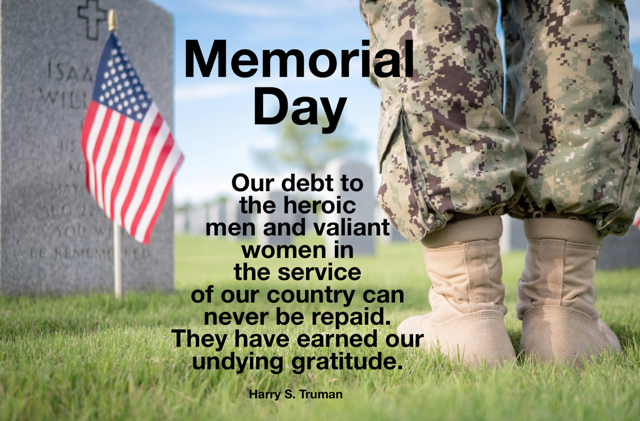
Monday, the US celebrates Memorial Day to honor those who have died in the service of their country. On Sunday evenings before Memorial Day, I enjoy watching the National Memorial Day Concert to be reminded of what this day means.

"Our debt to the heroic men and valiant women in the service of our country can never be repaid. They have earned our undying gratitude. – President Harry S. Truman

Our debt to the heroic men and valiant women in the service of our country
can never be repaid. They have earned our undying gratitude.
– President Harry S. Truman

We take this day to mourn for those
Who suffered fates of ills and woes,
For those who fought until the death,
Who gave this nation their last breath.
To these passed on—we now salute.
Their legend we will ne’er dispute,
And as they sleep let us bestow
The highest honor that we know.

Author Unknown

Laudable Linkage

Laudable Linkage

I have just a few good reads to share this week:

God is SO Good! “It is a vice—not a virtue—to add to Scripture’s rules our own ascetic prohibitions: “Do not handle, Do not taste, Do not touch,” and “Do not marry” (Colossians 2:21; 1 Timothy 4:3). Such rules may appear to be ‘super holy,’ but they are an offense to God, substituting legalism for the simplicity of the gospel. They deny the very pleasures God created us to enjoy.”

We Are Standing on Holy Ground. “It’s so sweet to walk into a church and know that God’s people are gathered for worship. Of course He is near. A holy moment. But isn’t it a holy moment, too, when you are sitting in a doctor’s office, holding hands with your faithful wife, enduring the bad news with faith? As believers we tread on holy ground in every school building, nursing home, leafy forest floor, and in every possible scenario we could dream up. Isn’t it just so thrilling to know that when we praise Him He is near, and when we walk through the valley of the shadow of death, there too, there especially, He is wrapping us up in His presence. Carrying us. Seeing us through. Never leaving, never forsaking.”

Who Can Understand Sin? Deep Mercy for our Dark Insanity, HT to Challies. “As Christians, we have all looked at ourselves and felt sorrow over sin. But have we ever deeply considered why we do it in the first place? Why do we sin?”

God Will Give Us More Than We Can Handle—But Not More Than He Can, , HT to Challies. “The sufferer may object, head shaking and hands up. But you insist, ‘Look, seriously, the Bible promises God won’t ever give you more in life than you can handle.’ There it is—conventional wisdom masquerading as biblical truth. You’ve promised what the Bible never does.”

Our Skewed View of Wealth, HT to Challies. “These case studies show how money is a litmus test of our true character and our spiritual life. If this is true of all people in all ages, doesn’t it have a special application to us who live in a time and nation of unparalleled affluence where the ‘poverty level’ exceeds the average standard of living of nearly every other society in human history, past or present?” This was especially poignant to me since I just read a novel discussing wealth, All My Secrets by Lynn Austin.

Bad Therapy, HT to Challies. “To become a lover of pleasure is to prioritise ‘feel good’ throughout life. We want to feel good, and we want others to feel good too. This is the ethic. We abandon a moral view of reality in which there is a good and right way, outside ourselves, to which we should train ourselves and our children to live up to. All that matters is feeling okay. This is therapy culture.” This has devastating effects on child discipline, as the author shows.

When You’re at Your Wit’s End. “When he was at his wits’ end, he was not at his faith’s end.”

The end result of all Bible study is worship--Warren Wiersbe

“The end result of all Bible study is worship,
and the end result of all worship is service to the God we love.”
–Warren Wiersbe,
With the Word

Laudable Linkage

Laudable Linkage

Here are some of the blog posts that spoke to me over the last few weeks:

Will Following my Heart Set Me Free? HT to Challies. “I think that summarises a story that our culture loves to tell: that success in the world means presenting your truest self, pushing off what society tells you to be, to be you. It’s almost like that’s the meaning of life. You are free to be yourself.”

Life Without Romans 8:28. “I have often heard it said that Romans 8:28 is the wrong verse to bring to the attention of those who are grieving, that while it is true in our especially difficult moments, it does not necessarily become helpful until some time has passed. And while I can only speak for myself, it has been my experience that in my lowest moments I have feasted on Romans 8:28, I have run to it like a starving man runs to a meal and I have drunk from it like a parched man drinks from an oasis. I have needed Romans 8:28 and it has both comforted my soul and directed my grief.”

The Irreplaceable Encouragement of Intergenerational Relationships, HT to the Story Warren. “I took a seat at my assigned table for my first Bible study at our new church and was surprised to see a number of gray and white heads dotted among the tables. I wondered, what would it be like to study alongside women who were 20, 30, or more years older than I? Up until this point, my close friendships consisted of almost exclusively people in or near my stage of life.”

3 Verses for Your Work. “If you are reading this right now, you have work to do. I’m not only talking about a paid job but any work you do—paid or unpaid, noticed or behind the scenes. I spend my days working on many things; most of my tasks do not result in a paycheck. Payment does not validate work; God does. Here are three truths and verses that have absolutely transformed my work.”

Can You Be Too Productive? “There seems to be a tension in the way people view productivity these days. On the one side, there is the push to do more, be more efficient, work harder. But in the last few years, another view has grown in popularity. On this side is the pull to slow down, do less, and get more rest.”

On Being an Ambassador: Walking the Tightrope of cultural differences. “As Christians, we get our instruction from the Scripture. We find there early examples of how Christians crossed cultural boundaries in taking the gospel to ends of their world. One instructive example is the preaching of the Apostle Paul. Since God called him to be the apostle to the Gentiles, we should expect that he would deal with widely diverse cultures—and he does.”

The Dress, HT to Challies. A touching meditation on a daughter’s upcoming marriage.

Consider Your Attitude Toward the Local Church, HT to Challies. “We can notice all the problems with our local church on some days and rejoice at God’s goodness to our local church on others. As many people consider the big issues in their lives during January, make sure you are thinking rightly about church this year.”

Why I’m a Better Pastor (for you) than . . . HT to Challies. “Not only do we have unfettered access to the Bible, but we have almost limitless access to some of the very best Bible teaching. What a gift we have. And yet, that begs a question: how is a normal pastor like myself supposed to compete? Why should you even bother with attending your local church?”

Sent to Need. HT to Challies. This is such a good perspective on missions. “I’m not saying that prayerfully planning, dreaming, and casting vision with expectation of what God can do is wrong. I am only asking if it strikes anyone else as odd that we get ‘sent to serve’ before being ‘sent to learn.’  I wish it was more like this: ‘Hi. I am sent to need.‘”

Afflictions sanctified prepare the soul for glory. Richard Sibbes