
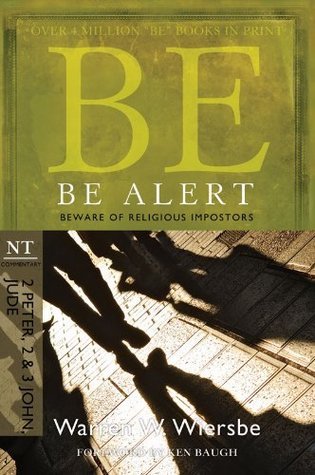
At first glance, it might seem like Warren Wiersbe collected leftover short epistles to review in Be Alert: (2 Peter, 2 & 3 John, Jude); Beware of Religious Imposters. However, as his subtitle indicates, these four books near of the end of the New Testament have a common theme.
Often we go to the Bible for comfort, affirmation, assurance that God loves us and will take care of us. Those motives aren’t wrong: we find all those things in the Bible.
But the Bible’s purpose isn’t just to make us feel warm and cozy. God is truth, and anything that isn’t in line with His Word is falsehood. Satan, as God’s enemy, works seemingly tirelessly to question and pervert what God said. Indeed, his first recorded temptation was to question Eve in the garden of Eden about what God said and then to twist it. Often Satan includes enough truth to hook unsuspecting individuals.
That’s one reason to know God’s truth well (the first being that we learn to know God by learning His truth). Paul warned that “Men will rise up even from your own number and distort the truth to lure the disciples into following them” (Acts 20:30). Peter shared that false teachers will “twist” the Scriptures (“wrest” in the KJV). “The Greek word translated ‘wrest’ means ‘to torture on the rack, to distort and pervert’” (p. 113).
2 Peter, 2 and 3 John, and Jude all share what false teachers do, what motivates them, and what judgement is coming to them.
We’re not to support false teachers in any way, not even allowing them into our homes (2 John 10-11), but we’re to help those who have been influenced by them. “And on some have compassion, making a distinction; but others save with fear, pulling them out of the fire, hating even the garment defiled by the flesh” (Jude 22-23).
While the call to beware of false teachers is meant to help us to be alert and careful, we don’t need to panic or live in fear. 2 Peter opens with the reminder that “His divine power has granted to us all things that pertain to life and godliness, through the knowledge of him who called us to his own glory and excellence, by which he has granted to us his precious and very great promises, so that through them you may become partakers of the divine nature, having escaped from the corruption that is in the world because of sinful desire” (2 Peter 1:3-4) and closes with “You therefore, beloved, knowing this beforehand, take care that you are not carried away with the error of lawless people and lose your own stability. But grow in the grace and knowledge of our Lord and Savior Jesus Christ. To him be the glory both now and to the day of eternity. Amen” (2 Peter 3:17-18).
Likewise, Jude ends his warnings with “But you, beloved, building yourselves up on your most holy faith, praying in the Holy Spirit, keep yourselves in the love of God, looking for the mercy of our Lord Jesus Christ unto eternal life” (verses 20-21). Wiersbe comments, “He did not write, ‘Keep yourselves saved!’ because he had already assured them that they were ‘preserved in Jesus Christ’ (Jude 1). He wrote, ‘Keep yourselves in the love of God.’ Our Lord made a similar statement recounted in John 15: 9: ‘Continue ye in my love’” (p. 191). After several paragraphs on Christian love, he concludes, “We grow in our love for God as we listen to His Word, obey it, and delight in doing what pleases Him. That is how we keep ourselves in God’s love” (p. 192).
Finally, Jude concludes with this wonderful benediction: “Now to Him who is able to keep you from stumbling, And to present you faultless Before the presence of His glory with exceeding joy, To ]God our Savior, Who alone is wise, Be glory and majesty, Dominion and power, Both now and forever. Amen” (verses 24-25).
Here are a few more thoughts Wiersbe shared:
In his first epistle, Peter emphasized the grace of God (1 Peter 5: 12), but in this second letter, his emphasis is on the knowledge of God. The word know or knowledge is used at least thirteen times in this short epistle. The word does not mean a mere intellectual understanding of some truth, though that is included. It means a living participation in the truth in the sense that our Lord used it in John 17: 3: “This is life eternal, that they might know thee the only true God, and Jesus Christ, whom thou hast sent” (italics Wiersbe’s) (p. 19, Kindle version).
God has not only given us all that we need for life and godliness, but He has also given us His Word to enable us to develop this life and godliness. These promises are great because they come from a great God and they lead to a great life. They are precious because their value is beyond calculation. If we lost the Word of God, there would be no way to replace it. Peter must have liked the word precious, for he wrote about the “precious faith” (2 Peter 1: 1; cf. 1 Peter 1: 7), the “precious promises” (2 Peter 1: 4), the “precious blood” (1 Peter 1: 19), the precious stone (1 Peter 2: 4, 6), and the precious Savior (1 Peter 2: 7) (p. 22).
God gives His children all that they need to live godly lives, but His children must apply themselves and be diligent to use the “means of grace” He has provided. Spiritual growth is not automatic. It requires cooperation with God and the application of spiritual diligence and discipline. “Work out your own salvation.… For it is God which worketh in you” (Phil. 2: 12–13) (pp. 22-23).
It is a frightening fact that many people who are now zealous members of cults were at one time attending churches that at least professed to believe the Christian gospel (p. 79).
And with that, I have finished all 50 of Warren Wiersbe’s “Be” commentaries!






 Stray Thoughts