Bruised Reeds Are We All

One of my children has a friend who, after graduating from a Christian college and working in Christian camps, went home, got involved with a guy who landed in prison, and ended up pregnant and unmarried. Her church was very supportive of her and helped her through her pregnancy and single motherhood. But within a couple of years, the same thing happened again, with the same guy. This time the church was kind to her children, but held themselves aloof from her. Their attitude seemed to be “To make one mistake is forgivable, but to repeat it — she must not have been very sincere in her repentance.”

Yet who among us hasn’t sinned at least twice in more than one category?

And while I’m tempted to quick judgment of these church people, I am convicted by by own tendency to hold grudges. I was thoroughly startled one day to realize that a grudge is just continual unforgiveness.

Jesus takes forgiveness seriously. He died to obtain it for us. The prayer He taught contains the line, “And forgive us our debts, as we forgive our debtors.” (Matthew 6:9-13). As we forgive our debtors. He goes on to say, “For if ye forgive men their trespasses, your heavenly Father will also forgive you: But if ye forgive not men their trespasses, neither will your Father forgive your trespasses” (verses 14-15). That’s a scary thought.

I used to have trouble with forgiveness when I felt the other person didn’t “deserve” it. But what finally changed my heart was the parable Jesus told in Matthew 18:21-35. Jesus had just talked about lost sheep and the process of church discipline. Then Peter asked, “Lord, how often will my brother sin against me, and I forgive him? As many as seven times?” He probably thought that was pretty generous. Jesus said it’s more like but seventy times seven. Then He told a story about a man who owed a massive debt that he could not pay to a king. When the king made plans to sell the man, his family, and all he had, the man fell to his knees and begged the king for patience, promising he would pay everything he owed. The king took pity on him and forgave the debt completely.

But when the forgiven man left, he ran into someone who owed him a much smaller amount and demanded repayment. This debtor made the same plea the forgiven man had made the king. But instead of responding in kind, the forgiven man refused to forgive and sent his debtor to prison.

Word got back to the king about this man’s behavior. The king summoned him, rebuked him, and threw him in prison til his debt should be paid. Jesus concluded, “So also my heavenly Father will do to every one of you, if you do not forgive your brother from your heart.”

I realized that I had been forgiven an immense debt when Jesus saved me. No one could sin against me to the extent I sinned against Him. So how could I hold a smaller transgression against anyone else when I had been forgiven so much? As C. S. Lewis said, “To be a Christian means to forgive the inexcusable because God has forgiven the inexcusable in you.” Yet I still have to remind myself of this often.

The beginning of Matthew 18 (as well as many other places in Scripture) shows that Jesus does not take sin lightly. It’s serious business, and forgiveness doesn’t mean just blowing it off like it doesn’t matter. We acknowledge that there has been a debt, an infraction, which caused pain. But, by God’s grace, we forgive it. We may not feel very forgiving, but forgiveness is not a feeling: it is a decision.

Forgiveness also doesn’t necessarily mean there aren’t consequences. In the same passage, Jesus described how people should go about handling an unrepentant sin against them to the point of church discipline. In cases where abuse or other crimes have been committed, the perpetrator still needs to be arrested. There’s a difference between enabling and helping, and it’s not always easy to know the difference when someone is addicted to something. We can’t be naive, and we need to pray for wisdom. Forgiveness also may not mean that now you’re best buds with the other person. Some relationships are toxic. There may be any number of good reasons why the relationship should not be restored. However, that doesn’t mean that treat everyone that way for every infraction.

There are times to separate from someone who persists in wrong doctrine or wrongdoing, but that’s only if they professing Christians who are unrepentant and if everything else has been tried to bring them around. Even that extreme measure is done with the hope that they might return, like the man in 1 Corinthians 5 who repented by 2 Corinthians 2. First Paul had to admonish the Corinthians to deal with the sin in 1 Corinthians. But when the man did repent Paul had to encourage the Corinthians to “forgive and comfort him, or he may be overwhelmed by excessive sorrow. So I beg you to reaffirm your love for him” (2 Corinthians 2:7-8).

Sometimes someone with a besetting sin needs counsel rather than aloofness. In a book I recently read, a man kept falling into the same sin, even after he was saved. There was a difference afterward, in that now he loathed his sin, whereas before he didn’t care. But he still felt like he just had to try to “do better.” What he really needed was to learn how to depend on the Lord and not his own strength.

In another book I read this year, a fictional story based on a real one, the female protagonist also had trouble with with sexual relationships. Though she made steady progress in her faith, she had trouble overcoming in this one area. I wondered how many people would dislike the book or would have distanced themselves from her in real life instead of helping her. She reminded me very much of the woman at the well, who had five different husbands and a current live-in boyfriend. She came to draw water from the well alone, not at the time when all the other women in the village came. Was it because she felt ashamed? Or had she suffered their condescending looks and comments before and wanted to avoid them? Either way, Jesus made a special point to be there when she was and to tell her about the water of life available through the Messiah — Himself. A multitude believed through the testimony of one “fallen woman.”

We tend to look down on certain types of sin more than others. But what did Jesus say the greatest commandments are? To love God with all our heart, soul, and mind and to love our neighbor as ourselves. Doesn’t it follow that if these are the greatest commandments, disobeying them is the greatest sin? And don’t we fall short of them every day of our lives? How then can we look down on any other sinner?

I’ve wondered, in this social media era, about the widespread tendency towards Internet outrage at people. Careers, reputations, and even lives have been ruined because someone started a tangent on Twitter without knowing half what they were talking about, and it spread like wildfire. Or someone did do wrong, but instead of extending grace and hoping they learn from their mistake, we right them off forever. How is this treating others as we would want to be treated?

There is a beautiful passage in Isaiah foretelling the coming Savior. Isaiah had just foretold in Chapter 41 about Cyrus, a conqueror who “tramples kings underfoot; he makes them like dust with his sword, like driven stubble with his bow” and “shall trample on rulers as on mortar, as the potter treads clay (verses 2, 25). By contrast, the Savior:

Behold my servant, whom I uphold,
    my chosen, in whom my soul delights;
I have put my Spirit upon him;
    he will bring forth justice to the nations.
He will not cry aloud or lift up his voice,
    or make it heard in the street;
a bruised reed he will not break,
    and a faintly burning wick he will not quench;
    he will faithfully bring forth justice. (Isaiah 42:1-3, ESV)

This passage is quoted again of Jesus in Matthew 12:15-21, ending with the line, “and in his name the Gentiles will hope.” He’s like the man in the parable he told who stood up for a fruitless fig tree and gave it another chance, working with it to help it bear fruit.

Henry F. Lyte draws on several passages of Scripture to form this stanza in his 1834 hymn, “Praise, My Soul, the King of Heaven“:

Fatherlike He tends and spares us;
Well our feeble frame He knows.
In His hands He gently bears us,
Rescues us from all our foes.
Alleluia! Alleluia!
Widely as His mercy flows!

Instead of an atmosphere of haughtiness or superiority, let’s show the same welcome,  mercy, gentleness, and grace we have received.

(Sharing with Inspire Me Monday, Tell His Story, Let’s Have Coffee,
Worth Beyond Rubies, Share a Link Wednesdays, Faith on Fire, Grace and Truth)


 

Laudable Linkage

IMG_0195

Here are some good reads I’ve discovered recently:

The Oh So Human Dad’s Club. A look at some biblical fathers commemorated in the “Hall of Faith” despite serious flaws – encouragement that God can use any of us who are “only human.”

Six Reasons We Love Faithful Fathers, HT to True Woman.

A Guide to Same Page Summer. This introduces a summer Bible reading plan, but it has some great principles for Bible reading in general.

Distinguishing Marks of a Quarrelsome Person, HT to Challies. “Of course, there are honest disagreements and agree-to-disagree propositions, but that’s not what the Bible means by quarreling. Quarrels, at least in Proverbs, are unnecessary arguments, the kind that honorable men stay away from (Prov. 17:14; 20:3). And elders too (1 Tim. 3). These fights aren’t the product of a loving rebuke or a principled conviction. These quarrels arise because people are quarrelsome.”

Why We Go to Church on Vacation.

When Old They’ll Still Bear Fruit, HT to Challies.

Losing a Foster Child. Some people don’t want to foster because of how painful it would be to let a child go after caring for it. But some children need just that kind of love and care during an unsettling time in their lives. This has some good help for the pain of giving back a foster child.

The True Woman blog, an arm of the Revive Our Hearts ministry, is holding a summer book club reading through Elisabeth Elliot’s just-published book, Suffering Is Never For Nothing. This book comes from a series of messages Elisabeth shared at a conference and is different from her earlier book, A Path Through Suffering (though I would guess they probably overlap). The book club starts this Tuesday, June 18, and continues for 6 weeks.

Someone set up a “bird photo booth” and caught some great close-up photos of birds.

Happy Saturday!

Friday’s Fave Five

It’s Friday, time to look back over the blessings of the week
with Susanne and other friends at Living to Tell the Story .

This has been another relatively quiet week. I usually try to keep a running list of what I might mention in the weekly Friday’s Fave Five: this week I had nothing. Not that it was a bad week at all: most of the week was just pretty uneventful after Sunday. But, as always, once I think about it I can find a few things to be thankful for.

1. Church potluck. A good time of food and fellowship. And everything I made turned out ok with no major or minor disasters. 🙂

2. Hot dogs are not something we eat often. But every now and then they hit the spot, especially in the summertime. My son and daughter-in-law had found some gluten-free hot dog buns they wanted to try out, so they offered to bring the fixings over to our house one night. Not having to cook or clean up was an added bonus!

3. Books are always a favorite. But summer seems to provide more time for them. My husband and I don’t watch all that much TV, but most of what we watch isn’t on in the summer. That allows for some pleasant evening reading. I often say that I will probably never finish my to-be-read list before I die, but that just means I’ll always have something to look forward to!

4. Sleep. For some reason, I had several nights of disrupted sleep, waking up every couple of hours. But the last few nights have been blissfully normal. That makes such a difference in my day.

5. Meal delivery. Often if my husband is out of town for more than a day, Jesse and I will get something out to eat. That stemmed from when the kids were little. By the time Jim got home from a business trip, I was ready to eat out. But he had been eating out all week, so he longed for a home-cooked meal. So we started getting one dinner out while he was away, both as a break for me and so I could get that craving out of my system. 🙂 This time we wanted something more restauranty than fast food, and discovered a local place delivered. It was very good!

Happy Friday!

Book Review: Wuthering Heights

For years I avoided reading Wuthering Heights by Emily Bronte. I had seen a couple of film adaptations and did not like them. But every year when I chose books for the Back to the Classics Challenge, Wuthering Heights came up as a possibility. This year, I took into account that books are usually better and fuller than their movie adaptations, and there must be some reason so many people love this story. So I put the book in my queue.

The story begins with a Mr. Lockwood taking possession of a house rental. He goes to see his landlord at a neighboring house, Mr. Heathcliff of Wuthering Heights. Being a solitary man himself, Mr. Lockwood rejoices to find out that Mr. Heathcliff seems to be of the same disposition. But on this and a subsequent visit, he discovers Mr. Heathcliff and his whole household are not just loners: they’re strange and surly, even cruel.

Wanting to find out more about the household, Lockwood asks his housekeeper, Nellie Dean, for more information. She tells him that she was housekeeper for the Earnshaw family who used to live at the Heights. They had two children, Hindley and Catherine. On a business trip, Mr. Earnshaw found an abandoned child and brought him home. The rest of the family thought the child a gypsy and did not like him. Earnshaw took Heathcliff’s part against Hindley, which incited Hindley’s further mistreatment of Heathcliff. Finally Hindley was sent away to college and Heathcliff and Catherine became close.

When Earnshaw died three years later, Hindley came back, married now, and assumed the role of master of the house. He treated Heathcliff as a common laborer.

One night Heathcliff and Catherine headed over the the neighbor’s house at Thrushcross Grange, where they peeped in the windows and made fun of the two Linton children.Then the family’s dogs came after them, biting Cathy. The family rescued and took Catherine in, sending Heathcliff back home. Cathy spent five weeks recuperating at the Grange. When she returned home, she was no longer a wild young, at least outwardly. She had seen another side of life which tamed and refined her, and she and Edgar Linton had feelings for each other. Eventually Cathy and Edgar married, and Heathcliff left.

Hindley and his wife had a son, Hareton. Hindley’s wife died and Hindley checked out of life, drowning in drink and gambling. Nellie took care of Hareton.

After three years Heathcliff returns with wealth from an untold source. He wants to renew his relationship with Cathy, who advises Edgar to allow it against his better judgment. Edgar’s sister, Isabella, falls in love with Heathcliff, despite Cathy’s warnings against him. Heathcliff only encourages Isabella’s interest out of revenge. A series of arguments result in Catherine becoming gravely ill and Heathcliff and Isabella eloping. Catherine has a daughter, Cathy, and dies.

Heathcliff returns and sets himself up at Wuthering Heights, lending money to Hindley only to ensnare him in debt. When Hindley dies, Heathcliff owns the Heights.

The rest of the book details Heathcliff’s manipulation and revenge carried out in the lives of Cathy’s daughter and his son.

My thoughts:

Wuthering Heights has had mixed reviews since it was first published. Respect for it has risen over the years: it even ranked as the number one love story in a poll several years ago. But others were shocked at it: one recent reviewer referred to it as a hot mess. Not a lot is known about its author, Emily Bronte, except that she was a very private person and she loved the moors, where the book is set. She died at the age of 30, a year after the book’s publication.

The introduction to the audiobook I listened to said one reason the book shocked people was because it had no moral. But I don’t think it needed to have a stated moral to convey the cruelty and futility of revenge. At first the reader feels sorry for Heathcliff’s being mistreated by everyone on the planet (including even Nellie and Catherine at first), and that treatment certainly contributed to his character. But his revenge exceeds normal bounds, wanting to ruin, control, and even annihilate the people and property connected with those who wronged him (near the end, when he has both houses, he speaks of arranging his will and wishes he could destroy both properties rather than let anyone have them).

Plus, I don’t think what Heathcliff and Catherine had was love. An unhealthy obsession, maybe. They both seemed motivated by selfishness than concern for each other’s good.

Also, there’s almost no “good” character. Joseph, the one religious character, curses and complains. Nellie shades the truth and outright lies. Even Lockwood takes a hand that has reached through his window and presses it against the cut glass. The daughter Catherine is better than most, but still motivated by self-will more often than not. But at least she does seek the good of her father and her cousin at times.

Still, there’s a strange fascination with the book — maybe it’s partly motivated by wondering how all these odd people and situations will end up. I had not known until a recent reading of one of Frances Hodgson Burnett’s books that “wuthering” meant a strong, even fierce wind. There is something strangely drawing about the wildness of the setting and story.

And Emily was a skilled writer. I loved how the characters revealed themselves by their conversation. Even in the opening paragraphs, Lockwood tells much about himself in his little asides and observations. Emily mastered “showing, not telling” even then.

I listened to the audiobook nicely read by Joanne Froggatt (Anna in Downton Abbey) and read over some passages in the online version. I chose this for the “Classic Tragic Novel” category of the Back to the Classics Challenge.

(Sharing with Carole’s Books You Loved and Booknificent)

The Little Women Treasury

The Little Women Treasury by Carolyn Strom Collins and Christina Wyss Eriksson is aptly named: it’s a treasure trove for Little Women fans.

The authors give an abbreviated history of author Louisa May Alcott’s life and share pictures of her and her family. Another chapter gives a brief description of each of the four March sisters, an illustrated family tree, and a brief overview of their lives as traced through the books about them: Little Women, Little Men, and Jo’s Boys.

Other chapters include details about Orchard House, the Alcott family home (they only lived there for nineteen years, but that’s where Louisa wrote Little Women); details of the March family life; a time line of world history dovetailed with incidents in the Little Women books and sequels; recipes, some from the book and some common to the era (I was glad to learn what blancmange was); activities from the books that readers can try (how to make a “work basket,” “mark” handkerchiefs like Beth, make a mailbox, etc.); fashions of the era; and gardening and floral crafts from the era, with a mention of each of the March girls’ garden plots.

The illustrations and embellishments are lovely and in keeping with the era. I thoroughly enjoyed this treasury.

LMA-button

Tarissa at In the Bookcase hosts the Louisa May Alcott Reading Challenge every June to encourage reading or listening to books by or about Louisa or about her family. I’m thankful she let me know about this book!

(Sharing with Carole’s Books You Loved and Booknificent)

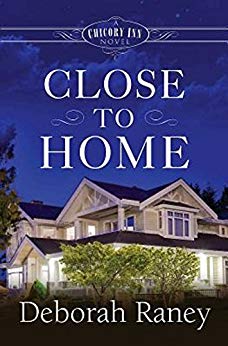
Book Review: Close to Home

 Close to Home is the fourth in Deborah Raney’s Chicory Inn series, where empty nesters Grant and Audrey Whitman have transformed their big, rambling home into a bed and breakfast. Each book focuses on one of their five children. This book, however, tells the story of daughter-in-law Bree. Bree had been married to their youngest son, Tim, who had died a solider in Afghanistan. Bree had issues with her own parents and drew close to the Whitmans. They, in turn, considered Bree as one of their own.

It’s been five years since Tim’s death. Bree’s coworker, Aaron, has shown an interest in her, but she’s just not sure she’s ready to date again. Yet she decides to go out with him just as friends. She enjoys him and the relationship, yet something isn’t right. Is it that Aaron isn’t the right one, or that Bree doesn’t want to lose her relationship with the Whitmans?

Another plotline in this book is that feisty Grandma Ceecee has been having some issues that make Grant and Audrey wonder how much longer she can live alone. Ceecee has already said she would not go to a nursing home. Yet it’s seeming less safe than ever for her to be on her own. And with the inn, they don’t think they can manage caring for her at their home.

As soon as one character from a previous book showed up, I had a feeling which way the plot would go. But I enjoyed the journey nonetheless. I have not been in Bree’s situation, but I could sympathize with her dilemma. And, as many of you know, we have dealt with a parent needing care, so I could empathize with the characters in that situation as well. As always, I enjoyed the time with the Whitmans. Though they have their squabbles and irritations, they they love each other, support each other, and pull together.

Previous books in this series (linked to my reviews):

(Sharing with Carole’s Books You Loved and Booknificent)

Studying the Parts to Understand the Whole

A few years ago I read an annotated version of The Screwtape Letters by C. S. Lewis. Sometimes I struggled with disrupting the flow of the story to read the notes. But the notes added so much to understanding the story, they were worth it in the long run.

I read recently an article where someone brought up this difference between reading for pleasure versus reading an annotated version of a story, stopping to read every footnote. This writer brought out the disruption of this type of reading. She pointed out that we don’t read regular books that way (unless we’re in school reading an assigned text), so we shouldn’t read the Bible that way.

There are times we should just read a particular passage as it is for pleasure, with no cross references or footnotes. But there are other times we should study it out in depth. It isn’t either Bible reading or Bible study. We need both.

Some people read and study in tandem. They’ll read one passage devotionally and study another, possibly to prepare for a group Bible study. Others will take turns: they’ll read one book of the Bible all the way through, then do a Bible study project on another book or topic, then read another book of the Bible through.

When I first started using a study Bible, I wasn’t sure I liked reading a verse or two and then stopping to read the footnotes sidebars, and charts. It did seem more halting and fragmented than just reading the passage. But the extra material did aid in understanding the passage.

Instead of reading a verse and it’s footnote one by one, sometimes I read a paragraph at a time, then look over the footnotes. Or, if there is a lot of footnote information for each verse, I’ll read each footnote after its verse, and then go back over the last few lines of text just to put it all together.

Then, beyond just the notes in a study Bible, there are commentaries, Bible study guides, and a whole slew of other Bible study materials with which to dig into a passage even further..

Let’s see if I can illustrate the benefit of study in another way. I was not exposed to classical music much as I was growing up. I remember one Girl Scout trip to a symphony, a couple of performances of Handel’s Messiah in school or church, our pastor playing excerpts of Mendelssohn’s Elijah oratorio in a high school assembly. I remember thinking the pieces were nice and enjoying a few of the songs more than others (especially “He, Watching Over Israel,” based on Psalm 121:4, from Elijah). But I didn’t get much more than that from the pieces.

Then I went to a Christian liberal arts university which wanted to teach us more than academics, so we were exposed to various kinds of classical music concerts, Shakespearean plays, etc. During my junior year, I asked a sophomore music major roommate to help me pick out some classical vinyl albums marked down to $3 at the bookstore that she thought I might enjoy. I grew a bit more in my appreciation of classical music.

But it wasn’t until my senior year in college, when I had a class called Music Appreciation, that I really began to understand and then love classical music. We went era by era, learning what kind of music was produced by which composers in each period. We learned something of the lives of major composers. We listened to and took apart some famous works. We learned to identify the different themes in each piece, note their development, and trace how they interacted with each other. We’d have tests where the professor would play a few seconds of a piece of music, and we’d have to identify it as the first theme of the second movement of Dvorak’s New World Symphony (a melody which was later given words by one of his students and turned into the lovely song “Goin’ Home“). Some of the works we studied then are my favorite pieces today – New World, Hayden’s Surprise Symphony (and the fun story behind it), Smetana’s The Moldau, Tchaikovsky’s Romeo and Juliet Overture and others. Listening to them again is like rereading a favorite book, enjoying and anticipating the flow. I came to understand and enjoy the whole much more by studying the parts. In fact, I haven’t added any new classical music loves because I haven’t studied any pieces to the extent I did then.

It’s the same way with the Bible. As we study the individual parts of a biblical book, we learn what the details mean, how they fit within the book itself, how the book fits within the whole Bible. We trace the themes and see how they intertwine. We’ll know and get more from those passages in ways we don’t know those we’ve only given a cursory reading. And each time we read that book, we build on what we know and appreciate what we remember from previous studies. Study might seem tedious in the midst of it, but it’s worth it when you put it all together. C. S. Lewis contrasted the difference between meditating on a single verse devotionally vs. working through a longer passage: “Hammer your way through a continued argument, just as you would in a profane writer, and the heart will sometimes sing unbidden (from The Collected Letters of C. S. Lewis).

Some days, even some seasons of life, like when young children are in the house, our Bible reading may be more like grabbing a quick protein bar instead of sitting down to a meal. There are many good reasons to read the Bible, and sometimes we’re greatly blessed from just reading a passage. While working on this post, I read Julia Bettencort’s great post about reading the Bible for pleasure. Some days our thoughts are already scattered, and focusing on and absorbing a single passage is more helpful than adding notes or references. But we also benefit from studying more in depth at times. Our study informs and enhances our general reading. It’s good to make time for both.

(Sharing with Inspire Me Monday, Literary Musing Monday, Tell His Story,
Let’s Have Coffee, Share a Link Wednesday, Grace and Truth, Worth Beyond Rubies)

Friday’s Fave Five

It’s Friday, time to look back over the blessings of the week
with Susanne and other friends at Living to Tell the Story .

This has been a fairly quiet week, with Jesse and I sick the first part of it. But I think we’re mostly better now. And here we are a full week into June already. It’s time to stop and consider the best parts of the week.

1. Sick days aren’t fun in themselves, but it’s nice to have an excuse to just lay around and read or putter on the computer. That may have contributed to the three book reviews I wrote this week. 🙂

2. My hydrangeas are going to town.

3. Scrabble tile magnets. I rediscovered these a few weeks ago when I cleaned out my pantry, but forgot to mention them. They were a gift from a while back that had gotten lost. I plan to change out the message from time to time.

4. Face Time. I know I have mentioned this before. But we enjoyed an extended FaceTime “visit” with my out-of-state oldest son. Then since we were sick last weekend, we’ve gone almost two weeks with seeing Jason, Mittu, and Timothy – a strain for this Grandma! But a FaceTime call helped span the gap.

5. Beautiful music. I looked up a couple of favorite classical pieces for reference in next Monday’s post (which isn’t actually about classical music itself – it’s about Bible study. :)) But I couldn’t just find the links and go – I had to listen to a couple all the way through. It’s been a long time since I listened to anything classical, and I was reminded how much I love some of it. I’m so glad for God’s gift of beautiful music in a variety of genres.

Happy Friday!

Book Review: The Returning

In the novel The Returning by Ann Tatlock, Andrea has loved her husband John since they were teenagers. She knew he did not love her and only married her because he had to after she became pregnant. But she hoped that his heart might change someday.

Now John has just been released from prison, where he spent the last five years after accidentally killing a man while driving drunk. Andrea is not sure how everything will work after the adjustments of the last few years.

Their youngest daughter, Phoebe, was just a baby when John left, so she doesn’t remember her father and is afraid of him. Teenage daughter Rebekah is angry and rebellious. Only their oldest son with Down Syndrome, Billy, seems genuinely happy to have John home.

John knows he has a lot to overcome. His brother-in-law gave him a low-paying job, but he needs to find something better. He needs to rebuild his relationships with his family. And he needs to tell them what happened to him in prison when he committed his life to Christ. His biggest need, though, he doesn’t even realize yet: he needs to get grounded in his faith and grow. When he succumbs to temptation again and again, he begins to wonder if Rebekah is right in her accusation that his faith was just “jailhouse religion.”

A friend went through this scenario with a husband returning home after several years in prison, though the details were different. Even with all parties wanting to heal and put the family back together again, they faced difficulties. I thought Ann showed this struggle tenderly and realistically within the framework of the Sheldon family’s circumstances.

Ann says in her acknowledgements page that Billy’s character was inspired by Down Syndrome actor Chis Burke. Chris and his mother read Ann’s manuscript and offered feedback. She also talked with local parents and others who work with people with Down Syndrome.

My only difficulty with this story is that Rebekah is into some pagan-ish, New Age-y practices along with her best friend. I don’t have a problem with this being in the story, as people do turn to these things (and, spoiler alert, Rebekah finds they give her no peace or answers). But I’ve found I am sensitive to this kind of thing, so when Rebekah was performing her rituals, I had to skim through those pages.

But overall, I enjoyed the story very much. I ached along with each character in their difficulties and rejoiced with them in their victories.

(Sharing with Booknificent Thursday, Carole’s Books You Loved)


Book Review: Promises to Keep

In Ann Tatlock’s novel, Promises to Keep, eleven-year-old Roz Anthony has just moved with her mother, older half-brother, and younger sister to a small town in Illinois in the 1960s. Roz’s mother, Janis, was compelled to leave her abusive husband, and her father helped set her family up in a new home.

After just a few days, though, they found a stranger sitting on their porch, reading their newspaper. She was a rather large older woman named Tillie Monroe, and she said this was her house. She had helped build it with her own two hands along with her husband, and no matter what the paperwork said, it was her house. All she wanted was to die in her home, but she had fallen and broken her hip, and her kids whisked her away to a nursing home. But now she’s better, and she wants to live in her own home

About that time, Tillie’s son drives up, apologizes profusely, and takes his mother back to the nursing home.

But a few days later, Tillie is back on her . . . er, their porch. Janis invites her in for coffee. Another time Janis comes home to find Tillie cooking dinner for them.

This happens so often that Janis is relatively sure that Tillie is safe and invites her to stay. The relationship is mutually beneficial as Tillie watches the children and helps out around the house while Janis works.

While Roz adjusts well to all the changes and even provides a humorous narration, she misses her father. She tries to focus on the good memories, but the bad ones creep in. She feels if her father could just stay the good dad and leave off the Dr. Jekyll bad side, they could all be together again.

Meanwhile, Roz faces a new school with trepidation. But she finds a friend in a black girl named Mara. She soon learns that Mara has her own daddy issues, secrets, and dreams. They girls decide together to pray for their secret dreams.

Though the family was healing and readjusting after all they had been through, the first part of the book seemed lighthearted and fun as the family interacted with Tillie and as Roz observed and processed her world. One sub-plot line could have worked out for good or bad, and Ann reeled out the tension and information skillfully. The dramatic climax was a surprise to me — I was expecting something, but not what happened.

I’ve enjoyed all of Ann’s books that I’ve read so far, but this will be a favorite. Roz and Tillie are a couple of my favorite characters.

(Sharing with Booknificent Thursday, Carole’s Books You Loved)