End-of-April Reflections

what happened in AprilWell, April has been quite the month, hasn’t it? I’m sure it’s been different for all of us than any other time in our lifetimes.

We were sad to have to cancel our oldest son’s visit here and our usual get-togethers. But we were thankful to see videos of our grandson’s Easter egg hunting and Easter basket unpacking, and then we did a three-way FaceTime with all the family for his birthday. We’ve had a few socially distanced visits with everyone but our oldest, so we’re not as deprived as some. It’s all still not the same as normal, but it could be worse.

Like many of you, I’m caught between knowing we need to reopen businesses and fearing another wave of outbreaks when we do. Our state just released a three-phase plan starting tomorrow. I hope it goes well. My husband and I will probably keep doing what we’re doing and hang back for a bit since we’re in at-risk groups.

So many people have talked about having extra time. I don’t know where mine has gone, but it doesn’t feel like I’ve had any extra on my hands! I have listened to some free writing-related webinars, but other than that and making face masks for the family, I haven’t gotten much extra done.

One of the nicest things about April has been seeing nature come back to life with the lawns greening and flowers and trees blooming.

Family

This birthday for my grandson was supposed to involve a big camp-out. That didn’t happen, but my husband set up his tent in the back yard for a few days. My son and grandson came over and got to explore it. It’s big enough that they were more than six feet from each other inside. We sat in lawn chairs while Timothy “mowed” the grass for us with his toy lawn mower. 🙂

Timothyisms

He learned a knock-knock joke this month:

T- Knock knock
Who’s there?
T- Europe
Europe, who?
T- I’m not a poo!

🙂 He tried to voice-text it to me, but I didn’t get it til his mom wrote it out in a text.

Creating

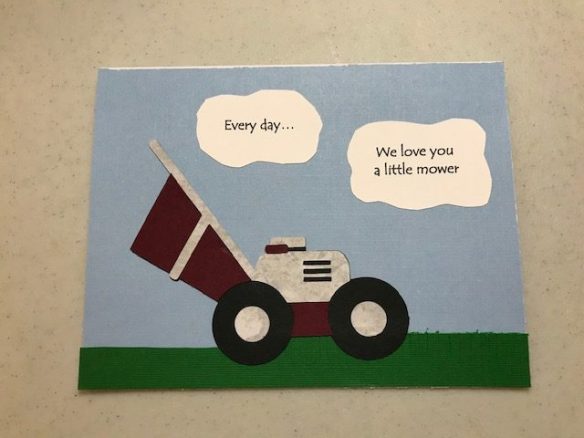
The only card I made this month was for Timothy’s birthday. I started to incorporate camping since that was the theme for the rest of his birthday. But I had seen variations on this mowing idea on Pinterest and wanted to use it. One of Timothy’s favorite things is when Granddad comes over to mow, and Timothy has turned so many items into imaginary push and riding lawn mowers. So when I saw this idea, I knew I would do it for him some time.
Watching

My husband and I watched an interesting PBS production called The Windemere Children, about Jewish children and young people who were rescued from Nazi prison camps after WWII and taken to an estate in England. Most were orphans, though they had to wait a bit to learn their family members’ fates. Some had only known life in the camps and a “survive any way you can” mentality. The first time baskets of bread were served, they grabbed handfuls and hid them in their rooms. The director said, “Let them. Let them see that here is plenty.” They were taught the English languages and customs and just given time to acclimate before either being adopted or starting to work. That was such a wise thing to do. The program was moving, as was this article about one of the men who was a teen then. The article also contains a photo of the actors with the men they portrayed.

And though it wasn’t planned, we happened to watch a different movie with a variation on the same theme titled Resistance. It’s the story of famous mime Marcel Marceau and his work with the French Resistance, especially in getting Jewish children out of France during the war. It was very good. Unfortunately, there was one brief bedroom scene. For those who like to fast-forward through such, as we do, it comes right after a girl steps out of a shower (she’s not the problem; she’s covered). (Updated to add: the scene is not explicit, no nudity is shown. But I still wish it had not been there. And, of course, this being wartime film, there are a few violent scenes.)

I was trying to find season six and seven of When Calls the Heart to watch while using my exercise bike, but it only seems to be available to rent. So I’ll have to wait on that. Then I saw there was a spinoff called When Hope Calls that was free, but when I looked it up on Amazon Prime, it said it could only be viewed with a Hallmark subscription. I hate when Amazon lists things that you can only get by subscribing elsewhere.

Do you have any recommendations of good clean movies or series on Netflix or Amazon Prime?

Reading

This month I’ve completed (links go back to my reviews):

I’ve collected most of Wiersbe’s “Be” commentaries as they have gone on sale for a dollar or two for the Kindle. But I kept forgetting about them. Finally I remembered to pull them out in conjunction with our church’s Bible reading plan.

I’m currently reading:

  • Over to Candleford by Flora Thompson, the second in the Lark Rise trilogy (audiobook)
  • Castle on the Rise by Kristy Cambron
  • Dying to Read by Lorena McCourtney
  • Breaking Anxiety’s Grip: How to Reclaim the Peace God Promises by Dr. Michelle Bengston

Blogging

Besides the Friday’s Fave Fives, book reviews, and occasional Saturday Laudable Linkages, my Monday posts have been applicable not just to the current pandemic, but to living with trials in general:

I also shared some of my favorite songs about Jesus’ death for us and songs to celebrate the resurrection.

Writing

Not much this month except for a devotional and guest post I’m going to send to sites that accept such. I’ve been listening to podcasts and webinars about writing, as I mentioned. Now I just need to get to it.

With April, it seems we’ve turned a corner into full-fledged spring. I love the weather in April and May before the heat of summer starts. I know this May will be a let-down for many with graduations and the usual end-of-school activities canceled. Perhaps our Mother’s Day will have to be as subdued as our Easter was. But we can count our blessings that we’re alive and well. This year will be one we’ll remember just because it was different.

How was your April?

(Sharing with Grace and Truth, Faith on Fire, Inspire Me Monday, Global Blogging,
Senior Salon, Hearth and Soul, Purposeful Faith, Tell His Story,
InstaEncouragement, Worth Beyond Rubies, Let’s Have Coffee)

Book Review: Be Resolute

Warren Wiersbe’s “Be Series” commentary on Daniel is Be Resolute: Determining to Go God’s Direction.

It’s easy to see why the author chose that title. If you’re not familiar with the book of Daniel except for the lion’s den, Daniel and his three friends (Shadrach, Meshach, and Abednego) were teenagers when Babylon conquered Israel. Most of the population was exiled to Babylon in three waves. Daniel and other young men were selected for a training period to be assimilated in the Babylonian government. But Daniel and his friends stood firm in their faith while still being gracious and kind to their captors.

God had multiple reasons for Israel’s captivity, the main one being their longstanding stubborn rebellion and disobedience to God. But one of the good things He brought out of it was the testimony of these four young men (and hopefully others as well) of the one true God.

The first few chapters contain some of the most familiar stories in the Bible: Daniel and his friends kindly asking for a diet in keeping with their convictions, and ending up in better health; Daniel’s interpreting Nebuchadnezzar’s dreams when no one else could; the three others in the fiery furnace, Nebuchadnezzar’s humbling transformation, the “handwriting on the wall” at Belshazzar’s feast, and Daniel in the lion’s den. In every case, the men gave glory to God and trusted Him for the outcome. The three who faced the furnace for not bowing to the king’s idol said something that rings down through the ages: “Our God whom we serve is able to deliver us from the burning fiery furnace, and he will deliver us out of your hand, O king. But if not, be it known to you, O king, that we will not serve your gods or worship the golden image that you have set up.” (3:17-18). God doesn’t always answer prayer as we’d like. Loved ones aren’t always cured. Crises aren’t always averted. But God is faithful and has His reasons for what He allows. And God used he testimony of these four young men not only in their own timeline, but in all the years since.

I say young men—though the book opens with them as teens, Daniel is in his 80s by the time he was thrown in the lion’s den. He spent his whole adult life in captivity. But he never complained.

Prayer is another big theme in the book, as Daniel seeks God throughout. His prayer of confession for the nation in chapter 9 is a model for us. In Daniel 10, He is told about spiritual warfare going on behind the scenes. Wiersbe says:

The prophet Daniel realized the great significance of God’s plans for Israel, and once again he fainted and was unable to speak. Here he had been involved in a cosmic spiritual conflict and didn’t even know it, and the Lord was using some of His highest angels to answer his prayers! This certainly lifts prayer out of the level of a humdrum religious exercise and shows it to be one of our strongest and most important spiritual weapons. The neglect of prayer is the reason why many churches and individual believers are so weak and defeated. The late Peter Deyneka, missionary to the Slavic peoples, often reminded us, “Much prayer, much power; no prayer, no power!” Jesus taught His disciples that the demonic forces could not be defeated except by prayer and fasting, the very activities that Daniel had been involved in for three weeks (Matt. 17: 14–21).

The last few chapters of Daniel are markedly different. Instead of interpreting dreams and vision for other people, Daniel receives a few himself that throw him for a loop. The angel Gabriel is sent to help him understand.

Honestly, without the ESV Study Bible notes and this book of Wiersbe’s I would have been pretty lost in these sections. I have read Daniel several times over the years, but I don’t remember what I did when I came to this part. Complicating matters is the fact that there are several schools on interpretation about some of it.

The part that covers the history of the next four dynasties is so accurate that people have attacked Daniel, saying it had to have been written after the fact. As Wiersbe says, “Prophecy is history written beforehand.”

The ESV Study Bible’s notes go into great detail about the various prophecies and schools of interpretation. Most of it refers to the history immediately after Daniel’s time, but there are differences of opinion as to what might be figurative and what might refer to end times. I appreciated this reminder:

There are many difficulties in deciding between these interpretations, which all involve questions of the proper approach to interpreting biblical prophecy. In all of this it is crucial not to miss Daniel’s message for his audience, namely, that God has allotted the amount of time for these events, and therefore his people should trust and endure (p. 1607).

I don’t think these different views are anything to fight or disfellowship over. But they can make for some interesting conversations.

The book ends with Daniel himself not understanding everything he’s been told: “I heard, but I did not understand. Then I said, ‘O my lord, what shall be the outcome of these things?’ He said, ‘Go your way, Daniel, for the words are shut up and sealed until the time of the end.'” Why tell him these things, then? Many reasons. For future readers and students of the Word of God through the ages. But for all of us, what the Bible tells us about future events reminds us He is in control (a major theme in Daniel). Also, as Wiersbe says, “Knowing God’s future plan and obeying God’s present will should go together. ‘And everyone who has this hope in Him purifies himself, just as He is pure.’ (1 John 3: 3 NKJV).”

A few other quotes from Wiersbe:

A heart that loves the Lord, trusts the Lord, and therefore obeys the Lord has no difficulty making the right choices and trusting God to take care of the consequences. It has well been said that faith is not believing in spite of evidence—that’s superstition—but obeying in spite of consequences.

Faith means obeying God regardless of the feelings within us, the circumstances around us, or the consequences before us.

Daniel was respectful to the king but he was not afraid to tell him the truth. Even if we don’t respect the officer and the way he or she lives, we must respect the office, for “the powers that be are ordained of God” (Rom. 13: 1).

All of these people and events may not be interesting to you, but the prophecies Daniel recorded tally with the record of history, thus proving that God’s Word can be trusted.

May the Lord help us to leave something behind in the journey of life so that those who come after us will be encouraged and helped!

Wiersbe ends his commentary with an extra chapter of summary of the themes in the book and Daniel’s character. He hasn’t done this in any of the other “Be” series that I’ve read. But it was helpful here, after our brains were stretched and heads were spinning over the last few chapters of prophecy, to go back over the book as a whole.

Once again I appreciated Wiersbe’s thoughts and insights.

(Sharing with Welcome Heart, Carole’s Books You Loved, Booknificent Thursday)

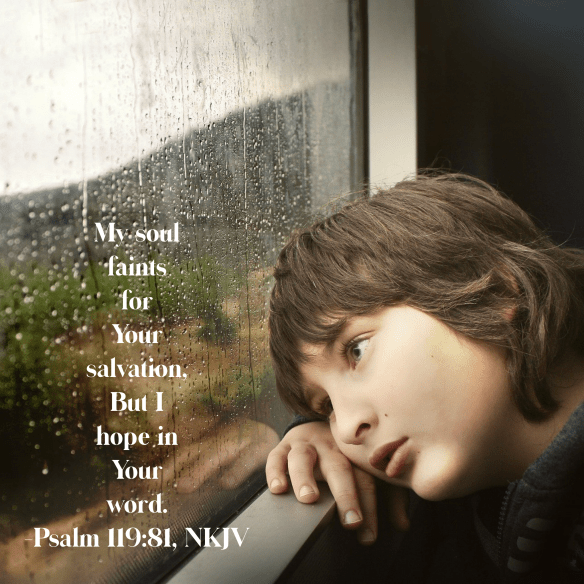
Help for the Fainthearted

Help for the fainthearted, encouragement to endureThere are at least 25 fillers for the saying “____________ is not for the faint of heart.”

Add pandemics and quarantine to the list.

By this time, most of us are tired of it all. The concerns about whether we or our loved ones will get COVID-19, others in public not taking precautions, what the best next steps should be, finding supplies, canceled plans, not being able to go places or see loved ones or friends in person—it all takes a toll.

In Warren Weirsbe’s commentary on Galatians, Be Free, I was especially taken with a section about not “fainting” based on Galatians 6:9. That led me to do a mini word study on “faint” and “fainting.” What I found encouraged me, so I thought I’d share it with you.*

Here are some things that might might help that weary, exhausted, tired out—faint— feeling.

Nourishment. We feel faint physically when we don’t get enough food or the right kinds of food. We’re faint spiritually when we don’t feed our souls. We need spiritual nourishment to stand strong.

Hungry and thirsty, their soul fainted within them. Then they cried to the Lord in their trouble, and he delivered them from their distress…he satisfies the longing soul, and the hungry soul he fills with good things. Psalm 107:5-6, 9

Man shall not live by bread alone, but by every word that comes from the mouth of God. Matthew 4:4

I have treasured the words of his mouth more than my portion of food. Job 23:12

Companionship. We often face trouble better with support. But it’s hard when we’re alone or even when we just feel alone. Though God often graciously gives human companionship, there are times in life when we find His presence is all we need.

When my spirit faints within me, you know my way! In the path where I walk they have hidden a trap for me. Look to the right and see: there is none who takes notice of me; no refuge remains to me; no one cares for my soul. I cry to you, O Lord; I say, “You are my refuge, my portion in the land of the living.” Psalm 142:3-5

Remembering God’s past dealings. Many of David’s psalms were written when someone was after him. There’s nothing like an active enemy to make you feel drained and weary. We can feel the same way with this virus. When it first began, I felt like I was taking my life in my hands every time I went out.

For the enemy has pursued my soul; he has crushed my life to the ground; he has made me sit in darkness like those long dead. Therefore my spirit faints within me; my heart within me is appalled. Psalm 143:3-4

David’s response:

I remember the days of old; I meditate on all that you have done; I ponder the work of your hands. I stretch out my hands to you; my soul thirsts for you like a parched land.

Answer me quickly, O Lord! My spirit fails! Hide not your face from me, lest I be like those who go down to the pit. Let me hear in the morning of your steadfast love, for in you I trust. Make me know the way I should go, for to you I lift up my soul.Deliver me from my enemies, O Lord! I have fled to you for refuge. Psalm 143:5-9

Confession and repentance. Any number of illnesses can make us feel weak and faint. In Isaiah, God likened his sinful, rebellious people to someone with a fatal illness.

They have forsaken the Lord, they have despised the Holy One of Israel, they are utterly estranged. Why will you still be struck down? Why will you continue to rebel? The whole head is sick, and the whole heart faint. From the sole of the foot even to the head, there is no soundness in it, but bruises and sores and raw wounds; they are not pressed out or bound up or softened with oil. Isaiah 1:4a-6

The remedy:

Wash yourselves; make yourselves clean; remove the evil of your deeds from before my eyes; cease to do evil, learn to do good; seek justice, correct oppression; bring justice to the fatherless, plead the widow’s cause.

Come now, let us reason together, says the Lord: though your sins are like scarlet, they shall be as white as snow; though they are red like crimson, they shall become like wool. If you are willing and obedient, you shall eat the good of the land; but if you refuse and rebel,  you shall be eaten by the sword; for the mouth of the Lord has spoken. Isaiah 1:16-20

Right motives*

People in Malachi’s time tried to cut corners on God’s requirements (Malachi 1:6-14) and called it all a weariness (v. 13). The church in Ephesus was commended by God for their work, their doctrinal stand, their endurance (Revelation 2:1-7). But, God said:

But I have this against you, that you have abandoned the love you had at first. Remember therefore from where you have fallen; repent, and do the works you did at first. Revelation 2:4-5

All through the Bible we’re called to love God with our heart soul, mind, and strength, to love Him above all else. When that love seems to wane, we should “go back to our first love”: remind ourselves “God shows his love for us in that while we were still sinners, Christ died for us” (Romans 5:8). He has shown His love for us by saving us, drawing us to Himself, providing for us, answering prayer. He declares His love for us over and over.

The Lord appeared to him from far away. I have loved you with an everlasting love;    therefore I have continued my faithfulness to you. Jeremiah 31:3

But God, being rich in mercy, because of the great love with which he loved us, even when we were dead in our trespasses, made us alive together with Christ—by grace you have been saved—and raised us up with him and seated us with him in the heavenly places in Christ Jesus. Ephesians 2:4-6

Let His love for us rekindle our love for Him.

The Thessalonians had the right combination with their “work of faith and labor of love and steadfastness of hope in our Lord Jesus Christ” (1 Thessalonians 1:3).

Persistent, humble prayer

And he spake a parable unto them to this end, that men ought always to pray, and not to faint. Luke 18:1 (ESV says “lose heart”).

Then Jesus told a parable about a widow who kept coming to an unjust judge to plead her case until the judge finally helped her. God is just and gracious: how much more will He answers His children’s prayers?

Then Jesus told a parable about a Pharisee who prayed boastfully, trusting in his good works, and a tax collector who had none:

 But the tax collector, standing far off, would not even lift up his eyes to heaven, but beat his breast, saying, ‘God, be merciful to me, a sinner!’ I tell you, this man went down to his house justified, rather than the other. For everyone who exalts himself will be humbled, but the one who humbles himself will be exalted. Luke 18:9-14

Centuries earlier, Jonah said in repentance:

When my life was fainting away, I remembered the Lord, and my prayer came to you, into your holy temple. Jonah 2:7

Hope

We get discouraged when we look at circumstances. But we can look ahead in hope:

I had fainted, unless I had believed to see the goodness of the Lord in the land of the living. Wait on the Lord: be of good courage, and he shall strengthen thine heart: wait, I say, on the Lord. Psalm 27:14-15, KJV

And let us not be weary in well doing: for in due season we shall reap, if we faint not. Galatians 6:9

Inward renewal

Paul says:

For which cause we faint not; but though our outward man perish, yet the inward man is renewed day by day. For our light affliction, which is but for a moment, worketh for us a far more exceeding and eternal weight of glory 2 Corinthians 4:16-17, KJV

How is our inward self renewed?

Looking to Jesus

Therefore, since we are surrounded by so great a cloud of witnesses, let us also lay aside every weight, and sin which clings so closely, and let us run with endurance the race that is set before us, looking to Jesus, the founder and perfecter of our faith, who for the joy that was set before him endured the cross, despising the shame, and is seated at the right hand of the throne of God. Consider him who endured from sinners such hostility against himself, so that you may not grow weary or fainthearted. Hebrews 12:1-3

The more we behold His glory, the more we’re changed to be like Him:

And we all, with unveiled face, beholding the glory of the Lord, are being transformed into the same image from one degree of glory to another. For this comes from the Lord who is the Spirit. 2 Corinthians 3:18

Waiting upon the Lord

Have you not known? Have you not heard? The Lord is the everlasting God, the Creator of the ends of the earth. He does not faint or grow weary; his understanding is unsearchable. He gives power to the faint, and to him who has no might he increases strength. Even youths shall faint and be weary, and young men shall fall exhausted; but they who wait for the Lord shall renew their strength; they shall mount up with wings like eagles; they shall run and not be weary; they shall walk and not faint. Isaiah 40:28-31

May these truths renew your spirit today.

_____

*The definition for one Greek word translated “faint” is “To weaken, relax, exhaust; to have one’s strength relaxed, to be enfeebled through exhaustion, to grow weak, grow weary, be tired out; to despond, become faint hearted.” Other Greek and Hebrew words I looked up that the KJV or ESV translate as “faint” say similar things. Sometimes those words are translated “weary,” “longing,” or “give up.”

*Thanks to Wiersbe for the thought about weariness that stems from lack of love (p. 147 in the Kindle version of Be Free.

* Verses not labeled are from the ESV.

(Sharing with Inspire Me Monday, Global Blogging, Senior Salon, Hearth and Home,
Purposeful Faith, Tell His Story, InstaEncouragement, Anchored Abode,
Recharge Wednesday, Worth Beyond Rubies, Share a Link Wednesday,
Welcome Heart, Heart Encouragement, Grace and Truth, Faith on Fire,
Blogger Voices Network)

Friday’s Fave Five

It’s Friday, time to look back over the blessings of the week
with Susanne at Living to Tell the Story and other friends.

This has been an odd week. It hasn’t been bad at all. We’re just plugging away at everyday life. But as I thought about the Friday’s Fave Five, my mind went blank. Usually I try to keep a running list through the week of what I want to share. This week, by Thursday, I only had one.

But … God is always good, and there are always things to be thankful for. Sometimes they are obvious; sometimes you have to spend more thought.

So here’s what I am thankful for this week:

1. Sibling provision. My brother and one sister are out of work due to the virus—my brother has been for several weeks now. Unemployment processing in his state was backed up. I just heard this week that his unemployment checks finally started coming through. My sister’s store cut hours at first and then closed a couple of weeks ago. Her employer is still paying her for now.

2. Free courses. Serious Writer is offering some free writing classes through the end of April. I just signed up for one and hope to start it soon.

3. Grilled pork loin. My husband prepared this in the sou vide cooker our son made for him and then browned them on the grill.

4. Sunshine. I know I say this off and on. I know rain is necessary. But it sure brightens my spirit to have clear blue skies and sunshine. The temperatures have been crossing back and forth between cool and warm. I always enjoy this stretch of nice weather before the heat of summer kicks in.

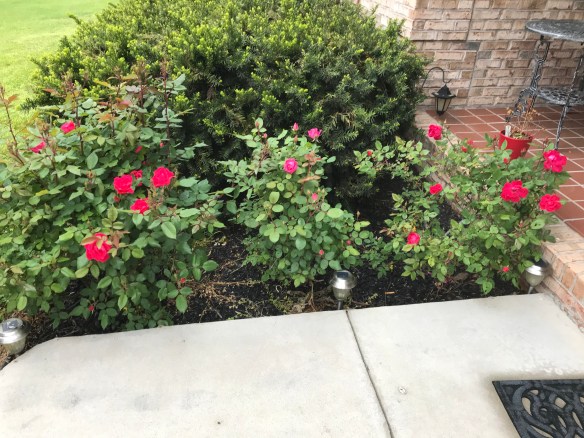
5. My roses are exploding.

This one is about to bloom even more.

We’re continuing to find everything we need except Clorox wipes. Thankfully I had plenty on hand already, and we haven’t run out yet. We’re trying new things like boil-in-bag rice when our regular jasmine rice wasn’t available. I made way too much the first time, but now I know about how much to expect out of each bag.

What’s a blessing from your week?

Book Review: My Antonia

My Antonia by Willa CatherThough I had heard of Willa Cather, I had never read her books and had no plans to. Then Hope’s great review of Cather’s My Antonia piqued my interest.

When ten-year-old Jim Burden’s parents died, he was sent to live with his grandparents in Nebraska. Arriving on the same train was a Czech (called Bohemian then) family, the Shimerdas, who became Jim’s grandparents’ neighbors.

The Shimerdas had one crooked relative in the area who sold them his cave of a home and some equipment for much more than they were worth.  Since they could not speak English, couldn’t ask for advice, and didn’t know any better, they paid his prices. But that meant almost all the money they brought with them was gone. The family had a hard time getting started, not only because of language barriers, poverty, and getting acclimated to new ways, but also for lack of what Jim’s grandmother called horse-sense.

The oldest daughter of the family was a bright, eager girl a few years older than Jim named Antonia (pronounced with accents on the first and third syllables—An’-ton-EE-ah). She learned English more quickly than the rest, and she and Jim became childhood friends traipsing over the countryside together. Jim taught two of the Shimerda girls English, and Antonia spent time helping Jim’s grandmother in the kitchen.

After a few years, Jim’s grandparents got too old to maintain the farm and moved into town. Antonia and many of the other immigrant girls worked in town and sent money home.

The story is told from Jim’s point of view, and he describes their adventures and relates many stories of townsfolk. We also see Antonia’s growth and development through his eyes. Though he had something of a crush on her for a while, he becomes more of a longtime family friend. Later he goes to college and law school and returns home less frequently, but he does see Antonia at intervals. She’s had a very hard life on many fronts, but maintained a strong spirit. He says of her near the end, “I know so many women who have kept all the things that she had lost, but whose inner glow has faded. Whatever else was gone, Antonia had not lost the fire of life.”

The book is partly about growing up on the prairie in the late 19th century. Cather herself moved to Nebraska from Virginia as a child, as Jim Burden did. Partly the book is about the immigrant experience of that time. But ultimately I think the story is about the resilience of people like Antonia.

Unfortunately, some people’s ideas of immigrants hasn’t changed much over time:

I thought the attitude of the town people toward these girls very stupid. If I told my schoolmates that Lena Lingard’s grandfather was a clergyman, and much respected in Norway, they looked at me blankly. What did it matter? All foreigners were ignorant people who couldn’t speak English. There was not a man in Black Hawk who had the intelligence or cultivation, much less the personal distinction, of Antonia’s father. Yet people saw no difference between her and the three Marys; they were all Bohemians, all ‘hired girls.’

I liked Jim’s (Cather’s?) summation:

Those girls had grown up in the first bitter-hard times, and had got little schooling themselves. But the younger brothers and sisters, for whom they made such sacrifices and who have had ‘advantages,’ never seem to me, when I meet them now, half as interesting or as well educated. The older girls, who helped to break up the wild sod, learned so much from life, from poverty, from their mothers and grandmothers; they had all, like Antonia, been early awakened and made observant by coming at a tender age from an old country to a new.

I can remember a score of these country girls who were in service in Black Hawk during the few years I lived there, and I can remember something unusual and engaging about each of them. Physically they were almost a race apart, and out-of-door work had given them a vigour which, when they got over their first shyness on coming to town, developed into a positive carriage and freedom of movement, and made them conspicuous among Black Hawk women.

The girls who once worked in Black Hawk kitchens are to-day managing big farms and fine families of their own; their children are better off than the children of the town women they used to serve.

I always knew I should live long enough to see my country girls come into their own, and I have. To-day the best that a harassed Black Hawk merchant can hope for is to sell provisions and farm machinery and automobiles to the rich farms where that first crop of stalwart Bohemian and Scandinavian girls are now the mistresses.

I love how Cather phrases some things:

Misfortune seemed to settle like an evil bird on the roof of the log house, and to flap its wings there, warning human beings away.

We burrowed down in the straw and curled up close together, watching the angry red die out of the west and the stars begin to shine in the clear, windy sky.

Grandfather’s prayers were often very interesting. He had the gift of simple and moving expression. Because he talked so little, his words had a peculiar force; they were not worn dull from constant use. His prayers reflected what he was thinking about at the time, and it was chiefly through them that we got to know his feelings and his views about things.

The week following Christmas brought in a thaw, and by New Year’s Day all the world about us was a broth of grey slush, and the guttered slope between the windmill and the barn was running black water.

In the winter bleakness a hunger for colour came over people, like the Laplander’s craving for fats and sugar.

The sun was going down in a limpid, gold-washed sky.

This book is the third in Cather’s Prairie trilogy, O Pioneers! and The Song of the Lark being the first two.

I enjoyed listening to the audiobook nicely narrated by Grover Gardner. I looked up some quotes in the online Gutenberg version and noticed some differences in the introduction there from my version. Wikipedia explains differences between the first and later editions. There are a number of Kindle editions at various prices.

I thoroughly enjoyed My Antonia. Some sources say this is Cather’s best, so her other work may fall short of this one. But I’d still like to explore some of her other books.

I’m counting this book as my 20th Century Classic for the Back to the Classics Reading Challenge.

Have you read My Antonia or Cather’s other books? What did you think?

(Sharing with Carole’s Books You Loved, Booknificent Thursday)

Stray Thoughts from Isolation

coping with pandemicNormally, I have a more focused, devotional or Bible study type of post on Mondays. Today I just want to share some “stray thoughts” about coping during this pandemic.

When we were first told to stay home to avoid spreading the coronavirus, many people felt that at least they’d have time to get things done around the house—home repairs, decorating, writing, or whatever.

How often I have wished for a cleared schedule in order to get more done. But, somehow, I wasn’t getting much done besides the bare everyday tasks.

Over the weeks I’ve seen people mention a strange lethargy, malaise, ennui, brain fog. Many of us are having trouble getting our minds in gear for long or for anything deep.

I think this state of mind is probably due to several things. Most of us have never lived through anything like this current pandemic. When I first heard of it, I had to battle panic regularly, especially since my husband and I are in at-risk groups. I was concerned about the virus itself, finding supplies, the economy in general, my husband’s and children’s jobs, and so much more. God ministered to me through His Word, and I remembered I needed to feed my soul truth. God is the same, and He has promised to be with us and meet our needs. I listen to uplifting music filled with truth. I remind myself, too, that if I worry and fret, I’m wasting that energy if nothing happens and doubling my misery if it does.

Then there was just a general unease due to normal routines being disrupted, sorrow over disappointments and canceled plans. All of those concerns above still pop up, but now there’s a weary wondering how long this will last.

At first it helped to remind myself that all of this isn’t as bad as it could be, except for those who have the virus, have loved ones with it, or have lost weeks of work and pay. For too many, this virus and its effects have been devastating. My heart goes out to those who have been battling the virus firsthand.

But for many of us, I told myself, this is not as bad as the Spanish flu epidemic, the black plague, the Depression, the Jews packed like sardines in small spaces hiding during WWII. We have safe places to stay and plenty of means to keep busy and entertain ourselves. It does help to focus on the positives even as we acknowledge the negatives and to shift perspective, as in safe at home rather than stuck at home.

But just because a problem isn’t as big as others doesn’t mean it’s not still a problem.

I’ve had a broken little toe before. Sure, it wasn’t as bad as a crushed ankle or amputation. But it still hurt severely and needed time and care to recover from.

So, whatever amount of strain or unease we’re going through, it still takes a toll. I think some part of our brains are still taken up with the pandemic and all its concerns even when we’re not actively thinking about them.

It’s okay to lament, to say it hurts. Ecclesiastes 3 talks about “a time to weep, and a time to laugh; a time to mourn, and a time to dance.” The psalms are full of people pouring out their hearts to God during trouble, then reminding themselves of God’s love and character. Most of them come to a place of peace even though the circumstances have not yet changed.

In our childbirth class for our first pregnancy, the instructor had a couple from a previous class who had their baby come back and tell of their experience. The new mother said said if she began to think during labor, “What if I have to do this for many more hours? Or days,” she would feel defeated and tired. But if she focused on just one contraction at a time, she had the energy and strength to get through it. That has stuck with me ever since. If we focus on just riding out one wave at a time, getting through just this day or this moment, eventually we’ll be done.

I still feel better if I accomplish something useful rather than fall into YouTube rabbit holes (though I’ve done a bit of that). I relax in the evenings, but I try to get needed things done during the work day. So sometimes I’ve pushed through that moving-through-molasses feeling even when I don’t feel like it, even if I don’t get as much done as usual. I’ve thought of a few “mindless” tasks I’d love to get to, like cleaning out some files, pulling out clothes I want to give away, etc. I’m thankful for all sorts of offerings online, from free courses to museum tours to operas, to various artists giving free mini-concerts or presentations online. I haven’t had as much time to engage in that kind of thing as I would like. But I’m glad they are available, and I hope to get to more of them.

And I think, for many of us, we have to remember our emotions may be up and down. The general anxiety is less for me than it was at first. I had acknowledged and processed the sadness of canceling my oldest son’s flight here and celebrating Easter and my grandson’s birthday virtually instead of in person. We’d had a good, if subdued, Easter day. But for some reason, that night I got suddenly weepy. I didn’t tell my husband, because I didn’t want to have to explain it when I couldn’t. I guess that undercurrent of emotion just needed a release. And that’s ok. The next day, I was fine. My little grandson had a similar experience. His family has made it a point to play outside a lot since they can’t go to his usual favorite places, and they’ve had many happy days. Then he had a couple of emotional ones. I think overall he’s doing okay.

It also helps not to compare. I have a friend who works full time from home yet gets all kinds of house projects done. I can admire her energy and zest without shaming myself for not doing the same.

So, for me, I’m trying to maintain balance. Keeping up with current news, but not so much that it keeps me stirred up. Acknowledging that my emotions are a little tender, but not giving way to panic. Giving myself grace if I am not accomplishing a much as I’d like to, but not becoming a total couch potato. Continuing to feed on His Word. Bringing concerns before the Lord for wisdom for the future. Reminding myself that He instructed us to pray for daily needs. Taking one day at a time. Waiting in hope.

How are you holding up? What things are helping you cope through this pandemic?

(Sharing with Inspire Me Monday, Global Blogging, Senior Salon, Hearth and Soul,
Tell His Story, Happy Now, InstaEncouragement, Recharge Wednesday,
Worth Beyond Rubies, Anchored Abode, Share a Link Wednesday,
Heart Encouragement, Grace and Truth, Blogger Voices Network,
Faith on Fire)


Laudable Linkage

IMG_0195

Here are a variety of good reads I’ve come across lately:

“Little House on the Prairie” Paper Dolls. So cute!, and generous of the creator. (I’m sorry, they were free when I first saw them, but aren’t any longer.)

Don’t Take the Fear Bait—Much to Lose, But More to Gain.

Suicide Is Not the Solution. From one who was tempted.

What Will the Virus Teach Us? “God has a purpose in everything that He does. Being the good Father that He is, He designs our lives with all kinds of opportunities to grow and change and become more like Him.”

God Hasn’t Distanced Himself From Us. “We often equate good with how comfortable we are or how safe we feel. God desires us and loves us too much to leave us in our current condition, so He calls us to walk in obedience through hard places, so we might resemble Christ more.”

A Prolonged Sabbath in a Culture of Productivity, HT to Challies. “Can I allow myself and my children to give up being productive or educated or entertained for even a small amount of time? Can I allow us to be bored? To be unessential? To rest?”

Quarantine: Nothing New Under the Sun. “Let’s seek to be a blessing, whether in our homes or online. Let’s be known for our reasonableness, not our agitation.”

How Talia’s Disabled Daughter Taught Her About the Love of God, HT to Challies.

With so many meeting “virtually” these days, I found this funny: a conference call as if it were a real life meeting. The ones I have participated in have gone much more smoothly than this, but my husband and sons have experienced many of these things.

Happy Saturday!

Friday’s Fave Five

It’s Friday, time to look back over the blessings of the week
with Susanne at Living to Tell the Story and other friends.

Time keeps ticking by, no matter what we’re doing. Here we are at another Friday and halfway thorough April already! I enjoy these weekly pause to note the best parts of the preceding week.

1. Easter. Though our Easter was different from usual, it was still good. We enjoyed a good church service via Zoom, and a great meal and dessert. The night before, we had a three-way FaceTime call with all the kids, and later my son sent us videos of my grandson unpacking his Easter basket from us and then hunting for Easter eggs. So all in all, a good day.

2. Food swap. We had made ham and cheesy potatoes, and my daughter-in-law had made lasagna. Later in the day my son dropped by for a food swap—we shared some of our Easter leftovers with each other.

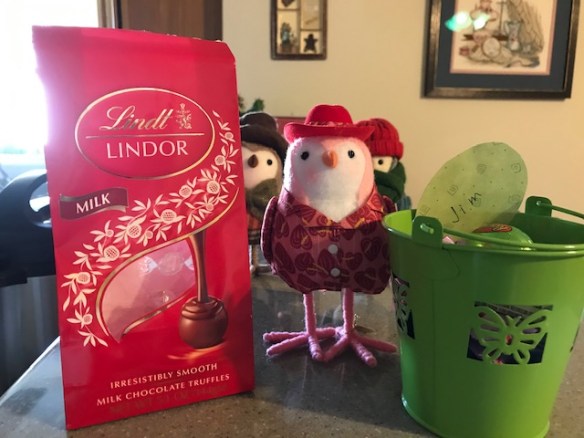
3. My favorite candy. I usually make, not Easter baskets, but little metal spring buckets for the kids with Easter candy in them. Timothy’s basket is bigger, with little toys and such. I don’t always make one for my husband, but we usually have enough extra candy for both of us to have some. I did make one for him this year, though. And I was surprised that he had bought me a bag of my favorite milk chocolate Lindt Lindor truffles. He doesn’t usually get them for Easter, so that was a treat. And I also love the small Reese’s eggs.

Yes, by the time I took the picture on Thursday, most of the truffles were gone. I’ve been rationing them out two a day. 🙂

4. Timothy’s birthday. Original plans had been to have a camp-out for my grandson’s birthday. Not only did social distancing throw a wrench in, but the weather was chilly. My son and daughter-in-law rearranged their living room to set up Timothy’s little play tent and their inflatable air mattress for a few days. Then on his birthday they set up a tent in the yard just to play in for a bit. We had another three-way FaceTime call to watch Timothy open presents and sing happy birthday to him. The next afternoon, my son dropped some birthday cake slices off for us.

camping cake

My daughter-in-law did an amazing job on that adorable cake!

5. Shakespeare’s sonnets. Sir Patrick Stewart has been reading one a day with his wonderful accent on his Instagram account. I’m not familiar with most of them, and I haven’t caught all of them, but I’ve enjoyed the ones I have taken the time to listen to.

I hope you’re still doing well this week! I feel we especially need to pray for our leaders now as decisions are made about reopening businesses and easing social distancing.

Book Review: A Portrait of Marguerite

In A Portrait of Marguerite by Kate Lloyd, Marguerite Carr’s only son is about to leave for college, and she feels lost. Her best friend drags her to an art class, just to get out of the house and do something fun. Marguerite had been an art major in college but had set art aside when she married and then had her son. She’s reluctant to let art back into her life, but she lets her friend talk her into the art class.

There she meets two people who will have an impact on her future: the instructor, Henry, and an older fellow student, Emily. Unfortunately, Henry is a friend of Marguerite’s ex-husband, Phil, which doesn’t raise him in her estimation.

We learn later in the book that Marguerite is weighed down by a secret from her past. As the story progresses, everyone that she holds in high regard is found to have faults and failures, even her beloved father. And her ex-husband, wonder of wonders, seems to have changed for the better.

I’m usually not one to infer symbolism where it’s not intended, but I do think Marguerite’s painting journey, from reluctance to dabbling to freedom, parallels her inner journey as she learns to forgive and accept herself and others.

The spiritual undercurrent, mainly from Emily, is subtle but realistic.

While this wasn’t the most riveting read, I enjoyed it. I’d give it a 4 out of 5.

(Sharing with Carole’s Books You Loved, Booknificent Thursday)

Book Review: Be Rich (Ephesians) Gaining the Things That Money Can’t Buy

Warren Wiersbe’s Be Rich commentary on the book of Ephesians does not a promote the “prosperity gospel”—insert prayers and gifts to televangelists and receive health and wealth. No, as the subtitle goes on to say. “Gaining the Things That Money Can’t Buy.”

Ephesians 1:3 says God “has blessed us in Christ with every spiritual blessing in the heavenly places.” Just some of those blessings:

  • Chosen in Him (verse 4)
  • Adopted as sons (verse 5)
  • Redemption through his blood, the forgiveness of our trespasses (verse 7)
  • An inheritance (verse 11)
  • Believers are “sealed with the promised Holy Spirit, who is the guarantee of our inheritance until we acquire possession of it, to the praise of his glory” (verses 13-14).

Wiersbe says, “‘In Christ’ is the most frequently used phrase in the book of Ephesians, and the point is clear: If you’re in Christ, you have everything.”

Another theme in the book is unity. Not a unity that ignores truth, but unity based on truth. Paul, the author of the letter to the Ephesians, says God’s plan was “to unite all things in [Christ], things in heaven and things on earth” (1:10). The first half of chapter 2 tells how we can be reconciled with God; the second half says that God, through Christ, broke down the barriers between Jew and Gentile. “For through him we both have access in one Spirit to the Father. So then you are no longer strangers and aliens, but you are fellow citizens with the saints and members of the household of God … ” (2:18-19). Chapters 4-6 share practical ways that unity in Christ is worked out in the church community, in the home, and in the workplace.

I’ve got dozens of quotes marked, but here are a few:

The Bible is our guidebook; the Holy Spirit is our Teacher. As we search the Word of God, we discover more and more of the riches we have in Christ.

Salvation is a gift, not a reward. Salvation cannot be “of works” because the work of salvation has already been completed on the cross. This is the work that God does for us, and it is a finished work (John 17: 1–4; 19: 30). We can add nothing to it (Heb. 10: 1–14); we dare take nothing from it.

By His death and resurrection, Christ overcame the world (John 16: 33; Gal. 6: 14), and the flesh (Rom. 6: 1–6; Gal. 2: 20), and the Devil (Eph. 1: 19–23). In other words, as believers, we do not fight for victory—we fight from victory! The Spirit of God enables us, by faith, to appropriate Christ’s victory for ourselves.

The Christian life is not based on ignorance but knowledge, and the better we understand Bible doctrine, the easier it is to obey Bible duties. When people say, “Don’t talk to me about doctrine—just let me live my Christian life!” they are revealing their ignorance of the way the Holy Spirit works in the life of the believer. “It makes no difference what you believe, just as long as you live right” is a similar confession of ignorance. It does make a difference what you believe, because what you believe determines how you behave!

Of course, there’s much more to Ephesians and Wiersbe’s book.

Ephesians contains two of my favorite Biblical prayers that I sometimes pray for myself and others. I’ll leave you with those

For this reason, because I have heard of your faith in the Lord Jesus and your love toward all the saints, I do not cease to give thanks for you, remembering you in my prayers, that the God of our Lord Jesus Christ, the Father of glory, may give you the Spirit of wisdom and of revelation in the knowledge of him, having the eyes of your hearts enlightened, that you may know what is the hope to which he has called you, what are the riches of his glorious inheritance in the saints, and what is the immeasurable greatness of his power toward us who believe, according to the working of his great might that he worked in Christ when he raised him from the dead and seated him at his right hand in the heavenly places (1:15-20).

For this reason I bow my knees before the Father, from whom every family in heaven and on earth is named, that according to the riches of his glory he may grant you to be strengthened with power through his Spirit in your inner being, so that Christ may dwell in your hearts through faith—that you, being rooted and grounded in love, may have strength to comprehend with all the saints what is the breadth and length and height and depth, and to know the love of Christ that surpasses knowledge, that you may be filled with all the fullness of God. (3:14-19).

(Sharing with Worth Beyond Rubies, Carole’s Books You Loved, Booknificent Thursday)