Unknown's avatar

About Barbara Harper

https://barbarah.wordpress.com

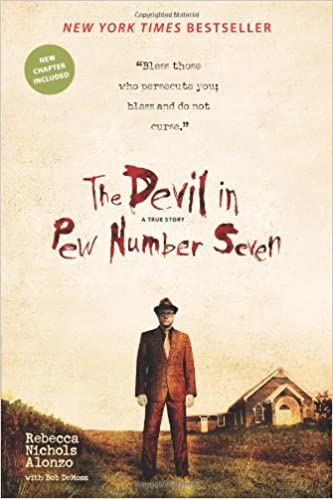
The Devil in Pew Number Seven

“The story you are about to read actually happened, every last detail of it. As the plot unfolds, my hunch is that you’ll need to remind yourself of this reality more than once.” So Rebecca Nichols Alonzo opens her book The Devil in Pew Number Seven.

Her hunch was right.

Rebecca tells the story of a man who harassed—no, terrorized her family for several years as she was growing up.

Rebecca’s father was the new pastor of a small church in Sellerstown, NC, in 1969. He found that one man, a Mr. Watts, held key positions in the church even though he was not a member. Recognizing Mr. Watts’ “stranglehold” on the church, Pastor Nichols “made changes to end his dominance” (p. 48).

Mr. Watts did not take his loss of position well, nor the pastor’s difference of opinion over issues like the style of the new church roof. Mr. Watts started acting up in church from pew number seven, making faces at the pastor while he preached, tapping on his watch, walking out and slamming the door loudly before the sermon was finished.

The Nichols family started receiving threatening anonymous phone calls in the middle of the night and unsigned letters. One letter promised the pastor’s family would leave “crawling or walking, running or riding, dead or alive” (p. 54).

Then followed several incidents of escalating attacks: home invasions while the family was away, which one time included water in the fuel tank and oil in the water pump; shots fired at the outside walls; dynamite set off near the house.

The Nichols family, the neighbors, the church, and even the police knew who was behind these attacks, but no one could prove it. Some of the incidents occurred while Mrs. Nichols was pregnant and then while the family had a newborn.

Finally events came to a tragic head. (It’s no spoiler to say this since it’s mentioned in the first chapter).

The rest of the book tells of the long-term effects these years had on the family and the necessity of learning to forgive those involved.

Rebecca was a child when much of this happened, but she read her parents’ journals, newspaper reports, court documents, and interviewed several people from the town.

It’s hard to fathom how far this man went to drive out the pastor. Rebecca’s father felt he couldn’t leave, because that would mean Mr. Watts would again assert his dominance over the church if Pastor Nichols left. The pastor and his wife also believed and modeled for their children “Love your enemies and pray for those who persecute you” (Matthew 5:44).

I first heard of this book from my friend Lou Ann. But I kept passing it by on my TBR list because I thought it might be too hard to read. I finally listened to the audiobook nicely read by Pam Ward. Then I checked the book out of the library to see the pictures and read the afterword.

The book was not hard to read or listen to. Rebecca doesn’t sensationalize the violence. She begins with the climactic incident, but then backtracks to tell how her parents met, were called to the ministry, how they came to Sellerstown, and other “normal” occurrences.

Some of my favorite quotes:

With a few rare exceptions, everyone in Sellerstown was related to one another in some way. Which is why at times, shotguns in hand, they watched out for one another. The Sellers kin are true salt-of-the-earth people . . . although some were saltier than others (p. 31).

I knew [God] said in the Bible that He’s a father to the fatherless and to the brokenhearted. I was both, so we had a perfect fit. There was one more insight I came to embrace. I needed God more than I needed to blame God (p. 235).

I didn’t ask for this abrasion on my soul to be a part of my life; it just is. Now, day by day, I have the choice to forgive the two men who took so much from me, or I can choose to wallow in a toxic brew of bitterness. True, I forgave . . . a long time ago. But that doesn’t mean I still don’t have to forgive him again and again . . . (p. 250).

I’m the one who remains in jail if I withhold God’s grace by failing to forgive when wronged (p. 251).

My one critique is that the author seems to belabor some points overmuch. For instance, with the first threatening phone call, a little more than a page is spent on describing what happens inside the phone when it rings, explaining how phones in those days didn’t have optional ring tones and couldn’t be left off the hook without setting off a warning tone, how her father couldn’t take the phone off the hook anyway because a country pastor was “on call” 24/7 just like a country doctor was. Maybe this was supposed to build suspense with three rings leading up to the first threat, but it just seemed extraneous and a touch irritating. But, this is a minor criticism and for the most part doesn’t hinder the story.

Sometimes the circumstances were hard to read about and illustrated how “truth is stranger than fiction,” But I highly recommend this book. Ultimately it’s about God’s grace and strength through the most difficult of times.

Is This the Right Way?

“I hope you know where we’re going.”

My mother-in-law would say this whenever I drove her anywhere.

Ten years before my mother-in-law passed away, we moved her from her long-time home in Idaho to be near us, then in SC and later in TN.

For the first five years, she was in an assisted-living facility. She was still mobile (with a walker) and verbal then.

When she first came, we had to gently insist that she needed new hearing aids. We could yell right next to her, and she’d encourage us to “just speak up.” When we finally got the new aids, she could hear much better and didn’t fuss about them any longer.

The new hearing aids required that we visit the audiologist’s office every few months for a tune-up and tube replacement. It was my responsibility to chauffeur Mom to these appointments.

Mom had never driven. She had several physical issues as a result of being born two months premature in the days before the streamlined NICUs we have today. She was used to her husband driving her wherever she needed to go. And she was used to the familiar roads in her small town in Idaho.

She did not have Alzheimer’s, but she had a degree of dementia that flared up most often when she was nervous or agitated.

So on our drives, in a place and vehicle and with a driver she wasn’t used to, she would frequently express her hope that I knew the way.

I would reassure her again and again. Once I teased, “No, I thought I’d just get in the car and drive around until we found it.” But her uncertain look told me that teasing probably wasn’t wise.

Later I would learn that when we’d get in these repetitive conversational loops, logic didn’t work. It was best to respond factually and then divert her attention. Trying to keep up a conversation kept her mind from reverting back to wondering where she was going . . . most of the time.

Her repeated question often reminded me of a poem I saw in one of Rosalind Goforth’s books. She and her husband were ministering in China when “foreign devils,” as they were called, were not welcome. They were staying in a “barn-like room” with paper windows full of holes. She couldn’t get warm. She got sick. She cried out, “O Lord, have you no pity? Oh, help me! Why should I suffer so?”

Just then someone brought in two baskets with a letter from two missionaries who had stayed with them the day before. The missionaries saw the Goforths’ meager accommodations and must have sensed that they had used most of their supplies to serve them. So the caring guest missionaries sent an assortment of food. Rosalind rejoiced at the kind provision. “But the most timely and precious evidence of God’s love and care came, when tearing paper off a bottle of grape juice,” she noticed this poem:

Is this the right road home, O Lord?
The clouds are dark and still,
The stony path is hard to tread,
Each step brings some fresh ill.
I thought the way would brighter grow,
And that the sun with warmth would glow,
And joyous songs from free hearts flow.
Is this the right road home?

Yes, child, this very path I trod,
The clouds were dark for Me,
The stony path was sharp and hard.
Not sight but faith, could see
That at the end the sun shines bright,
Forever where there is no night,
And glad hearts rest from earth’s fierce fight,
It IS the right road Home!

The poem was from an English paper printed in 1914, four years earlier, with no author listed. Who knows how it “happened” to find its way to Rosalind right when she needed it. She read the words over and over and finally prayed, “O Lord, if this is the right road home, then I will not murmur!”

Two days later, Rosalind returned to their home in Changte while others went on with the tour. Noting that she looked like a ghost of herself, friends cared for her until she recovered (Climbing, pages 118-120).

Even those of us who know the “prosperity gospel” is false sometimes fall into the trap of thinking the Christian life is akin to the “American dream.” When troubles come, we’re dismayed, because this isn’t what we thought the Christian life would be like. Did we take a wrong turn? Did God really mean for this to happen?

But He told us, “In the world you will have tribulation.” Yet He sandwiches that truth between two promises:

I have said these things to you, that in me you may have peace. In the world you will have tribulation. But take heart; I have overcome the world (John 16:33).

Several people in the Bible must have wondered if they, too, were on the right road:

Abraham and Sarah waiting long years for the son God promised.

The children of Israel wandering for forty years in the desert.

David, though anointed as the next king, hiding out in a cave from Saul.

John the Baptist in prison.

Peter when he heard Jesus speak of suffering and dying.

We’ve had friends who also must have wondered at times why life looked so different than they thought it would: a couple on deputation for the mission field when their son was diagnosed with leukemia; a young man in seminary who was in a car accident which left him paralyzed; a woman who is still alone though she thought she would have a husband and children; another woman who had to leave her beloved mission field due to her husband’s sin.

The Bible tells us often that trouble is part of life here. But the Bible also assures us time and again that God will be with us and help in trouble. God tells us not to lean on our own understanding, but to trust God (Proverbs 3:5).

He promises that when—not if—we pass through deep waters or fire, He will be with us:

When you pass through the waters, I will be with you; and through the rivers, they shall not overwhelm you; when you walk through fire you shall not be burned, and the flame shall not consume you (Isaiah 43:2).

What’s the best way to stay on the right path? “In all your ways acknowledge him, and he will make straight your paths” (Proverbs 3:6). If we’re seeking Him day by day, step by step, we can be assured we’re on the right path even if the circumstances are confusing.

What if we do stray from the path of God’s will? Sometimes trials are God’s chastening or His attempt to get our attention. Jonah went the opposite direction God told him and ended up inside a big fish. The prodigal son deliberately walked away from his father and ended up in a pigsty. Most of us don’t have one dramatic turn, but we gradually drift. We miss a few times with the Lord until we get out of the habit. We make excuses for a sin instead of killing it. Then we find ourselves either lukewarm and apathetic like the Laodicean church, or in a tangled mess. God issues many invitations in the Bible to repent and turn back to Him. One is Isaiah 55:7:

Let the wicked forsake his way
And the unrighteous man his thoughts;
And let him return to the Lord,
And He will have compassion on him,
And to our God,
For He will abundantly pardon.

A beautiful song based on this passage:

And I love this new version of the old hymn, “Coming Home”:

We can trust that God knows the way home and is with us every step.

(I often link up with some of these bloggers.)

Laudable Linkage

Here’s my latest list of thought-provoking online reads:

Meditation. “We have an advantage over Joshua in that we have the completed Word of God. God’s inspired instruction to us goes far beyond the Law of Moses. Joshua had a record of the past works of God, His requirements of Israel, and His promises to them. As Warren Wiersbe once noted, ‘If Joshua was able to conquer Canaan having only the first five books of the Bible, how much more ought we to overcome now that we have a complete Bible!’”

Back to the Word, HT to Challies. “I’m just about ready to give up the rational conversational approach to social intercourse and to start quoting straight Bible to people. The further we go, the more reason isn’t working anymore. In these sputtering last gasps of the Enlightenment, language itself is deconstructing before our eyes.”

Sin Coddlers Are Not True Friends, HT to Challies. “The affirmation-only style of friendship looks good on the surface, and no wonder it’s become mainstream. But the result is a reduced understanding of friendship.”

Prayer for the Unconverted. I love this old prayer.

Social Media’s Anger Problem, HT to Challies. “Someone says something online that we find offensive, and we retaliate with a harsh word, a quick jab, or a joke at their expense. What we have done at that moment is allow them to steal our blessing of a quiet and gentle spirit to pay them back for their worthless words.”

I Can . . . Except I Can’t, HT to Proclaim and Defend. “If ‘I can’t’ paralyzes people, ‘I can do it all’ sends them off pursuing the wrong things and forever wondering if they missed their passion.”

How Does God Equip Us? “It’s said that God doesn’t call the equipped, but he equips the called, and, as we reflected earlier in this 31 Day series, everyone is called and everyone has a part to play. So, how does God equip us for what he is calling us to do? The New Testament highlights three main ways.”

An Unexpected Way to Teach Our Children to Pray, HT to The Story Warren. “After years of praying about whatever her eyes land on, she’s getting her first glimpse of the struggle to come to God in ‘the right way.’  And how do I teach her when it’s a lesson I’m still trying to learn myself? Teaching our kids to pray can seem so daunting when we don’t know what to say too. But the beauty of our gracious God is that he doesn’t need our perfectly crafted words. Growing in our own prayer lives has the ability to speak volumes to our kids.”

The Purpose of Christian Books. “Christian books have a distinct purpose in today’s world and throughout history. What some might call ‘preaching to the choir’ is really ‘reminding the disciples about who God is and what he has done.’ Certainly, the Bible is the greatest example of God reminding us. The choir is a forgetful group.”

This is pretty neat: a piano-like instrument made from Popsicle sticks.

(For some reason, the video won’t play here. But if you click where it says, “Watch on YouTube,” you can see it there.)

Happy Saturday!

Friday’s Fave Five

It’s Friday, time to look back over the blessings of the week
with Susanne at Living to Tell the Story and other friends.

October is almost over. It seems like it has been a long month in some ways but has flown by in others. On Fridays I stop for a moment to remember the good things of the week lest I forget them in the blur of passing time.

1. A family outing. With various ones of us being sick and our traveling before that, it had been about three weeks since we had all been together as a family (those of us who are local). That’s a rarity for us. So it felt good in a number of ways to have an outing Saturday. It was good to be together and do something fun and get out. We visited the Pinta, a life-sized replica of Christopher Columbus’s ship (I wrote more about it here.)

Then we went out to eat, another thing we hadn’t done in a long time.

2. Grilled burgers. My husband had stopped at the store for me Saturday morning and noticed ground chuck was on sale. So he bought some and grilled hamburgers for us for Sunday lunch, then invited the kids for burgers Sunday evening. So we had a second family get-together last weekend.

3. My husband not only grilled twice on Sunday, but he loaded and ran the dishwasher, unloaded it, and reloaded it all in one day. He regularly cleans up the kitchen after Sunday morning breakfast while I get ready for church, and I appreciate that so much. But it was also a joy to come into the kitchen after dinner and find everything done.

4. A radio interview. I mentioned this unexpected opportunity last week. Thanks so much to those who prayed. It went well, and I felt God gave me the words to say. Some of you mentioned you’d like to hear it. My oldest son recorded it and made a link to it it here, if you’d like to listen.

5. Dinner and company. Jim had to go out of town overnight Wednesday, and Jason and Mittu offered to bring over some Mexican food for dinner. Then last night, Jesse brought over some peanut butter cake, the first cake he ever made from scratch.

Thus ends another week, and almost another month. I hope your October is wrapping up well.

October Reflections

We’ve had some quite pleasant days this month. Full fall color still isn’t out yet, at least in the few places I have been. We’ve gotten down in the forties a few nights, but no frost yet.

We’ve had a pretty full month. We started with a trip to Ohio for the memorial service of my husband’s former pastor and father of his best friend. This was our first overnight trip in the RV, which went okay. I don’t think I’d want to take long trips across the country in it, but a night or two is fine. This was also the first time we had seen some of these folks in years, so it was a little like a family reunion. Though we were sorry to hear Pastor Bob was gone, we’re glad he’s with the Lord, united with his wife, without discomfort and dementia. We rejoiced in his testimony and his life. And we thoroughly enjoyed catching up with his five adult kids and their families.

Then Jim, Jesse, and I were sick, and that took up the bulk of the month. Jesse’s Covid test came back negative, and we think our illness came from him, so we didn’t get tested. Some have told us he may have received a false negative since he was vaccinated. But we pretty much isolated as if we had Covid anyway–even if that’s not what we had, we didn’t want to spread it to anyone else.

Our church went back to Zoom meetings only for a few weeks because several people in our congregation had Covid. I think we’re going to try to meet in person again this week.

So in some ways, we felt as we did at the beginning of the pandemic.

We finally felt well enough for a family outing to see the Pinta, a replica of Christopher Columbus’s ship, last weekend. It was the first time we had been all together as a family for about three weeks, and it felt so good to be out and to see each other. We topped the day off by going out to eat.

I had another interview with the very kind and gracious Kurt and Kate of the Moody radio station in Florida. I am not quite sure how they discovered me, but this is the second time they’ve invited me to their program. All went well—thanks so those who prayed about it! My son recorded the interview and made a link to it here, if you’d like to listen.

One big change this month makes me a little sad. We have one of those big, unsightly transformer boxes on the corner of our property, right as you turn into the driveway—so it’s the first thing you see when you approach our house. I don’t know why they didn’t put it on the other side of the driveway or property, which has open grassy areas. Anyway, the previous owners had planted some little trees around the box. There was a sign on the box saying not to plant any vegetation that would obscure access to the box. But since the plants were already there, we figured we’d leave well enough alone. If the utility company had a problem, they’d let us know.

The trees were the same height as the box when we moved in. Now, after 11 years, they were six or seven feet tall.

We enjoyed putting lights on them for Christmas every year, and sometimes wrapping the box up for Christmas.

From Christmas 2011

But we finally heard from the utility company. They have to replace all the lines underground. And they had to take out our little (now big) trees. Our front corner looks all shaven and shorn.

Some time after they’re done, we’ll have to figure out a way to make the corner more presentable. And I know there are bigger concerns in the world, but I am going to miss that corner Christmas display.

As a aside, these guys only seem to work Tuesday through Thursday. No wonder these things take so long to complete.

Creating

I didn’t make any cards this month—no birthdays or other occasions for them. We didn’t do anything in the guest room since neither of us was feeling up to it at the same time. But I should be able to finish it out soon.

Reading

Since last time I finished:

  • Only Glory Awaits: The Story of Anne Askew, Reformation Martyr by Leslie S. Nuernberg, a fictionalized account of Anne’s testimony, life, and death.
  • Gentle and Lowly: The Heart of Christ for Sinners and Sufferers by Dane Ortlund, an interesting and helpful study of Jesus’ assessment of himself as meek, or gentle, and lowly which does not de-emphasize his righteousness and holiness.
  • Woman Heroes of World War II: 26 Stories of Espionage, Sabotage, Resistance, and Rescue by Kathryn J. Atwood, short true accounts of several women and their activities during WWII.
  • Gift From the Sea by Anne Morrow Lindbergh, musings about finding balance.
  • Be Strong (Joshua): Putting God’s Power to Work in Your Life by Warren W. Wiersbe
  • Catching the Wind by Melanie Dobson, audiobook, a touching time slip novel. One plot takes place in WWII, when two children try to escape Germany on foot. They make it to the English Channel, but are separated. In modern time, one of them hires a reporter to search for the other, who finds unexpected links to her own past.
  • Memories of Glass by Melanie Dobson, audiobook, another WWII time slip novel about a group of friends in the Resistance in Amsterdam and their modern-day descendants trying to research what happened to them.

It wasn’t on purpose that I read so much about WWII. I love that era, and some of my favorite authors write almost exclusively of that time. There’s plenty of scope for drama from that period. But I’m ready to read of another time for a while.

I’m currently reading:

  • Be Right (Romans): How to Be Right with God, Yourself, and Others by Warren W. Wiersbe
  • The Devil in Pew Number Seven by Rebecca Nichols Alonzo, audiobook, true account of a pastor’s family terrorized by a disgruntled member of their congregation.
  • Treasures of Encouragement: Women Helping Women by Sharon W. Betters
  • 100 Best Bible Verses to Overcome Worry and Anxiety
  • Chapel Springs Revival by Ane Mulligan, first in a series of novels about friends in a small town in GA.

Blogging

Besides book reviews, Friday Fave Fives, and Laudable Linkage, I had these posts on the blog this month:

  • Thoughts From a Memorial Service, ponderings about life, what we can learn from the end of it, realization that the “old guard” is slipping away and we’re supposed to take up their banner.
  • I Know God Promised, But . . . Having God’s promises but not relying on them doesn’t get us anywhere.
  • How to Read Books and Support Authors Inexpensively. Books ARE a worthy investment, even at full price. Authors and publishers work long and hard to provide books. But for some who like to read beyond what we can afford, here are some ways to read more inexpensively and still help authors.
  • From “What If” to “Even If.” We can scare ourselves to death with “what ifs.” But when we face them full on, we realize that even if the worst happens, God will provide help and grace.
  • What Light Reveals, two childhood stories when light helped distinguish between reality and imagination. We need the light of God’s Word to do that in our hearts as well.

Writing

There has not been much going on in that area, with everything else going on. I did make one decision, though.

I had been considering changing my “official” author name for a long time. There is another “Barbara Harper” who writes about water birth, something I know nothing about. I had thought our content would be different enough to distinguish between us. But people continually link to or follow my Facebook author page when they meant to link to hers. Plus, one article I read suggested looking up one’s name, which a potential agent or publisher is sure to do. When I did, it was six pages into Google results before anything of mine came up—all the rest were this other Barbara. So, to avoid confusion and distinguish myself, I decided to add my middle name and go by Barbara Lee Harper instead.

Some have mentioned the similarity to Harper Lee. That wasn’t intentional. My parents didn’t know I was going to marry a Harper when they named me Barbara Lee. 🙂 But if the name is associated with a good author, well, I don’t mind. 🙂

Another decision I’ve been pondering: I have a Facebook page for the blog here, and all my blog posts automatically go there for those who prefer to follow in that way. Then I created a separate Facebook author page (maybe prematurely? I’ve read different recommendations), which was meant for writing-related news and updates. I post my my devotional blog posts there as well and occasionally others. I’ve considered merging the two, but keep going back and forth.

There’s a writer’s group I looked into, but decided not to join. Their fee was pretty expensive, plus I didn’t feel their services were worth the price. But since I had registered for a free seminar, I still get occasional offers from them. Last week they offered a “summit” (which turned out to be some of their older recycled videos, but they were new to me). We could listen to them free, but the free link was only good for a day—unless I wanted to pay $67 for lifetime access! I didn’t, so I listened while resting or cleaning and sorting.

In one of those videos, an agent said that for a new author to be considered by a publisher, they needed to have about 10,000 followers with about 10% engagement—meaning at least 1,000 of those followers comment, “like” posts, etc.

Well. I have nowhere near 10,000 followers. And the necessity of “seeking followers” seems a wrong emphasis, though it also seems a reality the way things are set up in the business of publishing today.

I’ve considered self-publishing, if a publisher wouldn’t be interested in me due to a small “platform.” Plus, it takes a year or two for a manuscript to be published from the time it’s accepted. And I am not getting any younger. 🙂 Self-publishing would be quicker, though I would still want to pay for an editor and have the highest quality end product I could.

On the other hand—I’ve heard that if you self-publish and your book bombs, that pretty much guarantees a publisher will not be interested in your future books.

So, if you’re so inclined, I’d appreciate your prayers for some of these “behind the scenes” decisions, as well as for wisdom in carving time to actually finish writing the thing.

And I hope you’ll forgive this longer than usual monthly round-up. 🙂

(I often link up with some of these bloggers.)

Be Strong: Study of Joshua

Our church has been reading through the book of Joshua the last few weeks. I read Be Strong (Joshua): Putting God’s Power to Work in Your Life by Warren W. Wiersbe along with our daily Bible reading.

Joshua marks two major transitions in Israel’s history. First, Moses, their leader of over forty years, had just passed away. Then the Israelites had just finished forty years of wandering and were about to enter the land God had promised their ancestors long ago.

Either situation would be daunting to a new leader. So God encourages Joshua right off the bat:

No man shall be able to stand before you all the days of your life. Just as I was with Moses, so I will be with you. I will not leave you or forsake you. Be strong and courageous, for you shall cause this people to inherit the land that I swore to their fathers to give them (Joshua 1:5-6).

God also gives Joshua vital instruction:

Only be strong and very courageous, being careful to do according to all the law that Moses my servant commanded you. Do not turn from it to the right hand or to the left, that you may have good success wherever you go. This Book of the Law shall not depart from your mouth, but you shall meditate on it day and night, so that you may be careful to do according to all that is written in it. For then you will make your way prosperous, and then you will have good success. Have I not commanded you? Be strong and courageous. Do not be frightened, and do not be dismayed, for the Lord your God is with you wherever you go (Joshua 1:7-9).

Joshua seems to have followed God’s instruction faithfully throughout the rest of his life. He made a couple of costly mistakes: going up to Ai and making a pact with the Gibeonites without seeking counsel of the Lord. But Wiersbe spends a lot of time pointing out that when we err, we don’t give up: we confess our sins, pick up again, and get back on the right path.

Wiersbe discusses the difficulty of God having His people slaughter the nations in Canaan. He points out that the Canaanites weren’t innocent: they were known for cruel acts like sacrificing their children to their gods and vile sexual acts in the name of worship. And he reminds that God gave them plenty of space to repent. Rahab was one who heard of the God of Israel and turned to Him in faith (eventually becoming an ancestor of the Messiah).

Some hymns have portrayed the promised land as symbolic of heaven. But Wiersbe repeatably points out that the symbolism doesn’t fit: we don’t battle our way either into heaven or after we get there. He says that entering the promised land symbolizes our maturity in Christ. God often said that He was the one driving out the nations before Israel, yet they had to pick up their swords and fight (most of the time. Jericho and some of the other cities had different battle plans). So with us: we’re saved by grace through faith plus nothing. And we’re sanctified by grace as well. Yet we only become mature Christians as we pick up our “sword of the Spirit,” God’s Word, and believe it and apply it. We can and should pray for God’s grace and help in taking temptation away and helping us overcome, but He expects us to read and apply the Word He gave us. “What Paul’s letter to the Ephesians explains doctrinally, the book of Joshua illustrates practically. It shows us how to claim our riches in Christ. But it also shows us how to claim our rest in Christ (p. 22, Kindle version). Wiersbe discusses briefly the different kinds of rest Hebrews 4 and 5 tell about, then says, “This ‘Canaan rest’ is a picture of the rest that Christian believers experience when they yield their all to Christ and claim their inheritance by faith” (p. 22).

The victorious Christian life isn’t a once-for-all triumph that ends all our problems. As pictured by Israel in the book of Joshua, the victorious Christian life is a series of conflicts and victories as we defeat one enemy after another and claim more of our inheritance to the glory of God (p. 23).

The main point of Joshua is that God kept His promises to His people. Not only did He give them the land He originally promised Abraham, but He provided for each of the tribes. At the end of the book, Joshua tells the people, “You know in your hearts and souls, all of you, that not one word has failed of all the good things that the Lord your God promised concerning you. All have come to pass for you; not one of them has failed” (Joshua 23:14). He encourages them to “cling to the Lord your God just as you have done to this day” (23:8) and warns that just as God kept His promises to give them the land, He’ll keep His promise to punish them if they go after other gods.

Wiersbe has a closing chapter of the example of Joshua himself in his following the Lord and leading the people.

As always, I appreciate Dr. Wiersbe’s insights into this book of the Bible.


A Visit to the Pinta

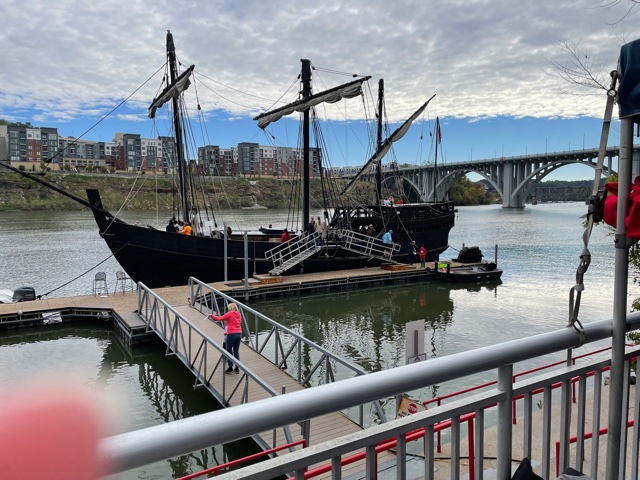
On Saturday, our family got to visit a life-sized replica of the Pinta, one of Christopher Columbus’s ships.

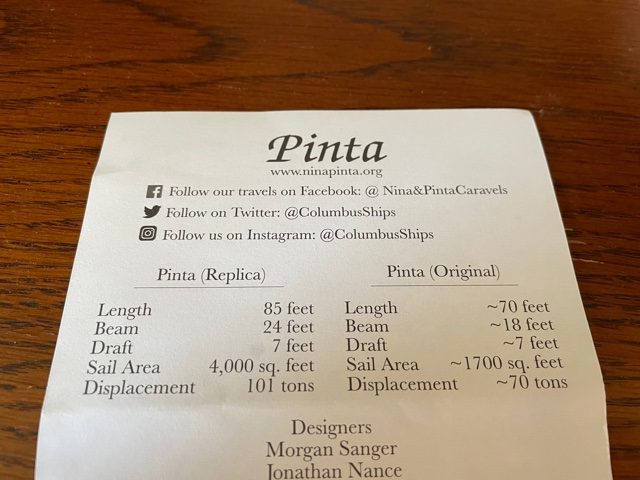
Actually, the Pinta was a little larger than life-size to accommodate the height of modern people. We were told the average European then was 5’2″.

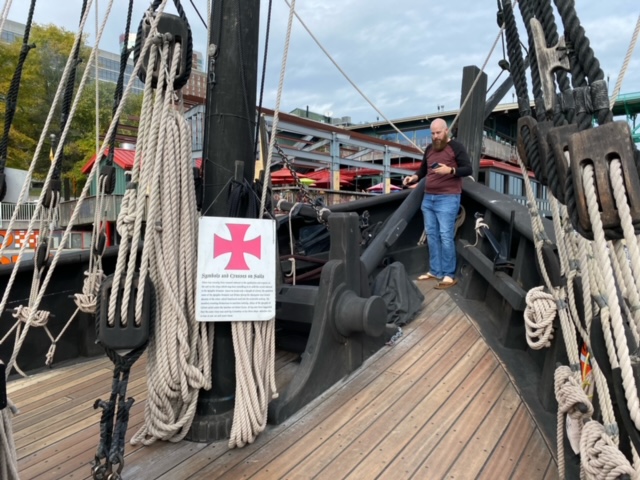
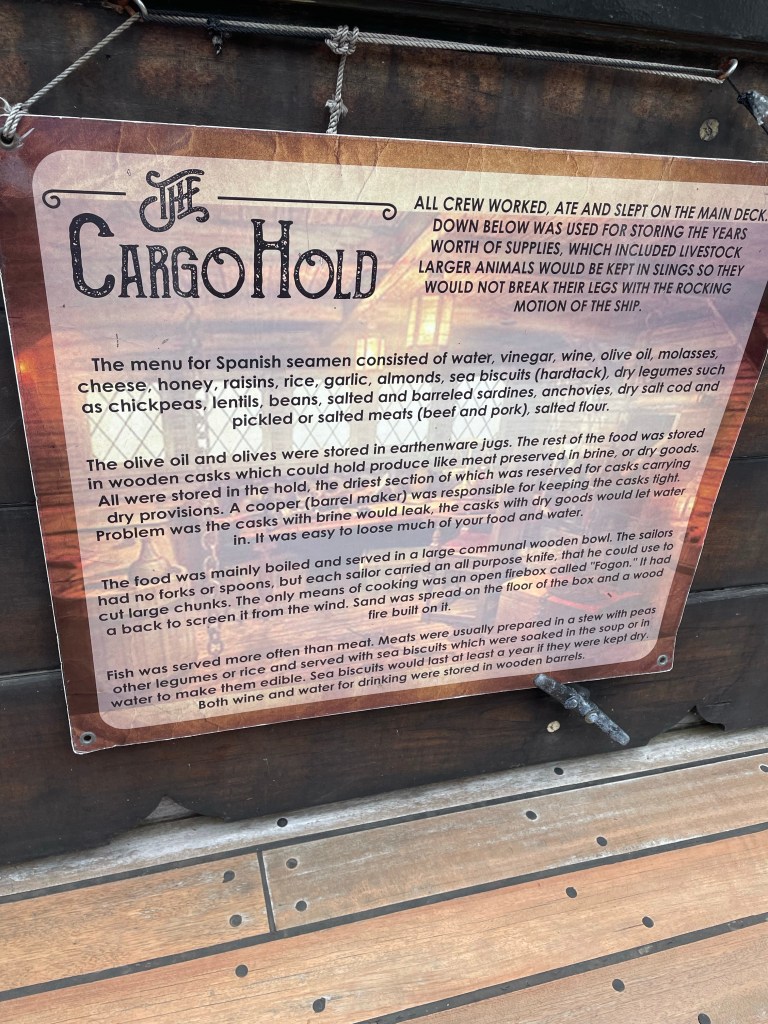
Still, our first impression was that the ship was much smaller than we would have thought. And there was no belowdecks. There was a cargo hold, but everyone would have lived and slept on deck. It was hard to fathom a crew of 26 men in that space for as long as they were at sea.

Several placards were placed around the ship with explanations of life on board, Columbus’s route, instruments he used, etc.

There were also several instruments and items like a sword (under glass), a model of the ship, etc.

A couple of volunteers were on board to provide information and answer questions.

We were amused by a couple of anachronistic inclusions. 🙂

I appreciated that nothing was mentioned about anything controversial with Columbus. Those conversations are important, but one can enjoy learning about the ship without agreeing with everything that was done. The ship was presented as a “sailing museum” and was for the purpose of sharing information about history. This type of ship, a caravel, had been in use for a couple of centuries and was a common “workhorse” type of ship, one brochure explained.

It was the first time I had ever been on a “tall ship.” All in all, it was a fun and educational outing.

You can learn more about the Nina and Pinta replicas here and follow their itinerary here.

What Light Reveals

I woke up in the middle of the night. As my eyes slowly adjusted to the darkness, I became aware of a round shape on the edge of my bed.

I thought it was a headhunter.

It’s not like we had a lot of headhunters roaming southeastern Texas in my childhood. But I was seven or eight with a vivid imagination. I constantly pictured someone hiding in dark corners, or reaching for my ankles in the darkness under the bed, or staring at me in the darkness while I slept.

I decided if the headhunter thought I was asleep, he wouldn’t bother me. So I laid very still, closed my eyes tight, and drifted off again.

In the morning, when I woke up to light streaming in my room, I saw the rounded head of my teddy bear beside me and had a good laugh at myself.

During this time, my brother and I shared bunk beds. I had the top bunk, since I was four years older. When he was little, my brother used to have some pretty wild dreams. Once he woke up in the night and toddled to my parents’ room to tell them there was a snake in our bed. They accompanied him back to our bedroom to turn on the light and assure him there was no snake . . . except there was a snake. The box springs under the top bunk were uncovered, and a snake was making its way through the coils. I happened to be asleep on the top bunk.

I don’t remember the sequence of events, but I was retrieved from bed, and our neighbor somehow appeared. I don’t remember her face because she usually wore a bonnet. She looked like an extra from Little House on the Prairie or maybe a middle-aged Holly Hobbie. Her name was Mrs. Beeson, and she seemed an expert on all manner of flora and fauna. She told us this was not a poisonous snake, and it was probably after a nest of eggs in the window next to the bed. Still, she chopped its head off. I can still remember watching in awe as the snake’s head and body still moved though they were severed.

In one situation, light exposed false reasons to fear and brought comfort. In another situation, light exposed a potential danger to be dealt with. In both, light showed the difference between reality and imagination.

Light provides rich imagery and symbolism in the Bible. This Bible Study Tools article says, “Throughout the Old Testament light is regularly associated with God and his word, with salvation, with goodness, with truth, with life. The New Testament resonates with these themes, so that the holiness of God is presented in such a way that it is said that God “lives in unapproachable light” (1 Tim 6:16). God is light (1 John 1:5) and the Father of lights (James 1:17) who dispels darkness.”

Ephesians 5:13 says, “When anything is exposed by the light, it becomes visible.” When we shine God’s light and truth into our lives, we discern reality from imagination. We see what’s innocent and what’s dangerous. Our fears are comforted with God’s power and grace. We see areas that need cleaning, like when the afternoon light exposes missed spots of dust. We see the next step on the path ahead as God’s “word is a lamp to my feet and a light to my path” (Psalm 119:105).

God’s light even exposes our hearts to us. Jeremiah asks, “The heart is deceitful above all things, and desperately sick; who can understand it?” (17:9). We can fool ourselves about our motives, even our own sin. Hebrews 4:12 tells us, “For the word of God is living and active, sharper than any two-edged sword, piercing to the division of soul and of spirit, of joints and of marrow, and discerning the thoughts and intentions of the heart” (emphasis mine).

Earlier in Ephesians 5, Paul says :

For at one time you were darkness, but now you are light in the Lord. Walk as children of light (for the fruit of light is found in all that is good and right and true), and try to discern what is pleasing to the Lord. Take no part in the unfruitful works of darkness, but instead expose them. For it is shameful even to speak of the things that they do in secret. But when anything is exposed by the light, it becomes visible (verses 8-13).

“The unfolding of your words gives light; it imparts understanding to the simple” (Psalm 119:130). We need to regularly shine God’s light on our circumstances, our culture, and our own hearts to have the right perspective and response.

(I often link up with some of these bloggers.)

Laudable Linkage

IMG_0195

Here are some noteworthy reads found this week.

The Weight and Wound of the Word, HT to Challies. “Some—perhaps much—of the Bible was given not for our comfort but for our discomfort. The Scriptures are profitable for reproof and correction, after all; they provoke, unsettle, and rebuke us. Far from harsh, this is a sign of God’s love. It is damaging for our souls—indeed, for our humanity—to turn against God in rebellion. The fact that he steers us away from sin and back to himself is evidence of his care.”

Three Unthievable Treasures. “Almost anything we treasure—from people to possessions to abilities—can vanish in an instant. However, Scripture teaches us about a few precious treasures that no thief, con man, devil, or despot can ever take away.”

If Just One Person Returned. “Instead of having us base our confidence on the word of friends or family members, he has us base our confidence on his infallible words. And why would we believe the word of a man if we will not believe the word of God himself? Why would we long to base our confidence on a created being if we will not believe the one who created us?”

The Best Choice: Bringing Christ into Our Decision Making, HT to the Story Warren. “I don’t remember much about registering for baby gear, but I remember crying. What was intended to be an exciting afternoon with my husband turned into a near panic attack. As if carrying a child with an eternal soul in my womb was not weighty enough, I was assaulted with hundreds of secondary and tertiary questions. Disposable or cloth diapers? If disposable, which brand? Pacifier or no pacifier? If yes, which brand? Three hours later, we walked out of a giant superstore far less confident and far more overwhelmed as soon-to-be parents.”

Why I Quit Praying for God to “Use Me,” HT to Challies. “Deep down, for the majority of my Christian life, I have lived, prayed, and ‘served’ because I related to God as my employer, not my ‘Abba Father’ (Gal. 4.6; Rom. 8.15). With God as my divine employer, I could count and quantify my work for him and be the judge of whether I was ‘useful’ or not. Having God as my employer, love, intimacy, acceptance, and belonging were not the name of the game. No. Productivity and getting things done are what was important. Meditation, confession, and repentance were replaced with planning and strategizing.”

A Key Sign You Are Maturing as a Preacher, HT to Challies. I’m not a preacher, but I see a parallel with writing. I used to think I couldn’t write on a given concept in Scripture without studying all the verses about it, and then I felt I had to include all the verses. But people don’t usually read lists of verses. And the more verses or points that are included, the harder it is to process. One’s head starts swimming instead of focusing or discerning a main point. So, substituting writing for preaching, this is a good reminder for me : “God calls us to preach the word, to be sure. But he calls us to preach to people. Real, living people. People with a distinctive set of issues, needs, and problems.”

7 Traits of False Teachers, HT to Challies. “In the same way Peter says, ‘There will be false teachers among you.’ Notice the words “among you.’ Peter is writing to the church and says, ‘There will be false prophets among you.‘ So he is not talking about New Age people on television. He is talking about people in the local church, members of a local congregation.”

These kinds of videos always get me a little misty. A baby gts glasses and sees his mom clearly for the first time. Love how he’s looking all over, taking things in, then he sees her eyes.

Happy Saturday!

Friday’s Fave Five

It’s Friday, time to look back over the blessings of the week
with Susanne at Living to Tell the Story and other friends.

It’s hard to believe we only have a week left in October. I enjoy these pauses every week to stop and reflect. They help time not to pass by in such a blur that we miss seeing God’s hand. Here are a few favorites from my week:

1. Feeling better. After being sick all week, I had a great Saturday. Then I had a horrible Sunday with head and body aches. I’m much better now. Jim still has a lingering cough from last week that’s plaguing him, but otherwise feels better.

2. Fall decorations. We finally had a day when we both felt like dealing with them–Jim getting the boxes up and down from the attic for me, and me placing them.

3. Sunday dinner with Jesse. I mentioned last week that we felt a little isolated, because we were trying not to share whatever illness we had. It felt almost like the beginning of the pandemic. Jesse asked to come over for dinner and a haircut, and since had been, was still a little sick, we felt it was okay to be together. It felt good to see him in person.

4. A cute new purse. I had not been able to find anything at my usual stores for months, so I looked on Amazon. This is a smidgen smaller than I usually have, but I think it will work okay.

5. Multi-tasking. A writer’s group I considered but decided not to join will still send me free videos sometimes. This week they had a series each weekday, but they were only accessible that week day–unless I wanted to pay $67 for lifetime access! No, thank you. When I wasn’t feeling well at the beginning of the week, I gave myself permission to just sit and listen. But I was too antsy to do that later in the week, so transferred stuff from my old purse to my new one and cleaned out files and old catalogs while I listened.

Bonus: an opportunity. Since some of you are only here for FFF, I wanted to mention something I shared earlier: I was invited to a radio interview next week, October 26, at 8:10 a.m. EDT. More information is here. It’s both exciting and nerve-wracking! I’d appreciate your prayers.

Hope you’ve had a great week!