Unknown's avatar

About Barbara Harper

https://barbarah.wordpress.com

Book Review: The Gilded Age

The Gilded Age: A Tale of Today is not one of Mark Twain’s more well-known books. It’s the only one he wrote with a collaborator, Charles Dudley Warner, who was also a friend and neighbor. The story goes that their wives challenged them “to write a better novel than what they were used to reading.”

But this book is distinctive for an additional reason: its name became applied to the era after Reconstruction until the 1900s. According to this site, “American economy grew at its fastest rate in history” during this period. Such a rise gave way to more industrialization and a class of sudden and ultra-wealthy citizens. “The period also was marked by social movements for reform, the creation of machine politics, and continued mass immigration.” according to the same site.

Twain’s and Warner’s novel satirizes much that was characteristic of the era. But the story itself focuses on a few individuals.

The Hawkins family is poor but decent, located in Obedstown, TN. The family patriarch, Si, has bought 75,000 acres of Tennessee land. It’s not worth much at present, but with the expected changes on the horizon—the expansion of the railroad and discovery of coal for fuel—Si expects some day the land can be sold for a fortune and provide for his children.

In the meantime, their old friend Eschol Sellers has written to urge them to come to Missouri for the wealth of opportunities there. Mrs. Hawkins supports her husband’s decisions, but following Sellers has not boded well for them in the past. He means well, but he always comes up with grand schemes that never quite work out as expected.

On their way, they acquire two more children by adoption who have been newly orphaned. Their fortunes go up and down—mostly down. Si is tempted to sell the Tennessee land several times, but holds out. The older children venture out to work and help the family.

Parallel to the Hawkins and Sellers story is that of two friends, Harry and Phillip, who set put to make their fortune by becoming civil engineers for the railroad. Harry seems like a more refined version of Sellers, but Phillip is earnest and wants to truly learn the job.

The young men eventually cross paths with Laura Hawkins, the adopted daughter who has grown into a fascinating beauty. Henry is smitten. Laura is not unkind, but neither is she interested in Henry. Phillip is also in love with a girl who wants to become a doctor and isn’t interested in committing herself to a relationship.

Laura has an unfortunate relationship with a man who swept her off her feet and encouraged her to elope. When he gets tired of her, he confesses that he was already married and therefore his marriage to her was a sham. He leaves her. Laura changes as a result, becoming more calculating and ruthless.

Sellers, Laura, and Washington Hawkins end up in Washington DC in a grand scheme to get Congress to buy the Tennessee land to establish a college for Negroes. The book’s authors seems to believe that there is not a sincere, uncorrupt senator or representative, and we see a lot of the machinations of the political process: “The chances are that a man cannot get into congress now without resorting to arts and means that should render him unfit to go there.”

Some of the characters end in tragedy. Some are singed by circumstances but wiser in the end. A couple receive a hard-won happy ending.

Some sections are autobiographical. Twain’s biography says that his father had his own version of Tennessee land that always seemed to hold out hope for a good future, and his brother was killed in a steamboat accident similar to the one that orphaned Laura. One section of the book describing Phillip has a footnote that his life to that point mirrored Warner’s.

I understood how the book’s title could be applied to the era. Of course, the era wasn’t named the Gilded Age at the time Twain and Warner wrote. So, though they were satirizing the times, I think they also might have been pointing out the futility of so many individuals in the story who were seeking after the next great elusive thing instead of settling down and working hard for their goals and livelihoods.

Though this book is satire, it also has some wonderfully sweet and poignant moments.

The book kind of dragged in the middle for me, with the young men’s relationships and everyone’s schemes not going anywhere. But it picked up again in the end, with some parts being riveting.

There are a few “damns” in it. The portrayal of black people was probably accurate to the times but is condescending and insensitive in places.

Eschol Sellers’ first name is different in some versions because a real Eschol Sellers showed up and protested after the book was first published. Sellers was based on a cousin of Twain’s who was influential in his father’s land deal.

A few of my favorite quotes:

He . . . was not wanting in courage, but be would have been a better soldier if he had been less engaged in contrivances for circumventing the enemy by strategy unknown to the books. It happened to him to be captured in one of his self-appointed expeditions, but the federal colonel released him, after a short examination, satisfied that he could most injure the confederate forces opposed to the Unionists by returning him to his regiment.

There are many young men like him in American society, of his age, opportunities, education and abilities, who have really been educated for nothing and have let themselves drift, in the hope that they will find somehow, and by some sudden turn of good luck, the golden road to fortune. He was not idle or lazy, he had energy and a disposition to carve his own way. But he was born into a time when all young men of his age caught the fever of speculation, and expected to get on in the world by the omission of some of the regular processes which have been appointed from of old. And examples were not wanting to encourage him.

Whatever her thoughts may have been they were unknown to Philip, as they are to these historians; if she was seeming to be what she was not, and carrying a burden heavier than any one else carried, because she had to bear it alone, she was only doing what thousands of women do, with a self-renunciation and heroism, of which men, impatient and complaining, have no conception. Have not these big babies with beards filled all literature with their outcries, their griefs and their lamentations? It is always the gentle sex which is hard and cruel and fickle and implacable.

I listened to the audiobook wonderfully read by Bronson Pinchot. He did an amazing job with the nuances, inflections, and numerous accents. One nouveau riche character is Irish but has traveled in France and changed her last name to a French pronunciation. Bronson nails an Irish accent trying to sound French as well as a variety of Southern accents.

This book first came to my attention when I was searching for a book set in TN for the “Classics from a place you have lived” category of the Back to the Classics challenge. As it turned out, only parts of the book take place in TN. But many of the main characters are from TN, and the “Tennessee land” is almost a character itself, so I am hoping this book will still qualify.

Have you ever read this book? What did you think?

Book Review: Till Morning Is Nigh

Till Morning Is Nigh: A Wortham Family Christmas by Leisha Kelly comes about in the middle of her six-book series about the Wortham family. I finished the series back in September but wanted to save the Christmas story until now.

The Wortham family had been down and out during the Depression. With their last hope of a job fallen through, they hit rock bottom. They took shelter in an abandoned house, then got the idea that perhaps the owners would let them stay there in exchange for fixing up the place. The owner was an elderly woman named Emma who took a chance on the family. She had not been able to live home alone, but the Worthams eventually moved her back into her home with them, and she became a grandmother and mentor to the family. That was back in Book 1, Julia’s Hope.

This story opens several years later. Emma has passed away as has the Wortham’s neighbor, Mrs. Hammond, a mother of ten children. George Hammond had been devastated and unstable after his wife’s death, and the Hammond children often spent as much time at the Wortham’s house as their own.

George had seemed to settle down for a while. But now it’s the first anniversary of his wife’s death, and he’s missing. The older children think perhaps he has drowned his sorrows in a drinking binge, but they fear worse. Some of the middle children are angry. The younger children are just sad and afraid. The Worthams take them all in and try to help. On top of everything else, some of them have the flu.

While nursing the various sick ones, keeping everyone fed, praying and worrying, Samuel and Julia Wortham try to prepare a meager Christmas and discuss what they should do if the worst has happened to George.

When a friend tells Julia, “I don’t know how you do it,” Julia responds, “I don’t. Whatever you think I’m accomplishing, I really can’t manage at all. Nothing but the good Lord could have gotten me through this holiday.”

Someone suggests that they make a Nativity scene out of what materials they have. The project starts out as a diversion but eventually becomes meaningful in various ways to different ones.

This story is a reminder that not all Christmases are giddy parties. Sometimes deep grief and stark need prevent the usual Christmas we’ve come to expect. But joy, love, and light can shine in and touch hearts.

I think this book could be read easily as a stand-alone. Enough of the back story is explained that readers new to the series wouldn’t feel lost. But the story is richer for having read the rest of the Worthams’ books. I enjoyed them all, so I recommend them all to you.

(Sharing with Grace and Truth, Carole’s Books You Loved, Booknificent)

God With Us

Our church is reading through Matthew this month. Luke’s account of Christ’s birth is more detailed than Matthew’s compact version. But one thing that stands out to me in Matthew’s telling is at the end of chapter one.

After reassuring Joseph that Mary is still pure and her pregnancy is of the Holy Spirit, the angel says: “She will bear a son, and you shall call his name Jesus, for he will save his people from their sins.” Then Matthew adds this comment:

All this took place to fulfill what the Lord had spoken by the prophet: “Behold, the virgin shall conceive and bear a son, and they shall call his name Immanuel” (which means, God with us).

Jesus was to be the baby’s name, but He would also be called Immanuel. The prophecy Matthew quoted was from Isaiah 7:14, written around 700 years before Matthew’s book.

We often zip by that phrase to get to the next part of the narrative. But the fact that God is with us is so significant, I want to ponder it for a moment.

God was with His people in full fellowship and harmony in the garden of Eden. But then they sinned and were sent out of the garden. Sin separates from God. He is always omnipresent, everywhere at all times. But that complete, harmonious fellowship was broken. He made a way for people to be reconciled to Him through Christ, but Jesus’ sacrifice would not take place for thousands of years. People in the OT looked ahead to what God would do to redeem them. People in the NT and our day look back.

God told Isaac: “I am the God of Abraham your father. Fear not, for I am with you and will bless you” (Genesis 26:3).

Israel became God’s chosen people, known especially because their God was with them. He was not a block of wood or brass set up in a tent. He was a Spirit who led and protected them. After one of Israel’s most grievous sins in the wilderness, before they came to the promised land, God sent them on ahead with Moses. God promised to make the way for them into Canaan, but He would not go with them “lest I consume you on the way, for you are a stiff-necked people.” Moses pleaded:

 Moses said to the Lord, “See, you say to me, ‘Bring up this people,’ but you have not let me know whom you will send with me. Yet you have said, ‘I know you by name, and you have also found favor in my sight.’ Now therefore, if I have found favor in your sight, please show me now your ways, that I may know you in order to find favor in your sight. Consider too that this nation is your people.”

And [God] said, “My presence will go with you, and I will give you rest.”

And he said to him, “If your presence will not go with me, do not bring us up from here. For how shall it be known that I have found favor in your sight, I and your people? Is it not in your going with us, so that we are distinct, I and your people, from every other people on the face of the earth?” (Exodus 33:1-16).

Have you ever felt like Moses? “Don’t send me if You’re not going with me. I can’t go forward without You.”

Before Moses died, he assured the people, “Be strong and courageous. Do not fear or be in dread of them, for it is the Lord your God who goes with you. He will not leave you or forsake you. (Deuteronomy 31:6).

When Moses died and Joshua was appointed to take Israel on to the promised land, God reassured him, “Have I not commanded you? Be strong and courageous. Do not be frightened, and do not be dismayed, for the Lord your God is with you wherever you go” (Joshua 1:9).

The psalmist rejoiced, “God is our refuge and strength, a very present help in trouble. . . The Lord of hosts is with us; the God of Jacob is our fortress” (Psalm 46:1, 4, 11).

David declared, “I have set the Lord always before me; because he is at my right hand, I shall not be shaken. . . You make known to me the path of life; in your presence there is fullness of joy; at your right hand are pleasures forevermore” (Psalm 16:8,11).

The prophets, who so often had to point out the people’s sins, also reminded them that God had nor forsaken them and was with them. “Then Haggai, the messenger of the LORD, spoke by the commission of the LORD to the people saying, ‘I am with you,’ declares the LORD. . . all you people of the land take courage,’ declares the LORD, ‘and work; for I am with you,’ declares the LORD of hosts” (Haggai 1:13; 2:4).

Through Isaiah, God promised His people: “When you pass through the waters, I will be with you; and through the rivers, they shall not overwhelm you; when you walk through fire you shall not be burned, and the flame shall not consume you” (Isaiah 43:2). Notice He didn’t say “if” you pass through water and through fire. He said “when.” Trouble’s going to come. But God is with us in it. Earlier Isaiah had quoted God, “Fear not, for I am with you; be not dismayed, for I am your God; I will strengthen you, I will help you, I will uphold you with my righteous right hand. . . For I, the Lord your God, hold your right hand; it is I who say to you, ‘Fear not, I am the one who helps you'” (Isaiah 43:10,13).

When Jesus took on flesh, He was with His people in a physical way. Before He ascended back to heaven, He promised them, “Behold, I am with you always, to the end of the age” (Matthew 28:20).

Those verses we often lean on in anxiety in Philippians 4 are predicated by “The Lord is at hand; do not be anxious about anything, but in everything by prayer and supplication with thanksgiving let your requests be made known to God. And the peace of God, which surpasses all understanding, will guard your hearts and your minds in Christ Jesus”(Philippians 4:5b-7).

We can trust God for our provision. “Keep your life free from love of money, and be content with what you have, for he has said, ‘I will never leave you nor forsake you’” (Hebrews 13:5).

At the end of life, if we know Him, we can rest in the fact that “Even though I walk through the valley of the shadow of death, I will fear no evil, for you are with me; your rod and your staff,  they comfort me”( Psalm 23:4). Then we’ll be “absent from the body, and to be present with the Lord” once again in full fellowship unhindered by a sin nature (2 Corinthians 5:8).

An old song said God is watching us from a distance. No, He is very close. “But now in Christ Jesus you who once were far off have been brought near by the blood of Christ” (Ephesians 2:13). Because Jesus was God’s Son, born of a virgin, lived a sinless life, died on the cross for our sins, and rose again, we can be forgiven, redeemed, close to Him. In overcoming and need, in anxiety and danger, in everyday life and our walk with God, and finally in death, we can rest and rejoice in the fact that God is with us.

For thus saith the high and lofty One that inhabiteth eternity, whose name is Holy; I dwell in the high and holy place, with him also that is of a contrite and humble spirit, to revive the spirit of the humble, and to revive the heart of the contrite ones. (Isaiah 57:15).

Immanuel

Written by C. H. Spurgeon at the age of 18

When once I mourned a load of sin;
When conscience felt a wound within;
When all my works were thrown away;
When on my knees I knelt to pray,
Then, blissful hour, remembered well,
I learned Thy love, Immanuel.

When storms of sorrow toss my soul;
When waves of care around me roll;
When comforts sink, when joys shall flee;
When hopeless griefs shall gape for me,
One word the tempest’s rage shall quell–
That word, Thy name, Immanuel.

When for the truth I suffer shame;
When foes pour scandal on my name;
When cruel taunts and jeers abound;
When “Bulls of Bashan” gird me round,
Secure within Thy tower I’ll dwell–
That tower, Thy grace, Immanuel.

When hell enraged lifts up her roar;
When Satan stops my path before;
When fiends rejoice and wait my end;
When legioned hosts their arrows send,
Fear not, my soul, but hurl at hell
Thy battle-cry, Immanuel.

When down the hill of life I go;
When o’er my feet death’s waters flow;
When in the deep’ning flood I sink;
When friends stand weeping on the brink,
I’ll mingle with my last farewell
Thy lovely name, Immanuel.

When tears are banished from mine eye;
When fairer worlds than these are nigh;
When heaven shall fill my ravished sight;
When I shall bathe in sweet delight,
One joy all joys shall far excel,
To see Thy face, Immanuel.

(Sharing with Inspire Me Monday, Global Blogging, Senior Salon, Hearth and Soul, Purposeful Faith, Happy Now, InstaEncouragement, Anchored Abode,
Worth Beyond Rubies, Recharge Wednesday, Let’s Have Coffee,
Faith on Fire, Grace and Truth)

Musings Of A Tired Mummy


Book Review and Giveaway: Catching Christmas

 In Terri Blackstock’s novel, Catching Christmas, Finn Parrish is a grumpy cab driver called to the house of an old woman named Callie. First he’s put out to make a residential call, as he needs money and can make more in the city or at airports. Then he finds the old woman alone and asleep in her wheelchair. She wakes up and introduces herself—and continues to fall asleep, wake up, and introduce herself for the rest of their time together. When she is awake, she makes unfiltered comments on the people she sees.

Finn takes her to her doctor’s office and tries to explain to the distracted receptionist. He leaves for a few hours, but can’t get his mind off Callie. He drives back by the doctor’s office to check on her, and finds her asleep right where he left her. He makes a fuss insisting that they see her now and waits for her, then takes her home. He leaves his card in case she needs help and wonders what kind of loved ones she has, that they would leave her in such a state.

Callie’s granddaughter, Sydney, is a lawyer in a firm that is downsizing. Her job is hanging by a thread, dependent on her current ridiculous case, one she doesn’t believe in. On top of the extra work created by layoffs, her grandmother suddenly seems to be not quite in her right mind. She wished she could have accompanied her to the doctor, but they both need her job.

The next day Finn gets an early call from his dispatcher. A customer has requested him by name. He’s thrilled until he finds out it’s Callie. She wants him to take her several places in town. He doesn’t want to be stuck with her all day, doesn’t want to be responsible for her, and can’t afford to spend his day on one fare. But he goes. Callie has a way of talking people into what she wants, and she has a secret mission.

This book is outside Terri’s usual suspense dramas (though there’s a touch of suspense when a black limousine shows up). But I’m so glad she wrote it. It’s a sweet and touching story, just right for the holidays. Finn and Sydney don’t have much of a spiritual foundation, but they’re impacted by Callie and some of the people in her life. The faith element is not spelled out quite as much as I’d like: Finn and Sydney are just beginning to understand what it means. But it’s a strong undercurrent.

I also enjoyed reading Terri’s afterword about the influences that went into the story.

I’d like to give away my gently-used copy of this book. If you’d like to enter a drawing to win it, leave a comment on this post. I’ll draw a name on Wednesday morning, Dec. 18, the same day as my giveaway for The Carousel Painter. You can enter both giveaways but only win one: if you’d like to enter both but have a preference of one over the other, let me know. Due to mailing costs, I can only ship to continental US addresses. I’ll count all comments on this posts as entries for Catching Christmas unless you ask me not to.

Even if you don’t win, I hope you’ll check out this great book.

(Sharing with Global Blogging, Senior Salon, Carole’s Books You Loved, Booknificent)


(Update: The giveaway is closed and the winner is Becka. Congratulations, Becka!)

Friday’s Fave Five

It’s Friday, time to count the blessings of the week
with Susanne and other friends at Living to Tell the Story.

Does time speed up in December? Sure seems like it! Here are some highlights from this busy week.

1. A pretty snowfall that didn’t impact roads much and was mostly gone in a day. Snow is not my favorite thing, but I couldn’t deny this was pretty.

2. Christmas decorations for the porch. I’ve long wanted something Christmasy on the table of our front porch. I had a couple of gift cards for Hobby Lobby, so I wandered around there for a while and came up with this:

I originally wanted one cardinal, but couldn’t find any in the Christmas section. I found a pack of three in the floral area, and now I am glad to have more than one.

3. Feeling better. I woke up Thursday morning feeling pretty awful and thinking I would probably have to go in to see the doctor. I spent most of the morning resting, and by lunchtime was pretty much back to normal. Such a relief on a busy week.

4. Lunch with a friend at Cracker Barrel. One of my favorite people and one of my favorite places!

5. Harvest Loaf Cake. I think I mention this every December, but it’s a favorite every year!

What’s a highlight from your week?

Book Review and Giveaway: The Carousel Painter

In the novel The Carousel Painter by Judith Miller, Carrington Brouwer has just traveled from France to Ohio. Her artist father has died and Carrington needs to find a means to support herself. She had befriended a young American women visiting France named Augusta, who had invited her to Ohio. But now Augusta’s mother, preoccupied with climbing the social ladder, is clearly not pleased. When Carrington learns that Augusta’s kindly father owns a carousel factory and needs an artist to paint the horses, Carrington assures him she could perform the job.

He hires her, but it’s uncommon for a woman to work in a factory full of men in 1890. Some protest and complain; some of the wives accost Carrie in public to try to scold her into quitting. Some men go so far as to quit or sabotage her work. Her supervisor, Josef, is not happy to have her there, but he can only abide by the boss’s wishes. The fact that Carrie is a friend of the boss’s daughter, and Carrie goes to their house every weekend, doesn’t sit well with the men, either.

Eventually Carrie’s talent speaks for itself. But a new enemy arises in the form of Augusta’s suitor, who has eyes for Carrie. Then some of Augusta’s mother’s jewelry is stolen, and Carrie is blamed.

Carrie’s mother had taken her to church, but her father “said God was for weak people who needed a crutch to get through life. Mama didn’t agree. She said believers were the strong ones because they had faith in something beyond what they could see and feel. I tended to agree with Mama. At least until she died.” Part of Carrie’s journey is realizing she has issues with besetting sins like pride.

I enjoyed the story and they way some of the relationships developed over the course of the book. Josef ended up being my favorite character. I also liked learning the background of how carousels were manufactured and painted. I guess they are probably made of molded and dyed plastic now. The old ones were individual works of art. I loved the cover.

Somehow I ended up with both a paperback and Kindle copy of this book. I read the Kindle version, so I’d like to give away the paperback. If you’d like to be entered in the drawing for the book, just leave a comment on this post. (I’ll take all comments here as entries unless you let me know you’re not interested in receiving the book). I’m afraid I can only ship to US addresses due to shipping costs. A week from today, Wednesday, Dec. 18, I’ll draw a name from the entries to determine the winner.

(Update: The giveaway is closed and the winner is Vickie. Congratulations!)

(Sharing with Carole’s Books You Loved, Booknificent)

Remembering the loved one who has forgotten you

As a person ages, friends and loved ones often stop communicating as much.

Part of the problem is a busy schedule. When I worked in a nursing home ministry in college and then visited my mother-in-law in various facilities, I figured busyness was the primary reason so many residents seemed never to have a visitor.

But now I think perhaps people don’t visit elderly loved ones because they feel it’s futile since the person doesn’t even know them any more.

Dementia is one of the saddest afflictions. It’s heartbreaking when a loved one can’t remember who you are or how you are related.

But I can’t encourage you strongly enough to keep visiting. Why?

Because you remember.

Their biggest need is to know that they are loved and not forgotten. For the few minutes you spend with them, they are receiving personal attention.

We don’t know what they actually remember.

When a loved one can’t process thoughts well, we don’t really know what’s going through their minds. It could be there is a flicker of familiarity, but they can’t express it. Or they might remember, if just for a few moments, that you were there.

Assisted living and nursing home facilities can be lonely places.

Some residents are able-bodied and/or social butterflies, but many sit by themselves. Most of the activities involve bringing the group to the common area rather than doing anything with individuals  Most of these places are overworked and understaffed. We found a few gems in each facility my mother-in-law was in, but too many of the staff were burned out, uncaring, just punching a time card. We observed as they talked to each other over her without ever looking her in the eye or talking directly to her. One aide had eyes glued to the TV as she fed Jim’s mom rather than interacting with her. Can you imagine an existence where most people just handle you or do what’s necessary without a smile or a kind word?

Personal, focused, loving attention is the greatest gift you can give them.

You can’t assume they are well taken-care of.

When you visit a facility and arrange to place your loved one there, you assume the best. The administration sounds competent, the brochures look inviting. But we could tell you dozens of stories from our own experience, not to mention that of others. The residents often can’t speak for themselves. They need advocates to visit them frequently and bring any issues to the management’s attention.

When you do visit, here are a few things to keep in mind:

  • Don’t ask, “Do you remember . . .” people or situations. John Zeisel calls this “testing” in his book I’m Still Here: A New Philosophy of Alzheimer’s Care. He says such questions just set them up for a test they are sure to fail and can increase anxiety, agitation, and feelings of incompetence.. Sometimes they can remember the distant past more than the recent occurrences, but don’t assume. Just start talking about the person or situation you have in mind. If your loved one remembers, they’ll chime in. Instead of asking, “Do you remember me?” just say who you are. “Hi, Mom! It’s me, Jim, and your grandson son, Jason, and great-grandson, Timothy.” Mention the names but don’t make a big deal about them.
  • “Don’t alter their reality” was the cardinal rule at the nursing home my mother-in-law was in. In our college nursing home ministry, one blind lady spoke as if she lived on a plantation, even encouraging us to pick some flowers. We didn’t know whether to go along or try to bring her back to reality. Now I would know: either go with the flow or try to bring up a different topic of conversation. If they think they are in another state, or their husband is waiting for them at home, or whatever, it only agitates them to say otherwise. When my mother-in-law was in a memory-care unit, we often saw residents get quite upset if they stopped to ask us to take them somewhere, and we said we couldn’t. We learned to say, “I’m just here visiting my mom, but maybe this lady could help you,” and point them to an aide. That was better than saying, “No, I’m sorry, I can’t take you,” and having them get upset, and an aide having to come over and calm them down.
  • Divert or distract rather than arguing. If your loved one starts asking about someone who died, or asks to be taken somewhere they can’t go, or says something that doesn’t make sense, don’t try to “talk sense into them.” Jim’s mom sometimes asked to be taken to her daughter’s house 2,000 miles away. I used to remind her that she had moved to TN. But later on, I’d just say, “We can talk about it when Jim gets home.” She was mostly silent her last two years, but she would still sometimes ask about her sister, who had died long ago. Our caregiver would say something like, “I think she’s still asleep” and then start talking about something else. We tried never to lie to her, but we did redirect the conversation.
  • Have some topics of conversation in mind before you go. Sometimes it’s hard to know what to talk about. Family news is always good. But conversation can sputter after that. This is something I wish I had done better with my mother-in-law. I saw her almost every day, so when she would ask what’s new, sometimes all I could come up with was, “Well . . . I got the laundry done.” She loved news or little interesting tidbits or real-life stories. I wished I had looked for things like that to share with her when I visited. I also wished I had asked her more about her past.
  • Some might be able to play games, put together puzzles, do small crafts. If you have old family photos of people you can’t identity, this is a great time to bring them and ask about them.
  • Be cautious about gifts. Most times, they don’t really need or have room for anything. But if it’s a special occasion and you want to bring something, be aware of their situation. Don’t bring food unless you know they aren’t on any kind of dietary restrictions. And then bring food in a form they can eat (someone sent my mother-in-law a fruit basket, but she had no way to slice or peel any of it. She couldn’t have a knife in her room.) Cut flowers in a vase might be better than a plant no one has time to care for. Some other ideas:

All-occasion greeting cards (if they still send them)
Stationery and stamps (if they can still write)
Pens and pencils
Lotions (some might have skin sensitivities)
Bath items: nice-smelling shampoo, body wash, powder. Avoid bath oils – too slippery
Large-print books, magazines, crossword or word search puzzle books (if   they can still read)
Small individually wrapped chewable candies (if they can have them)
Small packages of cookies (ditto)
Pudding cups
Small throw blankets
Socks (slip-proof, if they are still mobile) and slippers
Magnifying glass
Tissues
Nice nightgowns or pajamas. (or hospital gowns if they are bedridden. We used this place often.)
Small photo albums with pictures of your family. (Big ones are too heavy.)
Pictures colored by a child

If you have a project-based ministry to the elderly in your congregation, please take the items to the person rather than sending them home with a loved one or dropping them off on the porch. The visit means more than the things.

What if you don’t live near your loved one?

Don’t stop communicating because you don’t think it will do any good. One lady who used to write to my mother-in-law would check with me occasionally to ask if I thought it was still worthwhile. I told her I honestly didn’t know if Jim’s mom would know who she was or would remember the note I read five minutes later, but for those few moments, she knew someone cared enough to communicate with her. We’re more inclined to send texts or Facebook greetings, but it’s worth the time to send a personal note to an elderly person who doesn’t have access to those other venues. Sometimes a FaceTime or Skype call can be set up. One of Jim’s brothers used to do this even after Jim’s mom no longer spoke. She could at least see him and his family and would sometimes wave a finger.

What if your loved one is being cared for by a family member?

It still helps to visit or at least communicate for a number of reasons. Your loved one needs to know you still remember and care for them. And it greatly encourages the one caring for them to have the rest of the family still participating. Caregiving can be weighty and lonely, and the interest and care of the rest of the family can be greatly encouraging. By contrast, it’s immensely saddening to have birthdays and Mother’s Days go by without hearing from anyone, even if the loved one doesn’t know what day it is.

It can be hard to visit an elderly loved one.

It takes time and slowing down. It’s hard to acknowledge the effect of years and to know they’re only going to keep declining. Their might be messy or smelly. My mother-in-law was easy to get along with, but some dementia patients are angry or combative. It might be easier to remember them as they were than see them as they are. Most people’s main regret when a loved one dies is that they didn’t spend more time with them. Do all you can while you can to avoid that regret. Even if they don’t remember you, you remember them. I’m not trying to heap guilt on you; I’m trying to lessen it.

Godly love is about giving and isn’t dependent on what the other can do for us.

They don’t have to remember you in order for you to minister to them. Our blessing them comes from:

1) The example of our Lord, who blesses us every day of our lives even though we can never repay Him.

2) Gratefulness because of all our loved ones did for us.

3) Doing unto others as we would want them to do to us. (Matthew 7:12)

It can be especially hard when the relationship has not been good, when issues have never been resolved and there’s no hope of dealing with them now. Some of my friends have exemplified 2 Corinthians 12:15 with their parents: “ And I will very gladly spend and be spent for you; though the more abundantly I love you, the less I be loved.Loving like Jesus means loving people even when they don’t “deserve” it. Love costs a great deal sometimes. As we pray to love more, we can ask that our “love may abound more and more, with knowledge and all discernment” (Philippians 1:9) and ask God to “make [us] increase and abound in love for one another and for all” (2 Thessalonians 3:12).

I’d love to hear from you about this topic. What have you found helpful when visiting elderly family members?

(I wrote a series of posts from our experience caring for my mother-in-law called Adventures in Elder Care. If you are in a caregiving season of life, you might find something helpful there. A couple of the posts there most related to this one are Am I Doing Any Good? and It’s Not for Nothing.)

(Sharing with Inspire Me Monday, Global Blogging, Senior Salon, Hearth and Home, Purposeful Faith, Happy Now, InstaEncouragment, Recharge Wednesday,
Worth Beyond Rubies, Share a Link Wednesday, Let’s Have Coffee,
Heart Encouragement, Grace and Truth, Faith on Fire)

Laudable Linkage

Here’s my latest round-up of noteworthy reads:

Lies That Keep Women from the Word: Busyness Is Not the Problem, HT to True Woman. “Imagine if you thought that in order for a green bean to nourish you, you had to eat it in a calm place with nice lighting and no kids. What if a shower cleaned you only when you had a journal on hand to write about it? Or what if toothpaste worked only in Instagrammable moments?” Silly, yet we do the same thing with Bible reading. Good stuff here.

A Different Kind of Christmas List. Doing all the things leaves us exhausted. Choose the ones that mean the most to you and your family.

The Christmas Rush. From the first Christmas to now, people rush by the most important aspect of Christmas.

Someone Needs to See You Suffer Well. “Don’t assume your suffering is a detour. Suffering may hinder or even halt a hundred things in our lives, but God loves to use our griefs to magnify our small visions of him. And suffering makes the gospel run with a pace unknown in prosperity.”

Some Kids Barely Survive Christmas: Celebrating the Son with Special Needs. “Special needs can isolate families. When a child’s sensitivities preclude even a routine trip to the grocery store, the usual avenues of fellowship — birthday parties, baby showers, church-wide dinners — become unfeasible. But love and fellowship from other believers, offered without judgment, can provide parents a cool cup of water as they labor through arid terrain.”

The Humility of the Given Self. Wise words on sacrifice and humility in motherhood, but applicable to all of us who are task-oriented.

Why Did God Give My Kids a Sick Mom? HT to True Woman. “For mothers struggling with chronic pain, fatigue, physical or mental illness, our inabilities can be soul-crushing. . . . We want our kids to see us smile, even though it’s hard. . . . Whether or not you’ve struggled with significant illness, we all have seasons when we worry we don’t have enough to give to our children. And we can all be encouraged that God has good purposes for us and our children in every season.”

From Girl Power Strong to the Right Kind of Strong. HT to True Woman. “The Bible’s concept of weak and strong doesn’t line up with culture’s. This is especially the case when it comes to ideas about womanhood.”

And for a Christmas smile:

Happy Saturday!

Friday’s Fave Five

It’s Friday, time to count the blessings of the week
with Susanne and other friends at Living to Tell the Story.

Well, I didn’t get as much done as I had wanted to this first week of December. But I did make a dent in Christmas shopping and wrapping and hope to start my Christmas letter and cards soon! Meanwhile, here are some highlights of the last week.

1. Christmas decorating. I love that the whole family pitches in to help, even those who don’t live at home. Timothy came equipped to help us with our tree. 🙂

Mittu made soup and sandwiches for lunch. It makes for a busy few hours, but it’s nice to get it all done at once. Plus I love the comments and reminiscences about the decorations, ornaments, etc.

2. Black Friday/Cyber Monday deals. I don’t like going out into the fray, but we found some nice online sales for some items from our list. Plus, I did some of my own shopping when I discovered some deals on personal items plus a dress I’d had my eye on reduced to half-price.

3. Jesse’s first week at work. I mentioned before that he was hired, but they said the background check would take a couple of weeks. He started on Tuesday and so far, so good. The first few weeks are just training, the very first one just shadowing and observing. But it looks manageable and seems like a good place. The company sponsored a bowling event that he enjoyed going to, a nice way to get to know people right off the bat.

4. Turkey leftovers. Turkey Bone Soup is a tradition, and I made Turkey Pot Pie for the first time this year (I don’t know why I had never thought of that before!) I used vegetables I had on hand rather than the frozen ones called for.

5. The Man Who Invented Christmas is an creative retelling of Charles Dickens’ writing of A Christmas Carol. Jim indulged me in watching last weekend, and we both really enjoyed it.

It does have a couple of places that were uncomfortable for me (the nanny’s ghost story, for one). This review goes into more detail. But overall it was a good movie.

Happy Friday!

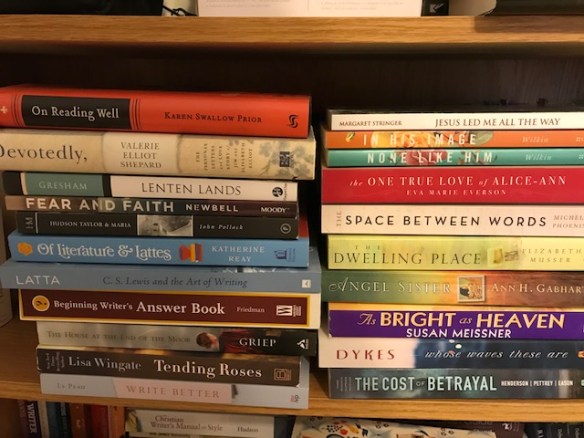
Book Review: On Writing Well

 On Writing Well by William Zinsser is on just about every list of books recommended for writers. The subtitle, which I assume is not originally Zinsser’s and was added later, is “The Classic Guide to Writing Nonfiction.”

Zinsser lived from 1922-2015. He began as a journalist, later wrote for magazines, wrote books on a wide variety of topics, and then began to teach writing. That vast experience informs this book.

On Writing Well was published in 1976 and has been updated numerous times. My copy was published in 2016 with a 2006 introduction by Zinsser explaining the most recent update to include the computer era.

The first of the book’s four parts covers “Principles”: grammar, style, word usage, eliminating clutter, etc.

Part 2 deals with methods: the unity of the piece, the lead and ending, and various other aspects.

Part 3 discusses a variety of forms: the travel article, memoir, science and technology, sports, business, arts, humor. I might have been tempted to skip or at least skim through this section, as most of my writing doesn’t fit those categories. But I have a compulsion to read all of a book. And I am glad I did. A couple of the principles in this section are:

De-jargonize. Almost any field has its own vocabulary. One business hired Zinsser specifically to help them with communication, because even their engineers couldn’t understand each other any more. In one exercise, he had educators rewrite “Evaluative procedures for the objectives were also established based on acceptable criteria,” keeping in mind “clarity, simplicity, brevity, and humanity.” The best result: “At the end of the year we will evaluate our progress” (pp. 171-172).

Focus on the human element no matter what you’re writing about. He gave an example about race car driving, something I have zero interest in. But the piece grabbed me because it shared one person’s story rather than a detailed technical report.

Part 4 explores attitudes: developing confidence and your own style, etc. In one chapter in this section, he gives readers a window into his thought processes by taking them through a longer piece he wrote and discussing why he made the choices he did.

The “clarity, simplicity, brevity, and humanity” mentioned earlier are what the author calls his “four articles of faith” (p. 171). Those are his main themes, demonstrated by example time and again.

This book is chock-full of good instruction and tips. I have markings and sticky tabs on almost every other page. Here are a few of the standout quotes:

Writing is hard work. A clear sentence is no accident. Very few sentences come out right the first time, or even the third time. Remember this in moments of despair. If you find that writing is hard, it’s because it is hard (p. 9).

The race in writing is not to the swift but to the original (p. 34).

Every successful piece of nonfiction should leave the reader with one provocative thought he or she didn’t have before. Not two thoughts, or five—just one. So decide what single point you want to leave in the reader’s mind (p. 52).

Don’t annoy your readers by over-explaining—by telling them something they already know or can figure out. Try not to use words like “surprisingly,” “predictably,” and “of course,” which put a value on a fact before the reader encounters the fact (p. 91).

True wit, however, is rare, and a thousand barbed arrows fall at the feet of the archer for every one that flies (p. 194).

Don’t alter your voice to fit your subject. Develop one voice that readers will recognize when they hear it on the page (p. 231).

Now, if I could only keep all these wonderful helps in mind all the times I’m writing! I generally only read 3-4 pages at a time so I could process as I went. But I think this is a book I’ll need to reread often in the coming years.

Have you read On Writing Well? What was a major takeaway for you?

(Sharing with Booknificent, Carole’s Books You Loved)