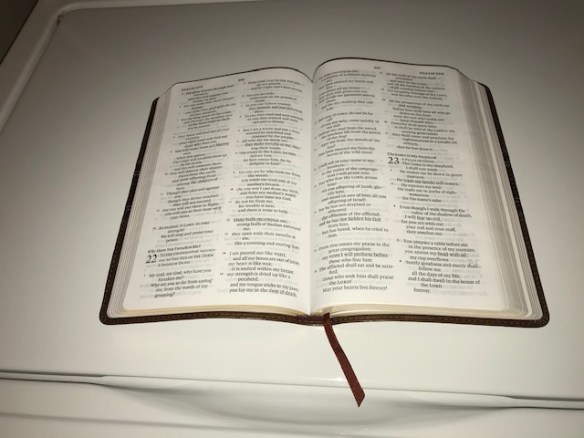
I love that Deborah emphasized engaging the Scripture—not just reading an assignment, not just searching for information. Rather, “we are to read intentionally with the purpose of hearing from God, knowing Him, deepening our relationship, and nourishing our soul” (p. 28).
Deborah has chapters on the importance of God’s gift of His Word, dealing with distractions, further explanation about what’s involved in engaging the Scripture. Then she has a chapter for each aspect of engaging Scripture: reading, writing, meditating, memorizing, and praying it. A later chapter shares ways to interweave these practices (meditating while memorizing, praying verses while writing them, etc,)
Each chapter is fairly short: three to six pages of text, a page of personal reflection about the chapter, a section on resources for implementing the chapter, and a practice page or two.
Each chapter includes multiple ideas for engaging, with the encouragement to chose which works best with your wiring, schedule, and season of life. Tidbits of advice, encouragement, and wisdom are interspersed throughout the pages. Just a few:
Experiencing distractions during our quiet time does NOT make us a failure (p. 34).
Overwhelm often results in total abandonment. Start small. Experience success. Then incorporate additional ideas as you move forward (p. 39).
The physical food we take into our physical body does not nourish us unless we properly digest it and take it into our cells. Just as physical food is needed for physical strength, spiritual food is necessary for spiritual strength. The Word you read (the spiritual food) must be chewed, digested, taken into your being, and one way to chew your food is by memorization (p. 100).
Deborah has mastered the art of writing the way writers for the Internet are advised to: short paragraphs and lots of white space. The book isn’t long, but its style makes it seem even more manageable.
This is a wonderful resource that I highly recommend.
What does mentoring mean to someone desiring to be mentored? Sometimes women have a specific area where they feel they need help. Some just want to have an older go-to person to ask questions.
Dictionary.com defines mentor as “a wise and trusted counselor or teacher; an influential senior sponsor or supporter.” But how do people work mentoring out into real life? Classes? Regular meetings? Shadowing?
The word “mentor” is not in the Bible—at least, not in the KJV or ESV. Probably the closest the Bible comes to the concept is discipling. The classic passage for women disciplining women is Titus 2: 3-5:
Older women likewise are to be reverent in behavior, not slanderers or slaves to much wine. They are to teach what is good,and so train the young women to love their husbands and children,to be self-controlled, pure, working at home, kind, and submissive to their own husbands, that the word of God may not be reviled.
It’s always important to look at the context of a Bible passage, and the context here is teaching and relating life to sound doctrine (verse 1). Then the character of a teacher or mentor is addressed. Several translations describe this older woman as reverent; others use the word holy. She’s trustworthy: she doesn’t spread gossip. Your secrets are safe with her. And she’s self-controlled, not given to excess.
What I’d like to suggest now is that mentoring doesn’t have to be a formal arrangement. You may have one person that you go to with every question and concern. That’s fine if you have such a person. But I have found that God has sent different women across my path with just a word in season that I needed at the moment. I’d like to tell you about a few of them.
Mr. and Mrs. B. were the pastor and wife we were under in our college days and then our first few married years. They were an older couple. Mrs. B. was kind, warm, wise. But she also laid things on the line. When I was struggling with some issue and finally ready to do whatever it took to deal with it, Mrs. B. was the person I would go to. I knew she would give it to me straight, yet kindly.
Mrs. C. was a lady whose family came to our church while I was away at college. When I came home for the summer, the family invited me over for dinner several times. They soon became a second family to me. I don’t remember Mrs. C. ever specifically trying to teach me anything, but I learned so much from her example, her character, her response to her husband, her homemaking.
These two relationships were long-term, but sometimes God had an older friend say something helpful in passing. For instance, once while working in the church nursery, another lady mentioned that she had hit the highest emotional highs and the lowest lows in the context of mothering. That stopped me in my tracks, because I had thought something similar, but hadn’t quite put it into words. I don’t think we discussed it any further, but her comment let me know that my feelings were normal. Another time, I was putting up a church bulletin board with a lady who had teenagers while my children were younger. She gave me some off-the-cuff advice not to dread the teen years. She said teens don’t all go through rebellious phases, and if the relationship has been good all along, there’s no reason it can’t continue to be good. That lifted a weight and gave me a healthy perspective of my children’s upcoming teen years, and I’ll be forever grateful.
Once I was doing something in the church building while the group who ministered to the seniors at church were setting up a banquet for them. That kind of preparation can get hectic. The wife of the couple involved, a very sweet woman, came into the kitchen to look for something. While she stood there a moment, gathering her thoughts and looking at cabinets, her husband came in behind her with an urgent question. He couldn’t see her face, but I saw her close her eyes a moment and then give him a calm answer. Whether she was thinking through the answer to his question or changing gears from her own pursuit, I don’t know. But my impression was that in a moment of being overwhelmed, she took just a beat or two to gain control and answer kindly when she might have wanted to be left alone to finish her own task.
Another older lady had to retire from her loved job due to what some considered unfair circumstances. I know this woman was hurt, but I never once heard her badmouth her employers. I watched as she sought out several different new ways of ministering until she found her new niche, and her efforts continued to make a different in other people’s lives.
The one factor all of these examples have in common is that they arose naturally, in the normal course of life and ministry.
There’s nothing wrong with setting up classes and seminars. I have learned boatloads from many great and mostly unknown women teachers. I’ve sought specific counsel from older women at times.
There’s nothing wrong with a formal one-on-one relationship specifically for the purpose of mentoring.
But a mentor does not have to be a formal teacher and may not have that kind of relationship with anyone. Even if she does, we’re all called to the kind of walk where our example teaches and where we’re so yielded to and in tune with the Holy Spirit that He can work though us in the course of everyday life. I think of this as organic, natural mentoring. I don’t remember in any of these cases praying for God to send an older, godly woman my way. But He did, because He knew I needed them.
It’s fine to pray for a mentor, to work through a book or Bible study together, to have a list of questions to discuss. Sue Donaldson has some great ones here. But I also saw a list of 100 questions to ask of a mentor. Honestly, that sounds exhausting. No one wants to feel grilled interrogated. If you want to approach someone with questions, I wouldn’t bring that many. And I’d suggest questions from your own heart rather than a list, things you would like to ask an older, experienced lady about living the Christian life in a way that honors the Lord.
But beyond questions, we can learn much just by spending time with these women and observing their walk and demeanor. I know I have probably asked older women specific questions, but I don’t remember most of those conversations. For some reason, I’ve remembered these instances I shared here for years. Many of them were foundational or transitional to my thinking. And the women in question probably didn’t even know they had said something that affected me. I don’t think I knew it myself at the moment. It probably took time to process their advice, comments, or example. A guest preacher at our church years ago once said that often, when the Holy Spirit uses us, we’re unaware of it.
That’s the kind of godly, older-ish woman I want to be: one who walks closely with the Lord, filled with His Spirit and His Word and a love for others, available for His use in everyday life and conversation.
Have you had such a mentor in your life—someone who wasn’t officially a teacher, yet taught you by word or example? I’d love to hear about them in the comments.
It’s Friday, time to count the blessings of the week with Susanne and other friends at Living to Tell the Story.
I’m full this week—with good food from Thanksgiving and with the riches of a great week. Here are a few:
1. Thanksgiving. All the special foods, time with family, FaceTiming with my oldest son, playing games, eating again. This year we added something new. I’ve wanted to set up a Thanksgiving tree for ages but just never got to it. I cut out a rough tree, bought some leaf shapes, then had them sitting on the counter through the week for people to write what they are thankful for on a leaf and put it on the tree.
2. Take-out is one of my favorite things, as I have mentioned. 🙂 We’ll often get something out on the weekend. But the Wednesday before Thanksgiving, I was catching a little nap in the afternoon after a very busy day. I’d had to make another run to the store for things the first store was out of, my laundry got pushed back because I was out most of the day I usually do it, plus I had a pie to bake and Thanksgiving dinner to prepare for. When I woke up, Jim mentioned getting dinner from a new Asian place he wanted to try. Not only did I appreciate not having to make or clean up dinner, but my heart was warmed by his thoughtfulness.
3. A breakfast date. Jim was off all this week, so one morning we went to Shoney’s breakfast bar. We spent almost two hours just talking after we ate.
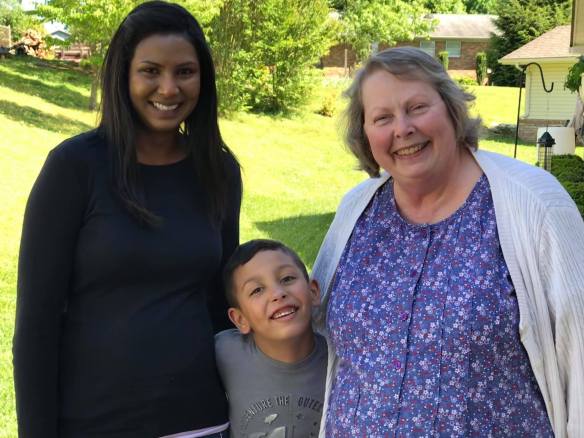
4. Playing with Timothy. Mittu had suggested we might come by some morning this week since Jim was off work and Timothy didn’t have school this week. So we brought lunch and talked and played a while. While we were making shapes with kinetic sand (something like Play-dough, but a different texture), Timothy said, “Grandma, I love you.” ♥ Then later in the week at our house, he played chef and server with some amusing outcomes.
5. An early anniversary gift. Because our anniversary is right in the middle of Christmas season, we usually just exchange cards and go out for a nice dinner. But since this year is our 40th, we’ve been talking about doing something different. The kids got together and got an early anniversary card and Visa gift card to contribute to anniversary plans.
Bonus: Jim’s mom’s main bath aide from hospice stopped by to drop off something for us. The hospice group had had a memorial for the families they had worked with who had lost loved ones this year. We did not go: we had had two memorials already, and didn’t want to attend this one with mostly strangers. They had ornaments for each family engraved with our loved one’s name, and this lady brought ours to the house. It was good to chat with her again and catch up with what she had been doing.
I was going to post my monthly round-up on Saturday. But then I thought it might get lost in the shuffle of Black Friday shopping and Christmas decorating. So I’ll look back over November a little early.
November is a nice transition month from a restful time to the holidays. The weather has been crazy: up and down and even an early snowfall.
Since there were not a lot of outside items on the calendar until Thanksgiving, we got to have a great outing at Cade’s Cove.
We had two long-term answers to prayer in our family this month. My oldest son was trying to buy a condo and applied for first-time home buyer’s assistance in his state (RI). That involved an inspector coming out to see what needed to be done and the homeowner making the necessary repairs. That process took several weeks. Then an inspector had to come back and approve everything that was done. Well the inspector added a few items, one being painting the outside of the building. This was a condo—the homeowner can’t paint the outside of the building! This had all dragged on so long, and the homeowner needed to sell, so he and my son worked together to get the price that was needed and to forget about the home-buyer’s assistance (makes you wonder if that was the inspector’s purpose . . .).
Then, my youngest son has been searching for a job for I don’t know how long. If he had the least bit of experience (in computer programming), he would have had no problem. But getting someone to take that first chance on you can take a while. He had a lot of interviews, a lot of second interviews, but everyone went with someone else. Finally he went to an interview where the staffing agency thought he might be a little “green” for the job, but figured they’d chance it anyway—and Jesse was offered a job on the spot! It’s not in programming: it’s an IT help desk. But it’s in his field. The company does have a programming department, so it might be possible to move into that at some point.
Throughout these processes, as I prayed for them, I knew God’s timing was perfect. Yet in the midst of a long, drawn-out waiting time, it’s hard not to feel strained. I prayed God would be working His will in their hearts as they waited on and looked to Him.
Transitioning to winter involves getting out sweaters and throw blankets and using the oven for meals again. It’s nice to get back to some of those heartier meals.
We’re looking forward to good food and having the family together tomorrow. Everyone will be here except my oldest son, who is coming for Christmas.
Creating
I made no cards this month, but I’ll have extra on my plate for next month. Maybe I should have started early . .
Timothyisms.
I know for some of you the Timothyisms from my grandson are your favorite part of these posts.:) I shared earlier some of his texts to me and this one from his dad:
Some of his other sayings:
After Halloween:
T: I know what a reefor (reaper) is, daddy.
J: What is it?
T: A farmer! (The blade cuts vegetables.)
He’s really into jokes now. One he made up himself:
T: Where do green eggs come from?
J: Where?
T: A green goose, of course!
When his parents got him some sleeveless undershirts: “Now I look like a workout guy!”
After learning about Moses and Pharaoh, they were re-enacting the story. Timothy, as Moses: “I got my superpowers from God, so you have to let my people go!”
Watching
We enjoyed watching the new movie Klaus and the new live-action version of Lady and the Tramp together as a family, both very nice. My husband indulged me in watching The Knight Before Christmas. During lunchtime Jesse and I, and Jim when he was available, watched the Netflix series Raising Dion about a mom who discovers her seven-year-old son has superpowers. That sounds like it could be a very cutesy premise, but it got really intense at points! It held us pretty spellbound. We also finished watching Merlin. I’ve written before about not being ok with magic as it is presented in some stories, but concluding that fairy-tale magic is a different thing than what real witches do. Nevertheless, a lot of the incantations in Latin or some other language in this series disturbed me. But aside from that, I loved the story, even if they did change it up from the legend as it’s usually known.
Reading
Reading is a must for me, and this month I completed (titles link to my reviews):
The Printed Letter Bookshop by Katherine Reay. A young lawyer about to make partner finds out she has inherited an estranged aunt’s bookshop. Good story and a lot of fun literary references.
Canteen Dreams by Cara Putnam. WWII story based on the author’s grandparents. Very good.
Jessie’s Hope by Jennifer Hallmark. A wheelchair-bound young woman plans her wedding and tries to reach her estranged father.
Canteen Dreams by Cara Putnam. WWII-era love story based on the author’s grandparents. A young man unable to enlist because he’s the only son of a farmer struggles with being left behind. A young woman plunges into helping the cause by serving at a canteen set up for soldiers on their way to the front. Very good.
Swiss Family Robinson by Johann David Wyss. Classic story of a family shipwrecked on a deserted island.
I’m currently reading:
On Writing Well by William Zinsser. Almost done with this one!
God’s Deadlines. God is longsuffering and merciful, but at some point the time to repent or to do good will be over.
What I Learned From Bare Trees. I can get a little down when the trees are bare and the landscape looks a little desolate. But learning the reasons behind the trees letting go of leaves led to some unforeseen spiritual lessons.
Biblical Thankfulness. It’s wonderful to thank God for food, protection, and answered prayer. But there’s so much more to be thankful for.
Writing
I’ve had a few good editing sessions, but writing will probably take a back seat during the holiday season. I was excited to receive an Honorable mention from a Writer’s Digest contest in the Inspirational/Spiritual category. I was surprised since my entry was basically my testimony, and this is a secular magazine. I wasn’t even sure I should mention it, since it was “just” honorable mention. But they sent me these neat stickers and a list of ways to use them, so I guess it’s ok. The biggest takeaway for me was just the encouragement that I’m progressing in the right direction.
Thanksgiving
Since I am posting this before Thanksgiving, the biggest event in November, I want to wish you a very happy and thankful day.
Finding a good translation of Swiss Family Robinson is not as easy as one would think.
The book was written by a Swiss pastor, Johann David Wyss, and originally published in 1812. Wyss wrote the story for his sons to teach about spiritual and family values, industriousness, and wise uses of plants and animals. One of his sons edited the book and one of them illustrated it (both named Johann, like their father, but with different middle names).
After that, the book passed through multiple hands which translated and added to or deleted from the story. I listened to an audiobook version and scanned a Kindle version which were alike at the beginning but had different characters and scenes in the second half.
The story, as I am sure you know, involves a family of two parents and four sons shipwrecked on an island somewhere in the East Indies. The family name is not Robinson: their last name is never mentioned. The book is styled somewhat after Robinson Crusoe: he is even referred to often in the book.
Their first order of business is to get as much as they can off the ship before it sinks and to find suitable shelter. They are able to gather some food from the ship, but then need to search the island to see what they can find.
Fortunately, the father has a wealth of knowledge of botany. He knows the scientific names of plants as well as their uses. One book I read recently said ministers of a certain era were expected to know a lot about botany. That may be the case here, or it may have just been an interest of Wyss’, or he may have crammed as much as possible into the story as a teaching tool.
They also get acquainted with the fauna as well as the flora. They use some animals as food and tame others to help them in their work.
The first half of the book details how they discovered the resources of the island and made a place for themselves. The only real danger they run into is a pack of jackals.
At the end of this section (what I think is the end of the original book), the family is content on their island and want to remain there. They’ve constructed various building projects and have plans for a sawmill and other industries. The father’s only concern is that his children will be alone when he and his wife pass on.
In the version I listened to, the father then espies a vessel at sea after about four years on the island. He meets a couple of men from the ship and gives them the journal he has kept. The men were exploring the island to see if it was suitable for the ship to land. They plan to put their people on boats and bring them in the next day. But a storm drives them out to sea again, and the family fears they ship is lost.
There’s a lot more drama in the second half: a couple of serious injuries, a massive storm, encounters with “savages” from another island. They discover a European missionary and a widow with two daughters on this island. The ship they had encountered was not lost at sea, but eventually made it home, along with the father’s journal. Another ship comes back to find them, and then decisions are made as to their future.
In the Kindle version, which happened to be the Kingston translation and is apparently more well known, the time jump in the second half is closer to ten years. The family discovers a girl who has been shipwrecked, Jenny Montrose. Eventually a ship comes looking for her, and decisions have to made about everyone’s future.
The first part is interesting, but a little dry, since the only action is discovering certain plants and animals, building a couple of different homes, handling whatever problems come up. The second half drew me in more since there was more action.
The four boys’ personalities are well-drawn and distinct.
Christian values form a major part of the story. The father corrects the children in various ways (especially in manifestations of pride). The family prays together, keeps Sunday set apart, applies Christian principles to life. One example, when they first discover the sailors on the ship have left them behind:
See how those on whose skill and good faith we depended have left us cruelly to our fate in the hour of danger. God will never do so. He has not forsaken us, and we will trust Him still. Only let us bestir ourselves, and each cheerily do his best. Who has anything to propose?
All in all, it was an enjoyable story. It was written for young people, but I wonder how it reads for young people now.
Near the end, the father in the story writes:
And my great wish is that young people who read this record of our lives and adventures, should learn from it how admirably suited is the peaceful, industrious and pious life of a cheerful and united family, to the formation of strong, pure and manly character.
You’re probably familiar with the 1960 Disney film version (which added pirates to the mix). We saw it ages ago, but I’d like to see it again some time now that I’ve read the book. There have been various other film versions as well. When my children were young, we saw a cartoon series version from the viewpoint of a daughter.
Besides Wikipedia, a couple of interesting articles about the book are:
Open Edition’s Swiss Family Robinson goes into more extensive detail about the translations and plot.
Here’s to you, Swiss Family Robinson, which says the book was highly popular in its day, but eventually Heidi outranked it (mainly because Heidi came back to Switzerland and [spoiler alert] the family in Swiss family Robinson did not).
We know thanksgiving is not just a day in November, but it is an activity we’re supposed to engage in year-round. But our annual thankful holiday does help turn our thoughts a more grateful direction.
In past years I’ve made lists of what I am thankful for throughout November, either once a day or all on Thanksgiving Day. I usually ended up with pretty much the same items on my list. That’s fine. We should continue to be thankful for what we have every year.
It’s harder to be thankful some years. Health issues cropped up, loved ones are no longer with us, finances have taken a downturn. The Bible speaks of the “sacrifice of praise”: “Through him then let us continually offer up a sacrifice of praise to God, that is, the fruit of lips that acknowledge his name.” (Hebrews 13:15). I’ve often wondered at that wording. “Sacrifice” hearkens back to some of the OT sacrifices, but here it is applied specifically to praise. I’ve thought that perhaps it’s a sacrifice because we have to turn our attention from ourselves to God. But maybe it’s also a sacrifice because we do it whether or not we “feel” it. Joni Eareckson Tada has said, “To give thanks is not the same as ‘feeling thankful.’ To give thanks in the midst of pain and problems is to take a step of faith based on the command of 1 Thessalonians 5:18: God tells us to give thanks in all circumstances (not just those we can handle or feel on top of). For what things can you give thanks, even while you’re hurting?”
C. S. Lewis said, “We ought to give thanks for all fortune: if it is ‘good,’ because is it good, if ‘bad’ because it works in us patience, humility, and the contempt of this world and the hope of our eternal country.”
One year I did a study on thanks and thanksgiving in the Bible.Just one aspect of it was noticing what people in the Bible thanked God for. It’s perfectly fine to thank God for material blessings and the people He has placed in our lives. But we can expand our thanks to include:
Attributes of God Himself
God’s goodness. “Oh give thanks to the Lord, for he is good, for his steadfast love endures forever!” (I Chronicles 16:34; Ezra 3:11; Psalm 106:1; 107:1; 118:1, 29; 136)
God’s holiness. “Sing unto the LORD, O ye saints of his, and give thanks at the remembrance of his holiness.” (Psalm 30:4, KJV)
God’s righteous judgments. At midnight I will rise to give thanks unto thee because of thy righteous judgments. (Psalm 119: 62, KJV)
God’s greatness. “Oh come, let us sing to the Lord; let us make a joyful noise to the rock of our salvation!Let us come into his presence with thanksgiving; let us make a joyful noise to him with songs of praise!For the Lord is a great God, and a great King above all gods.” (Psalm 95:1-3)
God’s power and reign. “We give thanks to you, Lord God Almighty, who is and who was,for you have taken your great power and begun to reign.” (Revelation 11:17)
God’s love and wonderful works. “Let them thank the Lord for his steadfast love, for his wondrous works to the children of man! And let them offer sacrifices of thanksgiving,and tell of his deeds in songs of joy!” (Psalm 107:21-2)
What God gives us or does for us
Saving us. “Giving thanks to the Father, who has qualified you to share in the inheritance of the saints in light. He has delivered us from the domain of darkness and transferred us to the kingdom of his beloved Son,in whom we have redemption, the forgiveness of sins.” (Colossians 1:12-14)
Bearing us. “Blessed be the Lord, who daily bears us up; God is our salvation.” (Psalm 68:19)
Victory over death. “Death is swallowed up in victory. ‘O death, where is your victory?O death, where is your sting?’ The sting of death is sin, and the power of sin is the law.But thanks be to God, who gives us the victory through our Lord Jesus Christ.” (1 Corinthians 15:54b-57)
Deliverance from mourning. “You have turned for me my mourning into dancing; you have loosed my sackcloth and clothed me with gladness, that my glory may sing your praise and not be silent.O Lord my God, I will give thanks to you forever!” (Psalm 30:11-12)
Comfort: “Blessed be the God and Father of our Lord Jesus Christ, the Father of mercies and God of all comfort,who comforts us in all our affliction, so that we may be able to comfort those who are in any affliction, with the comfort with which we ourselves are comforted by God.” (2 Corinthians 1:3-4)
Causing us to triumph, making Himself known through us. “Now thanks be unto God, which always causeth us to triumph in Christ, and maketh manifest the savour of his knowledge by us in every place.” (2 Corinthians 2:14, KJV)
God’s provision, enough for ourselves plus for giving to others. “He who supplies seed to the sower and bread for food will supply and multiply your seed for sowing and increase the harvest of your righteousness.You will be enriched in every way to be generous in every way, which through us will produce thanksgiving to God.For the ministry of this service is not only supplying the needs of the saints but is also overflowing in many thanksgivings to God. (2 Corinthians 9:11-12)
God’s inexpressible gift. “Thanks be to God for his inexpressible gift!” (2 Corinthians 9:15)
Food. “. . . foods that God created to be received with thanksgiving by those who believe and know the truth.For everything created by God is good, and nothing is to be rejected if it is received with thanksgiving,for it is made holy by the word of God and prayer.” (1 Timothy 4:3b-5)
Authorities. Really? Yes: “First of all, then, I urge that supplications, prayers, intercessions, and thanksgivings be made for all people,for kings and all who are in high positions, that we may lead a peaceful and quiet life, godly and dignified in every way.” (1 Timothy 2:1-2)
Other people.
“But thanks be to God, who put into the heart of Titus the same earnest care I have for you.” (2 Corinthians 8:16)
“I do not cease to give thanks for you, remembering you in my prayers . . .” (Ephesians 1:16)
“We always thank God, the Father of our Lord Jesus Christ, when we pray for you,since we heard of your faith in Christ Jesus and of the love that you have for all the saints” (Colossians 1:3-4) (See also I Thessalonians 1:1-3; 3:9-10; II Thessalonians 2:13-14.)
Everything.
“Giving thanks always and for everything to God the Father in the name of our Lord Jesus Christ.” (Ephesians 5:20)
“Give thanks in all circumstances; for this is the will of God in Christ Jesus for you. ” (1 Thessalonians 5:18)
“Blessed be the God and Father of our Lord Jesus Christ, who has blessed us in Christ with every spiritual blessing in the heavenly places.” (Ephesians 1:3)
This is probably just the tip of the iceberg! I’m sure further study would reveal even more things to be thankful for in the Bible.
I’ve been looking for a quote that I thought came from Martin Luther, but I can’t seem to find it with various searches. But it went something like this: God saved me when I didn’t deserve it. I could and should thank Him eternally for just that. Anything else He gives me or does for me after that is just extra blessings. (If you know this quote, please share in the comments. I would be so grateful.) We’re truly “loaded with benefits”: “Blessed be the Lord, who daily loadeth us with benefits, even the God of our salvation.” (Psalm 68:19, KJV).
No doubt August Storm had done a thanksgiving study of his own when he composed this hymn in 1891:
Thanks to God for my Redeemer, Thanks for all Thou dost provide! Thanks for times now but a memory, Thanks for Jesus by my side! Thanks for pleasant, balmy springtime, Thanks for dark and stormy fall! Thanks for tears by now forgotten, Thanks for peace within my soul!
Thanks for prayers that Thou hast answered, Thanks for what Thou dost deny! Thanks for storms that I have weathered, Thanks for all Thou dost supply! Thanks for pain, and thanks for pleasure, Thanks for comfort in despair! Thanks for grace that none can measure, Thanks for love beyond compare!
Thanks for roses by the wayside, Thanks for thorns their stems contain! Thanks for home and thanks for fireside, Thanks for hope, that sweet refrain! Thanks for joy and thanks for sorrow, Thanks for heav’nly peace with Thee! Thanks for hope in the tomorrow, Thanks through all eternity!
Here’s some noteworthy reads I’ve come across recently. Perhaps you’ll find something that speaks to you here.
With Thanksgiving coming up, naturally there are a lot of posts about being thankful and content. A few of the best:
Secret to a Contented Heart. “Satan doesn’t come at most of us with temptations to take drugs or rob banks. His main temptation is to rob our joy and rob God of glory by keeping a bunch of unhappy, complaining, whining women on the loose.” (Ouch—in a good way.)
Countless Blessings from a Generous God. “We’ve heard it said to count our blessings. But if we look at the shocking amount of blessings a generous God extends to us, they are hard to number.”
How to Celebrate Thanksgiving in the Chaos. “I am tempted to cancel Thanksgiving this year…I toyed with the idea for a whole 10 minutes, and then I remembered escaping from reality is never a healthy decision. Plus, the Holy Spirit also reminded me that I am called to let my little light shine in dark places. Sometimes those dark places are at the dinner table with stuffing and cranberry sauce.”
What if You Lost What You Weren’t Thankful For. “What people would you miss if you hadn’t taken time to thank God for them? Not just the ones in your family, but the ones who grow your food, repair your car, treat your illness, and serve your coffee.”
There Are No Extraordinary Means, HT to Challies. “What we want are extraordinary fixes to ordinary problems. In this desire we miss the reality that there’s always something else to fix, there’s always something else to do, and there’s always something we’ll miss. Looking for extraordinary means is a roadmap to variously intense levels of personal frustration. Ordinary means of grace are sufficient because our problems are ordinary.”
Don’t Confuse Spirituality with Righteousness, HT to Challies. “I cannot achieve righteousness without spirituality. But it is possible to be ‘spiritual,’ at least on the surface, without attaining righteousness.”
“Worthy?” also HT to Challies. This deals with the idea that we tend to come to God when we feel worthy and avoid coming when we don’t feel worthy. “Are you worthy? No. But Jesus doesn’t require fitness from you. You only have to feel your need of him. You only have to see that his worthiness is sufficient for you.”
It’s Friday, time to count the blessings of the week with Susanne and other friends at Living to Tell the Story.
Here we are near the end of November already, and Thanksgiving next week. But we don’t have to wait til Thursday to be thankful! Here are a few things I’ve appreciated the last few days:
1. My youngest son got a job! He has been working on it for a long time, and finally got a “yes!” He has to wait for results from a background check and drug test, but those shouldn’t be problems.
2. Dinner and a movie at home. Jason and Mittu brought over dinner last Friday and then we all watched Klaus together. It was a pretty cute movie.
3. Ladies Bible study group met last Saturday. Always a joy.
4. Sweaters and throw blankets. This time of year, they add just the right layer of warmth.
5. Sleep. For some reason, I woke up in the middle of the night and then couldn’t get back to sleep for 2-3 hours. I went back to bed this morning after Jim left, so I don’t feel quite as much like a zombie as I did at first. I’m thankful I have the kind of schedule that allows me to go back to bed, but I regret losing daytime hours to sleep that should have come during the night.
Bonus: A text from Jason about my grandson, Timothy. Looks like someone is eager for Christmas. 🙂
Tarissa of In the Bookcase hosts the Literary Christmas Reading Challenge each year in November and December. The basic idea is to read Christmas books! Since I like to read Christmas books in December anyway, this challenge was a nice fit. The details of the challenge are here.
One of the requirements of the challenge is to write a post expressing our intent to participate and sharing what we’ll be reading.
I have these books on hand and hope to read as many of them as possible:
Canteen Dreams is a novel based on author Cara Putman’s own grandparents. It was her first book, released eleven years ago. But Cara wanted to fine-tune and re-release it. This edition came out on 2017.
The story opens December 6, 1941. Audrey Stone attends a dance in her home town of North Platte, Nebraska, and is asked to dance by local rancher’s son, Willard Johnson. Willard is interested and wants to get to know Audrey better.
Then Sunday morning, the Japanese attack Pearl Harbor, and everything changes.
Willard’s brother, Andrew, was in the Navy. While the family waits to hear about Andrew, Willard would like nothing better than to enlist immediately.
But Willard’s father won’t let him. Farming and ranching are exempted occupations, since the country needs their work. Willard’s father feels he needs Willard’s help more than the military needs him.
Since North Platte is a railroad hub, and lots of troops come through on their way to service, someone gets the idea to offer the boys food and coffee during their brief stop. The young men are so encouraged and appreciative of the effort that the train stop refreshments grow into a canteen, with a nearby building, music, sandwiches, and a friendly atmosphere.
Audrey throws herself into working the canteen, on top of her full-time job as a teacher. She has little time for anyone or anything else, which doesn’t help her budding relationship with Willard.
Willard’s dissatisfaction with not being able to enlist grows into resentment and jealousy of the young soldiers at the canteen, which further impacts things with Audrey.
Both Willard and Audrey are believers and struggle with seeking God’s will for their lives. I liked their pastor’s counsel, especially these bits:
Let the sure hope we have in Christ build a bedrock of faith in your life. It’s the only way to survive a storm like the one your family has entered.
He is the vine, and we are the branches. We cannot expect to have the strength to lay down our lives, our rights, for others until we are firmly growing in a deep relationship with Christ. A superficial relationship is not sufficient. Without more, we will fail every time in our attempts to die, because we attempt to do it without the strength and love God gives.
This was a sweet story in itself, but knowing it was based on a real couple made it even more enjoyable.