Unknown's avatar

About Barbara Harper

https://barbarah.wordpress.com

What’s On Your Nightstand: September 2018

Nightstand82The folks at 5 Minutes For Books host What’s On Your Nightstand the last Tuesday of each month in which we can share about the books we have been reading and/or plan to read.

I checked my calendar yesterday morning, but I somehow got my weeks mixed up and thought I had another week before the Nightstand post! Instead, I am a day late. Oh, well…

Since last time I have completed:

The Guernsey Literary and Potato Peel Pie Society By Mary Ann Shaffer and Annie Barrows, reviewed here. Loved this! And the movie was wonderful, too, despite a few changes to the plot.

Julia’s Hope by Leisha Kelly, reviewed here. Loved this story about a family struggling during the Depression who ends up sharing a house with an elderly amputee.

Tea With Emma by Diane Moody, reviewed here. Something of a modern take on Jane Austen’s Emma. It was…okay.

Reclaim Your Life from IBS: A Scientifically Proven Plan for Relief without Restrictive Diets by Melissa G. Hunt, reviewed here. Both practical and helpful.

Helen Roseveare: On His Majesty’s Service by Irene Howat, reviewed here.

The Scars That Have Shaped Me: How God Meets Us in Suffering by Vaneetha Rendall Risner, reviewed here. Excellent. Deep. Convicting.

I’m currently reading:

Emma’s Gift by Leisha Kelly

The Lost Castle by Kristy Cambron

Rereading Women of the Word by Jen Wilkin

I’ve been using my normal audiobook time to listen to a series of lectures on Classics of British Literature by John Sutherland.

I’m also reading parts of The Elements of Style by William Strunk and E. B. White, but it’s more of a reference book than one to read straight through.

Up Next:

Reading the Bible for Life: Your Guide to Understanding and Living God’s Word by George Guthrie. Some of his blog posts have been very helpful to me, so I am looking forward to his book.

There’s a Reason They Call It GRANDparenting by Michele Howe, recommended by Michele Morin.

I am trying to decide whether my next audiobook with be Amazing Grace: William Wilberforce and the Heroic Campaign to End Slavery by Eric Metaxas or Alvin York: A New Biography of the Hero of the Argonne by Douglas V. Mastriano. I know a little of both men’s stories and would like to learn more.

I have all kinds of Christian fiction in my Kindle app and on my shelf, but I am not sure which one will be next.

I think that wraps up by reading activity for this month! Are you reading anything good?

Book Review: Julia’s Hope

JuliaIn Julia’s Hope by Leisha Kelly,  Samuel Wortham is out of a job, like so many others in the early 1930s. Not only did his business close, but the investment he financed with money from his wife’s inheritance failed. The family has just a few dollars. Sam’s cousin says there’s work for Sam in Illinois, so the family is going to hitchhike from Pennsylvania.

Julia, Sam’s wife, is understandably angry with Sam over the lost investment, but she tries to keep a brave face for the children and make the trip an adventure.

It occurred to me then that I ought to pray for help in getting over the anger I felt towards Sam. But I didn’t do it. I guess it was easier to think that I’d forgiven him already and was just entitled to my feelings beyond that.

A few days into the trip, with money gone and the family eating in soup kitchens and sleeping wherever they can, Sam calls his cousin to tell him where they are. He’s told the job fell through and the cousin himself is looking for work.

But when Samuel stepped out of that office, looking like a stormy wind had dashed him against a wall of stone, the clouds descended over me and I turned away. I knew by his face. Dewey wouldn’t be coming. Dewey couldn’t carry all the hopes we’d pinned on him. We were alone.

One day, caught by a sudden downpour, the family takes refuge in an abandoned farm house. Something about it appeals to Julia and the children, so she proposes they find the owner and see if they might be allowed to stay in return for working on the place. Sam thinks the idea is crazy, but Julia is so set, he humors her.

They discover the homeowner is an elderly lady named Emma. She loves the house, but due to a heart condition and the loss of  leg, she can’t live there alone any more, so she has been living in a boarding house in town. Though what the Worthams propose is unconventional, she agrees to let them stay at her house so that it doesn’t deteriorate further.

The Worthams feel like they are taking unfair advantage, though. So within a few days they propose a new situation: that Emma come out and live with them at the house. She agrees.

Emma and Julia both know how to live off the land – what greens are good for food or tea, how to plant seeds and cultivate vegetables etc. But Sam is totally out of his element. He has never farmed and he’s worried about Emma’s care. But there doesn’t seem to be anything else he can do, so he puts forth his best effort.

Emma is a town treasure, so many of her friends check on her and the Worthams. Some of her friends, however, suspect the Worthams have “sweet-talked” her and are out to milk her out of her property, and they make no end of trouble despite Emma’s assurances. One in particular “was a difficult sort, one who was pleased to be displeased.”

My thoughts:

I loved this story. Its main appeal to me is how clearly Leisha communicates the character’s feelings. I ached along with Sam in his financial predicament, his guilty feelings, and his loss of self-respect. I understood Julia’s struggle to put aside her anger,  forgive, and attend to her children in a way that kept them hopeful, rather than afraid. I felt Emma’s joy at being home again.

But I also enjoyed reading about this time era, not one that I can remember seeing much in fiction. I enjoyed the gelling of a new family group. And I appreciate the way the people in the community helped each other though most of them didn’t have a lot themselves.

We all need each other, and that’s how the good Lord intended things to be.

“You think when that boy come bringin’ the Lord bread and fish, that the Lord shoulda just sat an’ ate it all his own self?”

“Well, no, he couldn’t. He fed the five thousand.”

“That’s right,” she said with a smile. “Didn’t look like it, but God’s got plenty for ever’body. So it don’t hurt me none to share.”

The point of view switches between Sam, Julia, and Emma, so we see their different perspectives. The faith element is woven in naturally.

This is the first book in a long time that I stayed up too late to read and had a hard time putting down. I immediately started reading the sequel, and I am looking forward to more with the Wortham family.

(Sharing With Literary Musing Monday, Carole’s Books You Loved, Semicolon‘s Saturday Review of Books)

How to Have a Steady Soul

Unsteady.

I became well acquainted with unsteadiness after contracting transverse myelitis 23 years ago. For a few months afterward, I couldn’t walk on my own. I progressed from a walker to a cane to finally walking without support. But for a long time afterward, anything from uneven ground to someone walking by me quickly or brushing against me would throw me off balance. I had a few falls if I couldn’t grasp anything firm. Though my internal balance mechanism has vastly improved since then, I still have moments of unsteadiness now.

So the phrase “unsteady souls” stood out to me in a recent reading of 2 Peter 2 in the ESV. Other translations say unstable, unestablished, unsettled.

Peter is talking in this chapter – throughout this whole epistle, really – about false prophets and teachers. Chapter 2, verse 14 says “They entice unsteady souls.”

How do false teachers entice these souls? 1 Peter speaks of the false prophets’ sensuality, lust, greed, passion, so they “entice by sensual passions” (verse 18). James 1:14 uses the same Greek word for “entice,” which carries the idea of baiting, alluring, deceiving, when it says, “But each person is tempted when he is lured and enticed by his own desire.” They “despise authority” (verse 10). “They promise them freedom, but they themselves are slaves of corruption” (verse 19). They “exploit you with false words” (verse 3). They’re blasphemous (verses 10-13).

Probably most of the people who fall away to false teachers are not saved in the first place, but weak or new believers are susceptible as well. A true Christian can’t lose his or her salvation, but a believer can get tangled in false doctrines to their own confusion as well as that of everyone on their sphere of influence. But even those of us who think we’re strong need to “take heed lest we fall.” (1 Corinthians 10:12).

How can we make sure we’re not unsteady or unstable spiritually? Peter tells us:

  • Believe on Jesus as Savior and Lord . “Be all the more diligent to confirm your calling and election” (2 Peter 1:10).
  • Know His Word. “His divine power has granted to us all things that pertain to life and godliness, through the knowledge of him who called us to his own glory and excellence,  by which he has granted to us his precious and very great promises, so that through them you may become partakers of the divine nature, having escaped from the corruption that is in the world because of sinful desire” (2 Peter 1:3-4, ESV). Know it not just for facts, but to know Him (2 Peter 1:2-3)
  • Live out God’s Word. Be doers, not just hearers. Because of the above, “make every effort to supplement your faith” with virtue, knowledge, self-control, steadfastness, godliness, brotherly affection, love (2 Peter 1:5-7, ESV)
  • Rest on the Bible’s sure foundation. Know that God’s Word is not “a cunningly devised fable,” but is a “more sure word of prophecy” than even the transfiguration Peter was an eyewitness to. (2 Peter 1:16-19, KJV)
  • Know that Scripture comes from God. “Knowing this first of all, that no prophecy of Scripture comes from someone’s own interpretation. For no prophecy was ever produced by the will of man, but men spoke from God as they were carried along by the Holy Spirit” (2 Peter 1:20-21, ESV)
  • Look to Him. After listing several instances of punishment coming to wrongdoers, Peter assures us “The Lord knoweth how to deliver the godly out of temptations” (verse 2 Peter 2:9, KJV).
  • Confess sin to Him, seek His grace to overcome and resist it: “be diligent to be found by him without spot or blemish, and at peace.” (2 Peter 3:14, ESV).
  • Don’t twist the Scriptures as the unstable do. “There are some things in them that are hard to understand, which the ignorant and unstable twist to their own destruction, as they do the other Scriptures” (2 Peter 3:15-16). The unsteady twist (wrest in the KJV) the very thing which could stabilize them. We read it in context so we understand its meaning. We don’t wrangle it to make it say what we want it to say. We don’t adjust it to us: we adjust ourselves to it.
  • Be watchful. “Take care that you are not carried away with the error of lawless people and lose your own stability (2 Peter 3:17, ESV).
  • Grow in the grace and knowledge of our Lord and Savior Jesus Christ (2 Peter 3:18, ESV)
  • Listen to sound teaching. Contrast the characteristics Peter lists of false teachers in 2 Peter to what he says about godly shepherds in 1 Peter 5. Paul tells Timothy in 2 Timothy 4: “preach the word; be ready in season and out of season; reprove, rebuke, and exhort, with complete patience and teaching. For the time is coming when people will not endure sound teaching, but having itching ears they will accumulate for themselves teachers to suit their own passions, and will turn away from listening to the truth and wander off into myths.” Seek to feed our souls His truth rather than feeding our own desires.

Jesus said the one who hears his words and does them is like a man who built his house on a rock which was unshaken by winds and flood waters.

So we watch ourselves, that we’re not being led away of wrong desires. We read and listen to God’s Word as it’s written, in context, not trying to twist it. We listen to pastors and teachers who faithfully proclaim God’s Word. We we obey it. We get to know our Savior better and better and remind ourselves of His truth. and we keep growing spiritually. Doing all of these things might bring persecution, which Peter discusses often in both of his letters. But we can trust God to keep us and deliver us.

Keep steady my steps according to your promise, and let no iniquity get dominion over me. Psalm 119:133, ESV

(Sharing with Inspire Me Monday, Literary Musing Monday, Tell His Story, Wise Woman, Let’s Have Coffee, Porch Stories, Faith on Fire)

Laudable Linkage

IMG_0195

Here are some noteworthy reads found recently.

On Giving Criticism As a Christian, HT to Challies.

Personality Assessments and the Wondrous Knowledge of Being Known, HT to True Woman. While some personality tests are helpful, Lore Ferguson Wilbert says, they are limited. “I cannot worship at the altar of my personality, but I can look at it honestly and ask the creator God to make and remake me until Christ comes again.”

Biblical CBT (Cognitive Behavioral Therapy) vs. Worldly CBT in relation to depression, HT to Challies. Applying truth to our thoughts.

5 Better Ways to “Argue” About Social Injustice, HT to Challies. If you’re not aware of it, there’s a maelstrom all over the internet concerning just how social justice should be exercised and to what degree it should be under the purview of churches and governments. As with most online storms, there’s more conjecture, accusation, and misrepresentation than there is real conversation.

Lawnmower Parents Are the New Helicopter Parents, HT to Story Warren. “Lawnmower parents go to whatever lengths necessary to prevent their child from having to face adversity, struggle, or failure. Instead of preparing children for challenges, they mow obstacles down so kids won’t experience them in the first place…But in raising children who have experienced minimal struggle, we are not creating a happier generation of kids. We are creating a generation that has no what idea what to do when they actually encounter struggle. A generation who panics or shuts down at the mere idea of failure. A generation for whom failure is far too painful, leaving them with coping mechanisms like addiction, blame, and internalization.”

Hope When Hope Is Lost, HT to Out of the Ordinary. “While we commemorate the stories of freedom fighters, we tend to overlook the vast majority of regular people like my grandmother whose own hopes were sacrificed on the altar of someone else’s ideologies, ambitions, or societal norms. Their stories deserve to be heard as well.”

When Disability Makes Your World Feel Small.

A Writer’s Prayer, HT to Out of the Ordinary.

I’ve read biographies of Amy Carmichael, one of them a few times, and several of her own books. So seeing this tour of the Dohnavur compound that the Lord enabled her to build, where she lived and ministered most of her life and where she died and is buried, meant a lot to me. It was neat to see there are still people there who knew her personally.

Friday’s Fave Five

FFF fall flowersIt’s Friday, time to look back over the blessings of the week with Susanne at Living to Tell the Story and other friends.

OK, I will finally use the fall FFF button, since fall officially starts this weekend, even though it doesn’t feel like fall yet. 🙂 I sure am looking forward to cool breezes, hopefully soon.

Here are some of the best parts of last week:

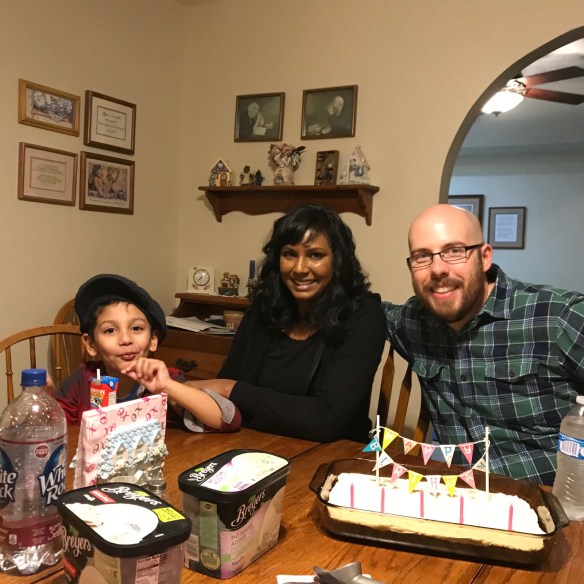
1. Jesse’s birthday. We love birthdays around here.  🙂

IMG_1146

2. Choco-Peanut Butter Dreams. Awkward name, but great taste! They’re not specifically associated with fall, but that’s when I crave them.

IMG_1150

3. Better weather than the forecast. We were supposed to have a couple of days of heavy rain from Hurricane Florence, with flash flood warnings and predictions of power outages. Thankfully none of that occurred. We did get some rain one day, but it was not at all heavy.

I just got an email this morning from a missionary helping with relief efforts on the NC coast. He said Florence has all but dropped from the news, but the devastation it left on the coast is still an issue.

4. Finding an errand done. We use milk for almost all of my mother-in-law’s meals to make her pureed food the right consistency, and we ran out one morning after breakfast. I was originally planning to go to the store the next day, but since I needed to get milk, I was debating whether to get my whole grocery list or just get milk. I decided on the latter, and when I told my husband what I was about to do, he said he had already gotten milk while I was in the shower. So nice to find that taken care of!

5. Clearing out files and baskets. I have a basket on my desk and on the kitchen counter for receipts, mail I need to answer, things I need to think about and take care of later, etc. Naturally those get full occasionally, leading me to go through them. I also cleared out a couple of paperwork files. None were very big or time-consuming jobs, but they needed to get done, and that kind of work is very satisfying sometimes.

Happy Friday!

Book Review: Tea With Emma

 Tea With Emma by Diane Moody is a story within a story.

The outer story has writer Lucy Alexander with writer’s block ever since her beloved aunt died. When Lucy’s father sends her the teacup collection that her aunt had willed to her, Lucy is reminded of their special times together and of the Jane Austen book her aunt had bought for her.

Then Lucy is inspired: she can write a series of stories based on each of the cups. The first one is loosely based on Jane Austen’s Emma.

Next comes the first story, Tea With Emma.

Two lifelong friends, Maddie and Lanie, are just returning from a trip to England. Maddie is inspired to open an English tea shop, and Lanie has agreed to help her. Their giggling and carrying on in the plane annoys the seatmate in front of them, an English professor. In a comedy or errors, the girls and the professor keep running into each other, with near-disastrous results.

When Maddie goes home to her grandmother in Texas, whom she has taken care of since the latter had a stroke, she lays out her plans for the tea room and gets her grandmother’s blessing. She soon discovers that the grumpy professor lives across the street. She tries to befriend him, but he rejects her efforts.

Inspired by Jane Austen’s Emma, but evidently missing what Emma had learned by the end, Maddie feels God’s mission for her life is to be a matchmaker. She encourages Lanie towards the contractor and away from an online computer geek. It does not go well.

Meanwhile the professor has to come to grips with the issues in his life which have made him so cranky.

My thoughts:

I thought the premise would make for a fun, touching story, but I just didn’t connect any of the characters, except maybe the grandmother and the computer guy. Maddie and Lanie seemed juvenile, Maddie seemed pushy, and the professor was just a grouch, at least until he got his heart right. And the transformation from irritation with Maddie to falling in love with her just seemed too quick and unrealistic. Of course, this is a novella, so things had to happen a little faster than they would have in a longer novel.

I enjoyed the theme of letting God have control and following His direction. Both Maddie and the professor became more likeable by the end of the story. I know Jane Austen’s Emma goes through a similar learning curve, but I always found Emma sophisticated and likeable even while I disliked her actions and motivations at the beginning.

Reviews on Amazon were mixed, with some people loving the story and others not, so it may just be a matter of personalities not appealing to everyone. It’s a sweet, clean story. So don’t let me discourage you from trying the book, especially as it’s free for the Kindle at the moment.  I’d love to hear what you thought of it.

(Sharing with Semicolon‘s Saturday Review of Books, Literary Musing Monday)


Book Review: The Scars That Have Shaped Me

ScarsWhen Vaneetha Rendall Risner was a baby in India, she contracted polio before her inoculation. The doctor had never seen a case of polio before, misdiagnosed it, and prescribed a wrong treatment which left Vaneetha paralyzed. Vaneetha had twenty-one operations from age two to thirteen. She spent much of her young life in the hospital and felt safe there and at home,  but was “openly picked on at school.”

She wanted “nothing to do with God because he had allowed all this to happen,” but when she was a teenager, He drew her to Himself.

Vaneetha’s trials weren’t over, though. After her first daughter was born, she had three miscarriages. Her son was born with a heart defect which surgery corrected, but a doctor’s mistake led to her baby’s death at the age of two. Then she contracted post-polio syndrome,  which causes “increasing pain and weakness, which could potentially result in quadriplegia.” There is no cure. Then her husband left her.

The magnitude of any of one of those trials weighs heavy, but all of them together are crushing. How does a person cope with all of that?

Vaneetha tells her story in short order in The Scars That Have Shaped Me: How God Meets Us in Suffering and then spends the rest of the book  sharing what God has taught her through her trials. Her words, like Joni Earecksn Tada’s, carry weight because they are based on Scripture and they’ve been tried in the trenches.

It’s hard to summarize a book like this, so I’ll just share a few quotes:

Our faith is not a facade we erect to convince ourselves and others that pain doesn’t hurt—it is an oak tree that can withstand the storms of doubt and pain in our lives, and grow stronger through them.

I’ve often been devastated when he tells me no, but as I submit to his will in those situations—even with disappointment and tears—he assures me he’s working for my good. I see only part of the picture. He has a purpose in his denials. The Father said no to the Son [in Gethsemane]. And that no brought about the greatest good in all of history. God is not capricious. If he says no to our requests, he has a reason—perhaps ten thousand. We may never know the reasons in this life, but one day we’ll see them all. For now, we must trust that his refusals are always his mercies to us (emphasis mine).

In this life, I may never see how God is using my trials. But one day I will be grateful for them. All I can do now is trust that he who made the lame walk and the blind see, who died on a cross so I could spend eternity with him, is going to do the very best thing for me.

This is the most precious answer God can give us: wait. It makes us cling to him rather than to an outcome. God knows what I need; I do not. He sees the future; I cannot. His perspective is eternal; mine is not. He will give me what is best for me when it is best for me (emphases mine).

Replacing “what if ” with “even if ” in our mental vocabulary is one of the most liberating exchanges we can ever make. We trade our irrational fears of an uncertain future for the loving assurance of an unchanging God. We see that even if the very worst happens, God will carry us. He will still be good. And he will never leave us.

So what do we do when we feel drained and empty? When no one understands our suffering and no one seems to care? When we feel discouraged and tired and unbearably lonely? Read the Bible and pray. Read the Bible even when it feels like eating cardboard. And pray even when it feels like talking to a wall. Does it sound simple? It is. Does it also sound exceedingly hard? It is that as well. But reading the Bible and praying is the only way I have ever found out of my grief. There are no shortcuts to healing.

When I say read, I don’t mean just reading words for a specific amount of time. I mean meditating on them. Writing down what God is saying to me. Asking God to reveal himself to me. Believing God uses Scripture to teach and to comfort me. To teach me wonderful things in his law (Ps. 119:18). To comfort me with his promises (Ps. 119:76). Reading this way changes cardboard into manna. I echo Jeremiah who said, “Your words were found, and I ate them, and your words became to me a joy and the delight of my heart” ( Jer. 15:16).

I mentioned yesterday the concept she brought out that what we think of as the lowest points of our lives are actually the highest, from God’s viewpoint, because that’s often where the most change and growth occurs in our lives. Another concept she described was that we often feel our prayers have not been answered when God doesn’t deliver us out of a situation, but His grace sustaining us through a trial is just as much an evidence of His power as a miraculous deliverance.

In waiting for the huge, monumental deliverance—the kind where I can put my issue to bed and never have to pray about it again—I’ve overlooked the grace that keeps drawing me to him. The prayers that may appear unanswered, but actually are fulfilled in ways that keep me dependent, tethered, needy.

I’ve often wondered about the difference between Biblical lament, such as what we see in the Psalms and other places in the Bible, and complaining. These thoughts helped:

Scripture never mandates that we constantly act upbeat. God wants us to come to him in truth. And so the Bible doesn’t whitewash the raw emotions of its writers as they cry out to God in anguish, fear, and frustration when life ceases to make sense. People like Jeremiah and Job, Habakkuk and David have all poured out their honest feelings of sadness and disappointment to God.

The Bible is shockingly honest. And because of that, I can be honest as well. I can both complain and cry, knowing that God can handle anything I say. The Lord wants me to talk to him, to pour out my heart and my thoughts unedited because he knows them already.

This conversation is different than the grumbling of the children of Israel. They complained about God and Moses to each other. I am talking directly to God. Telling him my doubts. Asking him to help me see. These saints I quoted all talked directly to God, which was the first step to healing. They named their disappointments and voiced their struggles before him. They needed to know that God understood them. And that they could be truthful with him. No pretense or platitudes. Just raw honesty, acknowledging their pain before God.

Like most of us, I would rather learn from others about suffering than have to go through it myself. But some portion of suffering is allotted to all of us, and I am so thankful for a godly example like Vaneetha’s. Much of what she said spoke to my heart even though my trials have been different.

(Sharing with Semicolon‘s Saturday Review of Books, Literary Musing Monday, Carole’s Books You Loved)

Our Valleys Are God’s Peaks

In Vaneetha Rendall Risner’s book, The Scars That Have Shaped Me , she shares an illustration that friends had shared with her. A counselor had asked her friends to make a timeline of the high and low points of their lives, briefly describe each one, and then connect them into up and down graphs. After spending some time on this project, the friends finally finished. Then the counselor asked them to turn their charts upside down. Why? To point out that what we consider the “low” times of life are often the times God is most at work in us, or when we come to know Him significantly better.

“God sees our lowest moments as our spiritual highs because that is when he is doing the deepest work in us…from them come our most significant growth and our greatest dependence on God.”

It’s not that God doesn’t work in the “good” or “high” times: He does, and those are blessings from Him. But it’s usually when we’re experiencing hardship, doubt, pain, need, or other trials that we most seek Him, and, as He promised, find Him. It’s in our weakness that we turn to and depend on His strength.

Vaneetha tried this exercise for herself and found the same observation to be true. She writes:

I often reflect back on that exercise when I’m struggling. Because when I’m in the pit, I’d like to eliminate all the valleys on my graph. I’d be thrilled if the line of my life story featured frequent upward peaks—times of success and fulfillment—but otherwise be mostly flat. That way there would be no more valleys, no more anguish or tears or pain. Just happiness. And that sounds wonderful.

But turning that graph around, I would see a boring, unexamined, and unfruitful spiritual life. An untested life marked by superficiality and entitlement. A life filled with temporary happiness but little lasting joy.

Suffering and trials are gifts. They refine my character, draw me to God, deepen my faith. They have shaped my theology and carved into me the capacity for great joy. In many ways they are God’s greatest blessings.

This gives a new perspective to the phrase “mountaintop experience.” That phrase comes from the time Peter, James, and John accompanied Jesus to a mountain and saw Him wondrously transfigured, talking to Moses and Elijah. Right on the heels of that glorious, once-in-a-lifetime experience, they descended the mountain to find the other disciples unable to help a demon-possessed boy. Often right after we experience some kind of glorious high point with the Lord, we run into a low point, and we wonder what happened and why we can’t feel those “highs” all the time. Vaneetha comments:

In the midst of trials, I rarely feel that spiritual growth is happening. Often I’m depressed and just trying to hang on. Life is gray, and I don’t see God’s work at all. But in retrospect, it is in the hanging on, the trusting in the dark, the waiting patiently for God, where real growth occurs.

For my thoughts are not your thoughts, neither are your ways my ways,” declares the Lord.For as the heavens are higher than the earth, so are my ways higher than your ways and my thoughts than your thoughts.” (Isaiah 55:8-9, ESV). What we would consider the lowest points of our lives He might consider the highest points, because those are the times we most turned to Him, leaned on Him, learned of Him, and grew in our experience and love of Him.

And you just can’t beat the view from the mountaintop.

(Sharing with Inspire Me Monday, Literary Musing Monday, Tell His Story, Let’s Have Coffee, Porch Stories, Faith on Fire)

Friday’s Fave Five

FFF daisies
It’s Friday, time to look back over the blessings of the week with Susanne at Living to Tell the Story and other friends.

I don’t know where this week has gone! Without these few moments to reflect on it and remember some highlights, it would be gone from memory, too.

1. Grandparents Day last Sunday. Jason, Mittu, and Timothy brought over a cake, flowers for great-grandma and me, snacks and a personally-drawn, one-of-a-kind piece of artwork made by Timothy for Granddad. 🙂

IMG_1122

IMG_1126

Granddad on his tractor, by Timothy.

2. Three nights off from cooking is unusual! I asked for one and my husband offered the other two.

3. Getting plants shaped up. Jim does the yard work, but I try to keep up with the planters and roses. They were badly in need of deadheading and a little snipping. I think our hanging baskets are about done, but a couple of petunias there are staging a final showing.

4. Small victories and answers to prayer, just between God and myself.

5. Using gift cards at Hobby Lobby and starting a new project. Just when I am going to work on it, I don’t know. Here’s a sneak peak:

IMG_1127

Happy Friday!

Book Review: The Guernsey Literary and Potato Peel Pie Society

GuernseyIn the novel The Guernsey Literary and Potato Peel Pie Society By Mary Ann Shaffer and Annie Barrows, Juliet Ashton had begun writing a lighthearted newspaper column during WWII under the name Izzy Bickertstaff. Her editors thought the country needed a bit of humor and uplift. After the war, the columns were collected and published as a book, making Juliet and her publishers a lot of money.

But now the war is over, and Juliet wants to write something more meaningful under her own name. She’s not sure what, though, until she receives a note from someone on Guernsey named Dawsey who had somehow ended up with a book she had given away about Charles Lamb. During WWII, Guernsey and surrounding Channel islands were occupied by the Germans. Most of the children were evacuated off the island, and for five years the island didn’t have contact with the outside world. As the island had been isolated during the war and no booksellers had come back yet, Dawsey can’t find other books by or about Lamb, and he  wonders if she might have access to some. In their correspondence, he mentions the Guernsey Literary and Potato Peel Pie Society.

Understandably curious, Juliet asks to know more about the society. It was invented one night when a few neighbors out after curfew were stopped and questioned by a guard (why they were out was another interesting story). One of them made up on the spot the literary society that they had supposedly just come from and even mentioned a German book. Thankfully the guard was a literary type and let them go. But now they had to implement such a society to avoid suspicion, so they began to meet regularly to discuss books they were reading. Some of the members were not avid readers, but they found at least one book to read and talk about.

The more Juliet hears, the more she feels maybe this is what she needs to write about. The book is made of of correspondence mostly between Juliet and her publisher, a few friends, and the various members of the society.

Some of their stories are comical, some are poignant, others are quite sad. Some were helped by the books they read; others were helped more by the camaraderie and community. And a fair bit of drama occurs in Juliet’s life as well, and her life changes in several ways she could not have predicted.

It seemed like everyone was talking about this book a few years ago, and I had always intended to read it “someday.” When I saw a film was being made of the book, I decided now was the time. I have not seen the film yet, but I knew I wanted to read the book first.

Epistolary novels are not my favorite form of story, but it works for this novel. You would have thought that it would be hard to “show rather than tell” through letters, which are a way of telling. But Mary Ann Shaffer and her niece, Annie Barrows, do this masterfully.

Unfortunately there is a smattering of bad words, including the Lord’s name taken in vain. There are no sexual scenes, but one woman has a baby out of wedlock, a couple of men are characterized as homosexual, and mention is made of women who fraternize with the Germans sexually.

But the characters are charming, and I love the way the story unfolds. I hated to see the story come to an end.

I’ve read much WWII fiction, but nothing that I can recall from this period of recovery just after the war. Amid the joy and relief of the war ending and the Germans retreating, there were still shortages, missing people who had been sent off to camps, buildings defaced or marred by Germans who had taken them over, not to mention the emotional trauma many carried with them for a long while afterward.

I listened to the audiobook wonderfully read by a number of people. At first it was a little hard to distinguish between some of the characters, but after a while I got them straight. I ordered the book as well, and it contains a wonderful afterword by Annie Barrows. Most of the book was written by Mary Ann Shaffer, but her health began to fail during the rewrites, and she asked Annie to step in. Evidently Mary Ann had always been a wonderful storyteller, and the family was so pleased that her work was received so well.

I’ll close with a few of my favorite quotes:

That’s what I love about reading: one tiny thing will interest you in a book, and that tiny thing will lead you to another book, and another bit there will lead you onto a third book. It’s geometrically progressive – all with no end in sight, and for no other reason than sheer enjoyment.

Perhaps there is some secret sort of homing instinct in books that brings them to their perfect readers. How delightful if that were true.

All my life I thought that the story was over when the hero and heroine were safely engaged — after all, what’s good enough for Jane Austen ought to be good enough for anyone. But it’s a lie. The story is about to begin, and every day will be a new piece of the plot.

Because there is nothing I would rather do than rummage through bookshops, I went at once to Hastings & Sons Bookshop upon receiving your letter. I have gone to them for years, always finding the one book I wanted – and then three more I hadn’t known I wanted.

Your questions regarding that gentleman are very delicate, very subtle, very much like being smacked in the head with a mallet…it’s a tuba among the flutes.

Reading good books ruins you for enjoying bad books.

(Sharing with Semicolon‘s Saturday Review of Books, Carole’s Books You Loved)