Unknown's avatar

About Barbara Harper

https://barbarah.wordpress.com

Laura Ingalls Wilder Reading Challenge 2018 Wrap-up

It’s the end of February and that means the end of the Laura Ingalls Wilder Reading Challenge for this year!

A week from today I’ll use random.org to draw a name from the comments on this post to win either The Little House Cookbook compiled by Barbara M. Walker or Laura’s Album: A Remembrance Scrapbook of Laura Ingalls Wilder by William Anderson, or a similarly-priced book related to Laura. A week should give some of us who are still reading time to finish up and post about our reading. You don’t have to have a blog to participate: you can tell us what you read in the comments here. If you have a blog, you can either let us know what you read in the comments or share the links back to any reviews or challenge-related posts from your blog or even from Goodreads if you review books there.

Before I go any further, I need to apologize for something. I had created a book list of books by, about, or somehow related to Laura. Some of them I had not read but had heard about or seen. Two of them turned out to have objectionable content. I have removed them from that list, and I feel terrible that some of you chose those books, probably because of seeing them on that list. I am going to be much more careful about that in the future, and, once again, I sincerely apologize for having books with serious problems on a recommended book list here.

For my own part, I did have to lay aside one I was reading: Death On the Prairie by Kathleen Ernst. It’s a modern-day mystery involving a quilt that might have been owned by Laura, might even have been made by Laura, being given to a historic museum curator named Chloe. She decides to go with her sister, with whom she had not been close lately, on a tour of all the Laura historical sites to consult with others and see if she can find out more information plus, as per the owner’s wishes, decide which of those sites to donate the quilt to. But early on a mysterious death occurs at the first site, which I assume later on is discovered to be a murder, and that somehow involves Chloe. I was irritated by some bad language (damns and hells), and then bothered by some vulgar words, and finally an appearance of the “f” word caused me to shut the book and give up on it. But it wasn’t grabbing me anyway. The writing was a little juvenile in places (one example: “Oh-boy-oh-boy-oh-boy! Chloe thought with giddy glee,” p. 6) and not great in others (“Something quivered beneath Chloe’s ribs, as if one of her heart-strings had been plucked,” p. 8). And, then, it was inaccurate in at least one place: when Chloe visits the site in Burr Oak, Iowa, the tour guide tells them this segment in the Ingalls’ life, where they manage a hotel next to a saloon, is neither in the books nor the TV series. It’s not in the LH books, but it is in the TV series, in season 5. The town is called Winoka there rather than Burr Oak, and the Dakota Hotel rather than the Masters Hotel, and the timing may have been different, but they are definitely helping in a hotel next to a saloon. Anyway, for all of those reasons and a couple more, the story just wasn’t grabbing me, but the language was “the last straw” that made me put it down. It’s too bad, because it sounded like it would have been good. Most of the reviews I’ve seen are positive, so a lot of other people liked it better than I did.

Other than that, for this year’s challenge I read:

The First Four Years by Laura, about her first four years of marriage. The manuscript was found among her papers after her death and published later after Rose’s death. They had quite a rough go of it at first, but in true pioneer spirit they summon the strength to persevere. I quite enjoyed rereading this.

I looked through several of the My First Little House books, designed for 4-8-year-olds. I have not reviewed them nor had a chance to show them to Timothy, but Rebekah has an excellent review here (where I first learned of them!) They are gorgeous, illustrated by Jody Wheeler and Renee Graf, “inspired by the work of Garth Williams with his permission.” I am so glad they kept with a similar style of the books that many of us grew up with. I have not read each of the thirteen books word for word yet, but from what I did read and what Rebekah said, they seem to follow the books very closely, except, of course, for being condensed and adapted for a younger child.

I’m still working on Little Blog on the Prairie by Cathleen Davitt Bell. This was not at all on my radar, but I just happened to notice it while passing through the children’s section of the library. It’s more YA than a children’s book, though, recommended for ages 12 and up. It’s about a modern-day family with several issues going for an extended “Camp Frontier,” where they are supposed to live like they did in the 1890s. The kids, of course, are not excited. The main character, Gen, manages to smuggle in a cell phone, where she texts about the experience to her friends, who put the texts on a blog which then goes viral. There’s a requisite mean girl and cute guy, along with a goth friend and several other characters. So far this seems pretty good – I hope it continues to be! I’ll review it in full when I am done. It’s not really directly related to LIW so far except to reference her a couple of times, like the mom in the family having been “a Laura Ingalls Wilder addict.” (Update: my review is here.)

So that’s my Laura reading this year. πŸ™‚ A few years ago, I thought I might end the challenge with the last book in the LH series, but I have found more LIW books that I want to read, so we’ll look forward to continuing on next year!

In the meantime, I am looking forward to finding out what you read and what you thought about it!

What’s On Your Nightstand: February 2018

Nightstand82The folks at 5 Minutes For Books host What’s On Your Nightstand the last Tuesday of each month in which we can share about the books we have been reading and/or plan to read.

It’s always nice when the fourth Tuesday occurs near the actual end of the month. It’s hard to believe we’re 1/6 through 2018 already! Here’s what I’ve been reading lately:

Since last time I have completed:

The Secret Garden by Frances Hodgson Burnett, reviewed here, including a discussion of the “magic” in the book.

Journey to the Center of the Earth by Jules Verne, reviewed here. Not my favorite of his books, but it’s still a classic after all these years, so probably others like it more than I did.

The Austen Escape by Katherine Reay, reviewed here. A fun Austen-themed vacation turns strange when one of the guests loses her memory and thinks she is actually from that era.

The First Four Years by Laura Ingalls Wilder, reviewed here. Laura and Almanzo’s marriage got off to a rough start with illnesses, crop failure, and debt, but they found the courage and strength to go on.

Trust: A Godly Woman’s Adornment by Lydia Brownback. I just finished this and hope to review it soon. Excellent.

I had to lay aside Death On the Prairie by Kathleen Ernst, a modern mystery set around some of the places Laura lived and involving a quilt that may have been hers. I’ll say more about it tomorrow for the Laura Ingalls Wilder Reading Challenge wrap-up, but the main problem was bad language, though the story itself wasn’t grabbing me anyway.

I’m currently reading:

The Story of My Life by Helen Keller

Frankenstein by Mary Shelley (This may be my biggest surprise book of the year! It’s quite good!)

Little Blog on the Prairie by Cathleen Davitt Bell, about a modern family with problems going to a β€œCamp Frontier.” Good so far.

Up Next:

Where the Red Fern Grows by Wilson Rawls

The Hunchback of Notre Dame by Victor Hugo

He Fell in Love With His Wife by Edward Payson Roe

Sins of the Past by Dee Henderson, Dani Pettrey, and Lynette Eason

Going Like Sixty by Richard Armour

Reading People: How Seeing the World through the Lens of Personality Changes Everything by Anne Bogel

Happy reading!

“Let patience have her perfect work”

Sometimes when people are going through a hardship or loss or suffering in some way, we want to “fix” it. And that can be good: sometimes the very reason God allows something to come to our attention is so that we can help in whatever way He has prompted us and gifted us to help.

But sometimes in our attempts to fix or set things “right,” we can seem to minimize someone else’s concerns or brush off their situation as not really that hard. Many of us are familiar with Romans 12:15: “Rejoice with those who rejoice, weep with those who weep.” Too often we want to make those who are weeping rejoice instead. That’s not wrong in itself: there’s certainly time for encouragement, for gently helping someone restore their focus, for cheering someone up. But there are also times to just sympathize.

We run a few risks when we don’t take that time to sympathize. The person might not feel heard and validated, and in that case, nothing we say is going to register. Or, we might make them feel somehow “less than” an ideal spiritual Christian for having such a struggle. We not only fail to help them, but also they’re sure not going to open up to us next time.

Here is an example: a single person says she sometimes struggles with loneliness and discontentment. Most Christians rush to point out that we need to find our contentment in Christ and not a human being, that no human being can totally meet our needs, that Paul says being single provides many more opportunities to serve the Lord. And those are all true. But we’re bypassing the cry of her heart: loneliness is hard. And it’s not unspiritual to feel lonely. God is the One who said it wasn’t good for man to be alone and who inspired Solomon to write “two are better than one.” He knows the hardship, yet He allows it for other purposes.

Or someone’s husband dies. We rush to assure that her loved one is in a better place. True, if they’ve believed on Christ. And we’ll see them again. True. But it hurts like everything until that time comes. It hurts when a loved one is away for a week, even with smartphones and Skype and texts and all the ways we have to keep in touch: how much more when they’re away for years with no contact? The Bible calls death an enemy. So while death has lost its sting and we don’t sorrow like those who have no hope, we do still sorrow.

Sometimes we find grace by acknowledging the pain and working through it rather than by downplaying it. I so appreciated the pastor speaking at a funeral of a young mom of five children: he said publicly to her husband, “I don’t know how you’re going to do it. You’re going to need God’s grace.” The husband was probably thinking the same thing, that he had no idea how he was going to carry on parenting five children without his wife while also missing her companionship. How refreshing to have someone acknowledge that rather that quote Romans 8:28, pat him on the back, and go on his merry way. The pastor pointed to the available and needful grace of God without minimizing the hardship.

James 1:3-4 says, “Knowing this, that the trying of your faith worketh patience. But let patience have her perfect work, that ye may be perfect and entire, wanting nothing. The ESV says, instead of patience, steadfastness: the NASB says endurance. If God allows trials to help us grow and strengthen our faith, among other reasons, we need to let it do its work, to work through grief and pain rather than bypassing it. We need to offer comfort and assistance, yes, but without short-circuiting or brushing away the depth or effect of it. Acknowledge it. Empathize with it. Someone once said Job’s friends did more for him when they sat in silence with him for a week than by saying all that they said to him.

True, sometimes we whine or wallow and need to adjust our perspective. Sometimes our thinking is wrong and needs adjustment. James even says to count it joy when we experience trials, not that the trial is joyful, but that God is using it to do a work of some kind in us. Sometimes as a friend or counselor, it’s not easy to know just what to say or how to help. That’s why I am so glad the next verses in James assure us that we can ask God for wisdom. He also reminds us a few verses later to be swift to hear and slow to speak. We need to hear people out and seek God’s wisdom rather than presuming or assuming or rushing in to “set them straight.” Sometimes God does guide and give us something to say in the moment. Sometimes all we can say is, “I don’t know why God is allowing this, but I know He has a reason. It’s hard. I don’t know how to help. But I can listen and pray with you.

When we go through a trial of some sort, usually we just want relief, preferably from a change in circumstances, or at least by finding some way of making the situation easier. And that’s fine, both to pray for and seek for relief. And when people sometimes say the wrong thing, we can avoid bitterness and appreciate that at least they were trying to help. When people don’t understand, we can encourage ourselves in the Lord. Sometimes that lack of understanding is part of the trial. But in the midst of all of that, we need to remind ourselves that “suffering produces endurance, and endurance produces character, and character produces hope, and hope does not put us to shame, because God’s love has been poured into our hearts through the Holy Spirit who has been given to us” (Romans 5:3-5). We can let them do their work; we can trust in and work with God’s processes and purposes; we can ask Him what He wants us to learn through it all. And knowing that God is working something in us, even when we don’t understand, we can “rejoice in our sufferings” (verse 3).

(Sharing with Inspire Me Monday, Literary Musing Monday, Tell His Story, Wise Woman, Woman to Woman Word-filled Wednesday, Writer Wednesday, Coffee For Your Heart, Porch Stories, Faith on Fire)

Laudable Linkage

IMG_0195

Here’s my latest round-up of good reading on the web:

You Don’t Love the Church.

What Does It Mean to Abide in Christ, HT to Challies.

The Long Drive Home. I can identify.

Studying God’s Word When You’re Tired and Busy, HT to Challies.

Three important differences between flattery and encouragement, HT to Challies.

False Friends and Dead Words, HT to Challies, on words in the KJV which mean something different now than they did then and how that causes confusion.

The Little Known Story of Olympian Eric Liddell’s Final Years.

Scott Hamilton Was Demoted As an Olympic Broadcaster. Don’t Feel Sorry For Him. Scott is my all-time favorite ice skater. I enjoyed his testimony here:

Happy Saturday!


Friday’s Fave Five

It’s Friday, time to look back over the blessings of the week with Susanne at Living to Tell the Story and other friends.

Here are some highlights of the last week or so:

1. Nice temperatures, mostly in the 60s, some cloudy skies but some sunshiny days, too. A great week weather-wise!

2. A church potluck. The church we have been visiting had an anniversary potluck dinner last week. I love potlucks – always good food. πŸ™‚ And a good way to get to know people.

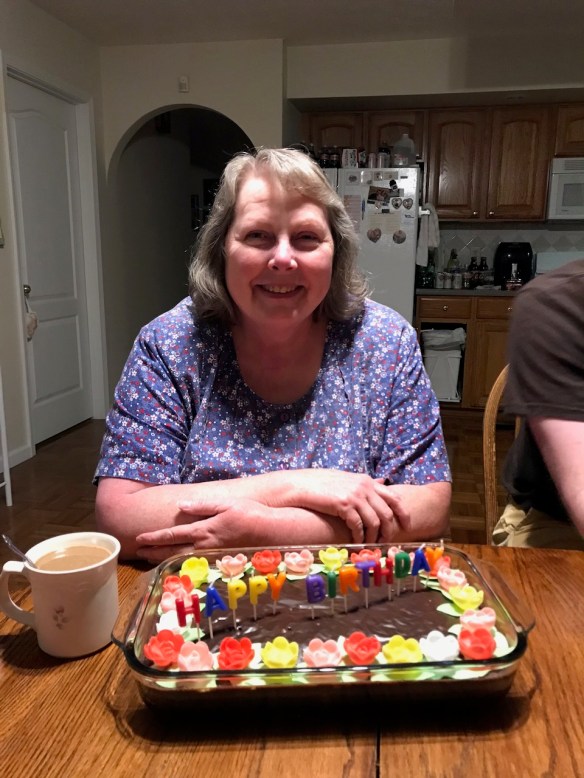
3. Mittu’s birthday. Always nice to celebrate our daughter-in-law. πŸ™‚

IMG_0755

I had to smile at the party plates Timothy (3 1/2) picked out for his mommy:

img_0758.jpg

4. Shopping and lunch with my husband. We’re still looking for living room furniture, so we did that Saturday morning. I like that we can have fun no matter what we’re doing.

5. Girl Scout Cookies! It’s that time of year again!

Bonus: Getting a new high score on HQ Trivia! Maybe some day I’ll get all twelve questions.

IMG_0770

All in all a good week. We’ve enjoyed the Olympics, but we’re glad they’re winding down.

Happy Friday!

Recent Cards

I thought I’d share with you some cards I’ve made lately, most of them for Valentine’s Day.

This one was for Jim, from an idea I saw on Pinterest.

IMG_0744

None of my heart punches was big enough for the size I needed for the heart cut-out, so I traced a stencil on the back to cut out with an Xacto knife. But I forgot that, since it was on the back, I needed to tilt it the opposite direction from what I wanted it to be on the front. So trying to write the initials the right direction was really confusing – I guess that must be the way left-handed people feel about much of the right-handed world. In fact, after a number of tries, I ended up tilting the paper with the initials on it to line up with the direction of the heart, resulting in the “grain” of the wood print underneath to run diagonally instead of vertically. But don’t tell anyone – maybe they won’t notice. πŸ™‚

This was for my oldest son, apt since he lives in another state:

IMG_0737

This was also spurred from a Pinterest find. To take you behind the scenes a bit, when I clicked through to the web site from which it came, I read that the box came from a stamp. I didn’t want to buy a stamp for a one-time usage and didn’t know if I could find one anyway, so first I tried to draw one. That didn’t go so well. πŸ™‚

IMG_0768

So I thought I’d look for a clip-art box online that I could trace around, and then it dawned on me that I could print off a clip-art box and then just cut it out (duh!). So I did that and used an Xacto knife to open a slit to put the little hearts into. The hearts were made with a heart punch and several scraps of red paper. The letters were stickers, which I ended up not being too crazy about because the sticker wasn’t just the letter: it included a little plastic around the letter, and when the light hits it just right, you can see all the plastic. But I did like the script and the way it came out overall.

This was for Jason, also inspired by Pinterest:

IMG_0741

I just noticed the title there said this was from designs “for her,” but I thought this was masculine-looking and used it for that reason! I found a world map online, printed it out, and used a stencil to make the heart shape.

This was for Mittu. She likes purple, so I looked through my purple papers until I came up with an idea. The design was embossed with a Cuttlebug folder, one I don’t think I had used yet.

IMG_0745

The wording on all of these except Jeremy’s was done on the computer, and I used scrapbooking scissors to make the edge on this one.

This was Timothy’s:

IMG_0743

You can tell who he likes. πŸ™‚ This idea was also from Pinterest. I found the cityscape on the Cricut and cut it out there. I found the Batman logo online and finagled the ray of light myself. I was going to put “Have a SUPER Valentine’s Day” in the light, like the example did, but the space ended up being small, so I just put a heart there and wished him a “super-duper” Valentine’s Day inside – apt not only for the superhero logo but also because he says “super-duper” sometimes.

This was Jesse’s:

IMG_0742

I found this design on the Cricut Design Space and and used the Cricut to cut it out, so it was pretty easy. And this was good for him – conveying the thought without being mushy. πŸ™‚

This one I was going to throw away, but I ended up not having time to make another one. It was from this idea and was going to be for my husband. Though it looks cute there, my version ended up looking childish, so I put it aside and went with the other idea I had for him above. As I worked on the other cards, I thought perhaps I could rework this for my mother-in-law and decided to use that idea if I didn’t have time to come up with something else. As it turned out, I didn’t have time – somehow I miscalculated and thought I had another week before Valentine’s Day, and then it hit me I think on Sunday that Valentine’s Day was THAT week. So I had to do all the cards between Monday and Wednesday. I changed the sentiment to “You planted love…” on the outside, and inside, “…and grew a family,” and went on to say that her love started it all for the rest of us. I liked the thought but still didn’t like the design itself – primarily the stems. I had tried to cut them out freehand and that just didn’t work very well.

IMG_0740

Then we celebrated my daughter-in-law’s birthday recently, and I made this card for her:

IMG_0753

Once again I looked through my purplish papers for inspiration, and when I started to use this one, I decided to keep the design simple since the paper itself was so pretty and had a lot of design in it. The wording and mat underneath were done with two different-sized punches.

The hard time I have with making cards for Mittu is that, since she’s the only daughter-in-law in the family so far, I have all these feminine ideas pinned and have a hard time narrowing down which one to use! And then I ended up not using any of my pinned ideas at all for her cards. But I liked how they turned out.

So, that’s it for this time – not perfect or professional, but heartfelt. πŸ™‚

Book Review: The First Four Years

One time when Laura Ingalls Wilder was asked why she didn’t write more books, she replied that the money she received from them cost her more in taxes. β€œShe never found taxes on those who had labored their way to prosperity to be an incentive for even more labor.” But another time she said that if she wrote more, she’d have to get into some of the sad times of her life (I Remember Laura by Stephen W. Hines, pp. 102, 97, and 122).

The First Four Years was not originally part of the little House series, according to the introduction. The manuscript was found among Laura’s papers when she passed away, written on the same kind of tablets on which she had written her other books. Her daughter, Rose, entrusted it to her friend and heir Roger Lea MacBride. After Rose passed away, Roger met with Laura’s editors, and they discussed and thought over the issue and decided that, considering what Laura, Rose, and Laura’s fans would want, the manuscript should be published as is.

A fairly short book at 134 pages, it’s also straightforward, and it’s easy to imagine that Laura would have filled in and fleshed it out a bit more than this first draft. But it is still a great story, covering the first four years Laura and Almanzo were married.

They had a rough go of it those years, and I imagine this is what Laura was alluding to when she talked about getting into the sad times of her life.

The story opens just before their wedding, with Laura saying she didn’t want to marry a farmer. She did want to marry Almanzo, however, so she encouraged him to do something else for a living. After debating about the problems and benefits of farming, Almanzo proposed that they give it a three year trial, and Laura agreed.

They had a very simple ceremony, no honeymoon, and on Laura’s second day of marriage, she had to make a meal for all the threshers who came to help with that work. But she was happy to be in her own home. “Laura found doing work alone very different from helping Ma. But it was part of her job and she must do it, though she did hate the smell of hot lard, and the site of so much fresh meat ruined her appetite for any of it” (p. 30).

They enjoyed horseback riding in the warmer evenings and sitting by the fire on cold ones. They dealt with larger dangers of Indians and blizzards and smaller domestic ones of neighbors borrowing and not returning equipment. Soon baby Rose came to them, and Laura discovered “there was a good deal to taking care of babies” (p. 75).

But trials came, too – lost crops, against which they had borrowed money, diphtheria for Laura, a stroke for Almanzo, the loss of another baby, fire, ever-present debt.

Though these things took their toll, and they grieved, there was nothing else to do but pick up and go on. Almanzo seemed characterized by optimism, and though Laura struggled wondering how everything was ever going to work out, eventually she concluded “it would be a fight to win out in this business of farming, but strangely she felt her spirit rising for the struggle” (p. 133).

Once again I marvel at that pioneer spirit. Any one of these trials would send a modern person into depression and counseling for years (please know that I am not making light of depression or the need for counselors). How did people cope then with so much loss? It seems it was just accepted as a part of life. Everyone had struggles, not just the Wilders. Has our relative ease weakened us? I don’t know. But here and there we still find those whose “spirits rise for the struggle,” who overcome overwhelming odds.

I’m so thankful this book was found and published. I enjoyed the peek into Laura and Almanzo’s first years and am inspired by their example.

(Sharing with Semicolonβ€˜s Saturday Review of Books, Literary Musing Monday, Carole’s Books You Loved)

Book Review: Journey to the Center of the Earth

Journey to the Center of the Earth by Jules Verne opens in Hamburg in 1863, where Professor Otto Lidenbrock has just come home with a prized Icelandic runic manuscript which he is eagerly showing to his uninterested (but pretending to be interested) nephew, Axel, who is also his ward and assistant. The professor’s enthusiasm is diverted, however, when an old piece of paper falls out of the book and is discovered to have a message in code from “Arne Saknussemm!…another Icelander, a savant of the sixteenth century, a celebrated alchemist.” After hours of trying to decipher the code, and asserting that neither he nor anyone else in the house will eat until they have figured it out, he darts out of the room in frustration. Axel works on it a bit, and, to his own surprise, figures out the message – but then determines that his uncle will never know it lest he act upon it. Suffering from hunger, however, Axel finally yields the message, which is:

“Descend, bold traveller, into the crater of the jokul of Sneffels, which the shadow of Scartaris touches before the kalends of July, and you will attain the centre of the earth; which I have done, Arne Saknussemm.”

And act upon it the professor does, immediately preparing for himself and Axel to go explore an extinct volcano called Sneffels (or SnΓ¦fell) in Iceland. Part of the professor’s interest is his regard forΒ Saknussemm, but in addition there is a raging controversy about whether the center of the Earth is cold or hot, and this will be his chance to prove his thinking is right. They hire a quiet but handy hunter named Han as a guide, and their adventure begins, fraught with both excitement and danger.

My thoughts:

I have to admit I didn’t like this story nearly as well as the two other Verne books I have read, Around the World in 80 Days and 20,000 Leagues Under the Sea. I think part of it was that the scientific aspect was so improbable, but also the characters don’t change or grow much at all. There is some suspense in determining whether the Professor is an intrepid explorer contrasted with Axel’s neurotic cowardice, or whether Axel’s is the voice of reason vainly opposing the professor as a mad scientist. I did read somewhere that Axel is a teenager, which would make his behavior make more sense, but I tried to find that in the book and couldn’t locate it.

I listened to the audiobook pretty well read by Derek Perkins. My only quibble is that even though Axel is the narrator of the story, Mr. Perkins uses a different voices for him as the narrator or the character, when they should sound the same. The German accent only comes out when Axel the character is speaking.

I looked through the Project Gutenberg version online while searching for Axel’s age, and was surprised by some subtle humor I had missed in the recording. Usually it’s just the opposite: usually I catch nuances in listening that I miss while reading. I don’t think I’ll be revisiting this book, but if I ever do, I’ll read it next time and see if that makes a difference.

There are a variety of translations of this book, and one, for some reason, changes the names of the professor to Hardwigg and Axel to Harry or Henry and rewrites portions of the book. I’d avoid that one. Wikipedia has information on other translations as does this post.

I also would not have considered this a children’s book, and Common Sense Media says, “Verne was writing in an earlier era for a mostly adult audience, presumed, if they were literate enough to be reading novels for pleasure, to be very well educated. The vocabulary is advanced, the descriptions lengthy, and the scientific and literary references removed from the experience of most young readers. Experienced teens will enjoy it, and younger experienced listeners may enjoy hearing it read by an adult with the patience to stop often for explanations.” However,Β Wikipedia says it was originally published in a boys’ magazine.

Wikipedia also says, “The genre of subterranean fiction already existed long before Verne. However, the present book considerably added to its popularity and influenced later such writings. For example, Edgar Rice Burroughs explicitly acknowledged Verne’s influence on his own Pellucidar series.” So it has its place in literary history, and it was probably a lot more believable then, or, if nor believable, at least enjoyed as an adventure story.

Have you or your children ever read Journey to the Center of the Earth? What did you think of it?

(Sharing with Semicolonβ€˜s Saturday Review of Books, Literary Musing Monday)


When I Don’t Get What I Need

I’ve always known I was an introvert, preferring small groups (or, better yet, home!) to big crowds, having a few close friends rather than being the social butterfly, needing time alone to process and think. Reading Susan Cain’sΒ Quiet: The Power of Introverts in a World That Can’t Stop Talking helped me understand myself better and understand that these issues aren’t just preferences, that introverts’ and extroverts’ brains are wired differently. When she pointed out that introverts are drained by social interaction and need solitude to recharge whereas extroverts thrive on social interaction, the proverbial light bulb went off in my mind. “That’s it!” I thought. I had never heard it put that way before, but it just fit my experience so perfectly. I don’t want to be a hermit; I do value social interaction, but it does drain me and I function better overall with some degree of time to myself.

When my kids were in school, I had about seven hours a day to myself. Oh, that wasn’t all spent curled up reading a book or thinking: housekeeping, grocery shopping, errands, and different ministry responsibilities kept me busy. But I did have a good bit of quiet time. I thought once my kids grew up and left home, that time would naturally increase. I’d miss them intensely, but I had plenty of things I looked forward to accomplishing when that time came.

Instead, I have less solitude than ever. One child is still home but working and taking classes online at home. We’re taking care of my mother-in-law in our home, and we have a lady who stays with her in the mornings plus hospice people coming in and out throughout the week. My husband’s job has him working from home a few days a week now. I am not complaining about any of that: this is the home of all of us, not just me, and of course they all have a right to be here. But some days quiet moments are hard to come by except for early morning and late evening.

I imagine some extroverts have the opposite problem: an intense need for companionship and struggles with too much alone time.

So what do we do in such cases? Allow ourselves to get cranky because our needs aren’t getting met? Whine and complain to God about it? I’m afraid I have done both of those.

Recently, though, I was arrested by Philippians 4:11-13: “Not that I am speaking of being in need, for I have learned in whatever situation I am to be content. I know how to be brought low, and I know how to abound. In any and every circumstance, I have learned the secret of facing plenty and hunger, abundance and need. I can do all things through him who strengthens me.”

Paul mentions hunger there. He didn’t thrash around before God and say, “You made me to need food. So why don’t I have it? What are you doing?” He trusted that God would help him in any circumstance. He would either meet his need for food or take him to where there is no more hunger and thirst. He will sustain us until the time that He provides. Paul says he learned this contentment, which encourages me that it’s first of all a process, and secondly, that it can be learned.

But why would God create us to need certain things and then not provide them for a time? Just to teach us contentment? Well, one other time that God allowed His people to hunger comes to mind:

And you shall remember the whole way that the Lord your God has led you these forty years in the wilderness, that he might humble you, testing you to know what was in your heart, whether you would keep his commandments or not. And he humbled you and let you hunger and fed you with manna, which you did not know, nor did your fathers know, that he might make you know that man does not live by bread alone, but man lives by every word that comes from the mouth of the Lord. Deuteronomy 8:2-3.

A few reasons are mentioned there:

  1. To humble us.
  2. To test us (the KJV says to “prove” us). He knows what’s in our hearts, but sometimes our reactions to unmet needs are a revelation to us of just how sinfully self-centered we are. This also tests the depths of our love and commitment: that was one of Satan’s challenges to God about Job: “He only serves you because You bless him. Take away some of those blessings, and You’ll see how fast he turns away from You.” Do we only serve God with a right heart when all of our perceived needs are being met?
  3. To teach us dependence on Him to meet our needs.
  4. To remind us of what’s most important.

These are not meant to be explanations for famine: that would be a completely different study. And God may have other reasons for not answering prayers. And this doesn’t mean that we can’t or shouldn’t take means sometimes meet our needs, but sometimes those needs surface despite our best efforts. Back to the need for solitude, Jesus many times went away from the crowds and His own disciples to be alone to pray – and He also had the experience of people seeking Him out during those times and interrupting His time alone, another way in which He was tempted in all points like we are, yet without sin.

But God has been working with me for a while on changing my attitude from one of demanding what I think I need or lamenting the lack of it to trusting that He knows what I need and will provide it. And He has, many times over, in unexpected ways. Plus that restful, trustful demeanor helps me not only inwardly but outwardly. Not only is my spirit at peace, but instead of focusing on myself, I can turn my attention to others and try to minister to them for whatever purpose God brought them into my life. I confess I have failed in that more often than I like to admit, but I am trusting His grace to change.

So whatever our need, whether for solitude or companionship, affirmation or humbling, inward or outward, we can trust that God has a reason for allowing it, will give us grace while it is unmet, and will meet it in His own time and way.

Your heavenly Father knows that you need them all. But seek first the kingdom of God and his righteousness, and all these things will be added to you. Matthew 6:32b-33

And he said unto me, My grace is sufficient for thee: for my strength is made perfect in weakness. Most gladly therefore will I rather glory in my infirmities, that the power of Christ may rest upon me. Therefore I take pleasure in infirmities, in reproaches, in necessities, in persecutions, in distresses for Christ’s sake: for when I am weak, then am I strong. 2 Corinthians 12:9-10

And God is able to make all grace abound to you, so that having all sufficiency in all things at all times, you may abound in every good work.Β  2 Corinthians 9:8

(Sharing with Inspire Me Monday, Literary Musing Monday, Glimpses, Tell His Story, Woman to Woman Word-filled Wednesday, Writer Wednesday, Coffee For Your Heart, Porch Stories, Wise Woman, Faith on Fire)

Friday’s Fave Five

friday fave five 12
It’s Friday, time to look back over the blessings of the week with Susanne at Living to Tell the Story and other friends.

Hello again! It’s been a while since I have gone so long without posting – but it has been a busy week! It’s also been a rainy week here but the temperatures have been nice – in the 60s and almost 70! So no snow or ice, thankfully. We even had to turn the AC on as it got up to 75 degrees F in the house. Here are some other favorite parts of the last week:

1. Yard work in short sleeves in February! I had been needing to prune my rose bushes for ages but just hadn’t been able to get to it – either there was no time or it was too cold. I don’t know if this is the right time of year to do it, but I figured it would be better now than when it started budding. Then my two big planters by the front door were still overgrown with dead stuff from last summer, so I got that cut back. It was nice to get done something I had been wanting to do for a long time, plus it was a beautiful day out and felt so good. And! I noticed some bulbs I planted last year from an arrangement someone had given to Jim’s mom were starting to come up. This was the first time I planted bulbs, so that was exciting.

2. Valentine’s Day is a favorite at our house. πŸ™‚ My husband brought me some lovely flowers, my favorite candy, and a beautiful card, and Jason and Mittu and Timothy brought some goodies. I’ll show the cards I made next week. I made our traditional “meat hearts” and cheesy potatoes and salad, peanut butter heart cookies, and heart-shaped chocolate cupcakes.

IMG_0746

img_0739.jpg

img_0738.jpg

And, for a post-Valentine’s bonus – the day after Valentine’s Day, Jim remarked that I had been in the kitchen so much that day, maybe I’d like to get something out for dinner on Thursday. Love that man! β™₯

3. Valentines from Timothy.

IMG_0747

4. Encouraging words from a couple of fronts. “A word spoken in due season, how good is it!” (Proverbs 15:23).

5. The Olympics. I don’t watch sports much, but there’s something about the Olympics. πŸ™‚

Happy Friday!