Unknown's avatar

About Barbara Harper

https://barbarah.wordpress.com

Laudable Linkage

Laudable Linkage

Here are some of the good reads found this week:

If You Confess: How to Bring Your Sins to God, HT to Challies. “When it comes to confessing our sins, many Christians fall into one of two errors — both of which steal joy, disrupt peace, and undermine assurance.”

When Life Feels Crushing, HT to Challies. “Some seasons are like that. They aren’t just overwhelming. They aren’t just hard. They aren’t just exhausting. They’re paralyzing, and from a humanity standpoint – they feel unbearable.” Sarah offers some helps for those times.

What Are Spiritual Gifts and How Do I Discover Mine? HT to Challies. This is probably the most helpful piece of writing I have seen on this subject.

Is “Allah” Just Another Word for God? HT to Challies. “There’s confusion about the word ‘Allah.’ Recently, a commentator claimed that ‘Allah’ is just the Arabic word for God, and that it doesn’t specifically refer to a different god. Her reasoning? ‘Arabic-speaking Christians pray to ‘Allah.’’ Is that true? Yes and no. Some nuance is needed. Here are four points to understand.” I appreciate clarity on this from one who knows.

Transgender, Intersex, and the Olympics. I appreciate the advice and example to wait and be sure we have the facts before we speak out on something. The topic here is two Olympic boxers who identified as female. “Political and religious conservatives jumped on the story immediately, decrying transgenderism and the unfairness to women in allowing transgender athletes to compete in women’s sports.” That’s a valid concern but wasn’t the issue here. The women were intersex, not transgender.

More Than Bodies: Examining Our Assumptions About Disability, HT to Challies. Our prayers ad concerns for disabled friends tends toward a desire for healing, for whatever their disability is to be “fixed.” But their needs go deeper.

Eliminating Negative Self-Talk: 4 Key Reasons and Actionable Tips. “Do you respond to a compliment by putting yourself down? Do you verbally attack yourself because of your own clumsiness, forgetfulness, or aging body? You, my friend, may struggle with negative self-talk. So do I. And I’m guessing we aren’t alone. What a relief, huh? But the everybody-does-it response won’t cut it. It can be a comfort but not an excuse.”

Come boldly, believer, for despite the whisperings of Satan and the doubting of your own heart, you are greatly loved. C. H. Spurgeon

Come boldly, believer, for despite the whisperings of Satan and the doubting of your own heart, you are greatly loved.–C. H. Spurgeon

Friday’s Fave Five

Friday's Fave Five

Some weeks overflow with blessings. For others, we might have to search a bit. But I am thankful for this weekly exercise to appreciate and thank God for the good things He brings into our lives with Susanne and friends at Living to Tell the Story.

1. A quiet week. No appointments or outside obligations besides the usual. I love a quiet week at home.

2. An offer for dinner out. I love when my husband asks “Do you want to get something out for dinner tonight?”

3. New Bible study and Sunday School classes have started for the fall session at church. We’re going over selected psalms on Sunday morning and delving into 2 Corinthians Wednesday evenings.

4. A published devotional. Christian Devotions has published a short piece I submitted titled Adequate Shelter.

5. Things that make me smile. This is a screenshot from a reel on Instagram. I think I’d have a shot at this competition. 🙂

Reading Olympics

    How was your week?

    August Reflections

    August reflections

    August is one of our busiest and most enjoyable months, with my oldest son coming to visit for his birthday and mine for about eight days (not counting travel days). Usually the family members who live locally visit more often and we have a few family excursions.

    Our visit was a little low-key this time with Mittu sick for a couple of weeks and unable to come over except for Jeremy’s birthday. But the rest of us talked a lot, played games, ate out a couple of times, and had a couple of outings. As always, it went too fast!

    The first part of the month was preparing for Jeremy’s visit, and last week was recovery time. 🙂

    Family funnies

    On the way home from church, I saw a car repair shop’s sign for “Painless Dent Removal.” I thought that was odd–did they mean painless for the car owner, as in low-cost? Or were they anthropomorphizing the car to be funny and appealing? I mentioned it to Jim, and he said it was paintless dent removal, not painless.

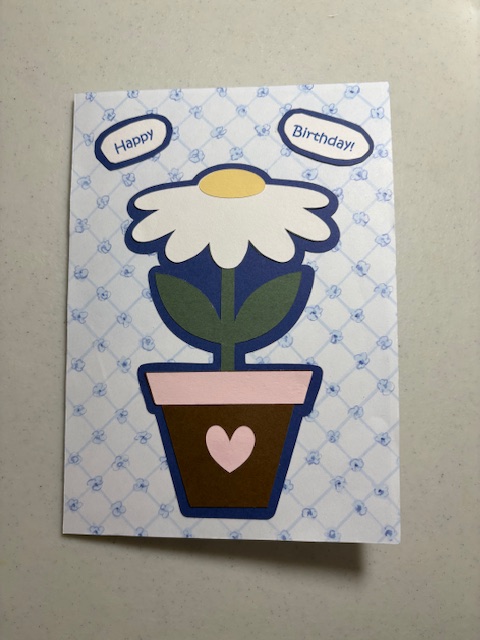
    Card-making

    This one was for the baby shower of a lady at church.

    baby shower card

    It didn’t turn out quite as well as I had envisioned. I probably should have only used one border instead of two (those came in a set of baby-related strips). But I loved cutting out those pink onesies with the Cricut along with a couple more for the inside! With my children and grandchild being all males, I don’t get to use my pink papers very much.

    This was for Jason and Mittu’s fifteenth wedding anniversary:

    anniversary card

    The little hearts were a crocheted set I had bought somewhere. And the swirly parts of the white cardstock were embossed with the Cuttlebug.

    This was for Jeremy’s birthday:

    I couldn’t find an odometer in the Cricut files that I liked, so I used a window frame and cut out the horizontal lines.

    Watching

    We didn’t watch much this month beside the Olympics. As I said earlier, I only saw the last hour or so of the opening ceremony, so I missed the controversial parts. We saw the NBC coverage most nights. It was frustrating that there were some parts of it they didn’t show—I didn’t even know about rhythmic gymnastics until afterward. On the other hand, they couldn’t show everything from all the competitions in prime time coverage.

    It seems like there were more athletes talking about their faith and giving glory to God for their achievements than I remember seeing in other Olympics. That was neat to see.

    Reading

    Since last time I finished (titles link to my reviews):

    • Be Decisive (Jeremiah): Taking a Stand for the Truth by Warren Wiersbe.
    • A Boy’s War by David Michell, nonfiction. David was a student at Chefoo school for missionary children in China when it was taken over by the Japanese during WWII. The school was eventually sent to an interment camp, where they remained until the end of the war.
    • Shadowed Loyalty by Roseanna M. White, fiction, audiobook. What do you do when your beliefs in God and His will for your life clash with your mob family? Not my favorite of Roseanna’s books, but an intriguing premise.

    My list is a little shorter than usual due to the Olympics and family get-togethers.

    I’m currently reading:

    • Be Hopeful (1 Peter): How to Make the Best of Times Out of Your Worst of Times by Warren Wiersbe
    • Help for the Hungry Soul: Eight Encouragements to Grow Your Appetite for God’s Word by Kristen Wetherell
    • Write a Must-Read: Craft a Book That Changes Lives—Including Your Own by A. J. Harper (haven’t actually looked at this much the last month)
    • Hillbilly Elegy by J. D. Vance (just picked this one back up after letting it sit a while. Not sure I’ll finish it. Several f-bombs and talk of ancestors murdering people.)
    • What’s a Disorganized Person to Do? by Stacey Platt (just started–want to read a small section at intervals)
    • Martin Chuzzlewit by Charles Dickens (audiobook)
    • Hope Between the Pages by Pepper Basham

    Blogging

    Besides the weekly Friday Fave Fives, Saturday Laudable Linkage, and book reviews, I’ve posted these since last time:

    • God’s Solutions Are Better. Sometimes we come to God asking for Him to solve our problems in a certain way, but He has something else in mind.
    • Christianity Is More Than Getting My Needs Met. God wants us to come to Him with our needs and promises to meet them. But God also wants us to glorify Him—not because He needs glory, but we need to give it to Him.
    • This I Call to Mind. In the midst of an utter wreck of his life and country, the writer of Lamentations remembers God’s mercy and faithfulness and finds cause for hope. We can, too, no matter what is going on in our lives.
    • Don’t Wait Until You Feel Like It. It’s wonderful when will and mind and emotion all work together. But when they don’t, we’re not faking it if we do spiritual things without spiritual feelings. We’re taking ourselves in hand and battling our fleshly nature.

    Writing

    Not much has happened on this front, with the other family things going on. Our critique group has taken some time off this summer, and while the break has helped with time for other things, I am looking forward to getting back at it.

    As we change the calendar to September, we look forward to celebrating Labor Day with the family and Jesse’s birthday in a couple of weeks. I’m anticipating fall breezes and color, but we won’t experience much of that til the end of the month. I’m trying to enjoy the time at hand and not rush past it too soon in anticipation of what’s ahead.

    How was your August?

    (I often link up with some of these bloggers.)

    Don’t Wait Until You Feel Like It

    Don't wait until you feel like it.

    It’s time to read the Bible. But I had a late night last night and tons of things to do today. I’m just not in a mental frame to read the Bible right now.

    It’s time to pray. But I just don’t feel like praying right now. I’ll wait til I am feeling more spiritual.

    It’s time to get ready for church. But I’ve had a lot of appointments this week. I just don’t feel like being around a lot of people and activity. I think I’ll just watch the service from home.

    Have you ever faced any of those scenarios? I think we’ve all had times we haven’t felt like doing what we know we need to.

    Sometimes it even feels like we’d be faking it if we proceeded with prayer, Bible reading, or going to church without the proper spiritual feelings in place.

    But I’d like to suggest that we wouldn’t be faking it. Instead, by doing what we ought to do even when we don’t feel like it, we’d be battling our fleshly nature, what the Bible calls our “old man.”

    We received a new nature at salvation. But we still have the old one as well. Our old nature constantly pulls us in the direction giving in to ourselves, yielding to fleshly desires.

    If we never felt like doing any spiritual activities, we’d have cause for concern about our relationship with the Lord.

    But even having experienced the blessing of prayer, Bible reading, and church attendance, sometimes we’re still sluggish and reluctant to participate in them.

    What can we do?

    Get enough rest. Sometimes the cause is physical. I’m often too drowsy for my morning Bible reading if I stayed up too late the night before. Those times of life when a full night’s sleep is impossible—when a new baby is in the house or we’re sick—we may have to adjust our time with the Lord into smaller breaks throughout the day.

    Search our hearts. Sometimes that sluggish or negative feeling might indicate something is wrong somewhere. We can ask God to “Search me, O God, and know my heart! Try me and know my thoughts! And see if there be any grievous way in me, and lead me in the way everlasting! (Psalm 139:23-24). If He brings something to mind, we can confess it to Him, ask His forgiveness, and make arrangements to do whatever else we have to do to make it right (apologize to someone, return an item, etc.).

    Search whether we’re filled with other things. Almost every mother I know has had to tell her children they can’t eat sweets or munchies before dinner, because those things would blunt their appetite for good, nourishing food. Maybe we need to lay aside something that’s dulling our spiritual appetites.

    Get help. Elisabeth Elliot wrote in On Asking God Why, “When I stumble out of bed in the morning, put on a robe, and go into my study, words do not spring spontaneously to my lips–other than words like, ‘Lord, here I am again to talk to you. It’s cold. I’m not feeling terribly spiritual….’ Who can go on and on like that morning after morning, and who can bear to listen to it day after day?” She chose to read psalms or hymns to help get her heart in the right place.

    Don’t turn away from the primary means of reviving us. “I will never forget Your precepts, For by them You have revived me and given me life” (Psalm 119:93, AMP). God uses His word, prayer, and His people to work in our lives. When we neglect them, we’re denying our souls the very things they need to thrive. One of my former pastors used to say that one of his best times of prayer happened after he had to confess to the Lord that he didn’t feel like praying.

    Don’t expect perfection. We haven’t failed at our devotional time if we haven’t run through our whole to-do list—pray so many minutes, read so many chapters, journal so many pages. Remember, it’s not a routine or a performance. Time in the Bible and prayer is simply communicating with the One who loves us best, getting to know Him better.

    Ignore the feelings. That’s part of maturity. Every day we have to do things we don’t feel like doing (go to work, wake up before we want to, make or at least provide for dinner, say no to excess sugar). If we only ever did what we’d felt like—well, many of us would be couch potatoes in dirty laundry living off fast food.

    I’ve only rarely had this problem, but sometimes people don’t feel like eating. Or they might, but they don’t want what’s available. But if they eat, the food nourishes them.

    J. Sidlow Baxter once wrote an amusing account of trying to get into the habit of regular prayer. First he had to fend off the constant pull of distractions and duties. But then he had to just do it.

    I found that there was an area of me that did not want to pray, and there was a part of me that did. The part that didn’t was the emotions, and the part that did was the intellect and the will.

    So I said to my will: “Will, are you ready for prayer?” And Will said, “Here I am, I’m ready.” So I said, “Come on, Will, we will go.”

    So Will and I set off to pray. But the minute we turned our footsteps to go and pray all my emotions began to talk. “We’re not coming, we’re not coming, we’re not coming.” And I said to Will, “Will, can you stick it?” And Will said, “Yes, if you can.” So Will and I, we dragged off those wretched emotions and we went to pray, and stayed an hour in prayer.

    If you had asked me afterwards, Did you have a good time, do you think I could have said yes? A good time? No, it was a fight all the way.

    What I would have done without the companionship of Will, I don’t know. In the middle of the most earnest intercessions I suddenly found one of the principal emotions way out on the golf course, playing golf. And I had to run to the golf course and say, “Come back”… It was exhausting, but we did it.

    The next morning came. I looked at my watch and it was time. I said to Will, “Come on, Will, it’s time for prayer.” And all the emotions began to pull the other way and I said, “Will, can you stick it?” And Will said, “Yes, in fact I think I’m stronger after the struggle yesterday morning.” So Will and I went in again.

    The same thing happened. Rebellious, tumultuous, uncooperative emotions. If you had asked me, “Have you had a good time?” I would have had to tell you with tears, “No, the heavens were like brass. It was a job to concentrate. I had an awful time with the emotions.”

    This went on for about two and a half weeks. But Will and I stuck it out. Then one morning during that third week I looked at my watch and I said, “Will, it’s time for prayer. Are you ready?” And Will said, “Yes, I’m ready.”

    And just as we were going in I heard one of my chief emotions say to the others, “Come on, fellows, there’s no use wearing ourselves out: they’ll go on whatever we do…”

    Suddenly one day weeks later while Will and I were pressing our case at the throne of the heavenly glory, one of the chief emotions shouted “Hallelujah!” and all the other emotions suddenly shouted, “Amen!” For the first time all of me was involved in the exercise of prayer. And God suddenly became real and heaven was wide open and Christ was there and the Holy Spirit was moving and I knew that all the time God had been listening.

    The point is this: the validity and the effectuality of prayer are not determined or even affected by the subjective psychological condition of the one who prays. The thing that makes prayer valid and vital and moving and operative is “my faith takes hold of God’’s truth.

    The Christian life isn’t without emotion. Emotional highs and lows are expressed all through the Bible, especially the psalms. But emotions are variable and unreliable. They shouldn’t be running our lives. One of my college professors used to say, “Good feelings follow right actions.”

    God understands our human frailty. “For he knows our frame; he remembers that we are dust” (Psalm 103:14). Jesus is the One who told his disciples (and us), “Watch and pray that you may not enter into temptation. The spirit indeed is willing, but the flesh is weak” (Matthew 26:41).

    It’s wonderful when will and mind and emotion all work together. But when they don’t, let’s not wait til we “feel spiritual” to do spiritual things. God may use what we didn’t feel like doing to create the right feelings.

    We walk by faith, not sight.

    (I often link up with some of these bloggers.)

    Laudable Linkage

    Laudable Linkage

    I have several good reads to share today:

    Hope In Hindsight: Navigating Unexpected Journeys, HT to the Story Warren. “Just as Stephen looked to the stories of Scripture to remind him of who God is and what he has done, we can do the same when we face uncertainty in our futures. When plans are interrupted, when hardship comes, and when we’re confronted with the reality of sin and death in a fallen world, we can look to the story of Scripture and the story of our life and see the goodness of God woven throughout.”

    Maybe You Don’t Need a Therapist, HT to Challies. “I’ve found that for a growing number of people there is an assumption that to be a human is to need therapy. We’re all maladjusted, and the purpose of therapy is to adjust us so that we’re high-functioning members of society, living flourishing, mentally healthy lives. In this model, therapy is something like a weekly medicine we all need to mentally survive a hostile world.” But such an approach raises concerns, which the author discusses.

    When Spiritual Disciplines Took Over My Life, HT to Challies. “Scrupulosity can be jaw-droppingly deceptive. Spiritual disciplines are essential for growth, and we want to encourage one another to practice them. But there’s a difference between healthy spiritual practice and someone who’s struggling with OCD. Since the outward behaviors may be the same, we need to look below the surface to identify scrupulosity.”

    On Biblical Mandates and Cultural Expectations, Part 3. “Once we’ve invested the time and effort it takes to be informed about what the Scripture says, and what the law requires, and what the culture expects, we need to get down to the business of making decisions about how we respond to specific demands from those authorities.”

    The Rise of Hyperpleasures, HT to Redeeming Productivity. “If humans experience pain and pleasure on a 1-10 scale, then hyperpleasures are those activities which take us ‘off the scale,’ so to speak. They give us experiences that make us feel like a 20, 30, 100, 1,000, and so on. The particular number is arbitrary, of course, but the principle remains — these are pleasures that go far beyond the ordinary range of enjoyment, principally by removing those discomforts we experience in our ordinary pleasures.”

    It Takes Years to Grow, HT to Challies. “We think transformation will be quick, and sometimes it is. But generally speaking, God isn’t in a rush. There’s a certain kind of holiness and beauty that develops only after decades of walking with God. You can’t microwave it. But when you see it, it’s a beautiful thing.”

    Mom and Dad: Show Your Need, HT to Challies. ““I have one regret of how I parented . . . I wish I would’ve shown my kids my need for Christ more. I worked so hard to show them my godliness that I didn’t show them my need. I should have been more transparent. I should have shown them just how much I needed Jesus.”

    To Everything in Motherhood, There Is a Season. “It would have been impossible for me to explain my grief in that moment. I was missing something. Not people necessarily, but a time of life with those people. . . Yet, each new season brings new joys.”

    People Who Were Bookworms As Children Often Display These Seven Unique Traits, HT to Linda. “Many of us were those so-called bookworms as kids, and it’s fascinating to see how this early love for reading has shaped us into the adults we are today. You see, spending all that time with our heads buried in books did more than just help us ace our English tests. It subtly carved out traits within us that are not only unique but pretty advantageous, too.”

    Do Quests, Not Goals, HT to Redeeming Productivity. “The conventional term for this sort of personal campaign is a ‘short-term goal.’ But I suggested to OBW participants that they drop the G-word in favor of something more fanciful: the quest. If that sounds a bit whimsical, hear me out. Whereas ‘goal’ has become a tired and bloodless descriptor for the (supposed) intention to do something great, the word quest instills the right mentality for achieving a real-life personal victory.” I’ve never thought of a “goal” as tired and dull, but the quest mentality does have some good points.

    This is a good time for my occasional reminder that linking to a site doesn’t mean 100% endorsement of everything on that site.

    Any theology that minimizes God’s holiness and tolerates people’s deliberate sinfulness
    is a false theology. — Warren W. Wiersbe,
    from Be Decisive (Jeremiah): Taking a Stand for the Truth

    Friday’s Fave Five

    Friday's Fave Five

    Here we are at another Friday already. Let’s slow time a moment and savor the blessings from the last week with Susanne and friends at Living to Tell the Story.

    1. Family outings. My oldest son, Jeremy, was with us through last weekend before going back to RI. Friday night, Jesse, my youngest, had us over for jambalaya. This was the first time Jeremy had gotten to see Jesse’s new house.

    Then Saturday we went to a Hummingbird Festival at a local nature center. Didn’t see any hummingbirds. 🙂 But we did see some owls, turtles, and other nature displays. The guys went on a guided nature hike.

    Owl

    Then we went to the new-to-us Mexican food restaurant I mentioned a couple of weeks ago where I had the scrumptious shrimp, onion, rice, and cheese dish. Yes, I had that again, and Jesse tried and loved it, too.

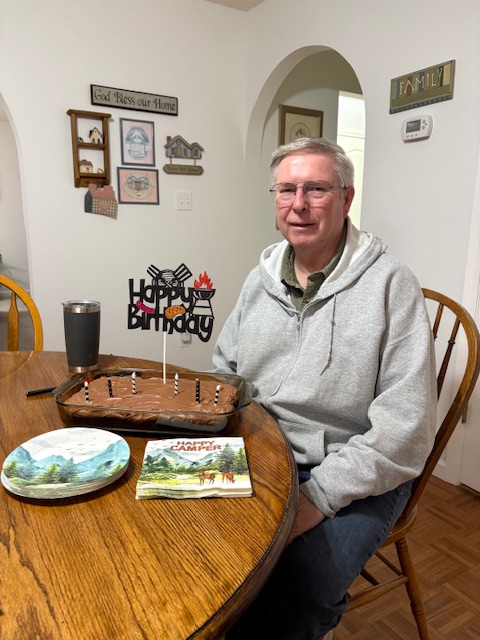
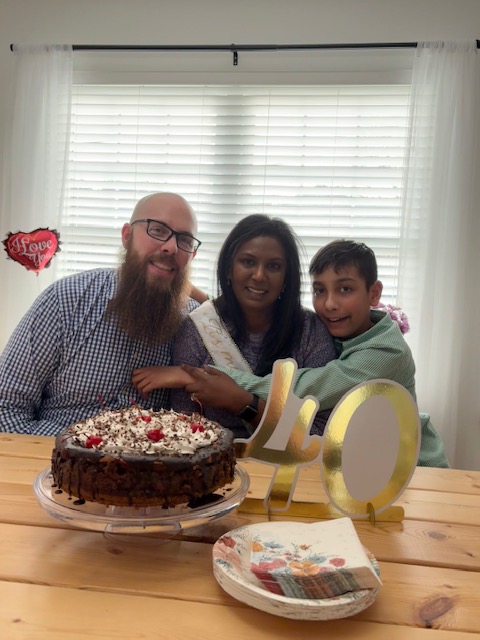
    2. My birthday was after Jeremy was scheduled to leave, so we celebrated it the Sunday before he left. After church, we went to one of my favorite restaurants, then headed home for presents and cake. Mittu usually makes my traditional birthday Texas Sheet Cake, but she was still sick, so Jim and Jeremy made it.

    birthday cake

    On my actual birthday, Jim brought me flowers and a Chick-Fil-A breakfast biscuit. 🙂

    Pink roses

    Then Jason, Mittu, and Timothy dropped by after the Kid’s Club at church with a card made by Mittu and a couple of Chick-Fil-A goodies (a chocolate chunk cookie and a brownie).

    Hand-drawn Mom card

    Then in a fun coincidence, the Strands game had a birthday theme on my birthday. At first I thought maybe that was on purpose, though I couldn’t remember having entered by birthday on their site. But when I looked it up, I saw that was just the theme that day.

    Strands birthday theme

    3. Luscious weather. The day of the Hummingbird Festival was pretty fair weather. We still got hot and sweaty, but some delightful breezes blew occasionally. Rain had been predicted but didn’t come, except for a few drops. The cloud cover helped a lot.

    Then Sunday afternoon, we went into the back yard for family photos and for Jeremy to try out his new drone. Rain was forecast again and the clouds looked threatening. But the wind and temperatures felt so good. I know we’re a long way from fall and we’ll have a lot more hot and humid days til then, but that respite felt so good.

    4. Family humor. We laugh a lot when we’re all together. 🙂 As an example, when we went to the bird festival, the volunteers explained that a bird banding event was extra–they try to catch a hummingbird in a net and attach a band around its leg. That doesn’t sound too pleasant for the hummingbird, but the sessions would explain why it’s done. We didn’t sign up for that part. After we paid for our general admission tickets, volunteers placed a band around our wrists. Jeremy joked that when you’re a nature center and banding is your only tool, you band everything and everyone, including visitors. 🙂

    Then while waiting in line, I pointed out to Jesse one of the features the sign listed was a “live animal display.” I commented that the wording seemed funny–why would they designate “live?” The first display we saw had a stuffed bat and bat skeleton and a glass case with pinned butterflies specimens. Jesse said, “What happened to the live animals?” 😀 We did see some later.

    5. Connect Four is a program at church were ladies who want to participate can sign up, then they are divided into groups of four. Each group is supposed to meet once a month over the next four months, to do whatever the group wants to do. Probably most meet for lunch at someone’s home or at a restaurant, but some do other activities like hike or play games. Our group had they first get-together yesterday. Thankfully I had at least met and talked with everyone, so none was a complete stranger to me. But it was fun getting to know everyone better. The conversation flowed for a couple of hours.

    It’s been a nice blend of activities and rest. I hope you’ve had a good week as well.

    This I Call to Mind

    This I call to mind, and therefore I have hope. Lamentations 3:21

    In some ways, it’s easy to call on the Lord for help when some outside issue comes upon us—illness, job problems, weather threats, and so on.

    But when we’ve gotten ourselves into a mess because of our own actions, lack of action, thoughtlessness, or selfishness—well, that’s a different story. We’re ashamed. We feel we deserve whatever trouble we’re in, so why would God help us out of it?

    Actually, we don’t deserve any blessings or help, whether we’ve done good or bad. God blesses us out of His grace, not what we deserve.

    But sometimes the consequences of our actions are designed to bring us to the end of ourselves so we’ll look to Him.

    I’ve just finished reading through Jeremiah and Lamentations. The prophet Jeremiah’s task was to warn God’s people of impending judgment. God had reached out to them and sent various messengers for years. But the people continued to worship idols, rely on nations that did not know God for help instead of going to Him, and various other transgressions. Now God was sending the Babylonians to desecrate their land and bring most of the population into exile.

    The book of Lamentations is set just after the Babylonian invasion. As the title indicates, the author mourns the devastation. Jerusalem had been under siege for so long before being taken into exile that parents were cannibalizing their own children. People had died. The temple was destroyed. The author says, “I have forgotten what happiness is” (3:17).

    In the middle of these Lamentations, the author makes an astonishing statement.

    Remember my affliction and my wanderings,
        the wormwood and the gall!
    My soul continually remembers it
        and is bowed down within me.
    But this I call to mind,
        and therefore I have hope (Lamentations 3:19-21).

    What does he call to mind?

    The steadfast love of the Lord never ceases;
        his mercies never come to an end;
    they are new every morning;
        great is your faithfulness.
    “The Lord is my portion,” says my soul,
        “therefore I will hope in him.”

    The Lord is good to those who wait for him,
        to the soul who seeks him.
    It is good that one should wait quietly
        for the salvation of the Lord.
    It is good for a man that he bear
        the yoke in his youth (3:22-27).

    In the midst of an utter wreck of his life and country, the writer remembers God’s mercy and faithfulness.

    God’s chastening is not a sign that He’s done with us. The ESV note on verses 31-33 says, “[God] sends judgment in order to effect restoration . . . God’s first instinct is not to punish. He only does so when his patience with sinners does not lead to repentance” (p. 1488).

    The prophetic books of the Bible are known for their condemnation of sin and warnings to turn back to God. But they are also full of God’s expressions of mercy and pleading in love for the return of his wayward children.

    I have blotted out, like a thick cloud, your transgressions, And like a cloud, your sins. Return to Me, for I have redeemed you (Isaiah 44:22, NKJV).

    Is Ephraim my dear son? Is he my darling child? For as often as I speak against him, I do remember him still. Therefore my heart yearns for him; I will surely have mercy on him, declares the Lord (Jeremiah 31:20).

    Have I any pleasure in the death of the wicked, declares the Lord GOD, and not rather that he should turn from his way and live? (Ezekiel 18:23).

    “Yet even now,” declares the Lord, “return to me with all your heart, with fasting, with weeping, and with mourning; and rend your hearts and not your garments.” Return to the Lord your God, for he is gracious and merciful, slow to anger, and abounding in steadfast love; and he relents over disaster (Joel 2:12-13).

    When we’re down in the dust, God doesn’t want us to stay there. He wants to give us hope. He wants us to look up to Him. He wants us to recall His love and mercy and come back to Him.

    Let us test and examine our ways,
        and return to the Lord!
    Let us lift up our hearts and hands
        to God in heaven . . .

    I called on your name, O Lord,
        from the depths of the pit;
    you heard my plea, ‘Do not close
        your ear to my cry for help!’
    You came near when I called on you;
        you said, ‘Do not fear!’

    You have taken up my cause, O Lord;
        you have redeemed my life (Lamentations 3:40-42; 55-58).

    Come, let us return to the Lord.

    (I often link up with some of these bloggers.)

    Laudable Linkage

    Laudable Linkage

    I have not done as much blog reading this week with family here, but I have found a few thought-provoking posts:

    How Can Christians Fight the War on Lies, HT to Challies. “This post-truth age poses profound challenges for Jesus followers. How does the church proclaim the gospel in a world where all truth claims are viewed with suspicion? How do we engage in meaningful dialogue when emotional resonance often trumps logical argument? And perhaps most critically, how do we maintain the integrity of our witness when the very concept of objective truth is under assault?”

    Is Modern Tolerance an Aspect of Love? “What is the role of government? According to scripture, it is to protect us from evil, not protect evil.”

    Impossibly, Gradually, Miraculously Changed, HT to Challies. “The apostle Paul talked about our slow path to holiness. We are, he said, being transformed (that’s the certain part) from one degree of glory to another (that’s the slow part) into the image of the Lord (that’s the beautiful part). More miraculous than an ocean of polished shell and glass, more changed than a river full of rocks is the transformation of a human heart by the Holy Spirit.”

    Don’t Forget to Remember: Lessons from a King and the Pride That Hides. “Asa didn’t fall into overt, obvious pride. The Scripture doesn’t say anything about his rebellion or foolishness, arrogance or selfishness. His was a sin harder to detect: the pride that hides. It hides behind Bible readings and worship songs, formal prayers and spiritual disciplines.”

    Seven Encouragements for Parents of Prodigals, HT to Challies. “I don’t think we or anybody has ever gotten to the bottom of it and its amazing portrait of the gracious heart of God.”

    I Do Not Know This Year, Lord, HT to Challies. This poem about trusting God for the year ahead was apropos for me since my birthday is coming up next week.

    Better a brief warfare and eternal rest, than false peace and everlasting torment. C. H. Spurgeon

    Better a brief warfare and eternal rest, than false peace and everlasting torment.
    C. H. Spurgeon

    Friday’s Fave Five

    Friday's Fave Five

    It’s Friday again, when I pause with Susanne and friends at Living to Tell the Story to reflect on the good things from the week.

    1. My oldest son is home. He came in last Friday from RI. It’s been a low-key week so far—Mittu has had a horrible respiratory infection (tested negative for Covid, flu, and strep), and Jim, Jason, and I have had touches of various things through the week. But we’ve enjoyed being together and talking, and we hope to get out to do some things later on.

    2. Clingman’s Dome is the highest point in TN. There’s an observation tower with a great view of the surrounding area. Jim and Jeremy hiked the trail to the tower Monday and enjoyed it the scenery.

    3. Jeremy’s birthday. I’m glad he could be here to celebrate it!

    4. An easy fix. I was having trouble with my most-used outlet in our bathroom working intermittently and then not at all. Jim took his tester in there, thinking he might have to replace the outlet. After he unscrewed and tested it, he found an inner screw was loose. That took care of the problem!

    5. A revitalized hair dryer. In the course of trying to fix the above problem, we thought at first my hair dryer might be having trouble. It was what worked the least in the outlet before it went kaput. Jim opened it up and cleaned out the lint and dust. Now it blows better than it has in a long time!

    That’s our week! How was yours?

    Review: A Boy’s War

    A Boy's War by David Michell

    David Michell was the tender age of six when he was sent to the Chefoo School, a Protestant boarding school for missionary children in what is now known as Yantai. He and his parents had no idea they would not see each other for six years because the Japanese captured the school during WWII.

    David tells his story in A Boy’s War. His parents moved from Australia to be missionaries to China with China Inland Mission, originally founded by Hudson Taylor, in 1930. David was born in China and lived with his parents and older sister until they were later joined by a younger sister. When it came time for school:

    In the China of those years the only way for most children of missionaries to get a good education in English was to go away to boarding school. Chefoo offered this opportunity. At Chefoo children of missionaries and a few sons and daughters of business people lived and studied together at the preparatory school, the Boys’ School, and the Girls’ School, getting a truly Christian education for body, mind, and spirit. So good was that education, in fact, that others, non-CIMers, wanted to take advantage of it, too (Location 59, Kindle version.

    Some of the school’s famous graduates were Henry Luce of Time Magazine and Thornton Wilder.

    On a side note, when I first read in missionary biographies of parents sending their children away to school so young, I was horrified. But home schooling materials were not as available then as now. Plus the British boarding school system had been in place for ages. Parents wanted their older children to have the credentials for college. And in some cases, the environment was such that children were more vulnerable to some of the horrific practices of the parents’ mission field, so parents felt they were safer away at school. These days, many mission boards work with parents to teach their children at home, especially in the younger years.

    David tells of his trip to school (“two thousand miles and a six-week journey away,” Location 145) and early days of adjustments. Though he missed his parents and younger sister and had some homesickness and struggles, for the most part he settled in fairly easily.

    Many of the teachers had been Chefoo students themselves. Outside the classroom, “housekeepers” helped the children write letters home, mended their clothes, and generally helped where needed. I was touched to see that many of these women were widows who now “mothered” these children.

    As early as 1940, the school’s headmaster conferred with the British Embassy about what they should do in the face of the conflict between Japan and China. They decided to keep the school open. However, many children could not travel home at Christmas break due to the dangers, so a larger number than usual were at the school over the holidays. The staff provided a memorable Christmas for them.

    They were used to seeing Japanese soldiers in the area, but the military didn’t bother anyone at the school. That changed after Japan attacked the US at Pearl Harbor the following year. Now British and Americans were the enemies. Immediately, Japanese soldiers arrested the headmaster for a month and took over the campus.

    Classes and activities were allowed to continue under the watchful eye of the Japanese, but supplies ran low and freedoms were curtailed.

    In November, 1942, the whole campus was sent on foot to an abandoned Presbyterian mission at Temple Hill, where conditions were even more crowded and supplies were even fewer.

    Then in September 1943, the school was sent on a longer journey to the Weihsien interment camp, where they remained until the end of the war. There they joined some 1,500 other people from all walks of life and several nationalities held by the Japanese.

    One of the detainees was Olympic medalist Eric Liddell. He had become a missionary to China after his Olympic feats. He had sent his pregnant wife and two children home, planning to join them later. But the Japanese took over before he could. One chapter of the book is a mini-biography of Liddell. He took an active part in teaching the children, who all called him Uncle Eric. He drew pictures of chemistry equipment they didn’t have so older students could be prepared for their Oxford exams. He arranged races and athletic activities and was generally thought of as a man “whose humble life combined with muscular Christianity with radiant godliness” (Location 1516). Sadly, he died of a brain tumor while at Weihsien.

    Another detainee was Herbert Taylor, oldest son of Hudson Taylor, in his eighties, having been a missionary in China for over sixty years.

    Though their years in camp were fraught with hardships, the children managed to have adventures as well.

    David describes the joy of seeing six American soldiers parachute nearby and the Japanese surrendered.

    Then came the scramble to get everyone home and taken care of.

    Though David exulted in freedom, he found some aspects hard to adjust to.

    In the last chapter of the book, David described going back to Weihsien with a few of his friends from there and their sons on the fortieth anniversary of their rescue. 

    I had read this book some decades ago but had forgotten much of it. Reading a frictional account of the Chefoo school’s captivity in When We Were Young and Brave by Hazel Gaynor made me want to revisit this book. I am so glad I did. Hazel’s book may have more emotion, but it’s imagined emotion. David’s book is more factual. While he doesn’t downplay the hardships, he doesn’t go into great detail about them, either. I appreciated what he had to say here:

    A situation like Weihsien is fertile soil for producing people of exceptional character. In our eyes, for instance, our teachers were heroes in the way they absorbed the hardships and fears themselves and tried to make life as normal as possible for us.

    In fact, I think at times all of us in camp considered ourselves as heroes. We were surviving, some would say even thriving, in the midst of war. By dint of hard work, ingenuity, faith, prayer and perseverance we had transformed a compound that was a hopeless mess into a habitable and in some rare corners, almost an attractive living place (Location 1333).

    Someone in the camp, Hugh Hubbard, wrote this of Eric Liddell after his death, but I think it was true of them all:

    Weihsien—the test—whether a man’s happiness depends on what he has or what he is; on outer circumstances or inner heart; on life’s experiences—good or bad—or on what he makes out of the materials those experiences provide (Location 1504).

    You can read a couple of testimonies of David Michell here and here.

    I’m thankful to have reread this book, and for God’s sustaining grace of His people through the hardest of times.