Unknown's avatar

About Barbara Harper

https://barbarah.wordpress.com

Wednesday Hodgepodge

Joyce From This Side of the Pond hosts a weekly Wednesday Hodgepodge of questions for fun and for getting to know each other.

Here are the questions for this week:

1. Would you rather talk to everyone at a crowded party for a short time or have a significant conversation with two people?

Definitely the latter. Although I feel I should get around to say hi to other people (though not necessarily everyone) rather than just holing myself in a corner, I’d much rather talk with just one or two people about something significant than chitchat with a lot of people.

2. What objects do you remember from your parent’s living room?

My mom collected owls, and I can’t remember how many she had at one point when I tried to count them — I am thinking over 100, but that may be exaggerated imagination. But she had scores of them, anyway. Most were figurines but one was a humongous wax one about 2 ft. high. She and my step-dad had recliners and there was a couch and love seat for the rest of us. And a pretty big entertainment center.

3. Do you hog the bed? Steal the covers? Snore?

I pretty much stay in the same spot all night, near the edge of the bed (so I can reach lamp, alarm clock, water bottle, tissues, etc., if needed.) In the morning, if my husband has not been in bed, my side of the covers is just folded back and very easy to remake the bed. I think he thinks I hog the covers because if he has gone to bed first, I sometimes have to pull them over — but he tends to “take his half out of the middle” (a phrase my mom used for people who drive down the middle of the road). I don’t think I snore when I am lying down, but sometimes I have woken (waked?) myself up snoring if I have fallen asleep in the desk chair or couch sitting up.

4. Speaking of Easter dinner….what is your favorite way to cook/eat lamb? Or does just the thought of that make you squeamish? If you’re not cooking lamb what will be your entree du jour on Easter Sunday?

I’ve never had lamb. I love meat in general and don’t have a problem eating animals, but there is something about the thought of eating a cute little lamb that makes me not want to. Though lamb would be fittingly symbolic for Easter, we usually have ham — and I feel funny about celebrating the resurrection of Jewish Savior with ham, but…..that’s what we usually have. I don’t know how it got to be tradition to eat ham for Easter, but it is. A local grocery store has a spiral-sliced brown sugar version that is very good and much cheaper than the name brand stores for such things. I usually also make cheesy potatoes and either broccoli or salad or Vegetable Medley. And we have Resurrection Rolls with breakfast.

5. Let’s throw some politics into this week’s mix-oooohhh…Do you know the whereabouts of your birth certificate and when was the last time you had to produce it to prove you’re you?

I couldn’t find it when after we moved here and the local DMV required it for driver’s license registration, though we have a file for that kind of thing. I need to send off for it — I still don’t have my TN driver’s license (sh, don’t tell…). The last time I remember needing it was when we applied for our marriage license. I don’t remember needing it for driver’s licenses in other states…but maybe I just don’t remember.

6. As a child, how did people describe you?

Quiet.

7. What do you complain about the most?

Out loud — probably being hot. Inwardly — probably thoughtlessness.

8. Insert your own random thought here.

I don’t understand why people put mushrooms in anything. They seem rubbery and don’t have any taste to me. They kind of gross me out — I usually pick them out of food if I can do so unobtrusively. (This just came to mind because I was disappointed to see some in my Chunky Soup today.)
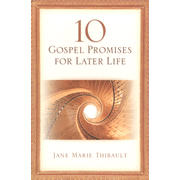

Book Review: 10 Gospel Promises For Later Life

I don’t usually begin book reviews this way, but I feel I must say at the outset that I cannot recommend 10 Gospel Promises For Later Life by Jane Marie Thibault.

The premise is a good one. Mrs. Thibault has been a clinical gerontologist and has worked with the elderly for nearly thirty years. After a consultation with a pastor whose housebound church members said they had trouble relating to the gospel any more for various reasons, Mrs. Thibault began discussing this with her patients and heard similar comments. So she compiled a list of ten major concerns elderly people face — among them, depending on others for help, fear of illness, pain, fragility, disability, loneliness, losing everything and ending up in a nursing home, life after death — and sought to apply gospel truth to them.

While there are some helpful parts to the book, unfortunately there are several major difficulties.

In a section speaking of Jesus’ suffering on the cross, the author says:

Jesus realized that his suffering was necessary. The only way he could convince humanity of God’s love for us was to die for his cause and his teaching. He put his money where his mouth was, dying for his message out of total and complete God-love for the entire world’s well-being until the end of time (p. 85).

Jesus’ death was much more than dying for his cause to convince us of his teaching! He died so that those who believe could be”justified freely by his grace through the redemption that is in Christ Jesus:Whom God hath set forth to be a propitiation through faith in his blood, to declare his righteousness for the remission of sins that are past, through the forbearance of God; To declare, I say, at this time his righteousness: that he might be just, and the justifier of him which believeth in Jesus (Romans 3:24-26.) If a judge told a convicted murderer that he could go free, everyone would cry that that was unjust. In the same way, God cannot just forgive sins without satisfying His justice. When Jesus took our sin on Himself and suffered our punishment, that act satisfied God’s holiness and justice, so He could justify us and still be just Himself, and those who receive Christ as Savior receive as well “the righteousness of God which is by faith of Jesus Christ unto all and upon all them that believe” (Romans 3:22).

Another major problem I have with the book is Mrs. Thibault’s belief that living people can ask the dead for help. Speaking of “institutionally acknowledged saints,” she writes:

“If they continue to live in God’s love and to participate in God’s love of us, the saints might also help us in our daily lives, especially if we ask them to enable us to grow in our love of God and one another” p. 121-122).

“I also believe that every single Christian in the church visible (that’s us) can ask for help from anyone in the church triumphant (those who have been promoted into heaven before us”) (p. 123).

She relates that in struggling with forgiving her mother because of feeling that her mother had been apathetic to her and emotionally abandoned her before her death when the author was a teenager, the author wrote a prayer to her mother asking that the two of them work on healing their relationship.

There is nothing in the Bible that encourages interaction with the dead: in fact, there are warnings against it. Deuteronomy 18:11 says, “There shall not be found among you any one that maketh his son or his daughter to pass through the fire, or that useth divination, or an observer of times, or an enchanter, or a witch.Or a charmer, or a consulter with familiar spirits, or a wizard, or a necromancer.  For all that do these things are an abomination unto the LORD: and because of these abominations the LORD thy God doth drive them out from before thee.” The only time I can remember in the Bible that anyone tried to communicate with the dead was in I Samuel 28 when King Saul was desperate because the Philistines were about to attack him and God wasn’t answering his prayers any more because of his disobedience. He tried to contact the prophet Samuel through a medium, and Samuel did not say, “Hi there, what can I do for you?” He said, “Why hast thou disquieted me, to bring me up?” He not only did not help him, but he prophesied that Saul and his sons would be die. There is nothing I am aware of in the New Testament that would negate these warnings. Mrs. Thibault is not advocating using mediums or having seances, but still, there is nothing in the Bible instructing us to seek help from the dead or to pray to anyone other than God. Why would we want to, anyway, when He has promised to meet every need exceeding abundantly above all that we ask or think?

A third major problem is the idea that “By interpreting our suffering as energy that can be useful to the human community and by offering this energy to God, we unite our sufferings with those of Christ…In effect, we turn the energy of our suffering into a gift for others to use for their well-being” (p. 86). She posits “According to the string theory of quantum physics, we are all inter-connected by subatomic ‘strings’ along which energy flows from one created thing to another. We can use our will, our intention, to direct this energy wherever we want it to go” (p. 88-89).  According to my husband, who is a physicist, this is a faulty application, and the string theory is just a theory: according to Wikipedia, “The theory has yet to make testable experimental predictions, which a theory must do in order to be considered a part of science.” Mrs. Thibault says “This sounds like the scientific equivalent of Jesus’ image of the vine and the branches” (p. 89), but Jesus is speaking of the spiritual life and energy He gives to those who abide in Him (John 15), not of our directing energy wherever we want it. She writes, “Jesus has promised us that we can use our suffering energy for the welfare of all” (p.91). Not in any version of the Bible I have ever read. There are many Scriptural reasons for suffering, but nothing like this is mentioned: even the section of suffering for others’ sake does not indicate this kind of thing. The author tells of “dedicated suffering” as a group for agreed upon persons and  says that those who participated in this kind of thing decreased their doctor visits and personal complaints. I don’t doubt that they felt better, but I think it was more likely due to the thought that their pain could help others and the practice of each participant expressing his or her pain. It is helpful to discuss your pain with others who also experience pain who would uniquely understand you. The author says this practice of offering the energy created by our pain to others or to God for Him to use for others “has its theological foundation” in Colossians 1:24: “Who now rejoice in my sufferings for you, and fill up that which is behind of the afflictions of Christ in my flesh for his body’s sake, which is the church.” But I do not believe this type of practice is what Paul is talking about (my views on what this verse is teaching align more with what is taught here.)

Even though there were parts of the book I found helpful and useful, I cannot endorse it overall for these reasons.

(This review will also be linked to Semicolon‘s Saturday Review of Books.)

The Week In Words

”"

Welcome to The Week In Words, where we share quotes from the last week’s reading. If something you read this past week  inspired you, caused you to laugh, cry, think, dream, or just resonated with you in some way, please share it with us, attributing it to its source, which can be a book, newspaper, blog, Facebook — anything that you read. More information is here.

This is one of those weeks when I have many I want to share, but I am afraid if I share all of them at once, some will lose their impact and get lost in the shuffle. But if I try to leave some for another week when I don’t have any….well, so far there has been only one week like that! So I think I will just get started and then decide what to do.

This is a quote from a former pastor on a friend’s Facebook:

“Obedience is not legalism. It is the beautiful response of spirit-enabled people to say yes to God.” — Mark Minnick

That’s a rich one that really needs some time to meditate on. I don’t know if you’ve ever experienced being accused of legalism when you were simply trying to obey something you felt Scripture taught (and another differed on), but I have. Or, on the other hand, some people so emphasize grace that they don’t seem to see a need for obedience because they have grace for their disobedience. God provides grace in abundance when we fail, but He provides grace to obey and avoid failing, too if we ask Him (speaking here of the everday walk of a Christian — we all need God’s grace for salvation because we all have failed in the first place.)

This was seen at Challies in a review of the book Written in Tears by Luke Veldt which he wrote after reading Psalm 103 every day for a year after his teen-age daughter suddenly died. I haven’t read the book yet, but I want to.

Sometimes people of faith have a hard time remembering that suffering was an excruciatingly painful process for Job. ‘The Lord gives and the Lord takes away; blessed be the name of the Lord,’ we quote Job brightly—forgetting that when he said it he had shaved his head and torn his clothes and that a few days later he was sitting on an ash heap, covering in painful boils and cursing the day he was born.

Don’t try to make the pain go away. The pain doesn’t go away. Hurt with me.

Rich advice for anyone wanting to help anyone suffering.

From a devotional titled The Invitation by Derick Bingham. commenting on John 7:37, 44:

You are not big enough to be the goal of your own existence. Make Him your goal.

The next few are from Jesus, Keep Me Near the Cross: Experiencing the Passion and Power of Easter, compiled by Nancy Guthrie.

From Adrian Rogers on Isaiah 53:7 concerning Jesus’s silence before His accusers (p. 53):

If Jesus had risen up in His own defense during His trials, I believe He would have been so powerful and irrefutable in making His defense that no governor, high priest, or other legal authority could have stood against Him! In other words, if Jesus had taken up His own defense with the intention of refuting His accusers and proving His innocence, He would have won! But we would have lost, and we would be lost for all eternity.

I had never thought about it that way before, but I am sure that that is at least one of the reasons for His silence.

And from Martyn Lloyd-Jones on Hebrews 2:14-15 (p. 77-78):

The world was very pleased with itself, was it not, as it looked upon him there dying upon the cross? That is why they laugh. That is why they are joking. At last they had got him, they had nailed him, they had killed him. He was finished….. The devil thought he was defeating Christ, but Christ was reconciling us to God, defeating the devil and delivering us out of His clutches.

If it was not so deadly serious, the irony would be amusing that when the devil did his worst against Christ, Christ was using that very act to redeem men and deliver them from the devil.

I think I will stop there today — I have another lengthy one but I think I will save it for its own post.

If you’ve read anything that particularly spoke to you that you’d like to share, please either list it in the comments below or write a post on your blog and then put the link to that post (not your general blog link) in Mr. Linky below. I do ask that only family-friendly quotes be included. I hope you’ll visit some of the other participants as well and glean some great thoughts to ponder.

And please do comment even if you don’t have quotes to share!

Laudable Linkage

Here are interesting things I’ve seen around the Web lately: maybe some will interest you as well.

10 reasons to break the sarcastic habit, with action plan.

So Was Jesus.

Thoughts on Modesty, not from the standpoint of causing guys to stumble, though that’s a valid concern, but as a matter of our own hearts before God.

“Dora the Doormat” and other Scary Straw Women of Complementarity, HT to Challies. Deals with some of the erroneous charges some make against proponents of complementarianism, the view that God created the sexes equal but with roles that complement one another.

Confessions of a Conflicted Complementarian, showing how gospel grace applies even in this.

One taxpayer’s response to the potential government shutdown. Heh, heh, heh.

Food:

Double Chocolate Treasures. I am definitely trying these!

Cake Balls. I usually take the easy route of just throwing cake batter in a 9 x 13 pan, but these looks so good.

Resurrection Rolls for Easter breakfast. I’ve posted my version with yeast rolls before, but this one uses crescent rolls and cinnamon. I might just try this kind this year.

Crafts/decorations:

Buttons on display. Really cute card made with buttons.

How to Turn Mini-Blinds Into Roman Shades, HT to Lizzie.

What guys think about modesty:

I can’t imagine all the work behind this:

Happy Saturday!

Friday’s Fave Five

Welcome to Friday’s Fave Five, hosted by Susanne at Living to Tell the Story, in which we can share five of our favorite things from the last week. This has been a wonderful exercise in looking for and appreciating the good things God blesses us with. Click on the button to learn more, then go to Susanne’s to read others’ faves and link up your own.

Here are a few highlights from this week:

1. A visit with a dear friend. I’ve mentioned my friend Carol in SC a few times here and there. She and her husband were in the Gatlinburg/Pigeon Forge area over the weekend, which is about an hour or so from us, and they drove over for Sunday dinner before heading back home. It was so good to see them again and to have them here!

2. Four Layer Dessert with chocolate this time!

3. A come-from-behind Scrabble move that wins the game. One friend I play Scrabble with via Facebook used to always beat me soundly, until I learned some of her moves (bwahahahaha). Now we go back and forth. In one game she had pulled ahead and it looked like she would win — but then I was able to go out with some unlikely letters and win. I love it when the game is close and suspenseful.

4. Dogwood trees. Back in SC, after the first crocuses, daffodils, and tulips bloom, spring’s next act is the dogwoods and azaleas. We’ve had dogwoods in nearly all of our yards over the years except at our very first home and this one, and I missed them. But in the last week or so I’ve seen many blooming around the neighborhood. Maybe some day we can plant one here, but in the mean time, I’ll enjoy them when I am out.

5. Eastern Redbuds. I’ve noticed these trees with lavender buds on them along the highway between here and church, and they’ve really brightened the view since many other trees don’t have their leaves yet. I wasn’t sure what they were, but a couple of people suggested Redbuds, and I think that’s right.

Sorry, no photos of either tree — I’m in the car when I see them.

Have a great weekend!

Flashback Friday: Poetry

Mocha With Linda hosts a weekly meme called Flashback Friday. She’ll post a question every Thursday, and then Friday we can link our answers up on her site. You can visit her site for more Flashbacks.

In honor of National Poetry Month, the prompt for today is:

What poems do you remember from your childhood? Did you have to memorize many poems for school when you were growing up? Did you learn any just for fun? Do you remember which ones they were–and can you still recite them? Did you have a poetry book that you liked to read? Do you enjoy poetry today? Do you prefer rhyming poetry or free verse? Whimsical poetry or epic poems that tell a story? Do you have a favorite poem or poet? Have you ever written any poems?

I must have been exposed to nursery rhymes early on, but my first conscience memory of poetry is from A Child’s Garden of Verses by Robert Louis Stevenson in first grade. Loved that book! My next memory concerning poetry involved making a poetry book a few years later. We were supposed to look up various poems, copy down our favorites, and illustrate them. I wish I still had that book! The only lines I remember from it are from one poem which said, “But I think mice/Are rather nice.” I do not think so now!!

I know I probably read more poetry in English classes through the years, but my next memory is of angst-filled poetry I both read and wrote as a teenager. I’ve written only a few in recent years, two silly and one serious: Ode to Hay Fever, Ode to a Summer Cold, and A Mother’s Nightly Ritual.

I do enjoy poetry today. Good poetry, anyway. When carefully chosen words really encapsulate a particular thought or feeling or truth in poetry, it just really hits home like nothing else.

In general I like rhyming poetry better than free verse — there is just something about the rhythm and disciple of rhyme that is beautiful. Free verse looks like it would be easier, but just stringing words down a page does not constitute a free verse poem, so in a way I think it might be harder to create something truly poetic as a free verse. But it can be done.

I like the idea of epic poems that tell an over-arching story — The Rime of the Ancient Mariner, etc. — but I think today’s readers would find it hard to sustain the thread of the story through that many verses. I enjoy “light verse” like Richard Armour‘s as well as devotional poetry like Amy Carmichael‘s.

I don’t know if I have a favorite poet, but the closest would probably be Robert Frost. Though his poems are mostly pretty short, he packs a lot of meaning in a few words that are accessible to most people today.

Some of my favorite poems of all time are:

Stopping By Woods on a Snowy Evening by Robert Frost
The Road Not Taken by Robert Frost
How Do I Love Thee by Elizabeth Barrett Browning
To A Waterfowl by William Cullen Bryant
To a Mouse by Robert Burns
To a Louse by Robert Burns
A Red, Red Rose by Robert Burns
The Cotter’s Saturday Night by Robert Burns
The Raven by Edgar Allen Poe
Annabelle Lee by Edgar Allen Poe
To My Dear and Loving Husband by Anne Bradstreet.
September by John Updike
Am I a Stone and Not a Sheep? by Christina Rosetti
The Blue Bowl by Blanche Bane Kuder
The Blue Robe by Wendell Berry
October’s Party by George Cooper
I Am Not Skilled to Understand by Dorothy Greenwell

Do you have a favorite poem?

Wednesday Hodgepodge

Joyce From This Side of the Pond hosts a weekly Wednesday Hodgepodge of questions for fun and for getting to know each other.

1. National Read a Road Map Day falls on April 5th. Would people say you have a good sense of direction? Do you rely on a GPS when you drive somewhere new? When was the last time you used a map?

No, I don’t have a good sense of direction at all. I need exact instructions. I haven’t used a fold-out paper map in…..oh….some years….but sometimes I do print out maps and directions from the Internet. Our satellite coverage from the GPS doesn’t seem to cover all the area here since we’ve moved, so printed directions help if we get stuck or the GPS can’t find the road we need. But I prefer the GPS to trying to read directions while driving. It’s been a tremendous help since we moved.

2. What’s your favorite cookbook?

The church cookbook from our previous church.

3. What painting would you like to “walk into” and experience? Why?

Wow, that’s a hard one. One of the first that comes to mind is The Journey to Emmaus, where two disciples were walking and discussing the events of the crucifixion and resurrection, and Jesus joins them, though they do not know it is Him yet. “And beginning at Moses and all the prophets, he expounded unto them in all the scriptures the things concerning himself” (Luke 24:27.) That would have been quite an interesting conversation!

4. What annoys you more- misspellings or mispronunciations?

Depends on whether I am reading or listening. 🙂 I don’t know — both annoy me. But I can understand typos and have them all too often myself, so maybe mispronunciations from newscasters and public speakers — seems that if they’re planning what they’re going to say they’d check out pronunciations ahead of time.

5. What is something your mother or father considered important?

My father’s biggest issue was respect.

6. Do you like or dislike schedules?

Yes. 🙂 I don’t particularly like them on a daily basis, but I do get more done with them than if I just meander through the day. But when any kind of big event is coming up, they’re essential and a big help.

7. Let’s have some fun with National Poetry Month (that would be April)…write your own ending to this poem-

“Roses are Red
Violets are blue…”

Incidentally if you’d like to read the history behind that little ditty you’ll find it here.

“It’s the time of year
Many people say, ‘Achoo!'”

8. Insert your own random thought in this space.

A few quotes seen here and there:

— “A chip on the shoulder is too heavy a piece of baggage to carry through life.” — John Hancock

— Every time history repeats itself the price goes up.

— A clean desk is a sign of a cluttered desk drawer.

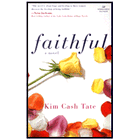
Book Review: Faithful

Faithful by Kim Cash Tate is another book I won in a contest at Mocha With Linda.

Kim unfolds the lives of three friends:

Cydney is approaching her 40th birthday, single, wondering why God has not fulfilled her desires for a husband and children, stung by the fact that her thoughtless sister planned for her wedding to take place on Cyd’s birthday. But as the handsome and likable best man shows interest in Cyd, she’s flattered and even attracted, yet sure he is not the one for her.

Dana seems to have a perfect marriage — until her husband is caught having an affair.

Phyllis has been praying for her husband to come to Christ ever since she did six years previously, but he remains adamantly opposed to anything smacking of Christianity. Then at a college reunion she runs into an old friend who is widowed and seems a sensitive, thoughtful, godly Christian man, and she finds herself torn between the marriage she has and the ideal one that could be.

Each of these women learns in various ways what it means to trust in God’s faithfulness and to be faithful personally in their situations.

This was a hard book to put down — I kept wanting to let everything else go so I could keep reading and see what happened! Kim Cash Tate made it very easy to like her characters and to empathize with them and to be drawn into their struggles.

I know some women might avoid a book like this because of its subject matter, but real women in this world do face these kinds of situations, and Kim shares both the struggles and temptations they face as well as both spiritual and practical ways to deal with them in a gracious and non-preachy manner. Nevertheless I would urge caution before allowing a teen to read it: I definitely recommend a mom previewing it first.

(This review will also be linked to Semicolon‘s Saturday Review of Books.)

The Week In Words

”"

Welcome to The Week In Words, where we share quotes from the last week’s reading. If something you read this past week  inspired you, caused you to laugh, cry, think, dream, or just resonated with you in some way, please share it with us, attributing it to its source, which can be a book, newspaper, blog, Facebook — anything that you read. More information is here.

I have just a couple this week:

I am only about 24 pages into Women’s Ministry in the Local Church by J. Ligon Duncan and Susan Hunt, but this quote stood out to me:

If we lack interest in the church we lack what for Jesus was a consuming passion. Jesus loved the church and gave himself for it (Eph. 5:25). ~ Dr. Edmund Clowney

There seems to be a disregard or even a disdain for church these days, and this is a needed reminder of just how important it is in God’s eyes.

Then in Jesus, Keep Me Near the Cross: Experiencing the Passion and Power of Easter, compiled by Nancy Guthrie, J. Ligon Duncan III shares in the chapter “Betrayed, Denied, Deserted.” speaking of the moment when Judas betrays Jesus with a kiss:

We cannot help but admire the dignity of the Lord Jesus Christ as he goes through this indignity. He does it with magnanimity and with the sense that he is nor forsaken. He is not out of control. God’s providence is ruling over all.  So the character and the calmness of Jesus remind us and provide an example for us in the midst of our own trials (p. 38-39).

And later in the same chapter:

In this statement, Jesus is stressing that is not not going to the cross because God lacks the power to stop it. Nor does Jesus lack the ability to ask of God to spare him. Instead, Jesus is going to the cross because he has chosen to go to the cross. He is not a passive victim. He is the prime actor. (p. 40).

This is so important to remember, especially as people’s thoughts turn toward the cross this season and they perhaps watch films dealing with the death of Christ. There are little clues throughout the gospels that Jesus was not a “passive victim,” but was very much in control of what happened when, and he went through it all willingly.

If you’ve read anything that particularly spoke to you that you’d like to share, please either list it in the comments below or write a post on your blog and then put the link to that post (not your general blog link) in Mr. Linky below. I do ask that only family-friendly quotes be included. I hope you’ll visit some of the other participants as well and glean some great thoughts to ponder.

And please do comment even if you don’t have quotes to share!

Spring….

INSTALLING SPRING…
████████░░░░░░░░░░░░░░░░░░░░░
33% DONE. Install delayed….please wait. Installation failed. Please try again.

__________________________________________________________
I saw this going around Facebook recently and thought many of you would get a kick out of it since many of you are experiencing back and forth weather like we are. Today is pretty springy, though — sunshiny and in the 60s. Let’s hope that spring installation completes and stays. 🙂