Book Review: Sunrise

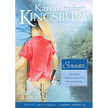
I finished Sunrise by Karen Kingsbury sometime last week, but hadn’t yet sat down to review it. It wasn’t on my original Spring Reading Thing list, but when I knew it was coming out in early May, I added it, just barely restraining myself so my kids could buy it for me for Mother’s Day. 🙂

The characters in Sunrise, the Baxter family, originated with the Redemption series of five books, then continued primarily focusing on John Baxter’s oldest son, an actor named Dayne, in the next Firstborn series of four books. The Sunrise series will end the Baxter family saga with I believe another four books, the first of which is Sunrise.

Sunrise has an ensemble cast: Dayne and Katy’s story continues, as does John Baxter’s and his daughter Ashley’s. The other Baxters are there in the book, but we see the most of these. Also, the family Katy lives with, the Flanigans, are spotlighted a little more in this book than the previous ones.

There are several issues touched upon: teen-age alcoholism, a friend’s jealousy, the need to be careful in dating — their are three dating or almost, sort of dating couples in the book, and each relationship has its challenges. There’s the issue os what a prime Hollywood actor would have to face if he became a Christian and the issue of dealing with the media. This storyline seemed the most real to me, even though I know no one in Hollywood. I am thinking that Karen must — or else she has a good imagination. 🙂

But one of the things I most enjoyed about the book was the continuation of Dayne and Katy’s story. In so much fiction, when the guy and girl get together and declare their love, that’s pretty much the end of it. But Karen progresses Dayne and Katy’s relationship and shows some of the struggles they will face and concessions and sacrifices they will have to make, especially when joining together from such different worlds.

Overall this was one of my favorite Karen Kingsbury books.

(By the way, many Spring Reading Thing participants are linking to reviews of the books they’ve read on Katrina’s blog here, if you’d like to see what other people think about other books. Plus Semicolon sponsors a weekly book review link on Saturdays.)

More book give-aways!

This seems to be a summer of book give-aways! That’s fine with me! Besides the ongoing ones at Katrina’s and the one I mentioned earlier at Deena’s, there is another one this week only at Joyful Days.

Booking Through Thursday: Paper or Plastic?

btt2.jpgQuestions for today from Booking Through Thursday:

  • Do you read e-Books?
  • If so, how? On your computer, or a PDA?
  • Or are you a paper purist? Why?

I have never read an e-book — I can’t imagine sitting at the computer for the length of time it would take to read through a book — although I probably sit at the computer long enough to read a book. 🙂

I think in my mind I think of reading on the computer in shorter bits — I even lose attention in very long posts or e-mails or articles. Plus there’s just something about curling up on the couch with a throw blanket and a good book. 🙂

So, I am not a paper purist in the sense that I think all books should be on paper and it’s a travesty to have books on the computer — not at all. I’m glad books are available on the computer, but my preference is to take any lengthy reading away from the computer.

I don’t own a PDA, so that might make a difference. I can’t imagine reading a book through that tiny little screen. But my husband and two older kids use them a lot. I may try it out down the road.

Book Give-aways!

I just discovered today a blogger named Deena at A Peek at My Bookshelf who will be giving away one book a week during the summer from June 1 to August 24. She’ll review a book each week for the contest, and whoever leaves a comment on the post of the featured book will have their name entered to be drawn the following Thursday.

Sounds like my kind of contest! Click on the doggie button for more information.

Book Review: A Tree Grows in Brooklyn

I first saw A Tree Grows in Brooklyn mentioned in a Bugs Bunny cartoon when I was a kid. I don’t remember the plot of the cartoon and don’t know if this book title related at all to what was going on in the cartoon: I just remember Bugs reading it as he was walking off into the sunset at the end of the episode. For some reason the title stuck with me. Then a few years ago I caught part of an old black and white film of the same name and discovered it was the story of a little girl with an alcoholic father. My father was an alcoholic as well, and though his personality and situation were different from the film, I still found many things I could identify with. So I planned to read the book “some day.”

I must say at the outset — I had no idea this books would have such profanity and vulgarity. I don’t read much modern secular fiction because of those elements. But I thought this book was published long enough ago that it wouldn’t be a problem. I know that profanity and vulgarity aren’t new to the 20th century, of course, but I just figured books from farther back in time would be “cleaner.” If I had known that this books contained so much of this, I would not have begun it; as it was I considered laying it aside many times.

I know, of course, that these things are a part of many people’s lives: I grew up in an unsaved family and heard  much of the same in my early years. I know many children today see, hear, and experience much worse things than are contained in this book. But I don’t want to fill my head with it again in my reading after years of trying to get that kind of thing out of my mind.  I think the realism of Francie’s life could have been expressed without being explicit.

That said….I discovered the book was not just about Francie and her alcoholic father. It is more about a young girl “coming of age” in Brooklyn in the early 1900s, though that description sounds so bland. Francie had more to deal with than an alcoholic father: extreme poverty, a mother who had hardened herself somewhat to deal with the blows of life and who loved Francie’s brother, Neely, more than she did Francie, a love of learning yet a need to quit school to work to support the family.

The symbolism of the tree in the title and in the story is clear: the tree that “liked poor people,” that grew in “sour earth” where it wasn’t given much inducement to grow, that continued to grow even after it was cut down, is parallel to Francie’s life.

There were several poignant moments in the book. Though I don’t think anyone in the family ever said so out loud, everyone knew that Francie’s mother favored her brother, Neely, yet when  her mother was in the last days of her third pregnancy and gave birth, she and Francie found a companionship they hadn’t had before.

Francie enjoyed reading, and later, writing, and often got As on her “pretty” compositions.  But when she began to write about her father, trying to “show that, despite his shortcomings, he had been a good father and a kindly man,” her teacher rebuked her for writing “sordid” stories, saying, “Drunkenness is neither truth nor beauty. It’s a vice. Drunkards belong in jail, not in stories. And poverty. There is no excuse for that. There’s work enough for all who want it. People are poor because they are too lazy to work. There’s nothing beautiful about laziness. Hunger is  not beautiful. It is also unnecessary. We have well-organized charities. No one need go hungry.”

Francie thought, “Imagine Mama lazy!” Her mother worked her finger to the bone. “Her mother hated the word ‘charity’ above any word in the English language and she had brought up her children to hate it, too.”

Though I do know of people who are poor because they aren’t diligent, there are also people who work harder than many of us have ever known, yet have low-paying jobs and just cannot get ahead — yet we so glibly let these judgmental thoughts pour forth. Francie had been brought up to believe that education was her hope, yet she began to realize that “her life might seem revolting to some educated people.” She didn’t want to grow up “ashamed of handsome papa who had been so lighthearted, kind, and understanding; ashamed of brave and truthful Mama who was so proud of her own mother, even though Granma couldn’t read or write; ashamed of Neely who was such a good honest boy.” She felt that all her pretty stories were lies and burned them.

There seems to be, in literature, at least, three kinds of “drunks.” There’s the “mean drunk” who abuses his wife and children and gets meaner the more he drinks. There’s the “happy drunk” like Magnolia’s father in Showboat, drunkenly sputtering “Happy New Year” to smiling observers. Then there is a kind of beautiful tortured soul — the person who is kind, often artistic, likable, charming, yet with this one destructive weakness. In the film Francie’s father seemed to be the happy, jolly sort, from what I remember, but in the book he was more the last type. He was warm, thoughtful. and caring; he was the one who took care of Francie when she was injured, who seemed to understand her in a way that her mother didn’t.

One situation in the book particularly showed Francie’s dilemma and character. The time came when the children were old enough to legally quit school and work. they needed the income of one of them; only one would be able to continue on to high school. Francie was studious and wanted to learn; Neely wanted to quit school and work. It would seem natural to let them both follow their desires. But Francie’s mother determined that Neely would go to school because if she didn’t make him, he never would, whereas Francie would fight to get an education. Both children were bitterly disappointed, but Francie’s mother’s prediction turned out to be true: Francie later put herself through college. I don’t know if I could have made the same decision in that mother’s place.

Along the way in the book there are intriguing historical glimpses into everyday life and the customs of that time and place.

Some portions of the book are autobiographical: Betty Smith grew up in Brooklyn and wrote what she knew. Yet she said that she “didn’t write it the way it was, but the way it should have been,” so it’s hard to know, at least from the biographical information in the back of the book, which parts were “the way it was” and which were the way she thought they should be.

I won’t give away the ending, but I will say it ends on a more hopeful note than what is found in most of the story.

Which Jane Austen heroine are you?

I am Elinor Dashwood!

Take the Quiz here!


:: E L I N O R ::

You are Elinor Dashwood of Sense & Sensibility! You are practical, circumspect, and discreet. Though you are tremendously sensible and allow your head to rule, you have a deep, emotional side that few people often see.

Booking Through Thursday: Bookless

btt2.jpg The question for today from the Booking Through Thursday site is:

It happens even to the best readers from time to time… you close the cover on the book you’re reading and discover, to your horror, that there’s nothing else to read. Either there’s nothing in the house, or nothing you’re in the mood for. Just, nothing that “clicks.” What do you do?? How do you get the reading wheels turning again?

I honestly can’t imagine that ever happening. 🙂 I have a stack of books waiting to be read, a few more on the shelves for “some day,” and several magazines piled up. I also have a list of books to check out compiled from other people’s reading lists that I have seen on the Spring Reading Challenge or on people’s sidebars.

I always have to-be-read non-fiction, which takes me longer to slog through, and there have been times I have no new fiction in the house (I’m usually into a couple of books at the same time, one of them always fiction). Then I might go to the Christian bookstore and just look around and see what looks interesting. I also have some I want to reread, like Jan Karon’s Mitford series, so that’s another possibility.

And…sometimes I just need to give reading a break and do something else. But those breaks don’t usually last long. 🙂

I forgot about the last couple of Booking Through Thursdays — I actually read the questions and planned to think about it and answer later — and then forgot. 😳 They had to do with whether we read in public or not and why, and where would we not read. Sure, I read in public — why not? 🙂 It helps pass the time, especially in places like doctor’s offices, airports and airplanes, etc. Sometimes I’ll read if I am eating by myself in public because I feel awkward sitting there alone — but sometimes it would feel more awkward to open a book in a restaurant. But I usually try to avoid eating out alone.

Choosing not to read in public has more to do with appropriateness or rudeness rather than location: I wouldn’t read a book in church (except the Bible passage while the preacher is reading it. 🙂 ) or at a play or concert or speech where I am supposed to be there to listen to what’s going on. And even in airplanes and doctor’s offices, sometimes it is rude to keep my nose in a book and ignore someone next to em who is trying to strike up a conversation.

One of my favorite people

from_cannibalism_small.jpgSeveral weeks ago at our ladies’ meeting one of my favorite people in all the world spoke to us. Margaret Stringer was a missionary to Indonesia (then known as Irian Jaya, now West Papua) for over 40 years. She’s been “retired” from the field for the last 2-3 years, but she stays more active than a lot of people half her age. When she retired she thought she would never have an opportunity to go back, but she was able to go for several weeks last November and December. She showed some video footage (24 minutes condensed from 5 hours) while she told us what was going on, interspersed with some history here and there of the people.I tell you — seeing footage of former cannibals and headhunters now singing hymns, hearing about the most powerful and feared witch doctor in the area who became a believer and whose son is now the head of the church — that just does something to your heart. The same God who performed miracles in lives in Bible times, who worked through Hudson Taylor and Amy Carmichael and other well-known missionaries in centuries past, is still the same God today and still has the same power to change lives.

Margaret and her co-worker were the last of what was a pretty good-sized mission station, with a doctor and his wife, and I think other missionary couples and three single ladies, if I remember correctly. There are some missionaries who go to work in one church in another country for life, and there are others who go to various places and start works, then “work themselves out of a job” by training the new believers to take over their own church — there’s a place for both types. But Margaret’s village was the latter type. I appreciated the way she endeavored to help them not to be too dependent on her. When they asked her to name the church, for instance, she told them they should name it.

She told us about one man who, during this visit, said something like, “When you left us, I was very sad for a long time. But you told us you were leaving God here, and He helped me. So when you leave this time, I will be sad, but not for as long a time, because God is here with me.” She said that’s not exactly how she put it to him, it it was so neat he got the concept that God was still there and didn’t leave when she did, and he could depend on Him.

I was amazed at her fearlessness. In one piece of footage, she was getting out of a boat to see one of the villages she used to work in, and one man took her hand and began leading her away. Her friend said, “Where are you going?” She said, “I don’t know!” As people came to greet her and hug her, the man would stop for a few minutes, and then take her hand and lead her away again. Finally he led her to his house, where he had prepared lunch for them.

Margaret can tell tales about harrowing, scary experiences that have us all in stitches laughing.

Some years ago before she retired, I asked her if she had ever considered writing a book, and she said yes, she was thinking about it. She’s had such interesting life experiences that she tells in such an engaging way, and the Lord’s hand has been so obviously in her life, I really feel these stories need to be shared.

Her first book is out now, titled From Cannibalism to Christianity. She had several copies with her that night, so I got one for myself plus two to give away to my mother-in-law and one friend who couldn’t come.

This book tells the story of one particular village, from first contact to the establishment of a full-fledged church. There are hilarious moments as well as frightening ones. But what joy there is in seeing the light of understanding dawn after repeated sharing of the gospel. I don’t remember if Margaret said this in the book, but I know I heard her say while speaking to us that there were moments when she thought, “This isn’t going to make sense to them.” Imagine sharing the Word of God with someone who doesn’t know anything about it and doesn’t know who God is. Yet they did share God’s Word by faith, and the Holy Spirit gave understanding and conviction.

Secularists don’t have to worry about the people’s culture being infringed on. The people still have their own traditions and culture. But they also have hope and life. As I said in an earlier post, I don’t know why anyone, even the most unchristian person on the planet, would have any objection to helping people get rid of traditions like cannibalism and killing a twin baby.

I asked Margaret’s cousin (I believe that’s who it was — either a cousin or a sister-in-law) who came with her if Margaret was writing any more books. She said Margaret had some in mind but had a hard time getting still enough to write with all the invitations to speak. I hope she keeps having opportunities to speak, but I hope some time she can find a way to keep writing, too. I would love to read her life story some time.

Show and Tell Friday

show-and-tell.jpg Kelli at There’s No Place Like Home hosts the “Show and Tell Friday,” asking “Do you have a something special to share with us? It could be a trinket from grade school, a piece of jewelry, an antique find. Your show and tell can be old or new. Use your imagination and dig through those old boxes in your closet if you have to! Feel free to share pictures and if there’s a story behind your special something, that’s even better! If you would like to join in, all you have to do is post your “Show and Tell” on your blog, copy the post link, come over here and add it to Mr. Linky.

Over 25 years ago as a college student I first heard the well-known story of the five missionaries who were killed by the tribe of Indians in Ecuador known then as the Aucas (later it was discovered their name for themselves was the Waodani) with whom they were trying to make contact. I read the book Through Gates of Splendor by Elisabeth Elliot, whose husband, Jim, was one of the five, which tells of these men, how they came to Christ and then to Ecuador, the events leading up to this moment, and the miraculous way the Lord opened the door for Elisabeth , her young daughte Valerie, and Rachel Saint, sister of Nate Saint who was another of the men, to go live with the same Indians who killed their loved ones and to bring them the gospel.

It’s a story that has been impacting lives for years. My life was one of them. To read of the faith and devotion of these men and their wives, the willing sacrifices they made, the way the Lord ministered to them and to the Waodani, and then to read about Waodani becoming brethren in the faith and growing in the Lord — I just don’t think I can convey everything the Lord has done in my own heart as a result.

Elisabeth’s book tells of a photographer for Life magazine named Cornell Capa who came out with the first responders to search for the men in the jungles after their deaths and the edition I have includes several of his pictures. It may seem an odd, silly thing, but I have always wished I could get a copy of that edition of Life.

Well, last Christmas I received a copy of it from my oldest son, Jeremy. We each make “Christmas lists” for the others in our family so that we have some idea of what to get for each other, but Jeremy likes to come up with something “just right” for the recipient that is not on the list. He had heard me speak of this and searched the Internet to see if he could find it. He had to buy a whole bundle of other issues that this one was in, but he ordered it and gave me the copy from January 30, 1956, which has a the ten-page story and pictures of this incident.

cimg0662.jpg

cimg0663.jpg

This is a treasure to me not only because it is a piece of history from an event that touched my life in so many ways, but also because of Jeremy’s thoughtfulness in getting it for me.

By the way, if you are interested in reading more about this story, besides Through Gates of Splendor mentioned above, several other books have been writen. Rachel Saint wrote The Dayuma Story, but the only copy of that I found searching the Internet shows Ethel Emily Wallis as the author: I don’t know if this is a republication of Rachel’s book or a completely different book. I read Rachel’s: I haven’t read this one. Another of the widows, Olive Fleming Liefeld, wrote Unfolding Destinies. The most recent one is End of the Spear by Steve Saint, son of Nate Saint. (I reviewed the film by the same name here.) These are just the ones I have read: there may be others I don’t know of. I have read most of Elisabeth Elliot’s other books since then as well.

You can visit Kelli’s place to see more “Show and Tell” stories or share your own.

And the winner is….

The winner of the book give-away for Queen of the Castle: 52 Weeks of Encouragement for the Uninspired, Domestically Challenged or Just Plain Tired Homemaker by Lynn Bowen Walker from my interview with her is…

(Trumpet fanfare…)

Bet!