Preparing for Easter with C. S. Lewis

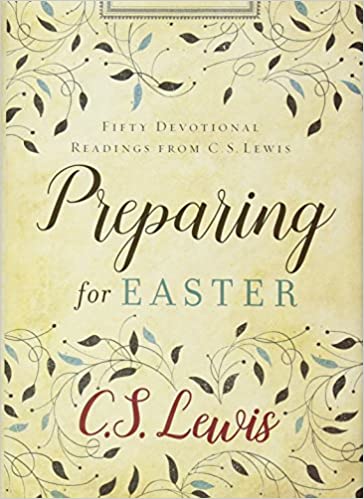
Preparing for Easter: Fifty Devotional Reading from C. S. Lewis. is a compilation of selections from his writings.

C. S Lewis is one of the most quotable Christians to have lived, maybe second to C. H. Spurgeon. In fact, I have a book titled The Quotable Lewis. So any book of quotes by him will have value.

By the title of this book, you’d expect an arc of quotations on the subject and application of Christ’s death, burial, and resurrection, leading up to Easter Day. If there was such an arc, I didn’t detect it. The book just seemed more like a random collection.

Of course, the death, burial, and resurrection of Christ touch everything in the Christian life, so, in one sense, any subject within Christendom could be related. Yet many selections in this volume didn’t seem to fit the theme. For instance, one had to do with the value of myths. Did the compiler feel that any part of the true Easter story was a myth? Or was he applying this quote to the bunnies and eggs part of Easter? I don’t know.

The book is set up to begin about six and a half weeks before Easter, with the last reading for Easter Day. The readings aren’t numbered in the book, but I numbered them in my notes. I was confused when I ended up with forty-seven. Then I remembered some day’s readings contained two short selections. So, as the title says, there are fifty readings, but not over fifty days. I started a week late, so I ended the Sunday after Easter.

Some readings are familiar quotes, such as those from the Narnia series or Mere Christianity. Others are from more obscure sources, like private letters. I’m always amazed at how literary Lewis sounds even in a letter. I wonder if he was a perfectionist who made several copies of a letter until it sounded just right? Or did such prose just flow from him? I remember reading somewhere that his books did not need much editing, so perhaps the latter is true.

Though some of the selections were easy to grasp, some suffered from the loss of their context.

I was also reminded that, though I love much of what Lewis wrote, I don’t agree with him on every little point of doctrine. I have several of those places marked, but I don’t think I’ll list them all here for the sake of time and space.

So, all told, I was more than a little disappointed in this volume. Nevertheless, as I said, there are always rich nuggets in his writing. Here are a few I found:

Our model is the Jesus, not only of Calvary, but of the workshop, the roads, the crowds, the clamorous demands and surly oppositions, the lack of all peace and privacy, the interruptions. For this, so strangely unlike anything we can attribute to the Divine life in itself, is apparently not only like, but is, the Divine life operating under human conditions (p. 7, originally from The Four Loves).

I think that many of us, when Christ has enabled us to overcome one or two sins that were an obvious nuisance, are inclined to feel (though we do not put it into words) that we are now good enough. He has done all we wanted Him to do, and we should be obliged if He would now leave us alone. As we say, ‘I never expected to be a saint, I only wanted to be a decent ordinary chap.’ And we imagine when we say this that we are being humble. But this is the fatal mistake. Of course we never wanted, and never asked, to be made into the sort of creatures He is going to make us into. But the question is not what we intended ourselves to be, but what He intended us to be when He made us. He is the inventor, we are only the machine. He is the painter, we are only the picture. How should we know what He means us to be like? (p. 14, originally from Mere Christianity).

We may be content to remain what we call ‘ordinary people’: but He is determined to carry out a quite different plan. To shrink back from that plan is not humility: it is laziness and cowardice. To submit to it is not conceit or megalomania; it is obedience (p. 15, originally from Mere Christianity).

A continual looking forward to the eternal world is not (as some modern people think) a form of escapism or wishful thinking, but one of the things a Christian is meant to do. It does not mean that we are to leave the present world as it is. If you read history you will find that the Christians who did most for the present world were just those who thought most of the next. The Apostles themselves, who set on foot the conversion of the Roman Empire, the great men who built up the Middle Ages, the English Evangelicals who abolished the Slave Trade, all left their mark on Earth, precisely because their minds were occupied with Heaven (p. 58, originally from Mere Christianity).

If I find in myself a desire which no experience in this world can satisfy, the most probable explanation is that I was made for another world. If none of my earthly pleasures satisfy it, that does not prove that the universe is a fraud. Probably earthly pleasures were never meant to satisfy it, but only to arouse it, to suggest the real thing. If that is so, I must take care, on the one hand, never to despise, or be unthankful for, these earthly blessings, and on the other, never to mistake them for the something else of which they are only a kind of copy, or echo, or mirage. I must keep alive in myself the desire for my true country, which I shall not find till after death; I must never let it get snowed under or turned aside; I must make it the main object of life to press on to that other country and to help others to do the same (pp. 60-61, (p. 58, originally from Mere Christianity).

If the new Self, the new Will, does not come at His own good pleasure to be born in us, we cannot produce Him synthetically (p. 72, originally from Present Concerns).

The world is so built that, to help us desert our own satisfactions, they desert us. War and trouble and finally old age take from us one by one all those things that the natural Self hoped for at its setting out. Begging is our only wisdom, and want in the end makes it easier for us to be beggars (p. 72, originally from Present Concerns).

God cannot give us a happiness and peace apart from Himself, because it is not there. There is no such thing (p. 80, originally from Mere Christianity).

Keep back nothing. Nothing that you have not given away will be really yours. Nothing in you that has not died will ever be raised from the dead. Look for yourself, and you will find in the long run only hatred, loneliness, despair, rage, ruin, and decay. But look for Christ and you will find Him, and with Him everything else thrown in (p. 212, originally from Mere Christianity).

One of the most poignant passages to me was a letter from Lewis to a Warfield Firor about facing the ramifications of aging (including compulsory retirement and rheumatism) and letting those “begin . . .to loosen a few of the tentacles which the octopus-world has fastened on one” and remind that “what calls one away is better” (pp. 138-139). (A portion of the letter is here.)

Though I doubt I’ll reread this book in coming Lenten seasons, I was blessed by some of its pages. I was also encouraged to reread Mere Christianity some time and to look up The Letters of C. S. Lewis.


Be Holy: Becoming “Set Apart” for God

Leviticus probably is no one’s favorite book of the Bible. In fact, as one man in our church put it, Leviticus is where Bible reading plans go to die.

But Leviticus is part of God’s inspired word, and “whatever was written in former days was written for our instruction, that through endurance and through the encouragement of the Scriptures we might have hope” (Romans 15:4). It is “quoted or referred to over 100 times in the New Testament.” So it’s highly worthy of our study.

As our church came to Leviticus in our Bible reading schedule, the ESV Study Bible notes and Warren Wiersbe’s Be Holy (Leviticus): Becoming “Set Apart” for God were invaluable companions.

It doesn’t take long to see that God’s holiness is the main theme of Leviticus. “The word holy is used 93 times in Leviticus, and words connected with cleansing are used 71 times. References to uncleanness number 128. There’s no question what this book is all about.” As I mentioned before, a seminary professor teaching Leviticus had his students try to live by its regulations for a period of time. One result was that holiness was a primary focus throughout the day, in regard to everything the students did.

Also, as Ken Baugh points out in his introduction to this book, “Almost everything in Leviticus anticipates the life and death of Jesus. The sacrifices, festivals, rituals, and laws foreshadow God’s redemptive plan. Jesus becomes the means to remove the guilt and penalty for sin through His substitutionary death on the cross. His death provides the final atonement for all sin.”

Though I saw some of those glimpses of Christ in past reading of Leviticus, this time they seemed to be on every page.

A couple of quotes from the book that stood out to me:

God’s church is supposed to be “a holy nation” in this present evil world, to “declare the praises of him who called you out of darkness into his wonderful light” (1 Peter 2: 9 NIV). The Greek word translated “declare” means “to tell out, to advertise.”

“Woe to those who call evil good and good evil, who put darkness for light and light for darkness” (Isa. 5: 20 NIV). The first step toward disobedience is often “reclassifying” sin and making it look acceptable instead of abominable.

Have you ever heard a preacher or teacher say that seven is the number of perfection in the Bible? I had, but I didn’t remember ever hearing why that was so. Wiersbe explains here:

The Hebrew word for seven comes from a root word that means “to be full, to be satisfied.” It’s also related to the word meaning “to swear, to make an oath.” Whenever the Lord “sevens” something, He’s reminding His people that what He says and does is complete and dependable. Nothing can be added to it.

This book helped me get more out of Leviticus than ever before.

What we have studied should make us realize the awfulness of sin, the seriousness of confession and restitution, the graciousness of God in forgiving those who trust Jesus Christ, and the marvelous love of our Savior in His willingness to die for undeserving people like us.

(Sharing with Booknificent, Carole’s Books You Loved)

The Warden by Anthony Trollope

Last year I read Doctor Thorne by Anthony Trollope after enjoying a mini-series based on the book. I discovered Doctor Thorne was the third book of a six-part series called The Chronicles of Barsetshire. I liked Doctor Thorne so much, I decided to read the rest of the series.

The first book in the series is The Warden, a position held by a Mr. Septimus Harding. The warden had various functions in the local church. One role unique to this particular church was overseeing a hospital or almshouse for aged men. In previous years, a man named John Hiram had made provision in his will for such a hospital, for twelve men and a warden to care for them.

A young reformer, John Bold, becomes concerned that the set-up for the hospital is unfair to the patients. He thinks the arrangement is not being carried out according to the Hiram’s will and that the warden is getting more money than he should and the pensioners less. John Bold has no personal quarrel with Mr. Harding himself; in fact, he’s in love with Harding’s daughter, Eleanor. But he’s the type of personality that opposes the principle of the thing and can’t let it go. He begins a lawsuit. Newspapers get wind of the situation and cast aspersions at Mr. Harding’s character.

This might not sound like a riveting plot line, but what makes it interesting is the personalities. Mr. Harding is the meekest of men and only wants to do the right thing. He thought he had been doing right, but now he wants to have the will looked into to make sure. His son-in-law, Archdeacon Grantly, is just the opposite: a take-charge person used to running the show and having his own way. Grantly confers with lawyers to oppose the suit on technical grounds. Grantly probably is probably making too much money from his position: he is described several times as rich. He has no compassion for the old pensioners.

He knew well how strongly he would be supported by Dr Grantly, if he could bring himself to put his case into the archdeacon’s hands and to allow him to fight the battle; but he knew also that he would find no sympathy there for his doubts, no friendly feeling, no inward comfort. Dr Grantly would be ready enough to take up his cudgel against all comers on behalf of the church militant, but he would do so on the distasteful ground of the church’s infallibility. Such a contest would give no comfort to Mr Harding’s doubts. He was not so anxious to prove himself right, as to be so.

Trollope lived and wrote during Dickens’ time, and I wonder what they thought of each other. He satirizes a writer in the story who went by the name Mr Popular Sentiment and who sounds a lot like Dickens or one of his characters. Many of Dickens’ novels seem to have been written to raise awareness and inspire reform. Trollope is not against reform, but he seems to caution here that it can be carried out in a way that hurts innocent people, stirs up negative sentiment without the right basis in facts, and doesn’t accomplish anything good. The question could have been looked into without becoming adversarial. That’s a timely message for these days.

In former times great objects were attained by great work. When evils were to be reformed, reformers set about their heavy task with grave decorum and laborious argument. An age was occupied in proving a grievance, and philosophical researches were printed in folio pages, which it took a life to write, and an eternity to read. We get on now with a lighter step, and quicker: ridicule is found to be more convincing than argument, imaginary agonies touch more than true sorrows, and monthly novels convince, when learned quartos fail to do so.

I especially like Trollope’s characterizations of the newspaper, which in this story is called the Jupiter. I wonder what he’d think of news media today.

From here issue the only known infallible bulls for the guidance of British souls and bodies. This little court is the Vatican of England. Here reigns a pope, self-nominated, self-consecrated—ay, and much stranger too,—self-believing!—a pope whom, if you cannot obey him, I would advise you to disobey as silently as possible; a pope hitherto afraid of no Luther; a pope who manages his own inquisition, who punishes unbelievers as no most skilful inquisitor of Spain ever dreamt of doing—one who can excommunicate thoroughly, fearfully, radically; put you beyond the pale of men’s charity; make you odious to your dearest friends, and turn you into a monster to be pointed at by the finger!’

Oh heavens! and this is Mount Olympus!

It is a fact amazing to ordinary mortals that the Jupiter is never wrong.

A man may have the best of causes, the best of talents, and the best of tempers; he may write as well as Addison, or as strongly as Junius; but even with all this he cannot successfully answer, when attacked by The Jupiter. In such matters it is omnipotent. What the Czar is in Russia, or the mob in America, that The Jupiter is in England.

I like that Trollope addresses the reader, not just as the narrator and member of the community, but as the author.

It is indeed a matter of thankfulness that neither the historian nor the novelist hears all that is said by their heroes or heroines, or how would three volumes or twenty suffice! In the present case so little of this sort have I overheard, that I live in hopes of finishing my work within 300 pages, and of completing that pleasant task—a novel in one volume.

Our tale is now done, and it only remains to us to collect the scattered threads of our little story, and to tie them into a seemly knot. This will not be a work of labour, either to the author or to his readers

I also enjoyed the humorous asides:

The bishop did not whistle. We believe that they lose the power of doing so on being consecrated; and that in these days one might as easily meet a corrupt judge as a whistling bishop; but he looked as though he would have done so, but for his apron.

He never had time to talk, he was so taken up with speaking.

In matters of love men do not see clearly in their own affairs. They say that faint heart never won fair lady; and it is amazing to me how fair ladies are won, so faint are often men’s hearts!

[Said of a particular painting] There on her pedestal, framed and glazed, stood the devotional lady looking intently at a lily as no lady ever looked before.

Popularity spoilt him for all further real use, as it has done many another.

I’m thankful I read Doctor Thorne first. It took me a while to get into The Warden, but I came to enjoy it. I especially liked Harding and his youngest daughter, Eleanor. Of Eleanor it was said, “She had no startling brilliancy of beauty, no pearly whiteness, no radiant carnation. She had not the majestic contour that rivets attention, demands instant wonder, and then disappoints by the coldness of its charms. You might pass Eleanor Harding in the street without notice, but you could hardly pass an evening with her and not lose your heart.”

According to a few sources, Trollope had not intended to write a series when he published The Warden. But a few years later, he was inspired by the characters and setting to write another story. When his popularity picked up, publishers asked him for more books from Barsetshire. It wasn’t until after the sixth was published that the books were marketed together and called The Chronicles of Barsetshire.

I listened to the audiobook superbly read by Simon Vance.

I’m counting this book for the 19th century classic in the Back to the Classics Reading Challenge.

(Sharing with Booknificent, Carole’s Books You Loved)

Do More Better

After several days of feeling like I was just spinning my wheels and not getting anywhere, I decided to pick up Do More Better: A Practical Guide to Productivity by Tim Challies. I’ve read his blog for years and saw this book on a Kindle sale a while back.

When we think productivity, we often think of life hacks. But before Tim gets to practical advice, he lays a biblical foundation with clarity about usefulness and purpose of productivity.

Productivity is not what will bring purpose to your life, but what will enable you to live out your existing purpose (p. 10).

We somehow assume that our value is connected to our busyness. But busyness cannot be confused with diligence. It cannot be confused with faithfulness or fruitfulness. . . .  Busyness may make you feel good about yourself and give the illusion of getting things done, but it probably just means that you are directing too little attention in too many directions, that you are prioritizing all the wrong things, and that your productivity is suffering (pp. 20-21).

No amount of organization and time management will compensate for a lack of Christian character, not when it comes to this great calling of glory through good—bringing glory to God by doing good to others . . .there is no great gain in being a productivity monster if the rest of your life is out of control (pp. 24-25).

After sifting through what productivity is and isn’t good for and what our purpose in life is as Christians, Tim shares this pithy definition: “Productivity is effectively stewarding my gifts, talents, time, energy, and enthusiasm for the good of others and the glory of God.” (p. 16).

He deals with enemies of productivity and the need to define our responsibilities and roles.

Then he discusses tools. Old-school equivalents would be a task-management tool, like a Daytimer or to-do list, a calendar, and a filing cabinet of vital information. But Tim brings us into the 21st century by sharing how to use apps that serve these purposes.

He shares his routines for managing his time and energy. We only have limited amounts of each, yet more opportunities to use them that we can handle, so we need to make decisions. “Motivation gets you started, but habit keeps you going. You need to use those times of high motivation to build habits and to embed those habits in a system. That way, when motivation wanes, the system will keep you going” (p. 79).

He reminds us that “Your primary pursuit in productivity is not doing more things, but doing more good” (p. 39). Sometimes that good is not a physical or practical thing one can check off a list. I had to learn this over and over while visiting with my mother-in-law when she was in assisted living. I “felt” like I was accomplishing more when there was something physical I could do, like tidy up her room. But she would get agitated if I puttered around, saying it made her feel like a bad housekeeper—even though she wasn’t supposed to be doing the housekeeping then. What she needed most was someone to sit down with her, look her in the eye, and talk and listen.

Interruptions are inevitable, and we need to view them from God’s sovereign hand.

Because your life is so prone to interruption and redirection, you have to hold to your plans loosely, trusting that God is both good and sovereign. At the same time, you cannot hold to your plans too loosely or you will be constantly sidetracked by less important matters. The solution is to approach each situation patiently and prayerfully and to trust that, in all things, God will be glorified so long as you flee from sin (p. 95).

Tim has some worksheets that tie into the material in the book on his site. One appendix shares a system for taming email; the second lists “20 Tips to Increase your Productivity.”

I read a lot of management books in early married years, but it was good to brush up on vital principles. Plus I don’t think any of them included some of the perspectives Tim shares here. I like that he repeats certain key principles.

This was a short book—128 pages—but it’s full of wisdom and good advice.

(Sharing with InstaEncouragements, Grace and Truth, Senior Salon,
Booknificent,Carole’s Books You Loved)

The First Gardener

In The First Gardener by Denise Hildreth Jones, Tennessee governor Gray London and his wife, Mackenzie, struggled for ten years to have a child. Now little Maddie is about to start kindergarten and Gray will soon be seeking reelection.

Then tragedy strikes. The whole state mourns with the family. But Mackenzie doesn’t seem like she’ll ever emerge from her grief.

Jeremiah Williams has been the gardener of the governor’s mansion for over twenty-five years. Each governor’s family has become special to him. He’s not sure how yet, but perhaps God will use him to minister to Mackenzie’s heart.

The main plot of this book deals with grief: the family’s, plus those who try to help them bear it. You could say a secondary plot is finding and following God’s leading. A subplot centers Mackenzie’s eccentric mother and her group of friends, which lightens the heaviness of the story in places.

Overall, I thought the story was good. You can’t help but sympathize with Mackenzie and her tendency to withdraw into herself. I didn’t care as much for the antics of the grandmother and her friends. I really liked the character of Jeremiah. There’s a twist about him at the end that I wasn’t expecting, though a few clues were sprinkled about. I also enjoyed the Southern flavor of the story.

But the book was marred for me by several unnecessary references. For instance, early on, after the grandmother’s friends leave her house, she takes off her clothes “just because she can” and does whatever she does in the house in the nude. Secondly, one of the grandmother’s friends is well-endowed, and mention is made of her breasts a number of times. And then Gray and Mackenzie are trying undergoing fertility treatments to conceive another child, and when “baby-making time” is upon Mackenzie, she drops by her husband’s office to take advantage of it. None of these is explicit, but they are unnecessary and unwelcome. I don’t want to know when or how often a couple has sex, and I certainly don’t need pictures in my mind of a naked grandmother or her friend’s bustiness. I looked up my review of another of this author’s books from several years ago and noted mentions of nudity in it as well. Since this seems to be a penchant of hers, I’ll avoid her other books.

And that’s too bad, because otherwise she writes a good, heart-warming story.

Hudson Taylor and Maria

Imagine a group of expats working in China in the 1850s. Two of the young people fall in love. The young man asks the girl’s guardian for permission to marry her—and receives a resounding “No.”

This was Hudson Taylor’s experience. He had come to China as a missionary in 1854. He had been interested in someone else back in England. After a lot of correspondence and angst, he finally accepted the fact that this woman would never consent to go to China.

A few years later, he met Maria Dyer. She and her sister were orphans under the care of a single lady missionary in China. As Hudson and Maria grew attracted to each other, Hudson sent a letter to Maria’s guardian requesting Maria’s hand in marriage.

The guardian, Miss Aldersey, not only said no: she stood over Maria while requiring her to refuse Hudson and request him to never broach the subject again.

Part of Miss Aldersey’s objection was that Hudson was not a “gentleman” by the standards of rank at that time. But more than that, Hudson was unwittingly and not on purpose a polarizing figure at the time.

Anti-foreign sentiment was high in China then. Just the presence of Europeans could start a riot in some areas. On top of that, their foreign ways were a distraction. Once while Hudson was speaking, a man watched him in rapt attention. Hudson thought the gospel was finally breaking through to someone. But the listener questioned him, not about his message, but his jacket: why in the world did it have decorative buttons that didn’t fasten to anything, and what a silly waste was that.

Hudson decided to dress as a Chinese. He shaved his head except for a patch at the back to have extension woven in for the long queue fashionable at the time. He dressed in the style of a Chinese teacher.

And it worked. He could move about freely, and the Chinese were not immediately put off by him. It didn’t take them long to realize he was a foreigner, but his integration into their way of life went a long way toward furthering his mission. In later years, his dress and demeanor also helped establish the fact that he was not trying to establish an English church or convert people to English ways, but to Christ.

But much of the European community found his actions eccentric or even harmful.

By the Victorian standards at the time, Hudson couldn’t just rush over to Maria’s house to talk things out or ask her to meet him at a coffee shop. But as God arranged things, they found a few moments alone together while at a mutual friend’s house. When he found that Maria did love him, he felt he could pursue their engagement.

John Pollock tells their story in Hudson Taylor and Maria: A Match Made in Heaven. He begins with Hudson’s salvation story and leading to China, then he details their work together.

I love the passages describing Maria’s influence on Hudson. “Her religion had been more orderly; she served to steady Hudson’s faith while he deepened hers” (p. 113). Furthermore:

Maria tempered without quenching his zeal, was largely responsible for the common sense and balance characteristic of Taylor at the height of his powers. She made him take holidays. Under the influence of her less mercurial yet gay temperament he shed those moods of melancholy; he could discuss every matter with her and forget to be introspective. He became more assured, grew up.

Though his was the finer intellect, Maria had a more thorough education. She improved his cumbrous style, teaching him to write good English though she never cured him of split infinitives.

Together they had such a reservoir of love that it splashed over to refresh all, Chinese or European, who came near them (p. 114).

Hudson Taylor had not intended to start a new mission agency. But while home in England recovering from some physical problems, he wanted to recruit more people to go into the interior of China. Most missionary effort was on the coast, leaving the biggest part of the country unreached.

The agency under whose auspices Hudson had come had failed him miserably, leading him to resign them while still in China.

Between the new recruits and Hudson’s experiences, the necessity for a new mission agency became apparent. The pressure on Hudson was excruciating until finally, after a friend’s sermon, he realized:

If we are obeying the Lord, the responsibility rests with Him, not with us. Thou, Lord! Thou shalt have the burden. All the responsibility lies on Thee, Lord Jesus! I surrender. The consequences rest with Thee. Thou shalt direct, care for, guide me, and those who labour with me (p. 141).

Thus the China Inland Mission was born. Taylor needed those assurances for the rocky path ahead.

One of Hudson’s mottoes was “Move man, through God, by prayer alone.”

In later years Hudson said, “As a rule prayer is answered and funds com in, but if we are kept waiting the spiritual blessing that is the outcome is far more precious than exemption from the trial (p. 125).

Another of his principles was this:

Pray ye to the Lord of the harvest that he will send forth labourers unto the harvest.’ Taylor decided that the divine method of riding missionaries did not lie in ‘elaborate appeals for help, but, first, earnest prayer to God to thrust forth labourers, and, second, the deepening of the spiritual Life of the Church, so that men should be unable to stay at home‘ (p. 128).

Although I don’t think this was meant to be a theme in Pollock’s book, one factor that stood out to me was that many of Hudson’s main problems were not with anti-foreign sentiment or the government: his most trying problems came through other Christians. The criticism of his Chinese dress, the division over his proposal to Maria (one of the leaders refused to give him communion over the issue!), the new recruits grumbling and fussing like the Israelites in the wilderness, dissension in the ranks, people spreading disinformation, and armchair commentators from afar touting uninformed opinions about everything he did, all weighed on him. He tried to be gracious, and he was not above rebuke or correction. But a lot of the opposition to his work and methods was fleshly and burdensome.

I also noticed with him as with Jim Elliot, whose story I reread a few weeks ago, that in their twenties, they were not at their most mature state (who is at that time?). For instance, in Hudson’s youthful zeal, he “suffered scruples about putting on a life jacket” during a storm at sea because he felt it showed “lack of faith in God’s power to intervene.” In later years, “he laughed at such extravagance. ‘I believe I can trust the Lord in some respects as much as I ever could, but I am a good deal modified in some of my views and do not think it right to neglect proper precautions'” (p. 84). But they still had a willingness to do God’s will no matter the cost to themselves and to think outside the box. They both grew in wisdom with more experience of walking with God.

After a particularly lengthy and trying period in his early days, he wrote to someone:

At home, you can never know what it is to be alone—absolutely alone, amidst thousands, as you can in a Chinese city, without one friend, one companion, everyone looking on you with curiosity, with contempt, with suspicion or with dislike. Thus to learn what it is to be despised and rejected of men—of those you wish to benefit, your motives not understood or respected—thus to learn what it is to have nowhere to lay your head, and then to have the love of Jesus applied to your heart by the Holy Spirit—His holy, self-denying love, which led Him to suffer this and more than this—for me; this is precious, this is worth coming for (pp. 81-82).

Sadly, Hudson and Maria only had twelve married years together. Pollack ends the book a little abruptly right after Maria’s death. He has a recommendation elsewhere in the book for the rest of Hudson’s life story. I had not read the one he mentioned, but I’ve read others. the classic is a large two-volume set written by Taylor’s son and daughter-in-law (though Pollock asserts that the daughter-in-law revised and left out some things, it’s still a great set). Even though I was familiar with much of Taylor’s life, I was blessed by going over parts of it again in this book.

Though this book was originally written in the 1960s, the style of writing seems much older to me. But the book is easily readable and well worth one’s time.

(Sharing with Grace and Truth, Senior Salon, Hearth and Soul,
InstaEncouragements, Booknificent, Carole’s Books You Loved)

Silas Marner

In Silas Marner by George Elliot (aka Mary Ann Evans), Silas is a weaver active in a small congregation. One morning, after helping take care of a sick deacon through the night, Silas is accused of stealing the congregation’s money that had been stored in the deacon’s house. He is suspect not only because he was there, but also because his pocket knife was where the money should be. But Silas distinctly remembers loaning his knife to his best friend, William Dane. The congregation decides to draw lots to determine Silas’ guilt or innocence, and Silas believes God will show that he’s innocent. However, the lot does just the opposite and finds him guilty.

Feeling betrayed by both God and man, Silas packs up and moves away to a rural area. He finds business weaving again, but he interacts with people as little as possible.

He hated the thought of the past; there was nothing that called out his love and fellowship toward the strangers he had come amongst; and the future was all dark, for there was no Unseen Love that cared for him. Thought was arrested by utter bewilderment, now its old narrow pathway was closed, and affection seemed to have died under the bruise that had fallen on its keenest nerves.

Because he’s such a loner and the folks are quite superstitious, rumors swirl about him. Because he doesn’t go anywhere—not even church—or do anything, the money he makes multiplies to the point of his idolizing it, counting it every night.

And then the unthinkable happens. One foggy night while out on a quick errand, he comes home to find his gold all gone. He’s completely undone, but the situation opens his neighbors’ hearts to him.

Then on another dark and snowy night, a little child wanders into Silas’ home, changing his life.

Intersecting several times with Silas’ story is that of the Cass family. The older Squire Cass, leading citizen of the area, has several sons. The oldest, Godfrey, has a secret that could ruin him and prevent his marriage to the woman he loves. His brother, Dunstan, knows the secret and uses his knowledge to manipulate Godfrey. Dunstan is a selfish cad. Godfrey is weak-willed and indecisive. He keeps turning his problems over in his mind but never doing anything about them, assuming somehow everything will come out all right in the end.

Silas Marner was first published in 1861 but set a few decades earlier. Elliot always delves deeply into the psychology of her characters, so the main action of the story deals with what they are thinking and why. But she also explores other themes: religion, change, class differences and parallels.

This book is much shorter than her others, so it’s a good one to give Elliot’s writing a try.

Hope has mentioned the Literary Life Podcast. When I looked it up, I saw they were discussing Silas Marner, so I decided to give them a try. I was a little put off during the first episode because it was an hour and twenty minutes just to cover the first three chapters, it took fifteen minutes before they started talking about the author, and another sixteen minutes to get to the book. The only other podcast I have listened to regularly is the Christian Publishing Show by Thomas Umstattd, Jr. He dives right in and puts all his “commercials” at the end—which I appreciate. But once the folks at the Literary Life Podcast got into the meat of the book, I enjoyed listening to them. They brought our several things that I missed and added insights from the times and Elliot’s life. The podcast doesn’t advertise itself as Christian, but from the discussions, the participants seem to be believers. I’ve listened to the first two podcasts on Silas and am in the midst of the third.

Some years ago I heard a Focus on the Family Radio Theater production of Silas Marner that was quite well done. From that, I knew the basic story but had forgotten many details. And the book is a richer, deeper experience.

I don’t know if I’ll ever forgive the Little House on the Prairie TV series for making me think this would be a boring book. 🙂 In one episode, Albert mourns having to read it for school instead of doing something else he’s rather do. I had never heard of the book before that.

On the other hand, I’ve heard others say that they didn’t like it when they first read it, either. Maybe it’s one that doesn’t go over so well in high school? I don’t know. But I am glad I read it when I did, because I enjoyed it quite a lot. I listened to the audiobook very nicely read by Andrew Sachs but also looked up parts in the Kindle edition, which, at the time of this writing, is 60 cents.

I’m counting this book for the classic by a woman author for the Back to the Classics Reading Challenge.

Have you read Silas Marner? What did you think?

(Sharing with Booknificent, Carole’s Books You Loved)

Nicholas Nickleby

When Nicholas Nickelby’s father died, Nicholas, his mother, and his sister, Kate, had to cast themselves on the mercies of their uncle, Ralph Nickleby.

Ralph had become a rich but hardened and unprincipled man. He only wanted to do the minimum for his poor relations. He got Nicholas an assistant’s position with Wackford Squeers, the one-eyed superintendent of the Dotheboys School in Yorkshire. As Nicholas prepares to leave, he is given a letter by Ralph’s odd assistant, Newman Noggs. Noggs offers Nicholas help if it is ever needed.

Nicholas finds that the Dotheboys school is a place of cruelty and injustice. Squeers and his wife take money for the boys’ education and use it for themselves, giving the boys very little to eat. They take the boys’ clothes and adapt them for their own son, Wackford, Jr. Squeers mistreats all the boys, especially a young man named Smike who has been abandoned at the school and become an unpaid servant to the family. Nicholas “hoped that by remaining where he was, he might do some good, even there; at all events, others depended too much on his uncle’s favour, to admit of his awakening his wrath just then.” But Nicholas fights Squeers while intervening to keep Smike from being beaten, and he and Smike leave the school.

Nicholas has little money and has not been trained for any work. After meeting up with Newman Noggs, Nicholas and Smike attempt to find work on a ship, but are disappointed. Nicholas meets up with an acting troupe, and he and Smike are taken on.

Meanwhile, back in London, Ralph puts Kate and her mother in an old slum that he owns. He sets Kate up in a dressmaker’s shop. He invites her to a dinner with other businessmen, hoping to use her to draw in the young Lord Verisopht further into his debt. All the men are lewd and crude, and Kate flees the scene. But she has attracted the notice of an older man, Mulberry Hawk, who sets his sights on her.

When Newman Noggs alerts Nicholas that Kate is in danger, Nicholas speeds back to London, removes his mother and Kate from their uncle’s house, and tells Ralph they want nothing more from him.

But now with the weight of his family’s support, Nicholas needs to find respectable work. At his lowest point, Nicholas runs into a benevolent businessman named Charles Cheeryble. Charles is so kind and forthcoming that Nicholas can’t help but spill his story. Charles hires him on the spot.

But the Nickleby trials aren’t over yet.

Nicholas Nickleby is Charles Dickens’ third novel. It was published in serialized form 1838-1839. Dickens is a master of creating chapter endings that stir up anticipation for the next chapter. I was glad I didn’t have to wait a month between installments like the original readers.

As usual, Dickens employs a plethora of memorable characters, some quite eccentric. I love how the names fit many of them so well.

Though Nicholas is honest, noble, devoted to his family, and well-intentioned, he’s also immature. According to Wikipedia, Dickens said of him, “If Nicholas be not always found to be blameless or agreeable, he is not always intended to appear so. He is a young man of an impetuous temper and of little or no experience; and I saw no reason why such a hero should be lifted out of nature.”

As much as I love Dickens, I had never read this book. I thought I knew the story from a film, but I only remembered the evil schoolmaster and the dressmaker. So I must have seen the beginning of a miniseries.

Some of my favorite lines:

“Good-night—a—a—God bless you.” The blessing seemed to stick in Mr. Ralph Nickleby’s throat, as if it were not used to the thoroughfare, and didn’t know the way out.

The day wore on, and all these bright colours subsided, and assumed a quieter tint, like young hopes softened down by time, or youthful features by degrees resolving into the calm and serenity of age. But they were scarcely less beautiful in their slow decline, than they had been in their prime; for nature gives to every time and season some beauties of its own; and from morning to night, as from the cradle to the grave, is but a succession of changes so gentle and easy, that we can scarcely mark their progress.

She began to think, too, that Sir Mulberry was not quite so agreeable a creature as she had at first supposed him; for, although a skilful flatterer is a most delightful companion if you can keep him all to yourself, his taste becomes very doubtful when he takes to complimenting other people.

Among men who have any sound and sterling qualities, there is nothing so contagious as pure openness of heart.

In unequal marriages, the rich party is always supposed to make a great sacrifice, and the other to get a good bargain!

One of my favorite parts was near the end when one older, unlikely character proposes to another by saying, “Let’s be a comfortable couple, and take care of each other! And if we should get deaf, or lame, or blind, or bed-ridden, how glad we shall be that we have somebody we are fond of, always to talk to and sit with! Let’s be a comfortable couple. Now, do, my dear!”

One bothersome feature of this book is a couple of characters’ overuse of various forms of the word “damned”

I don’t think Nicholas will rank with David Copperfield and A Tale of Two Cities as my favorite Dickens novels. But I am glad to be acquainted with the story now, and some of the characters are especially touching. I listened to the audiobook superbly read by Simon Vance. I enjoyed reading parts online here and looking at the illustrations.

I’m counting this book as a new-to-me classic written by a favorite author for the Back to the Classics Reading Challenge.

Have you read Nicholas Nickleby? What did you think?

(Sharing with Carol’s Books You Loved, Booknificent)

Book Review: Write Better

In every writer’s conference, writer’s blog, or book about writing I have encountered, writers are told to continually improve their craft. Wherever we are on our writing journey, we need reminders, encouragement, and instruction. We can too easily grow complacent. Plus, changes in what’s acceptable can occur so quickly, we need to keep on top of current trends.

At the last writer’s conference I attended virtually, one industry professional said she read a book about writing or speaking every month. I thought I was doing good to read one a year!

Last year, several people recommended Write Better: A Lifelong Editor on Craft, Art, and Spirituality by Andrew T. Le Peau. Blogger and author Tim Challies said, “It is every bit the book many Christians need as they consider writing, and every bit the book many Christian writers need as they attempt to grow in their skill.” Literary agent Steve Laube called it the “book of the summer” of 2020.

Mr. Le Peau worked for InterVarsity Press for over forty years, spending much of that time as the associate publisher for editorial. He’s also written several books and Bible studies. So he knows what he’s talking about.

He also writes from and for a distinctly Christian point of view.

Le Peau divides his book into three parts: Craft, Art, and Spirituality.

Craft deals with the “nuts and bolts” of writing: creating good openings, endings, and titles, the craft and character of persuasion, narrative nonfiction, etc.

Art goes into creativity, tone, metaphor, restraint, and more.

Spirituality discusses calling, voice, authority, courage, and stewardship.

Several appendices cover platform, editors, coauthoring, self-publishing, and copyright.

I agree with the high praise that others have given this book. Le Peau not only writes well and has heaps of experience: he reads extensively and gives multitudes of examples of what he’s teaching. He writes professionally but without lapsing into academese.

I have many more places marked than I can share, but I wanted to note a few points that especially stood out to me.

After observing that “persuasion is part of almost every piece of nonfiction” (p. 37), Le Peau encourages writers to be honest persuaders.

If we want to be honest persuaders, we will be on the lookout for and stay away from hasty generalizations, false analogies, demonizing opponents, avoiding or sidelining the central issue (that is, using red herrings), and more. Honesty means respecting the truth as best we can know it, respecting contrary viewpoints, giving due credit, and using logic (p. 44).

He points out that “presenting the arguments for these other viewpoints in as strong a form as possible” (p. 55) is not only honest, but doing so actually strengthens our own arguments and the solutions we offer.

Even though this book primarily covers nonfiction, Le Peau encourages using stories. Stories pull us in and touch the heart. Stories “are bound to stick with us long after the information has been forgotten” (p. 60).

His chapter on creativity helped diffuse some of its mystery: “Essentially, creativity isn’t concocting something entirely unprecedented. Rather it is bringing together two things that have been around for a while but previously hadn’t been combined. Innovation almost always involves building on the past” (p. 117).

A few other quotes:

Grammar has one—and only one—purpose: to facilitate clear, effective, powerful, artful communication (p. 129).

Metaphors, similes, and analogies sharpen the sword of our writing. They allow us to cut quickly through the fat to the meat of our purpose (p. 146).

When we are too focused on readers getting our point, we can become didactic and perhaps preachy, engaging only one dimension—perhaps just the mind or just the will. Art engages the whole person—will, heart, soul, mind, and strength (p. 158).

Regardless of what we are writing, however, we must treat our readers with dignity. Don’t announce that you are going to tell a funny joke or story. Give readers the dignity of deciding for themselves if it is humorous. Besides, doing so makes it less funny because you have given away the element of surprise. Don’t say a story will be sad or happy or startling. That inoculates the reader against sadness or happiness or shock. Just tell the story (p. 159).

The goal of writers is not complete originality but to take the past and give it a shake, a fresh look that helps us see  reality differently and better (p. 185).

Criticism is not just something to be endured. It is something to help us grow and improve (p. 214),

Though all the book is valuable, perhaps the most valuable part of it is the last section on spirituality, having the right perspective whether in success or failure, remembering we’re stewards of God’s truth and the talents He gave us. “Remember, my identity is in Christ. I am not defined by what I write. I am not defined by the praise or criticism or sales of my book or the number of hits on my blog. My identity is in Christ, who loves me with an everlasting love, who made me, who put the urge to write in me, and who helped me get it out” (p. 225).

I wish I could read a book like this and keep all of its information readily accessible in my mind. Since I haven’t figured out how to do that, I should plan to reread this one every year. Highly recommended.

You can read more from Mr. Le Peau at his blog, Andy Unedited.

(Sharing with Carol’s Books You Loved, Booknificent)

Book Review: Be Loyal

In Be Loyal (Matthew): Following the King of Kings, Warren Wiersbe notes that we don’t have any recorded words of the apostle Matthew in any of the gospels. Even in his own book, he didn’t write about himself: he wrote about “Jesus Christ, the son of David, the son of Abraham” (Matthew 1:1).

Matthew was one of the twelve disciples of Jesus. He had been a tax collector when Jesus called him to follow. Wiersbe comments, “Being accustomed to keeping systematic records, Matthew gave us a beautifully organized account of our Lord’s life and ministry” (p. 18).

I don’t think I had considered before that “Matthew’s gospel is the bridge that leads us out of the Old Testament and into the New Testament” (p. 17), but I see it now.

The Old Testament is a book of promise, while the New Testament is a book of fulfillment. . . .“God promised a Redeemer; and Jesus Christ fulfilled that promise. Fulfilled is one of the key words in the gospel of Matthew, used about fifteen times.

One purpose of this gospel is to show that Jesus Christ fulfilled the Old Testament promises concerning the Messiah.

Matthew used at least 129 quotations or allusions to the Old Testament in this gospel (p. 18).

Matthew wrote topically rather than chronologically. He gave the history and heredity of Jesus in His birth and genealogy and then laid out His credentials. “He recorded at least twenty specific miracles and six major messages” (p. 19). He related Jesus’ character, principles, and power. He shared how Jesus taught and trained His disciples and how He was betrayed, suffered, died, and rose again in victory.

A few more quotes that stood out to me:

Jesus also fulfilled the law in His teaching. It was this that brought Him into conflict with the religious leaders. When He began His ministry, Jesus found the Living Word of God encrusted with man-made traditions and interpretations. He broke away this thick crust of “religion” and brought the people back to God’s Word. Then, He opened the Word to them in a new and living way—they were accustomed to the “letter” of the law and not the inner “kernel” of life” (p. 49).

In Matthew 6: 22–23, Jesus used the illustration of the eye to teach us how to have a spiritual outlook on life. We must not pass judgment on others’ motives. We should examine their actions and attitudes, but we cannot judge their motives—for only God can see their hearts. It is possible for a person to do a good work with a bad motive. It is also possible to fail in a task and yet be very sincerely motivated. When we stand before Christ at the judgment seat, He will examine the secrets of the heart and reward us accordingly (Rom. 2: 16; Col. 3: 22–25) (p. 66).

This dramatic incident [in 8:28-34] is most revealing. It shows what Satan does for a man: robs him of sanity and self-control; fills him with fears; robs him of the joys of home and friends; and (if possible) condemns him to an eternity of judgment. It also reveals what society does for a man in need: restrains him, isolates him, threatens him, but society is unable to change him. See, then, what Jesus Christ can do for a man whose whole life—within and without—is bondage and battle. What Jesus did for these two demoniacs, He will do for anyone else who needs Him. Christ came to them, and even braved a storm to do it. This is the grace of God! He delivered them by the power of His Word. He restored them to sanity, society, and service (p. 79).

Why compare God’s Word to seed? Because the Word is “living and powerful” (Heb. 4: 12 SCO). Unlike the words of men, the Word of God has life in it, and that life can be imparted to those who will believe. The truth of God must take root in the heart, be cultivated, and be permitted to bear fruit. It is shocking to realize that three-fourths of the seed did not bear fruit (p. 108).

“Why did Jesus walk on the water? To show His disciples that the very thing they feared (the sea) was only a staircase for Him to come to them. Often we fear the difficult experiences of life (such as surgery or bereavement), only to discover that these experiences bring Jesus Christ closer to us (p. 124).

Many Christians have the mistaken idea that obedience to God’s will produces “smooth sailing.” But this is not true. “In the world ye shall have tribulation,” Jesus promised (John 16: 33). When we find ourselves in the storm because we have obeyed the Lord, we must remember that He brought us here and He can care for us (p. 128).

As we look into the Word of God, we see the Son of God and are transfigured by the Spirit of God into the glory of God (p. 150).

“Come and see!” was followed by “Go and tell!” (p. 266).

As always, Dr. Wiersbe’s commentary was a great companion through Matthew.

(Sharing with Carol’s Books You Loved, Booknificent)