31 Days of Missionary Stories: Whom God Has Joined

kuhn.jpgI mentioned Isobel Kuhn yesterday. her books By Searching and In the Arena are primarily autobiographical and contain some details about her marriage, but Whom God Has Joined focuses entirely on her relationship with her husband. It was originally titled One Vision Only, and the main part of it was Isobel’s own writings sandwiched in-between biographical remarks by Carolyn Canfield. It has been long out of print and was just reprinted not too long ago without Canfield’s part.

It begins with their first notices of each other at Moody Bible Institute and the attraction they felt despite their determination not to get “sidetracked” by the opposite sex.

As they got to know one another and grew in affection, John graduated from college first and went to China. At first they were interested in different areas of China, but the China Inland Mission assigned him to the area she was interested in. When he wrote to propose, she knew what her answer would be, yet she spread the “letter out before the Lord” with a problem. She wrote, “John and I are of very opposite dispositions, each rather strong minded. Science has never discovered what happens when the irresistible force collides with the immovable object. Whatever would happen if they married one another? ‘Lord, it must occur sooner or later. Are You sufficient even for that?’” The verse the Lord gave her was Matthew 6:33: “But seek ye first the kingdom of God, and his righteousness; and all these things shall be added unto you.”

Isobel was assigned and sent to China where they were to be married. One of the first problems they faced was that there were two ladies with very different personalities who each took charge of “helping” the young couple with their wedding plans — and neither plan was what the young couple wanted. God enabled them to very graciously navigate that situation without offending either party.

Isobel wrote in a very engaging way that lets us know missionaries are “of like passions” as we are. We feel like we are right there with her feeling what she is feeling. She not only had the adjustments of marriage but the adjustments of a new culture. Though she was ready and willing for both, sometimes it still threw her for a short while. One example was in her natural “nesting” as a new wife. The CIM way was to live directly with the people as they did, and Isobel was willing for that. She did have a few things to pretty up her home a little bit — nothing extravagant. She was excited to receive her first women guests, and as she began to talk with them, one blew her nose and wiped the stuff on a rug; the other’s baby was allowed to wet all over another rug. Isobel knew that they were not being deliberately offensive: those were just the customs of the country people in that time and place. Yet, naturally, resentment welled up and she had a battle in her heart. She wrote, “If possessions would in any way interfere with our hospitality, it would be better to consign them to the river. In other words, if your finery hinders your testimony, throw it out. In our Lord’s own words, if thine hand offend thee, cut it off. He was not against our possessing hands, but against our using them to holds on to sinful or hindering things.”

In their early marriage they had disagreements over the couple who were their servants (in primitive cultures it was not unusual for missionaries to employ helpers for the many tasks that would have taken up so much time). They were not only lazy, but helped themselves to some of the Kuhn’s own things. John was slower to see it because he had always gotten along fine with them before he was married. At one point when Isobel brought up something the man had not done, hoping for John to correct him, John instead sided with him against her. Angry and resentful, Isobel walked out of the house, not caring where she went, just to get away from it all. Gradually she came to herself and realized she was in a little village as darkness was nearing. In that time and culture that was not done: “good women were in their homes at such an hour.” She felt as if the Lord were saying to her, “You have not considered Me and My honor in all this, have you?” and then convicting her that she had not even invited Him into the situation. She confessed that was true, asked Him to work it out, and went home. And He did.

Isobel was more artistic and exuberant by nature, and once when she was telling a story she mentioned that it was “pouring rain.” John corrected her, saying it was “merely raining.” She was indignant that her story was being interrupted by such a minor detail and said, “I didn’t stop to count the raindrops.” He replied that that was just what she should do. He felt she exaggerated and wanted to break her of it. He began “correcting” her prayer letters and stories and began to use the catch-phrase, “Did you count the raindrops?” It was discouraging and distressing to her and she felt it had a stilted effect on her writing. She tells how over time the Lord used this to help her husband appreciate his wife’s gift of imagination and expression and helped her to be more accurate. She comments,

Similar situations are not uncommon among all young couples. If we will just be patient with one another, God will work for us…Until the Lord is able to work out in us a perfect adjustment to one another, we must bear with one another, in love…With novels and movies which teach false ideals of marriage, young people are not prepared to ‘bear and forbear.’ They are not taught to forgive. They are not taught to endure. Divorce is too quickly seized upon as the only way out. It is the worst way out! To pray to God to awaken the other person to where he or she is hurting us, to endure patiently until God does it: this is God’s way out. And it molds the two opposite natures into one invincible whole. The passion for accuracy plus a sympathetic imagination which relives another’s joys and sorrows—that is double effectiveness. Either quality working unrestrained by itself would never have been so effective. But it cost mutual forgiveness and endurance to weld these two opposites into one! Let’s be willing for the cost.

With humor and poignancy Isobel tells of further challenges and adjustments in the midst of ministry and growing love for each other and growth in the Lord.

(You can see a list of other posts in the 31 Days of Missionary Stories here.)

(This will also be linked to Semicolon‘s Saturday Review of Books.)

Wanting Things To Be Perfect

file000184058237

You know how it is when company’s coming. Though you always want to keep your house to a certain level of cleanliness, and you do esteem your family members above everyone else, there is just something about having company that sets off a housecleaning frenzy.

I learned long ago that I can’t usually get everything done that I’d like to do before company comes, so I’ve learned how to prioritize and hit the most important things first. If I have enough warning, sometimes I can get some of those long overdue household projects done as well.

But no matter how much I do, it seems there is always something I miss. One time a friend of my son and daughter-in-law’s was in town visiting them, and I invited them all over for dinner one night. I was rejoicing in getting just about everything done that I wanted to before they came. Dinner was not quite ready when they got here (because I decided I needed to vacuum my room before I started dinner, even though it was unlikely she would go in there. It had been needing it anyway and it was a relief of mind to get it done). They offered to help and set the table, but dinner was just a matter of waiting on things to cook through. While they waited, our guest played some different hymns. It rejoiced my heart to hear the piano at home again: no one had played in months since we let Jesse drop out of lessons. We enjoyed a nice time of fellowship later with dinner.

The next day, I was picking up some things in the living room when I noticed some scattered debris on the piano next to the keys. “What in the world…?” I thought. I had just dusted it the day before. As I drew closer to inspect it, I saw it was needles from the Christmas tree. From last December. On my piano in May. We had had the cover over the piano keys closed for so long, I didn’t even think to open it to dust under there. And there it was for our guest to discover!

That reminded me of another time in early married years when we wanted to have the youth group over after church one Sunday night. We had furiously cleaned the day before until everything was gleaming. As the young people came in and then started singing, my eyes strayed behind them to the bookcase, on top of which was the can of dusting spray, on top of which was the dustrag, which happened to be an old pair of my husband’s underwear with the distinctive waistband showing. I was mortified, but I couldn’t do anything about it: if I went toward it to remove it, all eyes would see and notice it then. So I just left it and hoped no one saw it. If they did, they were too polite to say so. I couldn’t do anything but laugh about it afterward, since there was no way to correct it.

I’ve had what sometimes seems like more than my share of laughable, imperfect cooking experiences from disastrous cakes to green gravy to volcanic teriyaki.

I was reading a book on hospitality once where the author wrote about having a bit of time to relax, so she sat on the sofa and read the newspaper. Then someone came to the door, and when she answered it she saw it was an acquaintance who had dropped by unexpectedly. The author was embarrassed that things weren’t “picked up,” but invited her guest in anyway. When the guest saw the scattered newspapers, she smiled and said something like, “Now we can be friends.” When people are “perfect,” we can’t quite relate to them and they can even seem unapproachable. But when we see they have the same struggles we do, then they are more genuine to us and we can interact with them more comfortably.

Years ago when I first joined the Transverse Myelitis Internet Club, I wanted to be a good testimony there. It’s frowned upon to use such a forum as a “bully pulpit,” and I didn’t want to do that, anyway. But I did want to honestly relate how God helped me and I wanted to be a light for Him there while gaining information and support. Because of that, I tried to keep my posts upbeat and hopeful. Some months later another Christian lady joined, and I was blessed by how honest she was about her struggles. She wasn’t morose or complaining, but she shared her everyday struggles as well as her faith. I e-mailed her privately about how refreshing her posts were, and she wrote back that it wouldn’t pay to hide her struggles. By sharing that she struggled with the same things everyone else did, she was more genuine and had more of an open door with them.

In the chapter “Women of Like Passions” from her book Keep a Quiet Heart, Elisabeth Elliot wrote of a woman at a conference who had asked to speak to her, but was hesitant to “bother” her and was a little afraid of her. Elisabeth agreed to speak with her and tried to reassure her, and later the leader of the conference told Elisabeth that the woman had told her, “Oh, it wasn’t bad after all! I walked in–I was shaking. I looked into her eyes, and I knew that she, too, had suffered. Then she gave me this beautiful smile. When I saw that huge space between her front teeth, I said to myself, ‘it’s OK–she’s not perfect!’”

Then in the same chapter she wrote of a time when her daughter, Valerie, was speaking, lost her place in her notes, and after a long, awkward time span of not being able to find it again, did the best she could ad-libbing the rest. She was nearly in tears as she finished, but afterward one person told her it was the best class so far and another thanked her for what she had said that helped her. Later she told her mother, “I couldn’t understand why this had happened. I had prepared faithfully, done the best I could. But then I remembered a prayer I’d prayed that week (Walt told me it was a ridiculous prayer!)–asking the Lord to make those women know that I’m just an ordinary woman like the rest of them and I need His help. I guess this was His answer, don’t you think?”

We need to let go of perfectionism. Who are we trying to fool, anyway? We so want for things to be “just right” when we have company or have an event. And that’s a worthy desire. It shows care for the guests and care for one’s home and surroundings. I’ve been in places where there was no such care, and they were uncomfortable places to be! We shouldn’t be slovenly or careless, but we don’t need to beat ourselves up when things aren’t “perfect” even when we’ve done our best. It helps to just laugh at ourselves (with others, if they’re aware), learn from the situation (next time I will lift the piano key cover and dust under there, and put cleaning supplies away!), and, for serious offenses, go to Jesus for cleansing and restoration. Even though He is perfect, He is approachable because He bore our sin and its punishment so that we could be forgiven. We can never be perfect on our own, but by His grace we can be washed white as snow, pure and spotless.

For verily he took not on him the nature of angels; but he took on him the seed of Abraham. Wherefore in all things it behoved him to be made like unto his brethren, that he might be a merciful and faithful high priest in things pertaining to God, to make reconciliation for the sins of the people.  For in that he himself hath suffered being tempted, he is able to succour (help, aid) them that are tempted. Hebrews 2:16-18.

For we have not an high priest which cannot be touched with the feeling of our infirmities; but was in all points tempted like as we are, yet without sin. Let us therefore come boldly unto the throne of grace, that we may obtain mercy, and find grace to help in time of need.
Hebrews 4:15-16.

_______________________________________________________

Revised from the archives.

Photo courtesy of morguefile.com.

Related posts:

A Perfect Christmas.
Perfect Peace.
Imperfect Families.

Book Review: The Fruitful Wife

Fruitful WifeHave you had the experience of having a book on your shelf for months, perhaps years, then feeling an urge to pick it up and finding it was just what you needed at that very moment? I have, many times, and The Fruitful Wife: Cultivating a Love Only God Can Produce by Hayley DiMarco was the latest instance. I first saw the book mentioned about a year ago at Carrie’s review, and, in fact, won a copy from her. But it had been sitting on my desk ever since.

Last year while reading through The Discipline of Grace by Jerry Bridges with Challies’ “Reading Classics Together” group, I was convicted when Bridges pointed out that we spend a lot of time thinking about the negative character qualities we need forgiveness and victory over but not enough of the positive ones that we need to incorporate in our lives. The Bible tells us not only to forsake and flee some things but to follow after others, not only to put off the old man, but to put on the new. So, because of that prompting and because of the lack of it in my life, at the beginning of this year I thought I might do a word study on each aspect of the fruit of the Spirit. But I think I was daunted by the massive amount of material in the Bible on the first one, love, and I never got started on it. Some ladies at church even went through Beth Moore’s study on this earlier in the year, which I thought was timely and would be beneficial, but for various reasons I ended up not participating. Then I noticed again The Fruitful Wife book on my desk and had a light bulb moment. 🙂 Here would be my “guided tour” through the fruit of the Spirit.

That’s exactly what Hayley does: she explores each of the nine facets of the fruit of the Spirit listed in Galatians 5 and applies its truths particularly to marriage. In some ways I wish this had been called The Fruitful Woman rather than just focusing on wives, because its truths are applicable in any relationship, and single women might not read it. But I understand that that’s probably the main relationship where our true self in all its flaws is seen and where we tend to let down our guard, so seeking to cultivate the fruit of the Spirit here will overflow into other areas. I would recommend this to single ladies: not only would the study be beneficial, but it might be eye-opening in regard to marriage in general.

In the introduction, Hayley points out that the fruit of the Spirit does not come naturally: naturally we react from the flesh. But when we believe on the Lord Jesus Christ for salvation and His Spirit enters our hearts, then He begins to work to cultivate that fruit into our lives. We do still have our flesh, though, and still react too often from it: the flesh and the Spirit are in almost constant conflict. But by abiding in Christ and yielding to the Holy Spirit, more of His fruit can be cultivated in our lives. She also points out that growing fruit isn’t just for our own self-indulgence: fruit is meant to feed people. “Your fruit is meant to serve the hungry, to prove the goodness of the Spirit from which it comes to those who would partake of it” (p. 16).

Then each following chapter focuses on one of each of the nine parts of the fruit of the Spirit. I can’t summarize each one, but I’ll share a sampling of the lines that most spoke to me:

“Love is less about how I feel, but more about what I do. It isn’t about getting, but giving. It isn’t about reward, but sacrifice. And it isn’t about excitement, but endurance” (p. 20).

“We are able to love those the world finds difficult because of God’s great and all-encompassing love for us” (p. 22).

Love must first be understood as dependant on His love for us, and our response to love must be action, not reliance on feeling good” (p. 22).

Love is not about responding to how others make us feel, but about the Holy Spirit’s promptings in our souls” (p. 23).

“We have to understand that to rejoice is to do something, not to feel something” (p. 44).

It’s through the Spirit that you can believe against all odds, find joy against all belief, and trust against all doubt that He is who He says He is and that your life is firmly in His hands” (p. 51).

“Once I took my eyes off of my lack and put them on His abundance, I found the joy I was lacking” (p. 55).

“To sit and wait for joy to arrive without turning your mind to the things of Christ is like expecting the Holy Spirit to take 15 pounds off your body while [you are] sitting on the couch eating ice cream” (p. 57).

“Peace comes from an absence of conflict, not external conflict but internal conflict…Peace comes from your acceptance of suffering, not your exemption from it…It is a calm knowing and a restful understanding of the ways of a world held in the hand of a perfect God” (p. 68).

God desires my patience over my deadline, my calm heart over my hurried schedule, my genuine love over my preferred plans for those I love. When we see God over the difficulty, we find the patience over the impatience (p. 94).

“See any minor disruptions to our comfort as potentially essential to our righteousness and perfection” (p. 96).

“When we make our kindness about Him and not about us, then we will find it comes so much more easily” (p. 120).

“It isn’t the kindness we experience in response to the way others make us feel but the kindness we give in spite of the way others make us feel, that truly exhibits the fruit of the Spirit” (p. 120).

“It isn’t your obedience that makes you good, but His goodness and love that make you obedient, and it’s this goodness that reveals our faith in Him” (p. 126).

“Faithfulness isn’t just about not cheating on someone but about living a life of truth in our depths – truth that permeates all of our thoughts, words, and actions” (p. 148).

“Remember that while He walked this earth, Christ didn’t micromanage the lives of people around Him. He wasn’t controlling in His demands of their obedience. He didn’t run after the rich young ruler who wouldn’t sell all he had to follow Him. Jesus didn’t chase him down and demand compliance. If then, being so perfect and wise, He can allow people to fail, why do we believe it our job to micromanage the life of our husband? Can we trust God to speak to him, teach him, and lead him?” (p. 168).

“Women who want to involve themselves in other people’s business and attempt to fix them, change them, or somehow micromanage their lives are meddlesome, and this is not a character trait of gentleness. It is harshness that interjects itself into the lives of others uninvited, and so the fruit of the Spirit doesn’t serve this end. The busybody or meddlesome woman isn’t walking in quiet gentleness, but in the harshness of control and micromanaging. But gentleness allows God to do what God does best – take care of everything, be in control, and manage the lives of His children” (pp. 168-169.)

“We must never, through our resistance to the idea of self-control, make our confession a pillow for our sin” (p. 193).

“Only the presence of life can grow fruit” (p. 197).

“Even though a farmer works hard at tending his crops, he can’t do anything to create the fruit. Only the vine has in it what is necessary for life. And so it is for us. It is because of the vine that we can grow any fruit at all. So then, why was all the paper wasted in printing this book, if it all rests on the vine? Because there exists for man a role to play, and that isn’t a passive role whereby we sit quietly by as God changes us without our participation. It is an active role that begins as we turn our thoughts toward the vine. Thus setting of your mind on the Spirit isn’t something you do only once; it is something that must continually be done. Each time our minds wander into areas of the flesh, into areas of darkness, they need to be redirected and brought back to the light. And in the light they will find just what they need for nurturing the fruit the way the farmer does as he waters and cares for his crops” (pp. 197-198).

“To continue to allow the flesh a voice in our lives is to subdue the voice of the Spirit and to reject His will as secondary to our own” (p. 200).

Hayley doesn’t write from the standpoint of a super-Christian who has it all down pat and worked out perfectly. No, she is very honest and straightforward about her own failings and where the Lord has taken her as she has sought to abide in Him. That lends an authenticity and a relatability that would be lacking in a book written from someone’s lofty perch of supposed perfection. But she also pulls no punches with her readers: if we are not honest and real with our faults and sins, we won’t get victory over them.

I read this book as quickly as I could at first, because I knew I needed it all. But I felt I had hardly grasped a fraction of it, so I reread and outlined it. I came to realize, though, that reading a book and doing word studies aren’t going to get me to the place where I can say, “I’ve got it!” and never have to sort through these truths again. No, as Hayley said in a quote above, I will need to remind myself of them often, and I can add to my understanding over time and continue to grow. I probably will reread this book at intervals. I have started those word studies and have a good base, but I am going to add to them over time as I read the Bible rather than sorting through and organizing hundreds of verses but missing their impact.

There are just a very few spots that were a little weak, in my opinion. For instance, in the first half or so of the chapter on goodness, instead of delving into what the word “goodness” means in Galatians 5:22-23 and bringing out verses about it, as she does in most of the other chapters, she kind of philosophizes that “good” is relative to what pleases us (chocolate ice cream is good to her, but bratwursts are good to her husband), therefore, since God is inherently good, whatever pleases God is good. That’s true, in a sense, but as I said, seemed weaker to me than getting into verses about goodness (which she does later in the chapter and which approach she does use in most of the chapters).

Overall the book is chock full of wisdom, and I am happy to recommend it. In fact, I think it is so beneficial that I am going to give away a copy. Not my copy – it is all marked up and has sticky tabs poking out of it. 🙂 But I’ll send one person your own brand new copy of the book. If you’d like to enter the giveaway, leave a comment below and I will choose one name from among the comments a week from today. (I will just use each name once, so multiple comments won’t count more). The drawing is closed. The winner is Janet! Congratulations!

(This will also be linked to Semicolon‘s Saturday Review of Books.)

Book Review: The Hidden Art of Homemaking

HomemakingEven though I’ve been discussing The Hidden Art of Homemaking by Edith Schaeffer a chapter at a time at  The Hidden Art of Homemaking Book Club, I wanted to write an overall review to have one post to refer back to when discussing the book. Too, I thought perhaps some who weren’t interested in reading the weekly chapter summaries might enjoy perusing one smaller review.

The basic theme of the book could be summarized in this quote from it:

“If you have been afraid that your love of beautiful flowers and the flickering flame of the candle is somehow less spiritual than living in starkness and ugliness, remember that He who created you to be creative gave you the things with which to make beauty and the sensitivity to appreciate and respond to His creation” (p. 109).

As a teen I struggled with whether the desire to look “pretty” and dress nicely was a fleshly one, and as a young woman I had the same struggles in regard to wanting an attractive home. Was it a waste of the resources God gave me to use them in such a way, or would it be in better keeping with Christian character to buy bargain basement items, no matter whether they suited me? Were decorative items wasteful and selfish or an enhancement?

It helped me greatly to realize that God could have made the world simply functional, but he made it beautiful as well. Another help was realizing that the Proverbs 31 woman dressed in “coverings of tapestry; her clothing is silk and purple,” the finest in her day.

I read Edith’s book as some point during this time, and I remember feeling so relieved that my natural inclinations were okay. She discusses the principles above, and the principle of balance: we have to keep our artistic desires within the context of our finances, our season of life, our responsibilities to our families and our calling in life at any given point. It’s possible to go overboard. Yet within those contexts, God gives us great freedom of self-expression which in turn can be used to glorify Himself and draw others to Him.

She discusses in turn (these are all linked to my discussions of each chapter):

The First Artist (God’s creativity)
What Is Hidden Art?
Music
Painting, Sketching, and Sculpturing
Interior Decoration
Gardens and Gardening
Flower Arrangements
Food
Writing
Drama
Creative Recreation
Clothing
Integration (of different races, ages, cultures, etc.)
Environment (the type we create in our homes or with our personalities)

She does concede that in some cases we may only be able to cultivate an appreciation for some of these areas rather than a talent in them, and she acknowledges that probably no one can incorporate all of them at once, but she makes a strong case for each one and brings out a variety of ways to employ them in our homes.

The book isn’t flawless: some of its examples and illustrations are a bit dated (it was originally published in 1971), sometimes Edith can get just a touch preachy, sometimes she goes on and on with examples when we’ve gotten the point already. But overall it is great encouragement and inspiration to employ creativity. I enjoyed perusing the book again.

I am sure that there is no place in the world where your message would not be enhanced by your making the place (whether tiny or large, a hut or a palace) orderly, artistic and beautiful with some form of creativity, some form of ‘art’ (p. 213).

(This will also be linked to Semicolon‘s Saturday Review of Books.)

Book Review: His Ways, Your Walk

HWYWHis Ways, Your Walk by my friend Lou Ann Keiser focuses on Bible passages written specifically to women. It grew out of Lou Ann’s long experience as a missionary wife, counseling many women and seeing the types of problems and struggles that regularly arise, and out of her years of Bible reading and study.

It covers a lot of ground for 244 pages: how to become born again, how to know God’s will for one’s life, singleness, romance, marriage, motherhood, women in the church, spiritual gifts, dress, entertainment, dealing with emotions, abuse – and that’s not even half the topics discussed. There are “application” questions after major sections, to process and apply what one has read. It is very practical, straightforward, balanced, chock full of Biblical wisdom, and laced with humor.

One of my favorite aspects of the book is that most of the time, when Lou Ann is discussing a passage, she includes the whole passage right there in the book rather than just a reference (though sometimes references are listed for further study).

One of my favorite quotes is in the chapter on dress: “We shouldn’t call attention to ourselves by looking tacky any more than we should call attention to ourselves by wearing too much bling. We need to find balance” (p. 152). Another, in a section on the husband’s headship over his wife, quotes I Corinthians 11:3 (“But I would have you know, that the head of every man is Christ; and the head of the woman is the man; and the head of Christ is God”), and then observes, “Is it negative to have a head? Obviously not, since Christ has one! Here, we have a glimpse of God’s order of authority. God the Father is in a position over Christ. Is God the father more important or better than Christ? No. They are equal; both are God! But Christ was obedient to His heavenly Father” (p. 72).

This book is good not only for personal study, but it would be good to share with daughters, a Sunday School class, or in a mentoring situation.

This book also represents a few firsts for me: this is the first (and only, so far) book I was asked to read and critique before publication, the first book in which I was listed in the acknowledgments, and the first book in which I am actually quoted. Thanks, Lou Ann!

You can read more of Lou Ann’s writings at her blog, In the Way.

(This will also be linked to Semicolon‘s Saturday Review of Books.)

The Hidden Art of Homemaking, Chapter 5: Interior Decoration

It’s Week 5 of  The Hidden Art of Homemaking Book Club hosted by Cindy at Ordo Amoris where we’re discussing Edith Schaeffer’s book, The Hidden Art of Homemaking a chapter at a time.

Chapter 5 is about Interior Decoration, and I have to say I think this might be the chapter I feel most at home in so far, because Edith talks about decorating one’s living space, whether a “dream home” or a boarding house room, not with the latest decorating fads for a magazine-worthy decor, but with originality and personality. She says our “spot” should not only express something of ourselves to visitors but should also be a place that is satisfying and feels “at home” to us. She advises the reader not to wait for certain funds or the ideal home (some of my frustrations along those lines are here) or even for marriage, but to start right where we are with personal touches to our space, and as she has said in previous chapters, ideas beget ideas, creativity begets more creativity.

She shares some personal examples that may be beyond the scope of what many of us can or want to do, but they’re good for sparking ideas. Some are time-honored traditions, like making quilts or rugs from scraps, or restoring old furniture rather than buying new. We did some of this when we were first married, transforming a storage barrel used in college into a side table with a long tablecloth over it. Once when the kids wanted a tree house, and new lumber was prohibitively expensive, my husband found some used wooden palettes and took the boards apart, sanded them down and made a great tree house. That was one of the things I hated leaving behind when we moved.

After last week’s chapter about drawing and sketching, I began to wonder why she didn’t include crafts or home arts, like embroidery, quilting, etc., but she mentions them here.

There is nothing inherently wrong with buying new furniture and decorations, and we’ve done a good bit of that as well, but the goal should be to make it homey and express one’s own tastes and personality.

We do need to keep in mind the other people with whom we live. I don’t believe in stripping the place bare when young children are in the house, but that’s probably not the time for antique vases. I have decidedly feminine tastes in decorating, but living with all males, I’ve tried to have the family room, at least, more neutral. My husband has said that if he lived alone he probably wouldn’t think to decorate, but he does appreciate the homeyness decorations add. He usually leaves the decorating choices up to me, but we do major furniture shopping together and consult on paint colors, etc.

We need to keep in mind, too, that “this world is not our [ultimate] home,” that we’re to lay up treasures in heaven rather than earth, that here on earth moth doth corrupt and thieves can break through and steal, and we’re not to set out hearts too much on “things.” And sometimes “we are to be willing to sacrifice in the area of material things as well as in all other areas, to put first the things of God, to put first His use of our time, or money, and our talents” (p. 79). I was reminded of that just yesterday morning with this post about a time of loss. Isobel Kuhn tells of a time early in her marriage when they were ministering to a poor  tribe whose manners were decidedly different from her own. She was pleased with her nesting and her newlywed “things,” but then one of the women blew her nose into her hands and then wiped them on the new couch, and a mother held her baby away from her while the baby urinated on the new rug. Those things weren’t done to express hostility toward Isobel – it’s just the way things were done there. She had to struggle to not let her precious “things” take precedence in her heart over the needs of the people she was working with, and she learned to be very practical with her possessions. The Goforths lost everything four different times in their lives. After the last time, “when, in the privacy of their own room, the ‘weaker vessel’ broke down and wept bitter, rebellious tears, Goforth sought to comfort her by saying, ‘My dear, after all, they’re only things and the Word says, ‘Take joyfully the spoiling of your goods!’ Cheer up, we’ll get along somehow.’” He wasn’t being calloused: he had a generally faith-filled, buoyant spirit, while his wife had…one rather more like my own. We need to hold all of God’s material gifts to us loosely, remembering they are ultimately His and He has promised to supply all we need.

But even within those parameters, He often allows for some expression of personality and creativity in our living spaces.

I shared a tour of my house here, but I thought I might share just a couple of those expressions of personality here.

This one has a story behind it:

CIMG0034

I collected Boyd’s Bears figurines for a while, and this is a small figurine of a flower basket with a teeny little bear hiding in it. I kept it on the windowsill above the kitchen sink for a while. One day I found this little dinosaur next to it, put there by one of the boys when they were younger. I don’t know if the dinosaur was supposed to be after the flowers or the bear. 🙂 Or maybe the boys were just adding to the decorations. But I’ve always loved this as a picture of living with boys, and now I keep these together in a little curio cabinet.

Of course, living with boys, sometimes the “decorating” gets a little out of hand…

Life with boys

I mentioned Boyd’s Bear figurines – I posted some of my collection here. I just love their little faces and the details of them. There is only room for so many, though, before they become just a blur of too many to keep track of, but I tried to get my collection to reflect my interests – there is one holding the music to an Irish folks song, one reading a book, a couple cooking, several “Mom” and “couple” ones. Most were given to me by my husband or Mom.

Another of my favorites is a needlepoint piece I did when expecting my first son. My youngest still had it up in his room until his twelfth birthday, when we took it down so he wouldn’t get teased about it. That was kind of sad – an official turning from little boyhood.

Needlework bears

You can’t really tell from the picture, but there are different types of stitching in different places and the little cookies are raised rather than flat.

CIMG0557

This is one I am hanging on to. I don’t know if I will hand it off to a grandchild (if any of their parents want it) or keep it for a playroom here.

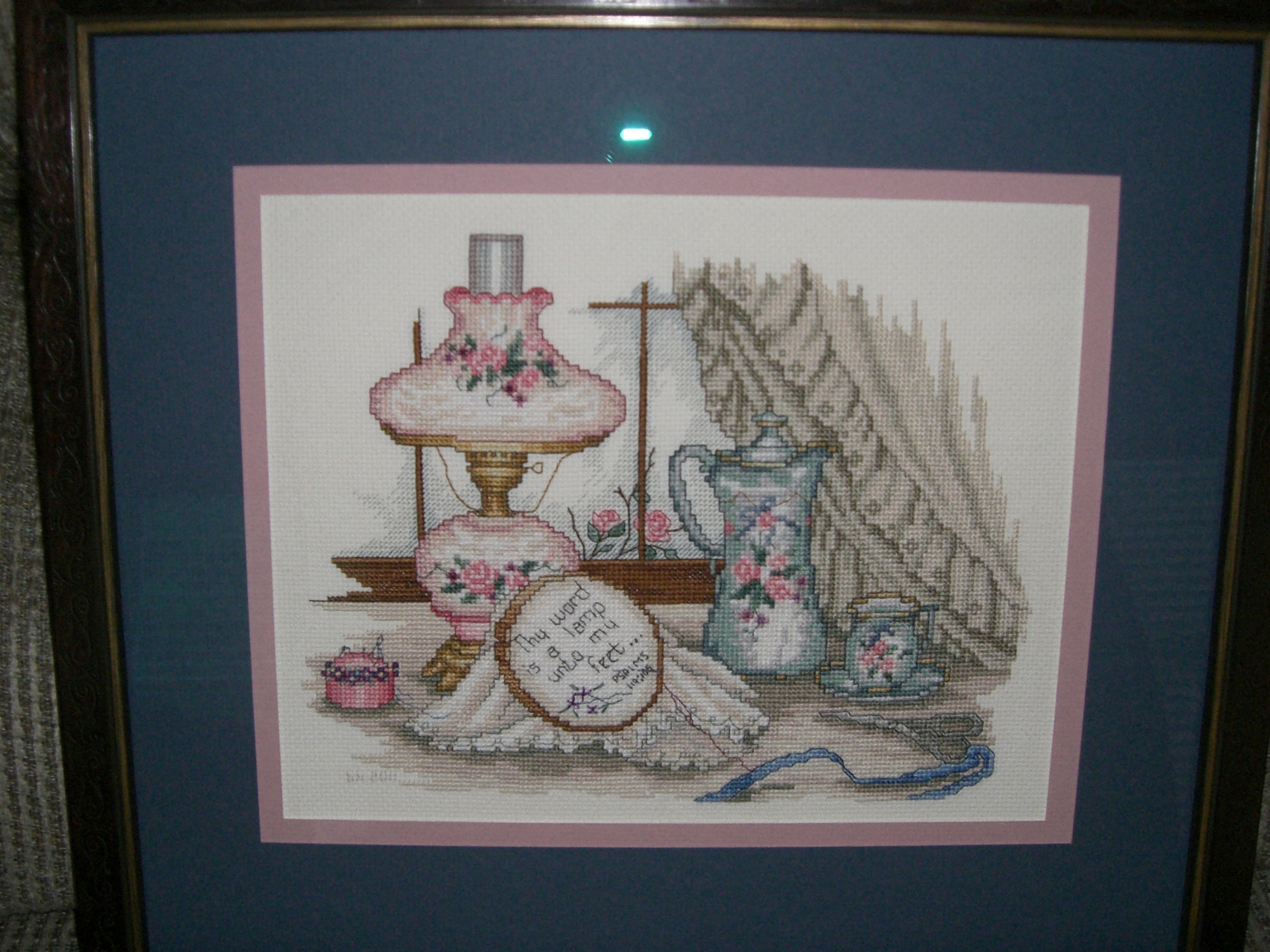
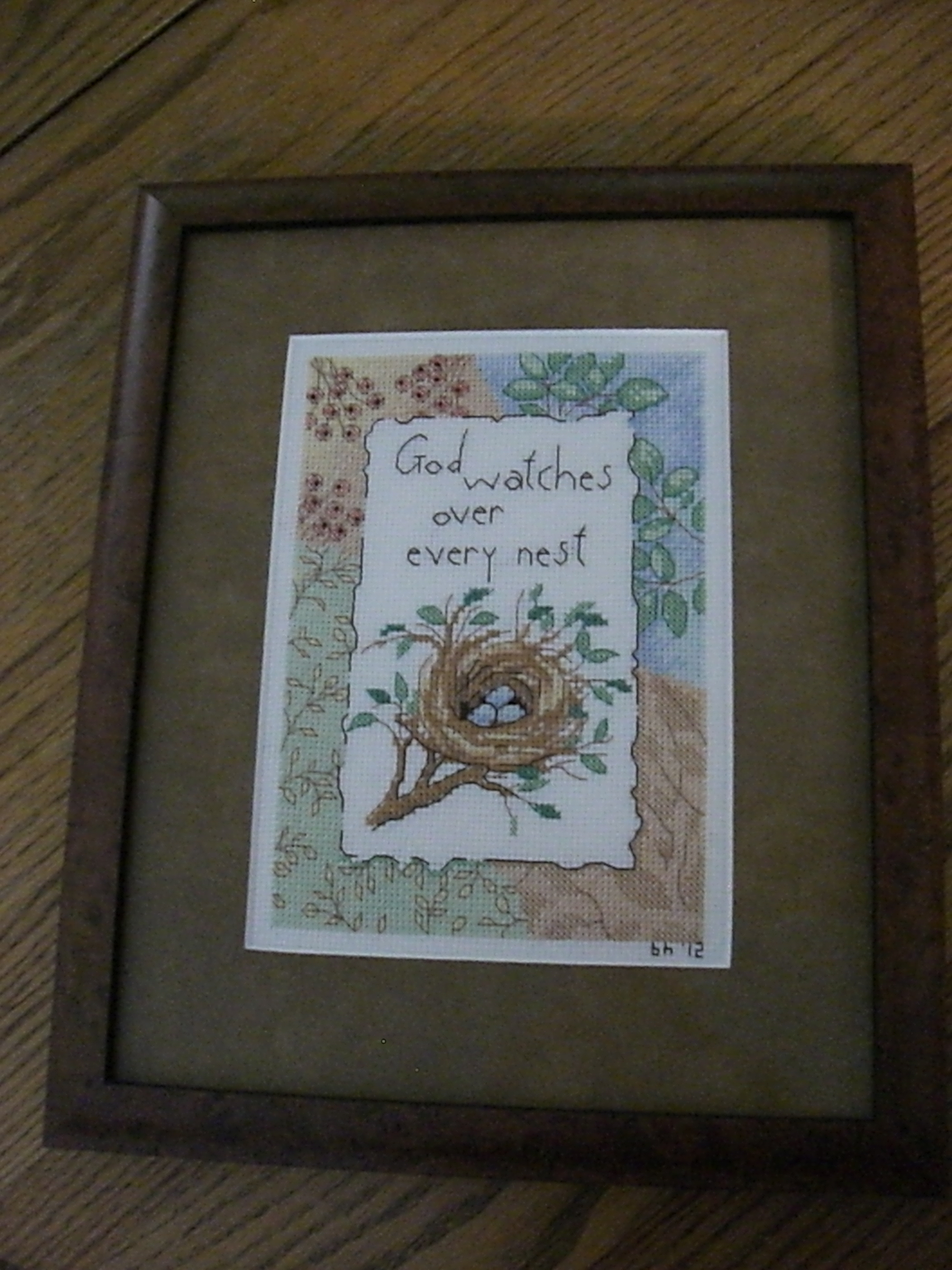
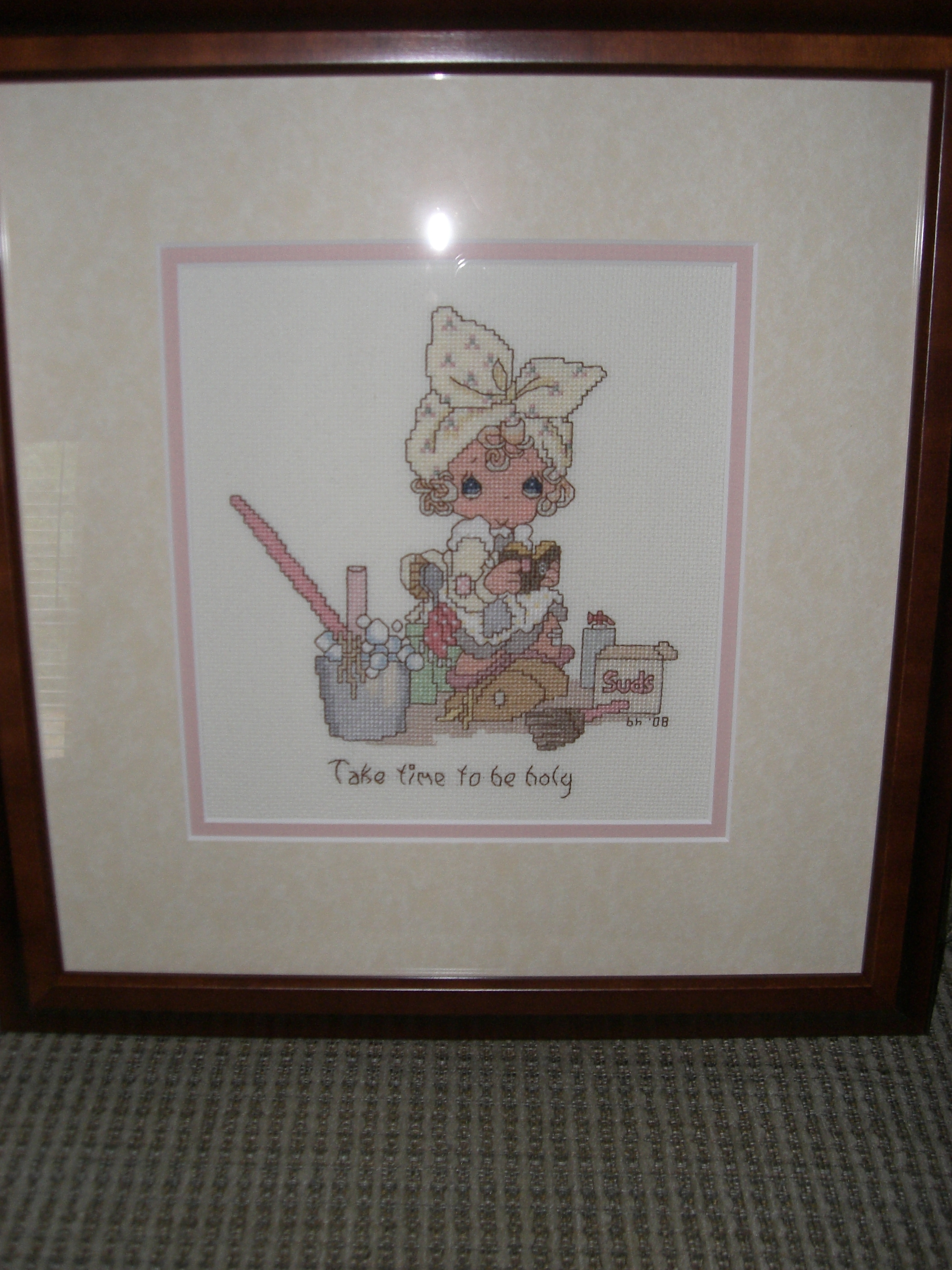
A few years ago I realized that I had done a lot of cross stitch through the years that I had given away for gifts, but didn’t have much that I had done for my own home. I wanted to do a few pieces both to express my own personality and maybe to hand down to progeny. Of course, my tastes are more feminine, as I said, and having all boys, I don’t know if they’d be interested in any of these just because their mom made them, and daughters-in-law will have their own tastes. I hope when I am gone that they will keep some things like this for grandchildren – I often wish I had something personal from my grandparents. But at any rate, these are a couple of my favorites:

Our only investment in “real art” was a set of prints by Paula Vaughan, a gift to me from my husband, who knew how much I liked them. But I have also framed cards and pages from calendars.

I did have one class in Home Furnishings in college, where we learned a bit about elements of art and principles of design, but I am far, far from expert in it. I never did get to go on and take the next class, Interior Decorating, which I would have loved, I think. Sometimes I watch decorating shows and “get” what the designers are saying, sometimes I have no idea. 🙂 I don’t always agree with what they do, but I sometimes enjoy listening to their reasons. But though some of these principles and elements are helpful (i.e., wondering why something looks “wrong” with the end table next to the couch and then realizing that it’s because the lamp there is way too small in proportion to the rest of the furniture), overall what’s most important is what Edith stresses: making a place homey, comfortable, and an expression of your own creativity and personality.

More discussion on this chapter is here.

This post will be also linked to Women Living Well.

Why I Wear a Hat to Church

Every now and then someone sends around those “getting to know you” questions, and I’ve answered them a few times on my blog. Sometimes one of the questions is “What is one thing people might not know about you?” One good answer to that question is that I wear a hat, or headcovering, to church, but I have never mentioned it on my blog because I don’t want to be thought weird or misjudged because of it.

But in real life, of course, a hat in church is obvious and sticks out like a sore thumb, even though I try to keep them unobtrusive and not overly decorative. My husband and I don’t want to make it our “pet issue,” soapbox, or hobby horse by bringing it up and discussing it excessively with people, so we usually only explain it when asked. I don’t think we have ever been asked, though I was once accused of “formalism” by someone who pronounced that judgment without trying to find out our reasons.

Online discussions of those who wear headcoverings often pronounce them as legalists. Since I am neither a formalist or a legalist, I thought perhaps an explanation would be in order.

The practice comes from I Corinthians 11:1-16, which I’ll include here for easy reference:

Be imitators of me, as I am of Christ. Now I commend you because you remember me in everything and maintain the traditions even as I delivered them to you. But I want you to understand that the head of every man is Christ, the head of a wife is her husband, and the head of Christ is God. Every man who prays or prophesies with his head covered dishonors his head, but every wife who prays or prophesies with her head uncovered dishonors her head, since it is the same as if her head were shaven. For if a wife will not cover her head, then she should cut her hair short. But since it is disgraceful for a wife to cut off her hair or shave her head, let her cover her head. For a man ought not to cover his head, since he is the image and glory of God, but woman is the glory of man. For man was not made from woman, but woman from man. Neither was man created for woman, but woman for man. That is why a wife ought to have a symbol of authority on her head, because of the angels. Nevertheless, in the Lord woman is not independent of man nor man of woman; for as woman was made from man, so man is now born of woman. And all things are from God. Judge for yourselves: is it proper for a wife to pray to God with her head uncovered? Does not nature itself teach you that if a man wears long hair it is a disgrace for him, but if a woman has long hair, it is her glory? For her hair is given to her for a covering. If anyone is inclined to be contentious, we have no such practice, nor do the churches of God.

There are several different ways of interpreting this passage, so I’ll just go through them to explain the conclusions we came to.

1. It’s a cultural issue. I’m told that in the days in which this was written, respectable women wore veils in public and women of ill repute did not, so it was a matter of good reputation to be veiled in public. While that may be true, that’s not the reason given here (and the apostle probably would not have needed to encourage them to do what they were already practicing as a culture anyway). The reason given here for a woman to wear a head covering is to illustrate that her husband is her head and she is honoring him, and she is specifically to have it on when she is “praying or prophesying” in a public assembly of the church.

2. It’s just talking about hair. Verses 14-15 cause some people to attribute the whole discussion to hair length. There are a few reasons I don’t agree that that’s the case. The phrasing of the passage seems to indicate that this is an example of the same principle in nature, not the culmination of the discussion. And if it is talking about hair, wouldn’t it be saying that men should be bald when they pray (verses 4 and 7)? When it says a woman should have her head covered when she prays or prophesies, that seems to indicate something she puts on at that time.

3. Women should cover their heads all the time. Some people who do believe in using head coverings take this view because a woman needs to be ready to pray or prophesy (verse 5) at any time. However, the context of the passage is public worship (verse 1 talks about keeping the ordinances, then the remainder of the chapter after this discusses communion [or the Lord’s Table or the Lord’s Supper, whatever you choose to call it]). The early New Testament church participated in the Lord’s Table much more often than modern churches do (I was told once that they did so every time they met, but I don’t know how to find out whether that is true). Therefore, since the context of the passage is public worship with both men and women present, I don’t wear a hat around the house or at the grocery store or to women’s meetings at church.

4. A head covering in Bible times is like a wedding ring now, just a symbol that a woman is married. They may both indicate marriage, but the instruction in this passage seems to me to go beyond just being married, particularly since the head covering seems to be something they put on while meeting together, not something that is kept on all the time.

5. Woman should wear a headcovering in a public assembly of the church to illustrate that she is under the headship of her husband and honoring him. That’s obviously the view that I hold.

What is the verse about angels referring to (verse 10)? Some think that is a reference to pastors, as the angel of each church in Revelation is its pastor. Some think it refers to actual heavenly angels and that God shows something of Himself to them through us (“so that through the church the manifold wisdom of God might now be made known to the rulers and authorities in the heavenly places,” Ephesians 3:10, ESV).

To me the cultural difference comes in the type of head covering. Woman in Western societies don’t wear veils, so at some point they began wearing hats. Amish and Mennonite women wear prayer kapps. In some Eastern European churches, the woman wear scarves over their heads. Some of the women who wear headcoverings all the time here use a bandana style, though often they use white fabrics.

Women wearing some type of head covering in American churches was practiced up until the 50s or 60s, not that long ago. Somehow the practice fell away, maybe because it was no longer taught. Gradually people forgot the basis for it, and then didn’t see a need to keep on with it. Or maybe the practice was rejected because the world in general rejected the idea of man being head over a woman. Oddly, society has kept the practice of men praying with their heads uncovered. You do still see men removing their hats when during public prayer, though I think even that is beginning to decline.

There are some fundamental Biblical issues for which there is no wiggle room: the Deity of Christ, salvation by grace through faith, and others. But on other issues, Romans 14 has instructions for those who come to different conclusions about what the Bible teaches in those issues that aren’t fundamental to the Christian faith (though the passage is discussing weaker brethren, I think some of these overarching principles apply). Some people can read the same passage, like this one, and come to different conclusions about what is taught or meant. Each should do whatever they do as unto the Lord (verse 6), not judging or condemning each other, (verses 3, 10,13), being fully persuaded in their own minds (verses 5, 22), remembering they’re accountable to the Lord (verse 12), not being contentious about it (verses 1, 17-19).

As I said at the start, this isn’t a soapbox issue and I rarely mention it. I don’t judge other women who don’t wear hats or headcoverings because I understand that they may read the passage differently. But because I see the passage the way I do, I need to follow what I believe it is teaching. I thought perhaps explaining where the conviction comes from would help others not to judge the practice unfairly.

This post will be also linked to Women Living Well.

The Hidden Art of Homemaking, Chapter 4: Painting, Sketching, and Sculpturing

It’s Week 4 of  The Hidden Art of Homemaking Book Club hosted by Cindy at Ordo Amoris where we’re discussing Edith Schaeffer’s book, The Hidden Art of Homemaking a chapter at a time.

In Chapter 4 Edith discusses how to incorporate “Painting, Sketching, and Sculpturing” into everyday life as an expression of creativity and encourages us that we can do so without having formal training or making a career of it. It can be used, just like the other categories of creativity that she’s discussed, to enrich our lives and stimulate our imaginations.

This chapter was a little harder for me because I have absolutely no talent in this area. In fact, a photo I saw on Pinterest pictures this perfectly:

drawing

I don’t even do stick figures very well, though they were useful at times when I had a little one on my lap that I was trying to entertain and keep relatively still and quiet, in church or a doctor’s waiting room. I’d draw something and ask them what it was, and they’d recognize my fledgling attempts to portray a duck or a car (I had to laugh when the Cube first came out because they looked just like the cars I used to draw.)

I don’t even remember doodling much in high school or college. In Junior High a new classmate said something about having had art in her previous school, and I was incredulous and envious. I don’t remember having any kind of artistic instruction in school (until a college Art Appreciation class), and no one in my family, as far as I knew, had any artistic tendencies. Somehow my middle son developed a talent for drawing quite well in his later high school and college years, mostly teaching himself with various art books, except for a year or when he was under the instruction of a gifted art teacher who helped him refine his talents.

I went through a “paint by number” phase in elementary school. I did enjoy a little bit of painting when a talented lady in one church we were in hosted a night to teach other ladies how to paint a flower on a tote bag. She used the same pattern with everyone to make easier to teach en masse but had different paints so we could each choose our own colors. It was exciting to me to learn to use light and shade to make a flat blob of a flower appear more realistic. I took a couple of One Stroke painting classes at Michael’s and loved them, but just never went any further with it.

But though I can’t draw well, I can use aids. I went through periods of using stamps or stencils or even stickers to make cards or decorate various things. I like to buy decorative Post-it notes or notepads rather than plain ones. I disagree with Edith when she says “Original ideas carried out can be an expression of love and care which cannot be made by buying something  ‘ready made’ or plastic” (p. 50). I think that kind of thinking can be burdensome and guilt-inducing, to feel personally or to make our loved ones feel that a gift that’s store-bought doesn’t “measure up” to something hand-made.

She didn’t discuss art appreciation in this chapter, but she has discussed in other chapters that we can come to appreciate forms of creativity that we may have no talent in ourselves.  I did mention an Art Appreciation class in college: I enjoyed it, but didn’t retain much from it, perhaps because one can’t go over the material as readily as one can music from Music Appreciation.

Unfortunately we did not go to museums much as the children were growing up, so I’m afraid I’ve perpetuated my ignorance in this area. I found one neat book about identifying art and artists that I wanted to use some time with them, but we never got around to it. These days, however, there is so much information available on the Internet that one can learn something of classic art if one wants to. I did discover over the years that I seem to like realistic more that abstract art, like that of Normal Rockwell and some of the old masters, though I liked some of the Impressionists, too, like Mary Cassatt. I find that I do enjoy art more by learning about it: the last time we were at a museum, as we were leaving I saw there were headphones one could use for a self-guided tour, and I thought that would be the way to really get the most out of it (for me).

But besides learning about great paintings and painters, one can develop an eye for artistry, for appreciation of color and design. I think for me that happened mostly through a Home Interiors class (thankfully interior decorating is the next chapter!) and then grew through various craft classes and helped as I started doing a newsletter for our church ladies’ group in terms of layout, making a cover page that is reasonably attractive, etc. Someone who really knew what they were doing in that area could probably point out many ways in which I could improve, and that’s fine – we all can grow, no matter what our level of knowledge or talent. But I am thankful for the ways I have grown so far.

I liked her idea of using drawing, even simple stick figures, to not only help keep a child’s interest during a sermon but also to help them grasp what was being taught. A former pastor used to say that it helped him in his Bible study to draw things out as he read.

My favorite line in this chapter, which really could be applied to the whole book, is “Ideas carried out stimulate more ideas” (p 49). I tend to gather a lot of ideas and my imagination can be stimulated by perusing Pinterest or web sites or books, but even that doesn’t compare to actually carrying out those ideas. Whatever area of creativity we’re discussing, just starting in some way or another stimulates more ideas, more creativity.

You can find more discussions on this chapter here.

Previous chapters discussed:
Chapter 1: The First Artist.
Chapter 2: What Is Hidden Art?
Chapter 3: Music.

Myths and Maxims of Ministry

IMG_1791

Recently a friend told me that she was somewhat overwhelmed with the details of a particular ministry she had started and had trouble finding joy in it until she reminded herself of the reason she began it in the first place. That got me to thinking about some of the misconceptions I had about ministry over the years, and  I thought I’d share some of those here. I’m not talking about “the” ministry: the paid professional, full-time minister of some sort, though some of these may apply there as well, but rather I am talking about the average Christian who participates in some ministry and then gets dismayed with it.

Here were some of my faulty assumptions:

1. Since this is being done for the Lord, everything should go smoothly. I can picture some of you smiling. Though I don’t see the devil behind every little problem, we do have an active enemy behind the scenes, and we do live in a fallen world where things break down and problems occur. The icemaker doesn’t know it’s in a church and shouldn’t fall apart just before a banquet that has been planned for months (just one of my “things gone wrong” scenarios.) The microphone makes an excruciating noise just as the soloist steps up, the babysitter forgot she should be there, etc. etc. It just happens.

2. Since we’re all Christians here, we should all agree on how everything should be done. If you read through the book of Acts, you see that the early church leaders had to hammer some things out. Even Barnabas and Paul had a major disagreement, causing them to part ways (and the Bible doesn’t really say who was right and who was wrong there. Some have faulted Paul for not being gracious, but maybe John Mark needed to know how serious his previous failure was. At any rate, they all reconciled later and God used it to multiply the number of people sent out). Leaders should not expect a panel of “yes men” (or woman), no one should be oversensitive about their proposals or ideas, we should all be open to differing opinions but be prepared to stand firm when something needs to be done a certain way.

3. Since we’re all Christians here, we should all have the best attitudes and act in an exemplary way. We should. But we don’t. We’re sinners. That’s not an excuse, but it is a truth. We fail. We disappoint each other. We display selfishness. We need to react to each other with grace, remembering our own faults and failures and need for grace. We might get our feelings hurt, but we need to take it to the Lord: we might need to go to the other person and let them know and try to explain and apologize to each other, or we might need to just let it go, but what we should not do is get bitter and drop out of church or avoid that person forevermore.

4. I should always feel joyful in my ministry. There are times when we get bogged down in details, feel overwhelmed, get tired of it, just don’t enjoy it, wish we hadn’t signed up, etc. And if we think about it a minute, we can feel that way in other areas of life as well. We don’t always respond to our loved ones with love and joy, though we want to and strive and pray for help to. We can get bogged down in the daily duties at home and get irritable about them instead of lovingly ministering to our families. A lack of joy in a ministry may be an indication it’s time to make changes, but more often than not it just means we’re human and, like my friend at the beginning, need to remind ourselves of why we’re doing what we’re doing and for whom we’re doing it. And I usually find that the joy comes not before or even during a task, but afterward.

5. If God calls me to do something, I should always feel sufficient for it. I have found just the opposite to be true. Usually, like Moses, I feel insufficient for it even before I start, but sometimes even if I am asked to do something that I feel God has equipped me for, there is always a point where I feel overwhelmed (I mean locked in the bathroom crying type of overwhelmed). But that’s a good place to be, because that’s when we learn by experience and not just principle that His strength is made perfect in our weakness.

6. If this ministry is in God’s will, there should be plenty of people willing to help with it.  Not necessarily. A lot of ministries end up being understaffed because others don’t catch the vision or feel just too busy. Once when I needed to round up some helpers for a particular endeavor, I asked someone who looked to me like she’d have time, but she didn’t feel she did. Then another lady whom I would never have asked because she had so much on her plate volunteered. You just never know, but instead of getting frustrated, just pray about whom to ask. In some cases, it might need to be laid aside until enough people get burdened for it. Once when we were part of a Christian homeschooling ministry, the lady who had started it had her seventh child and just could not carry on with it. We went without it for a year, and then several ladies volunteered to take it up again, breaking it into more manageable pieces for each one rather than having the whole thing on one person’s shoulders. Praying for laborers isn’t restricted to the mission field.

Those are some myths, or misconceptions. Here are the maxims, which will overlap a bit with the above.

1. Something will go wrong, some times worse than others, no matter how well you plan. Take it patiently and pray for wisdom about what to do. God’s given me some marvelous ideas right in the midst of a crisis. And on the other side, if a lady comes tearing out of the church asking you if you’d be willing to go buy some ice because the icemaker  stopped working and the banquet starts in half an hour and 100 ladies are coming — please don’t act grumpy and displeased and take 20 minutes to get going (yes, that happened). You don’t know what a balm you can be for someone in the throes of a major problem. And if you come to an event and it’s starting late, don’t be critical: you never know what has happened behind the scenes.

2. Disagreements will occur no matter how much you prayed beforehand. But don’t just dismiss them: sometimes they are God’s way of showing you an aspect you may not have thought of. Even if you can’t make a change and do what the other person suggested, you can make sure they feel heard and respond graciously.

3. You won’t always feel like doing whatever it is you’ve agreed to do. Pray for grace and do it anyway. You’ll probably feel better about it afterward.

4. Realize you can’t do it on your own. Jesus said, “without me ye can do nothing” (John 15:5b), but “I can do all things through Christ which strengtheneth me” (Philippians 4:13).

5. People will fail you. They failed Jesus, too. We have failed Him and others. We may need to discuss the specific matter with the person involved as part of their growth and training, but we also need to forgive as we have been forgiven.

6. People will surprise you with sometimes with their willingness to pitch in and help, to support you, to do what needs to be done, to have a great idea just when you can’t think any more, to say a word of encouragement to edify you.

7. Ministry will stretch you. If we never venture out of our comfort zones, we’ll never grow. It’s scary, but we can find God meeting us in our need and providing in the most wonderful ways when we let Him stretch us.

8.Get adequate rest before or in the midst of extra-busy or pressured times.

9. Delegate. Easier said than done sometimes, but pray not only for helpers, but the right helpers. Be prepared that they might not do everything just the way you would and pray for wisdom about when to insist on something being done a certain way and when to go with the flow.

10. Sometimes it is best to say no or step down. A principle instilled in me early on is not to say “no” unless I’ve prayed about it. But sometimes the answer should be No, and sometimes the desire to step down from the ministry is from the Lord. I don’t know how to tell you five easy steps to discern that, but as you walk with the Lord, He’ll show you. Don’t throw in the towel at the first sign of weariness or problems, but take it to Him to see whether he wants you to lean on Him more to carry on, or whether He wants you to make way for someone else to step in.

11. There is nothing like seeing God provide strength and ideas and and even tiny barely-significant details that make you marvel at His attention and care.

12. There is nothing like being used of God (which is what ministry comes down to: allowing God to work through you in some way to minister to another). When someone lets you know that they were blessed or instructed or encouraged through some small thing you said or did, and you know it was only through His grace that it was accomplished, it rejoices your heart, encourages your faith, and spurs you to minister for Him even more. And even if no one else notices, you can be sure that God does.

13. We’re all called to ministry. We may not be a part of an official ministry within the church, but all those who know God are called to minister to one another, to exercise the spiritual gifts He has given, whether in an official church-based capacity or just quietly behind the scenes.

14. Keep first things first. Like Martha, we can be “cumbered about much serving,” “careful and troubled about many things,” and forget the one needful thing: fellowshipping with our Savior. Serving is no substitute for engaging with Him, getting to know Him better, growing in love for Him, believing in Him. Sometimes weariness in service is an indication we’re off track just here.

A beloved former pastor, Jesse Boyd, once said:

Worship without service is a hollow farce.
Service without worship is a hectic fervor.
But worship which issues in service is a holy force.

There is much more that can be said about ministry: there are whole books written on the subject. But I hope some of these thoughts help encourage you in your ministry for the Lord.

What have you learned about ministry along the way?

Other posts about ministry here at Stray Thoughts:

Am I Doing Any Good?
Women in Ministry.
Why Older Women Don’t Serve.
How Older Women Can Serve.
God’s Help for God’s Assignment.
Whose life is it, anyway?
Mentoring Women.
Church Ladies’ Groups.

This post will be also linked to  Women Living Well.

Save

The Hidden Art of Homemaking Book Club, Chapter 3: Music

It’s Week 3 of  The Hidden Art of Homemaking Book Club hosted by Cindy at Ordo Amoris where we’re discussing Edith Schaeffer’s book, The Hidden Art of Homemaking, a chapter at a time.

In Chapter 1, “The First Artist” (linked to my thoughts) Edith makes the case that because God as Creator is artistic, making the world not just functional but beautiful, and we’re created in His image, it follows that we’re created to be creative and to appreciate the artful and beautiful. In Chapter 2, “What Is Hidden Art?” (also linked to my thoughts), she goes on to explain that she is talking primarily about everyday endeavors, not necessarily pursuing the Arts as a profession (though some are called to that), and encourages us that though we’re finite and limited, though being creative requires some discipline and prioritizing, there are ways we can pursue it. The next several chapters are going to delve into some specific areas where we can learn to appreciate and perhaps even incorporate beauty and creativity. Chapter 3 discusses music in particular.

Experiencing music together as a family or with friends gives an outlet for expression, for relaxation, for “creative ideas and imagination [to be] sparked off” in each other, for enjoyment, and for personal development. She encourages letting children start off with their natural inclination to explore sound and rhythm (I can remember mine banging pans and such as toddlers).

She spends only the last few paragraphs talking about musical expression in the Bible, but that would be a very rich study to pursue further. We have the Psalms with their variety of emotions expressed in song, we have the encouragement to “make a joyful noise” unto the Lord, the instruction to teach and admonish one another with psalms and hymns and spiritual songs. God tells Job about when the morning stars sang together and is Himself called a song: “Behold, God is my salvation; I will trust, and not be afraid: for the Lord Jehovah is my strength and my song; he also is become my salvation” (Isaiah 12:2).

To my regret, I don’t know how to play a musical instrument, but I do enjoy singing around the house, in the car, etc. I can’t say I know a lot about music, but I have always enjoyed it, and one of my favorite classes in college was Music Appreciation. I did not grow up with classical music but developed a love for it in college. I’m not much into pop music – the closest I get to it is some of Josh Groban, Michael Buble, Il Divo, etc. I love “the standards” – “I’ll Be Seeing You,” “The Way You Look Tonight,” etc. I also grew to enjoy folk songs – American, Irish, Scottish, English – a lot of songs from musicals, and a rich variety of hymns. Music, even secular music, touches the soul in a particular way that nothing else does.

I remember having a little toy drum and piano when my kids were toddlers, and if I remember correctly, our library had a regular time for preschoolers that involved musical instruments. Of course I sang to them from their infancy, we sang a variety of songs together, and they grew up hearing music at home. They all went to sleep listening to Patch the Pirate and other musical tapes. We didn’t start any formal lessons until they were 8: that was the age recommended to me by a friend who is the mom of a very musical family, and coincidentally, the age their school began piano lessons. I wanted them to take piano because it would give them a good foundation for singing, for choir, and for any other instrument they wanted to take, plus it’s a good discipline and use of time. I don’t know if any of them liked it. They were excited to begin, not so excited about practicing. They would have liked it a lot better if they hadn’t had to play in front of people at recitals. Only one taught himself a variety of other instruments (guitar, penny whistle, ocarina). But they do all enjoy listening to music. They all sang in school choirs, one sang in the church choir for a while, and one sang with an ensemble at school.

Edith mentioned at some point in the first couple of chapters that even if we don’t have talent or skill in a given area of art or creativity, we can learn to appreciate it, to see the beauty in it. I had not originally planned to do this when I first started this post, but this morning I was thinking that it might be helpful to some to share a little bit about listening to classical music from an amateur. I mentioned earlier that I didn’t have much exposure to classical music until college. I grew up with “You’re Cheatin’ Heart” and other such lovely little ditties. 🙄 I can remember going to hear an orchestra with my Girl Scout troop and being fascinated, hearing a high school concert of Handel’s Messiah, and a few other exposures, and then when I got to college, I not only heard more classical music from some of the programs we were required to attend, but I had a Music Major roommate who got me started with some basic classical records. Then my senior year I was required to take Music Appreciation and loved it. But the first time or two I heard a whole concert, I was lost. I found a couple of parts that particularly appealed to me, but afterward I couldn’t have told you what they were. Listening more and learning more about classical music helped immensely. I don’t know a whole lot, but here are a few pointers for enjoying classical music:

1. Listen for the theme, a few notes put together in a specific pattern that repeats. This is easiest to do at first with something that is a variation on the same theme, like the second movement from Hayden’s Symphony No. 94, the Surprise Symphony (so called because it has some unexpected loud parts designed to wake up those who were dozing :)) or Ravel’s Bolero or the first movement of Beethoven’s Fifth Symphony. The composer takes the same series of notes and repeats them with different variations: different instruments, different themes, different harmonies, different tempos and rhythms, etc. It’s similar to your music leader at church saying, “Everyone sing harmonies on the first stanza of this hymn, men sing the second stanza, ladies the third, then we’ll all join in unison on the fourth without the instruments.”

2. Listen for how the themes work together. This is easiest to do if the themes mean something to you, like in Tchaikovsky’s Romeo and Juliet Overture: the first part is here, the second part is here – I guess maybe it was too big for one YouTube video. It begins with what some people would consider high church or holy-sounding music, representing the friar, then goes into the the fight theme, representing the discord between the two families (the music picks up, clashes, you can imagine sword thrusts back and forth), then goes into the love theme (which you’ve probably heard at some point),  – and then all these themes start interacting, playing over and above each other as the young lovers try to connect amidst the fighting, the friar tries to help out, etc. Even if you can’t follow it line by line, you can get the overall feel of it. One of my favorite examples is The Moldau by Smetana, representing one of the rivers in his native Czechoslovakia. It begins with two streams that merge into a river, then the river flows alongside a country wedding, through mermaids, rapids, etc. It wasn’t until the Romantic Era that music was made to represent nature or literary themes on a large scale: before that it was mostly “absolute music” the same interplay of themes, but just as themes and not meant to represent something in life. Still nice, but a bit harder to pick out sometimes.

Two good piece for children are Peter and the Wolf and Carnival of the Animals (especially the latter with Odgen Nash’s poems in-between.

3. Listen for the progression. Like a good story, most classical pieces have a beginning, build to a climax, and then resolve.

4. Read up just a bit on the different kinds of compositions. A symphony, for instance, has 2 or 3 “movements,” and each one usually following certain parameters (the second is usually slower, for instance) and each with its own themes. It helps you not to feel so lost if you know a little bit about how it is put together and what to expect.

5. Learn a bit about the piece. Knowing that Dvorak’s New World Symphony was written when he felt America didn’t have a”national sound,” and that he invoked a lot of Native American and African-American-sounding themes in it, helps you get more out of it. The song “Going Home” is from the second movement.

6. Learn about the composer. A friend did this once: chose a composer and read about him while listening to various works of his to get the flavor of them. Knowing that Hayden’s situation and personality were both different from Beethoven’s, for instance, helps to account for some of the differences in their music.

You can see why Easy Listening music is called that. 🙂 It’s not that classical music is hard, necessarily, but you do get more out of it if you put a little more into it. And then just like any other song or story, once you’re familiar with a piece, you enjoy it, anticipate your favorite parts of it, etc.

I wish I had listened to more classical music with my kids. I had planned to have some sessions with one of these pieces playing in the background while we did other things, but I either never thought about it when we could have done it, or it never worked out as they got older and busier.

I mentioned my thirteen favorite classical music pieces here and some favorite CDs here (though I’d have several to add to that list now). Here are some of my favorite selections from different genres: