Laudable Linkage and Funny Videos

Just a few links this week:

For the Young Mother: Ministry, Guilt, and Seasons of Life.

Why So Critical? Excellent thoughts on the difference between judgmentalism and discernment — too often people ignore the latter thinking it is the former.

How To Find a Job (Yes, Even Now). Thought this had some creative ideas.

Summertime Pest Control: round-up of home-made remedies for getting rid of pests.

Root Beer Float Cake. Looks.So.Good.

Crafty stuff:

Spring Hats Pincushion. SO cute! Makes me wish I were planning another ladies’ luncheon to use these as favors. 🙂
Crafting with Kid’s Prints by Karla Dornacher…but not just for kids, I think. Good tutorial on making a simple plaque.
Tutorial for making covered buttons.
Paper roses.
Charlotte Lyons’ Spring Stitching — so pretty. I’d like to make a sampler like this.
“Sweet Menagerie” Nine Patch Quilt. Maybe someday….
How to make a thread rack.
Bird in the House.
How to hand quilt.

I keep having to remind myself of this in this season of sorting and discarding while preparing to move. My boys love this:

This is a take-off on those hilarious Old Spice commercials.

I almost listened to this when trying to think up “Momisms” yesterday to see if I had forgotten any — I wish I had, I forgot plenty!

Happy Saturday!

Love Divine, All Loves Excelling

This is one of my favorite old hymns. I know it primarily by this tune, but another familiar one is here as well as this one set to Pachelbel’s Canon. My favorite instrumental version is on a Steve Pettit CD.

Love divine, all loves excelling,
Joy of heaven to earth come down;
Fix in us thy humble dwelling;
All thy faithful mercies crown!
Jesus, Thou art all compassion,
Pure unbounded love Thou art;
Visit us with Thy salvation;
Enter every trembling heart.

Breathe, O breathe Thy loving Spirit,
Into every troubled breast!
Let us all in Thee inherit;
Let us find that second rest.
Take away our bent to sinning;
Alpha and Omega be;
End of faith, as its Beginning,
Set our hearts at liberty.

Come, Almighty to deliver,
Let us all Thy life receive;
Suddenly return and never,
Never more Thy temples leave.
Thee we would be always blessing,
Serve Thee as Thy hosts above,
Pray and praise Thee without ceasing,
Glory in Thy perfect love.

Finish, then, Thy new creation;
Pure and spotless let us be.
Let us see Thy great salvation
Perfectly restored in Thee;
Changed from glory into glory,
Till in heaven we take our place,
Till we cast our crowns before Thee,
Lost in wonder, love, and praise.

~ Charles Wesley, 1747

Book Review: God Wears His Own Watch

When my ever-practical husband first saw the title of God Wears His Own Watch by Reid Lehman, he commented, “God doesn’t wear a watch.” True, but Mr, Lehman explains that what he means is that God operates on His own time table, not ours. Sometimes He seems to act in ways that seem late, even past our human deadlines, but He never fails.

At 144 pages, this book is a brief but compelling history of Miracle Hill Ministries and how God has provided for it and worked in the lives of both the workers and the clients.

If you’ve ever tried to work with homeless or addicted, you know it can be discouraging and frustrating, yet God does still patiently change lives. Sanctification is a long process, and when we struggle with our own besetting sins we shouldn’t be surprised that others with perhaps more visible sins do as well. It was a thrill to read of those whose lives the Lord saved and changed, and it encouraged hope for some of my own lost loved ones. One particular lady in one pastor’s neighborhood was in “a drunken haze” for fifteen years before she finally responded to his invitation to trust Christ. How few people are that patient and persistent in working with people! This lady was one of the very few who never relapsed once she was saved and later on became a faithful worker at Miracle Hill. Her own children had been taken from her by DSS, but she became a baby-sitter to Mr. Lehman’s children, which helped heal that wound in her heart, and she was later able to reestablish a relationship with her own children. Sometimes we can harshly judge that some of the painful consequences people encounter are “only what they deserve,” forgetting the depth of pain of those consequences and the mercy we have received in not getting everything we “deserve” for our sins.

Mr. Lehman is also very transparent about his own struggles with feeling inadequate to take over the leadership and how God used different situations in the ministry to reveal to him his own sins and needs in order to change him. He says on page 129:

The people we serve at Miracle Hill have real problems — massive, unsolvable problems. Pious platitudes just won’t do. Quoting Scripture at them, even though it’s the tool God uses to change lives, isn’t enough, either. When we want to see the lives of others transformed, we cannot hold anything back in our own lives — secret sins, past hurts, or running from an issue we have never been willing to face. Some counselors have left our ministry defeated because they were unable, or unwilling, to allow God to change [them].

All of us are broken in some way. If we’re allowing God to continue His painful work of change within us, if we are willing to admit we’re struggling, we can still help others change. If we deny we have problems, or hide our struggles, how can we tell others God can transform and change their lives? And so we have persevered in prayer until God showed Himself.

There are many accounts of God’s provision for the many needs of the ministry. I enjoyed hearing how it got its name: when they were pouring concrete for the children’s home, rain threatened, and volunteers who had come from out of state were limited in the time they could spend before having to return home, so they really needed to finish what they were doing. They stopped “to pray that God would not allow the rain to hinder pouring of the concrete. Soon after that prayer, the workers could see a solid sheet of heavy rain moving toward them, but they watched in astonishment as the thunderclouds parted right at the construction site at the top of the hill. The rain fell all around them, on both sides of the hill, then joined again at the base in force. The bottom of the hill was soaked, but there was only a light sprinkle at the top!” So the volunteers were able to keep working. When secretary Vera Wright heard of this answer to prayer, she said, “This is just like a miracle, isn’t it?” The “miracle on the hill” led to the entire ministry being named “Miracle Hill,” looking forward, I am sure, to the greater miracles they were trusting God to accomplish in lives.

I enjoyed this closer look into this ministry, and I hope many will read it and be stirred anew for what God can accomplish in and through people.

(This review will be linked to Semicolon’s Saturday Review of Books)

Cliques? Really?

I’ve mentioned before that I went to a middle school that was extremely cliquish, with set groups which didn’t interact much with each other or anyone new. It made it very hard for a new person to make friends unless someone in one of the groups noticed them and brought them in.

But sometimes I hear people who feel a little on the outside of things accuse other people of being cliquish, and that’s not always the case. It’s especially sad when people feel that way in church. I imagine, human nature being what it is, it’s possible there are some churches which do have cliques, and that’s abominable. But sometimes it’s just a matter of certain groups of people who know each other better just because they do things together. Unfortunately, when people do feel they’re in the outer fringes of a group, they tend to pull away more, making them even less a part of the group, making them feel even more like an outsider, and so the cycle goes.

But you can’t get closer to people that you don’t spend any time with. And you won’t feel part of the group if you rarely interact with the group.

Some years back our church had a little fellowship time between Sunday School and church with coffee and sometimes doughnuts or muffins. It was a chance to talk with people and to get up and mill around in between an hour or so of Sunday School and another hour or more of church time. Most people got up to move around a bit and stood and talked in smaller groups near where the coffee was served. There were also soft drink machines on that side of the room for those who preferred that to coffee. There was one couple — a middle-aged couple who had attended the church for years, so they weren’t new — who pretty much always sat off to themselves on the other side of the room. I don’t think anyone thought anything of it — if I had I probably would have thought they didn’t want anything to eat or drink or preferred to sit rather than stand or walk around. But some months later I heard they “didn’t feel a part of things.” I was astounded. I probably thought something like, “And whose fault is that?” To literally place oneself away from everyone else and not interact and then not feel a part of things! People did sit at their table during the Sunday School hour, so it’s not like no one ever interacted with them.

It is true that we tend to gravitate toward people we already know. Our church has regular fellowships during the summer after Wed. night services. When we go through the line to get our refreshments and then turn and look for a place to sit, it’s natural to look for friends to catch up with, especially since we pretty much see most of them only at church. And we should, at least some times, seek out new people or people we don’t know as well.

When my husband and I first came to our present church and would go to these fellowships, we somehow often ended up as one of the first people going through the line and finding an empty table. But then no one came to sit with us for a few weeks in a row. We could have sat there feeling sorry for ourselves, but instead, we began to hang back so we weren’t first in line, and then, as we looked for a place to sit, we’d find a table where a few people were seated and asked if we could join them. Introductions and small talk ensued and eventually spun off into relationships. Should someone have sought us out as the new people? Probably. But it would have made it worse if we hadn’t taken some initiative. It took me a good year to really feel a part of things there, but it wasn’t because people were exclusive and unwilling to be friendly. Some of those people had known each other for thirty years, and it just took time as a new person to develop relationships: I couldn’t expect to have the same intimacy within a few weeks as those who had known each other longer.

I would advise anyone who “doesn’t feel a part of things” to:

1. Go where the people are.

2. Don’t hold yourself aloof. Interact, even if you feel awkward at first.

3. Go to some functions that you might not be interested in for the fellowship if not the activity.

4. Talk to people! Don’t wait for them to come to you!

The Bible says that “A man that hath friends must shew himself friendly” (Proverbs 18:24). Aloof people don’t have many friends. You may feel that you’re not aloof, you’re just shy, but it can come across the same way.

Reaching out to others is harder if you’re naturally shy and quiet. I was one of the shyest, most self-conscious people on the planet: I would almost panic if I was in a group and someone asked me a question, trying to draw me into the conversation. That is still my default mode: even now it is hard for me to raise my hand to answer a question in a Sunday School class or share a prayer request in prayer meeting. But I can testify that the Lord can give grace to overcome that natural tendency.

One thought that has helped me a lot over the years was shared by a former pastor’s wife during an officer’s meeting for a ladies’ group. She was encouraging the various officers to speak up as they gave their reports, because it did no one any good if they couldn’t hear what was said, and then she remarked, “Self-consciousness is consciousness of self, and we’re supposed to forget self.”

The more I am thinking about myself — the thought of people looking at me, wondering how they will receive me — the more I am likely to retreat into my own shell. But if I try to forget myself and focus on the other person, everything goes much better.

Every encounter or attempt to make conversation won’t be successful, but don’t let that deter you. “People skills” can be developed. But you have to exercise them to develop them.

Are you free?

I discovered the following on the back of a church bulletin in a box I was cleaning out. It was written by a former pastor of our family’s, Jesse L. Boyd, for whom our son, Jesse, was named.

Are Your Free?

One of the frequent cries of our day is, “I want to be free.” Well, what is freedom? It is not the living of life without restraints of law.

It is not licentiousness or immorality, because their slimy arms can soon wrap us up in their dark and dismal prison-house of suffering.

It is not the lack of government, but rather the privilege of having the right of freely enjoying one’s own government.

It is true Americanism: founded on the Holy Bible, bequeathed to us by our forefathers, and symbolized in Old Glory — The Star-Spangled Banner — “Oh, long may it wave o’er the land of the free, and the home of the brave.”

It is the privilege of spending one’s treasure, of spilling one’s blood, and of being prompted by the spirit of liberty to stand against despotism and tyranny.

It is liberty and loyalty combined.

It is the enjoyment of civil and religious liberty.

It is the title to justice.

It is living as one should; no wicked man lives as he should, therefore, he is never free.

It is having full mastery over all matter.

Freedom ends where tyranny begins.

It comes by mastering one’s self.

It comes through knowing the truth. “Ye shall know the truth, and the truth shall make you free” (John 8:32).

It comes through receiving Jesus Christ as Lord and Saviour. “If the Son therefore shall make you free, ye shall be free indeed” (John 8:36). “It was for freedom that Christ set us free; therefore keep standing firm and do not be subject again to a yoke of slavery” (Galatians 5:1, NAS). “For the law of the Spirit of life in Christ Jesus hath made me free from the law of sin and death” (Romans 8:2). Hallelujah! What a Saviour!

Freedom is that which one receives from God in the new birth. Man cannot govern himself, because, when all restraints are taken away, then evil dethrones him. He can only find rest (soul rest; freedom) in the arms of Jesus Christ. Are you free?

Laudable Linkage and Grandma’s Birthday

We enjoyed celebrating Grandma’s 82nd birthday last night  with Pizza, cake, presents and “Team Scrabble.”

I don’t know how many people are around this holiday weekend, but here are a few things I’ve enjoyed reading the past couple of weeks.

Sometimes It’s Just Plain Hard, a very honest perspective that not everyone has beautiful, inspiring last days and death, but the hardness is all the more reminder that death is an enemy and Christ has overcome it and offers new life.

Another on the subject of death: I was brought to tears by the text of The Long Goodnight, HT to Challies. My own preferences for musical style is more conservative than the accompaniment here, but the text is from an old German hymn.

Laura introduced me to the M. O. B. Society (Mothers of Boys) with the post A Woman of God in a Household of Boys.

The High Calling of a Wife and Mother in Biblical Perspective.

“If Anyone Destroys God’s Temple…” Very convicting, not the usual take you see on this passage.

Beware the anger of man that attempts to produce the righteousness of God.

How can I make sure I am regularly shepherding everyone in the church?

In the “something to think about” department: Girlie Christianity.

Hope all my American friends have a happy Independence Day! I’ve loved this explanation of the Declaration of Independence by Red Skelton since I first heard it:

Treasures

I don’t know what brought this to mind this morning, but I decided to share it. I have never heard this song except at the church I attended as a teen when a new family came and sang it. I am not sure who wrote it — looking it up online I saw it quoted without an author several times, attributed to Martha Snell Nicholson a couple of times and a slightly different version of it in a poem by James S. Hewett. But whoever wrote it, it contains a good thought:

Treasures

One by one He took them from me
All the things I valued most;
‘Til I was empty-handed,
Every glittering toy was lost.

And I walked earth’s highways, grieving,
In my rags and poverty.
Until I heard His voice inviting,
“Lift those empty hands to Me!”

Then I turned my hands toward heaven,
And He filled them with a store
Of His own transcendent riches,
‘Till they could contain no more.

And at last I comprehended
With my stupid mind, and dull,
That God cannot pour His riches
Into hands already full.

The Week In Words

Welcome to The Week In Words, where we share quotes from the last week’s reading. If something you read this past week  inspired you, caused you to laugh, cry, think, dream, or just resonated with you in some way, please share it with us, attributing it to its source, which can be a book, newspaper, blog, Facebook — anything that you read. More information is here.

Here are some interesting quotes I saw this week:

From ivman:

“Nobody sins because they want to be miserable. We somehow think we’re better off to sin than to obey.” – Drew Conley

That reminds me about the verse that there is pleasure in sin for a season — but just a season. The misery from it will come soonser or later, but people forget that.

This one is a quote within a quote within a quote. 🙂 Girltalk quotes C. J. Mahaney quoting John Piper about reading:

Is reading worth the time investment when so much is forgotten? John Piper says yes.

In a message long ago (July 12, 1981) he said this:

What I have learned from about twenty-years of serious reading is this: It is sentences that change my life, not books. What changes my life is some new glimpse of truth, some powerful challenge, some resolution to a long-standing dilemma, and these usually come concentrated in a sentence or two. I do not remember 99% of what I read, but if the 1% of each book or article I do remember is a life-changing insight, then I don’t begrudge the 99%.

Read, but not to remember everything. Read because that 1% that you remember has to potential to change your life.

That is such a comfort to me, because I have gotten so frustrated with myself because I do tend to remember just a few sentences or principles rather than feeling as if I have a grasp of the whole book.

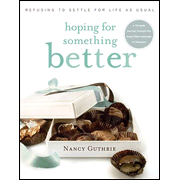
This is from p. 59 of Hoping for Something Better: Refusing to Settle for Life as Usual, a Bible study by Nancy Guthrie. It is an expansion on a similar quote from C. S. Lewis in Mere Christianity about Christ being able to sympathize and help us in temptation because He faced temptation and resisted:

Jesus doesn’t roll his eyes and wonder how we could even consider taking a step in the direction we’re being tempted in. He doesn’t take lightly our struggles with sin, because he knows what it is like to be tempted. Jesus was tempted in all the ways we are — yet he never gave in to sin.

We might think that if Jesus never sinned, he really doesn’t know what temptation is like, But if you think about it, only the person who tries to resist temptation knows how strong it is. The one who gives in after a few minutes doesn’t know what it would be like after a few hours. Who has experienced greater temptation: the one who is tempted and quickly gives in to the temptation or the one who holds on and holds out and doesn’t give in? Christ, in never yielding to temptation, knows more about the strength of temptation and the suffering involved in temptation than we will ever know. He’s our advocate who understands.

If you have some family-friendly quotes you’d like to share, please leave the link to your “Week In Words” post with Mr. Linky below, and don’t forget to leave a comment telling me what you think about these quotes. :) And whether you have any you’d like to share, if you like reading you might find some interesting quotes at the other participants: I hope you’ll visit them as well.

Be Still My Soul

“Be still, and know that I am God.” Psalm 46:10

Be still, my soul: the Lord is on thy side.
Bear patiently the cross of grief or pain.
Leave to thy God to order and provide;
In every change, He faithful will remain.
Be still, my soul: thy best, thy heavenly Friend
Through thorny ways leads to a joyful end.

Be still, my soul: thy God doth undertake
To guide the future, as He has the past.
Thy hope, thy confidence let nothing shake;
All now mysterious shall be bright at last.
Be still, my soul: the waves and winds still know
His voice Who ruled them while He dwelt below.

Be still, my soul: when dearest friends depart,
And all is darkened in the vale of tears,
Then shalt thou better know His love, His heart,
Who comes to soothe thy sorrow and thy fears.
Be still, my soul: thy Jesus can repay
From His own fullness all He takes away.

Be still, my soul: the hour is hastening on
When we shall be forever with the Lord.
When disappointment, grief and fear are gone,
Sorrow forgot, love’s purest joys restored.
Be still, my soul: when change and tears are past
All safe and blessèd we shall meet at last.

Be still, my soul: begin the song of praise
On earth, believing, to Thy Lord on high;
Acknowledge Him in all thy words and ways,
So shall He view thee with a well pleased eye.
Be still, my soul: the Sun of life divine
Through passing clouds shall but more brightly shine.

~ Katharina A. von Schlegel, 1855

The Week In Words

Welcome to The Week In Words, where we share quotes from the last week’s reading. If something you read this past week  inspired you, caused you to laugh, cry, think, dream, or just resonated with you in some way, please share it with us, attributing it to its source, which can be a book, newspaper, blog, Facebook — anything that you read. More information is here.

Here are some interesting quotes I saw this week:

From various friends’ Facebook status updates:

“Where the heart is willing, it will find a thousand ways. Where it is unwilling, it will find a thousand excuses.”~ Arlen Price

“The benefit of memorizing Scripture is so you can be thinking God’s thoughts; trading your thoughts for His; meditating on what’s important to God instead of what’s important to yourself.” ~ Nancy Leigh DeMoss.

Seen at Brenda‘s:

Right is right even if no one’s doing it.
Wrong is wrong even if everyone’s doing it.

Seen at Dawn‘s:

A successful marriage requires falling in love many times, always with the same person. ~Mignon McLaughlin.

I’ve marked a number of quotes in Hoping for Something Better: Refusing to Settle for Life as Usual, a Bible study by Nancy Guthrie. The parts emphasized in each one are my emphasis, the parts that particularly jumped out at me.:

Christianity is corporate. There are no lone rangers in the body. We need each other. And we need to encourage each other. Maybe you are full of courage today. If so, then offer some of yours to someone else. Don’t operate in the body looking only to get your needs met. Look for needs that you can uniquely meet, and in the process you’ll find your needs uniquely met. (p. 117).

[In regard to those who say they can’t forgive themselves…] If God says we are forgiven, who are we to keep punishing ourselves? If we refuse to forgive ourselves, it is as if we are saying that we are greater than God, that our judgment is higher than His. (p. 105).

When God forgives, it doesn’t mean He looks at our sin and says, “It doesn’t matter. It is no big deal.” When He said He would forgive our wickedness, He knew what it would cost. He knew that the price for sin would be paid through the death of a perfect sacrifice — His own Son. (p. 97).

While Hebrew 4:1 has an invitation, it also has a warning. “Since the promise of entering His rest still stands, let us be careful that none of you be found to have fallen short of it”….In the New Living translation this verse reads, “We ought to tremble with fear that some of you might fail to experience it.” Here we learn that there is something worth being afraid of — terrified of — in this life: unbelief, not trusting God. It is a scary thing to hear and know the promises of God and to choose not to trust them — to decide we don’t really need them or want them, to walk away from them rather than enter into them. (p. 46).

Forgive me for including quite so many: I know that the more there is, the longer the post, the more people’s eyes glaze over and they tend to skim rather than read carefully. I know quotes make more impact when there are just a few succinct ones. Yet…I didn’t feel I could leave any of these out.

If you have some family-friendly quotes you’d like to share, please leave the link to your “Week In Words” post with Mr. Linky below, and don’t forget to leave a comment telling me what you think about these quotes. 🙂 And whether you have any you’d like to share, if you like reading you might find some interesting quotes at the other participants: I hope you’ll visit them as well.