The Gospel and Christian Fiction

The Gospel and Christian Fiction

I have commented many times in book reviews on authors’ treatment of the gospel. After one author recently took me to task for my comments in several e-mails, I thought perhaps I should explain myself further.

A novel is a work of fiction. It’s primary purpose is to tell a story. The very best witness a Christian fiction author can have is to tell his or her story well, just as a painter’s best witness is to do his absolute best job painting rather than inscribing John 3:16 somewhere in it. A story that is a thinly-veiled sermon, doctrinal treatise, or tract will likely turn away readers, especially lost readers who most need the message. Some stories will hopefully be a springboard to awaken a thirst or a need in the reader which will then lead him or her to seek out someone to talk further, but a full exposition of the gospel is a rarity just because of the nature of story-telling.

In addition, the style of writing most prevalent in this era is the “show, don’t tell” variety. Subtlety, suggestion, nuance, illustrating what is going on in the characters’ hearts through their actions are all considered a better form of story-telling than spelling everything out for the reader. The Bible even does this in some places; for example, the book of Esther does not mention God’s name at all, but He is clearly evident in the events. Thus the gospel might be only suggested or referred to, or the author might show the character’s change of belief in the change in his or her actions rather than sharing the details of that character’s conversion.

I do understand and agree with those points. What I have sometimes criticized in book reviews is not so much the amount the the gospel that is presented in a book, but rather the clarity of the gospel. Whatever there is of the gospel in a work of fiction needs to be accurate and not misleading. For example, in one work of Amish fiction, a girl who had gone to live among the Amish to  find answers for her own heart is told, when she finally opens up to talk to someone about her need, to keep living as they are living and following their rules, and eventually it will come to her. I can understand encouraging someone who does not yet understand to keep coming to church and hearing the gospel in the hopes that it will eventually become clear, but the advice given in this book seemed more like, “Keep living like a Christian and eventually it will become real to you.” That is unbiblical advice and confusing to one who is searching.

In another book I read recently, a seeking soul is told that “Jesus invites you to join him on the journey.” There is a sense in which that might be said, but as a stand-alone sentence, I feel that is confusing and misleading.

In other books, a Christian’s faith is attributed to having been in church “all her life.” If that’s the only evidence of a person’s faith, it can be misleading because a lost person would obviously conclude that church attendance is what makes a person a Christian rather than a relationship with Christ, and an unbeliever who attends church might think they’re all right spiritually.

Christian fiction has been criticized in some instances for being formulaic and predictable in that the main character has some crisis of faith and “sees the light.” I don’t really have a problem with that in one sense, because each genre has a certain amount of predictability: you expect the guy and girl to declare their love for each other in a romance, or the good guys to win in a western, or the detective to solve the mystery and find the criminal he is searching for. It’s how each of those things happens which makes them interesting and keeps us reading even when we have a good idea of what will happen in the end. But I do understand how some readers would be turned off by a blatant formula. However, now it seems some authors have swung the pendulum so far the other way that often the gospel is so buried in subtext that it is almost completely hidden. “But if our gospel be hid, it is hid to them that are lost,” Paul says in II Corinthians 4:3. Even if the context of the story precludes a full explanation of the gospel, what is included needs to be correct, accurate, and clear rather than so shrouded it is unclear at best, or at worst, misleading.

I was accused of being insular by the author I first mentioned, of wanting Christian fiction to be such that it would only appeal to Christians. That is totally untrue. Christians are those who would pick up on the nuances of the gospel even when it is not spelled out. It is the lost who wouldn’t understand.

I was also told that to include a gospel presentation would mean writing on a fifth grade level. Again, I disagree. I have seen some wonderful salvation stories in fiction told in an effective way within the context of the story that was beautiful and fit very well in the flow of the story. Not every piece of Christian fiction will have a salvation story: some will deal with those who are already believers, with their problems and issues and growth. But for those involving a conversion experience, it can be done and done well.

I think perhaps I am sensitive to this issue because for many years I sent my mother copies of Christian fiction books I enjoyed, and she loved them, even though she was not a believer at that point. She did want to learn more, and she did benefit from seeing how Christians interacted in books. I did not send her only “conversion story” books: she probably would have gotten turned off if every book was like that. Yet there are some books that I would not have sent to her, not because it was not a “salvation story,” but because it was misleading, and I felt she would have gotten the wrong idea from it.

Rather than being insular and wanting Christians books written just for those who already believe, on the contrary, it is precisely for those who don’t yet understand or believe that I want the gospel to be clear and accurate, as well as for the glory of the Lord who gave us the gospel. Understanding, conceding, and supporting everything I mentioned in the first paragraphs about the nature of fiction, I still do believe and expect that whatever allusion there is to the gospel should not be misleading. I know it can be done: I have read wonderful examples of it.

St. Francis is supposed to have said “Preach the gospel; if necessary, use words.” I agree that a life should back up and reinforce the words we speak, but someone likened this to saying, “Feed starving children, when necessary use food.” Jesus said, “The words that I speak unto you, they are spirit, and they are life” (John 6:63). He also said, “Now ye are clean through the word which I have spoken unto you” (John 15:3). Paul said, “So then faith cometh by hearing, and hearing by the word of God” (Romans 10:17). Words do matter; words are necessary to convey the gospel. Within the medium of Christian fiction those words may not take the same form as a tract or a sermon, but they ought to at least not obscure the truth.

The Week In Words

Welcome to The Week In Words, where we share quotes from the last week’s reading. If something you read this past week  inspired you, caused you to laugh, cry, think, dream, or just resonated with you in some way, please share it with us, attributing it to its source, which can be a book, newspaper, blog, Facebook — anything that you read. More information is here.

I only have one today, from an Elisabeth Elliot e-mail devotional:

If my life is once surrendered, all is well. Let me not grab it back, as though it were in peril in His hand but would be safer in mine! ~ Elisabeth Elliot, Keep a Quiet Heart

It’s absurd that we do that, isn’t it? We fear the possibility of some major catastrophe, or something serious happens to a loved one, or God allows something we don’t understand, and then we somehow feel we can protect ourselves better than He can. This set my thoughts running back through a previous post about being afraid to surrender all to Him. I hope it doesn’t sound self-indulgent or self-promotional to quote myself, but I tend to have to go back over some of the same lessons learned, and something I said in that post along these same lines was a good reminder to me:

There have been whole books written about reasons for suffering, and we hear testimonies of God’s grace through those times. Yet that lurking fear or reluctance can still snake into our thoughts.

As I was pondering these things this morning, the thought came, “What’s the alternative, really?” Suffering will come to most of us in some form or another. We live in a fallen world and deal with its effects; we’re not in heaven yet, where there are no tears, sorrow, pain. We’re not going to stop these things from coming into our lives if we don’t surrender to God. We can’t somehow insulate ourselves or protect ourselves from any pain or trial.

But if we are the Lord’s, we can trust that He has a purpose in what He has allowed. We can trust Him for His presence, peace, grace, and help. If we’re surrendered to Him, we can face these things in a way that we can’t otherwise.

I’m thankful we can “come boldly unto the throne of grace, that we may obtain mercy, and find grace to help in time of need (Hebrews 4:16).

If you’ve read anything that particularly spoke to you that you’d like to share, please either list it in the comments below or write a post on your blog and then put the link to that post (not your general blog link) in Mr. Linky below. I do ask that only family-friendly quotes be included. I hope you’ll visit some of the other participants as well and glean some great thoughts to ponder.

Exposing kids to evil

Jesse’s English teacher is requiring his junior students to read six books during the course of the year and write a report on them (and this book-loving mama is cheering!) The genre they needed to choose from this month was a non-fiction book that was not a biography. As we perused our bookshelves and I made recommendations, the book he chose was Spirit of the Rainforest: A Yanomamo Shaman’s Story by Mark Ritchie (my review of the book is here). I forewarned him that the first couple of chapters were very hard to read: the book is written from the shaman’s point of view, and his conferring with his spirits is disconcerting as is the brutal attack of one village on another. But I told him it was recommended by a missionary we knew and trusted and supported and it did get better as you went farther along.

But it had been almost three years since I had read it, and I had forgotten exactly how graphic it was until he shared some parts of the book that disturbed him. As I picked up the book and flipped through it again, I wondered if I had made a mistake letting him read this book and whether he should switch to something else.

I was still pondering that yesterday morning as we drove to school, and I asked him if the book was getting any better. He said yes, and we discussed some of the good aspects, some of the reasons I had recommended the book in the first place — the need the Indians felt within themselves for change, the difference they saw in the lives of others, both white people and other Indians, who believed once the gospel began to be spread. We discussed the presence of evil spirits and how they operate behind the scenes in our culture as well as primitive cultures though they are mostly unrecognized here. We discussed the sickening exploitation of the Indians by others who wanted to prey on them. We even discussed the funny parts, such as how the Indians came up with their names for each other, wondering what names would be attributed to us if we followed their example.

Something we didn’t have time to talk about this morning but I want to bring up soon is what missionaries have to face when they go to such fields — and, really, not just such fields where demonism is open and obvious and rampant, but any area where the gospel is opposed.  The admission that “we wrestle not against flesh and blood, but against principalities, against powers, against the rulers of the darkness of this world, against spiritual wickedness in high places” in Ephesians 6 is immediately followed by the admonition “Wherefore take unto you the whole armour of God, that ye may be able to withstand in the evil day, and having done all, to stand” (verses 12-13). I want to discuss how that truth is not just for missionaries; it is for all of us.

I shared with him a familiar verse from A Mighty Fortress Is Our God which stood out in bold relief to me as we sang it in church Sunday:

And though this world with devils filled
Should threaten to undo us,
We will not fear, for God has willed
His truth to triumph through us.

Though, if I had it to do over again I probably would not have recommended this book yet, I am glad that his exposure to some of these things came from a book headed in the right direction such as this one and that we could discuss these issues.

I don’t think we have to wonder how and when to expose our children to the darker side of life. I think somehow it breaks out upon their awareness all too soon — a news report, an awful happening in the community, something that comes up in a TV show that we’re not expecting. I wish we could keep them innocently sheltered in the Hundred Acre Woods much longer, but unfortunately that is not real life.

Sometimes the weight of the evil in the world is so heavy and oppressing. I cannot fathom how Christ bore it all on the cross.

And we have to be careful not to just lament what we think of as excessive evil “out there” while we excuse what we think of as our relatively minor sins. Some of the things the Bible says the Lord hates are pride, lying, wicked imaginations; envy, strife, and divisions are what the Bible calls carnal. Those added to that weight of evil Christ bore as well.

“If thou, LORD, shouldest mark iniquities, O Lord, who shall stand?” the Psalmist asks in Psalm 130:3. Thank God he answers, “But there is forgiveness with thee, that thou mayest be feared.” And “thanks be to God, which giveth us the victory through our Lord Jesus Christ” (I Corinthians 15:57). “Ye are of God, little children, and have overcome them: because greater is he that is in you, than he that is in the world” (I John 4:4).

Jesus Christ the Apple Tree

As the apple tree among the trees of the wood, so is my beloved among the sons. I sat down under his shadow with great delight, and his fruit was sweet to my taste. Song of Solomon 2:3

The tree of life my soul hath seen,
Laden with fruit and always green:
The trees of nature fruitless be
Compared with Christ the apple tree.

His beauty doth all things excel:
By faith I know, but ne’er can tell,
The glory which I now can see
In Jesus Christ the apple tree.

For happiness I long have sought,
And pleasure dearly I have bought:
I missed of all; but now I see
‘Tis found in Christ the apple tree.

I’m weary with my former toil,
Here I will sit and rest a while:
Under the shadow I will be,
Of Jesus Christ the apple tree.

This fruit doth make my soul to thrive,
It keeps my dying faith alive:
Which makes my soul in haste to be
With Jesus Christ the apple tree.

Author Unknown

Music composed by Elizabeth Poston.

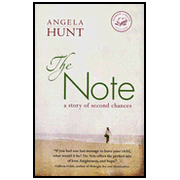
Book Review: The Note

A horrific plane crash off the Florida coast has shocked the nation. Debris washes up on shore for days, some of it a distance from the crash site itself. A note of a father’s love and forgiveness on a napkin inside a plastic bag survives and lands at the house of a woman who wants to remain anonymous but who wants the message to get to its rightful recipient, so she takes it to a local newspaper columnist, Peyton McGruder.

Peyton recognizes a golden opportunity for her column, which has only been given a few weeks to attract more readers or face changes, but Peyton also has the integrity to handle the search for the note’s  intended recipient in a sensitive manner. The note is addresses simply to “T,”and as Peyton researches and then takes the note to those who might claim it, its message has different effects on all of them, Peyton included.

Unfortunately not all reporters have the same integrity and sensitivity, and a TV reporter out to make a name for herself moves in to scoop Peyton’s story.

My thoughts:

I thoroughly enjoyed The Note by Angela Hunt. It was well written, and it was intriguing to see how the note affected each who read it. The underlying spiritual parallels were beautifully illustrated without being overstated. My only teensy criticism is that there were a few asides by several of the characters commenting on Peyton that seemed to me to disrupt the flow of the story and often told me things I already knew or figured out. I’d be interested to know why the author handled these thoughts in this way. They might have worked better in a sidebar. But that’s just my opinion, and the overall story is wonderfully satisfying.

The Week In Words

Welcome to The Week In Words, where we share quotes from the last week’s reading. If something you read this past week  inspired you, caused you to laugh, cry, think, dream, or just resonated with you in some way, please share it with us, attributing it to its source, which can be a book, newspaper, blog, Facebook — anything that you read. More information is here.

Here are some that caught my eye this week, with little commentary:

You’ll see why I like this one from a friend’s Facebook. 🙂

“The wisdom of the wise and the experience of the ages are perpetuated by quotations.” — Benjamin Disraeli

From Mennonite Girls Can Cook:

“Every house where love abides
And friendship is a guest,
Is surely home, and home sweet home,
For the heart can rest.”
~Henry Van Dyke~

I want my home to be a place where the heart can rest.

From another friend’s Facebook

“Perseverance is the hard work you do after you get tired of doing the hard work you already did.”

And from yet another friend’s Facebook, advice from a friend of hers while recuperating from a serious condition:

“Give yourself time to completely heal without guilt for taking the time.”

If you ever have had to heal from something, you know about feeling either guilty or discouraged  because you can’t do things that need to be done. But healing takes time.

From Keep a Quiet Heart by Elisabeth Elliot:

The secret is Christ in me, not me in a different set of circumstances.

And finally, from Angela Hunt’s The Note:

Some people…accept the “trappings” of belief without ever actually embracing the belief itself.

Sad but true. One of my prayers for each of us in my family, myself first of all, is that we would be genuine believers and not just going through the motions of Christian culture.

If you’ve read anything that particularly spoke to you that you’d like to share, please either list it in the comments below or write a post on your blog and then put the link to that post (not your general blog link) in Mr. Linky below. I do ask that only family-friendly quotes be included.

Laudable Linkage and Neat Photo

Just a few to share this week:

Do Your One Small Thing by Lisa Notes, about little things that minister to people.

Friendly Thorns by Chris Anderson, about how God can use a “thorn in the flesh” (II Corinthians 12:7-10).

I’ve been following Wrestling With an Angel for some time, a raw, honest, deep, thoughtful account of a father whose son is autistic, and I was glad to see that Tim Challies convinced the author to write a book.

I’ve mentioned before that my blog is more like visiting neighbors over the fence than a business, but 5 Minutes For Mom shares some good thoughts about When and What a Blogger Should Charge For Their Services for those considering that. Many of us get a slew of requests for free publicity, and this is a good guideline if you don’t want to be used in that way.

I think I may have shared this here before, but I came across it again recently, and I like it:

And this is really cool:

funny pictures of cats with captions
see more Lolcats and funny pictures

Have a great Saturday! I’m off to bake Jesse’s birthday cake.

The Week In Words

Welcome to The Week In Words, where we share quotes from the last week’s reading. If something you read this past week  inspired you, caused you to laugh, cry, think, dream, or just resonated with you in some way, please share it with us, attributing it to its source, which can be a book, newspaper, blog, Facebook — anything that you read. More information is here.

Also, if you’ve posted a quote on your blog this past week, feel free to link it here as well. You don’t have to save it for Mondays. :) And please do read and comment even if you’re not posting quotes.

I am so very sorry to be so late with this today! I sometimes work on this post on Sunday evenings, but after Skyping Jeremy (or Skyping with Jeremy? Not sure how to say that) last night, I fell asleep on the couch until about 2 a.m., and then went to bed. Then this morning I laid back down for a little while…and then it turned into a long while. And then I woke up to several phone calls that needed attention. I hope I am not coming down with Jesse’s cold.

Anyway, on with the quotes!

From Janet‘s sidebar:

Goethe once wrote in a letter that “there are three kinds of reader: one, who enjoys without judgment; a third, who judges without enjoyment; and one between them who judges as he enjoys and enjoys as he judges. This latter kind really reproduces the work of art anew” (quoted in Alan Jacobs’ A Theology of Reading).

I don’t know how long you’ve had that there. Janet, but it just jumped out at me last week. I am not sure how “judging” is meant there, but I took it to mean thinking. analyzing, discerning, and I like to think I am the third kind of reader.

From this post via a friend’s Facebook status:

The gardener’s sharp-edged knife promotes the fruitfulness of the tree, by thinning the clusters, and by cutting off superfluous shoots. So is it, Christian, with that pruning which the Lord gives to thee. ~ C.H. Spurgeon

That, of course, echoes John 15:1-2: “I am the true vine, and my Father is the husbandman. Every branch in me that beareth not fruit he taketh away: and every branch that beareth fruit, he purgeth it, that it may bring forth more fruit.”

From another friend’s Facebook status:

Do not ask the Lord to guide your footsteps if you are not willing to move your feet.

I have to admit I too often do that. Sometimes a delay to pray about something can be a delay to obey what I already know the Lord wants me to do, or sometimes I am praying for guidance when I am reluctant or even not yet willing to go in the direction that might be the answer.

This was from Laura writing at Kindred Heart Writers:

Ring the bells that still can ring,
Forget your perfect offering.
There is a crack in everything.
That’s how the light gets in.
– Leonard Cohen

That cracked me up but also illustrated a great truth, that none of us is perfect and that God’s grace shining through the cracks can glorify Himself.

And finally, from Elisabeth Elliot‘s book A Lamp For My Feet quoted in one of her e-mail devotionals:

But my limitations, placing me in a different category from Tom Howard’s or anyone else’s, become, in the sovereignty of God, gifts. For it is with the equipment that I have been given that I am to glorify God. It is this job, not that one, that He gave me.

I had quoted that once years ago in regard to physical limitations, but Elisabeth was mentioning it in regard to talents, abilities, and opportunities. It applies as well to time and any other type of limitation — whatever it is is allowed by God and is the framework in which He wants us to glorify Him, rather than chafing or wasting time wishing things were different.

If you’ve read anything that particularly spoke to you that you’d like to share, please either list it in the comments below or write a post on your blog and then put the link to that post (not your general blog link) in Mr. Linky below. I do ask that only family-friendly quotes be included.

His Robes For Mine

This is a recent hymn by Chris Anderson of Church Works Media which wonderfully expresses what Christ did for us. It is on the Promises CD by Soundforth — you can hear a snippet here and read more of the thoughts behind the text here.

His robes for mine: O wonderful exchange!
Clothed in my sin, Christ suffered ‘neath God’s rage.
Draped in His righteousness, I’m justified.
In Christ I live, for in my place He died.

Chorus:

I cling to Christ, and marvel at the cost:
Jesus forsaken, God estranged from God.
Bought by such love, my life is not my own.
My praise-my all-shall be for Christ alone.

His robes for mine: what cause have I for dread?
God’s daunting Law Christ mastered in my stead.
Faultless I stand with righteous works not mine,
Saved by my Lord’s vicarious death and life.

His robes for mine: God’s justice is appeased.
Jesus is crushed, and thus the Father’s pleased.
Christ drank God’s wrath on sin, then cried “‘Tis done!”
Sin’s wage is paid; propitiation won.

His robes for mine: such anguish none can know.
Christ, God’s beloved, condemned as though His foe.
He, as though I, accursed and left alone;
I, as though He, embraced and welcomed home!

Laudable Linkage and Video

Just a few links this week to some worthwhile reads:

Growing As a Homemaker. This is great encouragement for young moms who feel overwhelmed.

Wondering Why God Makes Life Impossible Sometimes. Jon’s Stuff Christians Like is usually funny and/or satirical (not always the same thing), but sometimes he comes up with a serious one that touches the heart. When I read this I had just been somewhat down because of problems or issues several friends or extended family members were facing, and though this truth is not new to me, I still have to go over it from time to time and adjust my perspective.

You Need a Mother Very Badly. Some of you may be familiar with Gregg and Sono Harris, pioneers in speaking and writing about the home school movement. Sono recently passed away, and this poem is a tribute by one of her sons. Keep the tissues handy, especially if you’ve lost your own mom.

From the ever helpful Tipnut: 12 Simple Sore Throat Remedies and 12 Home Remedies For Nausea.

It’s hard to believe all these people took the time to do this, but it’s pretty neat, for at least the first 45 seconds or so.

A one man quintet. This man has been to my church — but he didn’t do this then! This is one of my favorite songs.

I saw this at Nannykim‘s. I am not familiar with Francis Chan, but I can identify with this tendency to handling fears.