Don’t-ing or Doing?

In my early Christian life, a lot of teaching I heard seemed to emphasize what we as Christians don’t do. We don’t dress like that. We don’t listen to that kind of music. We don’t watch those programs. We don’t play those games. We don’t use that kind of language.

During part of this time I had a job in retail sales. I wanted to be a good testimony. I politely said no to invitations to places I didn’t feel comfortable going with my coworkers. I quietly absented myself from certain conversations. My style of dress was noticeably different from that of others. They knew I didn’t do a number of things. Some were even kindly protective of me, careful not to put me in situations where I might be uncomfortable. I couldn’t help but wonder, however, what these actions (or inactions) indicated to my coworkers and customers. They knew I was “religious.” But could they tell the difference between me and an adherent of any number of other religions? They saw my standards, but did they see my Jesus?

The Bible does have a lot to say about what we should not do. Freedom in Christ doesn’t mean we live any way we want to. God’s command for our holiness filters down into every part of our lives, and our love for Him does influence our choices of dress and entertainment. We need to understand what things are wrong. We need to realize we’re innately drawn towards wrong. Paul said, “if it had not been for the law, I would not have known sin. For I would not have known what it is to covet if the law had not said, ‘You shall not covet’” (Romans 7:7). It’s important to remember the Bible’s warnings against sin. Some people fall off-balance by minimizing or even overlooking the “don’ts” in the name of love and positivity or an effort to be inoffensive.


But the Bible doesn’t stop with a list of “don’ts.” “So flee youthful passions,” 2 Timothy 2:22 says. But it goes on to say, “and pursue righteousness, faith, love, and peace, along with those who call on the Lord from a pure heart.”

Colossians 3:5-9 tells us to “ Put to death ” or “put away” “sexual immorality, impurity, passion, evil desire, and covetousness, which is idolatry . . . anger, wrath, malice, slander, and obscene talk from your mouth. Do not lie to one another.”

But the passage doesn’t stop with “putting off.” “You have put off the old self with its practices and have put on the new self, which is being renewed in knowledge after the image of its creator” (verses 9-10). The next verses enumerate what that new self we put on looks like:

Put on then, as God’s chosen ones, holy and beloved, compassionate hearts, kindness, humility, meekness, and patience, bearing with one another and, if one has a complaint against another, forgiving each other; as the Lord has forgiven you, so you also must forgive. And above all these put on love, which binds everything together in perfect harmony. And let the peace of Christ rule in your hearts, to which indeed you were called in one body. And be thankful. Let the word of Christ dwell in you richly, teaching and admonishing one another in all wisdom, singing psalms and hymns and spiritual songs, with thankfulness in your hearts to God. And whatever you do, in word or deed, do everything in the name of the Lord Jesus, giving thanks to God the Father through him (verses 12-17).

Ephesians 4:17-32 has similar instructions to “to put off your old self, which belongs to your former manner of life and is corrupt through deceitful desires, and to be renewed in the spirit of your minds, and to put on the new self, created after the likeness of God in true righteousness and holiness” (verses 22-24). We trade lying for truth (v. 25), stealing for honest work (v. 28), corrupt talk for edifying words (v. 29). We don’t let anger linger (v. 26), and we replace bitterness, wrath, anger, clamor, slander, and malice with kindness, tenderheartedness, and forgiveness “as God in Christ forgave you” (verses. 31-32).

We’re not aiming just for “positive thinking”: we’re seeking a balanced focus. “Putting on the new” not only keeps us balanced, but it actually helps us put off the old. We have known of preachers who have fallen into sexual sin after years of preaching against it. Surely a number of factors contributed to their fall, but one may have been an undue focus on the forbidden.

Erwin Lutzer shared a helpful illustration in How to Say No to a Stubborn Habit: if someone tells you not to think of the number eight—suddenly that’s all you can think about. The more you try not to think about it, the more it fills your mind. But if you start thinking of other numbers or working equations, you’re distracted from eight.

Likewise, if I try to diet by repeating to myself, “Don’t eat chocolate cake, Don’t eat chocolate cake, Don’t eat chocolate cake,” what is my mind filled with? Chocolate cake. I’m thinking about it so much, I am likely to give in and have some. But if I turn my thoughts toward other things I can eat, chocolate cake lessens it’s hold on me. Now I can focus on the positive, on what I can do rather than what I can’t.

Years ago I read in a forgotten older book about “chastity meetings.” The author didn’t elaborate, but evidently these meetings were held to help young people make a decision to pursue purity. His wise advice was, “Have your chastity meetings, but then go on to another subject.” If every single week these young people were warned about sexual sin and urged to avoid it, their thoughts would be filled with it just like mine would be with the chocolate cake I needed to avoid.

Concentrating on “doing” rather than just on “don’t-ing” not only helps us avoid sin and pursue good, but it presents a better testimony. If all we talk about is what we don’t do, we sound either curmudgeonly or self-righteous.

Pursuing the positive also creates joy in Christ rather than mourning what we can’t do.

But we don’t follow a list of impossible good works in order to gain favor or rack up points with God. We focus on these good traits not to become righteous but to demonstrate that God has changed us and made us righteous. The Ephesians passage mentioned above says the goal is to  “attain to the unity of the faith and of the knowledge of the Son of God, to mature manhood, to the measure of the stature of the fullness of Christ” (verse 13). It also says we effect these transformations by being “renewed in the spirit of [our] minds (v. 23) and because that’s the way we have learned Christ (verses. 20-21). Romans 12:2 tells us “Do not be conformed to this world, but be transformed by the renewal of your mind.” Colossians 3:10 tells us our “new self…is being renewed in knowledge after the image of its creator.”

How do we renew our minds in the knowledge of Him? By beholding Him in His Word: “And we all, with unveiled face, beholding the glory of the Lord, are being transformed into the same image from one degree of glory to another. For this comes from the Lord who is the Spirit” (2 Corinthians 3:18). As we see Him in His Word, we get to know Him better, and we become more like Him. As we pursue the pure and good and holy, the lesser things fall away.
(Revised from the archives)

(I often link up with some of these bloggers)

Laudable Linkage

Here’s another list of good online reads:

Biblical Literacy: Jen Wilkin on the Importance of Bible Study, HT to Knowable Word. “By her twenties, Wilkin understood it was possible to drown in waves of opinion. If she was going to learn to swim, she would have to learn to read the Bible for herself.”

On Basketball, Spiritual Disciplines, and Sanctification. “I had in mind a list of characteristics that I felt were necessary for me to sanctified—to be holy. Most of them had something to do with keeping a list of rules or living by a certain standard in my life.” I did, too. I appreciate this testimony of learning that “Sanctification comes through relationship.”

You Will Fail Sometimes. Don’t Quit. “I used to think that there is some point in the Christian life when you arrive, when you finally see that your heart and head and spirit align in some sort of beautiful sphere of sincerity and goodness and true devotion to Christ. But the older I get and the more I have begun to understand why the Bible teaches that we need armor.”

Does Your Prayer Life Need to Change? Sometimes we don’t know where to start–sometimes our routines have turned into ruts. There are helps here for either problem.

Moms and Dads: Show Your Need, HT to Challies. “I wish I would’ve shown my kids my need for Christ more. I worked so hard to show them my godliness that I didn’t show them my need. I should have been more transparent. I should have shown them just how much I needed Jesus.”

Far From Home, HT to Challies. “Some of us include in our spaces only those who support our biases or our preferences; or those who have been born into our circle or have earned membership there. But the Bible is filled with admonitions to welcome and care for the widow, the orphan and the foreigner. It doesn’t say anything about first determining whether or not they deserve it, or how well they live up to our cultural ideals.”

The Scenes They Leave Out, HT to Challies. “This steady diet of films and books and TV full of action, adventure, and high drama is stimulating. But are we inadvertently teaching ourselves that normal life is not? When the ordinary stuff of daily living is at best a quick montage to set up the real action, aren’t we in danger of losing sight of the fact that the ordinary stuff of daily living is actually most of the real action of real life?”

It‘s Not Martyrdom if You’re Being Obnoxious. “When Christians suffer, there are more possible reasons than just ‘suffering for Jesus.’ Christians, individually or corporately, might be suffering because they’ve said or done stupid things, placing themselves under the divinely designed cosmic order, whereby life is tougher if you’re stupid (as John Wayne allegedly said).”

It Is All a Snare to Me. I don’t always get a lot out of reading other people’s prayers. But this touched home in many areas, reminding me “my greatest snare is myself.”

Should Christians Cuss? HT to Challies. “It is true that Jesus often used sharp, confrontational words, but that is not the same thing as using obscenities.”

2021 Audubon Photography Awards, HT to Challies. Stunning photos of God’s creation.

This is a cute excerpt from a BBC special about “Snow Bears” (which I have not seen):

“But it’s the wrong hole.” Not for the seal! 🙂

Happy Saturday!

Friday’s Fave Five

It’s Friday, time to look back over the blessings of the week
with Susanne at Living to Tell the Story and other friends.

I’m running a little late today, so I’ll jump right in . . .

1. Relief, at least temporarily. I’ve had an earache for the past three days. Wednesday night we got ear wax drops that my husband patiently administered, and then he flushed the ear with distilled water. It felt better that night and the next morning. But then it started hurting again. No wonder babies cry with earaches. I’m late this morning because I wanted to call the doctor’s office to see if I could get in today and see if this is an infection. I got ready to go first thing in case they had an opening right away. But they didn’t have one til this afternoon. (Update: diagnosis: ear canal infection. I hope my prescription ear drops start working soon.)

2. Baptism and church lunch. It’s always neat to see someone take that step of obedience, showing outwardly what’s happened in their hearts as they surrendered to Christ and were raised to newness of life.

3. Library system. Our local library is very nice but a little small. But I can look up books through the city library system online, place a hold, and have the book sent to my library to be picked up. So convenient.

4. Peonies. I’ve always thought they were so pretty, but I’ve never had one. One night this week Jason and Timothy brought over some cut ones they had found in a store. I didn’t know they started out as tight rolls. It’s been fun to watch them slowly unfold this week.

5. Good news for friends at church, including a young baby and an older woman home from hospitalizations.

How’s your week going?

The Secret War of Charles Fraser-Smith

I have not seen the James Bond films, but evidently the supplier of his cool spy gadgets is someone known as “Q.”

“Q” is based on a real person: Charles Fraser-Smith.

Charles started out as a British missionary in Morocco. One day he spoke at a church about his “pioneer missionary work in Morocco and the often unorthodox methods I had used to keep my various projects alive” (p. 22).

Sitting in the audience was the director of the Ministry of Supply, who chatted with Fraser-Smith afterward. The next day the director asked Fraser-Smith to meet him at the ministry headquarters and offered Fraser-Smith a job.

Outwardly, Fraser-Smith was a civil servant of the Ministry of Supply’s Clothing and Textile Department.

In reality, he procured or developed an astonishing numbers of gadgets and supplies for the Special Operations Executive during WWII.

Fraser-Smith and most of the people he dealt with had to sign an Official Secrets Act, requiring thirty years of silence about their wartime activities.

Some time after that thirty years, Fraser-Smith wrote The Secret War of Charles Fraser-Smith, the “Q” Gadget Wizard of World War II along with Gerald McKnight and Sandy Lesberg.

The “Q” designation came from “warships disguised as freighters and unarmed trawlers” during WWI which were known as “Q ships” (p. 10).

Some of what Fraser-Smith supplied were kits to go with soldiers in case they were captured: miniature maps and compasses hidden in hairbrushes, pipes, pens, even dominoes. Sometimes these included a flexible surgical saw with which to try to cut through bars to escape. Fraser-Smith also supplied spies and other soldiers.

He had to take great care that nothing would alert a casual observer—or a sharp-eyed prison guard—to anything that was hidden or unusual. One trick Fraser-Smith often used was to thread a screw-on lid or top in the opposite direction, so if anyone tried to unscrew it in the usual way, he’d actually be tightening it.

Hairbrushes had to be made with bristles native to the country his clients were going to. Sometimes he had to supply uniforms from other countries for men to go undercover. Fraser-Smith had to make sure the fabric was the same type and quality. In one of his first attempts, the manufacturer he used made the uniforms too well and had to redo them.

Sometimes Fraser-Smith came up with ideas himself. Other times, he had to consult with experts and convey what he needed without giving away too much information. And in either case, he had to employ manufacturers to produce what he needed in sufficient quantity. He had to swear many of these folks to the Official Secrets Act. Most of them rose to the challenge admirably. A few dragged their feet, not wanting to vary what they did for their own profit.

One of the most interesting parts to me were miniature cameras which were used to take pictures of the terrain of certain areas. These pictures would be smuggled back to photographic interpreters who would project the height of hills, depth of crevices, etc., so invading soldiers would know the lay of the land exactly.

Another fascinating section told of the S. O. E. employing an illusionist to disguise things, like making a military base look like a working farm.

Fraser-Smith had to come up with various ways to get his supplies to people, particularly POWs. He never used food packages like the Red Cross sent, because he didn’t want to risk those packages being refused if someone found one of his gadgets in them.

Fraser-Smith wrote that he “slightly” knew Ian Fleming, the creator of James Bond. But he said Fleming misused one of his ideas of hiding things in golf balls. Fleming’s golf balls would not have performed as golf balls and “wouldn’t have fooled an Irish farmhand let alone the lynx-eyed prison officers and S.S. of the O Flags” (p. 128).

Fraser-Smith also wrote of the “everyday people,” from resistance fighters to sympathetic citizens, who would pass on vital information or supplies at great risk to themselves. “Day after day these men and women continued against the greatest odds with no one present to encourage them. Seldom was it possible to let them know if their arduous and perilous work was successful. Much of it went unrecognized. Those who fought in the services were spurred on by team spirit, e’sprit de corps. The S. O. E. agent and the resistance fighter were alone. This was the highest order of heroism” (pp. 152-153).

I was surprised that some of these tricks would be revealed even after thirty years. Maybe most of them had been discovered by then. I’m sure the types of things that are hidden and disguised now are much different from what they were then.

I first heard of Fraser-Smith in this post, and I was so intrigued, I had to look up his book. It’s long out of print now, but I found used copies on Amazon. He reminded me of other pioneer missionaries, like Nate Saint, who devised ways to carry sheet metal strapped under his small plane or to drop a bucket to people below while flying in a circle. John Paton once had a major spiritual opening with a tribe after building a well. God doesn’t just use preachers and scholars, speakers and writers: He uses people He has gifted in various ways.

This was quite a fascinating book. I read it for pure interest, but I am also counting it towards the Nonfiction Reading Challenge. It would fit equally well for the Inventions or Wartime Experiences category, but I think I’ll count it for the former.

(Sharing with Carole’s Books You Loved)

Ten Words to Live By

The Ten Words are the Hebrew designation for what we know as the Ten Commandments.

In Jen Wilkin’s book, Ten Words to Live By: Delighting in and Doing What God Commands, she cites a study showing that more Americans could name all the ingredients in a Big Mac than the Ten Commandments.

“When the Ten Commandments are not forgotten, they are often wrongly perceived. They suffer from a PR problem. They are seen by many as the obsolete utterances of a thunderous, grumpy God to a disobedient people, neither of whom seem relatable or likeable” (p. 12).

Even when people accept that these commandments come from a righteous God, they set them aside because they think they don’t apply since we’re under grace. “Thus, law and grace have come to be pitted against one another as enemies, when in fact, they are friends. The God of the Old Testament and the God of the New have been placed in opposition, when, in fact, they are one and the same” (p. 13). Christianity is based on relationship with God rather than rules, but “rather than threaten relationship, rules enable it” (p. 13). “Without rules, our hopes of healthy relationship vanish in short order. Jesus did not pit rules against relationship. It was he who said, ‘If you love me, you will keep my commandments” (John 14:15) (p. 14). We see this even in our earthly relationships: there are none without boundaries and preferences.

Though we rightly want to avoid legalism, the Bible also condemns the other extreme of lawlessness. “Legalism is external righteousness only, practiced to curry favor. Legalism is not love of the law, but its own form of lawlessness, twisting the law for its own ends” (p. 14).

By contrast, “Obedience to the law is the means of sanctification for the believer. . . . not out of dread to earn his favor, but out of delight because we already have it” (p. 15).

“The Ten Words show us how to live holy lives as citizens of heaven while we yet dwell on earth” (p. 17).

The Ten Words are an expression of love. When asked which commandment was the greatest, Jesus said, “ You shall love the Lord your God with all your heart, and with all your soul, and with all your mind, and with all your strength.’ The second is this, ‘You shall love your neighbor as yourself'” (Mark 12:30-31). A former pastor used to say that if our hearts were right, these two would be all we needed. But they’re not, so we need things spelled out for us. “For the commandments, “You shall not commit adultery, You shall not murder, You shall not steal, You shall not covet,” and any other commandment, are summed up in this word: “You shall love your neighbor as yourself.” Love does no wrong to a neighbor; therefore love is the fulfilling of the law” (Romans 13:9-10).

With these premises in place, Jen devotes a chapter to each of the ten commandments. She argues not for a letter-of-the-law merest obedience possible, but for an expansive obedience of the spirit of the law. She employs Jesus’s explanation that the law doesn’t cover just outward action, but our hearts.

Take, for instance, the sixth commandment: “Thou shalt not kill,” literally, “You shall not murder.” Most of us would say we’re safe from transgressing that one. But Jesus said, “You have heard that it was said to those of old, ‘You shall not murder; and whoever murders will be liable to judgment.’ But I say to you that everyone who is angry with his brother will be liable to judgment; whoever insults his brother will be liable to the council; and whoever says, ‘You fool!’ will be liable to the hell of fire” (Matthew 5:21-22).

Is Jesus adding to the law by broadening our attention from murder to anger and contempt? By no means. He is pointing out the seedling that grows into the thorny vine that chokes out life. He is appealing to us to fastidiously weed the garden of our personal holiness. He is teaching that if every person dealt with anger quickly and rightly, there would be no need for the sixth word at all (p. 94).

Jen also points out the progression of thought from anger to devaluing another.

First, I am angry with you in response to a hurt. Next, I begin to question your character with an insult. Then, I begin to question your worth as a person. As anger degrades into contempt, the personhood of another is devalued (p. 93).

But an expansive obedience “will not be content to simply be not-murderers, or not contemptuous, or not angry. We will not merely refrain from taking life—we will run toward giving it. Let us read in the sixth word’s prohibition of murder the exhortation to take every care to preserve life. Let us run to be life-protectors and esteem-givers and peacemakers” (p. 96).

Thus Jen couches each commandment in its initial setting, then examines how it applies today, then explores not just the letter, but the spirit of the law from the rest of the Bible.

I have markings on most of the pages, but here are just a few other quotes from the book:

Every transgression of one of the Ten Words begins by transgressing the first, to have no other gods before him (p. 34).

When we look to Christ, imitating him, we begin to see restored what sin has diminished. Bearing the image of God does not mean we look like him in physical terms but rather in spiritual terms—not so that others may worship us, but so that they may worship him (p. 42).

Our patterns of work and rest reveal what we believe to be true about God and ourselves. God alone requires no limits on his activity. To rest is to acknowledge that we humans are limited by design. We are created for rest just as surely as we are created for labor. An inability or unwillingness to cease from our labors is a confession of unbelief, an admission that we view ourselves as creator and sustainer of our own universes (pp. 64-65).

No one ever set out to sin against God or neighbor without first desiring something out of bounds (p. 140).

Our actions are the incarnation of our belief (p. 135).

My recent post A Better Blade for Killing Sin grew out of Jen’s comment on what Jesus said about cutting off whatever tempted us to sin. As Jesus always went to the heart,  not just the outward actions, so this admonition shows us something: even if we could cut off the lusting eye or the stealing hand, we’d still have a problem in our hearts.

We need a better blade than any formed by human hands, one aimed at ridding our hearts of disordered desires.

Praise God, we have one. The blade that slays the beast is the word of God, made living and active by the Spirit of God, dividing thoughts and intentions of the heart (Heb. 4:12). By the word of God we learn to delight our hearts in the Lord, and the outcome is that which the psalmist predicts: “Delight yourself in the LORD, and he will give you the desires of your heart” (Ps. 37:4) (p. 106).

That blade doesn’t just lop off offending members until there is nothing left. It transforms us as we delight in Him. “The antidote to the lust of the eyes is not self-inflicted blindness, but seeing as God sees (pp. 106-107).”

I wish I could share some of the core truths of each chapter, but that would make this post too long. Instead, I encourage you to read the book. It’s one that I probably need to revisit regularly. I was convicted in each chapter.

I’m counting this for the “Published in 2021” category of the Nonfiction Reading Challenge

(I often link up with some of these bloggers)


Three Shall Be One

Francena Arnold was one of the first—if not the first—writers of Christian fiction. Her first book, Not My Will, was published in 1946 and became a classic. I read it at least twice and its sequel once. I wasn’t aware (or had forgotten) she had written other books until I saw her Three Shall Be One on a Kindle sale.

In this story, Linda and Tony are a young couple with two little ones. They don’t have much, but they’re happy—at least until Tony’s controlling mother comes for an extended visit and moves them into a nice place with better furniture.

Linda is furious, not only at her mother-in-law, but at her husband for not standing up to her. But Tony has learned through long years of experience that he never wins with his mother, and it’s easiest just to let her have her way.

Linda learns to be quiet for the most part when her mother-in-law is there, despite constant criticism. Occasionally Linda will let slip a sarcastic remark, exasperating Tony.

When Tony’s mother leaves, he and Linda have it out. Tony had thought couples argued when they no longer loved each other, and he is “troubled by the realization that ugly quarrels could come even when they loved.” But after a day apart, they regret their harsh words and make up.

Both Tony and Linda had rejected religion of any kind as a sign of weakness.

Life goes on much the same—until the next mother-in-law visit. An incident then sets off a chain of events none of them could have anticipated.

There are a couple of implausible plot twists in the book that take away from the story, but I can’t go into them here without revealing too much. And this book suffers from the same problem a lot of early Christian fiction had: the main character(s) come to a crisis which leads to their salvation, and then all their problems are solved. Of course, problems don’t go away when we become Christians, though at that point we do have His grace and help and wisdom for them.

If you can look past those issues, though, the book is a sweet, old-fashioned story. I liked that the book didn’t end with Linda’s salvation and showed some of her growth afterward. Also, Linda’s friends’ care for her was a great example. The author shows good understanding of the psychological factors involved in the couple’s troubles.

I looked at Amazon to see what other books they had by Francena Arnold. The Kindle versions of some of them are 99 cents as of this writing, including this title. I’m glad to see someone made them available for the Kindle app, though they are still available in paperback as well.

Have you read Francena Arnold? What did you think of her books?

(Sharing with Carole’s Books You Loved)

Remembering How God Has Led

I don’t know what triggered my trip down memory lane. I sat with my Daily Light open but unread, and began to pray for God to open my understanding and speak to my heart from His Word.

I thought back with wonder of the many different paths my life could have taken. Several events led to my salvation. What if one of them hadn’t happened?

There were different temptations, some of which I regret failing. I could have been done in by any of them.

My life could have followed any number of paths, not just theoretically, but due to influences at the time. I could have become an alcoholic. I had planned to get married right out of high school, not realizing I would be marrying the wrong person. I not only would have missed meeting my wonderful husband, but I would not have experienced all I learned both intellectually and spiritually at a Christian college.

I could have fallen for a television evangelist’s false doctrine (I actually called the number on the screen once). People are so vulnerable just before and after salvation, when their interest in the Lord is aroused but they have no discernment yet.

In 8th or 9th grade, we moved to a new town. The school I attended was the most cliquish place I had ever been. Well-defined groups didn’t allow for new members. My mom had to plead and almost push me out of the car at school in the mornings. I spent many lunch breaks walking around the grounds by myself in tears. Finally I became friends with another girl who was also, for some unknown reason, outside the school’s social circles. I discovered years later that it was the Lord’s mercy that kept me from getting involved with the popular crowd, as they were into a lot of unhealthy activities. What if I had gotten in with them? I probably would have gotten into some kind of trouble and possibly would have become proud and condescending.

Between my sophomore and junior year, my mother left my father and took my siblings and me to Houston. The break had been coming for years, but it still hurt when it finally happened. We moved from a very small town of less than 200 to the teeming metropolis of Houston. The culture shock was very real. In those days before the Internet, I had little contact with my friends from school. I had no opportunity to make new friends since school wouldn’t start for months yet. It was the loneliest time in my life. I remember lying on my bed clinging desperately to Romans 8:28: “And we know that for those who love God all things work together for good, for those who are called according to his purpose.” Looking back, I didn’t know fully what that verse meant. But I knew that, to the degree I knew how, I loved God, and I trusted Him to work things out for good. Though that was one of the lowest points in my life, it was also pivotal. It was through this move that God provided miraculously for me to go to a Christian school for two years, led me to a good church, helped me make sure of my salvation, and let me know about a Christian college.

Somehow God led me all the way.

My heart was tender thinking back over God’s working in my life. As I opened my Bible reading for the day, I came to Deuteronomy 8:2: “And you shall remember the whole way that the Lord your God has led you these forty years in the wilderness.” It’s amazing how God prepares me for what I am going to encounter in His Word. I thought my mental wanderings about my past were just daydreams and rabbit trails, but here He had led me to do just what the Scripture said.

Several times in Deuteronomy 8, Moses urged the Israelites to remember the Lord and not forget Him. Peter wanted “to stir you up by way of reminder” (2 Peter 1:13; 3:1). Jesus told the Ephesian church, “But I have this against you, that you have abandoned the love you had at first. Remember therefore from where you have fallen; repent, and do the works you did at first” (Revelation 2:4). As God called Israel, back to Himself, He said, “I remember the devotion of your youth, your love as a bride, how you followed me in the wilderness, in a land not sown” (Jeremiah 2:2).

This is what I most want my children, grandchildren, readers, and anyone with whom I have any influence to know, to remember: that Christianity is not just a culture, not just a set of doctrines, not just what we do and don’t do. It is the basis of all of those. But first of all it’s that personal relationship with the Lord.

Do you have that? Have there been times in your life you knew God was at work in you, drawing you to Himself? Do you have warm and tender moments where He met with you personally?

If you professed faith as a young child, you may not remember a definite “before” and “after” to your life of faith. But you can be grateful for God’s preventative work in your life and the scars and bad memories He kept you from. As you’ve walked with the Lord, I am sure you’ve found that the “big sins” are not always the dramatic ones that everyone sees. Inner wrestlings with pride and self-will are just as deadly. You’ve discovered that it takes as much of God’s grace to battle those as it does to defeat addiction. You’ve probably experienced times when God answered prayer or something in His Word met your need of the moment. It’s not the drama of one’s initial testimony that determines what kind of Christian life we have: it’s simple faith, not in our faith, but in Jesus Christ as Lord and Savior.

Nothing stirs up our love and gratitude towards the Lord like remembering how He saved us and led us. It’s a blessing to sometimes review the “Ebenezers,” those special times of help that we’ve experienced along the way. Then we can say along with the psalmist:

My soul will be satisfied as with fat and rich food,
    and my mouth will praise you with joyful lips,
 when I remember you upon my bed,
    and meditate on you in the watches of the night;
 for you have been my help,
    and in the shadow of your wings I will sing for joy.
 My soul clings to you;
    your right hand upholds me.
Psalm 63:5-8

(I often link up with some of these bloggers)

Laudable Linkage

A collection of good reading online

I found lots of good online reading this week:

What’s Next? 8 Questions to Get You Ready to Roll. Evaluating and preparing for post-pandemic life.

I came across two good posts about praying for lost loved ones: A Prayer for When They Don’t Believe and A Parent’s Prayer for an Unbelieving Child.

Coping with Publishing Conflict. Though written in the context of publishing, the advice is good for any area of conflict.

10 Ways God Desires to Set Apart His People. “The purpose in being set apart is to be set to something else. Biblically speaking, something else is desiring what God desires for us. It means desiring someone else—God. And not desiring the things of this world more.”

Stretching Application Beyond the Big Three. “It is good to be reminded to read the Bible, pray, and talk to our friends about Jesus, but that doesn’t mean these are the only applications we should draw from Scriptural truths.” Ryan provides some helpful tips and a worksheet for getting to the heart of a passage’s applications.

Who Will Roll the Stone Away? Good take-aways from the women who went to anoint Christ’s body that first Resurrection morning.

What Does Binding and Loosing Mean in Matthew 16:19? HT to Knowable Word. Probably the clearest explanation of this verse I can recall reading.

With Independence Day last weekend, there were some good posts about patriotism. Since patriotism isn’t just for the 4th of July, though, I’m including them now:

Why Younger Evangelicals May Feel Uneasy in a Patriotic Church Service. A good, balanced article about some of the positives and some of the problems of a patriotic church service.

How Can an Ordinary Citizen Begin to Practice a Radical Patriotism? “Viewing a flawed nation led by deeply flawed individuals, G.K. Chesterton asked:  ‘Can we hate it enough to change it, and yet love it enough to think it worth changing?'”

If you need a dose of cuteness, try this:

Happy Saturday

Friday’s Fave Five

It’s Friday, time to look back over the blessings of the week
with Susanne at Living to Tell the Story and other friends.

It’s the first full week of July, and summer has settled in. Here are some of the best parts of the last week.

1. A long weekend. Everyone had Monday off, but Jim took Thursday and Friday off as well. He worked on some things he had wanted to, but spent the better part of Saturday fishing, something he hadn’t done in a long time.

2. Donuts. There’s a new independent donut shop nearby we stopped at, but they were closed. We heard they usually sell out before noon. Jim went back Saturday morning and got some donuts and fritters. Those things were huge, but so good. They were too big to eat a whole donut in one sitting, so we cut pieces off the next few days.

3. Independence Day. Though our country has serious problems, I still believe it’s the best place in the world to live. I’m thankful for the freedoms we enjoy. We celebrated the 4th all together after church on Sunday. One nice thing about celebrating with adult children is divvying up the meal. Jim grilled burgers and sausage, I made French fries, Jesse made a cheesy hash brown casserole and shucked corn on the cob for me. Mittu made a wonderful cheesecake. Jason and Mittu found the festive paper products to make clean-up easier.

Favorite picture of the day:

4. Fireworks are illegal in our county—but the law doesn’t seem to be enforced unless something gets out of hand. From our yard, we saw several large displays of fireworks from at least six different places. Jason caught this photo of one, but we saw many fuller and higher than this one. It was fun to see fireworks without leaving the yard.

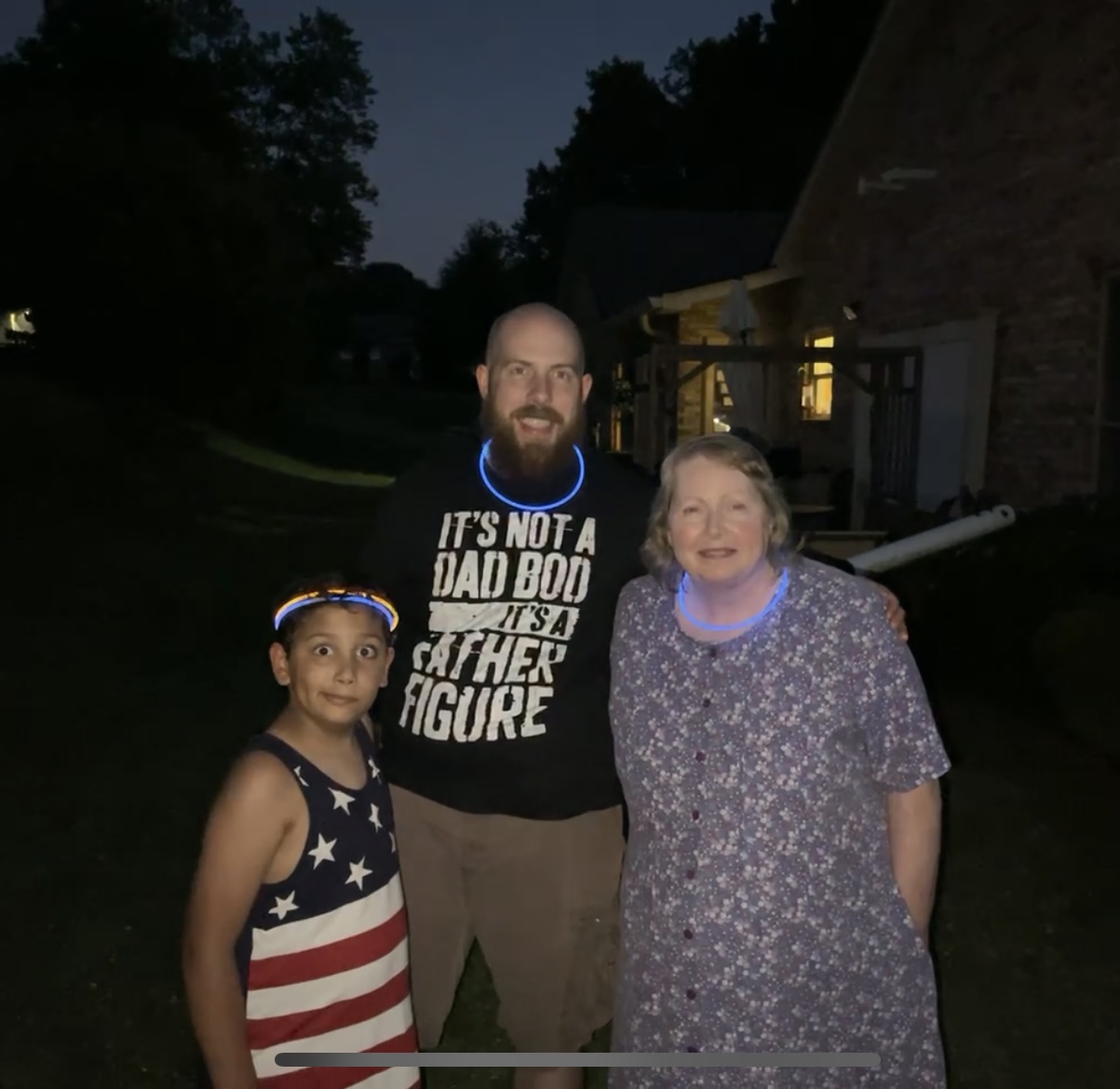
We didn’t have fireworks, but Jason and Mittu brought over glowsticks, pop-its (these little things that make a popping sound when you throw them on the ground), and these other devices that have strings you pull on, and they release confetti.

5. Family meal at a restaurant. Jason and Mittu invited us over Monday afternoon, and talk turned to going somewhere for dinner. We ended up going to one of my favorite restaurants on a river. And I didn’t even ask—Jim suggested it. 🙂 We called to see if Jesse wanted to meet us there. It was the first time we had eaten all together in a restaurant since before the pandemic.

All in all, a good week. I hope yours was as well!

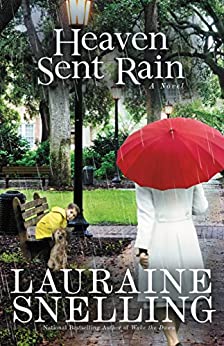
Heaven Sent Rain

In the novel Heaven Sent Rain by Lauraine Snelling, Dinah Taylor is a scientist who started her own company of food supplements to improve health. Her job, her life, her all-white condo and wardrobe are perfectly ordered.

One day at her usual breakfast stop, she sees a small boy and his dog sitting out in front. They look shabby, but not dirty. Dinah offers to buy the boy, Jonah, breakfast, and he accepts. Then he’s at the same place the next day, and then every day thereafter. Dinah tries to find out his background, imagining everything from a drug-infested home to neglect. But Jonah evades her questions.

Then in the middle of one night, Dinah receives a frantic phone call. Jonah’s dog is badly injured. Can she help?

Dinah isn’t sure what she’s getting into, but she can’t refuse. Searching for an emergency vet clinic open that time of night, she takes Jonah and his dog in. They are met by veterinarian Garret Miller, who seems warm and kind toward Jonah and the dog, but icy toward Dinah.

As Dinah continues to help Jonah, she gets in over her head. As she, Jonah, and Garret interact, their lives change.

Most of the other books I’ve read by Lauraine were historical fiction about Norwegian immigrants. I didn’t think I had read any of her contemporary fiction, but then remembered I had read Someday Home a couple of years ago.

I loved the way Dinah’s story unfolded, with the author revealing just a bit at a time until the whole picture came into view. Garret is an enjoyable character, too, after getting past his initial standoffishness, which is explained later.

Dinah is not a Christian, having rejected her parents’ teaching and beliefs. The details of that situation are gradually revealed, too. Garret and Jonah are both believers, as is Dinah’s receptionist. But the faith element felt very natural and not forced.

I thought the ending wrapped up a bit too quickly, and I had a theological quibble with one sentence. But overall I really enjoyed the book.

(Sharing with Carole’s Books You Loved)